Nintendo Switch2024Puzzle-platformerNintendo Software TechnologyRemake of the 2004 GBA gameTwo new worldsCo-op with Toad1.12 million soldMetacritic 76
Mario vs. Donkey Kong (Nintendo Switch)
Twenty years after it first appeared on Game Boy Advance, the toy-factory caper came back. Mario vs. Donkey Kong for Nintendo Switch, announced in the Nintendo Direct of 14 September 2023 and released worldwide on 16 February 2024, is a ground-up remake of the 2004 original by the same studio, Nintendo Software Technology. The story is unchanged (Donkey Kong sees a television advert for Mini-Mario toys, finds the shops sold out and empties the factory instead), and so is the clever key-and-door design. Around it, nearly everything is new: full 3D models in high definition, a rearranged soundtrack, two new worlds in Merry Mini-Land and Slippery Summit, a forgiving Casual Style, a Time Attack mode, sixteen new bonus levels and a second player as Toad. Nintendo counts over 130 levels, and sales had reached 1.12 million copies by the end of March 2024.
Music:Lawrence Schwedler (music director) with DigiPen’s music department; James Phillipsen (audio lead)
Worlds:Eight: the original six plus Merry Mini-Land and Slippery Summit
Levels:Over 130 (Nintendo)
Difficulty:Classic Style or Casual Style
File size:1.3 GB
Sales:1.12 million by 31 March 2024 (Nintendo)
Metacritic:76 (104 critics)
Advertisement
Overview
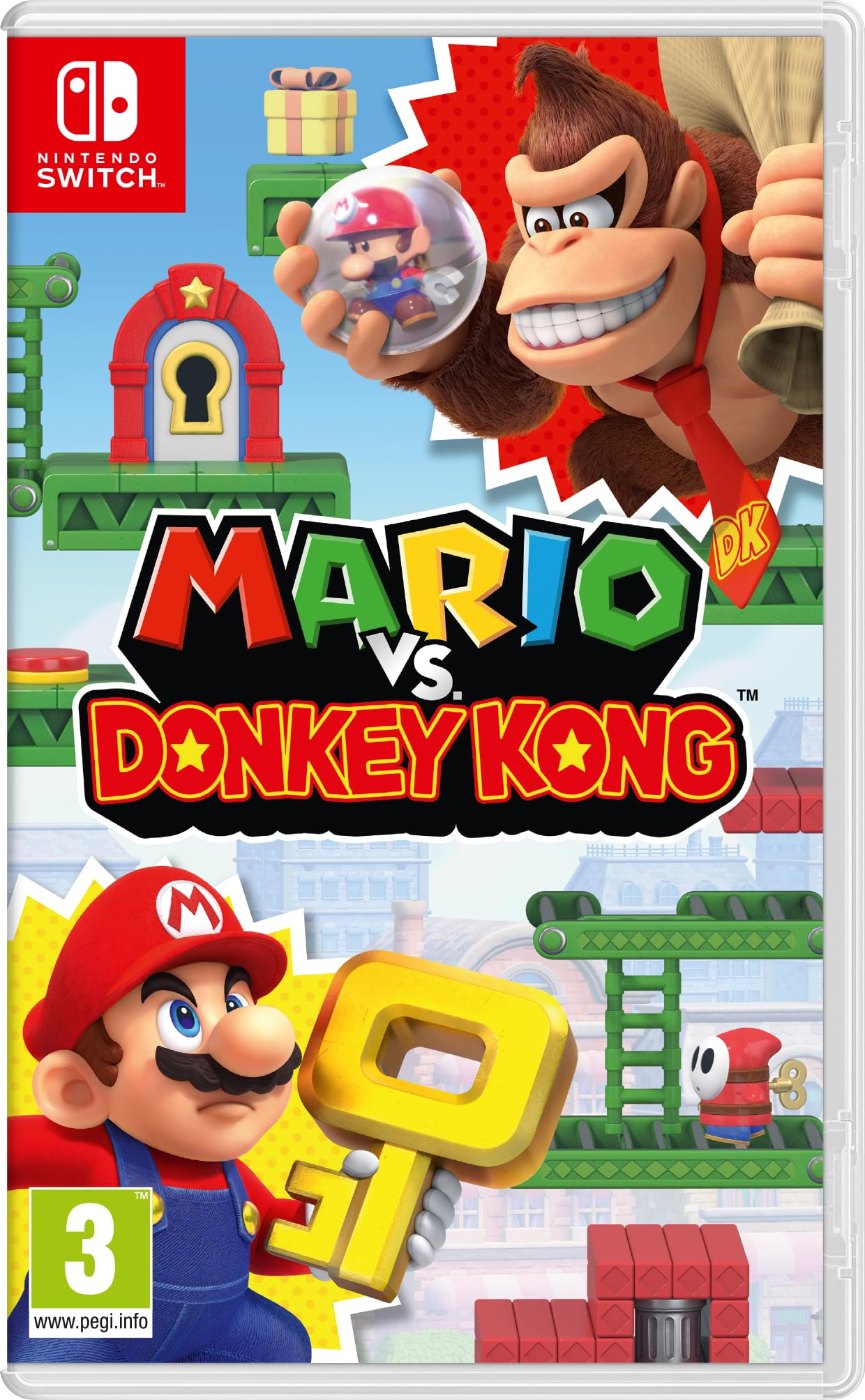
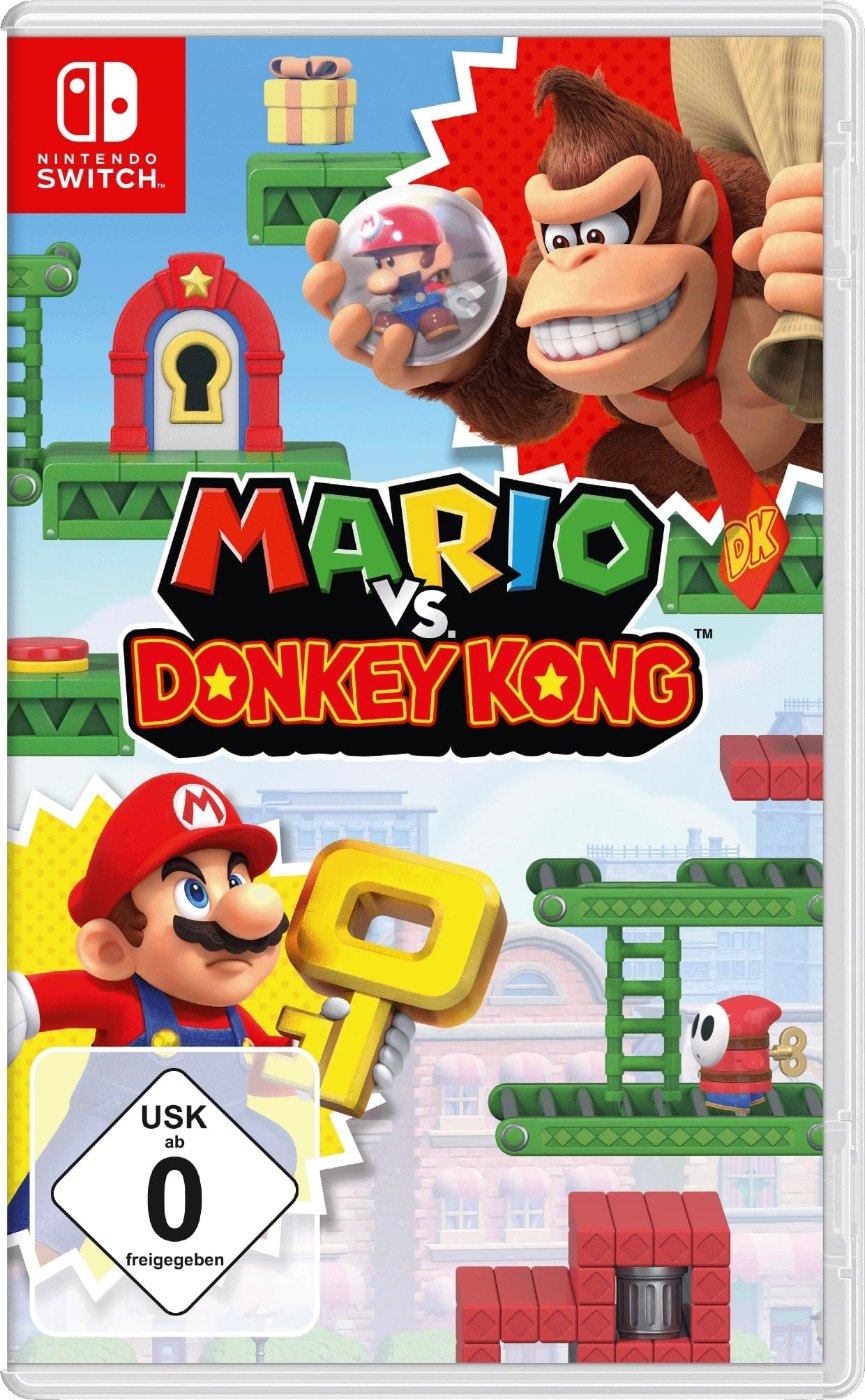
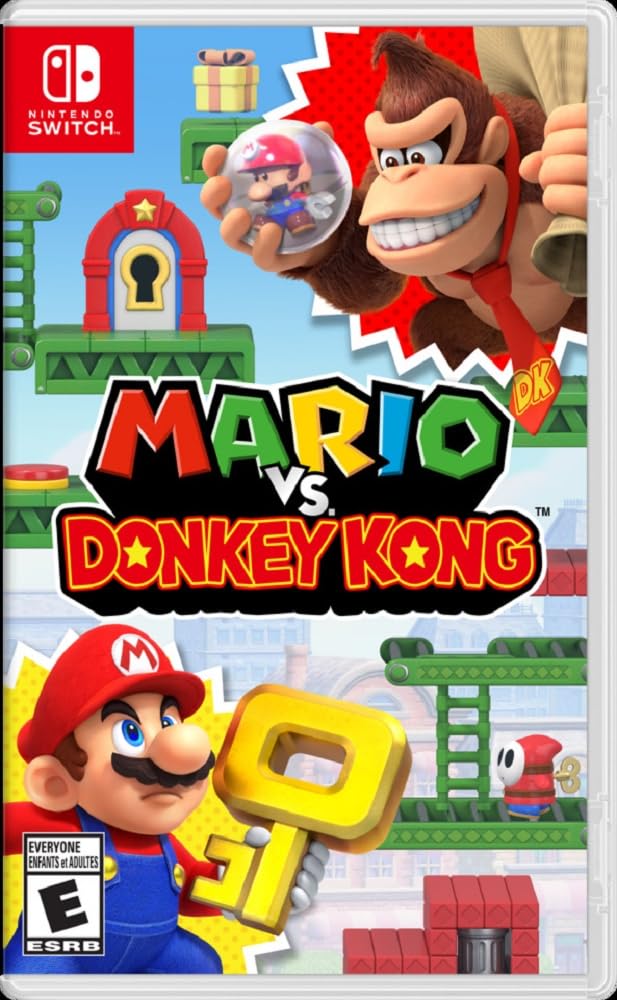
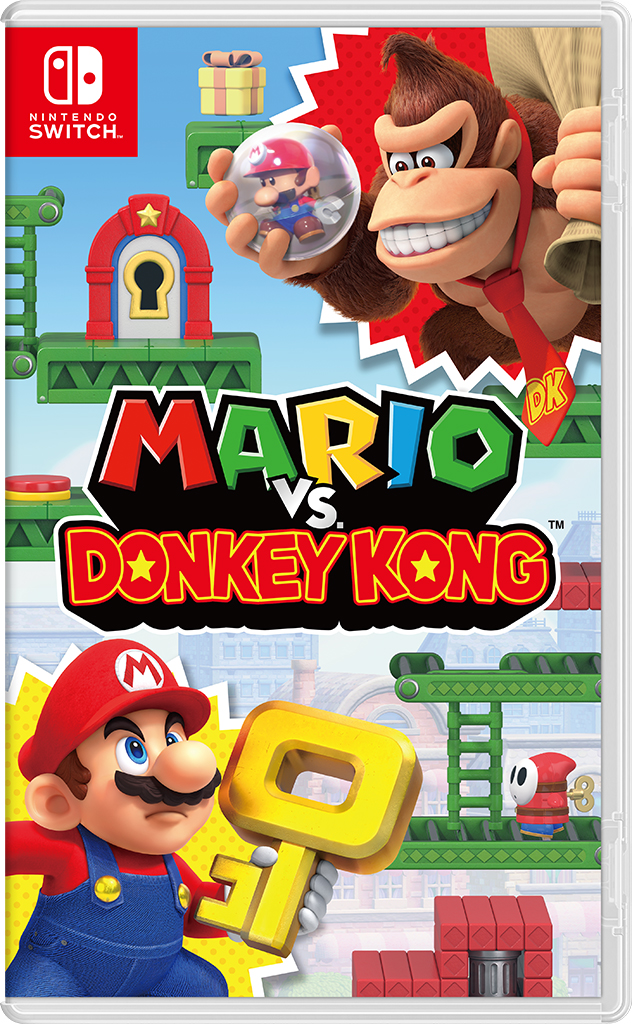
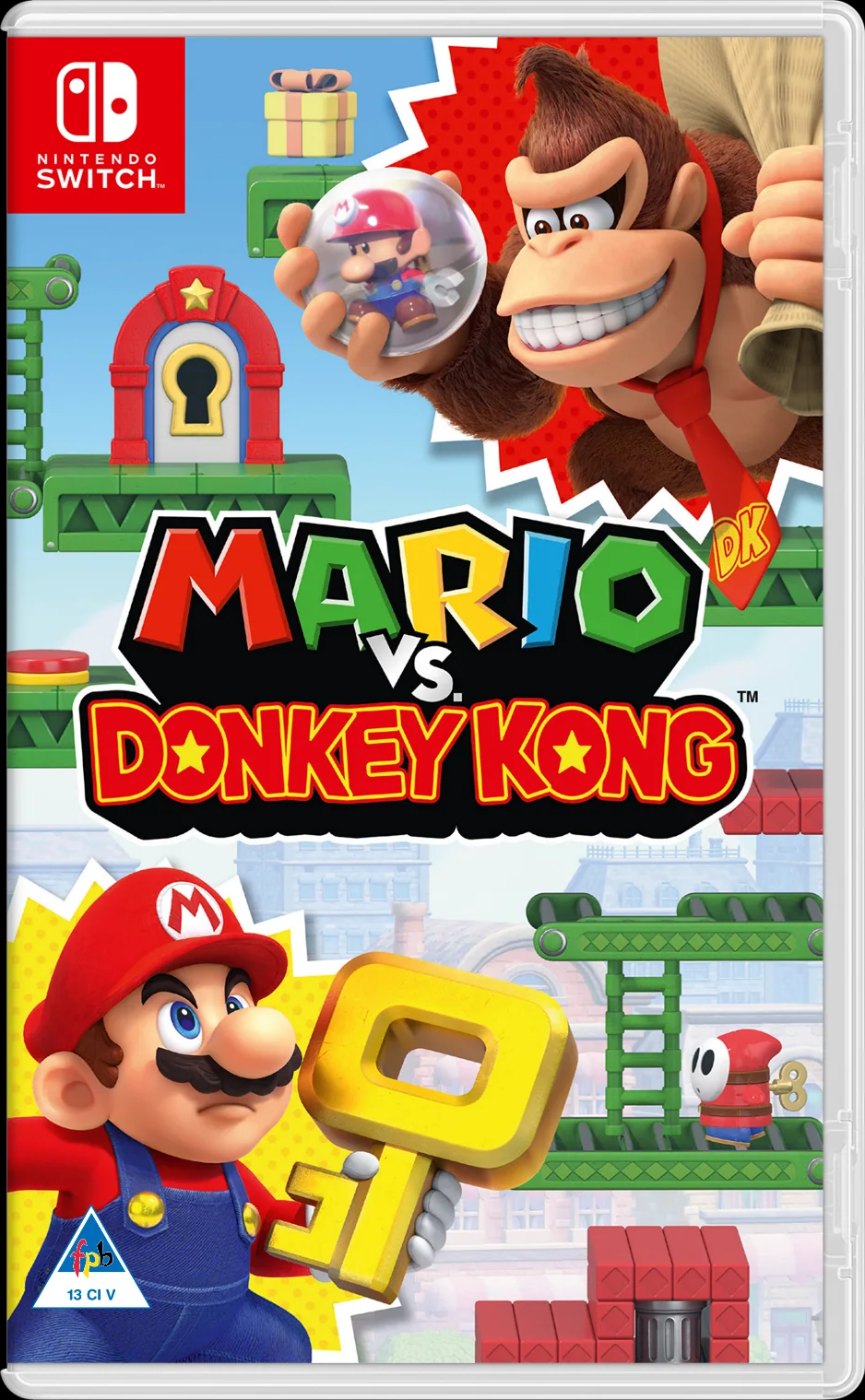
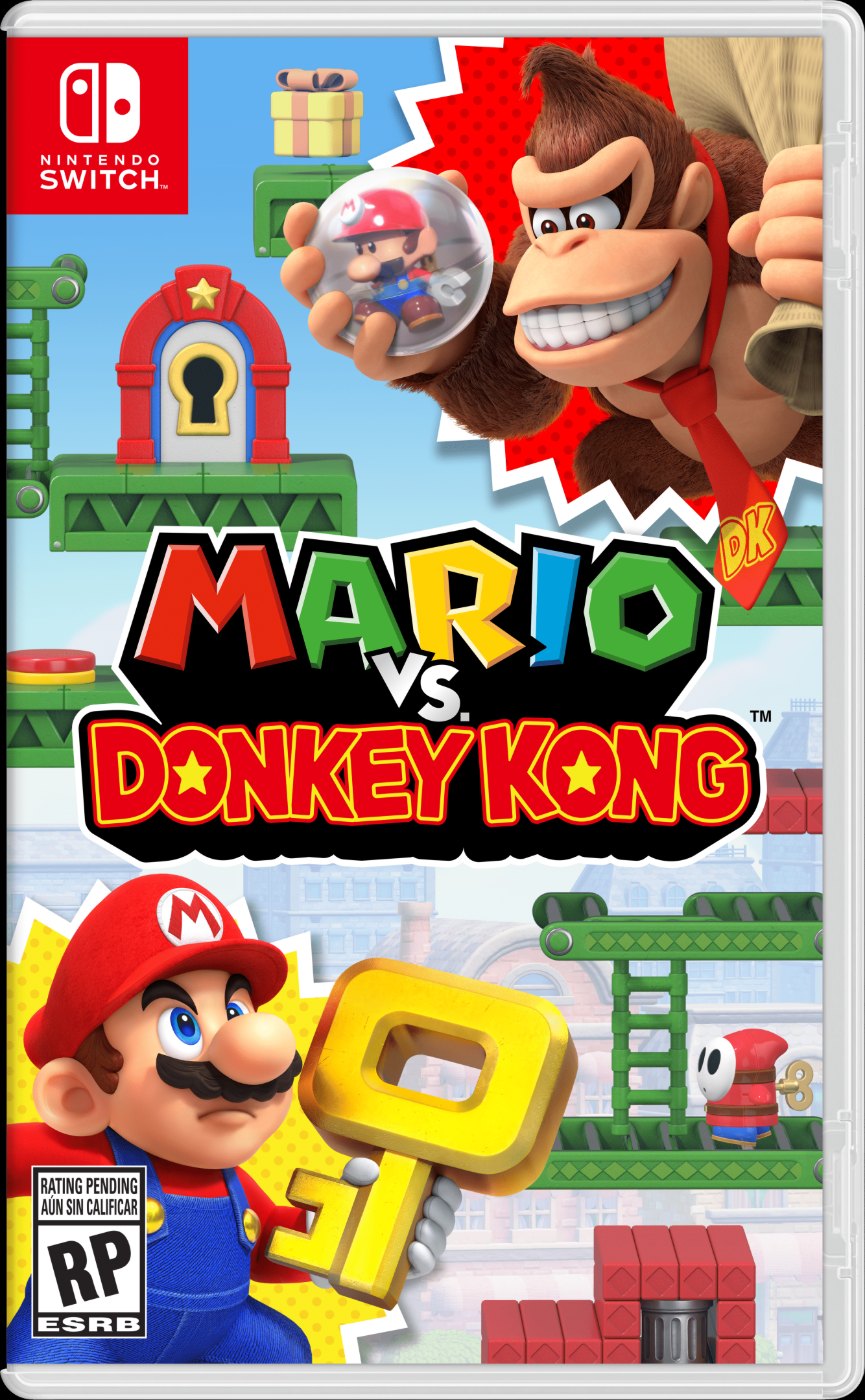
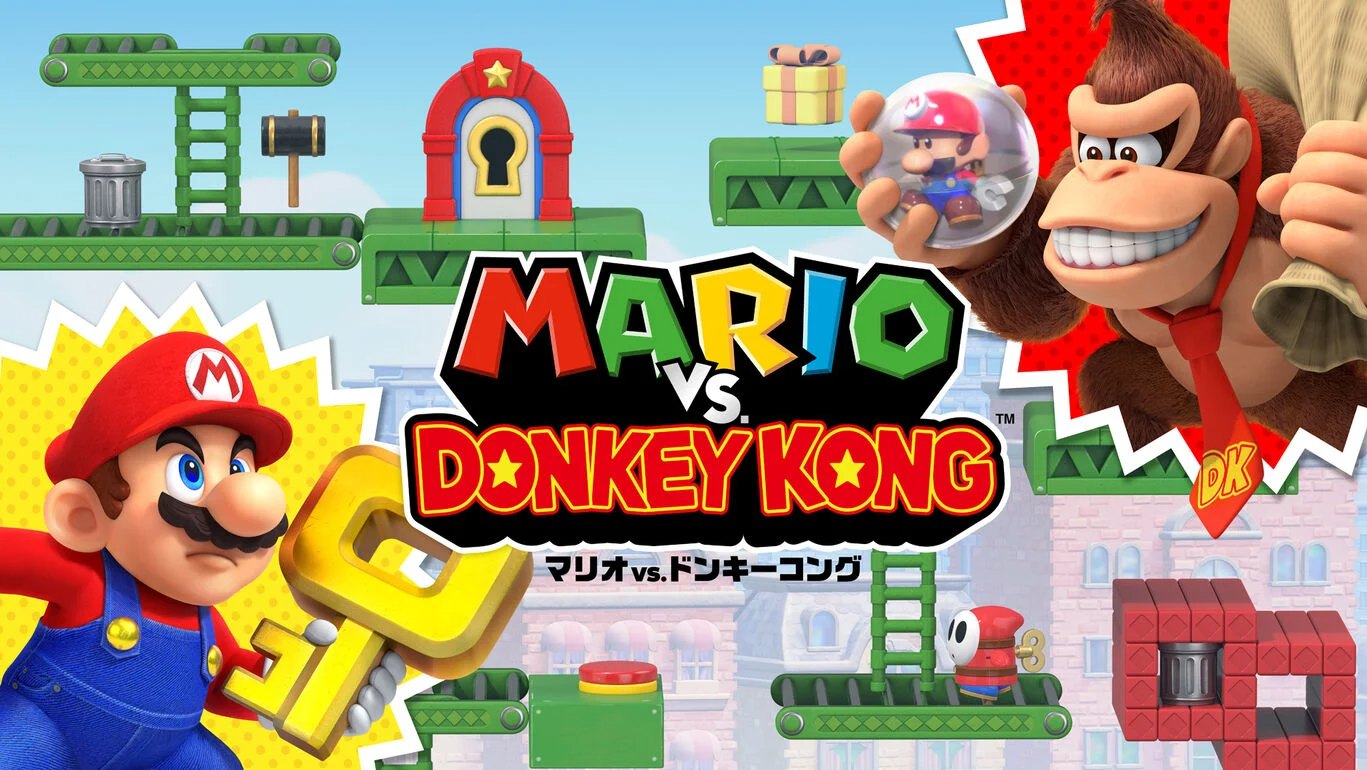
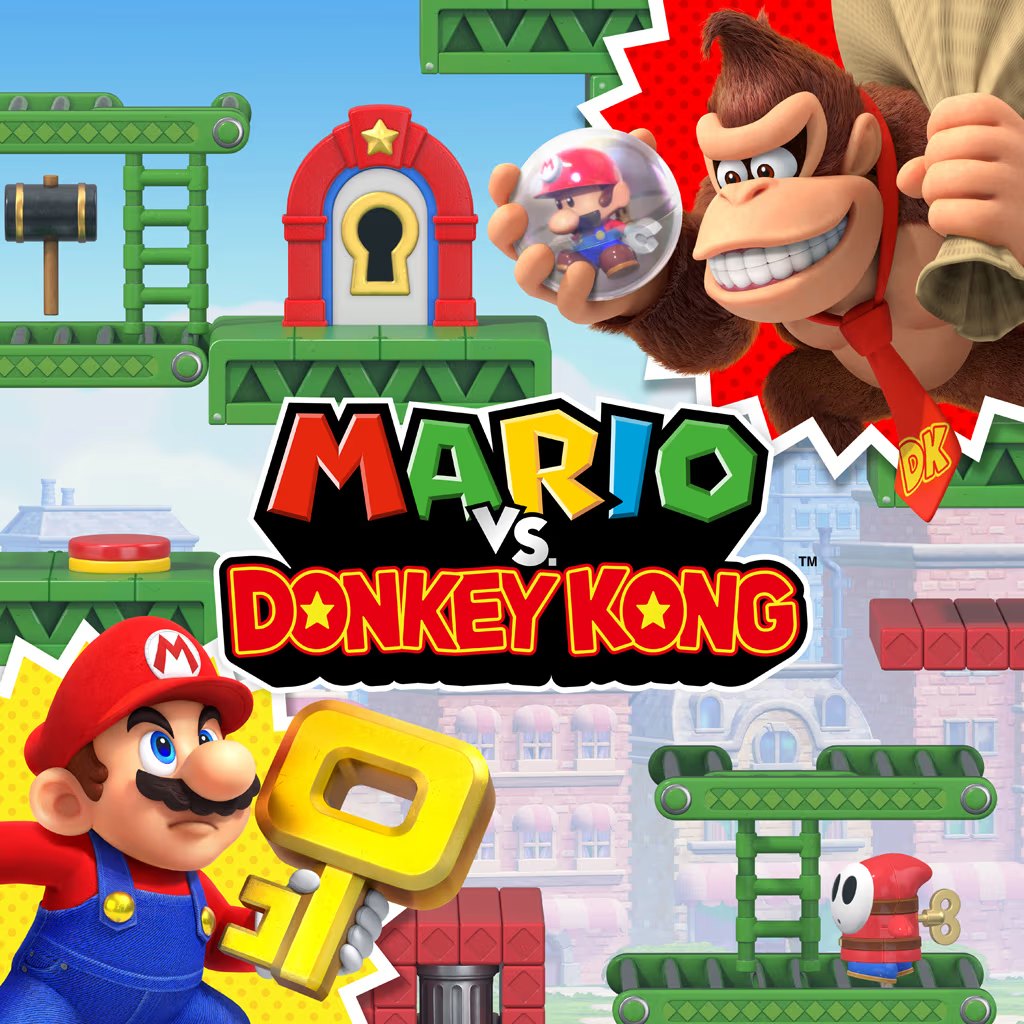
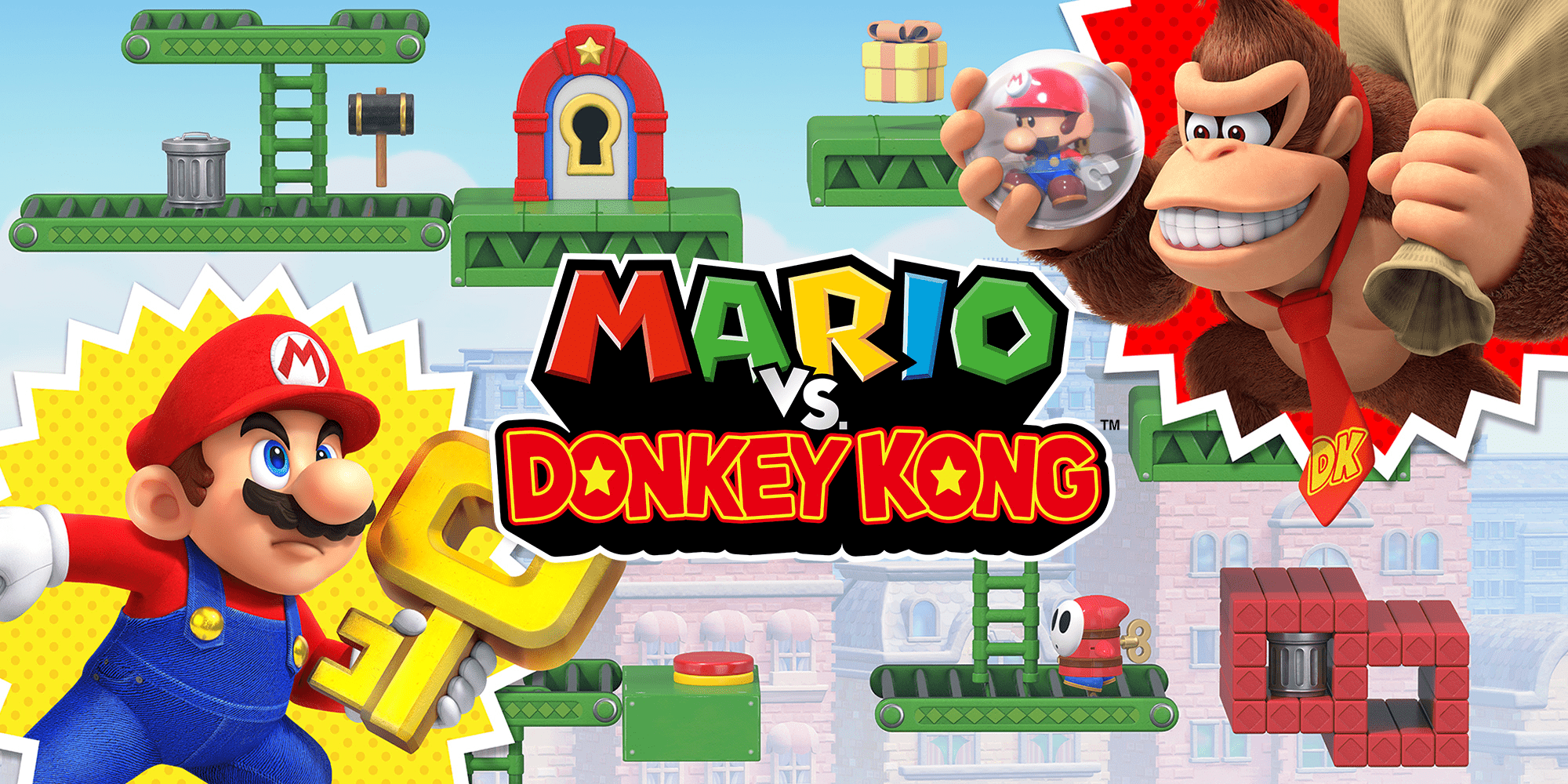
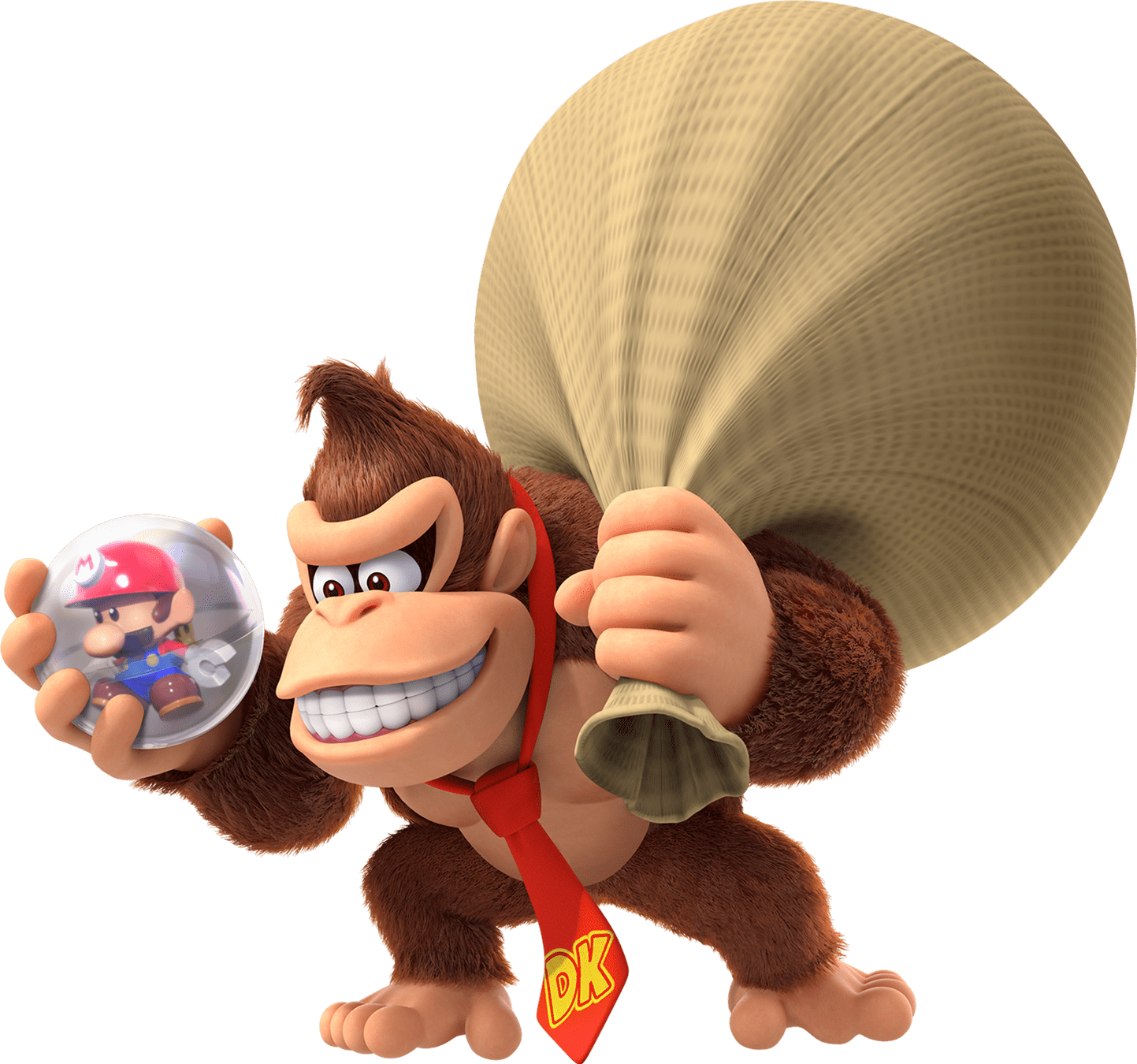
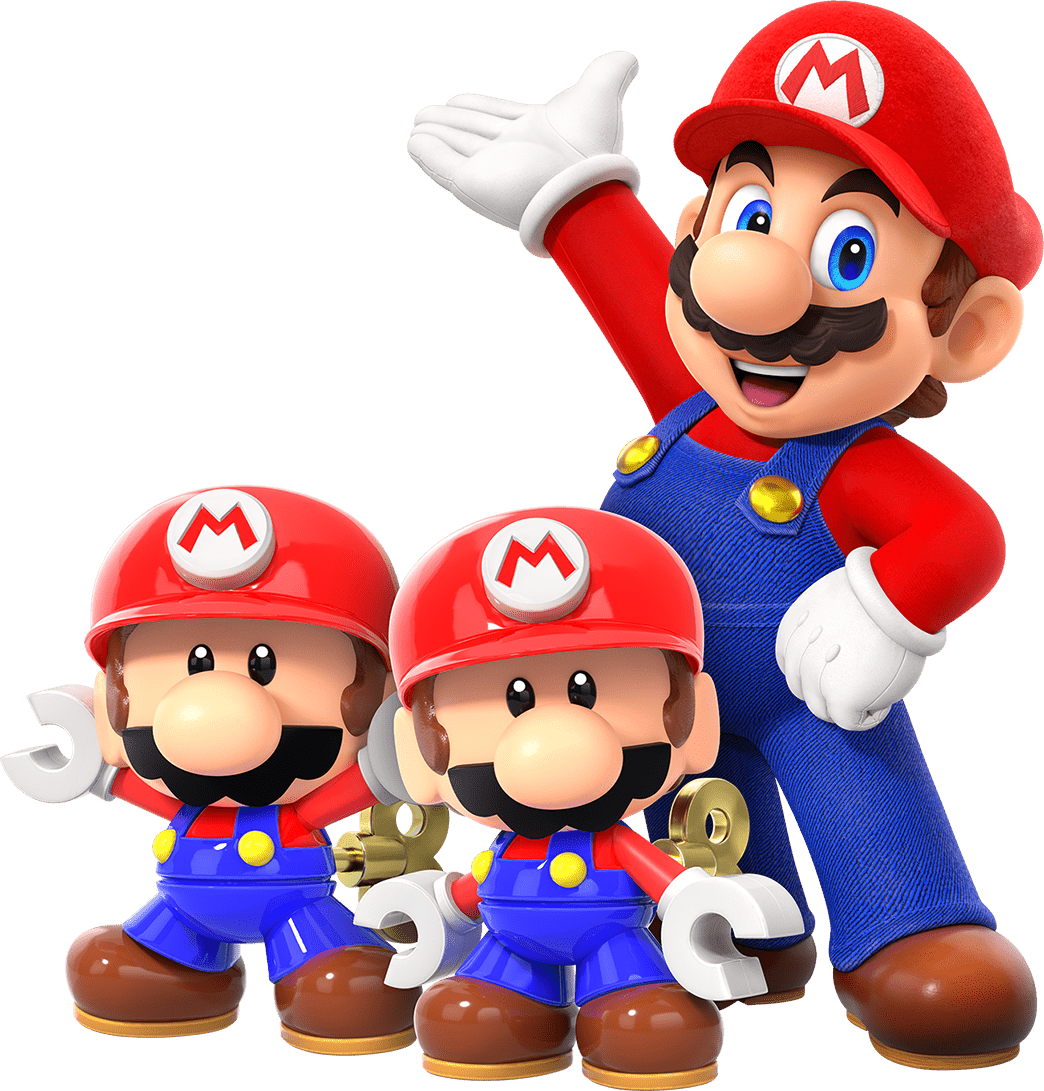
The key artwork for the Switch remake.
The Game Boy Advance Mario vs. Donkey Kong was a puzzle game in a platformer’s clothes: every level a compact machine of switches, ladders and conveyor belts, with a key to carry to a locked door and a Mini-Mario toy waiting on the other side. It spawned a whole series about the Minis. In 2024 Nintendo Software Technology, the studio that made it, went back and rebuilt the original from scratch for Switch.
What you get is the same game in a new suit, with a good deal added. The pre-rendered sprites are gone, replaced by full 3D models in a clean, modern Mario style that is often likened to Super Mario 3D World. Every world has been redressed and the music rearranged. Two worlds are new: Merry Mini-Land, an amusement park, slots in fourth, and Slippery Summit, a snowy forest, sixth. Each comes with its own levels, a Plus version and new Expert stages.
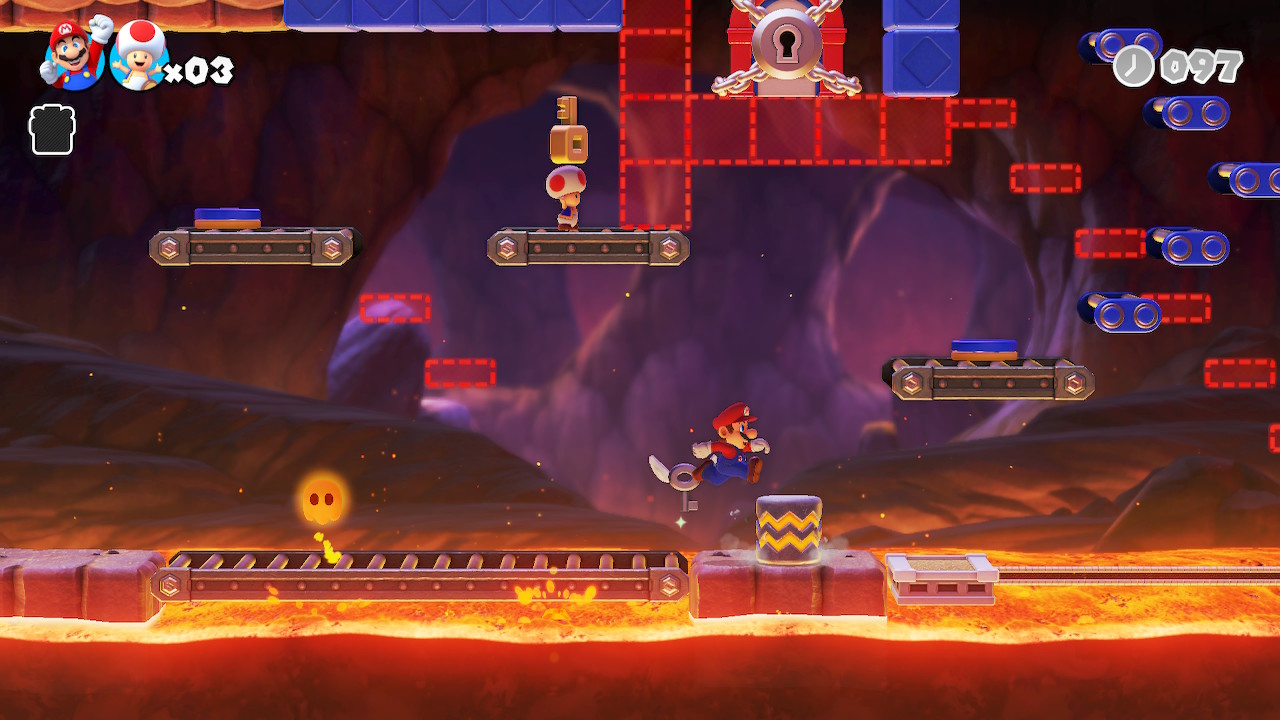
The bigger changes are about who can play. Casual Style switches off the timer and lets you take five hits per level, respawning at checkpoint flags. A second player can join as Toad, with a silver key to chase in every level. Time Attack sets a target time for every stage, and the old present-swapping minigames have become proper bonus levels. A few things were lost on the way, most notably the e-Reader levels, and the old scoring system went entirely.
Reviews were warm without being ecstatic: a faithful, polished revival of a game that some found too easy until its Expert levels. Fans bought it all the same: Nintendo counted 1.12 million sales in its first six weeks.
The toys are back in town in Mario vs. Donkey Kong on Nintendo Switch! Solve puzzles and test your platforming smarts as you try to recover the stolen Mini-Marios. This remake of the Game Boy Advance game features all-new graphics, levels, and other new ways to play.
Donkey Kong wants the hot new Mini-Mario toy, but they’re all sold out. So he’s broken into the factory where they’re made and stolen the whole lot! It’s up to Mario to give chase and get them back.
Run, jump, climb, swing, handstand and even backflip through eight worlds. Find the key needed to reach the Mini-Mario, grab all the presents and see if you can earn a Perfect rating on every level!
— Official description (Nintendo UK, 2024)
Should you play this or the original?
For most people, this one. It contains everything the 2004 game’s main mode offered plus two worlds, sixteen bonus levels, four more Expert stages, co-op and a gentler difficulty for newcomers. Purists will miss the score system and the e-Reader levels, and the Game Boy Advance version has its own charm; it is covered on our original Mario vs. Donkey Kong page, and since March 2026 it has been playable on Switch too, through Nintendo Switch Online.
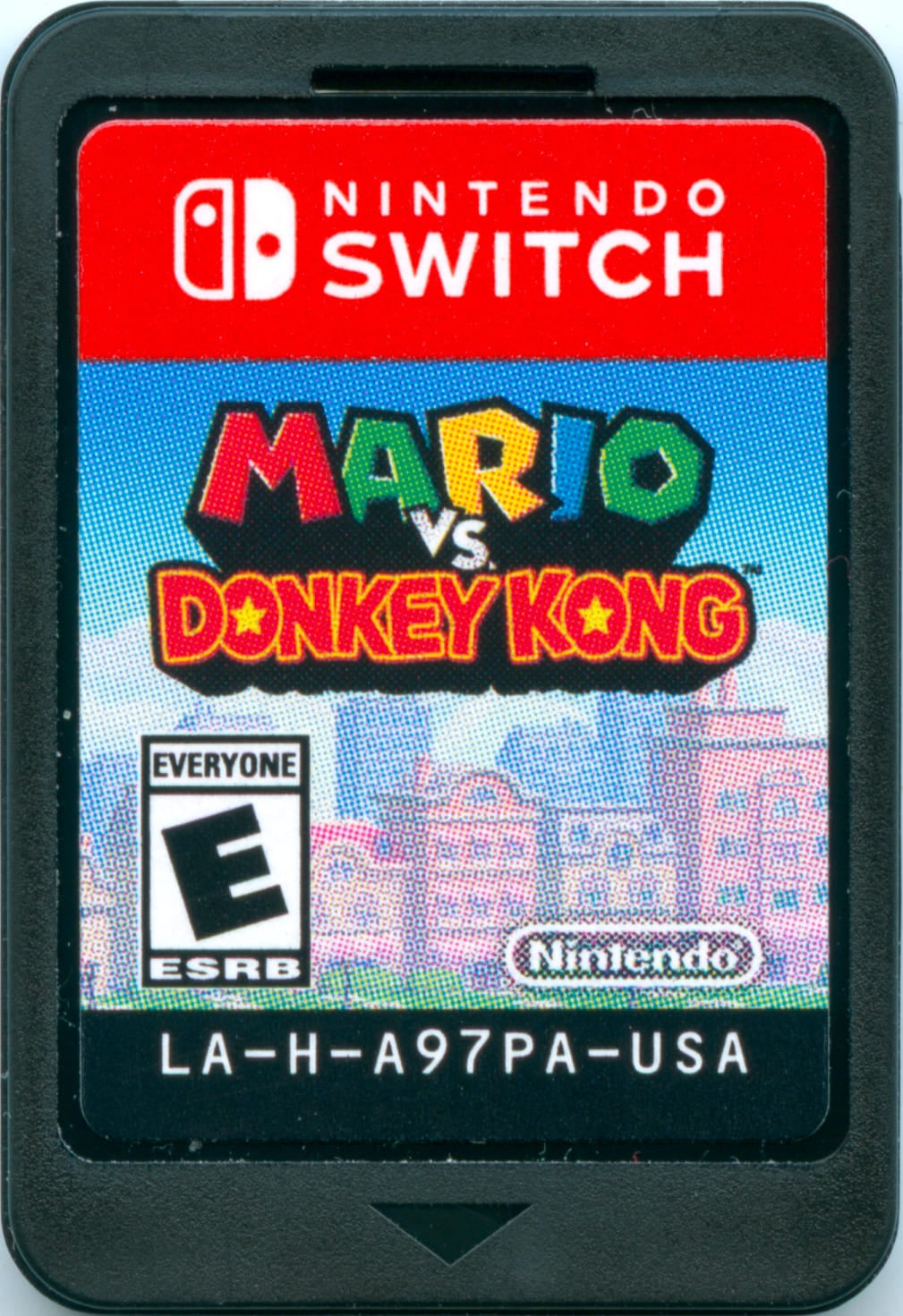
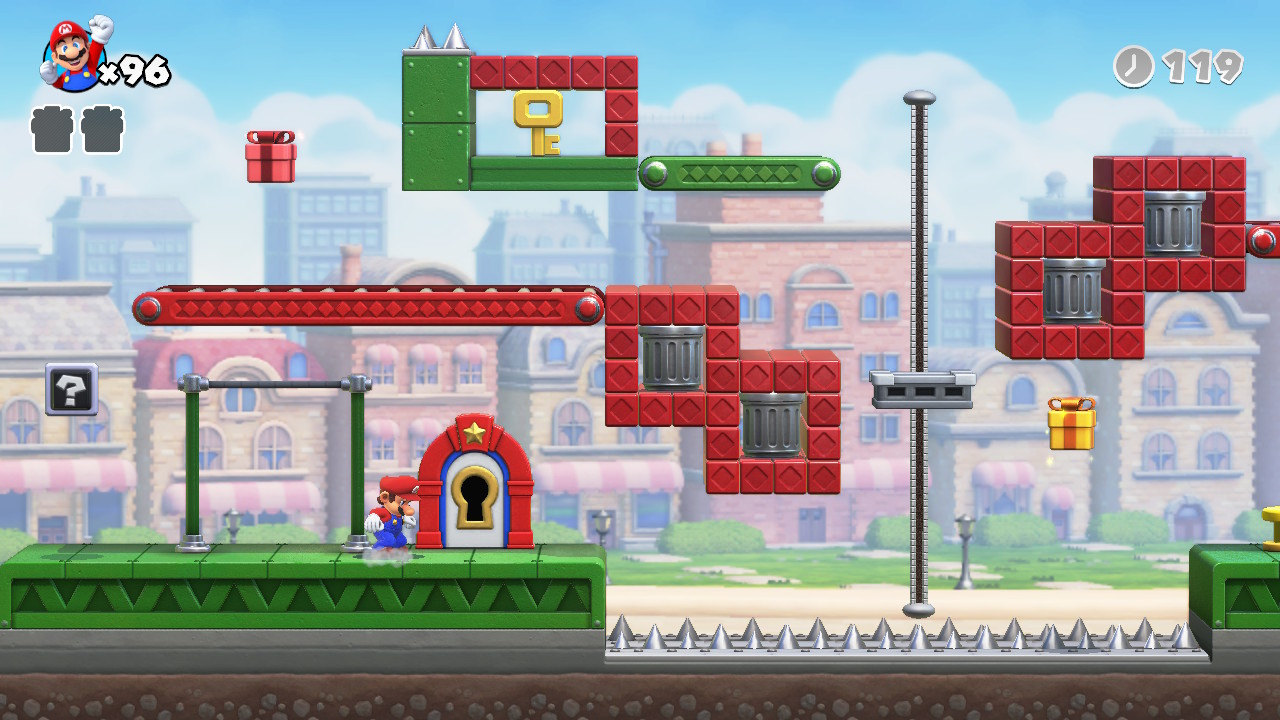
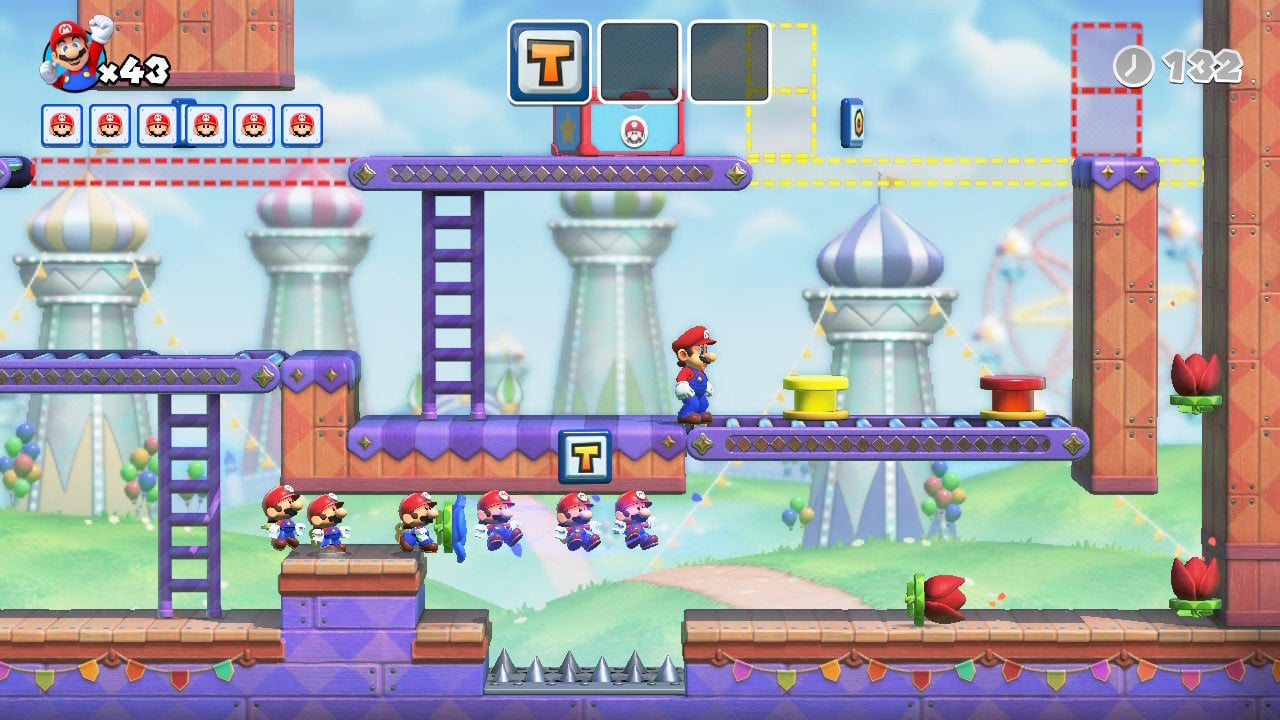
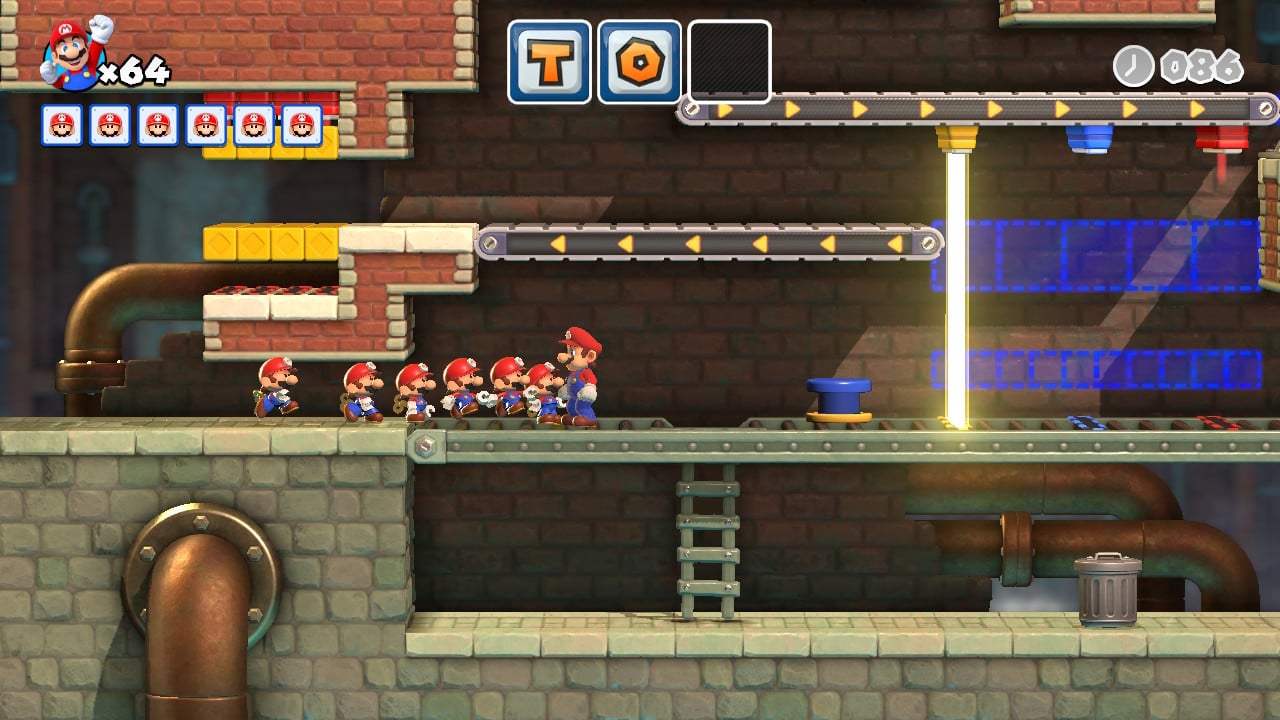
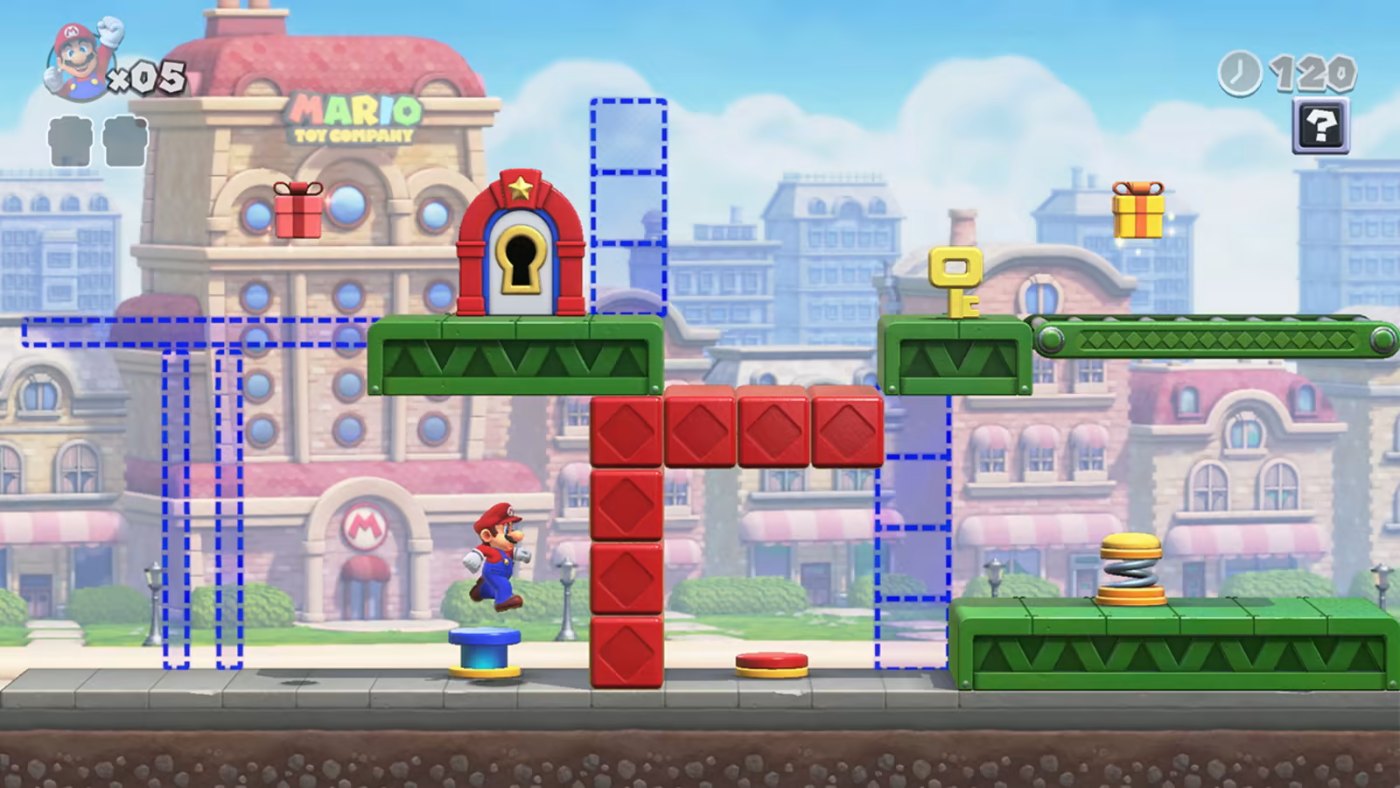
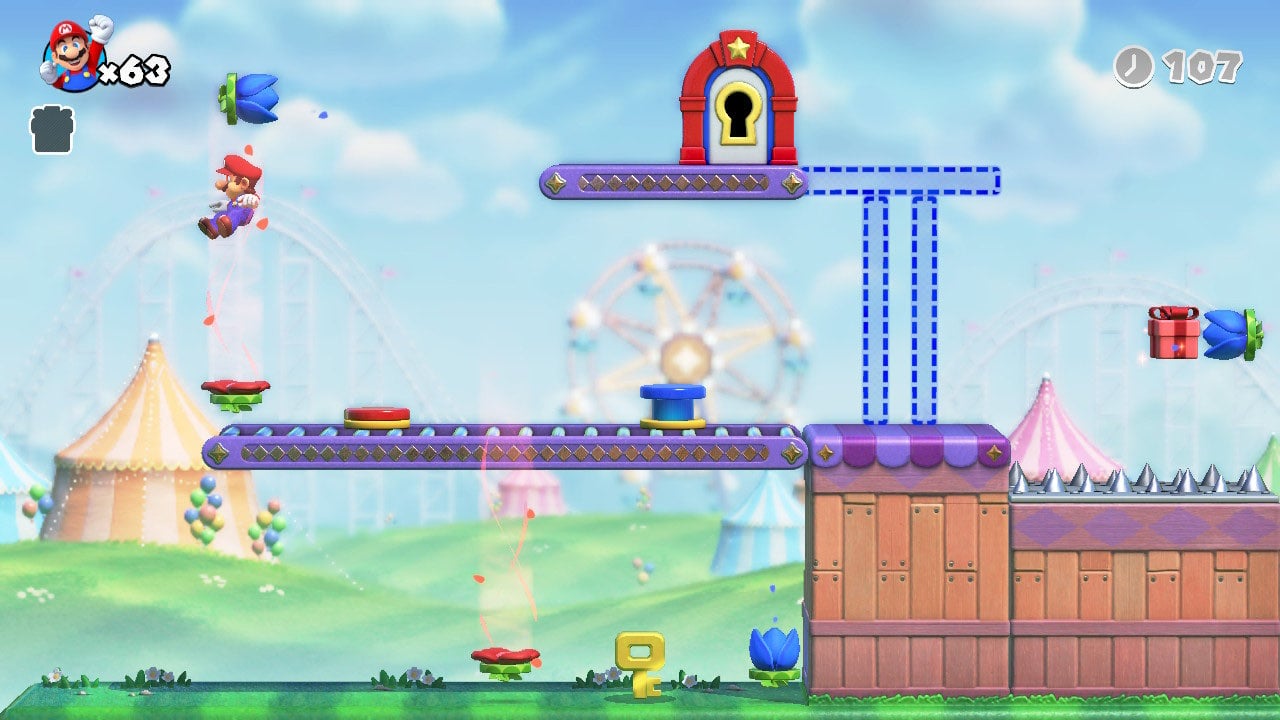
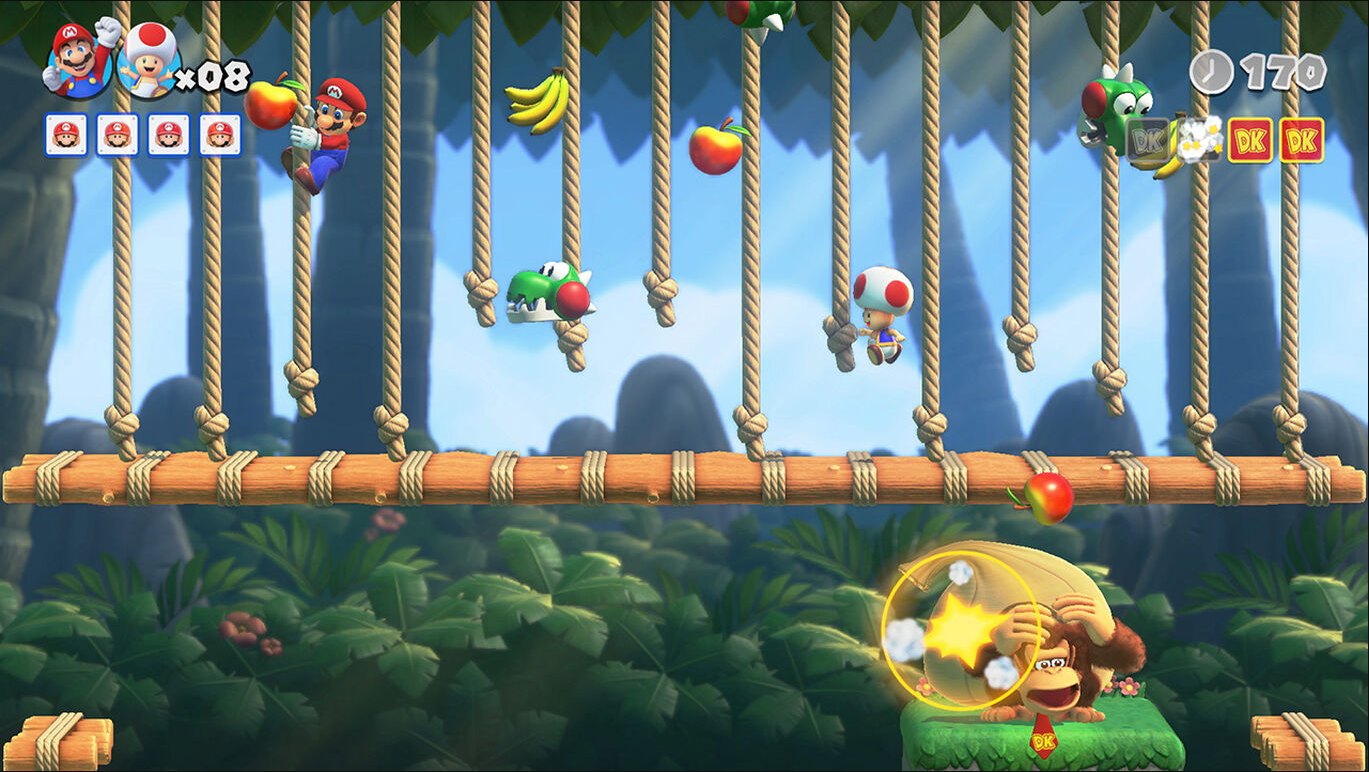
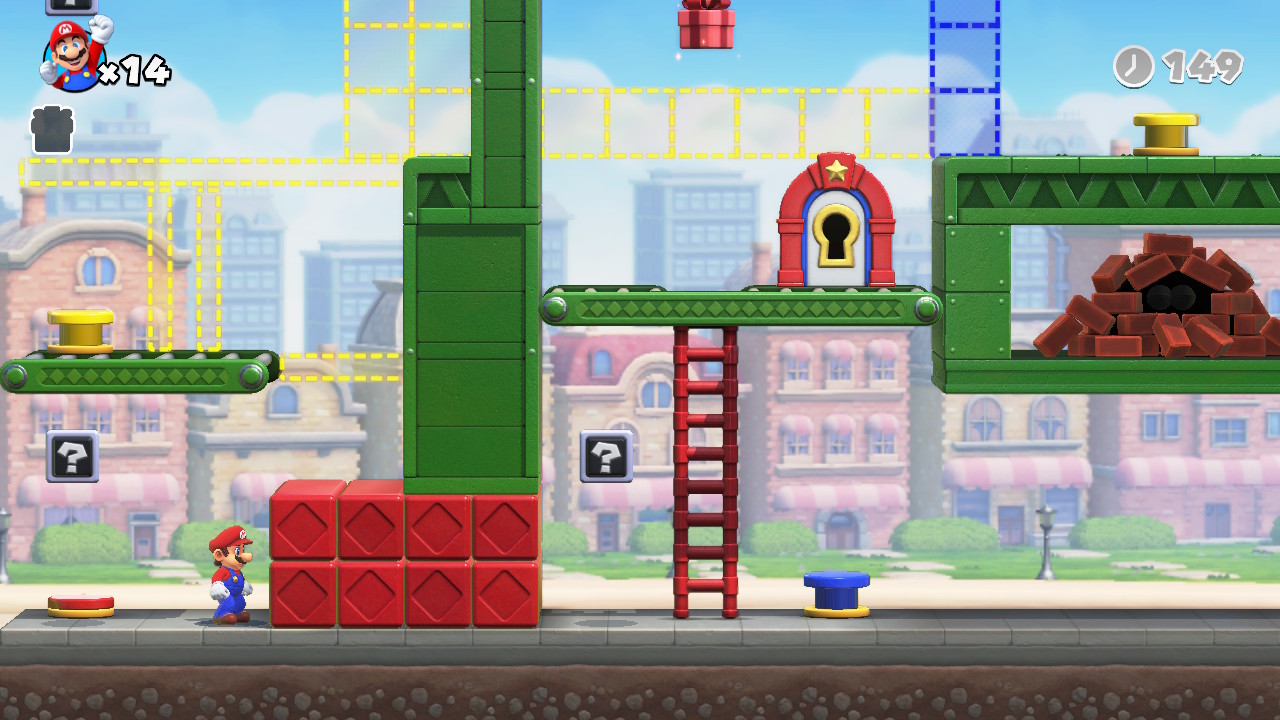
Level 1-1, rebuilt in high definition.Level 4-1 in the new Merry Mini-Land, with Flower Fans.Toad joins in for two-player co-op (Level 2-DK).
Quick Answers
Quick answers about the Switch remake. The 2004 original has its own page.
Is Mario vs. Donkey Kong on Switch a remake?
Yes. It remakes the 2004 Game Boy Advance game with new 3D graphics, rearranged music, two new worlds, co-op, Casual Style and Time Attack. Nintendo Software Technology made both. More →
When did it come out?
On 16 February 2024, worldwide. It was announced in the Nintendo Direct of 14 September 2023, and a free demo followed on 31 January 2024. More →
What are the new worlds?
Merry Mini-Land, an amusement park that is now World 4, and Slippery Summit, a snowy forest that is now World 6. Both have Plus versions and new Expert levels. More →
How many levels are there?
Nintendo says over 130. Each of the eight worlds has six main levels, a Mini-Mario level and a Donkey Kong fight; then come the Plus worlds, 16 Expert levels, 16 bonus levels and two showdowns with Donkey Kong. More →
What is Casual Style?
An easier way to play: no time limit, five bubbles per level so that a mistake sends you back to the last Checkpoint Flag, keys that wait 15 seconds instead of 12, and fewer enemies in some levels. More →
Is there multiplayer?
Two-player local co-op. Player 2 is Toad, who can squeeze through one-block gaps in a handstand and climbs ropes faster; each level adds a silver flying key the pair must catch. More →
How does Time Attack work?
Press X on the level select screen to race a target time on any level you have cleared; beating it earns a gold medal with a clock on it. It opens after you beat vs. Donkey Kong. More →
What was removed from the GBA version?
The score system, the present-swapping bonus games (replaced by bonus levels), the pre-level preview scenes and all e-Reader levels. Several of Mario’s voice lines were also dropped. More →
How well did it sell?
Nintendo reported 1.12 million copies by 31 March 2024, six weeks after launch: 210,000 in Japan and 910,000 elsewhere. More →
Who made it?
Nintendo Software Technology, the studio behind the original, directed by Vivek Melwani. The original composer, Lawrence Schwedler, returned as music director. More →
Story
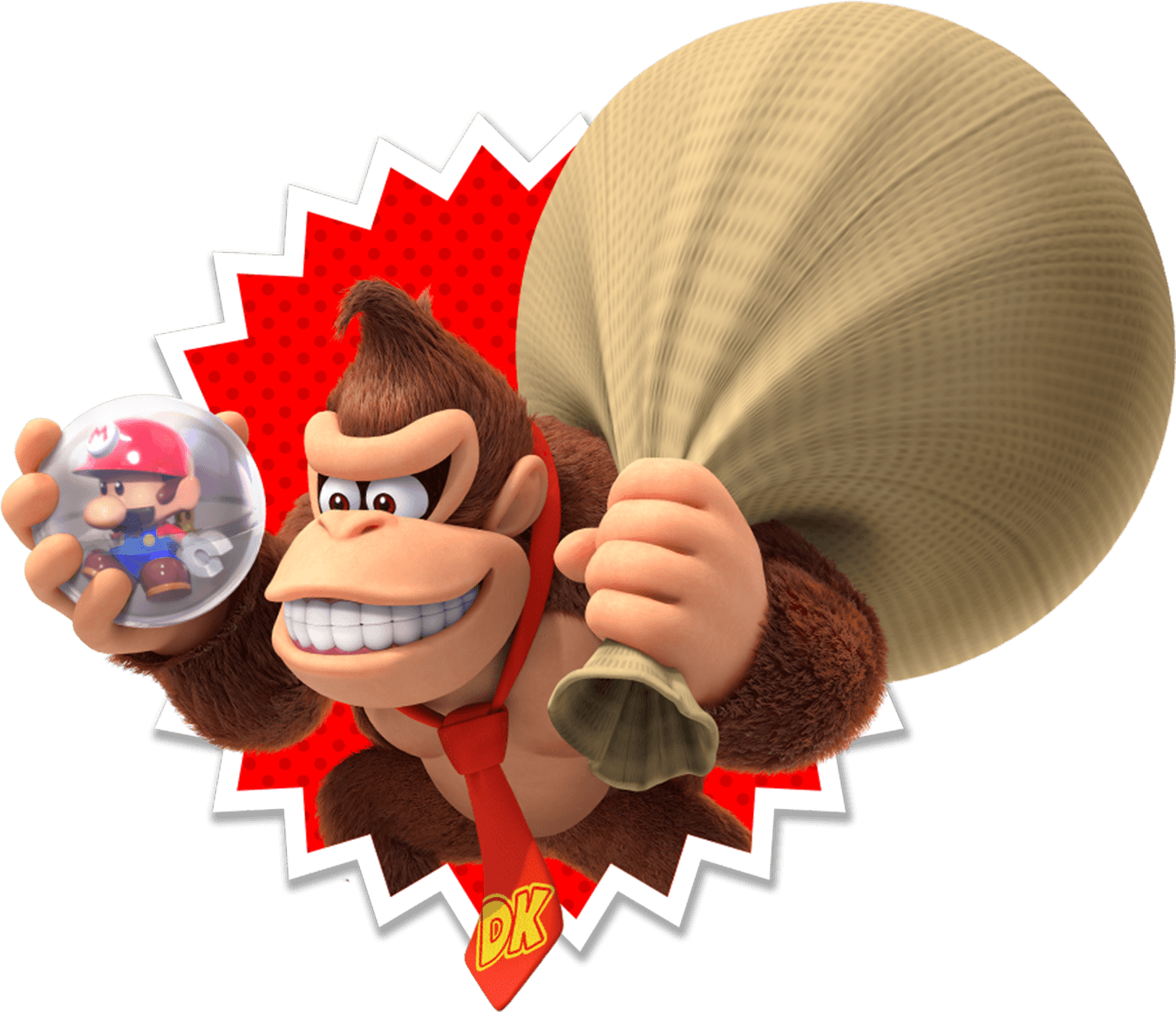
Donkey Kong and his bag of stolen toys.
The plot is the 2004 one, scene for scene, now told in fully animated cut-scenes rather than a sequence of still frames. Our original Mario vs. Donkey Kong page retells it at length; here is the short version, with what the remake changes.
Buy them all!
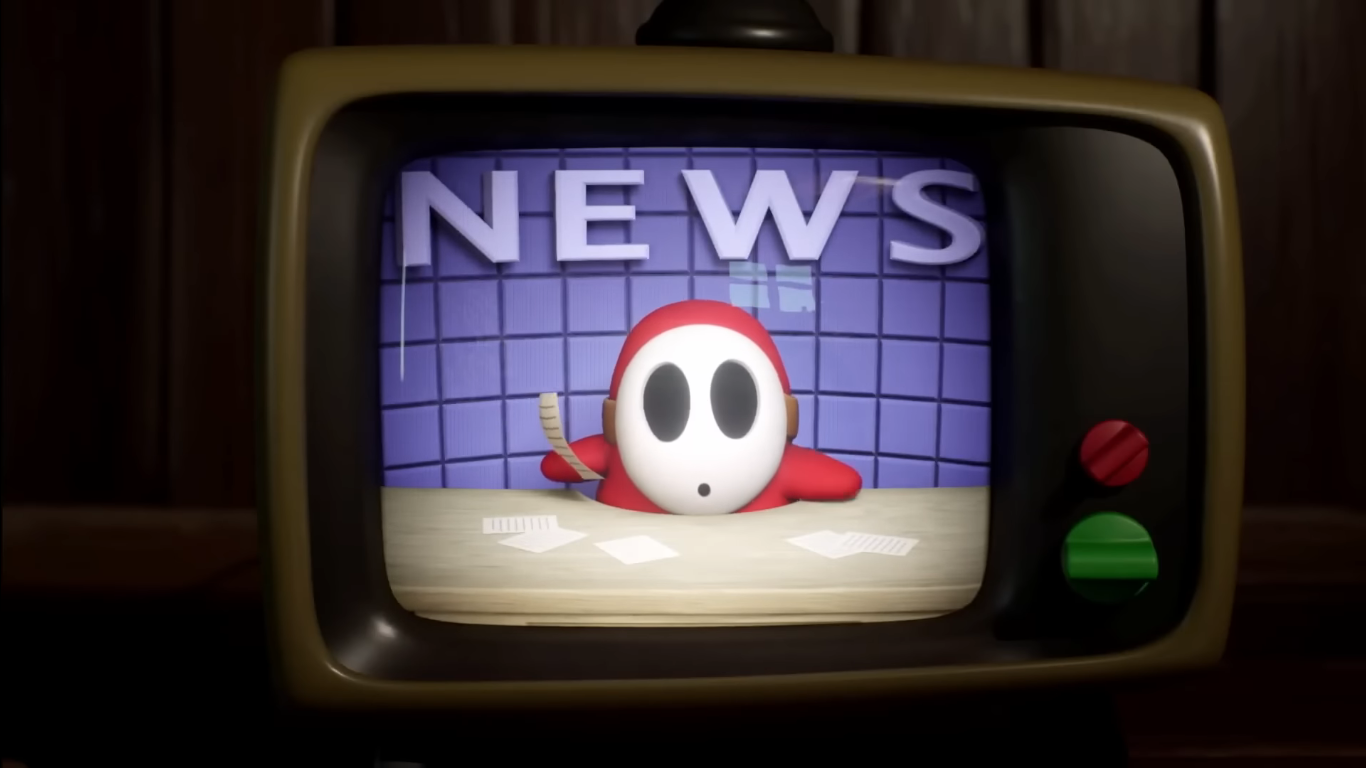
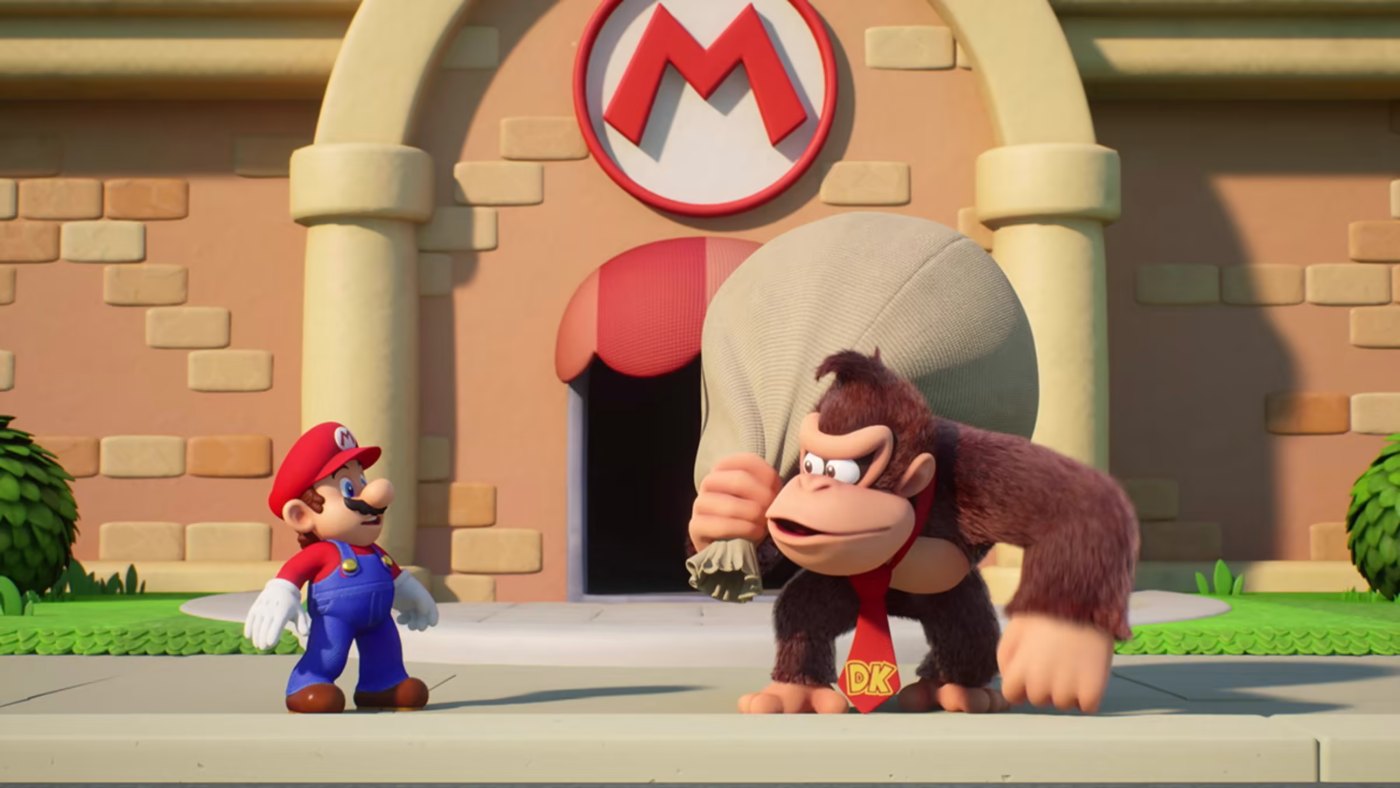
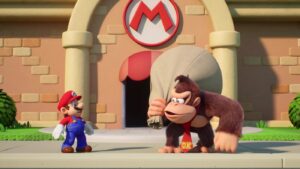
Donkey Kong is flicking through the channels when an advert for Mario’s new Mini-Mario wind-up toys comes on, and he wants one at once. The toy shop is sold out, but the Mario Toy Company factory is nearby, so he helps himself to the whole stock, sealing the Minis in crystal balls and stuffing them into a sack while the factory’s Toads, now in hard hats, look on helplessly. Mario sees him leave and gives chase.
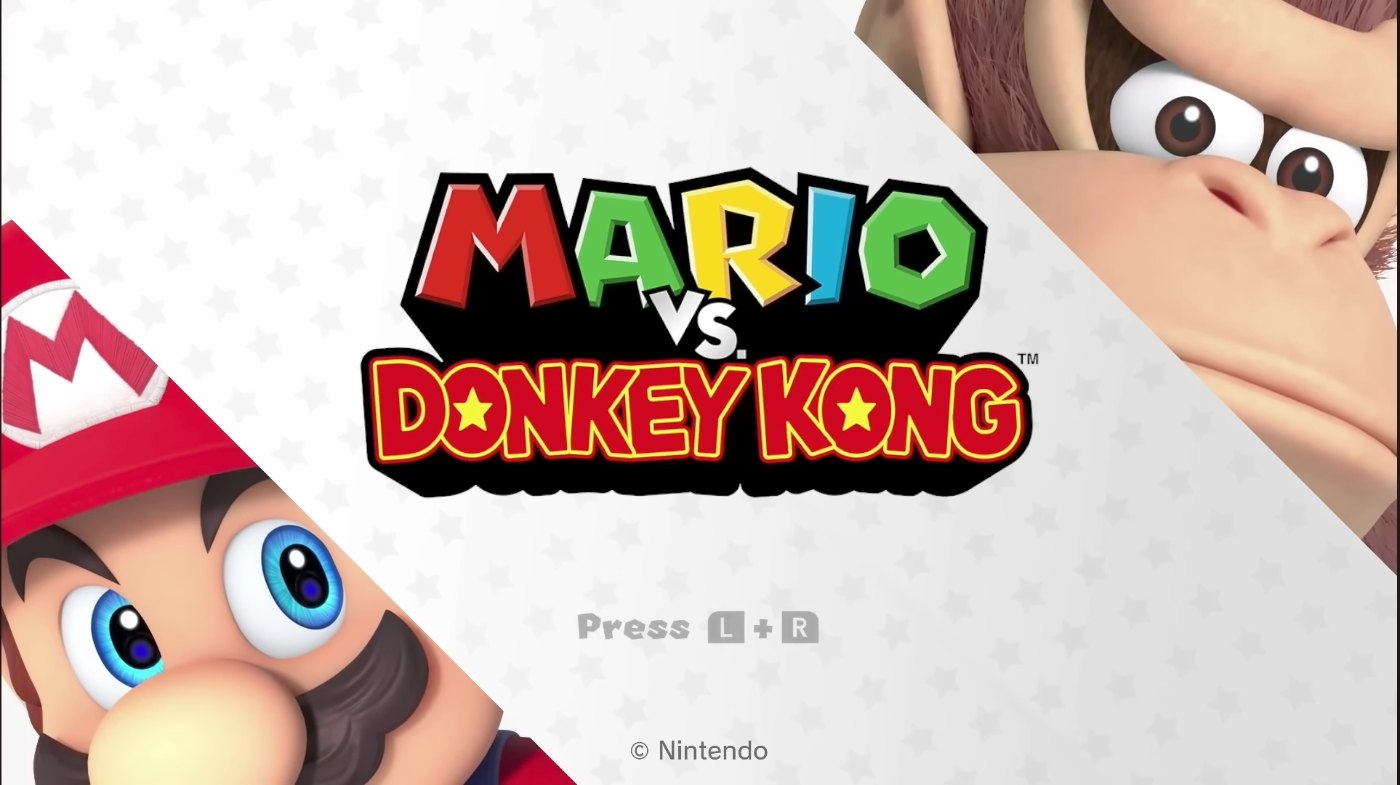
Channel-hopping: a Shy Guy reads the news.Mario catches up with the thief.The title screen.
Worlds 1 to 3: the factory, the jungle and the volcano
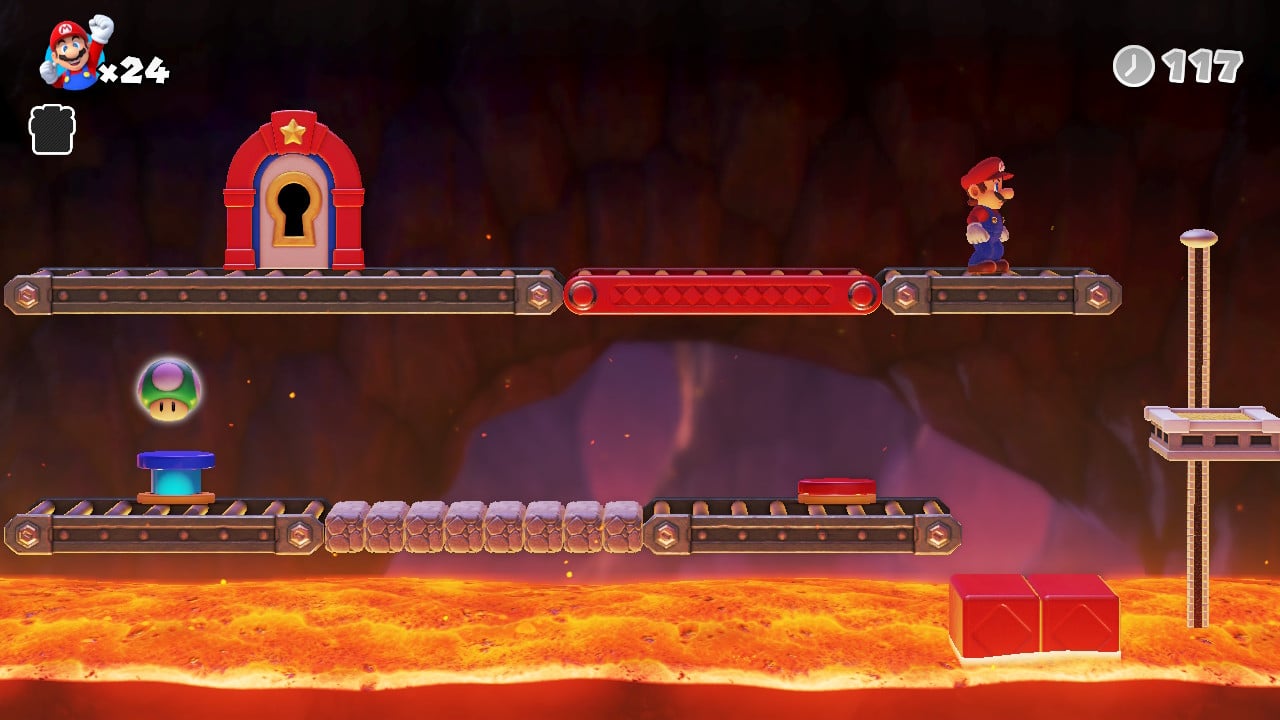
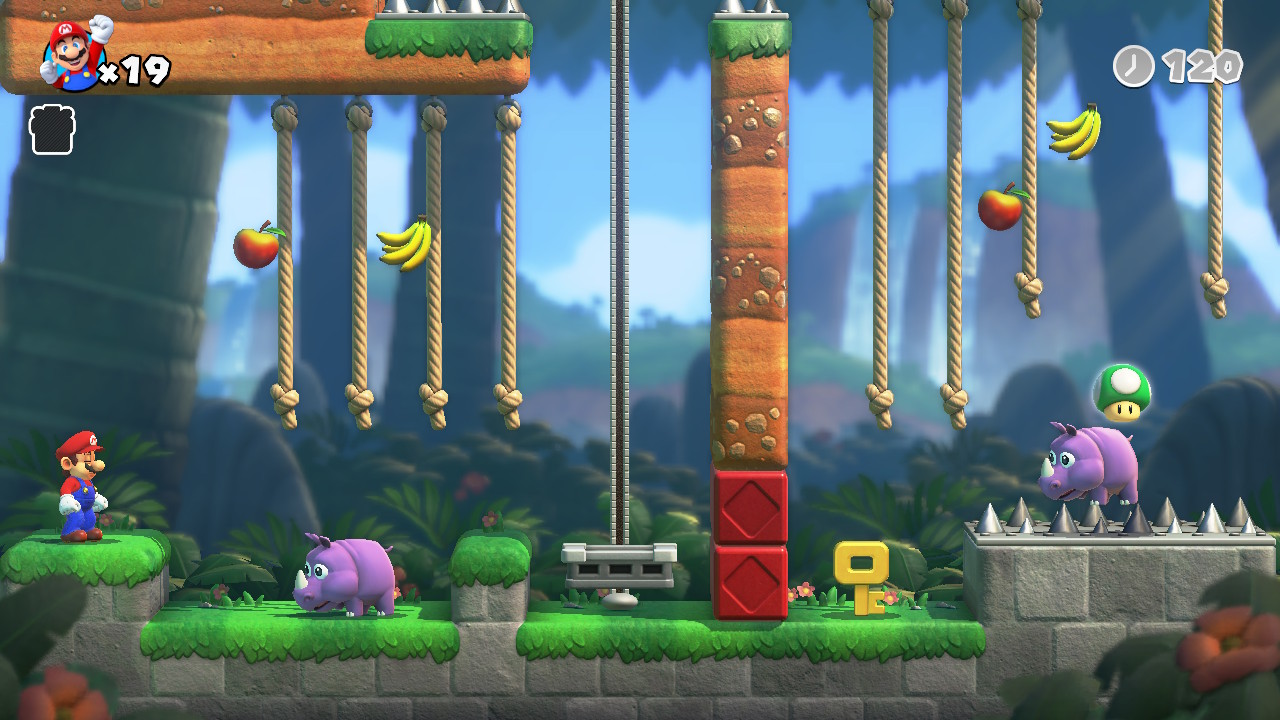
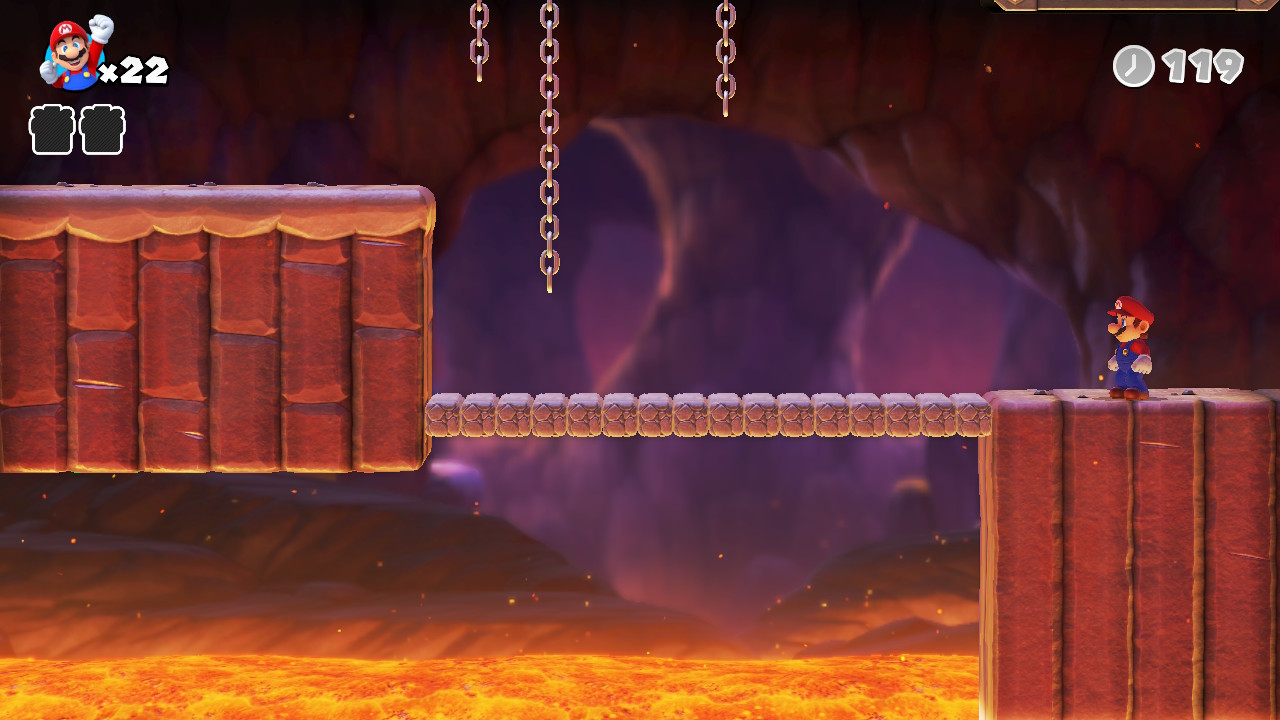
The chase starts at the Mario Toy Company, redesigned with red roofs, brick walls and a Mario-style logo, where Mario learns ladders, wires, conveyor belts and springboards. Donkey Kong Jungle adds ropes, RamRams and Snapjaws, and a fight in which Mario drops fruit on the ape; Fire Mountain brings lava geysers, rising lava and a new, more mysterious theme tune.
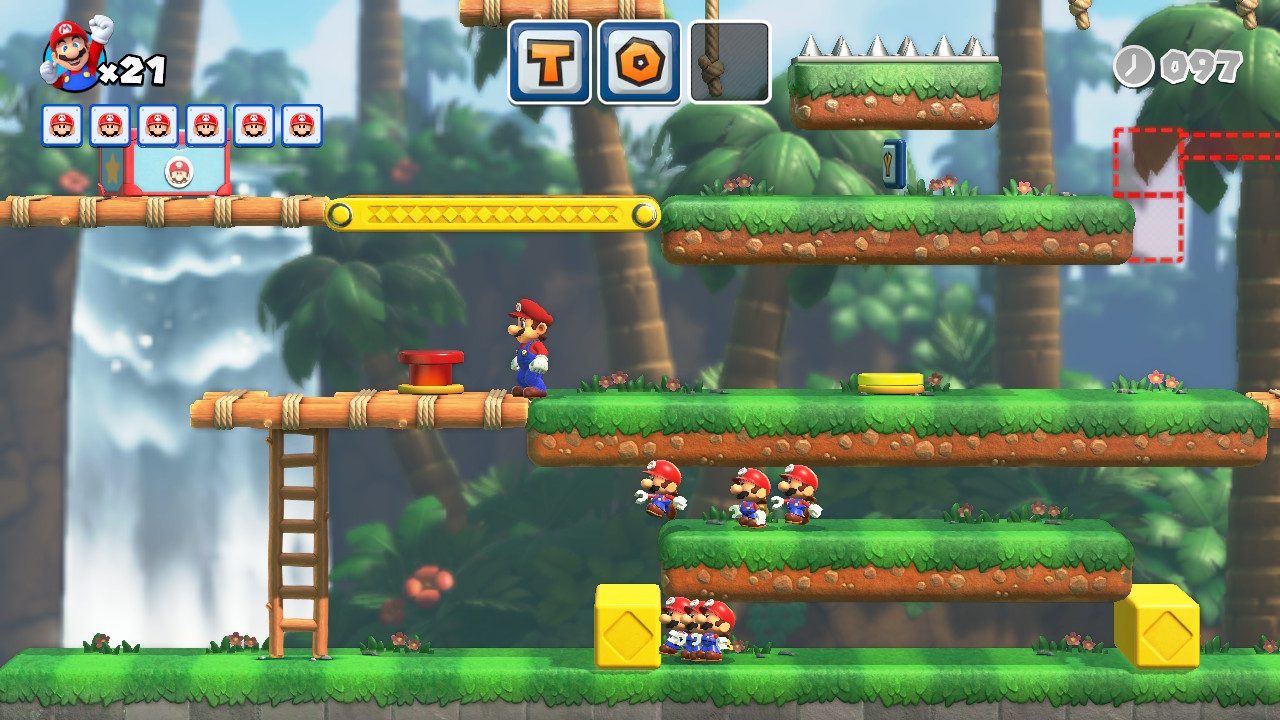
Level 1-6: handstand techniques and a Brickman.Level 2-5: ropes and Snapjaws.Level 3-3: rising lava.
World 4: Merry Mini-Land (new)
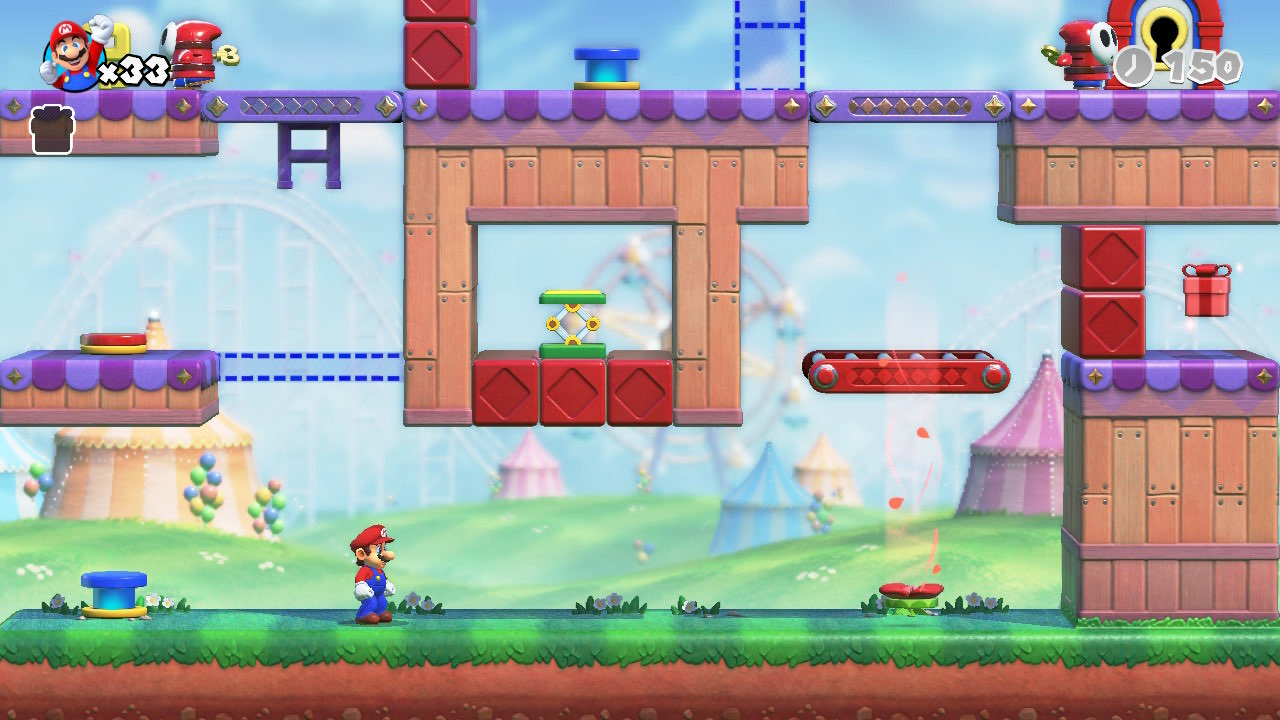
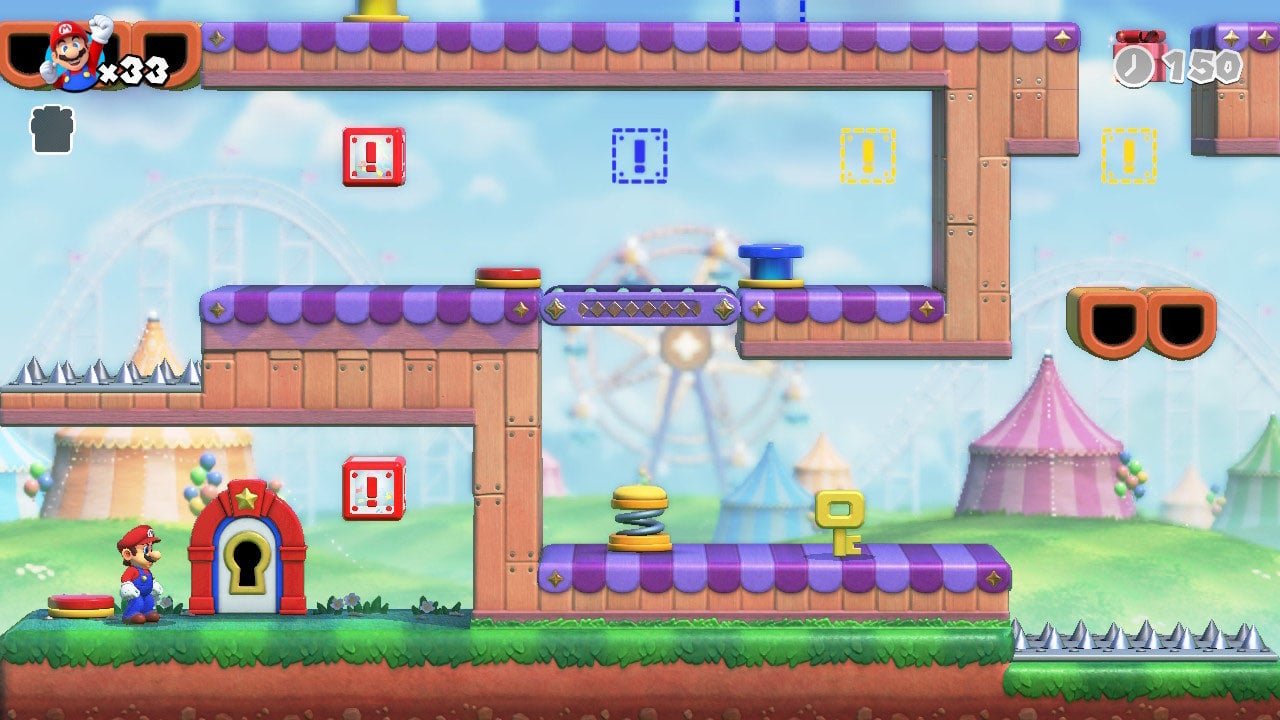
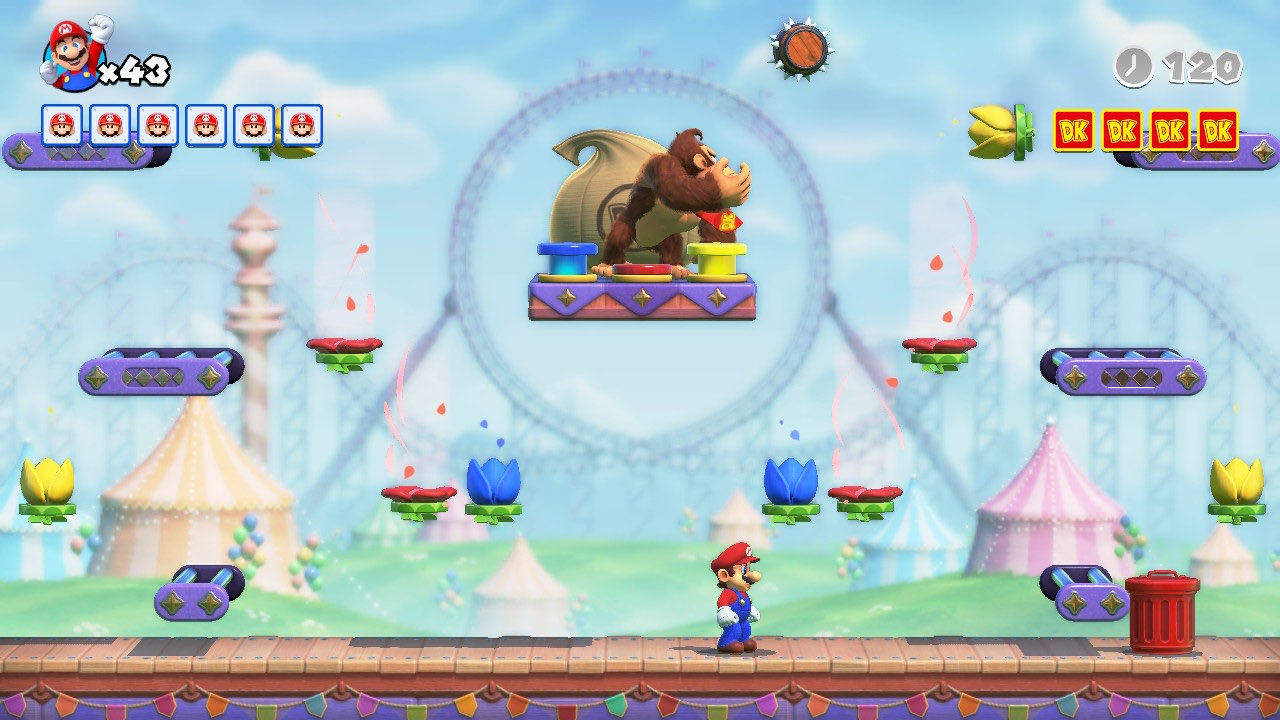
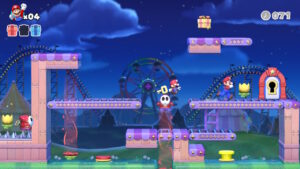
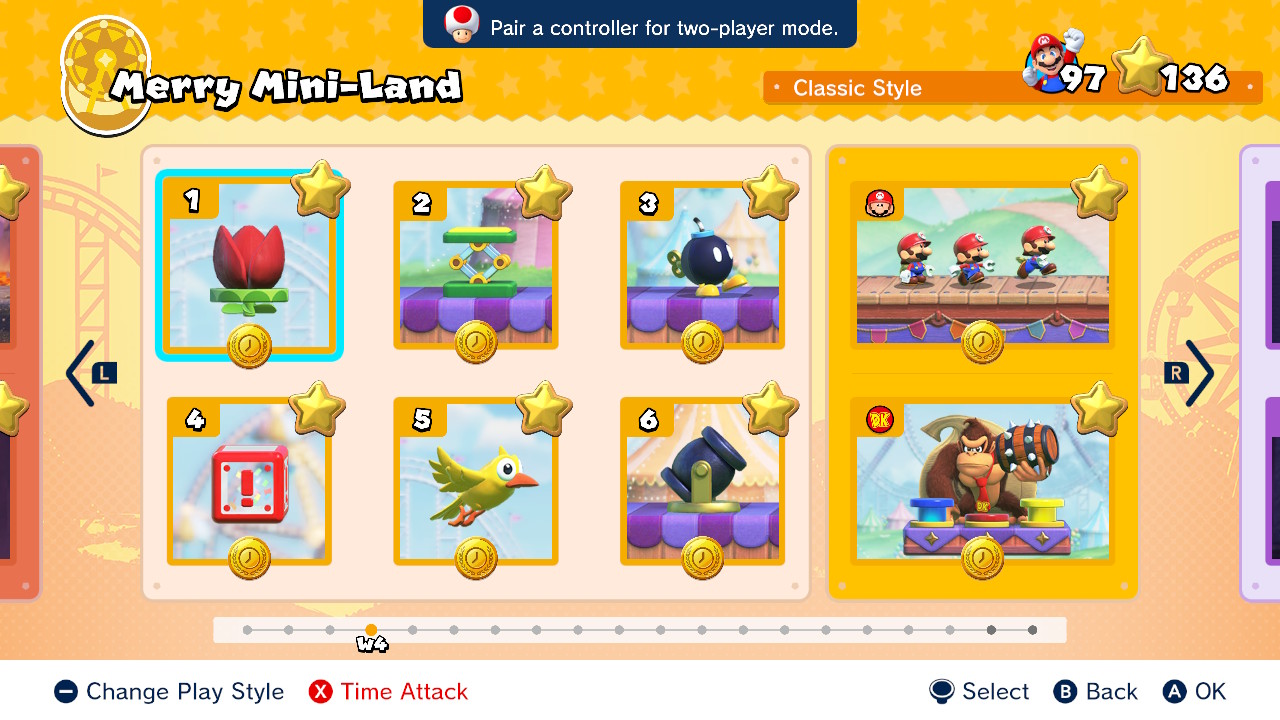
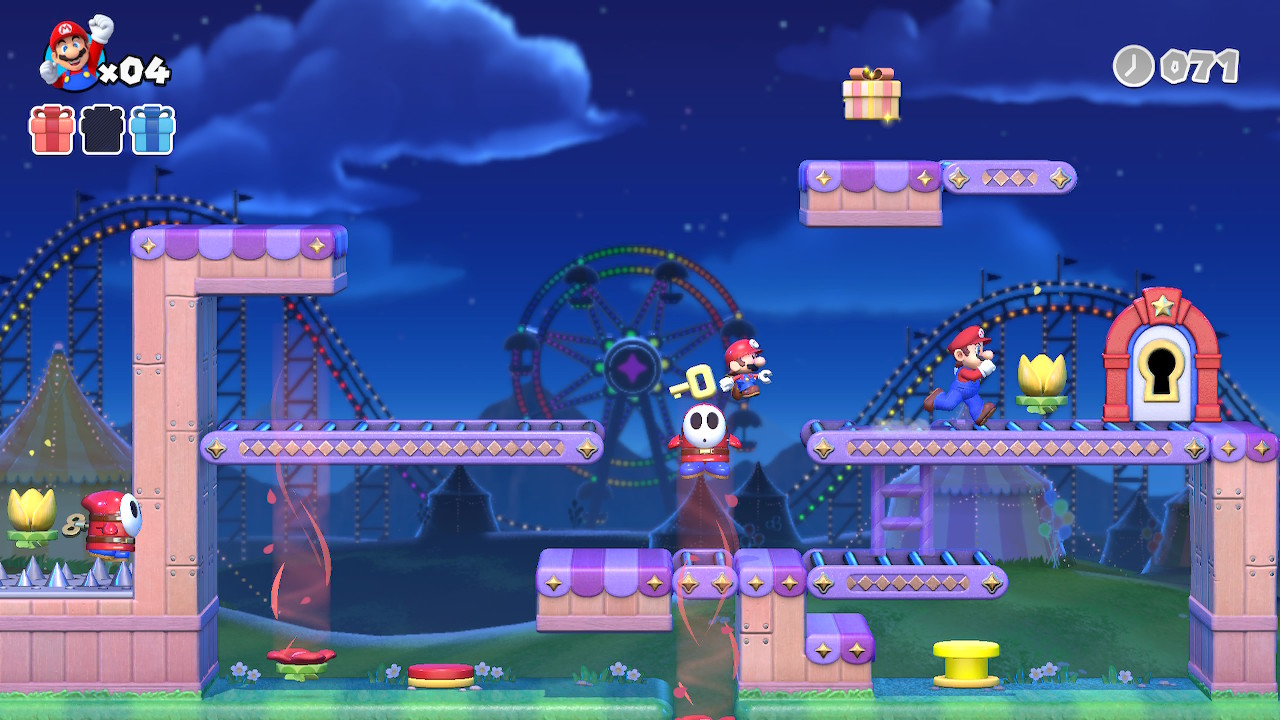
The first of the remake’s new worlds is an amusement park named after Mini-Land Mayhem!, with a skyline borrowed from that game’s Coaster Hills. It introduces Flower Fans in 4-1, carryable springs in 4-2 and Warp Boxes in 4-4. Because the worlds have been reordered, it is also where Bob-ombs, Bob-omb Blocks, Donut Blocks and cannons now first appear. In 4-DK Donkey Kong throws spiked barrels and flips the fans on and off with his own switches.
Level 4-2: springs you can carry.Level 4-4: Warp Boxes.Level 4-DK.
World 5: Spooky House
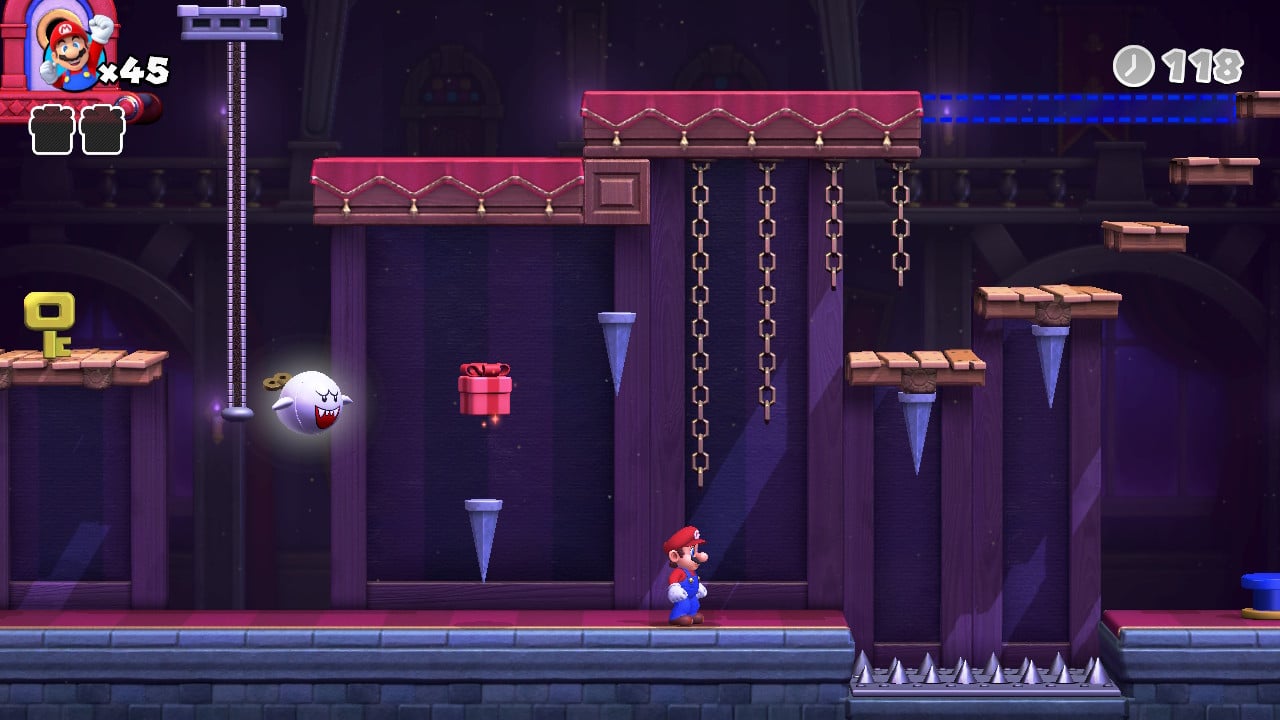
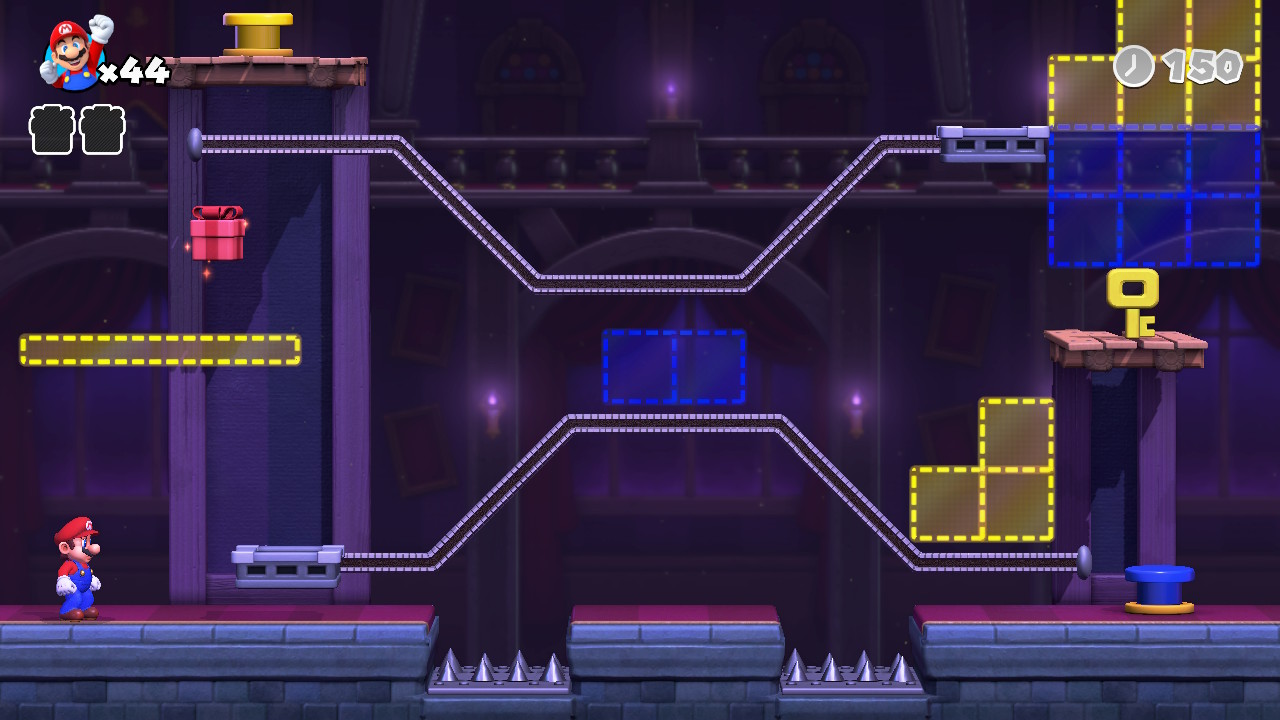
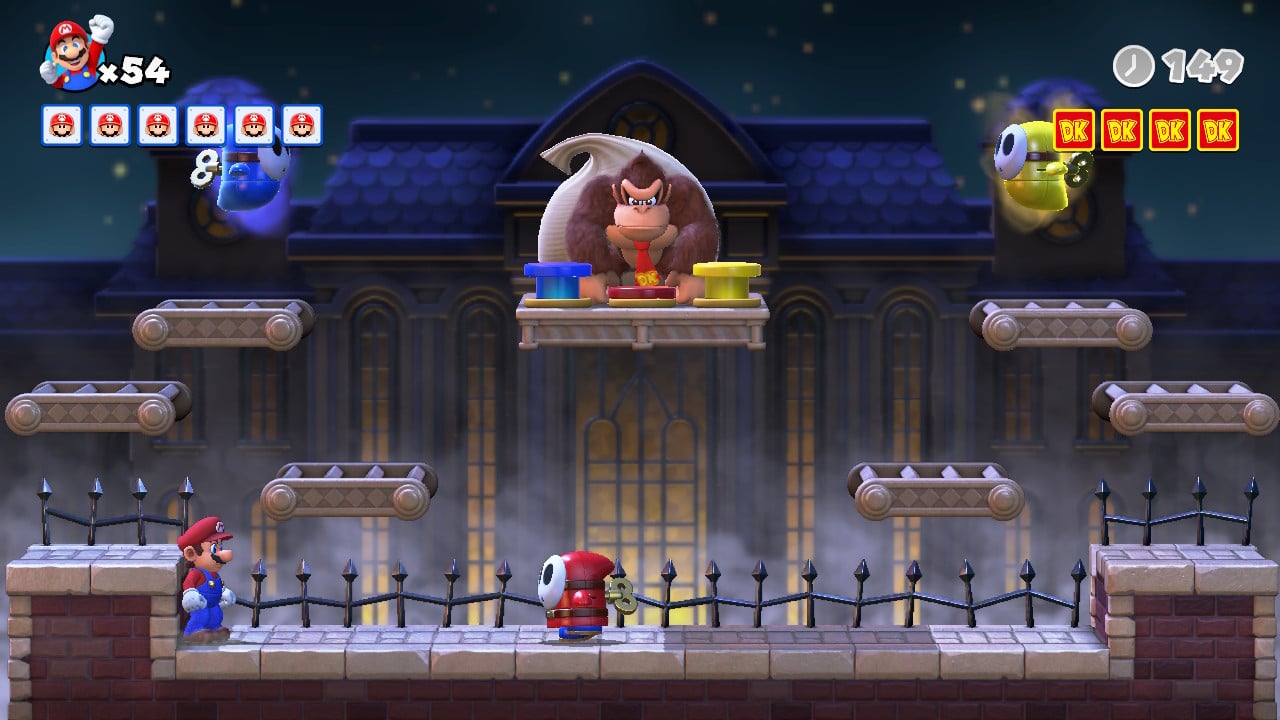
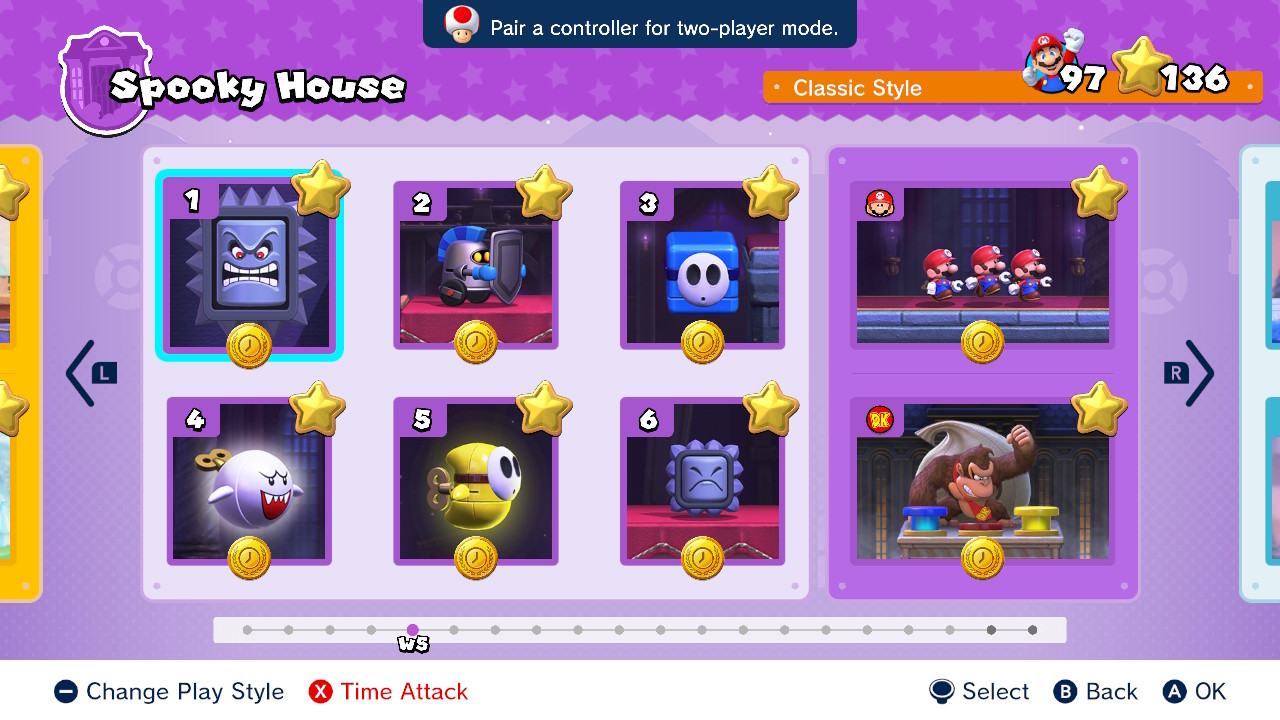
The original fourth world, renumbered. Thwomps and Thwimps (now mechanical, with sliding faces) arrive in 5-1, Polterguys in 5-3 and Boos in 5-4, and in the Donkey Kong fight Mario throws Polterguys at him.
Level 5-3: Polterguys.Level 5-DK.
World 6: Slippery Summit (new)
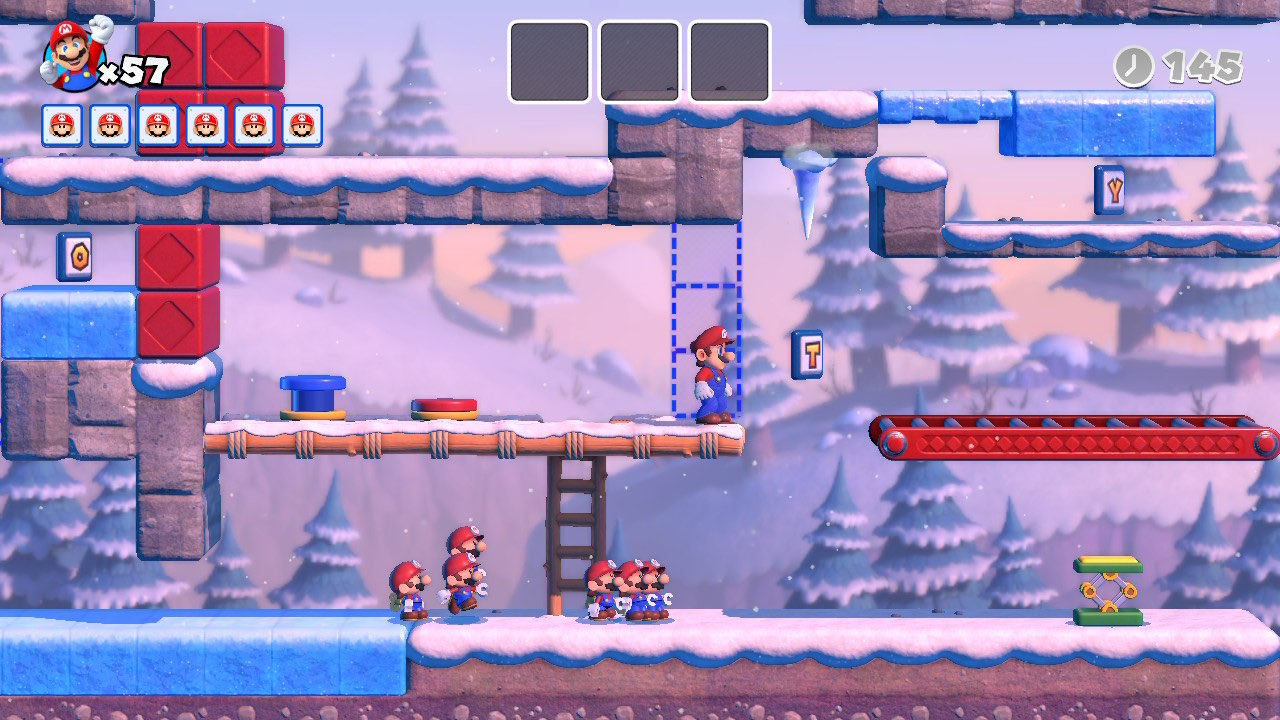
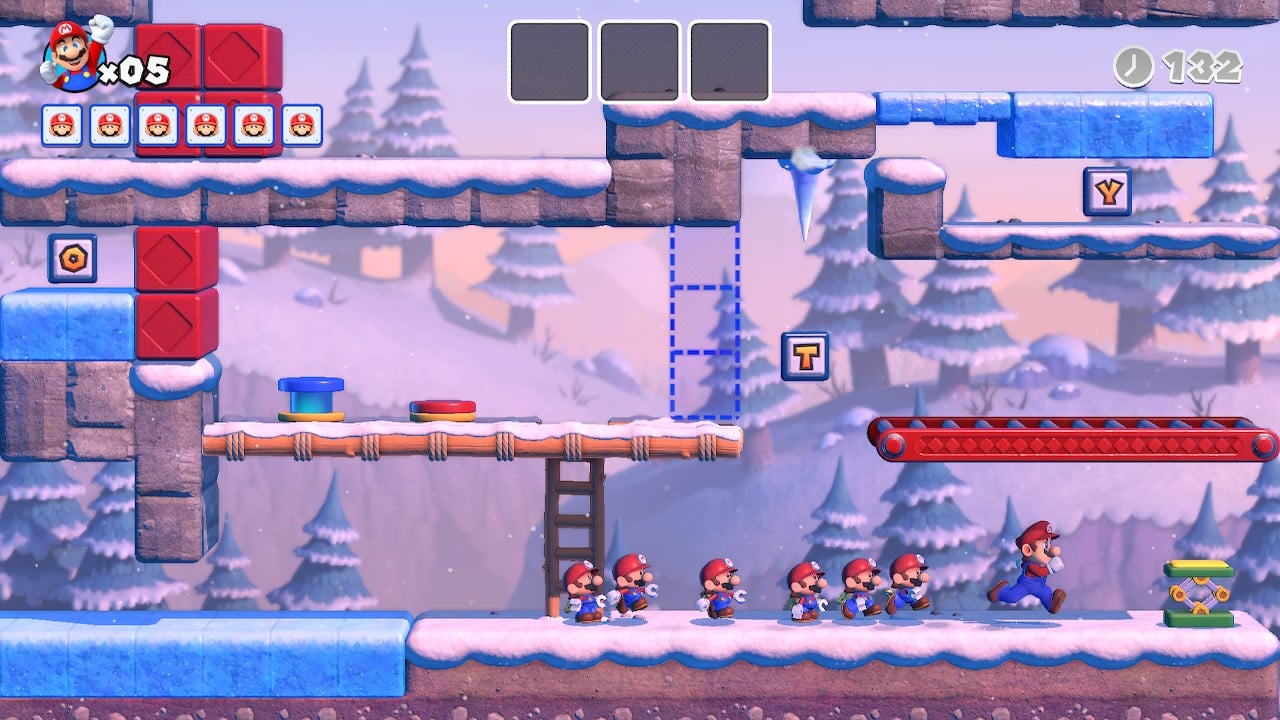
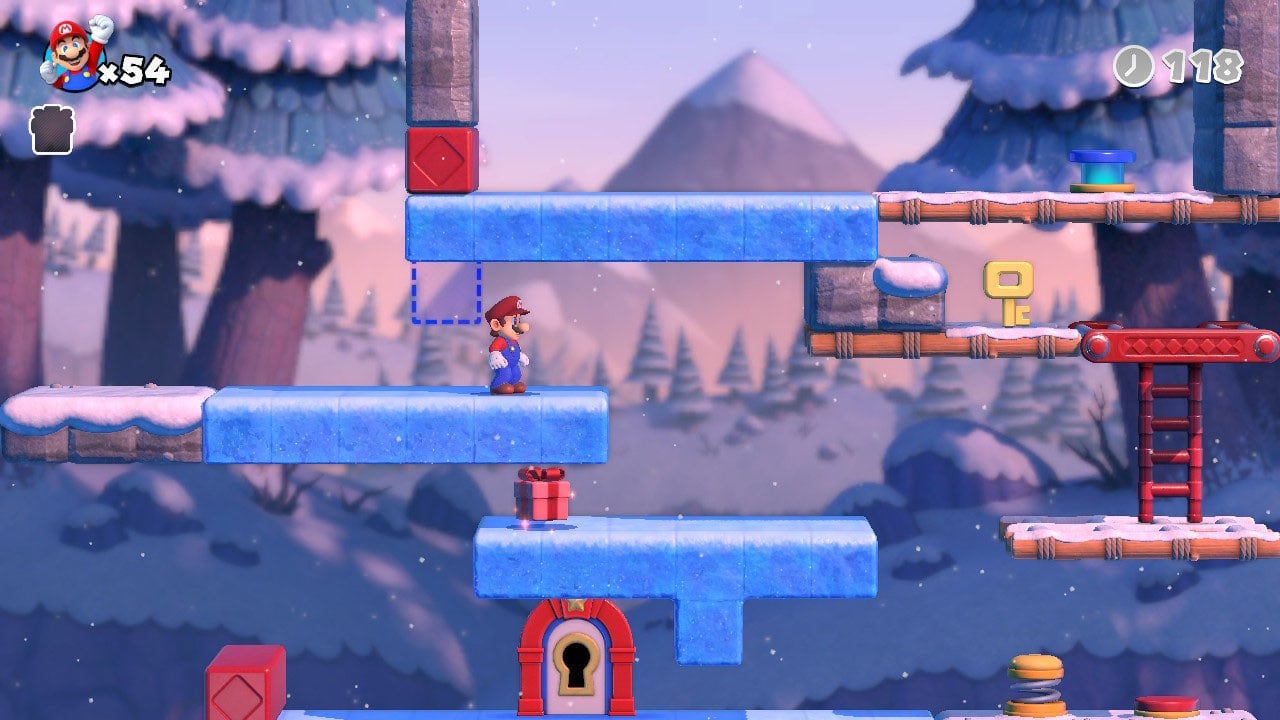
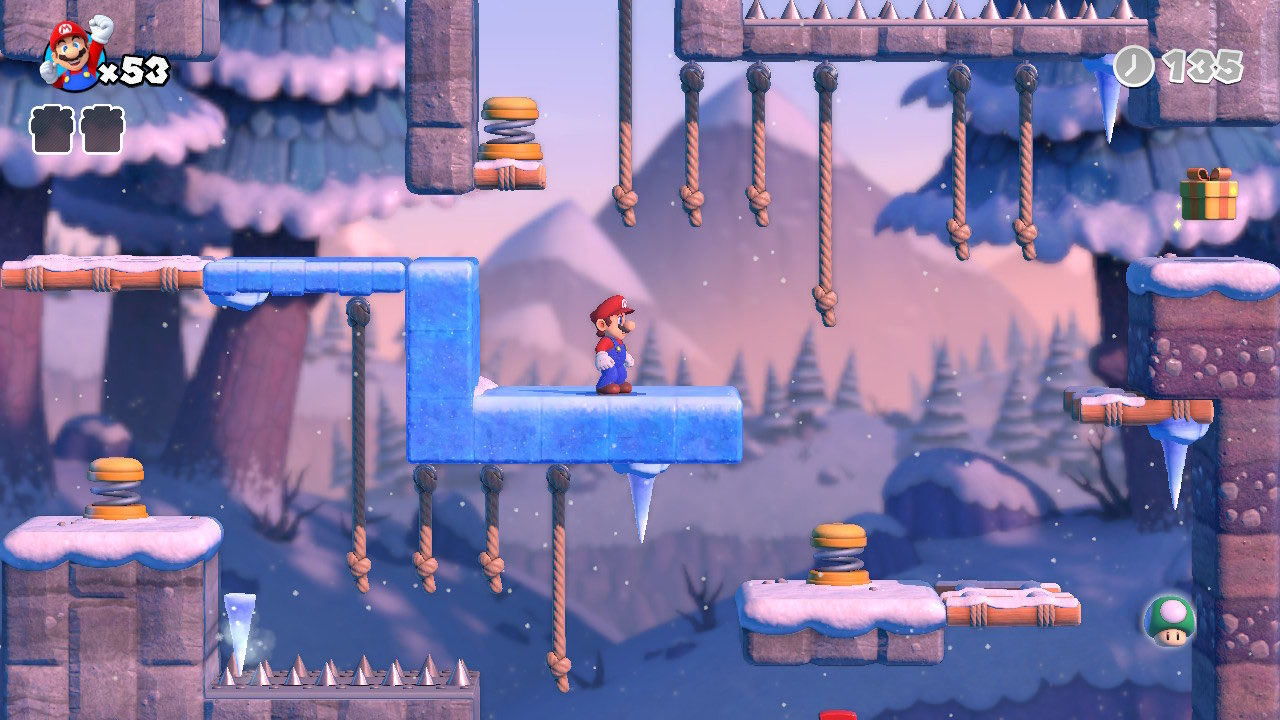
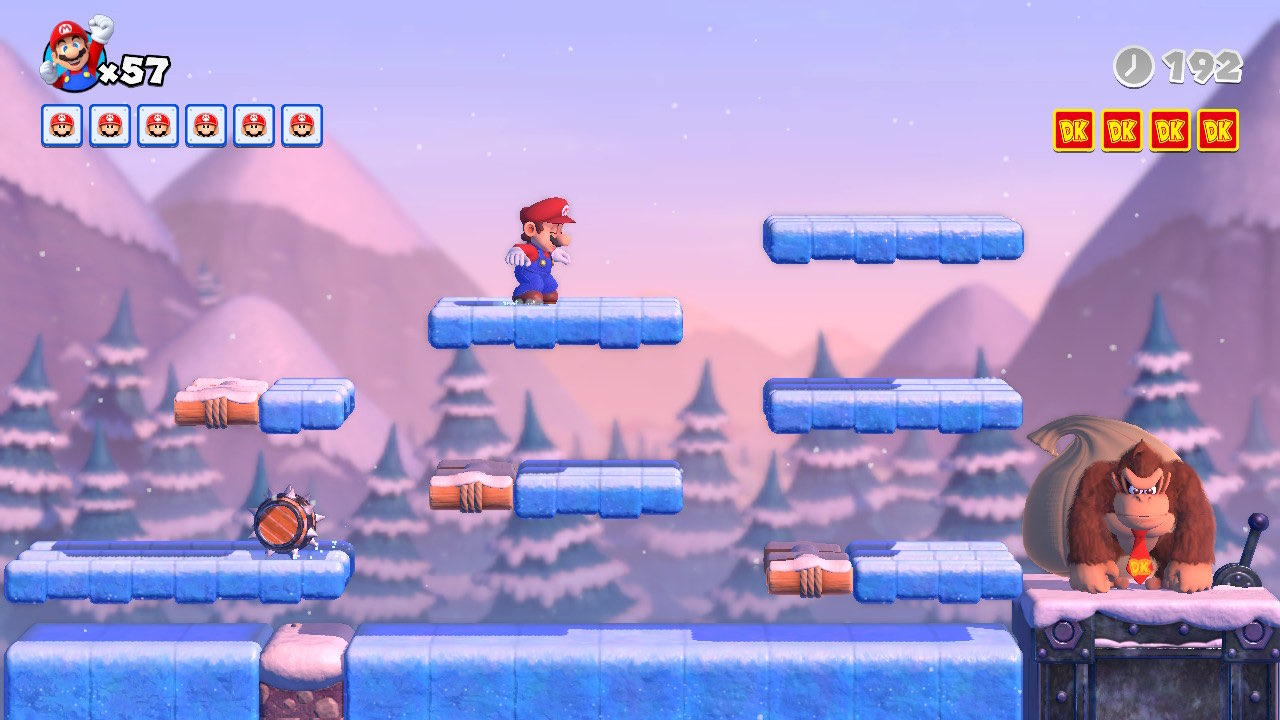
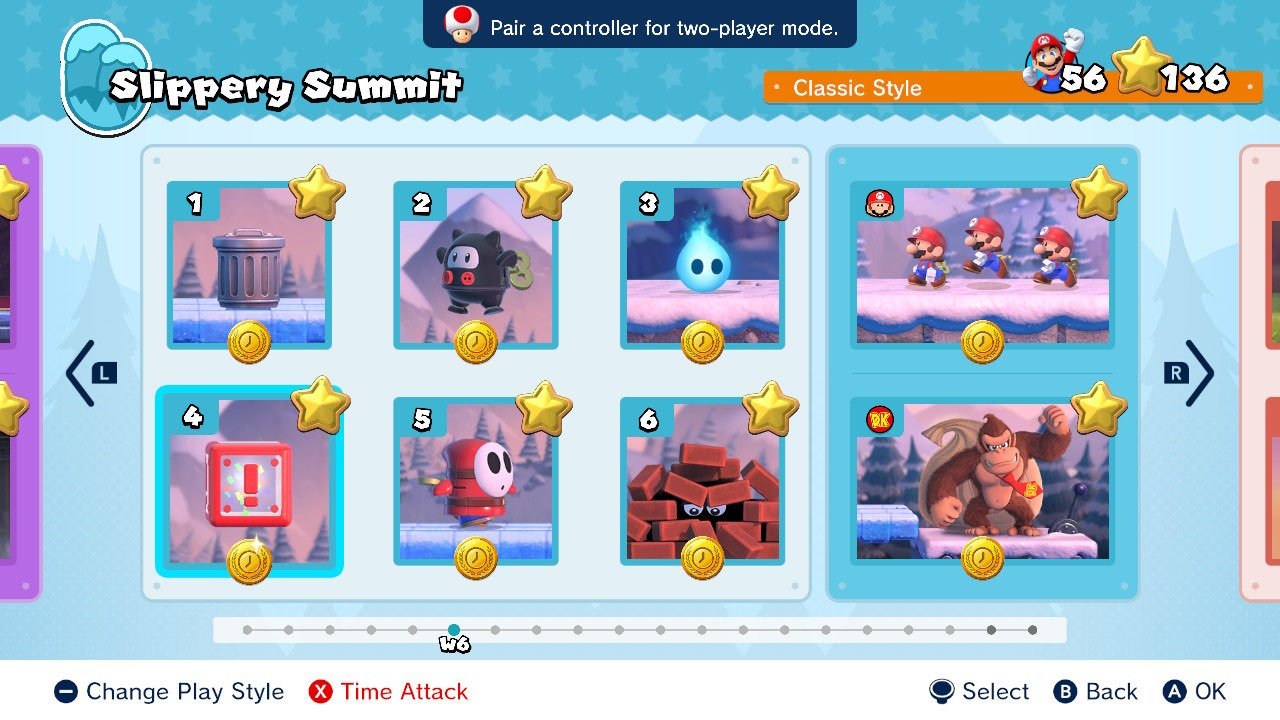
A snowy forest under the mountains, usually counted as the first snow-themed world in the series. Everything slides: Mario on the icy platforms from 6-1, and in 6-6 the items too. Icicles drop from above, and a blue, icy Fireball makes its debut in 6-3. In 6-DK Donkey Kong hurls spiked barrels and pulls a lever to raise and lower himself.
Level 6-1: the ice arrives.Level 6-3: Icicles and ropes.Level 6-DK.
Worlds 7 and 8: Mystic Forest and Twilight City
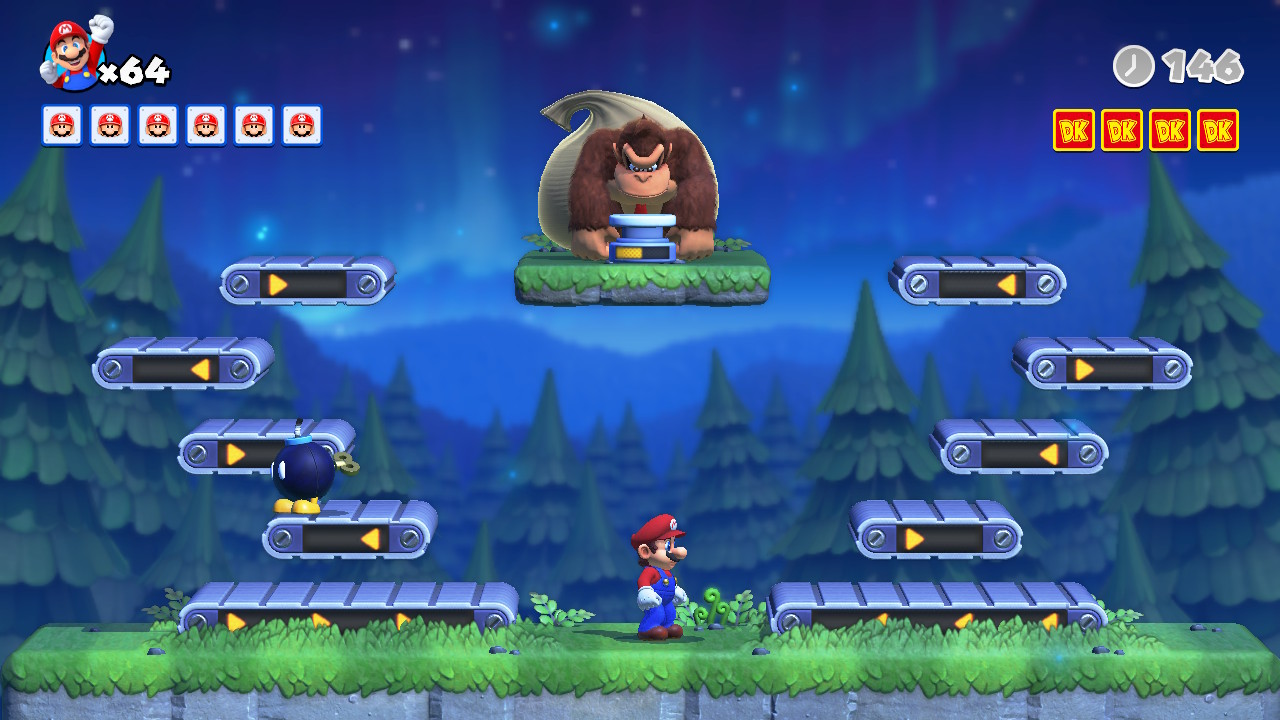
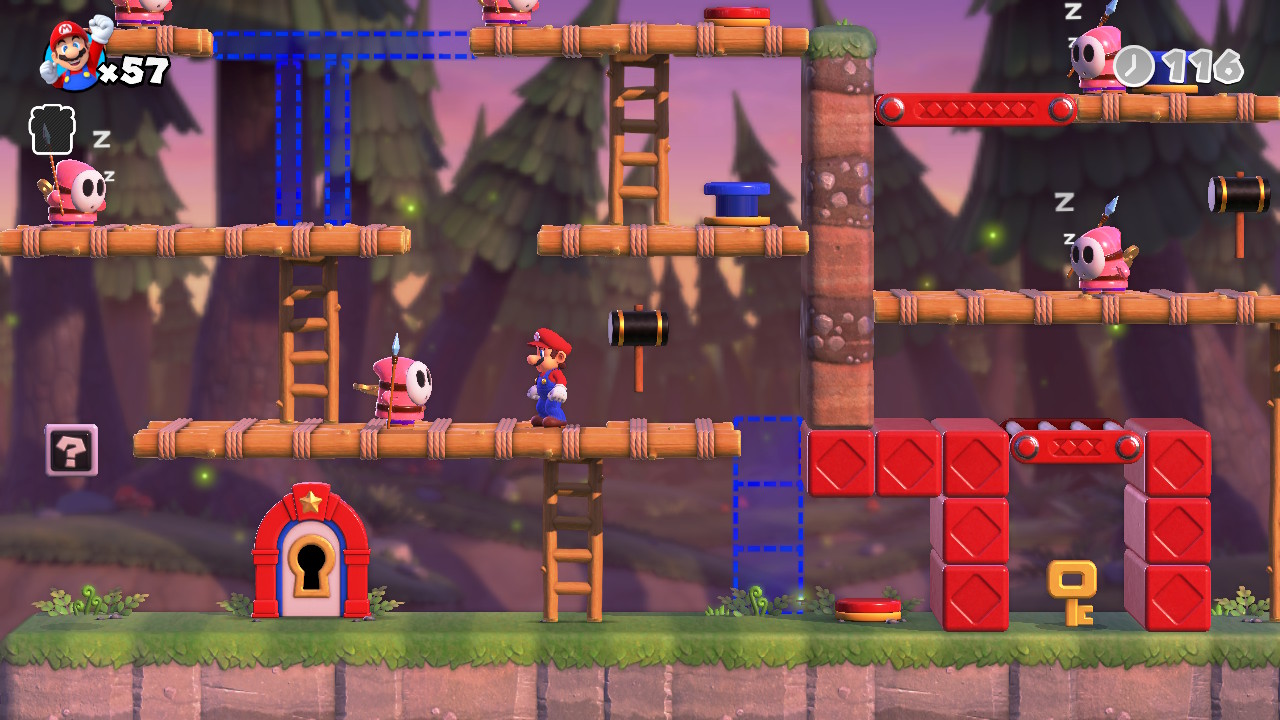
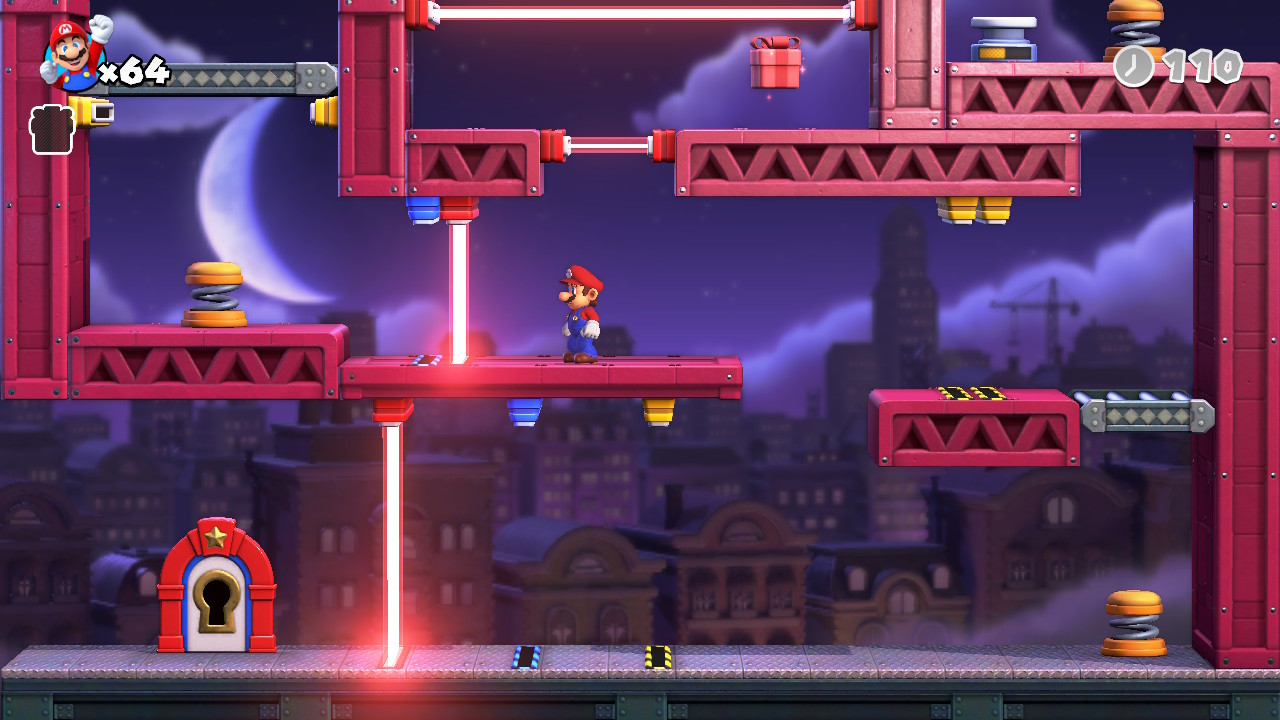
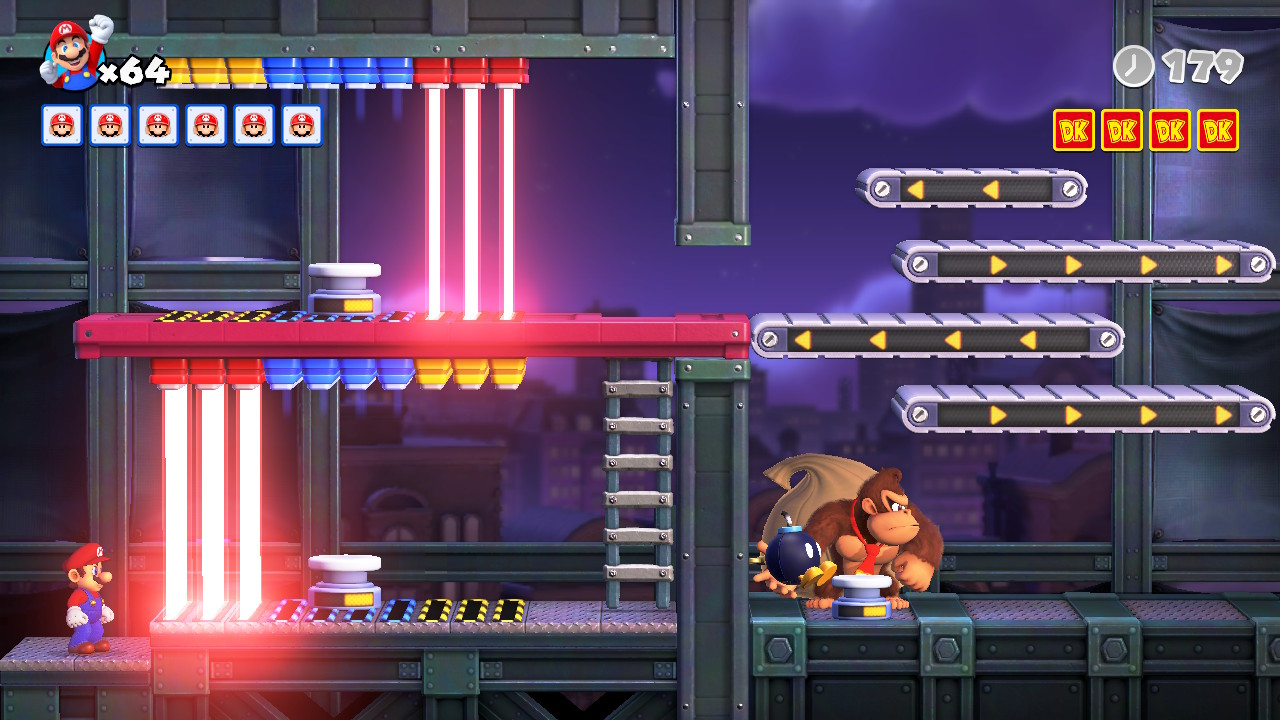
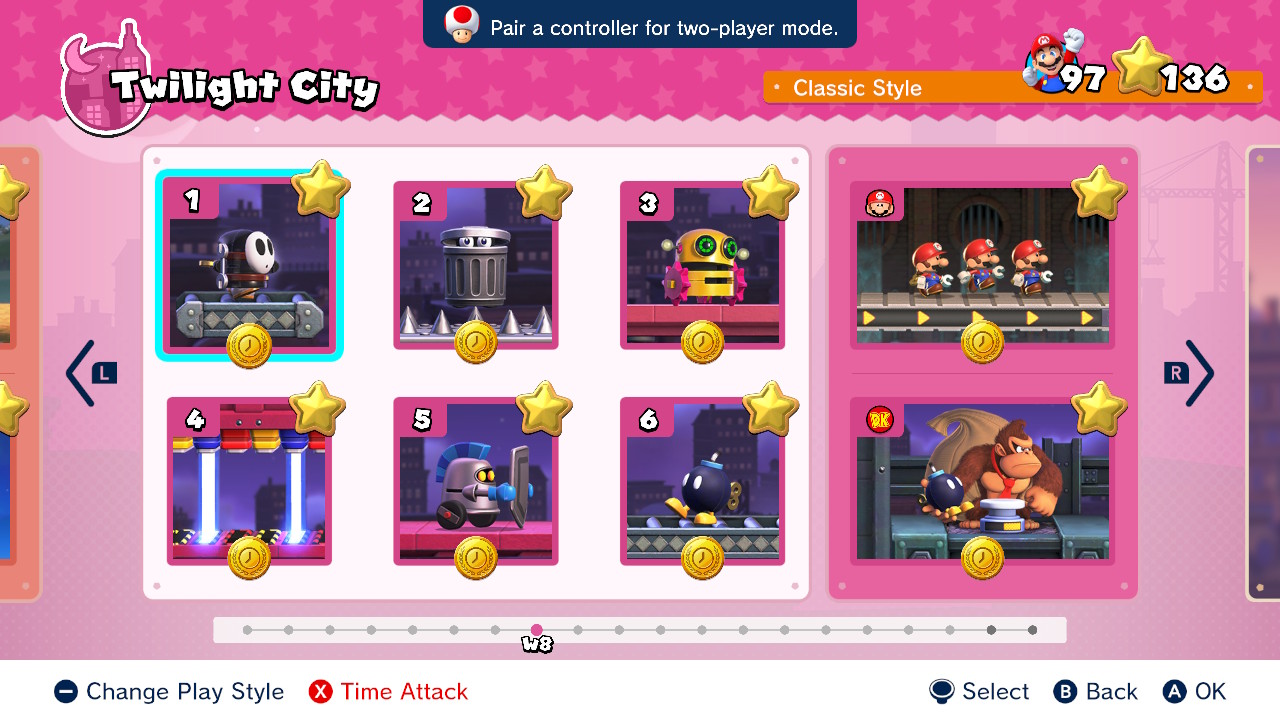
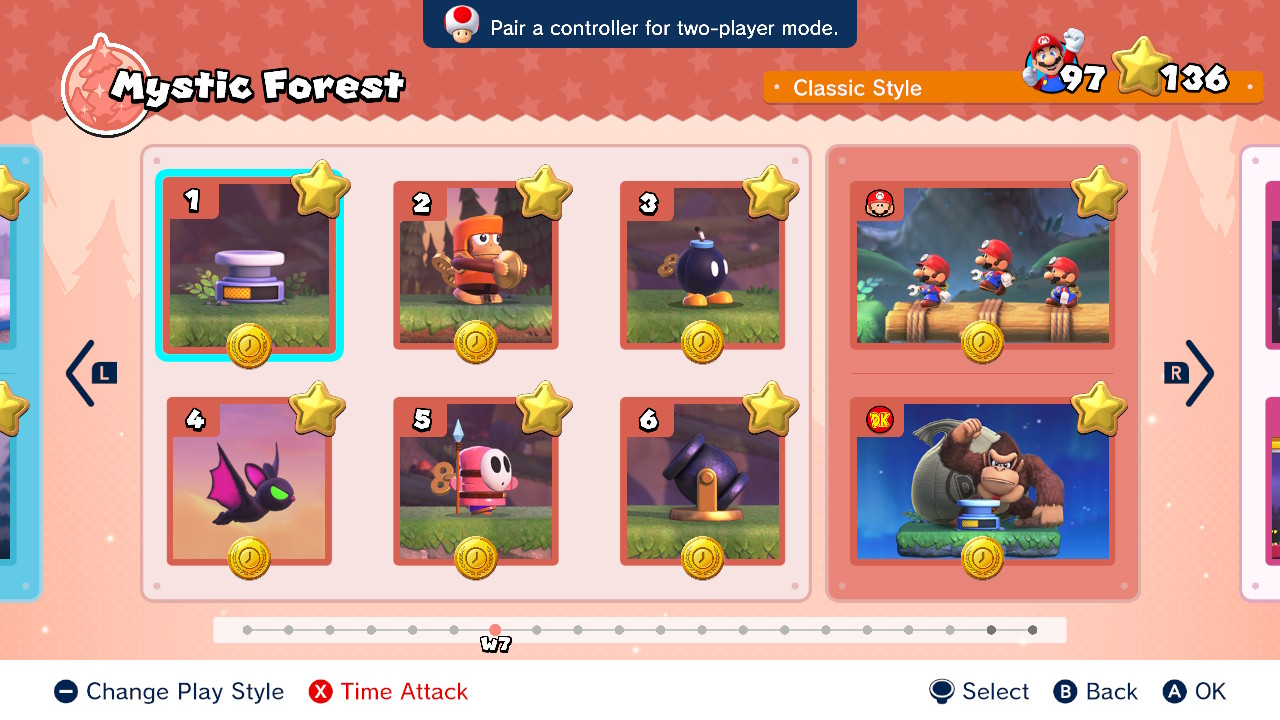
Mystic Forest, its menu now peach rather than cyan, brings Direction Switches, Spear Guys, Monchees, bats and a Bob-omb battle on reversing conveyor belts. Twilight City, once a construction site and now a city skyline with a jazzy new score, adds lasers, Wrench Shy Guys and Robo Kikkis before a fight in which Mario steers Bob-ombs down on Donkey Kong.
Level 7-2: Spear Guys and Monchees.Level 8-1: lasers and Wrench Shy Guys.Level 8-DK.
An empty sack, and vs. Donkey Kong
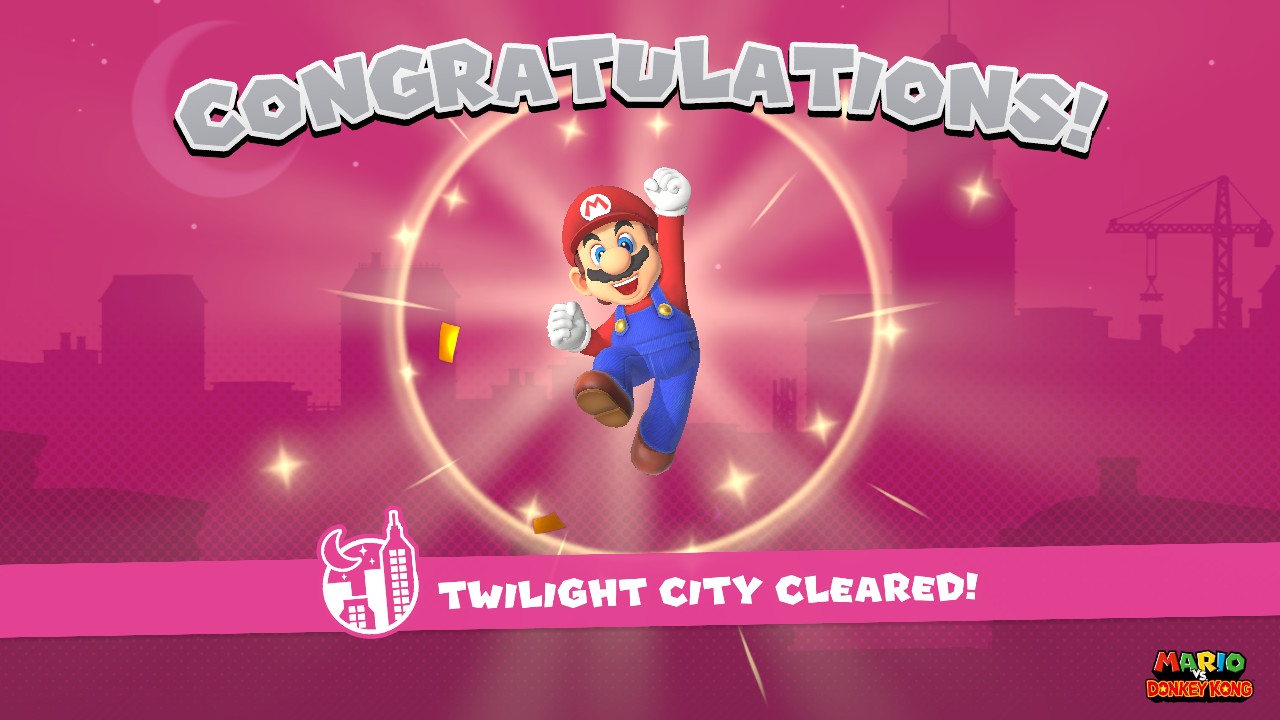
By the end of Twilight City the Minis have all fallen out of the sack. In the original everyone laughs at Donkey Kong; in the remake Mario and the Toads just look puzzled as he rummages in the empty bag. Furious, he grabs the three Toads and climbs an unfinished tower for the showdown now called vs. Donkey Kong. This time the Toads do not stamp on his fingers to send him over the edge, and they look worried when he falls, straight on to a lorry full of more Mini-Marios.
Twilight City on the world map.Twilight City cleared.
The Plus worlds and the robot
So begins the second chase, through Plus versions of all eight worlds: Merry Mini-Land Plus by night and Slippery Summit Plus in a blizzard. At the end, in vs. Donkey Kong Plus, the ape climbs into a giant robot packed with the stolen Minis. Mario wrecks it, and finds him sulking (in 2004 he sobbed). Without the old telling-off, Mario gives him a Mini-Mario of his own, and fireworks go up.
The fireworks that end the remake.Mario and the rescued Mini-Marios.
Expert and bonus levels
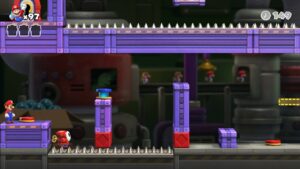
After vs. Donkey Kong, the Expert levels open in two sets of eight, EX1 and EX2. Twelve come from the original and four are new, built around Merry Mini-Land, Slippery Summit and their Plus versions; each needs a certain number of Perfect stars. The bonus levels appear as you play, one for each main world and one for each Plus world; the Expert sets have none.
Level EX-9, inside the toy factory.The Slippery Summit bonus level.
Every world in Mario vs. Donkey Kong (Switch)
Each main world has six levels (x-1 to x-6), a Mini-Mario level (x-mm) and a Donkey Kong fight (x-DK). Plus worlds have six levels and a Donkey Kong fight each. World numbers are the remake’s; the GBA numbers are given where they differ.
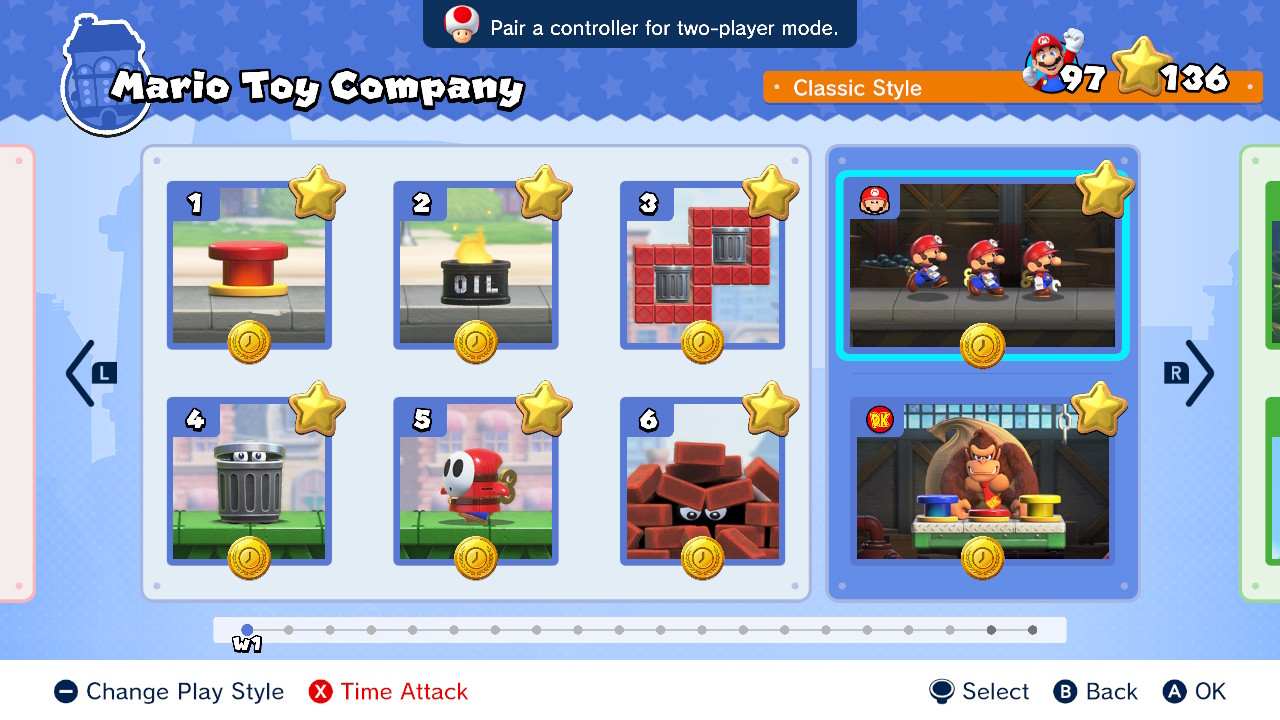
World 1: Mario Toy Company8 levels + bonus · 1-DK: debris and three Color SwitchesLadders and Hammers (1-2), Color Switches and wires (1-3), conveyors (1-4), springboards (1-5), handstands (1-6).
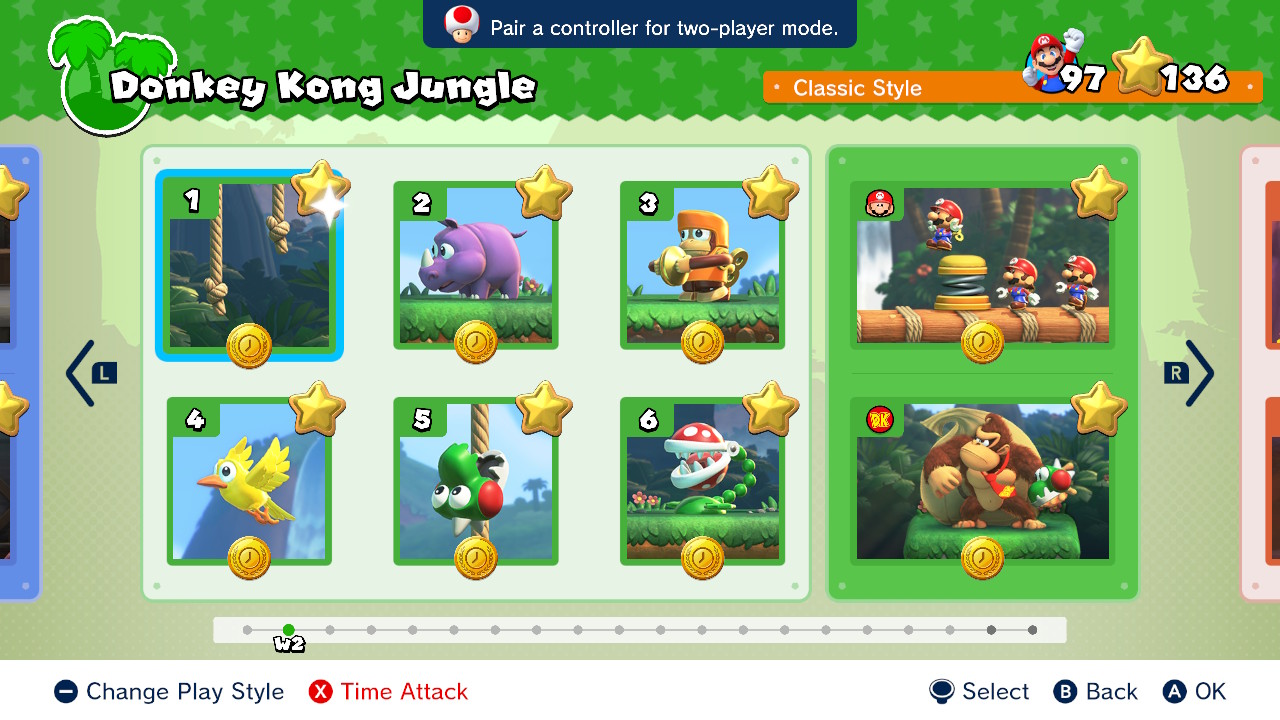
World 2: Donkey Kong Jungle8 levels + bonus · 2-DK: drop fruit on himRopes and Tane Pakkun, now mechanical Fire Piranha Plants (2-1), spikes and RamRams (2-2), Snapjaws (2-5).
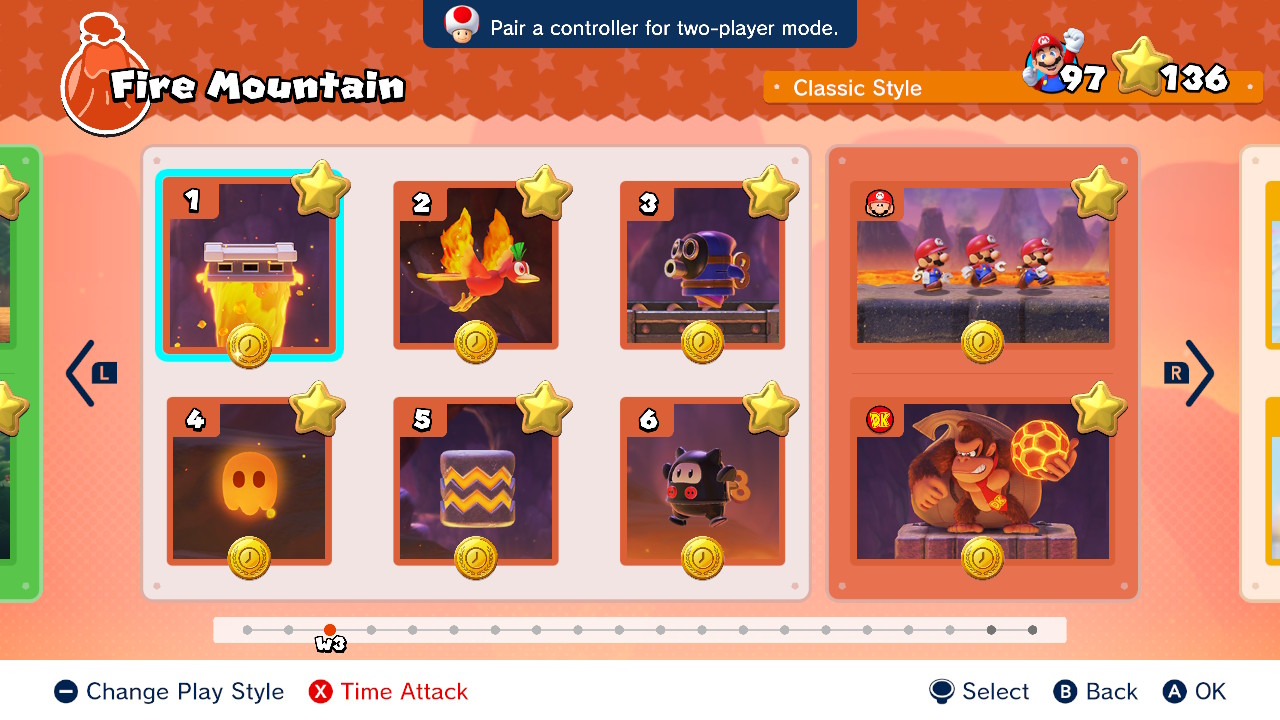
World 3: Fire Mountain8 levels + bonus · 3-DK: barrels and rocksLava geysers and Ninji (3-1), Thwomp platforms and fire birds (3-2), rising lava and Lava Bubbles (3-3), Fire Shy Guys (3-6).
World 4: Merry Mini-LandNew · 8 levels + bonus · 4-DK: spiked barrels and Flower FansFlower Fans (4-1), carryable springs (4-2), Bob-ombs and Bob-omb Blocks (4-3), Warp Boxes (4-4), cannons and birds (4-5).
World 5: Spooky HouseGBA World 4 · 8 levels + bonus · 5-DK: throw PolterguysThwomps and Thwimps (5-1), Sir Shovalots (5-2), Polterguys (5-3), Boos (5-4).
World 6: Slippery SummitNew · 8 levels + bonus · 6-DK: spiked barrels and a lift switchIce (6-1), Ninji (6-2), Icicles and icy Fireballs (6-3), Warp Boxes (6-4), Brickmen and Spike Traps (6-5).
World 7: Mystic ForestGBA World 5 · 8 levels + bonus · 7-DK: Bob-ombs and reversing conveyorsDirection Switches (7-1), Spear Guys and Monchees (7-2), Bob-ombs (7-3), bats (7-4), cannons (7-6).
World 8: Twilight CityGBA World 6 · 8 levels + bonus · 8-DK: lasers and falling Bob-ombsLasers and Wrench Shy Guys (8-1), moving platforms and wires (8-2), Robo Kikkis (8-3, 8-4), Sir Shovalots (8-5).
vs. Donkey KongRenamed from “Donkey Kong” · rooftop showdownRescue the three Toads from the top of an unfinished tower. Beating it opens the Plus worlds, Expert levels and Time Attack.
Plus worldsEight worlds · six levels and a Donkey Kong fight eachLead a key-carrying Mini-Mario to the door; Merry Mini-Land Plus is set at night and Slippery Summit Plus in a blizzard.
vs. Donkey Kong PlusFinal battleDonkey Kong’s giant robot, full of stolen Mini-Marios.
Expert levels EX1 and EX216 levels (4 new) · 8 to 128 starsThe hardest stages, unlocked with Perfect ratings once vs. Donkey Kong is beaten.
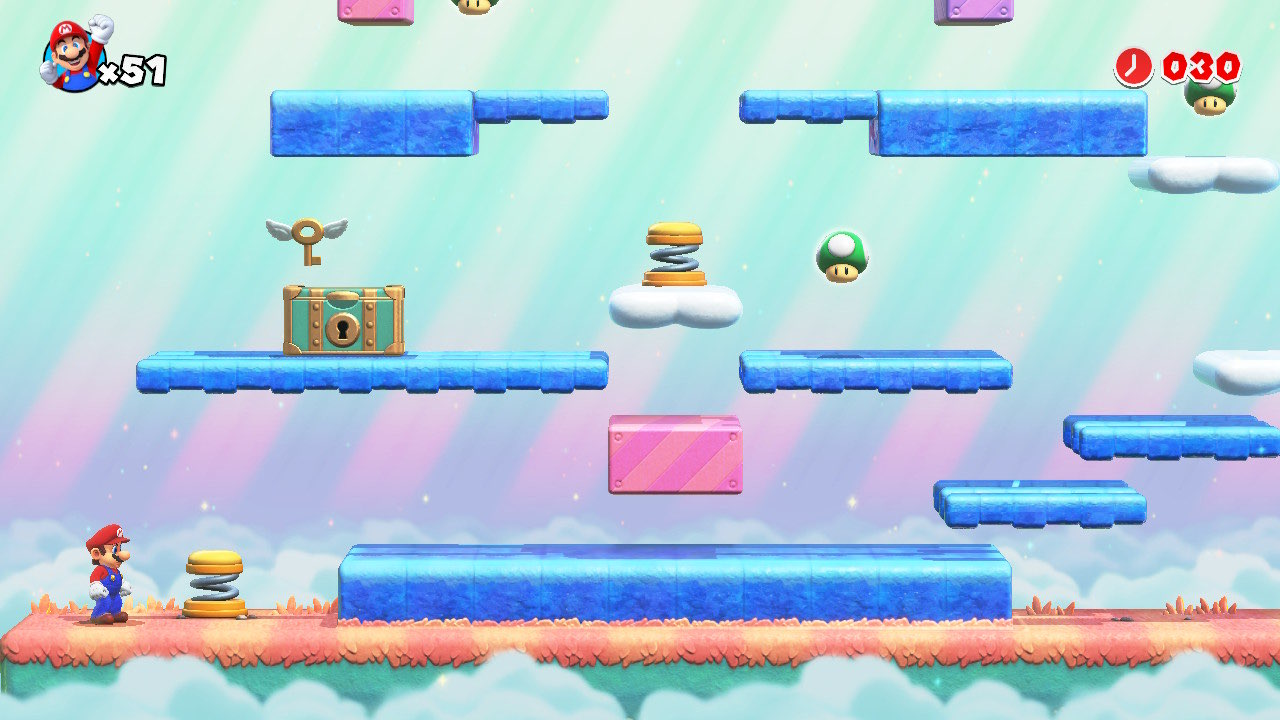
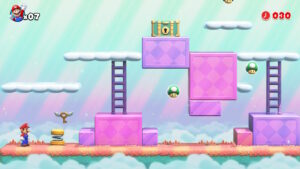
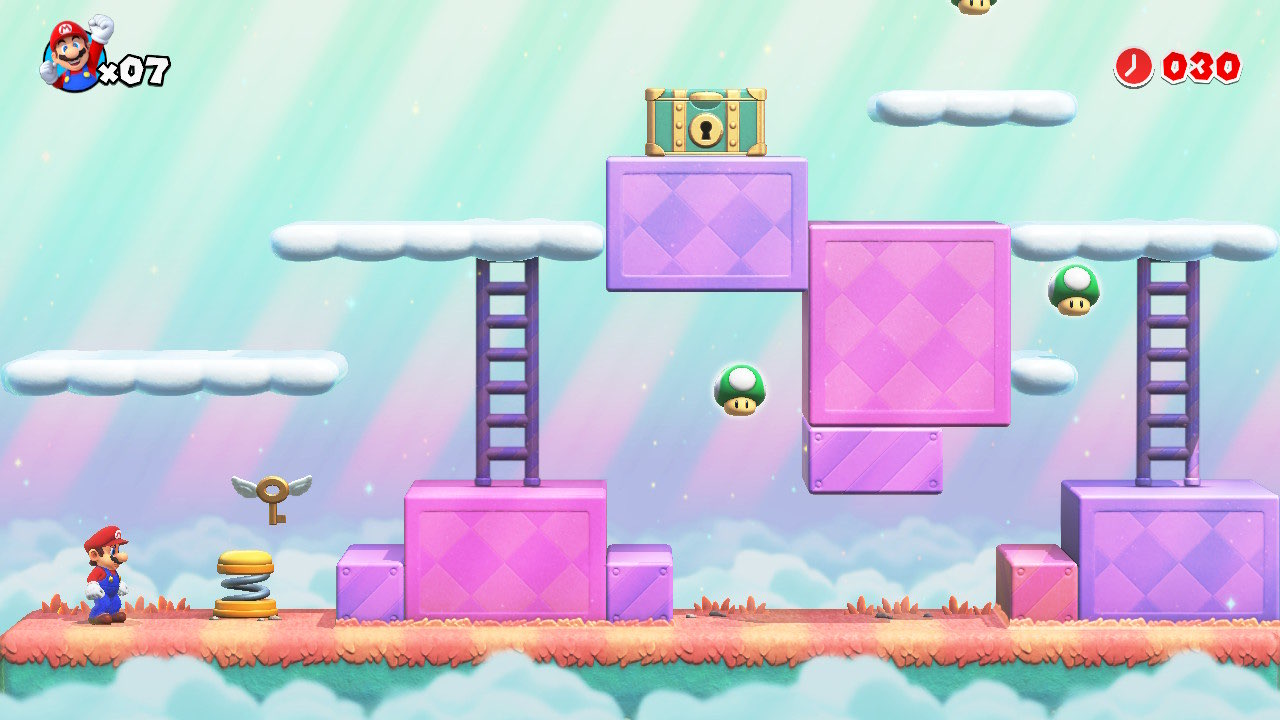
Bonus levels16, all newCatch a flying key and reach the chest before time runs out, collecting 1-Up Mushrooms on the way.
Counting them up: 64 main levels, 56 in the Plus worlds, the two vs. Donkey Kong showdowns, 16 Expert levels and 16 bonus levels make 154, comfortably over Nintendo’s “over 130”.
Advertisement
Gameplay & Controls
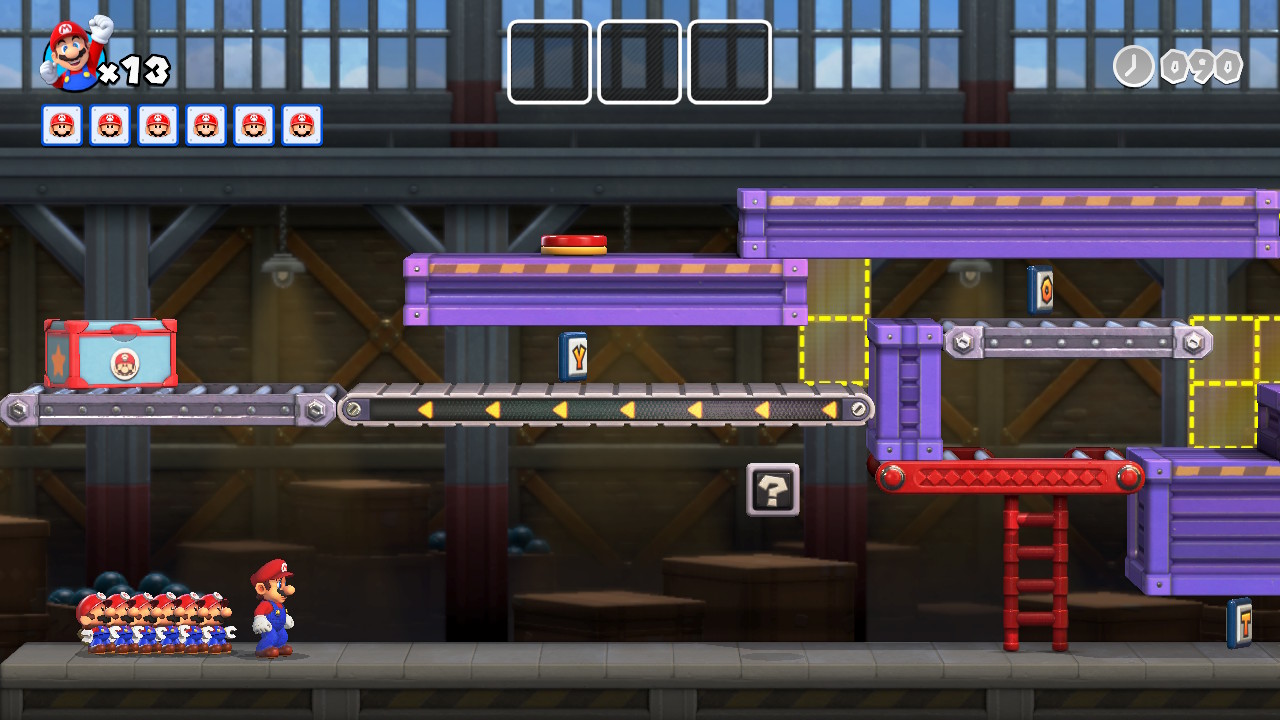
The heart of it is untouched. In each of the first six levels of a world Mario finds a key, carries it to a locked door and, in the second half, frees a Mini-Mario from a crystal ball. The seventh level has him lead six Mini-Marios to a toy box; the eighth is a fight with Donkey Kong. What follows is what the remake adds and changes; the GBA rules in full are on the original’s page.
Classic Style and Casual Style
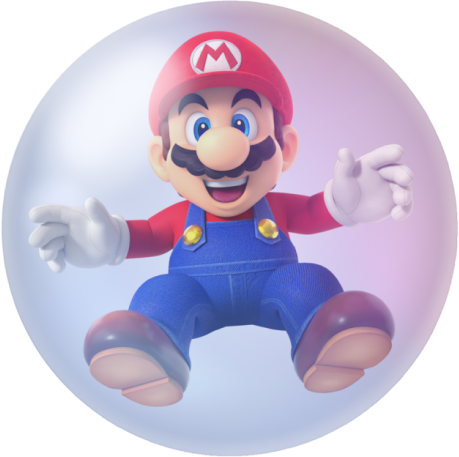
You choose a style when you start a file. Classic Style is the 2004 game: a timer on every level and one hit to lose a life. Casual Style is new. The timer becomes an infinity sign, and you start each level with five bubbles: while any remain, a mistake does not cost a life but floats Mario back, inside a bubble, to the last Checkpoint Flag he touched. Several levels gain these flags, though just one is ever active. Keys left lying around wait 15 seconds before returning to their starting point instead of 12, and some levels lose a few enemies.
Even in Classic Style the game is kinder than it was. Falls that used to kill Mario now only stun him, and falls that used to stun him do nothing. Retrying or quitting an unbeaten level no longer costs a life, and clearing the first level of a world opens all its other main levels at once.
A Checkpoint Flag, used in Casual Style.Mario in a bubble.
Two players: Mario and Toad
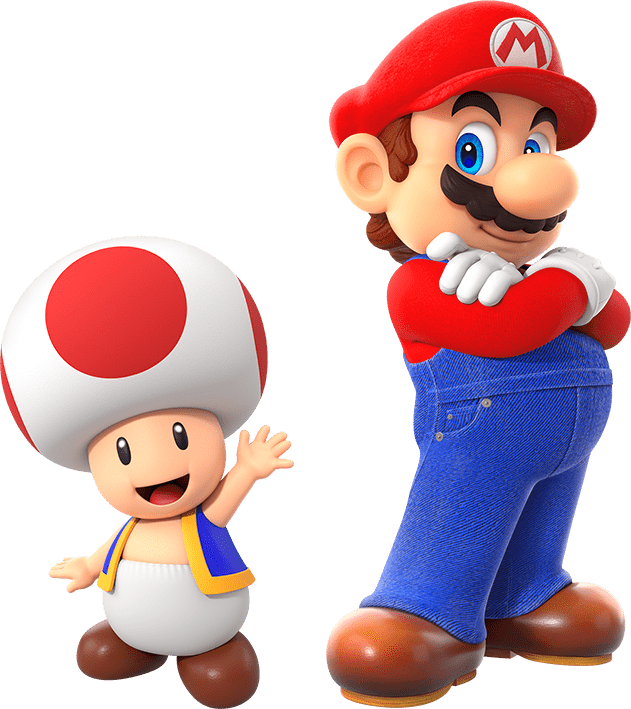
New to the remake, a friend can join in as Toad, with a Joy-Con each. Toad has Mario’s moves and two of his own: a handstand that gets him through gaps one block high and a quicker climb up ropes. Every level gains an extra objective for two, a silver flying key that must be caught before the locked door or toy box will open. If one player is knocked out, he floats back to his partner in a bubble (mash A or B to hurry it), but the life is still lost, much as in Super Mario 3D World.
The camera pulls back to keep both players in view, showing blurred borders at the level’s edges when it is fully zoomed out. Co-op is local only and is not available in Time Attack.
Mario and Toad.The silver flying key that co-op players must catch.
Time Attack, Perfect ratings and bonus levels
The points have gone. In their place each level awards a gold star for a Perfect clear: all three presents collected, all six Mini-Marios home in a Mini-Mario level, or a boss beaten without taking damage. Stars still unlock the Expert levels, now in multiples of eight, from 8 for Level EX-1 to 128 for EX-16.
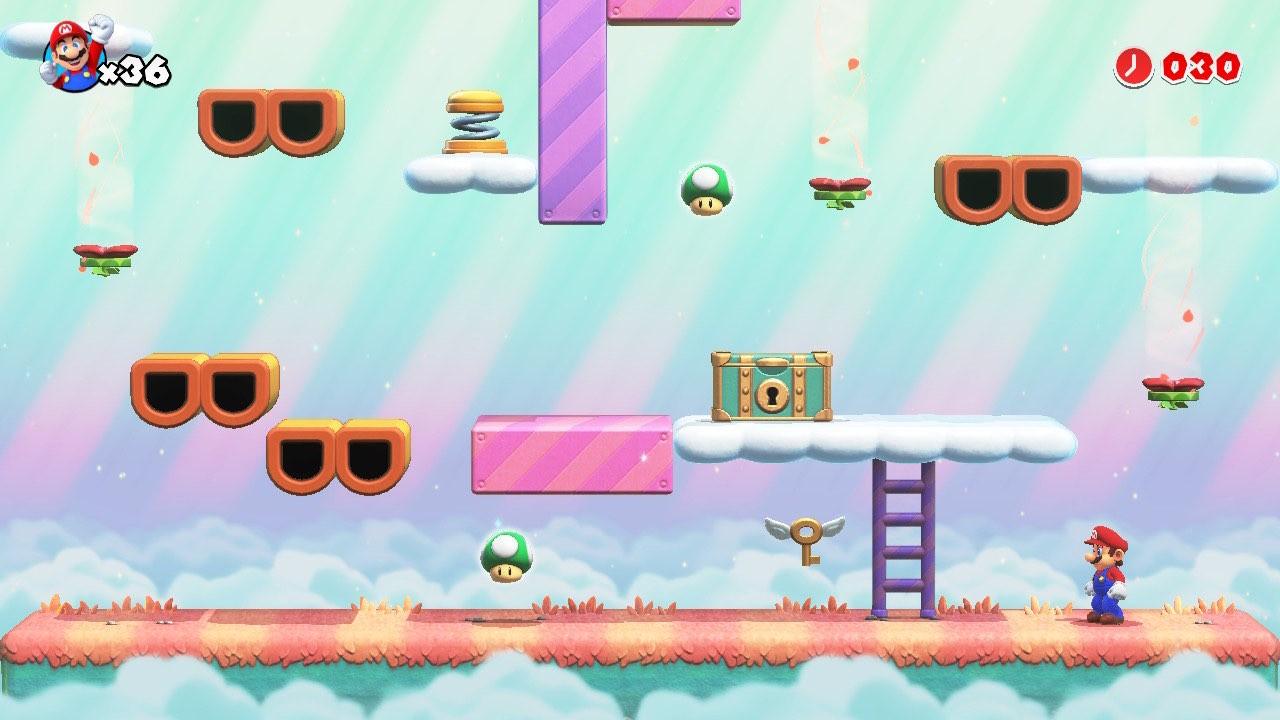
Time Attack opens after you beat vs. Donkey Kong (vs. Donkey Kong Plus for the Plus levels). Press X on the level select screen, race the target time, and a gold medal with a clock face is yours. It is not needed for 100 per cent completion. The old present minigames are replaced by sixteen bonus levels, one for each of the eight worlds and one for each Plus world (the Expert sets have none), which turn up roughly every eight levels you clear: catch a flying key and get it to a chest before time runs out for five extra lives.
The Merry Mini-Land bonus level.A flying key, the target in every bonus level.
Smaller changes
Hammers and fruit reappear after use, and Mario can now jump on birds. The toy box closes by itself once every surviving Mini-Mario is inside (standing on it early still works, but rules out a Perfect). Pressing up no longer makes Mario look up; the right stick pans the camera across bigger levels instead. The preview scenes that opened each level are gone, a few turned into Help Blocks, and some levels have been reshaped: empty spaces filled in and floating semisolid platforms merged into the terrain in Fire Mountain, Color Blocks moved in 7-3, a new wire and a moved switch in 8-5, more platforms in several Donkey Kong fights.
The biggest loss is the e-Reader. The original could load extra levels from Nintendo e-Reader cards, and none of those levels are in the remake.
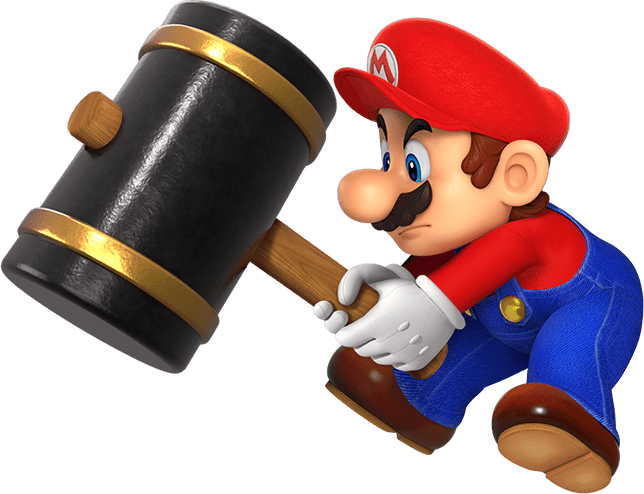
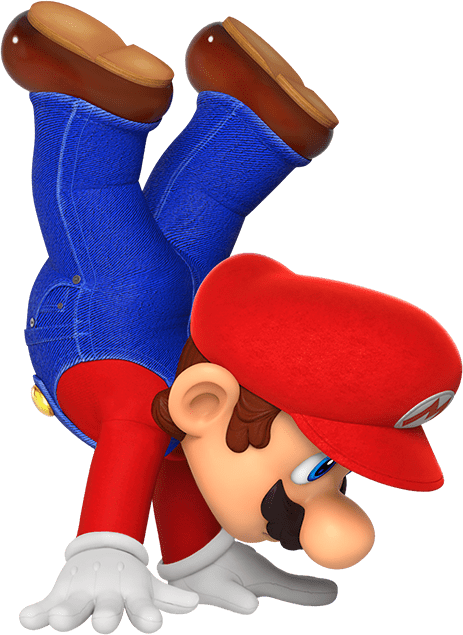
Mario with a Hammer.The handstand, which blocks things falling from above.
How the levels work
Mario’s acrobatics are those of the GBA game: handstands that shield him from falling objects, handstand jumps and double jumps, backflips, swinging from wires and climbing ropes. He picks up and throws enemies, barrels and garbage cans, and uses them as stepping stones. Three presents in every main level are the key to a Perfect.
In a Mini-Mario level he wakes six toys, which follow him in a line, and steers them past the hazards to the toy box; the Minis themselves must collect the three Letter Blocks that spell T-O-Y. In a Donkey Kong level the ape has to be hit with whatever he throws, or with something dropped on him. The Plus worlds that open after the first showdown are harder versions of all eight worlds; in the 2004 game a Mini-Mario held the key in each of them and Mario had to escort it to the door in one go.
Level 1-mm, the first Mini-Mario level.Mario carrying a key.Swinging on a wire.
Items and objects
New to the remake first, then the returning objects.
Checkpoint FlagNew. A respawn point in Casual Style; only one can be raised at a time.
Flying keyNew. Drifts around bonus levels and sticks to whoever touches it; opens the treasure chest.
Silver flying keyNew. The extra key co-op players must catch in main and Mini-Mario levels.
Warp BoxNew. A clear box that sends Mario to the box of the same colour, switched on by Color Switches.
Flower FanNew. Blows gusts that carry objects; turned on by the matching Color Switch.
Ice BlockNew. Slippery frozen terrain in Slippery Summit.
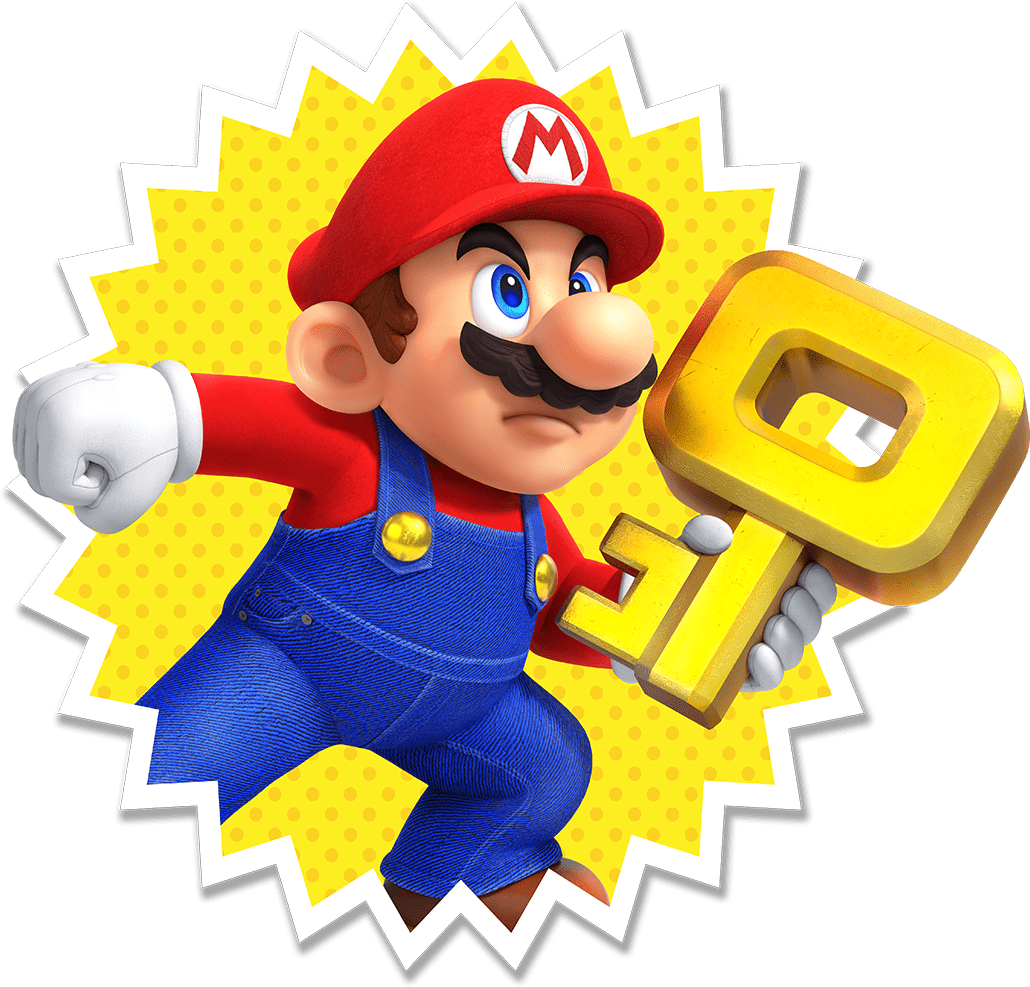
KeyFound in the first half of each main level and carried to the locked door.
PresentsRed, yellow and blue; all three are needed for a Perfect.
Letter BlocksT, O and Y in Mini-Mario levels; only the Minis can collect them.
1-Up MushroomAn extra life.
HammerKnocks out enemies; in the remake it comes back after use.
Toy boxThe goal of a Mini-Mario level, now decorated with stars.
Color SwitchRed, yellow or blue; turns matching blocks, ladders and fans on.
Color BlockSolid only while its switch is on; inactive ones now look like dotted outlines.
Direction SwitchReverses moving platforms and conveyor belts.
SpringBounces Mario up to high platforms.
TrampolineA spring that can be picked up and thrown.
Garbage CanCarry it, throw it or stand on it.
BarrelCarry it, throw it or stand on it.
Bob-omb BlockOnly a Bob-omb can break it; restyled like a cracked block from Super Mario 3D World.
Donut BlockDrops if Mario stands on it too long; now in its Super Mario 3D Land style.
Help BlockGives a hint when hit; some replace the old preview scenes.
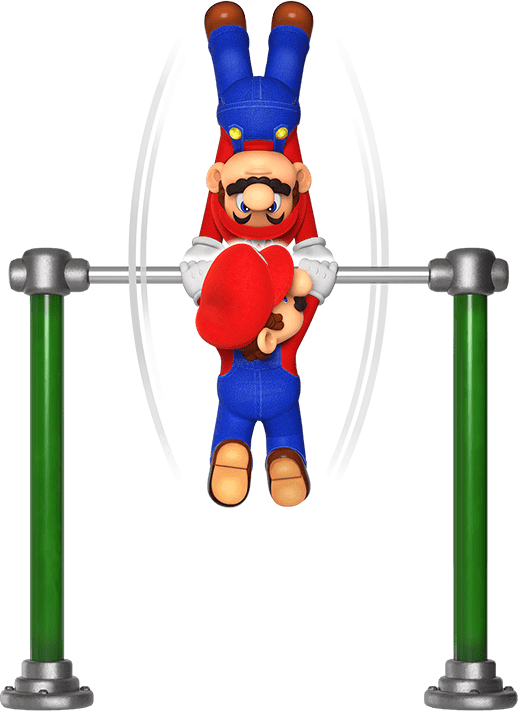
WireHang from it, travel along it and spin off it.
Cartoons, Comics & Other Media
The remake borrows from across Mario’s back catalogue.
Super Mario 3D WorldWii U · 2013The heads-up display borrows its font and style. Bob-omb Blocks look like its cracked blocks, and losing a life in co-op works the same way.
Super Mario MakerWii U · 2015Builder Toads work inside the Mario Toy Company factory.
Mario Party SuperstarsNintendo Switch · 2021Toad’s artwork for this game is reused from it.
Super Mario Maker 2Nintendo Switch · 2019The semisolid platforms resemble those of its Super Mario 3D World style, which is also often named as an influence on the remake’s look.
Dance Dance Revolution: Mario MixGameCube · 2005Mario’s official artwork strikes an updated version of the same pose.
Nintendo Switch OnlineGame Boy Advance – Nintendo Classics · 2026The 2004 original joined the service on 10 March 2026, so both versions can now be played on Switch.
Characters
A small cast, as in 2004: the hero, his rival, the toys and the factory’s Toads, one of whom now steps up as Player 2.
Character
Who they are
In this game
Abilities & notes
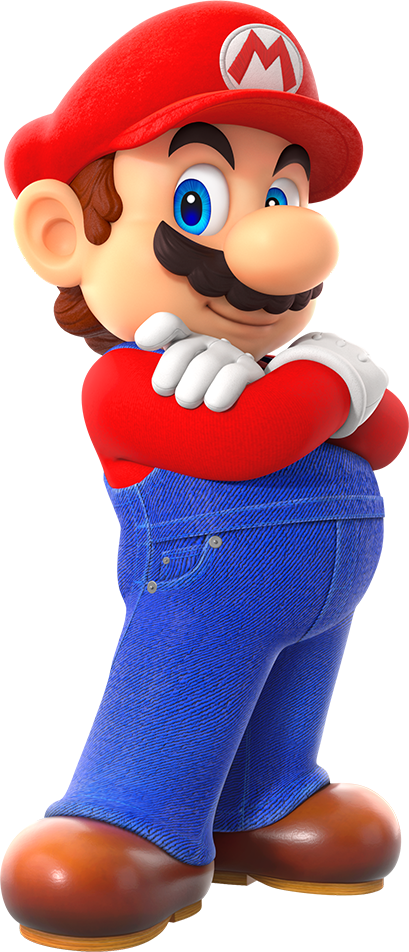
MarioToy tycoon
Founder of the Mario Toy Company and inventor of the Mini-Marios.
Chases Donkey Kong through eight worlds and their Plus versions to win back his stock.
Moves: handstand, handstand jumps, backflip, wire spin, rope climbing, lifting and throwing. Voiced with archival clips of Charles Martinet.
ToadNew: Player 2
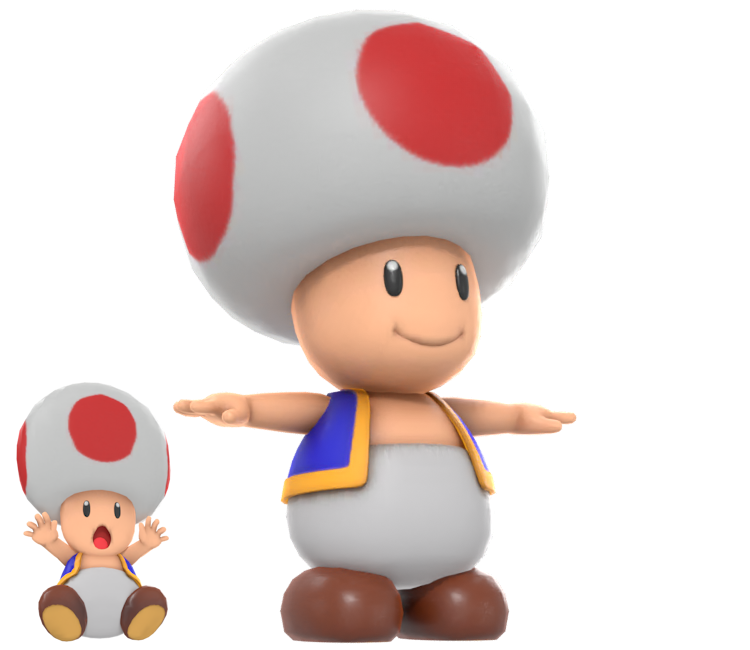
One of the Toads who run the factory, playable in this version as Player 2.
Joins Mario in two-player co-op. Three Toads also appear in the story, and are kidnapped before vs. Donkey Kong.
Mario’s moves plus a handstand through one-block gaps and faster rope climbing. Voiced by Samantha Kelly.
Donkey KongToy thief
The ape who saw an advert and could not wait.
Steals the Mini-Marios, fights Mario at the end of every world, on a rooftop, and finally in a giant robot.
Looks angrier on his last hit point. Voice clips by his regular actor, Takashi Nagasako, replacing the original game’s.
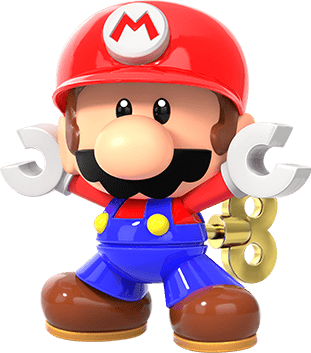
Mini-MariosThe merchandise
Wind-up Mario toys, kidnapped in crystal balls.
Freed at the end of every main level; six of them follow Mario to the toy box in each Mini-Mario level, and in the Plus worlds one carries the key.
Voiced with archival clips, some of them not heard in the original.
Enemies and obstacles
Every enemy and hazard in the remake. Many were redesigned as toys or machines; the bosses are all Donkey Kong (see the world list above).
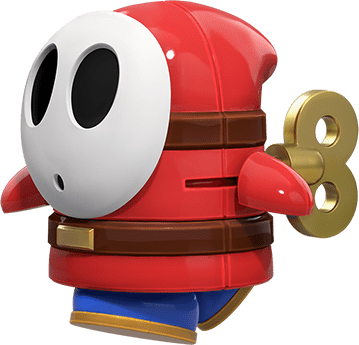
Shy GuyEnemyWind-up Shy Guys that walk the levels and can be stood on.
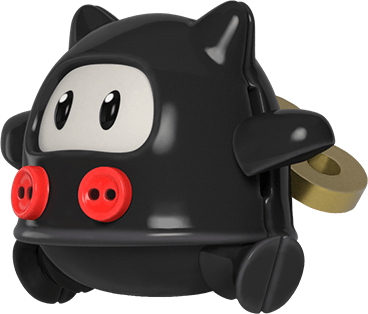
NinjiEnemyHops in place; a handy platform over spikes. Now black with red buttons.
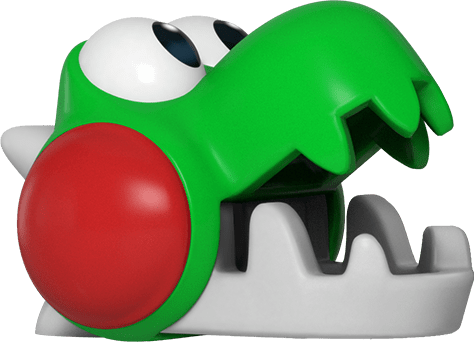
SnapjawEnemyA climbing crocodile that only falling fruit can stop.
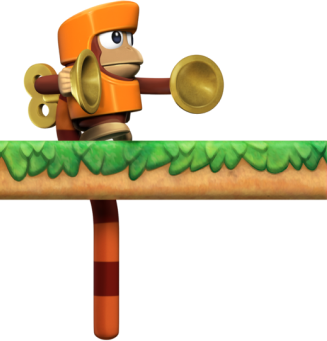
MoncheeEnemyA clockwork monkey: hang from its tail, avoid its body. Its cymbals now give off notes.
Bucket ManEnemyAn attacking garbage can, beaten with a Hammer.
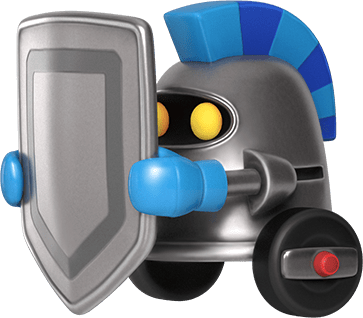
Sir ShovalotEnemyA knight who shoves Mario with his shield, now silver.
PolterguyEnemyA ghostly Shy Guy that turns into a block when a Color Switch is pressed.
BooEnemyChases when you look away; now a toy with a sliding face.
BatEnemySwoops across stages and knocks players off ropes.
BirdEnemyDrops eggs; a handstand keeps Mario safe. Can now be jumped on.
Fire birdEnemyDrops burning eggs.
Bob-ombEnemyExplodes soon after Mario comes near; carry it to blow up other things.
BrickmanEnemyHides in a brick pile and throws rows of bricks. Its bricks now act as eyebrows.
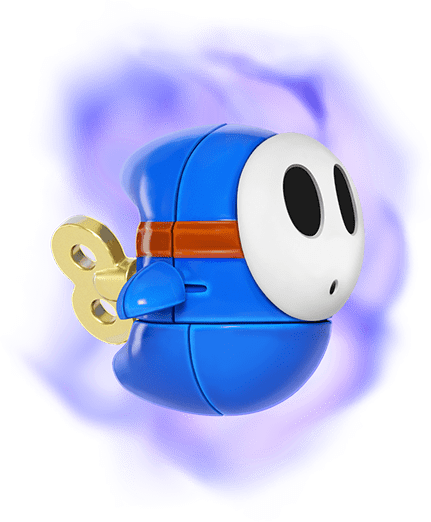
Fire Shy GuyEnemyBreathes fire through its mask; now styled like a blue Snifit.
Wrench Shy GuyEnemyThrows spanners straight at Mario.
FireballEnemySlides along platforms; the blue Slippery Summit kind freezes Mario.
Lava BubbleEnemyLeaps out of lava.
RamRamEnemyCharges at Mario; can be thrown on to spikes to make a platform.
Robo KikkiEnemyA robot that works like a Monchee.
Spear GuyEnemySleeps until Mario is close, then gives chase.
Tane PakkunEnemySpits fireballs; now a mechanical Fire Piranha Plant.
ThwompEnemyFalls when Mario approaches; now mechanical.
ThwimpEnemyA small hopping crusher.
SparkObstacleRuns along wires and shocks Mario.
SpikesObstacleFatal on contact.
Falling spikeObstacleDrops from the ceiling; once stuck, it is a temporary platform.
IcicleObstacleSlippery Summit’s version of the falling spike.
CandleObstacleMoves up and down and burns; a Hammer puts it out.
OilObstacleA burning hazard that a Hammer deals with.
CannonObstacleTilts up and down and fires cannonballs.
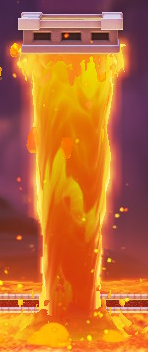
Lava GeyserObstacleErupts and lifts platforms higher.
Thwomp PlatformObstacleA stone block that rises when stood on.
Spiked BarrelObstacleThrown by Donkey Kong in several fights.
Bird NestObstacleKeeps producing birds.
Key staff and voices
From the game’s staff credits.
Nintendo Software TechnologyDeveloperThe studio that made the 2004 original and its sequels.
Vivek MelwaniDirectorPreviously worked on Super Mario 3D World + Bowser’s Fury.
Lawrence SchwedlerMusic directorComposer of the original, who had left NST for the DigiPen Institute of Technology around 2012; he adapted his own music, recorded with DigiPen’s music department in 2023, and again narrates the Bananas advert.
James PhillipsenAudio leadIn the series’ sound team since the 2004 game.
Samantha KellyToadVoices Toad and most of the other Toads.
Charles MartinetMario (archival)No longer Mario’s voice by 2024; earlier recordings of his are reused.
Advertisement
How It Was Made
Nintendo has said little about how the remake was made. These are the facts on record.
Back to Redmond
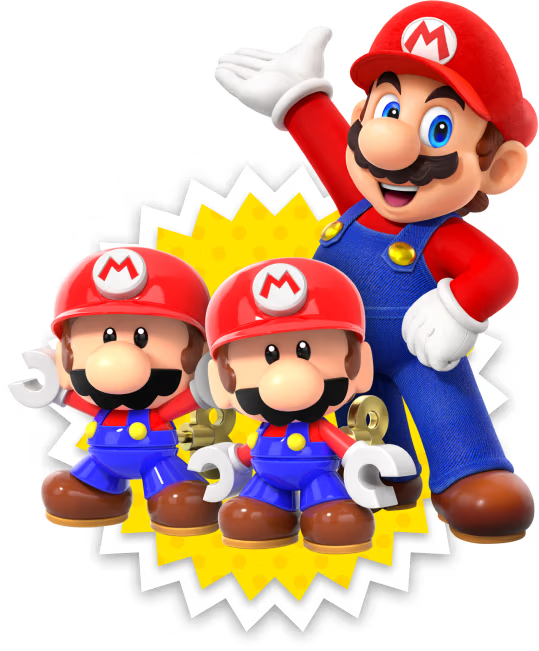
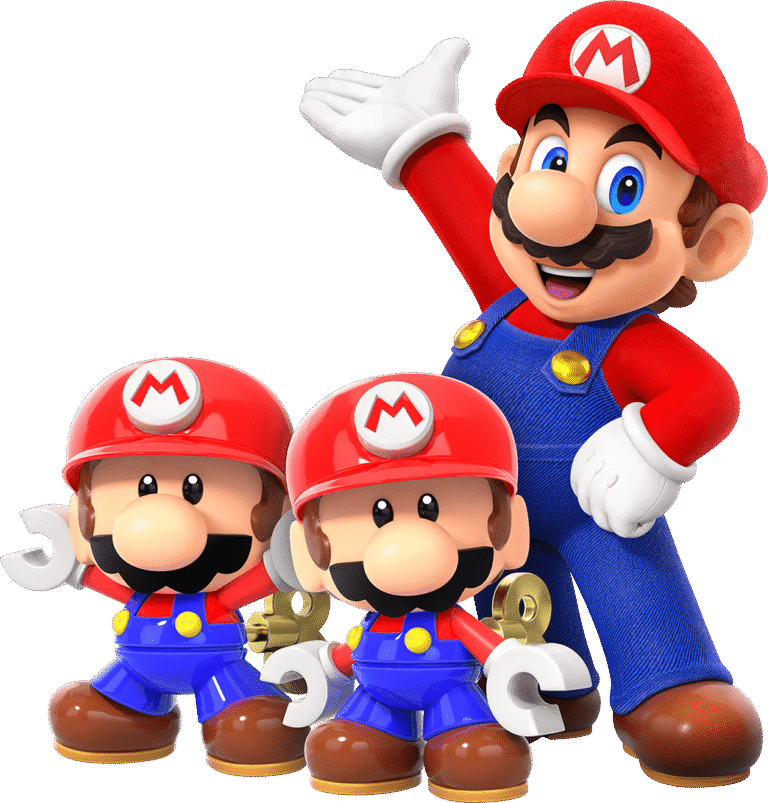
Mario and the Mini-Marios in the remake’s style.
The remake was developed by Nintendo Software Technology (NST), the studio that made the 2004 original and the Minis games that followed it. Vivek Melwani is credited as director; he had worked on Super Mario 3D World + Bowser’s Fury. The game is the first in the series on Switch and the first to carry the Mario vs. Donkey Kong name since Tipping Stars, nearly nine years earlier.
The new look abandons both the pre-rendered sprites of the GBA game and the shiny, outlined toy style of the later Minis games for a standard modern Mario style, which is often traced to Super Mario 3D World and the Super Mario Maker 2 theme based on it. It also introduced a redesigned Donkey Kong series logo. Backgrounds were rebuilt with terrain that suits each world rather than blocky tiles, and many enemies were redesigned as machines or toys.
Music and voices
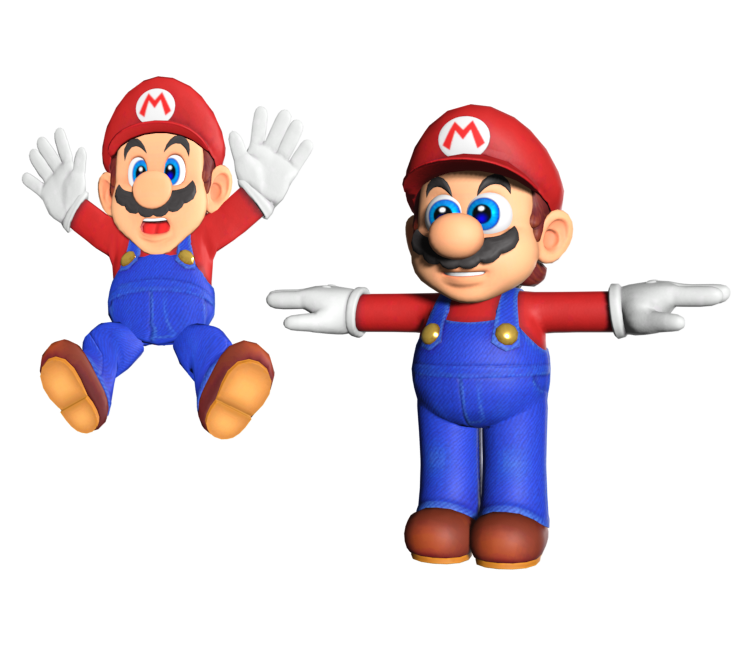
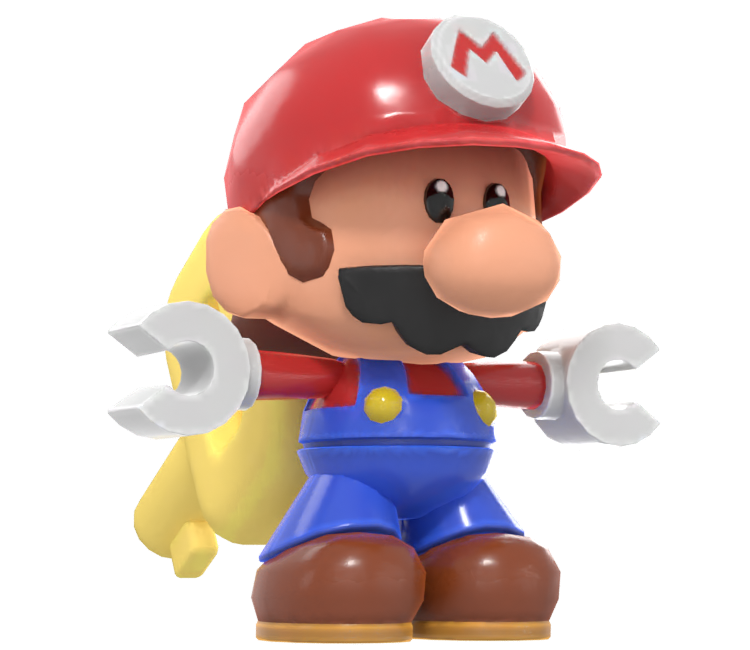
Mario’s 3D model.
Lawrence Schwedler, who wrote the original soundtrack and left NST for the DigiPen Institute of Technology around 2012, returned as music director and rearranged his own work, recorded with DigiPen’s music department. The whole score was rearranged, some tracks with extended melodies; Fire Mountain and Twilight City got entirely new themes (the latter in a jazzy style), each world now has its own version of the boss music, and the Expert levels no longer play the music faster.
The voices changed more. Charles Martinet no longer voiced Mario by 2024, so his part is made up of archival recordings, some of them new to this game. Donkey Kong uses clips by his long-standing actor Takashi Nagasako instead of the original’s sounds, Samantha Kelly voices the Toads, and the opening news channel uses Nate Bihldorff’s Shy Guy voice. Several of Mario’s lines were cut, from the spoken title to his occasional “Spaghetti!” on the Game Over screen.
Announcement, demo and launch
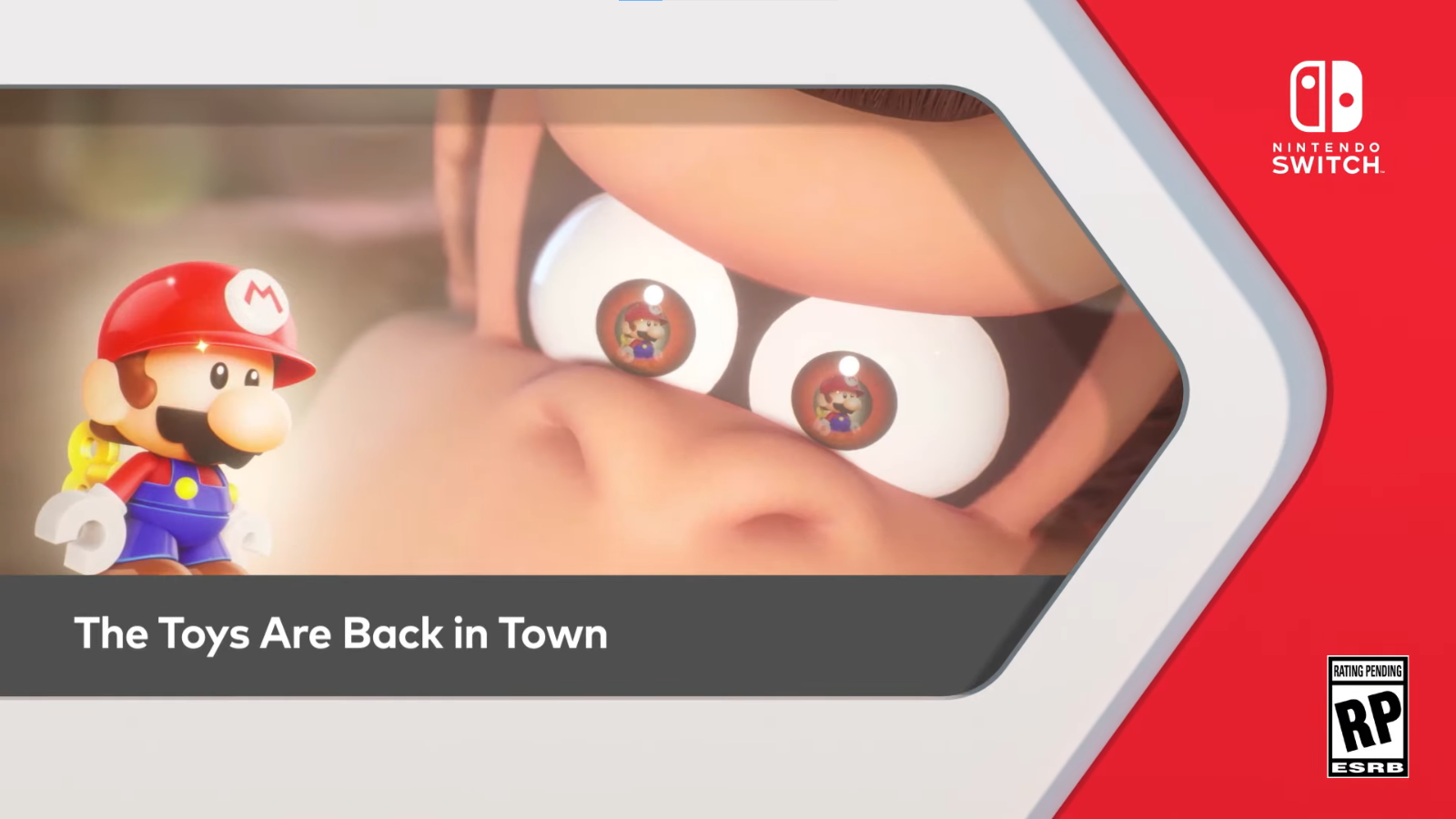
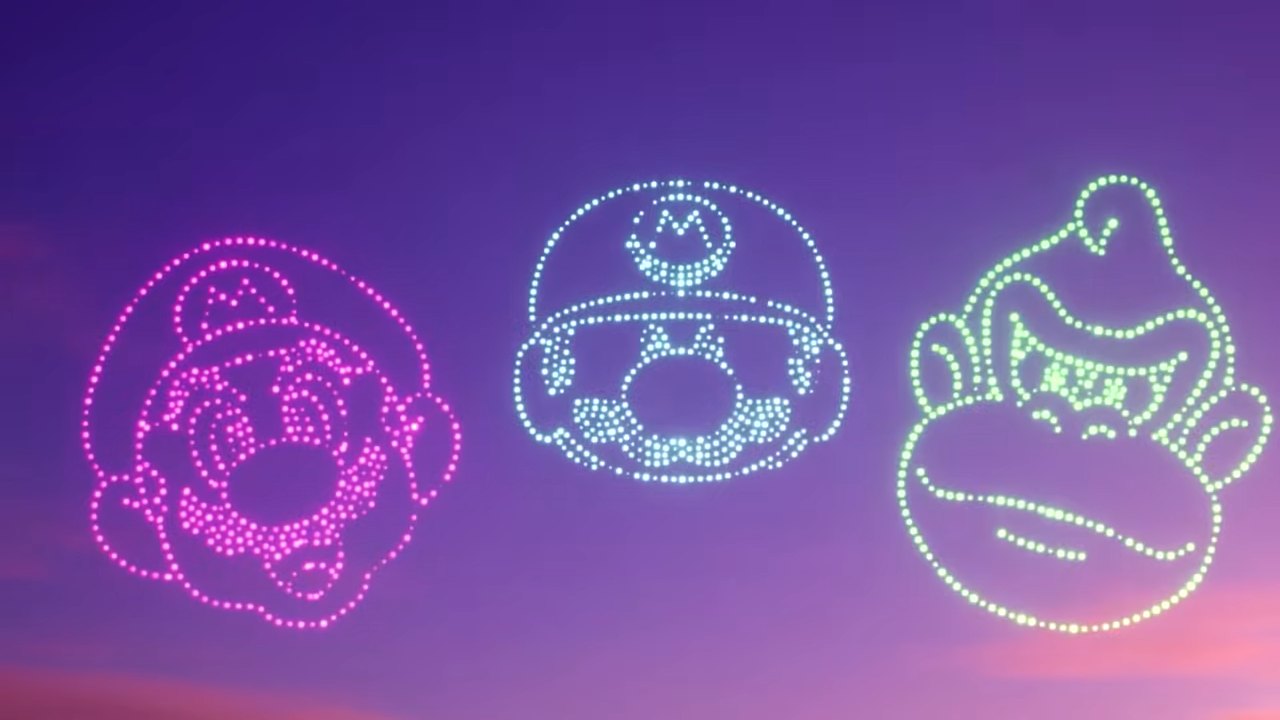
The reveal card from the September 2023 Direct.
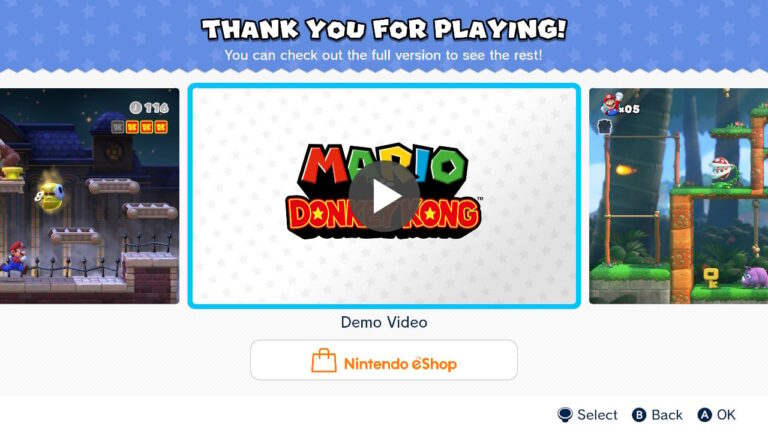
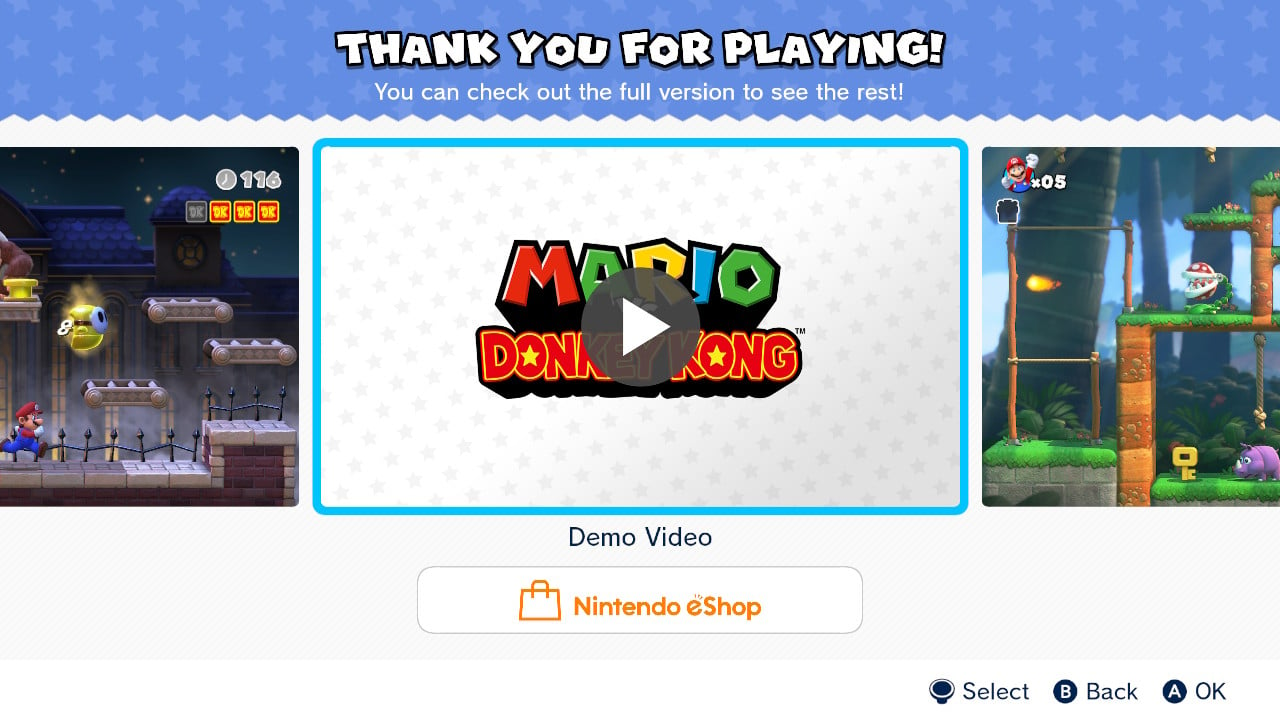
Nintendo revealed the remake in its Direct of 14 September 2023 with a release date of 16 February 2024. On 31 January 2024 a free demo went up on the eShop, with an Overview trailer: four levels of the Mario Toy Company (1-1, 1-3, 1-5 and 1-mm), co-op and both play styles included, ending with a trailer and a Product Info page instead of the boss fight.
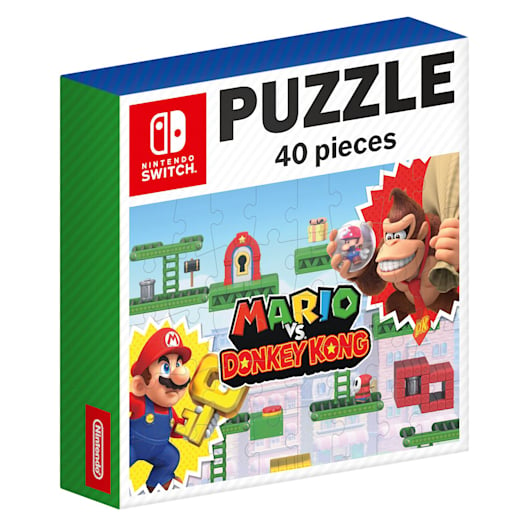
The game launched on schedule on game card and as a download. Retailers sweetened it in places: the Japanese shop Otakara gave pre-order customers a Donkey Kong tin badge, and Nintendo’s European My Nintendo Store sold it with a 40-piece jigsaw and three stickers.
Series Firsts
1First Mario vs. Donkey Kong on Nintendo SwitchAnd the first game to use the series name since Tipping Stars in 2015.
2First game card outside Japan since 2010It was the series’ first game card outside Japan since Mini-Land Mayhem!, thirteen years before. (It is sometimes called the first anywhere, but Tipping Stars came out on a 3DS game card in Japan in 2015.)
3The series’ first snow worldSlippery Summit is usually described as the first snow-themed world in the whole series.
Cheats & Secrets
No codes, but plenty to unlock.
Unlocking everything
Beat vs. Donkey Kong to open the Plus worlds, the Expert levels and Time Attack for the main and Expert levels. Time Attack for the Plus levels needs vs. Donkey Kong Plus.
Expert level requirements
Each Expert level needs a number of Perfect stars, rising in steps of eight from 8 for EX-1 to 128 for EX-16.
Getting a Perfect
Collect all three presents in a main or Plus level; get all six Mini-Marios into the toy box in a Mini-Mario level (and do not close it early by standing on it); beat Donkey Kong without taking a hit. The two vs. Donkey Kong battles have no Perfect rating.
Finding the bonus levels
A bonus level appears roughly every eight levels you clear, set in the world you last played. In a newly opened world you need to clear four to six of its levels first. Each one is worth five extra lives.
Casual Style tips
Raise every Checkpoint Flag you pass: only the most recent one counts. With no clock, there is no penalty for taking your time over a puzzle.
Co-op tips
Send Toad through the one-block gaps and up the ropes; he is quicker at both. The silver flying key must be caught as well as the normal key, so one player can chase it while the other carries.
Videos
Two official Nintendo videos: the Overview trailer released with the demo, and the reveal from the September 2023 Direct.
Official Nintendo of America trailer, 31 January 2024.
Official reveal trailer from the Nintendo Direct of 14 September 2023, on Nintendo’s Japanese channel.
Trivia & Interesting Facts
In the opening, the television’s news channel now uses Nate Bihldorff’s Shy Guy voice clips instead of fast gibberish, and the announcer’s closing “Buy them all!” is a touch slower.
The channel with a Spanish countdown now plays a remake arrangement of the Donkey Kong Plus music.
The Toads in the opening wear hard hats in the remake.
Donkey Kong now sulks in the final scene instead of sobbing, though he still sobs when beaten in battle. Mario no longer scolds him before handing over the Mini-Mario.
Mario and the Mini-Marios celebrate.The game ends with fireworks after Mario gives Donkey Kong his toy, something the GBA ending did not have.
Mario’s death animations follow the modern Mario games: he is no longer charred by fire.
Lost voice lines include Mario saying the game’s title, the “Mamma mia!” when a Mini-Mario breaks and a joke about Charles Martinet in the credits.
Tane Pakkun became mechanical Fire Piranha Plants, Fire Shy Guys now resemble blue Snifits, and Boos, Thwomps and Thwimps became toys with sliding faces.
Presents are fully coloured boxes now, not white with coloured ribbons.
The French, Italian, German and Spanish versions give the worlds local names; the original left them in English. The remake also adds Chinese, Korean, Dutch, Canadian French and Latin American Spanish text.
The Audio Options sound test and Visual Options cut-scene viewer are merged into one Gallery menu.
Lawrence Schwedler, the composer, also narrates the in-game advert for Bananas, as he did in 2004.
Each world’s menu colour changed in places: Fire Mountain from brown to red, Mystic Forest from cyan to peach (to tell it apart from Slippery Summit) and Twilight City from indigo to pink.
Donkey Kong looks angrier than before when he is down to his last hit point.
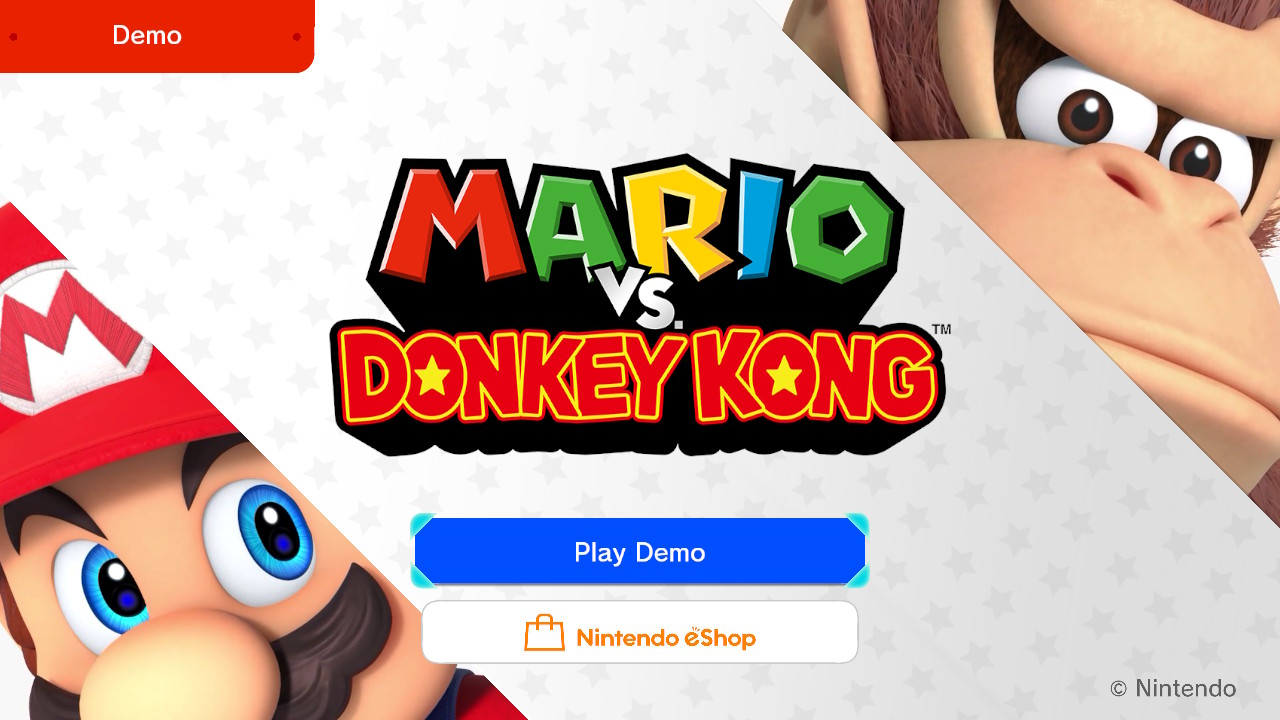
The demo’s Product Info page.The demo’s Guides menu still explains rope-climbing moves that cannot be used in its four levels.
Regional Box Art
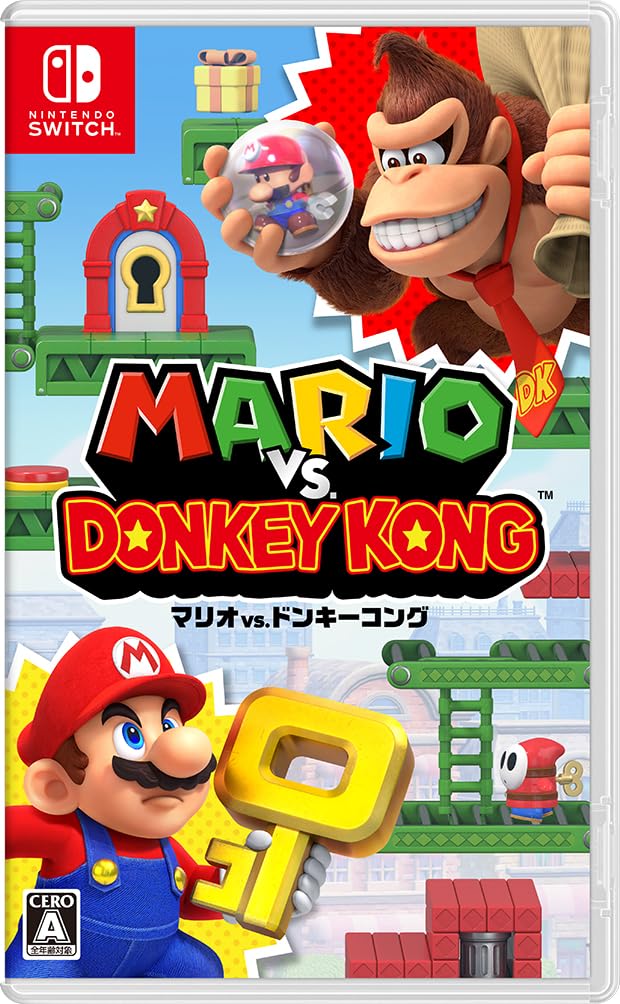
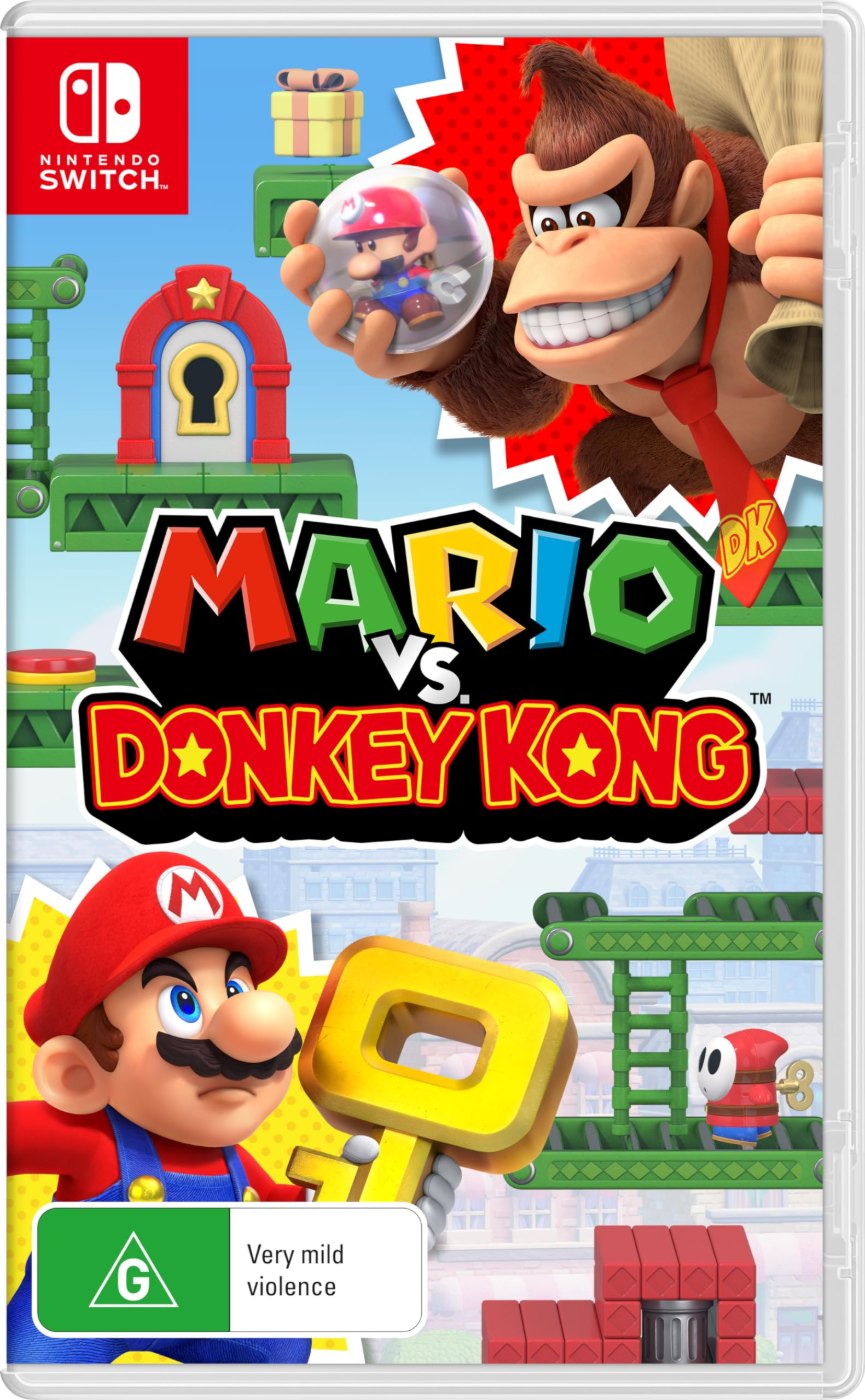
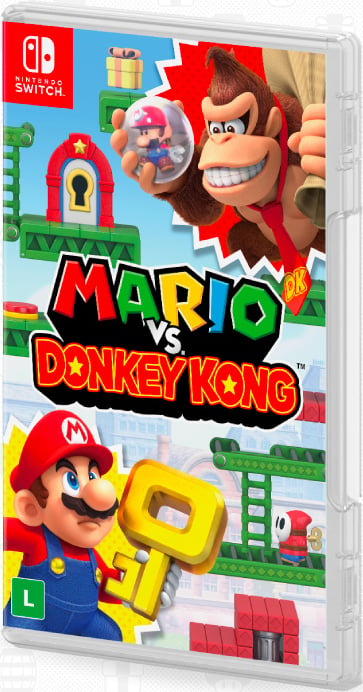
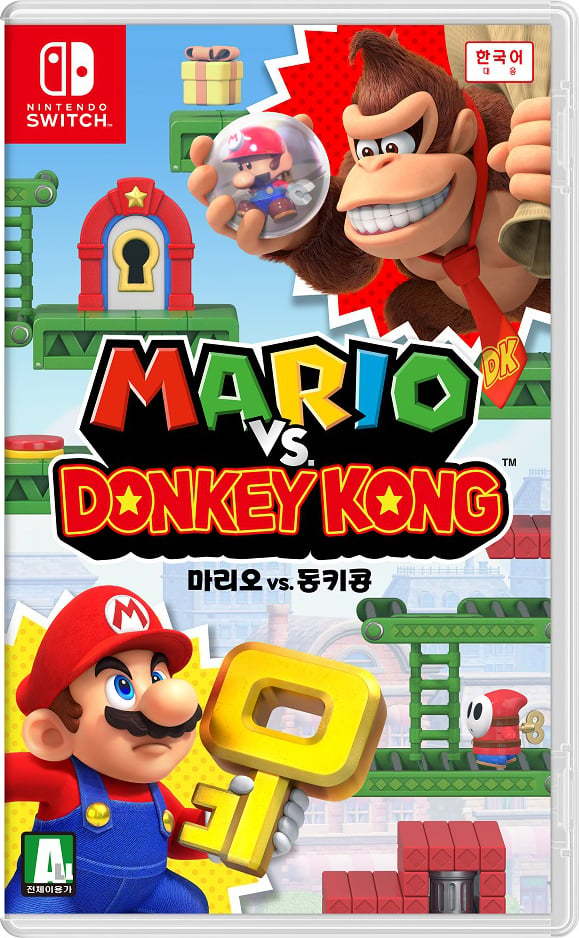
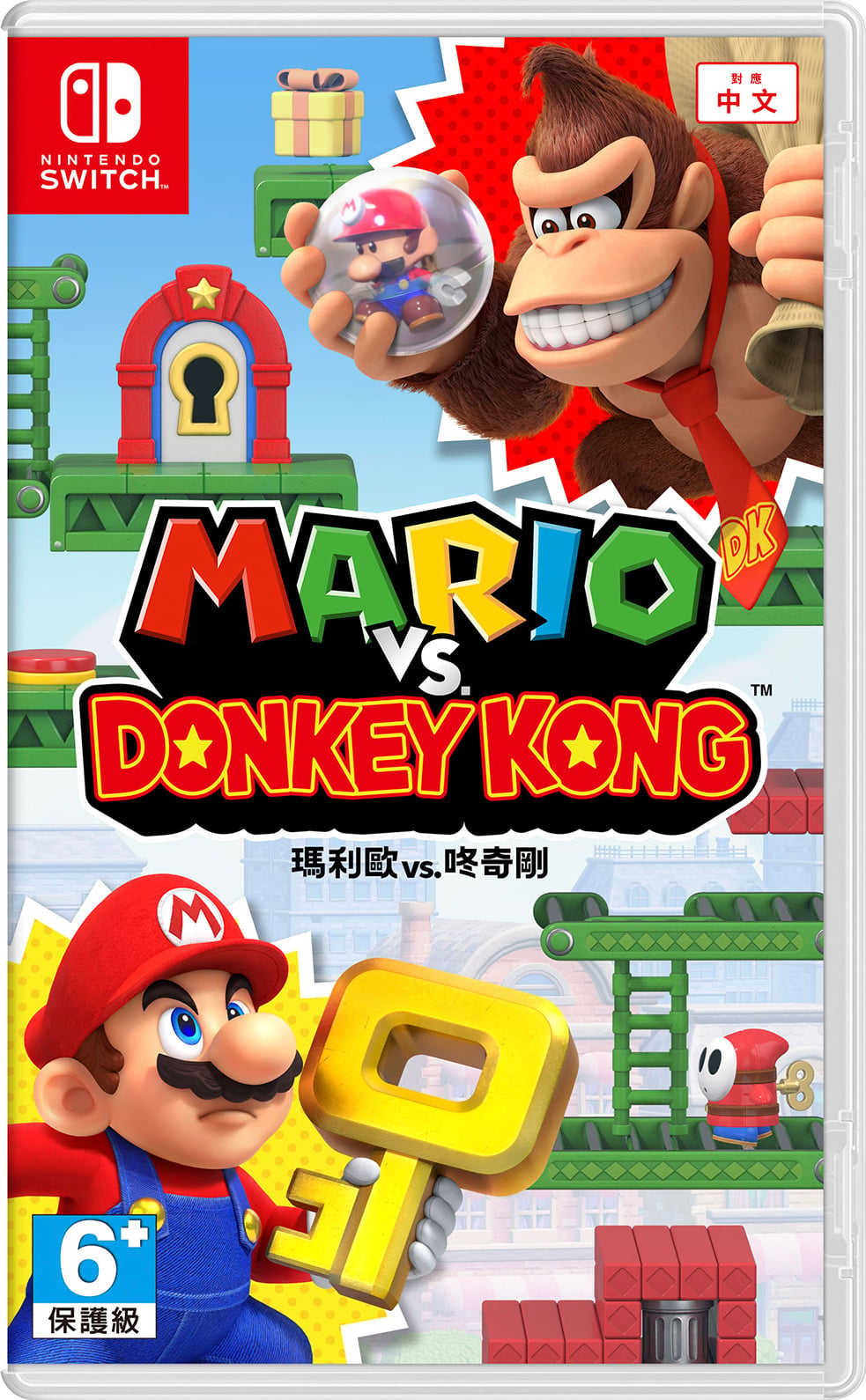
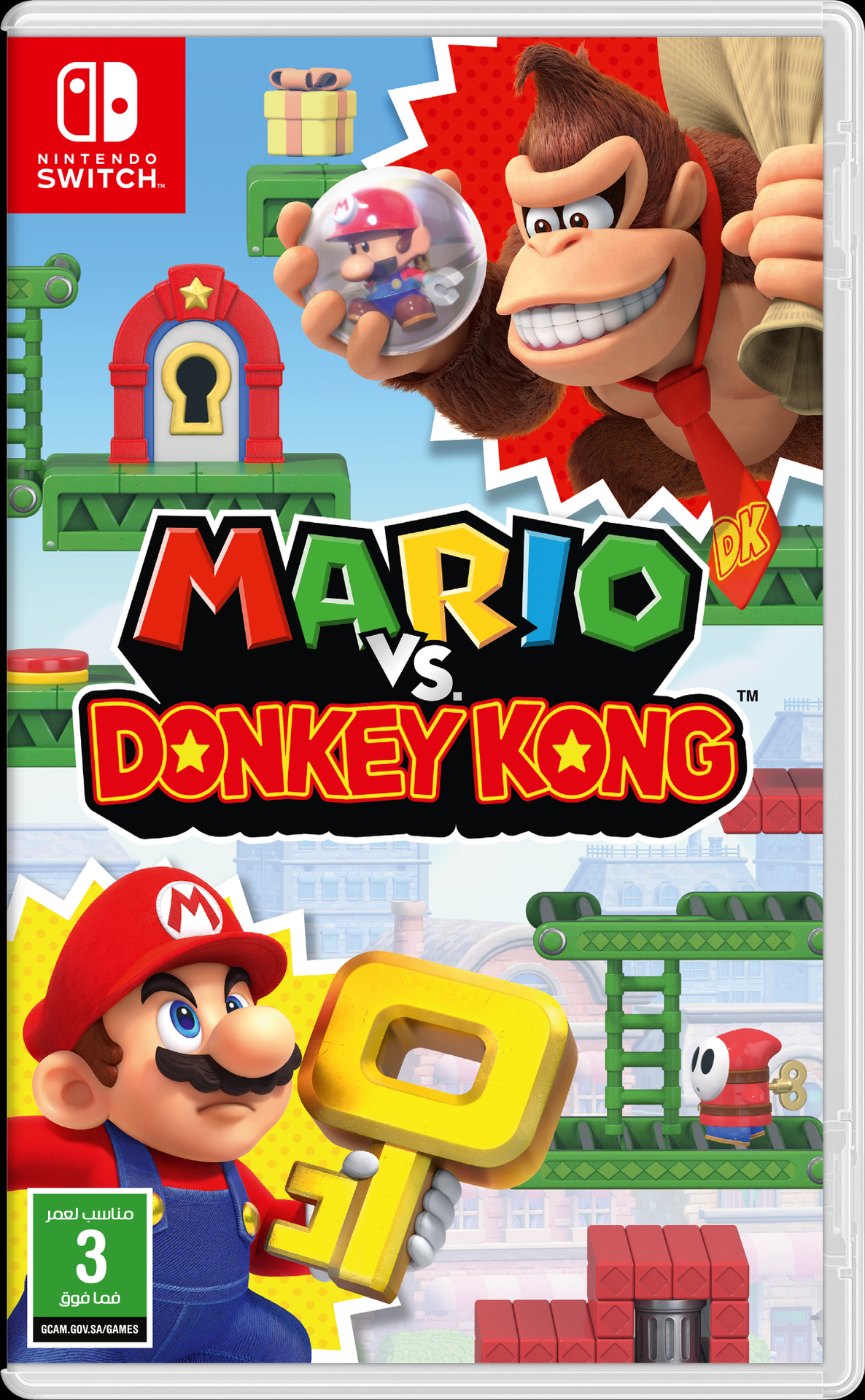
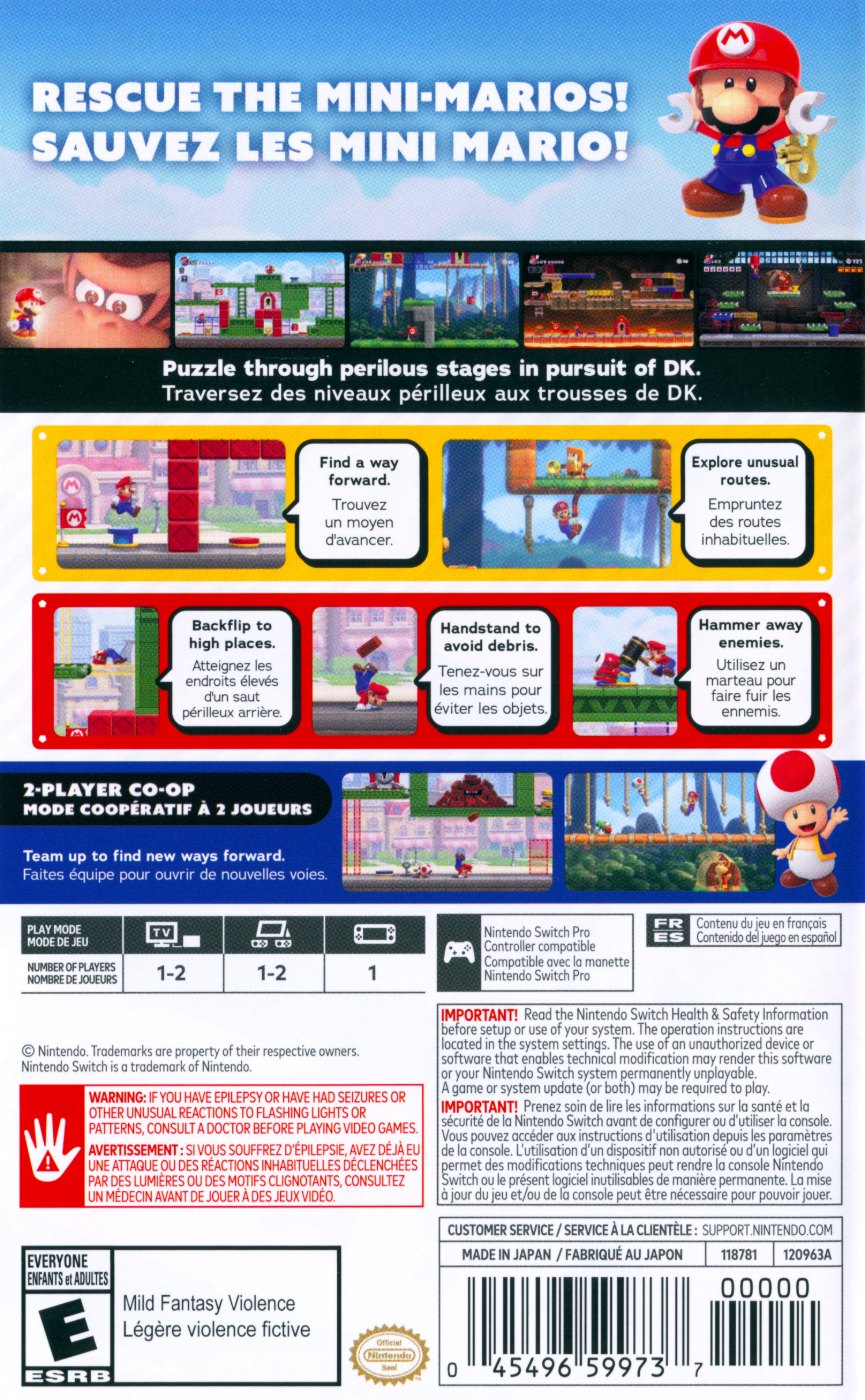
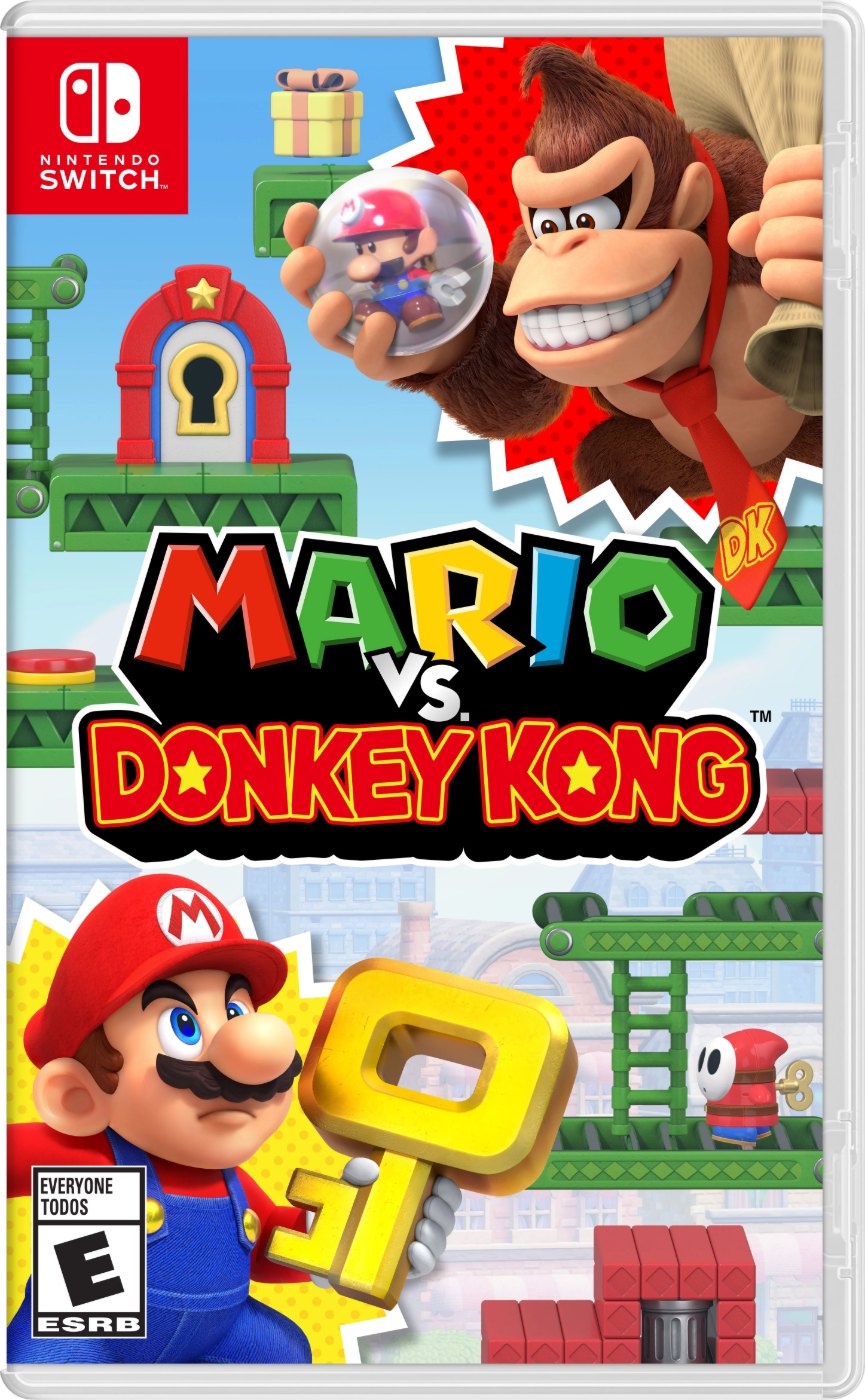
One design worldwide, with the usual regional ratings and logos. The Japanese logo is now mostly written in English.
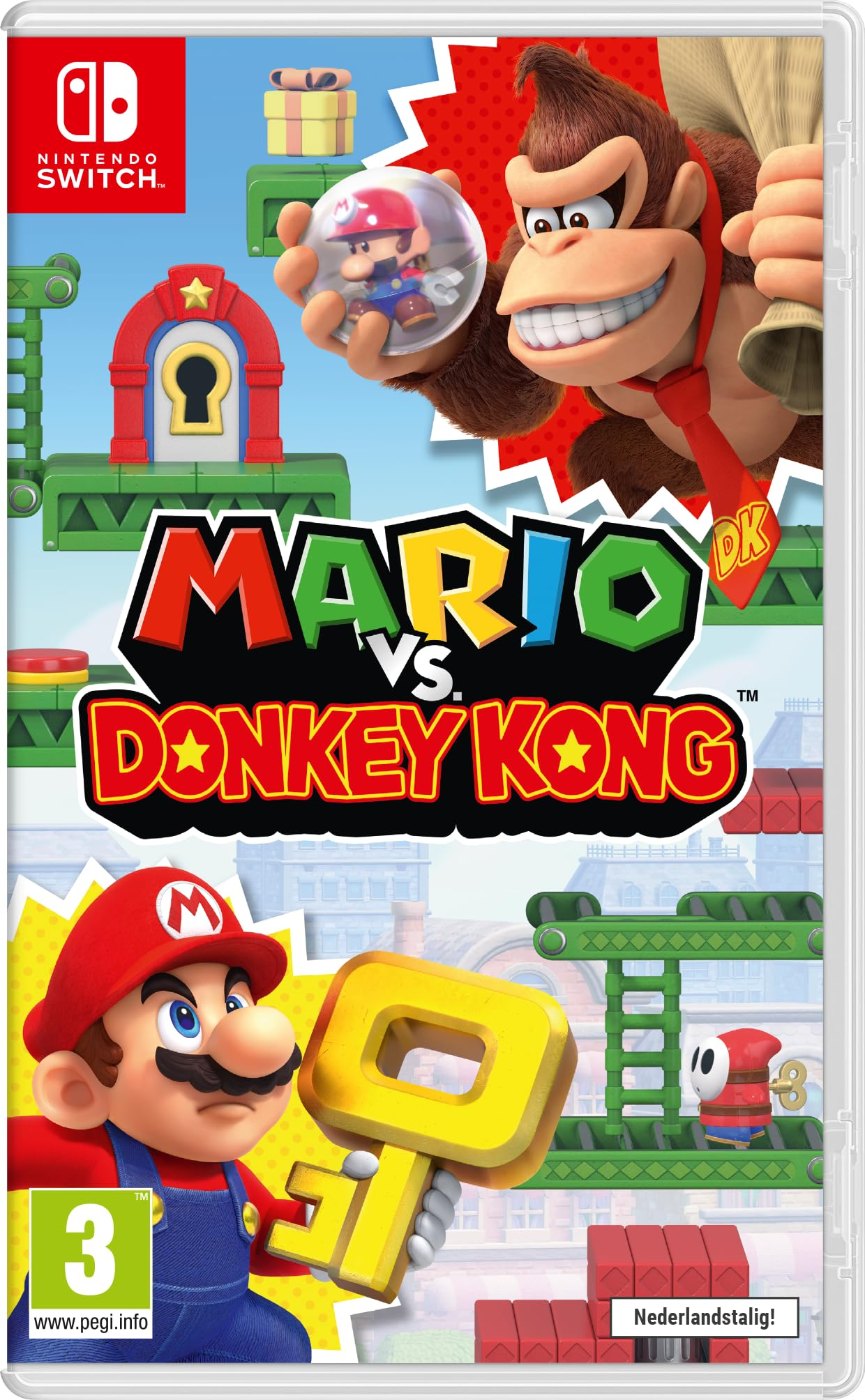
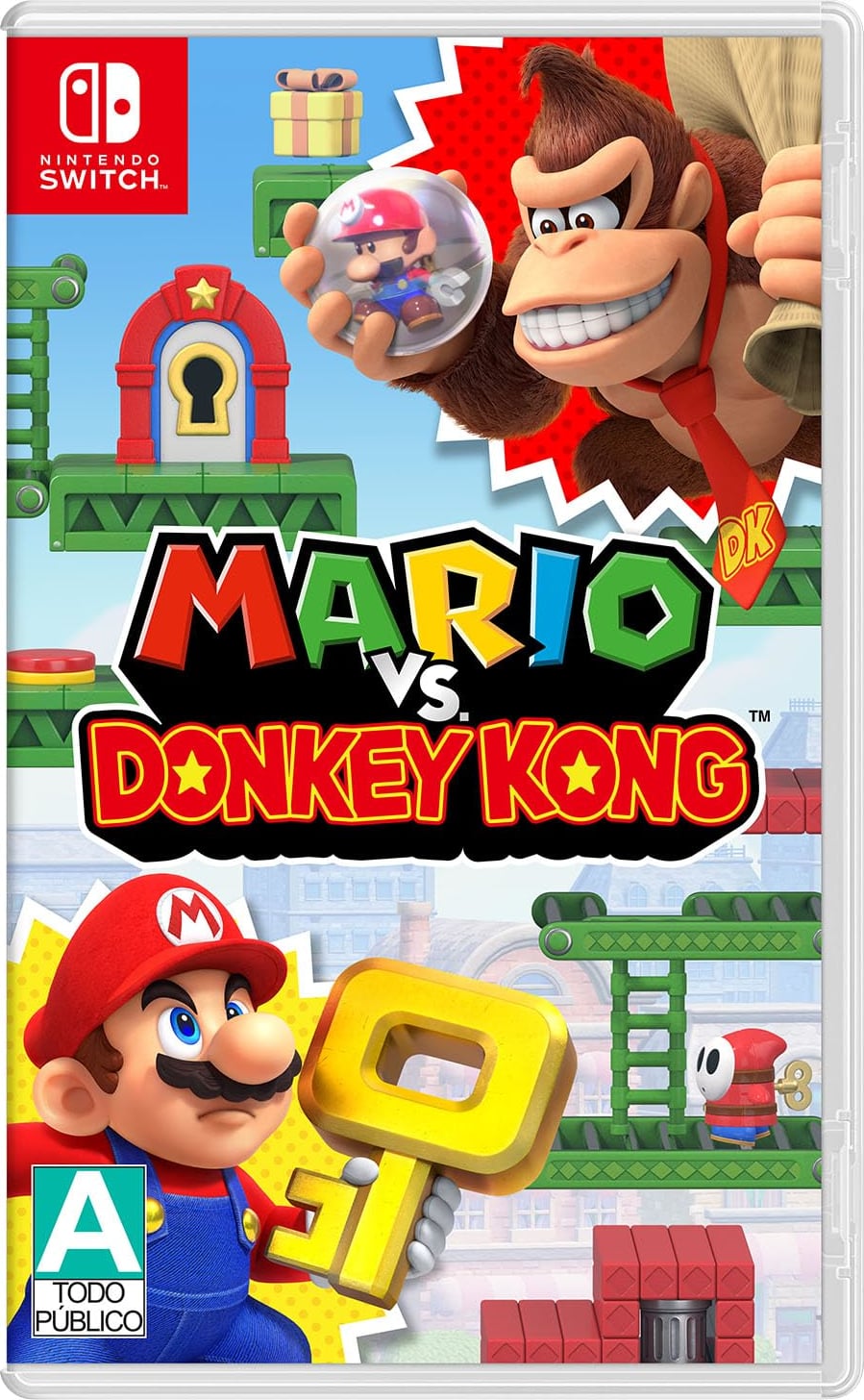
North America and Latin AmericaThe standard American box.EuropeJapanAustraliaGermanyNetherlandsCanadaMexicoBrazilSouth KoreaHong Kong and TaiwanSoutheast AsiaSouth AfricaSaudi ArabiaCanada (back)North America (pre-release)The box as first shown.North American game card
Screenshots
More of the remake.
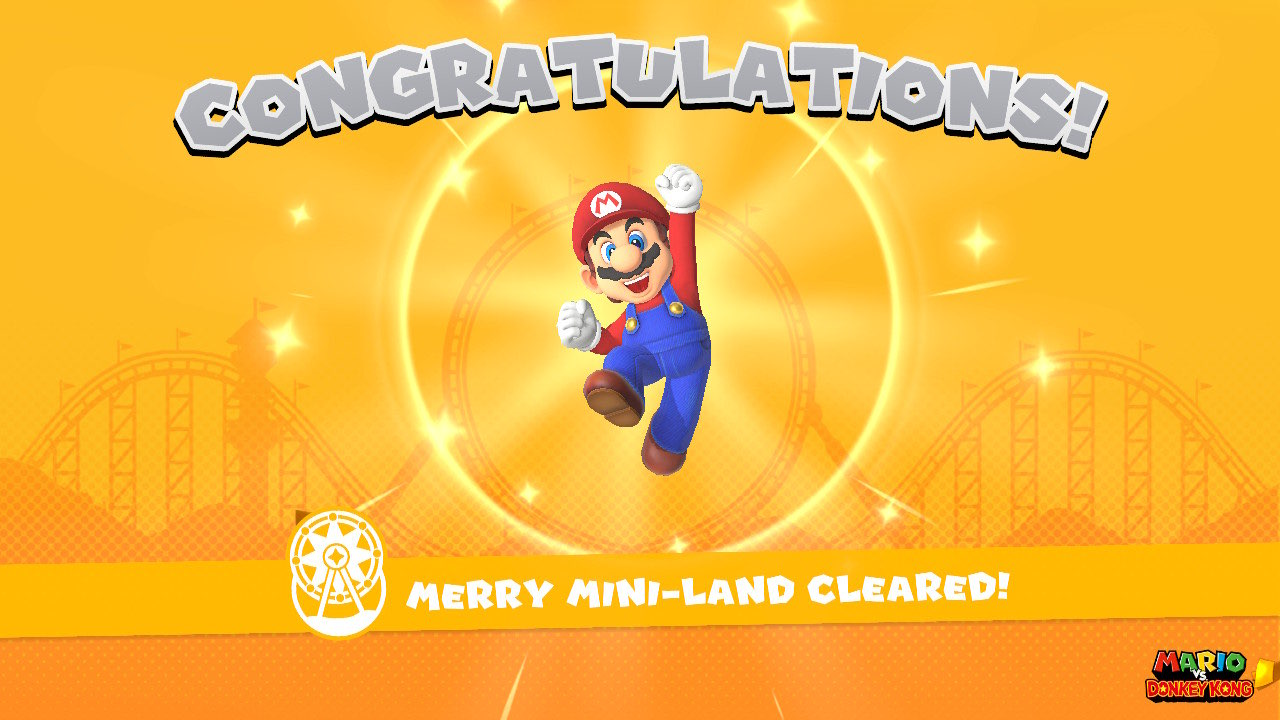
Level 1-3: Color Switches and wires.Level 2-mm.Level 3-6: Fire Shy Guys.Level 4-mm in Merry Mini-Land.Level 5-4: Boos.Level 6-mm on the ice.Level 7-DK.Level 8-mm, the last Mini-Mario level.Level 3-6, as shown on the demo’s Product Info page.Level 6-mm, from the demo’s Product Info page.The demo’s title screen.Merry Mini-Land cleared.
Artwork & Media Gallery
Official artwork and renders for the remake.
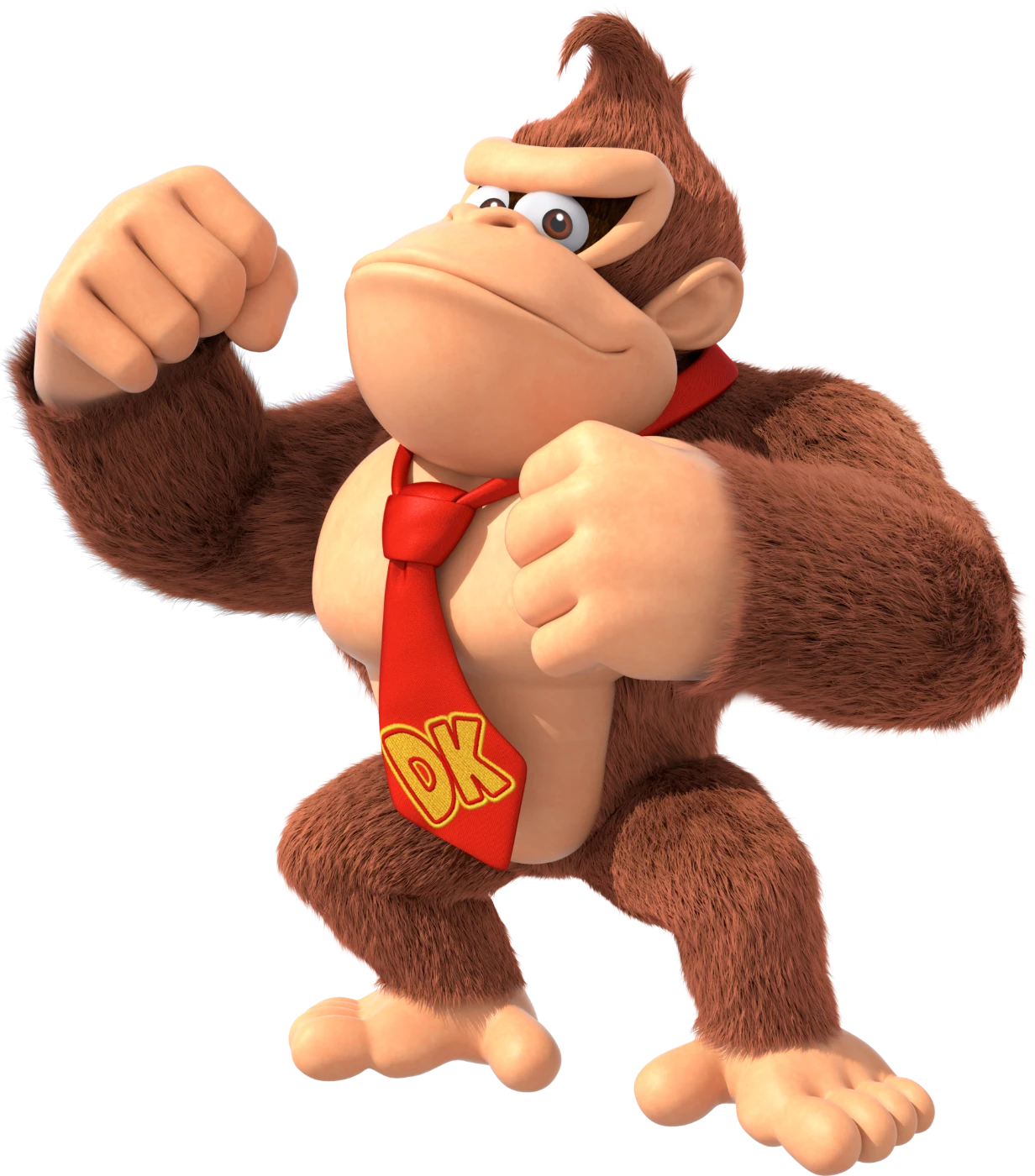
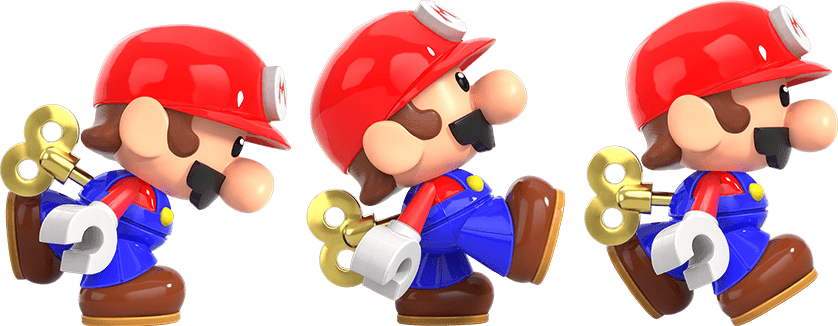
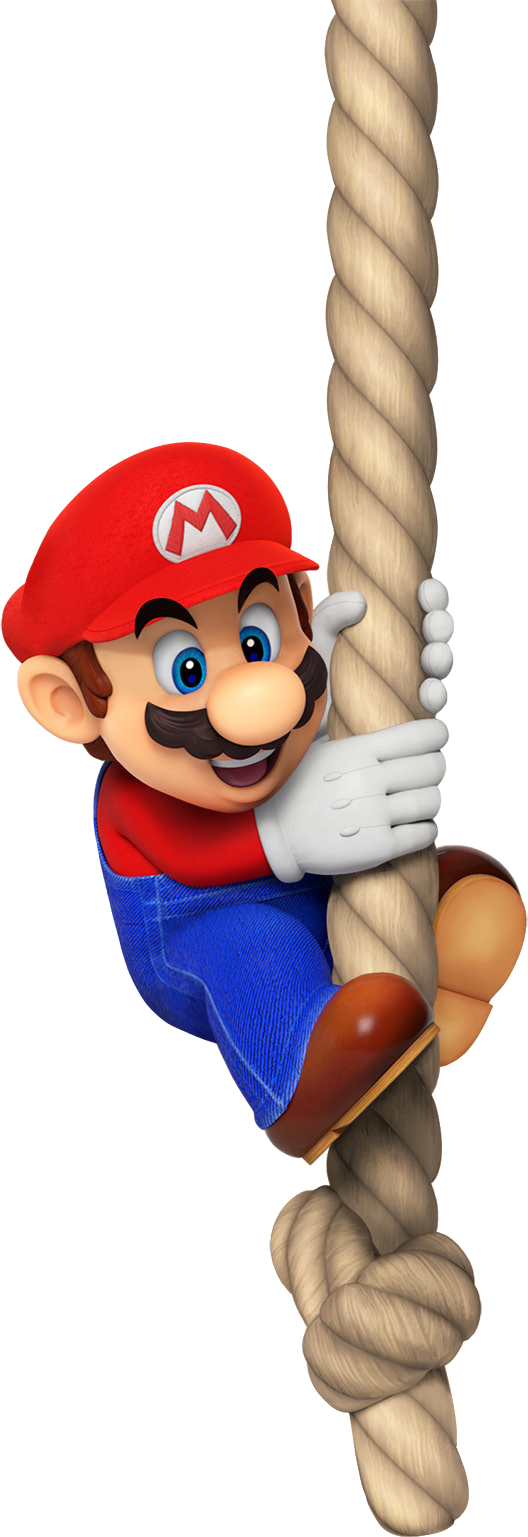
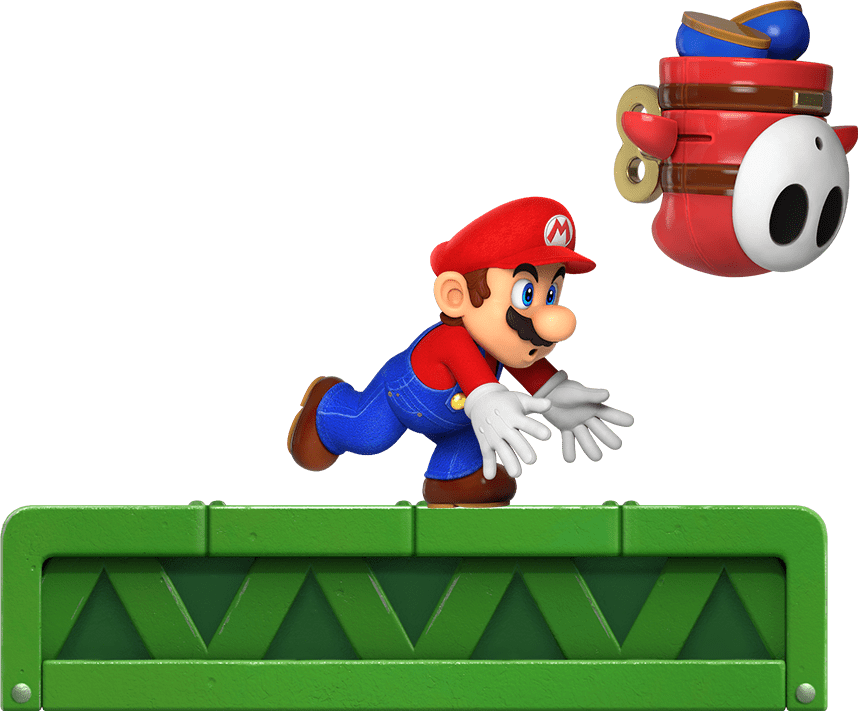
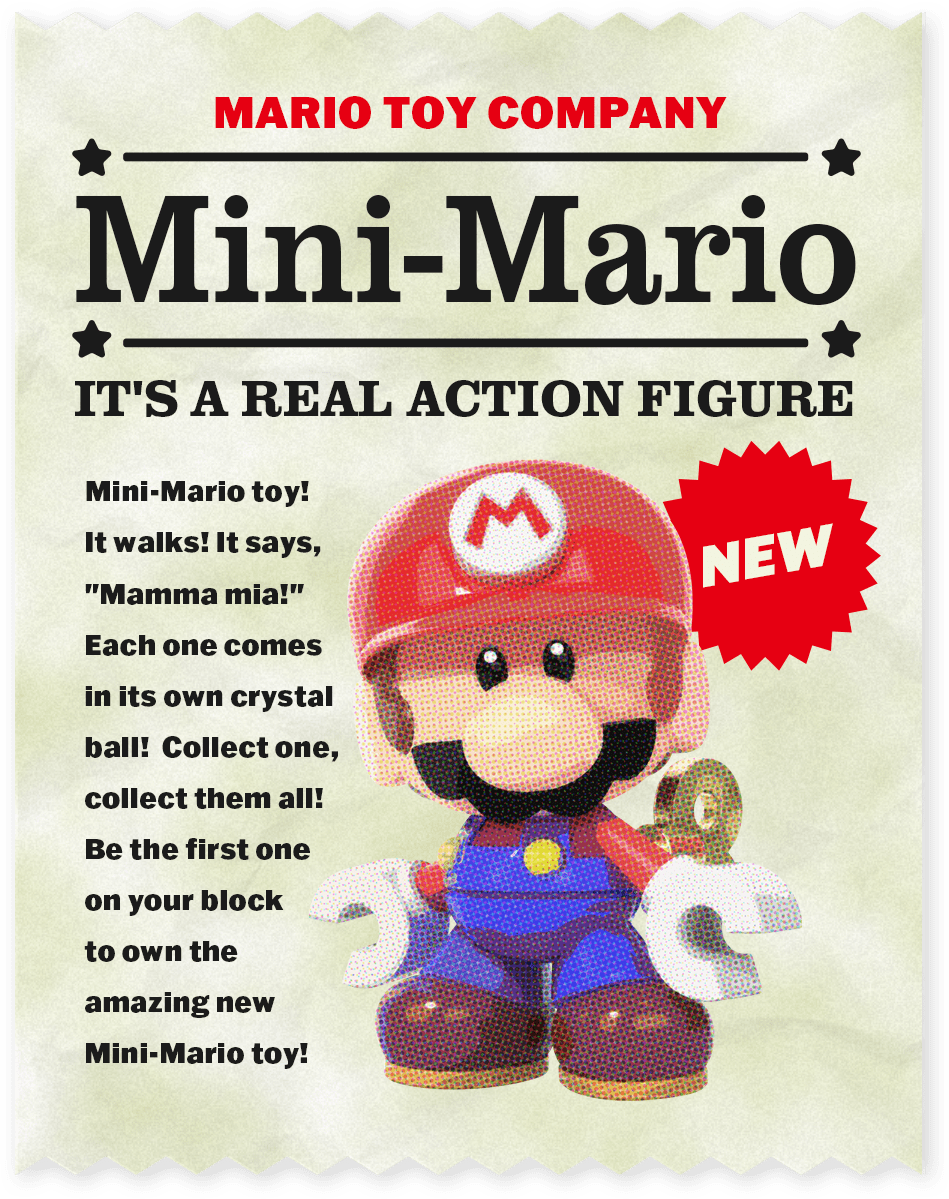
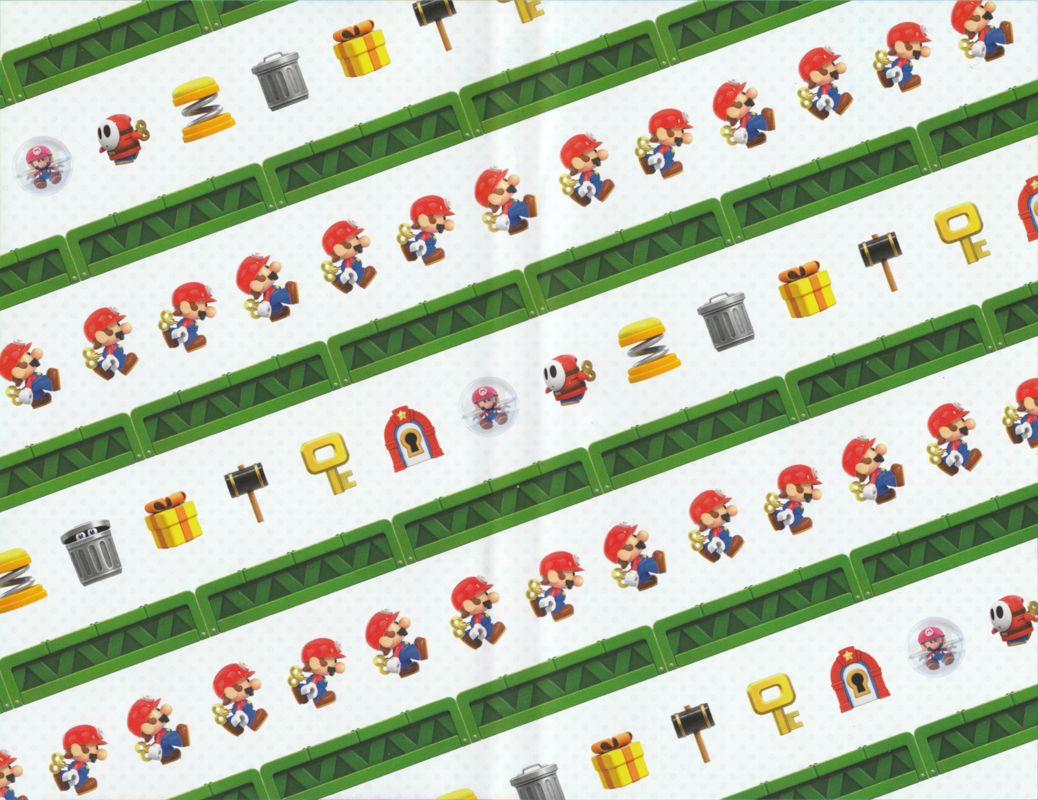
Japanese key artwork.Donkey Kong.A group of Mini-Marios.Mario sliding down a rope.Mario throwing a Shy Guy.The Mini-Mario flyer.Inside-cover artwork.Toad’s model.A Mini-Mario model.The international logo.The Japanese logo.The HOME Menu icon.Otakara’s pre-order tin badge.The jigsaw in the European My Nintendo Store bundle.World icon: Donkey Kong Jungle.
Legacy & Re-releases
A remake of the game that started a series, and proof that Nintendo still had time for the Minis.
Nintendo Direct14 September 2023The remake is revealed with a release date.
Demo31 January 2024Free on the Nintendo eShop, with the Overview trailer.
Nintendo Switch16 February 2024Worldwide launch on game card and download.
Million-seller31 March 20241.12 million copies, reported by Nintendo on 7 May 2024.
GBA original on Switch10 March 2026The 2004 game joins Game Boy Advance – Nintendo Classics for Nintendo Switch Online + Expansion Pack.
Where it sits in the series
The original Mario vs. Donkey Kong grew out of the 1994 Game Boy Donkey Kong and led to a run of Minis games: March of the Minis, Mini-Land Mayhem! and Tipping Stars among them. The remake returns to where all that started, long before games such as Tipping Stars handed the whole show to the Minis.
Its new worlds nod to that later history, Merry Mini-Land above all, and Nintendo’s million-seller listing showed that a modest puzzle-platformer could still find a big audience on Switch. Since March 2026 players can compare it directly with the 2004 game, which is now part of the Game Boy Advance library on Nintendo Switch Online.
Reviews & Sales
Sales
Nintendo’s results briefing of 7 May 2024 listed Mario vs. Donkey Kong among its million-selling first-party titles: 1.12 million copies in the year to 31 March 2024, which for a game released on 16 February means about six weeks on sale. Of those, 210,000 were sold in Japan and 910,000 elsewhere. Nintendo counts downloads in these figures. We found no later official figure.
In the United Kingdom it went straight to number one in the boxed charts in its launch week, as reported by GamingBolt (via Wikipedia).
1.12mworldwide by 31 March 2024 (Nintendo IR)
910koutside Japan
210kJapan
No. 1UK boxed chart, launch week
76Metacritic (104 critics)
Reviews
Metacritic averaged 76 from 104 critics. Scores below are from the reviews and from Metacritic’s list.
Most critics enjoyed the revival and argued about its difficulty. Nintendo Life’s PJ O’Reilly called it “a slick return to the 2004 GBA adventure that finds fresh fun in cooperative play”, finishing the main game in about five hours and praising the co-op in particular. Game Informer’s Charles Harte enjoyed the controls, and Destructoid’s Eric Van Allen found it surprisingly demanding, especially the Mini-Mario levels. Eurogamer’s Christian Donlan called it a lovely package.
The doubts were about value and challenge. Video Games Chronicle’s Andy Robinson thought most of the game far too easy, with only the Expert levels giving real satisfaction; GameSpot’s Steve Watts felt its short, bite-sized levels belonged to an older handheld; and Digital Trends criticised the missing e-Reader levels and saw Time Attack as a way of stretching the replay value.
SLB User Reviews
Mario vs. Donkey Kong (Nintendo Switch) has yet to receive a community review on Super Luigi Bros.
If you’ve played Mario vs. Donkey Kong (Nintendo Switch) and would like to submit a review, please get in touch.
More from the Super Luigi Bros Guide
These picture lists come from the earlier Super Luigi Bros guide to Mario vs. Donkey Kong (Nintendo Switch) and are kept here in full.
Characters
Mario vs. Donkey Kong has a focused 4-character cast (5 if you count the Mini-Marios as a group entity). The character roster reflects the puzzle-platformer focus rather than the sprawling ensembles of mainline Mario games.
Mario
Player 1Owner/inventor of the Mario Toy Company. Chases DK through 8 worlds to recover stolen Mini-Marios.
Donkey Kong
AntagonistSteals all the Mini-Mario toys after the store sells out. Boss at end of every world.
Mini-Marios
Rescue TargetsWind-up tin toys that march to the goal. Must be guided safely each level.
Toad
Co-op P2 (NEW)Switch remake exclusive co-op partner. Plays alongside Mario in 2P mode.
The 2024 New DK Design
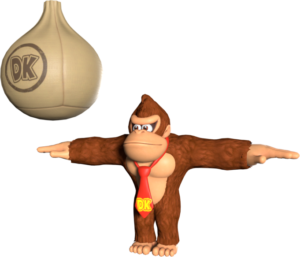
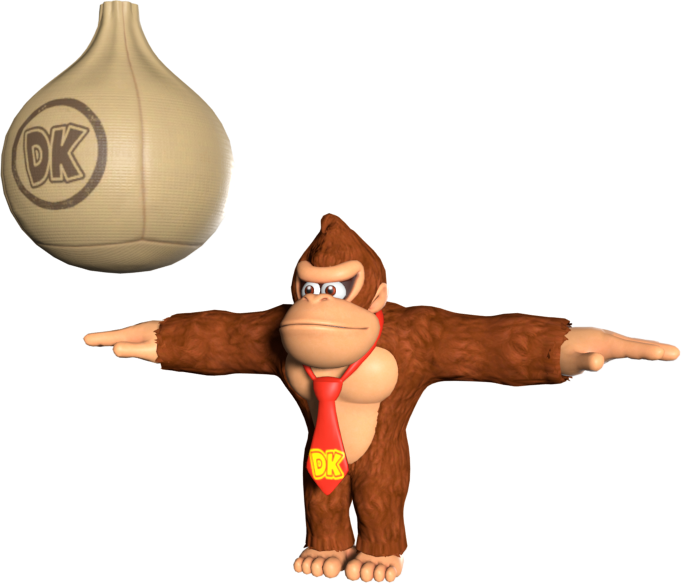
The 2024 remake rebuilds Donkey Kong as a full 3D model in a modern art style — a significant visual update from the 2004 GBA original’s pre-rendered sprites. DK now gets an angrier expression when he’s down to his last hit point, his voice clips come from Takashi Nagasako, and he has more expressive facial animations, exaggerated comedy, and visual charm appropriate for the lighter Mario vs. DK tone.
DK in tin-toy / wind-up aesthetic — matching the Mini-Mario styleMario with rescued Mini-MariosToad climbing in 2P co-op (Switch exclusive)
A Focused Puzzle CastThe 4-character roster is intentionally minimal to keep the puzzle-platformer’s focus tight. Mario is the player; DK is the obstacle; Mini-Marios are the rescue objective; Toad is the co-op partner. No supporting characters dilute the central rivalry. This focused approach contrasts with sprawling ensemble Mario games and keeps Mario vs. DK’s identity distinct.
Mini-Marios
The Mini-Marios are the heart of the Mario vs. Donkey Kong concept. They’re wind-up tin toys manufactured by the Mario Toy Company — small mechanical figures shaped like Mario himself. They march in straight lines when wound up, climb ladders automatically, and follow Mario when he calls them.
Wind-Up Toy Mechanics
The Mini-Mario Concept
Mini-Marios are wind-up mechanical toys shaped like Mario. They’re manufactured by the Mario Toy Company and feature throughout the franchise as the central rescue objective. In the 2024 remake, they retain all their classic characteristics: they march forward when activated, climb ladders, and follow Mario when called.
The Mini-Mario design has remained remarkably consistent across the 20-year franchise history — small, red-and-blue, with the iconic Mario “M” cap, expressive button eyes, and visible wind-up key on their backs. The 2024 remake updates the visuals to HD but preserves all the design elements that have made them iconic.
Mini-Mario Behaviors in Gameplay
Auto-march — once wound up, Mini-Marios walk forward continuously until they hit an obstacle, fall off an edge, or reach the goal.
Auto-ladder climb — Mini-Marios automatically climb up ladders they encounter on their march path.
Follow Mario when called — when Mario presses the call button (during march levels), Mini-Marios change direction to follow him.
Fragile to hazards — Mini-Marios are destroyed if they fall too far, get hit by enemies, or fall into pits/spikes.
Star-rating system — the player’s star rating per level is based on how many Mini-Marios reach the goal safely.
Mini-Mario goal scenes — once all 3 (or more) Mini-Marios reach the goal toybox, the level completes with a triumphant march animation.
A group of Mini-Marios marching togetherA Mini-Mario in its protective wind-up orbMini-Mario in tin-toy model formThe promotional flyer that triggers DK’s rampage
The Mini-Marios Define the FranchiseThe Mini-Mario concept is what makes Mario vs. Donkey Kong distinct from any other puzzle-platformer. Their wind-up mechanics introduce a level of indirect control — the player isn’t directly moving the rescue targets, but rather setting up paths for them to safely navigate. This creates puzzle-design space that’s impossible in standard platformers. The Mini-Marios are also the through-line of the entire 6-game franchise; every Mario vs. DK title features them as the central mechanic. The 2024 remake doubles down on their iconic design, making them visually prominent in promotional materials.
Visual Style
The HD Switch title screen — modern presentation
HD Modern Visual Direction
The 2024 Switch remake takes the 2004 GBA’s pixel-art aesthetic and translates it into modern HD presentation. The visual style is consistent with contemporary Mario games — the cartoonish, expressive Switch-era Mario universe look.
Visual Identity Elements
Full 3D Donkey Kong — a modern 3D model with more expressive animation than the 2004 sprites.
HD Mini-Mario animations — the wind-up toy marches are now smoothly animated with mechanical visual flourishes (visible wind-up rotations, articulated joints).
Toy-themed environmental detail — every stage emphasizes the Mario Toy Company branding via posters, packaging, manufacturing equipment.
Vibrant color palette — each world has a distinct color identity (toy company yellow, jungle green, fire mountain red, etc.).
HD Rumble integration — tactile feedback synced to key gameplay moments.
1080p docked / 720p portable — native HD presentation in both modes.
Refreshed cutscene animations — the story cutscenes between worlds are fully HD remade, with new expressive DK and Mario animations.
Japanese promotional key artOfficial My Nintendo Mini-Mario wallpaperNintendo Switch social media promotional coverPhysical packaging inside cover artwork
A Beloved Identity Preserved & ModernizedThe 2024 Switch remake successfully translates the GBA original’s pixel-art charm into HD without losing the visual identity that fans loved. The Mini-Mario animations specifically are universally praised; their HD presentation is delightful to watch.
To provide the best experiences, we use technologies like cookies to store and/or access device information. Consenting to these technologies will allow us to process data such as browsing behavior or unique IDs on this site. Not consenting or withdrawing consent, may adversely affect certain features and functions.
Functional
Always active
The technical storage or access is strictly necessary for the legitimate purpose of enabling the use of a specific service explicitly requested by the subscriber or user, or for the sole purpose of carrying out the transmission of a communication over an electronic communications network.
Preferences
The technical storage or access is necessary for the legitimate purpose of storing preferences that are not requested by the subscriber or user.
Statistics
The technical storage or access that is used exclusively for statistical purposes.The technical storage or access that is used exclusively for anonymous statistical purposes. Without a subpoena, voluntary compliance on the part of your Internet Service Provider, or additional records from a third party, information stored or retrieved for this purpose alone cannot usually be used to identify you.
Marketing
The technical storage or access is required to create user profiles to send advertising, or to track the user on a website or across several websites for similar marketing purposes.

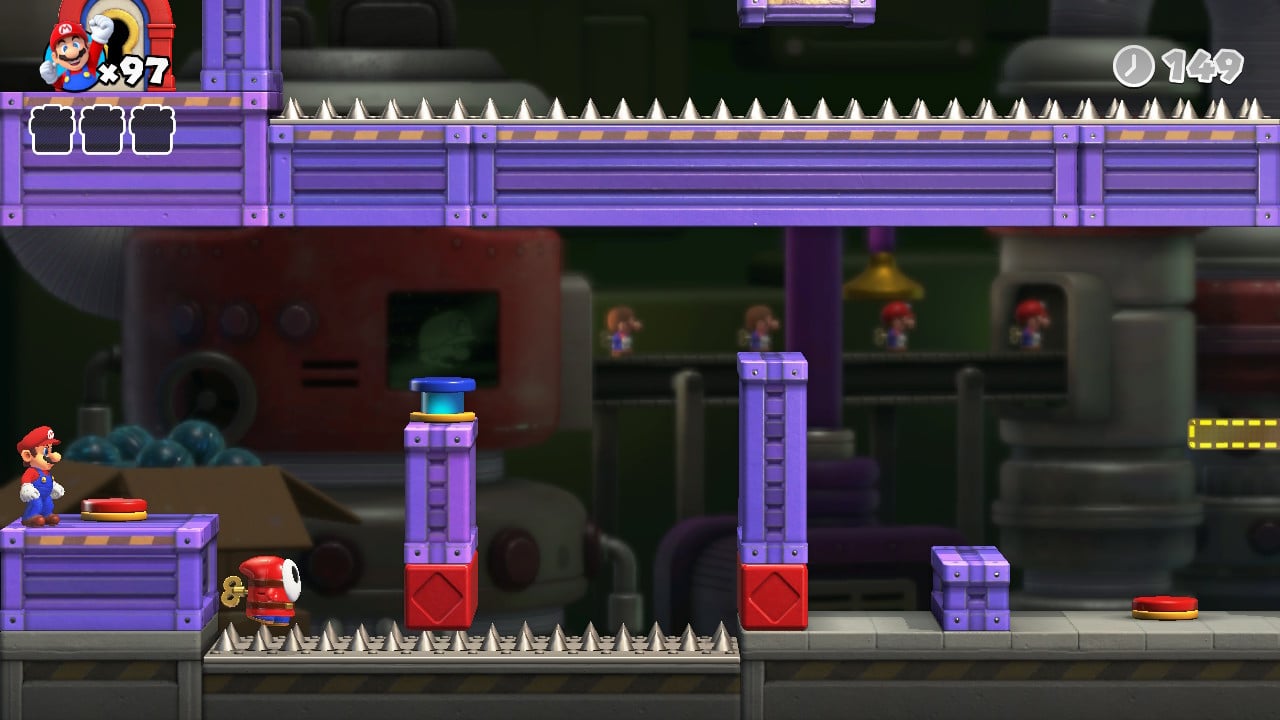
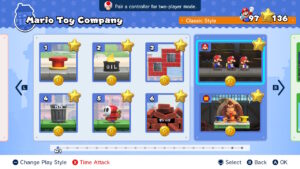 World 1: Mario Toy Company8 levels + bonus · 1-DK: debris and three Color SwitchesLadders and Hammers (1-2), Color Switches and wires (1-3), conveyors (1-4), springboards (1-5), handstands (1-6).
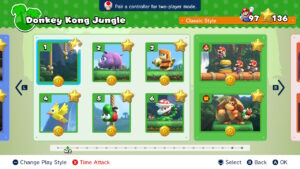 World 2: Donkey Kong Jungle8 levels + bonus · 2-DK: drop fruit on himRopes and Tane Pakkun, now mechanical Fire Piranha Plants (2-1), spikes and RamRams (2-2), Snapjaws (2-5).
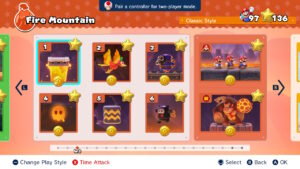 World 3: Fire Mountain8 levels + bonus · 3-DK: barrels and rocksLava geysers and Ninji (3-1), Thwomp platforms and fire birds (3-2), rising lava and Lava Bubbles (3-3), Fire Shy Guys (3-6).
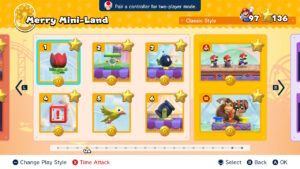 World 4: Merry Mini-LandNew · 8 levels + bonus · 4-DK: spiked barrels and Flower FansFlower Fans (4-1), carryable springs (4-2), Bob-ombs and Bob-omb Blocks (4-3), Warp Boxes (4-4), cannons and birds (4-5).
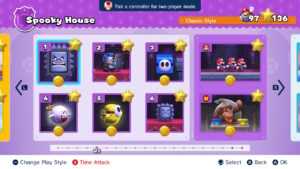 World 5: Spooky HouseGBA World 4 · 8 levels + bonus · 5-DK: throw PolterguysThwomps and Thwimps (5-1), Sir Shovalots (5-2), Polterguys (5-3), Boos (5-4).
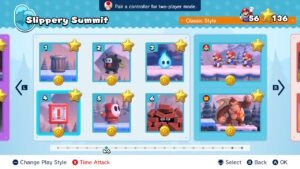 World 6: Slippery SummitNew · 8 levels + bonus · 6-DK: spiked barrels and a lift switchIce (6-1), Ninji (6-2), Icicles and icy Fireballs (6-3), Warp Boxes (6-4), Brickmen and Spike Traps (6-5).
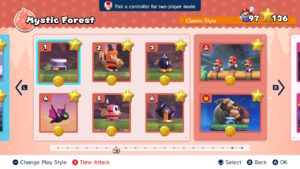 World 7: Mystic ForestGBA World 5 · 8 levels + bonus · 7-DK: Bob-ombs and reversing conveyorsDirection Switches (7-1), Spear Guys and Monchees (7-2), Bob-ombs (7-3), bats (7-4), cannons (7-6).
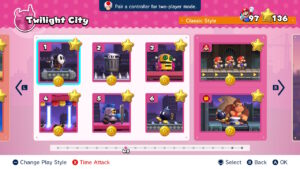 World 8: Twilight CityGBA World 6 · 8 levels + bonus · 8-DK: lasers and falling Bob-ombsLasers and Wrench Shy Guys (8-1), moving platforms and wires (8-2), Robo Kikkis (8-3, 8-4), Sir Shovalots (8-5).
 vs. Donkey KongRenamed from “Donkey Kong” · rooftop showdownRescue the three Toads from the top of an unfinished tower. Beating it opens the Plus worlds, Expert levels and Time Attack.
 Plus worldsEight worlds · six levels and a Donkey Kong fight eachLead a key-carrying Mini-Mario to the door; Merry Mini-Land Plus is set at night and Slippery Summit Plus in a blizzard.
 vs. Donkey Kong PlusFinal battleDonkey Kong’s giant robot, full of stolen Mini-Marios.
 Expert levels EX1 and EX216 levels (4 new) · 8 to 128 starsThe hardest stages, unlocked with Perfect ratings once vs. Donkey Kong is beaten.
 Bonus levels16, all newCatch a flying key and reach the chest before time runs out, collecting 1-Up Mushrooms on the way.



 Warp BoxNew. A clear box that sends Mario to the box of the same colour, switched on by Color Switches.
 Flower FanNew. Blows gusts that carry objects; turned on by the matching Color Switch.
 Ice BlockNew. Slippery frozen terrain in Slippery Summit.
 KeyFound in the first half of each main level and carried to the locked door.
 PresentsRed, yellow and blue; all three are needed for a Perfect.
 Letter BlocksT, O and Y in Mini-Mario levels; only the Minis can collect them.
 1-Up MushroomAn extra life.
 HammerKnocks out enemies; in the remake it comes back after use.
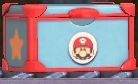 Toy boxThe goal of a Mini-Mario level, now decorated with stars.
 Color SwitchRed, yellow or blue; turns matching blocks, ladders and fans on.
 Color BlockSolid only while its switch is on; inactive ones now look like dotted outlines.
 Direction SwitchReverses moving platforms and conveyor belts.
 SpringBounces Mario up to high platforms.
 TrampolineA spring that can be picked up and thrown.
 Garbage CanCarry it, throw it or stand on it.
 BarrelCarry it, throw it or stand on it.
 Bob-omb BlockOnly a Bob-omb can break it; restyled like a cracked block from Super Mario 3D World.
 Donut BlockDrops if Mario stands on it too long; now in its Super Mario 3D Land style.
 Help BlockGives a hint when hit; some replace the old preview scenes.
 WireHang from it, travel along it and spin off it.




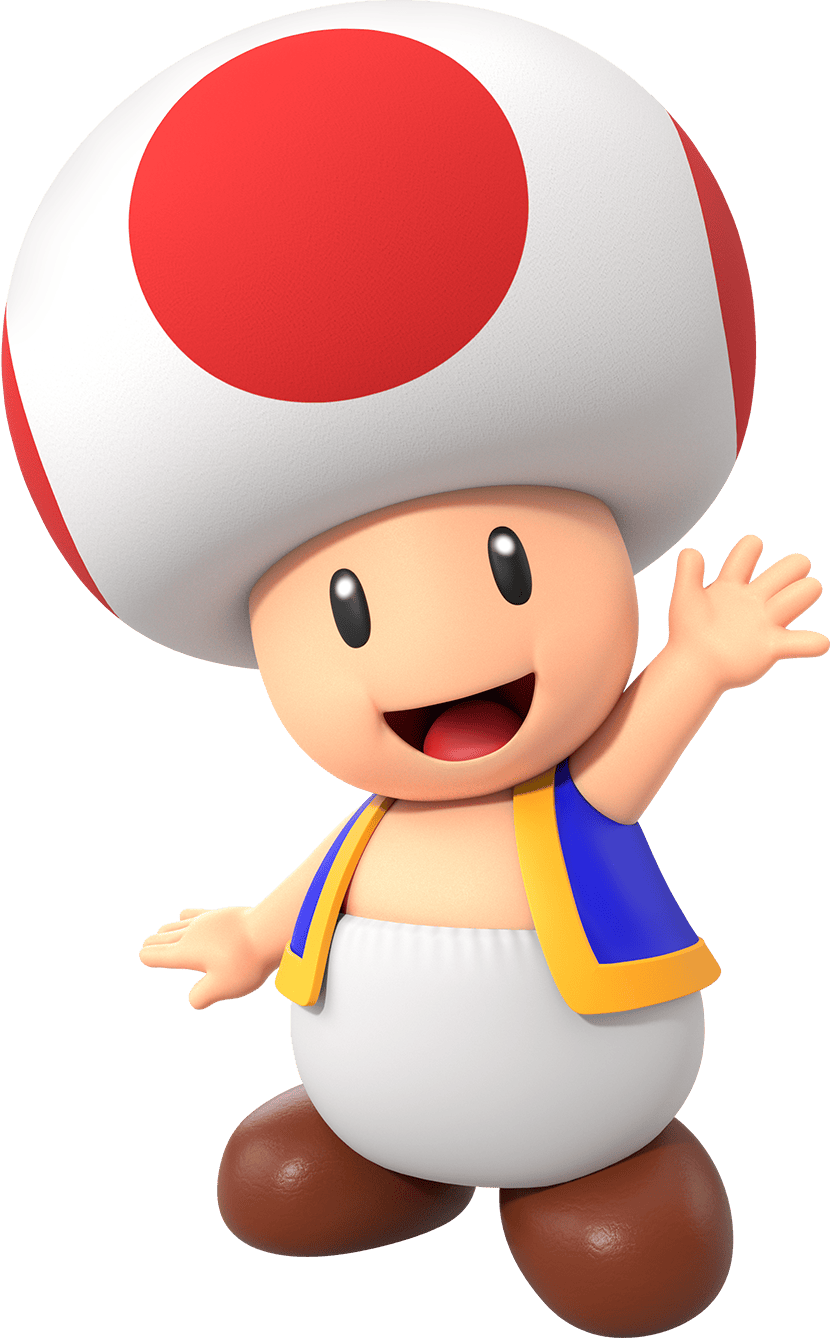 Mario Party SuperstarsNintendo Switch · 2021Toad’s artwork for this game is reused from it.
 MarioToy tycoon
 Donkey KongToy thief
 Mini-MariosThe merchandise
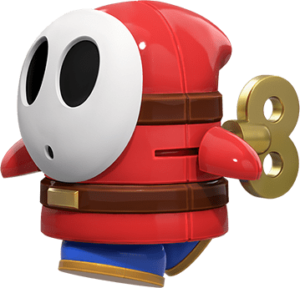 Shy GuyEnemyWind-up Shy Guys that walk the levels and can be stood on.
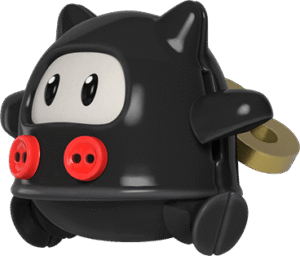 NinjiEnemyHops in place; a handy platform over spikes. Now black with red buttons.
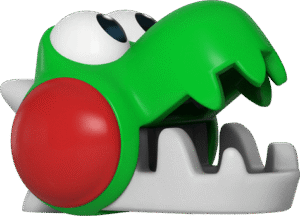 SnapjawEnemyA climbing crocodile that only falling fruit can stop.
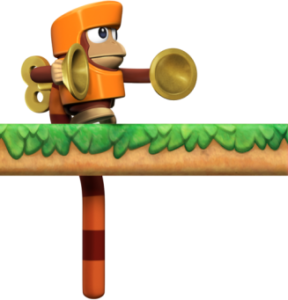 MoncheeEnemyA clockwork monkey: hang from its tail, avoid its body. Its cymbals now give off notes.
 Bucket ManEnemyAn attacking garbage can, beaten with a Hammer.
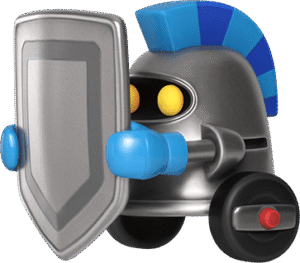 Sir ShovalotEnemyA knight who shoves Mario with his shield, now silver.
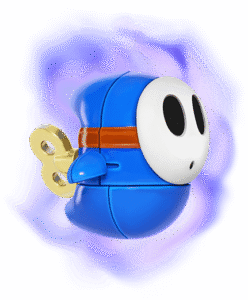 PolterguyEnemyA ghostly Shy Guy that turns into a block when a Color Switch is pressed.
 BooEnemyChases when you look away; now a toy with a sliding face.
 BatEnemySwoops across stages and knocks players off ropes.
 BirdEnemyDrops eggs; a handstand keeps Mario safe. Can now be jumped on.
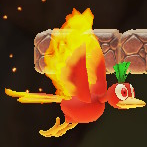 Fire birdEnemyDrops burning eggs.
 Bob-ombEnemyExplodes soon after Mario comes near; carry it to blow up other things.
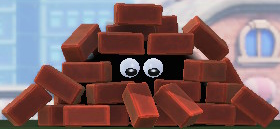 BrickmanEnemyHides in a brick pile and throws rows of bricks. Its bricks now act as eyebrows.
 Fire Shy GuyEnemyBreathes fire through its mask; now styled like a blue Snifit.
 Wrench Shy GuyEnemyThrows spanners straight at Mario.
 FireballEnemySlides along platforms; the blue Slippery Summit kind freezes Mario.
 Lava BubbleEnemyLeaps out of lava.
 RamRamEnemyCharges at Mario; can be thrown on to spikes to make a platform.
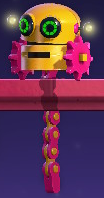 Robo KikkiEnemyA robot that works like a Monchee.
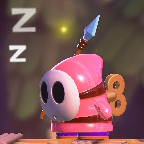 Spear GuyEnemySleeps until Mario is close, then gives chase.
 Tane PakkunEnemySpits fireballs; now a mechanical Fire Piranha Plant.
 ThwompEnemyFalls when Mario approaches; now mechanical.
 ThwimpEnemyA small hopping crusher.
 SparkObstacleRuns along wires and shocks Mario.
 SpikesObstacleFatal on contact.
 Falling spikeObstacleDrops from the ceiling; once stuck, it is a temporary platform.
 IcicleObstacleSlippery Summit’s version of the falling spike.
 CandleObstacleMoves up and down and burns; a Hammer puts it out.
 OilObstacleA burning hazard that a Hammer deals with.
 CannonObstacleTilts up and down and fires cannonballs.
 Lava GeyserObstacleErupts and lifts platforms higher.
 Thwomp PlatformObstacleA stone block that rises when stood on.
 Spiked BarrelObstacleThrown by Donkey Kong in several fights.
 Bird NestObstacleKeeps producing birds.