Nintendo 3DS2011Kart racingNintendo EAD + Retro Studios18.99 million soldBest-selling 3DS game32 courses, 17 driversGliders and underwater racingBuild-your-own karts
Mario Kart 7
Mario Kart 7 is the one where the karts grew wings. Released for the Nintendo 3DS in Japan on 1 December 2011, in Europe the next day and in North America on 4 December, the seventh Mario Kart launches its drivers off blue ramps on hang-gliders and sends them along the sea bed on propellers. It lets you bolt together your own kart from a body, tyres and a glider, puts coins back on the road for the first time since the Game Boy Advance, and offers a first-person view that you steer by tilting the console. Director Kosuke Yabuki and producer Hideki Konno were so short of staff at Nintendo EAD that they called in Retro Studios of Texas, which makes this the first Mario Kart built by two studios. Together they delivered 32 courses (16 new, 16 classics rebuilt) and 17 drivers, among them newcomers Metal Mario, Lakitu, Wiggler and Honey Queen but, notoriously, no Waluigi. It also gave the world the Maka Wuhu skip and the first patch for a 3DS game. With 18.99 million copies sold, it is the best-selling Nintendo 3DS game of them all.
Developer:Nintendo EAD with Retro Studios (Super Mario Wiki also credits Nintendo SPD Group No. 3)
Publisher:Nintendo (iQue in mainland China)
Platform:Nintendo 3DS
Genre:Kart racing
Japan:1 December 2011
Europe:2 December 2011
Australia:3 December 2011
N. America:4 December 2011
Players:1 in Grand Prix and Time Trials; up to 8 by local wireless or Download Play (online play ended on 8 April 2024)
Key staff:Yusuke Shiraiwa (programming director), Yoshihisa Morimoto (design director), Masaaki Ishikawa (characters and karts), Jun Takamura (course design lead)
Music:Kenta Nagata and Satomi Terui
Drivers:17 (8 from the start, 9 to unlock) in five weight classes
Courses:32 race courses in 8 cups (16 new, 16 classic) plus 6 battle courses; 50cc, 100cc, 150cc and Mirror
Kart parts:17 bodies, 10 sets of tyres and 7 gliders: 1,190 possible combinations
Sales:18.99 million worldwide (Nintendo, to 31 March 2026), the best-selling Nintendo 3DS game
Also released:South Korea 31 May 2012; Hong Kong and Taiwan 28 September 2012; mainland China 7 December 2012; Nintendo eShop download from October 2012 (Europe and Australia 4 October, North America 18 October, Japan 1 November)
Advertisement
Overview
Mario, Bowser, Peach, Luigi, Yoshi, Donkey Kong and Lakitu on Toad Circuit, in Nintendo’s key artwork.
Every Mario Kart has one idea that the next game cannot live without. Mario Kart 64 had hills, Mario Kart DS had online play and retro cups, Mario Kart Wii had tricks. Mario Kart 7 has the third dimension in the most literal sense: hit a blue Glide Ramp and a hang-glider snaps open above your kart; drive into a lake and, instead of Lakitu fishing you out, a propeller pops from the back and you carry on along the bottom. Water had been a hazard for nineteen years. Here it is just more road.
The second big idea is the garage. Karts are no longer chosen whole but assembled from a body, a set of tyres and a glider, each of which nudges your speed, acceleration, weight, handling and off-road grip, and behaves differently again in the air and under water. You begin with a handful of parts and win the rest by collecting coins, which are back on the track for the first time since Super Circuit and make you a little faster with every one you hold, up to ten.
Around those two ideas Nintendo and Retro Studios built 32 courses. Sixteen are new, including a neon city in the rain, a musical circuit made of pianos and tambourines, a jungle borrowed from Donkey Kong Country Returns and two long journeys across Wuhu Island from Wii Sports Resort that swap three laps for one lap in three sections. Sixteen are classics from every earlier game, rebuilt with ramps and flooded basements to suit the new tricks. Eight karts race at a time (down from twelve on the Wii), in 3D, at 60 frames a second, and the bikes of the last game are nowhere to be seen.
It was also the most connected Mario Kart yet. Up to eight people could race by local wireless, by Download Play from a single game card or over the internet, where Communities let anyone set up a private club with its own rules. StreetPass and SpotPass delivered ghosts to race, seven at a time. And the game arrived when the 3DS badly needed it, in the same season as Super Mario 3D Land and soon after the price of the console had been cut. Critics found it polished but familiar. Players bought 18.99 million copies, which is more than any other game on the system.
Why Mario Kart 7 matters to Mario fans
Gliders, underwater driving and build-your-own karts all start here, and Mario Kart 8 kept every one of them. It is the game that made Lakitu, Wiggler, Metal Mario and Honey Queen into racers, gave Shy Guy a proper place on the grid and left Waluigi out for the only time since he joined the series. It helped to turn the 3DS around alongside Super Mario 3D Land, and it was the first Mario Kart directed by Kosuke Yabuki, who went on to direct Mario Kart 8. Fourteen of its sixteen new courses have been raced again in later games. The two set on Wuhu Island never have, which makes this cartridge the only place to drive them.
The title screen. Later ones are unlocked as you play.Mario and Luigi glide behind Peach’s Castle on Mario Circuit.Mario about to take the plunge on Cheep Cheep Lagoon.The first-person view, a first for the series.
“We wanted it to be instantly enjoyable, but deep.”
Kosuke Yabuki in Iwata Asks: Mario Kart 7, Volume 2, Nintendo, 2011.
Director Kosuke Yabuki, explaining to Satoru Iwata how the team chose what to add (flying, diving, coins and kart customising) and what to leave out of the seventh Mario Kart.
Quick Answers
The questions people ask most about Mario Kart 7, answered briefly here and in depth further down the page.
When did Mario Kart 7 come out?
Japan: 1 December 2011. Europe: 2 December 2011. Australia: 3 December 2011. North America: 4 December 2011. A download version followed on the Nintendo eShop in October and November 2012. More →
How many courses are there?
Thirty-two race courses in eight cups of four. The Mushroom, Flower, Star and Special Cups hold 16 new courses; the Shell, Banana, Leaf and Lightning Cups hold 16 classics from the six earlier games. There are also six battle courses, three new and three old. More →
Who are the drivers?
Seventeen. Mario, Luigi, Peach, Yoshi, Bowser, Donkey Kong, Toad and Koopa Troopa are there from the start. Daisy, Wario, Rosalina, Metal Mario, Shy Guy, Honey Queen, Wiggler and Lakitu are each unlocked by winning one of the eight cups at 150cc, and your Mii by finishing every cup in any one engine class. More →
Why is Waluigi not in Mario Kart 7?
Nintendo has never said. He is the only regular to miss out: this is the one mainline Mario Kart since Double Dash!! without him, although his course, Waluigi Pinball, is in the Banana Cup. More →
How do you unlock kart parts?
By collecting coins in Grand Prix races, ten at most per race. A randomly chosen part is handed over at set totals from 50 up to 4,500 coins. The gold parts have their own conditions, such as 20,000 coins or an online rating of 10,000 VR for the Gold Standard body. More →
What is the Maka Wuhu glitch?
A skip on the Star Cup’s last course. Hopping into the water at one spot early in the second section made Lakitu put you back much further along, saving about 20 seconds. Nintendo first said it would not be fixed, then removed it from online play with an update on 15 May 2012. It still works offline. More →
Which items are new?
Three: the Fire Flower (a stream of bouncing fireballs), the Super Leaf (a raccoon tail that swats rivals and items) and the Lucky Seven, which surrounds your kart with seven items at once. More →
Did Retro Studios really make Mario Kart 7?
It made about half of the courses. The Texan studio behind Metroid Prime started work in December 2010, first rebuilding the 16 classic courses and then designing new ones, DK Jungle among them. Nintendo EAD in Kyoto led the project and made everything else. More →
How many copies did it sell?
According to Nintendo’s own figures, 18.99 million, which makes it the best-selling game on the Nintendo 3DS, ahead of Pokémon X and Y. More →
Can you still play it online?
Not officially. Nintendo switched off online play for Nintendo 3DS software on 8 April 2024. Grand Prix, Time Trials, local wireless races and Download Play all still work. More →
Cups & Courses
Mario, Bowser and Luigi on Toad Circuit in Nintendo’s promotional artwork.
Mario Kart has no plot, only trophies. Mario Kart 7 has eight of them. The Mushroom, Flower, Star and Special Cups contain the 16 new courses; the Shell, Banana, Leaf and Lightning Cups contain 16 classics: four each from Mario Kart Wii and Mario Kart DS, three from Mario Kart 64, two each from Super Mario Kart and Double Dash!! and one from Super Circuit. Each cup can be run at 50cc, 100cc and 150cc, and then again in Mirror.
Only the Mushroom and Shell Cups are open when you start. Three courses (Wuhu Loop, Maka Wuhu and Rainbow Road) throw out the three-lap rule and run as a single lap divided into three sections. And this is the Mario Kart with the most disagreement about names: eight race courses and one battle course are called something different in the British version, so both names are given below.
Mushroom Cup: learning to fly, learning to swim
The first cup is a tutorial in disguise. Toad Circuit is a plain loop past giant mushrooms and three enormous Toad balloons, with a single Glide Ramp that lifts you over a flyover so that you can see how the wings work. Daisy Hills is an Alpine-looking village with windmills, where goats wander across the road and the big glide takes you over a lake full of hot-air balloons. Bounce off the top of one and it throws you forward.
Cheep Cheep Lagoon (Cheep Cheep Cape in the UK) is the game’s first trip under water: over a bridge with a sign reading Go! Dive! Go!, down among the seaweed and the giant clams, and up through a cave of stalactites. Shy Guy Bazaar ends the cup in an Arabian night market, where the stalls split the road, snakes sway out of jars and Shy Guys on flying carpets drift across the final glide. It was drawn as a daytime course until Retro Studios artist Ted Anderson set it after dark.
The Mushroom Cup.Toad Circuit.Daisy glides past the windmills of Daisy Hills.Cheep Cheep Lagoon.Shy Guy Bazaar.
Flower Cup: an island, a castle, a piano and a mountain
Wuhu Loop (Wuhu Island Loop) is one long lap of the island from Wii Sports Resort, starting in the town, crossing the red iron bridge and climbing past the lighthouse while cars and pick-up trucks use the same road. Its music is an arrangement of the Wii Sports Resort title theme. Mario Circuit spirals up through the inside of Peach’s Castle and throws you out of it on a Glide Ramp, then finishes through a pipe big enough to drive in.
Music Park (Melody Motorway) floats in space and is built from instruments. You drive along a piano keyboard and across xylophones, tambourines bounce you like trampolines, big Piranha Plants snap from the verges and, near the end, giant musical notes hop on the spot and flatten anyone underneath. Rock Rock Mountain (Alpine Pass) is a climb in three acts: a cave full of Swoops, a long glide down into a forest of fallen trunks and a steep final ascent on Dash Panels while boulders roll down to meet you.
The Flower Cup.Wuhu Loop.Leaving the castle on Mario Circuit.Peach on the piano at Music Park.Wiggler drifts through the woods on Rock Rock Mountain.
Star Cup: pipes, wrecks, rain and a volcano
Piranha Plant Slide (Piranha Plant Pipeway) is the underground of the original Super Mario Bros. turned into a water chute, complete with blue Goombas, rows of blocks hanging in the air and a flooded pipe to finish. Even the bushes and clouds share one shape, as they did in 1985. Wario Shipyard (Wario’s Galleon) winds through a graveyard of wrecked ships, much of it under water, with a tunnel shaped like a Fish Bone and patrolled by real ones, a swinging anchor and a glide between the sails.
Neo Bowser City (Koopa City) is the stylish one: a neon metropolis in a downpour, all sweeping bends and no margin for error, with puddles on the last corner that spin you like oil. Its music quotes Toad’s Turnpike. Then comes Maka Wuhu (Wuhu Mountain Loop), the second Wuhu Island course and the most notorious track in the game. It runs from the beach, through a cave and along the cliffs above the lake, up the volcano past falling rocks and off the top by glider. It is also where players found the skip that Nintendo eventually had to patch.
The Star Cup.Mario lets fly on Piranha Plant Slide.Wario and Bowser at Wario Shipyard.Bowser in Neo Bowser City.Evening on Maka Wuhu.
Special Cup: jungle, ice, fire and stars
DK Jungle is Retro Studios bringing its own game to the party. It is the world of Donkey Kong Country Returns, with Tiki Goons patrolling the road, Frogoons hopping across it, DK’s treehouse by the track, and a glide into the Golden Temple where Screaming Pillars try to blow you off course. The music is DK Island Swing. Rosalina’s Ice World is a frozen world with the Comet Observatory from Super Mario Galaxy hanging in the sky, with penguins on the ice, a dive beneath it and a cave of icicles.
Bowser’s Castle starts with a flight in through the front door and then gets worse: staircases guarded by Thwomps, a hall of lava, a tunnel turned by a paddle wheel and a flooded chamber with lava pouring into it from pipes. And Rainbow Road is a single lap in three parts that leaves the track altogether. You glide on to the rings of a ringed planet, bounce across the surface of a moon in low gravity among rolling Chomps, and corkscrew through a tube on the way home.
The Special Cup.Metal Mario, Yoshi and Bowser in DK Jungle.Rosalina on her own Ice World.Bowser at home.Honey Queen on Rainbow Road.
Shell Cup: four gentle classics
The retro half opens with N64 Luigi Raceway, still an oval with a tunnel, though the balloon that once dangled a guaranteed Spiny Shell now carries a Mii and an ordinary Item Box. GBA Bowser Castle 1 is rebuilt in full 3D, with a Glide Ramp at the lava jumps near the end. Wii Mushroom Gorge keeps its bouncing toadstools and turns one of them, in the cave, into a blue launch pad for the glider.
DS Luigi’s Mansion was the first course Retro Studios worked on. Artist Ryan Powell went back to both the DS original and the GameCube game it is based on, and the rebuilt foyer now matches the real mansion. The portraits on the walls have become Boos that pop out at you, an idea that had been cut from the DS version, and the walking trees still wander across the road to the finish.
The Shell Cup.Koopa Troopa on N64 Luigi Raceway.Gliding through GBA Bowser Castle 1.Wii Mushroom Gorge.Luigi and Koopa Troopa in DS Luigi’s Mansion.
Banana Cup: sand, tarmac, shops and pinball
N64 Koopa Troopa Beach (Koopa Beach in the UK) brings back the beach and its scuttling Sidesteppers. SNES Mario Circuit 2 is the flat original given real height, three laps instead of five and a Glide Ramp on its famous jump, with the oil slicks and pipes left where they were.
Wii Coconut Mall swaps the Dash Panels at its exits for Glide Ramps and floods the level beneath the glass floor, and the cars in the car park are still waiting to reverse into you. DS Waluigi Pinball fires you up the launch tube by glider and then lets the table do its worst with bumpers, flippers and giant steel balls. Waluigi himself, of course, is not here to see it.
The Banana Cup.SNES Mario Circuit 2.Peach in Wii Coconut Mall.Wario on DS Waluigi Pinball.
Leaf Cup: trains, snow, a liner and a very big tree
N64 Kalimari Desert has shorter, slower trains than in 1996 (three carriages instead of five) and two Glide Ramps that carry you over the railway. The tunnel that speedrunners once used is now out of bounds. DS DK Pass is a snowy climb with snowballs rolling down it and a Glide Ramp where its big jump used to have a Dash Panel, and the fog lifts for the final lap.
GCN Daisy Cruiser makes the best use of the new rules of any classic: the swimming pool can be driven through and the hold below decks has become an aquarium, home to giant clams and an eel. Wii Maple Treeway, the longest of the 16 classics, sends you by cannon and glider into the crown of an autumn tree where two giant Wigglers stroll along the branches.
The Leaf Cup.Shy Guy in the Cact-X on N64 Kalimari Desert.DS DK Pass.The start on GCN Daisy Cruiser.Yoshi in the Bumble V on Wii Maple Treeway.
Lightning Cup: the hard ones
Wii Koopa Cape has lost the roof of its glass tunnel, so the river ride now ends under water among Cheep Cheeps. GCN Dino Dino Jungle gains Glide Ramps around its cave, and its long-necked dinosaur can still put a foot down on you or get its head in the way of your flight.
DS Airship Fortress swaps its Bullet Bills for huge Banzai Bills and the cannon up to the tower for a glider launch. And the last race of all is the first Rainbow Road. SNES Rainbow Road is still flat and still has no walls, but the Thwomps are fewer and bigger: seven where there were sixteen, each one sending a ripple down the track when it lands.
The Lightning Cup.Koopa Troopa on Wii Koopa Cape.Yoshi on GCN Dino Dino Jungle.Metal Mario on DS Airship Fortress.Donkey Kong and Lakitu on SNES Rainbow Road.
The six battle courses
Three arenas are new. Honeybee Hive (Honeybee House in the UK) is a honeycomb of chambers with sticky honey on the floor, a pipe in the middle that blows you across the room and a swarm of Stingbies to avoid. Sherbet Rink is an ice rink shared with wandering penguins. Wuhu Town is the town square of Wuhu Island, and it returned in Mario Kart 8 Deluxe.
Three are old friends: GBA Battle Course 1, N64 Big Donut and DS Palm Shore. All six are open from the start.
Honey Queen in Honeybee Hive.Mario on Sherbet Rink.Yoshi in Wuhu Town.GBA Battle Course 1.Bowser on N64 Big Donut.Luigi on DS Palm Shore.
Every course in Mario Kart 7
All 32 race courses in cup order. For the new courses the notes give the British name where it differs and where each has been raced since; for the classics, the game they first appeared in.
Toad CircuitMushroom Cup · new · later in Mario Kart Tour and 8 DeluxeA simple loop with one Glide Ramp over a flyover, watched by three giant Toad balloons.
Daisy HillsMushroom Cup · new · later in Mario Kart TourAn Alpine village with goats on the road and hot-air balloons over the lake.
Cheep Cheep LagoonMushroom Cup · new · UK: Cheep Cheep Cape · later in Mario Kart TourThe first underwater drive in the game, past clams that snap shut on the unwary.
Shy Guy BazaarMushroom Cup · new · later in Mario Kart Tour and WorldA night market of jars, snakes and Shy Guys on flying carpets.
Wuhu LoopFlower Cup · new · UK: Wuhu Island Loop · never remadeOne lap of Wuhu Island in three sections, shared with ordinary traffic.
Mario CircuitFlower Cup · new · later in Mario Kart TourUp through Peach’s Castle, off the roof by glider and home through a giant pipe.
Music ParkFlower Cup · new · UK: Melody Motorway · later in Mario Kart 8 and 8 DeluxePiano keys, tambourine trampolines and bouncing notes that squash you.
Rock Rock MountainFlower Cup · new · UK: Alpine Pass · later in Mario Kart Tour and 8 DeluxeA cave of Swoops, a long glide and a climb against rolling boulders.
Piranha Plant SlideStar Cup · new · UK: Piranha Plant Pipeway · later in Mario Kart 8, 8 Deluxe and TourThe underground of Super Mario Bros. as a water slide, with blue Goombas and a flooded pipe.
Wario ShipyardStar Cup · new · UK: Wario’s Galleon · later in Mario Kart Tour and WorldA graveyard of wrecked ships, much of it under water, with a swinging anchor and Fish Bones.
Neo Bowser CityStar Cup · new · UK: Koopa City · later in Mario Kart 8 (DLC), 8 Deluxe and TourA neon city in the rain, with puddles waiting on the final bend.
Maka WuhuStar Cup · new · UK: Wuhu Mountain Loop · never remadeBeach to volcano in three sections, and the home of the game’s most famous glitch.
DK JungleSpecial Cup · new · later in Mario Kart 8 and 8 DeluxeRetro Studios’ tribute to Donkey Kong Country Returns, Tikis and all.
Rosalina’s Ice WorldSpecial Cup · new · later in Mario Kart Tour and 8 DeluxePenguins, icicles and a dive under the ice. The only new course without a glide.
Bowser’s CastleSpecial Cup · new · later in Mario Kart TourThwomps on the stairs, a paddle-wheel tunnel and a lake fed by lava.
Rainbow RoadSpecial Cup · new · later in Mario Kart Tour and 8 DeluxeOne lap in three sections: the rings of a planet, the surface of a moon and a spinning tube.
N64 Luigi RacewayShell Cup · classic · from Mario Kart 64The 1996 opener, with no gliding or diving at all.
GBA Bowser Castle 1Shell Cup · classic · from Mario Kart: Super CircuitThwomps, Lava Bubbles and a new glide across the lava jumps.
Wii Mushroom GorgeShell Cup · classic · from Mario Kart WiiBouncy toadstools over a canyon, one of them now a glider launch.
DS Luigi’s MansionShell Cup · classic · from Mario Kart DSThrough the haunted house and out past the walking trees.
N64 Koopa Troopa BeachBanana Cup · classic · from Mario Kart 64 · UK: N64 Koopa BeachSun, sand and Sidesteppers.
SNES Mario Circuit 2Banana Cup · classic · from Super Mario KartThe 1992 circuit with real height and a glider on its big jump.
Wii Coconut MallBanana Cup · classic · from Mario Kart WiiEscalators, shop fronts and a car park full of bad drivers.
DS Waluigi PinballBanana Cup · classic · from Mario Kart DSA pinball table from the inside. Its owner is absent.
N64 Kalimari DesertLeaf Cup · classic · from Mario Kart 64Two trains, two crossings and two new glides over the rails.
DS DK PassLeaf Cup · classic · from Mario Kart DSA snowy mountain road with rolling snowballs.
GCN Daisy CruiserLeaf Cup · classic · from Mario Kart: Double Dash!!A cruise liner whose pool and hold you can now drive through under water.
Wii Maple TreewayLeaf Cup · classic · from Mario Kart WiiAutumn leaves, a cannon and giant Wigglers in the treetops.
Wii Koopa CapeLightning Cup · classic · from Mario Kart WiiA river, a waterfall and an underwater tunnel without its roof.
GCN Dino Dino JungleLightning Cup · classic · from Mario Kart: Double Dash!!Geysers, rope bridges and a dinosaur with heavy feet.
DS Airship FortressLightning Cup · classic · from Mario Kart DSBanzai Bills, Rocky Wrenches, flame jets and a glide to the tower.
SNES Rainbow RoadLightning Cup · classic · from Super Mario KartNo walls, no mercy and seven outsized Thwomps.
The six battle courses (Honeybee Hive, Sherbet Rink, Wuhu Town, GBA Battle Course 1, N64 Big Donut and DS Palm Shore) are described above. Of the 16 new race courses, Mario Kart Tour has revisited all but Wuhu Loop, Music Park, Maka Wuhu and DK Jungle.
Advertisement
Gameplay & Controls
Underneath the new toys this is Mario Kart as it has always been: three laps, Item Boxes, a drift round every corner and somebody ruining your afternoon with a shell. Eight karts start each race, four fewer than in Mario Kart Wii, and that game’s bikes have been left in the shed.
What has changed is where a race can go. Courses now have routes through the air and under water as well as along the ground, and the kart you built on the menu decides which of the three you are best at.
Driving, drifting and jump actions
Mario in the Standard kart, in Nintendo’s artwork.
A or Y accelerates, B brakes and reverses, and the Circle Pad steers. R makes the kart hop, and holding it through a corner turns the hop into a drift that pays out a Mini-Turbo when you let go. L or X uses whatever item you are holding. Keep the accelerator pressed from the moment the countdown shows 2 and you leave the line with a Rocket Start.
Tricks from Mario Kart Wii survive under a new name. Press R as you leave a ramp or a bump and your driver throws a pose called a jump action, which is now the only way to earn a Jump Boost on landing. Do it on a Glide Ramp and you get a burst of speed as the glider opens. And if Lakitu has to put you back on the road, pressing the accelerator the instant your wheels touch down gets you moving again with a small boost.
The lower screen shows a map of the course that covers a wider area than before, though it no longer marks hazards. Lakitu’s lap boards now read 2/3 and 3/3, and ordinary races no longer show a running clock.
A Rocket Start, seen from the driving seat.Eight on the grid: four fewer than on the Wii.
Gliders and propellers
Mario and the Super Glider.
Blue Glide Ramps are dotted around almost every course. Drive off one and the glider on top of your kart unfolds, and for a few seconds you are flying. Push the Circle Pad forward to dive, pull back to float and stay up longer, and press B to fold the wings and drop. Flights are where many of the best shortcuts hide, and they are scattered with coins: Yabuki worried that players would have nothing to do with their hands in mid-air, so the team gave them something to steer for.
Water works the same trick in reverse. Where a road dips below the surface a propeller appears at the back of the kart and you simply keep driving, a little more floatily than on land. Some courses run almost entirely along the sea bed. Both ideas had been in Yabuki’s head since before the team was formed, and he first demonstrated them by modifying Mario Kart Wii.
Under the bonnet, every driver and every part carries separate figures for speed and handling on land, in water and in the air, so a combination that flies along a road may wallow in a lagoon. Rosalina’s Ice World is the only new course with no gliding at all, and two of the classics, Luigi Raceway and the Super NES Rainbow Road, have neither gliding nor diving.
Propeller out: Mario under water in the official artwork.Peach dives into Cheep Cheep Lagoon.Donkey Kong glides for coins above Rock Rock Mountain.
Coins
Coins lie on the track, hang in the air and sit on the sea bed. Each one gives a tiny boost as you collect it and raises your top speed a notch, up to a limit of ten; anything beyond that is ignored. Get hit by an item or fall off the course and some of them spill.
They are also the game’s currency. Every coin you finish a Grand Prix race with is banked, and the running total is what unlocks new kart parts. According to the developers, coins had been tried and dropped in earlier sequels because they were always added late and ran out of time. This time programming director Yusuke Shiraiwa insisted that they went into the very first experiments.
Building a kart
The kart-building screen.
Before each race you pick a body, a set of tyres and a glider. There are 17 bodies, 10 sets of tyres and 7 gliders, which makes 1,190 possible karts. You start with three bodies (Standard, Birthday Girl and Bolt Buggy), three sets of tyres (Standard, Roller and Monster) and the Super Glider.
Bodies set the character of the machine: the B Dasher and Bruiser are quick on land, the Egg 1 and Tiny Tug come into their own under water, and the Bumble V, Barrel Train and Koopa Clown give the longest Mini-Turbos. Tyres trade speed for grip. Slicks and the Gold Tires are fastest on tarmac and hopeless on grass, Monster tyres are heavy and shrug off rough ground, and little Roller wheels accelerate and corner best of all. Gliders matter least, but the Peach Parasol and Flower Glider steer more sharply in the air while the Super Glider is quicker.
Thirteen bodies, six sets of tyres and four gliders are handed out at random as your coin total climbs; the gold parts and the Beast Glider have conditions of their own, listed under Cheats & Secrets. The Standard body, the Pipe Frame and the Super Glider change colour to suit whoever is driving. Yabuki expected people to treat parts “like fashion items”, and the game obliges by showing your chosen kart to everyone you meet by StreetPass.
Several parts have different names in Europe: the Birthday Girl is the Royal Ribbon, the Bruiser is the Growlster, the Zucchini is the Gherkin, the Swooper glider is the Swoop, the Paraglider is the Parafoil and the Beast Glider is the Ghastly Glider.
Standard, in Toad’s colours.B Dasher, back from Mario Kart DS.Bumble V.Roller tyres.Monster tyres.Super Glider.Peach Parasol.
The view from the driving seat
Press Up on the +Control Pad and the camera moves inside the kart. In this first-person view you can steer by tilting the whole console like a wheel, using its gyro sensor, or carry on with the Circle Pad. It is the first driver’s-eye camera in any Mario Kart.
It began as a gyro experiment in the usual chase view, which the team felt was wrong, so the camera was moved to match. That caused two problems. The steering wheel had never been modelled to be seen so close, and spinning the whole picture when you hit a banana made producer Hideki Konno dizzy after a single race. The finished game pulls the camera back out whenever you are hit and lets only the kart spin. Online, other players can see that you are driving this way, and anyone who does it often enough earns a gold steering wheel.
Gliding for coins in first-person view.Lakitu at the wheel on Kalimari Desert.
Grand Prix, Time Trials and Battle
Grand Prix is the one-player championship: eight cups of four races against seven computer drivers at 50cc, 100cc or 150cc, with Mirror to unlock. Points run 10, 8, 6, 5, 4, 3, 2 and 1 from first to eighth, so every place scores, and at the end you are given a trophy and a rank of up to three stars. Only the Mushroom and Shell Cups are open at first; winning one opens the next. A course you have unlocked can be used in every mode.
Time Trials hands you three Mushrooms and an empty road. Every course has a staff ghost to beat and a faster expert ghost behind it, and ghosts collected from other players by StreetPass or SpotPass can be raced up to seven at a time, which makes a full grid of eight.
Battle comes in two forms, each a two-minute scramble on one of six arenas. In Balloon Battle everyone starts with three balloons and scores a point for each hit they land; lose all three and you lose half your points, then return with a fresh set. Coin Runners (Coin Battle in the UK) is won by whoever is holding the most coins when time runs out, with a limit of ten at once. For the first time you can battle in any kart you have built instead of a standard one.
There is no one-player VS race against the computer, the only game since Mario Kart DS to lack one, and DS’s mission mode has not returned either. VS exists for multiplayer only.
The main menu.A free-for-all Balloon Battle.Team Coin Runners.
Multiplayer, Communities and the Mario Kart Channel
Up to eight consoles can link by local wireless. Only one of them needs a game card: the rest can join by Download Play, in which case they all drive as Shy Guy in different colours and cannot customise their karts, though every course is available.
Online play offered worldwide races and battles for eight, scored with a single rating called VR that started at 1,000 and went up or down with every result. The cleverer idea was Communities: anyone could found a club, set its rules (bananas only, say, or nothing but Bob-ombs) and hand out its code for others to join. Community races did not affect your VR. Yabuki had wanted a feature like that built into the 3DS itself, ran out of time, and by his own account said: “I’ll do it with Mario Kart 7.”
The Mario Kart Channel collected everything that arrived by StreetPass and SpotPass: other players’ Miis, their ghosts, their favourite kart and a nickname summing up their habits. Nintendo ended online play for the 3DS on 8 April 2024, which closed worldwide races and Communities for good. Everything local still works.
Finding opponents around the world.Nintendo’s own picture of how online play worked.
Every item in Mario Kart 7
Eighteen items come out of the Item Boxes, three of them new. Out go the Fake Item Box and Boo, along with Mario Kart Wii’s Mega Mushroom, POW Block and Thunder Cloud. The Spiny Shell has lost its wings again and now skims along the road as it did on the Nintendo 64, bowling over anyone in its path before it blows up the leader. The warning chime only sounds for a Spiny Shell or a Bullet Bill.
CoinFound on the course, not in boxes. Each one adds a little top speed, up to ten.
BananaDrop it or hold it behind you as a shield.
Triple BananasThree peels trailing behind the kart.
Green ShellFlies straight and bounces off walls.
Triple Green ShellsThree shells circling the kart until fired.
Red ShellHomes in on the next kart ahead.
Triple Red ShellsThree homing shells in orbit.
Spiny ShellHunts the leader along the ground and explodes. Never appears in the first 30 seconds.
Bob-ombThrow it forwards or drop it behind. Blows up whoever is near.
MushroomOne burst of speed that ignores rough ground.
Triple MushroomsThree boosts. What you are given in Time Trials.
Golden MushroomAs many boosts as you can press for in seven and a half seconds.
Bullet BillTurns you into a rocket on autopilot that flattens everything.
BlooperSquirts ink over the screens of everyone ahead.
LightningShrinks and slows every rival and makes them drop their items.
Super StarSeven and a half seconds of speed and invincibility.
Fire FlowerNew. Throw up to ten bouncing fireballs, forwards or backwards.
Super LeafNew. A raccoon tail that swats karts, deflects items and sweeps up coins.
Lucky SevenNew. Seven items circle your kart at once: Mushroom, Banana, Green Shell, Red Shell, Blooper, Bob-omb and Star.
Item BoxDrive through one to spin the roulette. The further back you are, the better the odds.
Cartoons, Comics & Other Media
Mario Kart 7 had no cartoon or comic of its own, but it did get two real karts, a stage in Super Smash Bros. and a long afterlife in the games that followed.
The West Coast Customs kartsPromotion · Los Angeles Auto Show · November 2011Nintendo of America commissioned the car builders West Coast Customs to make two life-size, electric versions of karts from the game: Mario’s Standard kart with a glider on top and Luigi’s Bumble V with a propeller at the back. They were on show at the Los Angeles Convention Center from 18 to 27 November 2011, alongside playable copies of the game, and the Mario kart was then offered as a prize to members of GameStop’s rewards scheme. “Mario karts offer more fun per mile than any other vehicle,” said Nintendo of America president Reggie Fils-Aime. Neither one could fly.
Japanese television advertsAdvertising · 2011For its Japanese commercials Nintendo had a full-size Standard kart built as a prop by the model makers Takahashi Art.
Wheels, bundles and a guideMerchandiseThe game was sold in Japan and Europe in a pack with a steering-wheel accessory. It was later pre-installed on blue Nintendo 3DS XL consoles in Canada, south-east Asia and the Middle East and on a New Nintendo 2DS LL in Japan, and paired with Mario & Luigi: Paper Jam in a Japanese double pack. Prima Games published the official guide.
StreetPass Mii PlazaCameo · Puzzle SwapA Mario Kart 7 picture was added to Puzzle Swap, the jigsaw game inside StreetPass Mii Plaza.
Super Smash Bros. for Nintendo 3DSStage · 2014This game’s Rainbow Road is a stage in the 3DS Smash Bros., with its music to match, and both the 3DS and Wii U versions include trophies based on the game. The Wii U game’s Mario Circuit stage plays an arrangement of the Mario Kart 7 circuit theme.
Donkey Kong Country: Tropical FreezeCameo · 2014Leave Donkey Kong standing still in Retro Studios’ next game and he passes the time with a game of Mario Kart 7, playing as himself.
In later Mario Kart gamesCourses, karts and musicMario Kart Arcade GP DX borrowed the gliders and underwater driving. Mario Kart 8 kept both, along with kart customising and many of the parts, and brought back Music Park, Piranha Plant Slide and DK Jungle, with Neo Bowser City following as downloadable content. Mario Kart 8 Deluxe added Wuhu Town for battles and, in its Booster Course Pass, Toad Circuit, Rock Rock Mountain, Rosalina’s Ice World and Rainbow Road. Mario Kart Tour ran 12 of the 16 new courses and all 16 classics. Mario Kart World has Shy Guy Bazaar and Wario Shipyard, the Bumble V and Cloud 9, and new arrangements of eight of this game’s course themes.
The soundtrackMusic · Nintendo Music, 2025Kenta Nagata and Satomi Terui’s score was added to the Nintendo Music app on 30 April 2025.
Characters
Seventeen drivers, eight of them available from the start: the cast of Super Mario Kart, with Donkey Kong in place of Donkey Kong Jr. The other nine are unlocked. There are five weight classes (Feather, Light, Medium, Cruiser and Heavy), and every driver in a class gets identical bonuses, so the choice within a class is a matter of taste. The figures below are those bonuses as listed by Super Mario Wiki, out of a possible 4 for speed, 8 for acceleration, 8 for weight, 2 for handling and 2 for off-road. In Grand Prix each driver also has two particular rivals among the computer players.
Character
Who they are
In this game
Abilities & notes
MarioMedium · starter
The all-rounder, voiced as ever by Charles Martinet.
Rivals: Metal Mario and Bowser. He drives the staff ghosts on Mario Circuit and SNES Mario Circuit 2.
Speed 2 · Acceleration 4 · Weight 4
Handling 1 · Off-road 1
LuigiMedium · starter
Mario’s brother, with the same figures in a greener kart.
Rivals: Mario and Daisy. Staff ghosts on N64 Luigi Raceway and DS Luigi’s Mansion, both of them his own courses.
Speed 2 · Acceleration 4 · Weight 4
Handling 1 · Off-road 1
PeachLight · starter
The princess of the Mushroom Kingdom, voiced by Samantha Kelly.
Rivals: Lakitu and Donkey Kong. Her castle is the centrepiece of Mario Circuit. The Birthday Girl body and Peach Parasol glider come in her pink unless one of the other women is driving.
Speed 1 · Acceleration 6 · Weight 2
Handling 2 · Off-road 1
YoshiLight · starter
Mario’s dinosaur friend, voiced by Kazumi Totaka.
Rivals: Wiggler and Toad. Staff ghosts on Maka Wuhu and GCN Dino Dino Jungle.
Speed 1 · Acceleration 6 · Weight 2
Handling 2 · Off-road 1
BowserHeavy · starter
The Koopa King, voiced by Kenny James.
Rivals: Mario and Rosalina. He has three courses to his name: Bowser’s Castle, Neo Bowser City and GBA Bowser Castle 1.
Speed 4 · Acceleration 0 · Weight 8
Handling 0 · Off-road 0
Donkey KongCruiser · starter
The king of the jungle, fresh from Donkey Kong Country Returns and voiced by Takashi Nagasako.
Rivals: Wario and Koopa Troopa. DK Jungle was built for him by the studio that made his last game. The Cruiser class sits between Medium and Heavy.
Speed 3 · Acceleration 2 · Weight 6
Handling 0 · Off-road 1
ToadFeather · starter
Peach’s loyal attendant and the smallest target on the grid.
Rivals: Rosalina and Peach. Toad Circuit, the first course in the game, is his.
Speed 0 · Acceleration 8 · Weight 0
Handling 2 · Off-road 2
Koopa TroopaFeather · starter
One of the original eight from 1992, making his first appearance in a handheld Mario Kart.
Rivals: Yoshi and Shy Guy. Staff ghosts on N64 Koopa Troopa Beach and Wii Koopa Cape.
Speed 0 · Acceleration 8 · Weight 0
Handling 2 · Off-road 2
DaisyLight · unlock: win the 150cc Mushroom Cup
The princess of Sarasaland, voiced by Deanna Mustard.
Rivals: Peach and Wario. Daisy Hills and GCN Daisy Cruiser are hers. Sponsor boards with her name replaced ones for a made-up oil company on Daisy Hills late in development.
Speed 1 · Acceleration 6 · Weight 2
Handling 2 · Off-road 1
WarioHeavy · unlock: win the 150cc Flower Cup
Mario’s greedy rival, here without his usual partner.
Rivals: Luigi and Mario. Wario Shipyard is his, and with Waluigi missing he drives the staff ghost on DS Waluigi Pinball as well.
Speed 4 · Acceleration 0 · Weight 8
Handling 0 · Off-road 0
RosalinaCruiser · unlock: win the 150cc Star Cup
The guardian of the cosmos from Super Mario Galaxy, voiced by Kerri Kane. Playable in Mario Kart Wii and now on a handheld for the first time.
Rivals: Honey Queen and Peach. Rosalina’s Ice World is her course, and she drives the Music Park ghosts too.
Speed 3 · Acceleration 2 · Weight 6
Handling 0 · Off-road 1
Metal MarioHeavy · new · unlock: win the 150cc Special Cup
Mario after a Metal Cap, promoted to a character in his own right for the first time in a Mario Kart. Charles Martinet voices him.
Rivals: Bowser and Rosalina. He is the one exception to the rule that size follows weight: a medium-sized kart frame with a heavyweight’s figures.
Speed 4 · Acceleration 0 · Weight 8
Handling 0 · Off-road 0
Shy GuyFeather · unlock: win the 150cc Shell Cup
The masked minion from Super Mario Bros. 2, voiced by Nate Bihldorff.
Rivals: Toad and Lakitu. In Mario Kart DS he was only ever the stand-in for Download Play guests. Here he is a full member of the cast with a course of his own, and Shy Guys in assorted colours still do the stand-in job.
Speed 0 · Acceleration 8 · Weight 0
Handling 2 · Off-road 2
Honey QueenHeavy · new · unlock: win the 150cc Banana Cup
The giant bee from Super Mario Galaxy, where English versions called her Queen Bee. She was scaled down to fit in a kart.
Rivals: Koopa Troopa and Metal Mario. The game’s most debated choice of driver, and so far a one-off: in later Mario Karts she appears only as a sponsor logo and a badge.
Speed 4 · Acceleration 0 · Weight 8
Handling 0 · Off-road 0
WigglerCruiser · new · unlock: win the 150cc Leaf Cup
The many-legged caterpillar, more often met as an enemy, voiced by Dolores Rogers.
Rivals: Shy Guy and Yoshi. Giant Wigglers were a hazard on Maple Treeway in Mario Kart Wii and still are here, so on that course Wiggler can be run over by his own relatives.
Speed 3 · Acceleration 2 · Weight 6
Handling 0 · Off-road 1
LakituFeather · new · unlock: win the 150cc Lightning Cup
After nineteen years of holding the start lights, a Lakitu finally gets to race. The driver has a red shell; the referee, who is still on duty, keeps his green one.
Rivals: Donkey Kong and Honey Queen. His voice was borrowed from Mario Super Sluggers in early footage and re-recorded by Tadd Morgan for the finished game.
Speed 0 · Acceleration 8 · Weight 0
Handling 2 · Off-road 2
MiiMedium · unlock: finish every cup in one engine class
Your own Mii, as in Mario Kart Wii.
Your Mii never turns up as a computer opponent, but Miis collected by StreetPass can, and they are the only computer drivers allowed to use gold parts.
Speed 2 · Acceleration 4 · Weight 4
Handling 1 · Off-road 1
Hazards and trackside characters
Each course has its own residents. Several of them are thinned out in multiplayer and online races to keep the connection steady: one train instead of two on Kalimari Desert, one giant Wiggler instead of two on Maple Treeway, and so on.
GoombaMario Circuit, Piranha Plant Slide, Mushroom Gorge, Koopa CapeWaddles to and fro. Hit one with a shell and it leaves a Mushroom.
Piranha PlantMusic Park, Piranha Plant SlideLunges at anything that passes too close.
Mountain GoatDaisy HillsRoams the hillside and bowls over anyone who hits it.
Hot-air balloonDaisy HillsBounces gliders off, sometimes usefully.
ClampyCheep Cheep Lagoon, Daisy CruiserA giant clam that may hold an item, and may close on you.
Cheep CheepCheep Cheep Lagoon, Koopa CapeSwims about under water and nudges karts aside.
SidestepperCheep Cheep Lagoon, Koopa Troopa Beach, Palm ShoreA crab that shuffles across the road and spins you out.
Flying Shy GuyShy Guy BazaarRides a carpet through the gliding section and gets in the way.
Snake jarShy Guy BazaarA jar with a snake in it that slides round the market.
CarWuhu Loop, Coconut MallOrdinary traffic on Wuhu Island, and reversing shoppers at the mall.
Bouncing NoteMusic ParkHops in time and squashes karts. Quicker on the last lap.
SwoopRock Rock MountainBats in the cave that slow you down.
BoulderRock Rock Mountain, Maka WuhuRolls down the mountain and flips whatever it meets.
Fish BoneWario ShipyardA skeletal fish that patrols the first tunnel.
Tiki GoonDK JungleA walking drum from Donkey Kong Country Returns.
FrogoonDK JungleHops across the road before the temple.
Screaming PillarDK JungleA stone face whose shriek pushes karts and gliders back.
PenguinRosalina’s Ice World, Sherbet RinkSlides about on the ice. You bounce off.
ThwompBowser’s Castle, GBA Bowser Castle 1Blocks the way and flattens anyone underneath.
ChompRainbow RoadRolls in circles on the moon, as on the Nintendo 64.
Super ThwompSNES Rainbow RoadSeven big ones. Their landings send a wave along the track.
TrainN64 Kalimari DesertTwo of them circle the course on a loop of track.
PinballDS Waluigi PinballSteel balls the size of a kart, batted about by flippers.
Banzai BillDS Airship FortressFired down the opening straight in place of the DS game’s Bullet Bills.
Rocky WrenchDS Airship Fortress, GBA Battle Course 1Pops out of a manhole and flips passing karts.
NossieGCN Dino Dino JungleA dinosaur whose feet stamp like Thwomps.
Giant WigglerWii Maple TreewayStrolls along the treetop. You bounce off without crashing.
Walking TreeDS Luigi’s MansionPlods across the last stretch and stops karts dead.
SnowballDS DK PassRolls down the mountain road.
StingbyHoneybee HiveA swarm of bees patrolling the battle arena.
BarrelWario Shipyard, DK JungleSmash it for a banana, Mushroom, Green Shell or Star.
The people who made it
Two studios on two continents. Roles are as given in the game’s credits (listed by Super Mario Wiki) and in Nintendo’s Iwata Asks interviews.
Kosuke YabukiDirectorProposed gliding and underwater driving before the team existed, and went on to direct Mario Kart 8.
Hideki KonnoProducerDirector of the first two Mario Karts. He asked for Retro’s help, pushed for Wuhu Island and the gyro controls, and reckoned he played the game thousands of times before it shipped.
Shigeru Miyamoto and Satoru IwataGeneral producer; executive producerIwata also interviewed both halves of the team for Iwata Asks.
Yusuke ShiraiwaProgramming directorHeld the game to 60 frames a second and made sure coins went in early.
Yoshihisa MorimotoDesign directorOversaw the courses on his fourth Mario Kart, and flew to Texas twice.
Masaaki IshikawaCharacter design leadResponsible for drivers and karts, including the puzzle of fitting a glider over seventeen different heads.
Jun TakamuraCourse design leadLed the Kyoto course designers.
Kenta Nagata and Satomi TeruiMusicNagata had scored Mario Kart 64 and Double Dash!! and called this his chance for “revenge” after fifteen years.
Michael KelbaughPresident, Retro StudiosHead of the Austin, Texas studio behind Metroid Prime and Donkey Kong Country Returns.
Tom IveyDesign lead, Retro StudiosLed Retro’s course designers through the first part of the project. Bill Vandervoort joined the team later and worked closely with Nintendo’s coordinator.
Vince Joly and Ryan PowellArt director and art lead, Retro StudiosPowell’s first course was the remake of Luigi’s Mansion.
Charles MartinetVoice of Mario, Luigi, Wario and Metal MarioThe voice cast is not named in the credits; Super Mario Wiki lists it.
Advertisement
How It Was Made
Nintendo told the story of this game unusually fully. Satoru Iwata devoted two volumes of Iwata Asks to it in late 2011, one with the staff of Retro Studios and one with the in-house team, and most of what follows comes from those conversations.
Eight people and a modified Wii game
Mario Circuit as shown at E3 2010, before ramps and gliders. Nintendo, via Super Mario Wiki
Planning began in early 2010, at the same time as nintendogs + cats, which Konno’s group was also making and which had to be ready for the launch of the 3DS. Mario Kart started with a staff of eight. Kosuke Yabuki, directing, already knew what he wanted to add. He had taken Mario Kart Wii and altered it so that karts could float and fly, and those experiments became the glider and the propeller.
The public first saw the result at E3 2010, under the working title Mario Kart 3DS, as a short demonstration that replayed recorded laps of Mario Circuit, Rock Rock Mountain and Wuhu Loop. It had no ramps and no gliders yet, races lasted two laps, and the Dash Panels were rainbow-striped as in Double Dash!!. Files left inside that demo show the team trying out old courses that never made the final list: Mario Circuit 1 from the Super NES, Yoshi Circuit from the GameCube and Mario Circuit from the DS.
Calling Texas
DK Jungle, Retro Studios’ tribute to its own Donkey Kong Country Returns. Nintendo, via Super Mario Wiki
The problem was people. The Legend of Zelda: Skyward Sword was running long and soaking up staff, and Konno could not find enough designers inside EAD. “This time, we couldn’t free up enough internal design members, so we approached Retro,” Iwata summed up. Konno asked his colleagues Shinya Takahashi and Kensuke Tanabe, who looked after Retro Studios, whether the Texans might help. They were just finishing Donkey Kong Country Returns, and the timing fitted.
Work began in December 2010 with a dinner at a yakiniku restaurant, where Yabuki and Retro’s design lead Tom Ivey were already talking through course changes over the grill. Nintendo’s artists had been nervous: character designer Masaaki Ishikawa admitted he had been worried about handing a series that had always been made in-house to outsiders, and design director Yoshihisa Morimoto thought at first that the plan was a joke. Retro’s staff, for their part, were lifelong fans. Iwata called it “the first international development in the Mario Kart series”.
Retro learned the tools by rebuilding the 16 classic courses, then moved on to new ones, and in the end each studio made about half of the tracks. Each course had a single designer, builds were exchanged daily, and progress was reviewed every week. Programming director Yusuke Shiraiwa had feared that the time difference would cause chaos, and found instead that the two teams thought alike. His verdict gave the second interview its title: “We’re the same!”
3D, 60 frames and eight players
Gliding towards Wuhu Town, the heaviest scenery in the game. Nintendo, via Super Mario Wiki
The team set itself three targets and refused to drop any of them: stereoscopic 3D, 60 frames a second and eight karts in a race. On the 3DS that meant drawing the picture twice, once for each eye, plus the lower screen. Shiraiwa’s method was to get a bare eight-kart race running at full speed first and only then let the artists add detail, never allowing the frame rate to slip.
Wuhu Island was the hardest case. Konno had asked for it and checked on it almost daily, but the island from Wii Sports Resort was huge, and all that scenery strained the hardware. Its two courses are among those that swap three laps for one long lap in three sections. Morimoto travelled to Texas to tune the graphics while the programmers in Kyoto worked on the engine.
The 3D itself turned out to suit a driving game. Konno’s first experiment had been to wire Mario Kart Wii to a 3D screen, and he found that because every kart is heading the same way and your eyes rest on a point down the road, the effect is comfortable. Iwata mentioned that the makers of Super Mario 3D Land used Mario Kart 7 as a reference for their own 3D.
The music that knows you are winning
Kenta Nagata, who had written the music for Mario Kart 64, added a trick of his own. When you are leading at full speed on 100cc or above, an extra layer of percussion joins the soundtrack. Brake, leave the road or take a hit and it drops out; as the kart behind closes in, it fades. The team called it the go-go track. Iwata admitted he had felt more elated in first place than in earlier games without noticing why.
For the 16 classic courses Nagata polished up the original tunes instead of replacing them, a process he described as “memory revision”: making them sound the way people remember them. Gliding brings in wind and birdsong, and the sound changes again under water.
From Mario Kart 3DS to Mario Kart 7
The logo shown at E3 2011, with a different 7. Nintendo, via Super Mario Wiki
By E3 2011 the game was playable and had its number, though the 7 in the logo was drawn differently. That version still showed the Spiny Shell with its Mario Kart Wii wings and reused that game’s menu music; DK Jungle had an extra barrel and no Frogoons, and Maple Treeway had no Wigglers. Footage from a Nintendo presentation later in the year shows a Lucky Seven without its chequered border, a final-lap sign reading Final Lap instead of 3/3, more cacti on Kalimari Desert and far more coins everywhere.
Traces of other ideas remain in the finished game. Data for the Fake Item Box and the Mega Mushroom is still on the card, along with unused models of a football and a blue shell. Rock Rock Mountain once had a second cave route, cut before release.
Series Firsts
What this entry added to the series. Each was checked against the six earlier games.
1GlidersGlide Ramps and hang-gliders appear for the first time. Guinness World Records lists Mario Kart 7 as the first flying kart video game. Every Mario Kart since has kept them.
2Driving under waterBefore this game, deep water meant a visit from Lakitu. From here on karts sprout propellers and carry on.
3Karts built from partsEarlier games offered a list of finished karts. This is the first to have you combine a body, tyres and a glider, each with its own figures.
4A first-person viewThe driver’s-eye camera, steered with the gyro sensor, is described by the game’s director as a first for the series.
5Two developersAccording to Super Mario Wiki this is the first Mario Kart with more than one developer, and Satoru Iwata called it the series’ first international development.
6One lap, three sectionsWuhu Loop, Maka Wuhu and Rainbow Road replace three laps with a single journey in three parts, something no earlier course had done.
7Three new itemsThe Fire Flower, the Super Leaf and the Lucky Seven make their Mario Kart debuts. The Fire Flower has stayed; the other two were not in Mario Kart 8.
8Four new driversMetal Mario, Wiggler, Honey Queen and Lakitu race for the first time, and Shy Guy becomes a normal selectable driver. For Honey Queen and Lakitu it is the first playable appearance in any game.
9CommunitiesOnline clubs with their own rules and a code to join are new here, as is a single VR rating covering both races and battles.
10A patchMario Kart 7 was the first Nintendo 3DS game to be updated through the console’s patching system, on 15 May 2012.
Cheats & Secrets
There are no button codes in Mario Kart 7. Everything is earned, mostly with trophies and coins. SLB’s cheats, tips and unlockables page, linked under Reference below, has more.
Unlocking the eight hidden drivers
Each one is the prize for winning a particular cup at 150cc: Daisy (Mushroom Cup), Wario (Flower Cup), Rosalina (Star Cup), Metal Mario (Special Cup), Shy Guy (Shell Cup), Honey Queen (Banana Cup), Wiggler (Leaf Cup) and Lakitu (Lightning Cup). Your Mii becomes available once you have finished every cup in any one engine class.
Mirror
Win the gold trophy in all eight cups at 150cc and the Mirror class appears, with every course flipped left to right.
Kart parts by the coin
Coins banked in Grand Prix unlock a part at each of these totals: 50, 100, 150, 200, 250, 300, 400, 500, 600, 700, 800, 900, 1,000, 1,200, 1,400, 1,600, 1,800, 2,000, 2,500, 3,000, 3,500, 4,000 and 4,500. That makes 23 prizes for the 23 ordinary parts, and which part you get each time is chosen at random, so two players will not unlock them in the same order. Since a race pays ten coins at most, the full set takes at least 450 races.
The gold parts and the Beast Glider
Gold Standard body: reach 10,000 VR online, or collect 20,000 coins. Gold Tires (Gold Wheels in Europe): earn at least a one-star rank in every cup of every engine class, or collect 15,000 coins. Gold Glider: meet 100 players by StreetPass, or collect 10,000 coins. Beast Glider (Ghastly Glider in Europe): collect 5,000 coins, a target that comes down if you win parts through StreetPass. With online play closed, coins are now the only route to the Gold Standard.
The gold steering wheel
Race 100 times and use the gyro controls in at least 80 of them, and the steering wheel in first-person view turns gold.
Stars
Each Grand Prix is graded with up to three stars. Earn at least one star in every cup of every class and a star appears beside your flag for other players to see; do the same with two or three stars and it becomes two or three.
Expert staff ghosts
Every course has a staff ghost in Time Trials from the start, and setting a good enough time of your own unlocks a much faster expert ghost. The names tell you who made them: those beginning Nin are from Nintendo and those beginning Ret are from Retro Studios. One on DS Luigi’s Mansion is signed Konno and one on SNES Rainbow Road is signed YABUKI, the surnames of the producer and the director.
New title screens and the full ending
The title screen changes as you make progress, first to Mario gliding and then to Mario under water, and there are versions starring Peach, Yoshi and Donkey Kong. The group picture that closes the credits also comes in two versions, one with the eight starting drivers and a Mii and one with all seventeen.
Rocket Start and other boosts
Hold the accelerator from the moment the countdown shows 2 for a Rocket Start. Press R as you leave any ramp for a Jump Boost. When Lakitu drops you back on the track, press the accelerator just as you land for a quick getaway.
Shortcuts worth knowing
Daisy Hills: steer on to the top of a hot-air balloon during the glide and it bounces you forward, saving more than a second. SNES Mario Circuit 2: the off-road shortcut has gained a trick ramp, and a Bullet Bill will fly a hidden path right through it. Rainbow Road: three Item Boxes are hidden beneath the rings of the planet. Rock Rock Mountain: the Peach Parasol and Flower Glider turn tightly enough in the air to cut the first corner. N64 Kalimari Desert: the two Glide Ramps over the railway are off the road, so save a Mushroom to reach them.
Download Play
Up to eight people can play from one game card. Guests race as Shy Guy and cannot change their kart, but every course is on offer.
Tail tricks
The Super Leaf’s tail does more than hit rivals. A well-timed swing knocks away an incoming shell, and the tail collects any coin it touches.
Unlock conditions are from Super Mario Wiki, checked against GameSpot’s and GamesRadar’s guides and SLB’s own cheats page. Guides from 2011 that list a fixed part for each coin total are describing one player’s game: the order is random.
Glitches & Oddities
Mario Kart 7 is remembered for one glitch above all, because it changed how Nintendo treated its own games. Within weeks of release players had found that on three courses Lakitu could be tricked into carrying them past a large part of the track, and online races on those courses turned into a contest to see who could cheat fastest.
The Maka Wuhu skip
The Maka Wuhu shortcut in progress.
Just after the second section begins, by the entrance to the cave, turn towards the water and hop in at the right spot (or hit the rocks with a Mushroom). The game decides that you have fallen off further up the mountain, and Lakitu sets you down near the start of the third section, at least 20 seconds ahead. Online it quickly became the normal way to drive the course.
Wuhu Loop: two more
The other Wuhu Island course had the same weakness in two places. Turning off a Dash Panel by the lighthouse and hopping into the sea puts you back at the entrance to the town. Better still, boosting through the grass beside a tree near the end of the second section and into the ocean returns you after the first bend of the third, which can produce a time of under 0.3 seconds for that section.
GBA Bowser Castle 1
Jump the wall into the lava just before the third turn and Lakitu drops you beside the second Dash Panel, two or three seconds to the good. It needs no item and works best with a heavyweight.
No fix, then a fix
After the update, the Online Multiplayer button carries the label Ver. 1.1.
In January 2012 Nintendo of America told the website Stick Twiddlers that it knew about the Maka Wuhu route but that “there are no plans to update the game to remove this shortcut”, on the grounds that doing so would be unfair to people with the original version. Four months later it changed its mind. Version 1.1, released on 15 May 2012, closed all three skips in online play and was compulsory for anyone who wanted to race over the internet. It was the first time a Nintendo 3DS game had been patched. The skips were left alone in one-player and local games, where they still work, and ghosts that used them were not deleted.
GCN Dino Dino Jungle: a lap for nothing
With the Flower Glider or Peach Parasol, leave the Glide Ramp before the bridge with the dinosaur’s head and steer back across the fence line. The game counts a lap.
Wii Maple Treeway: the high road
One of the more elaborate tricks needs Metal Mario in a B Dasher on Slick tyres: skip the first left-hander, climb the wall by hopping, and it is possible to enter the cannon from above and be carried over part of the course.
Neo Bowser City and Rainbow Road
At the start of Neo Bowser City a heavier kart can shove a lighter one clean through the neon guard rail, and from the second lap on a glider can pass underneath the upper road to save a second. On Rainbow Road, gliding slowly from the second Glide Ramp can take you under the next piece of track and, now and then, up through it.
Small oddities
A piece of Airship Fortress that the game has forgotten to draw.
On DS Airship Fortress, looking backwards after gliding into the tower shows part of the course near the start line missing. In Time Trials a ghost is sometimes drawn in the wrong place. When two karts cross the line almost together, the game can play the fanfare for the wrong finishing position. And a Triple Banana reduced to its last peel stays glued to a reversing kart.
The 2022 security update
More than a decade after release, Version 1.2 (13 December 2022) fixed a flaw in the network code, reported by independent researchers, that could have let an attacker take control of another player’s console during an online race. It too was required for online play.
Videos
Nintendo’s own trailer from 2011, and a tour of the game’s glitches from the series that documents them best.
Nintendo’s official trailer, from the Nintendo UK channel.
A+Start’s Son of a Glitch episode on Mario Kart 7 (November 2016), including the Wuhu Island skips.
Trivia & Interesting Facts
The placeholder logo from E3 2010.The game was announced in 2010 as Mario Kart 3DS, with a placeholder logo to match. It became Mario Kart 7 the following year.
No Mario Kart has more courses that change name between America and Britain: eight race courses and one battle course. Music Park is Melody Motorway, Neo Bowser City is Koopa City, Maka Wuhu is Wuhu Mountain Loop and so on.
Maka Wuhu is named after the volcano on Wuhu Island. In the European version of Wii Sports Resort the same mountain is called Mt. Tenganamanga.
Both Wuhu Island courses use an arrangement of the Wii Sports Resort title theme, and Wuhu Loop follows the road used for Free Run in Wii Fit.
This is the first Mario Kart whose title screen does not show the year of release.
New courses fly the modern Mario Kart logo on their start banners. The classic courses keep the old one.
On Piranha Plant Slide the bushes and the clouds are the same model in different colours, a nod to the original Super Mario Bros., where they shared a sprite. Its Goombas are blue, as they were underground in 1985, but only in this game; later versions of the course did not keep the colour.
The chequered line on Rainbow Road is not black and white. It uses cyan, magenta, yellow and black, the four inks of colour printing.
The laugh that echoes round Bowser’s Castle is recycled from Double Dash!!. It was recorded by Scott Burns, who voiced Bowser before Kenny James.
A signpost at Wario Shipyard shows Bull Wario, the horned-helmet form from Wario Land: Super Mario Land 3, and the course music quotes a tune from the same Game Boy game.
Neo Bowser City is known inside the game’s files as Advanced Circuit.
The layout of Toad Circuit closely resembles a course that was left unused in Mario Kart DS.
Daisy Hills at E3 2011, with its original sponsor boards.Early versions of Daisy Hills were lined with boards for a made-up sponsor. The finished game replaced them with adverts for Princess Daisy.
The unused football.A football is modelled in the game’s data and never appears on any course.
Several parts are old friends. The Barrel Train comes from Double Dash!!, the Egg 1 and B Dasher from Mario Kart DS, and the Pipe Frame is the kart from Super Mario Kart, though with the twin exhausts of the Mario Kart 64 version.
The small burst of speed you get from picking up a coin was borrowed from the arcade game Mario Kart Arcade GP.
Online ratings start at 1,000 VR. In Mario Kart Wii they started at 5,000, and battles had a separate rating.
During development four people from Nintendo EAD and four from Retro Studios played an eight-player online match against each other. “We all put our pride on the line,” said coordinator Ichijo.
Retro’s artists recorded their own staff ghosts and tried to match the times set in Kyoto.
The mainland Chinese edition was published by iQue in December 2012 and was one of the last two games the company released, with Super Mario 3D Land.
According to Super Mario Wiki it was the first Mario game to use the Nintendo Network service.
In multiplayer, Kalimari Desert runs one train instead of two and Wuhu Loop loses some of its traffic, changes the game makes quietly to keep eight consoles in step.
Regional Box Art
Every region used the same cover illustration. What changes is the frame around it: North America alone had four printings, and the game was later sold inside console boxes and with a steering wheel.
North America (2011)The original American box.North America (back)The reverse of the American box.North America (Nintendo Network)A later printing with the Nintendo Network logo.North America (red frame)A reprint with a red border.North America (later release)The most recent American design.CanadaBilingual packaging.BrazilThe Brazilian release.Europe (2011)The standard European box.Europe (back)The reverse of the European box.GermanyGerman-language packaging.PortugalThe Portuguese version.Australia (2011)The Australian box.Japan (2011)The Japanese box.Japan (back)The reverse of the Japanese box.South Korea (2012)Released 31 May 2012.Hong Kong and Taiwan (2012)Released 28 September 2012.Japan (wheel pack)The game boxed with a steering-wheel accessory.Europe (wheel pack)The European equivalent.Canada (3DS XL bundle)A blue Nintendo 3DS XL with the game pre-installed.Japan (New 2DS LL bundle)A New Nintendo 2DS LL with the game pre-installed.Japan (double pack)Sold together with Mario & Luigi: Paper Jam.
Screenshots
More from the 3DS original: menus, items in action and a second look at some of the courses.
The full character-select screen, with all seventeen drivers.How it looks at the start: eight drivers and a Mii.Mario with the Super Leaf.Peach with a Lucky Seven on Toad Circuit.Koopa Troopa under the influence of a Super Star.The village on Daisy Hills.Mario and Yoshi beneath the Cheep Cheeps.Donkey Kong glides through Shy Guy Bazaar.Mario over Rock Rock Mountain.Metal Mario passes a Goomba.The Screaming Pillars of DK Jungle.Mario on Rosalina’s Ice World.The start line on Maka Wuhu.Yoshi drifts on Maka Wuhu.DS Waluigi Pinball.A Mii with a Super Leaf on SNES Mario Circuit 2.Bowser on GBA Bowser Castle 1.DS Luigi’s Mansion.
Artwork & Media Gallery
Official artwork, logos, kart parts, maps, title screens and pre-release curios from Mario Kart 7. Select any image to see it full size; SLB’s box art, screenshot and artwork galleries are linked below.
The international logo.The Japanese logo.Mario, Bowser and Luigi.Mario winds up a fireball.Luigi takes to the air.Luigi gliding with a Super Leaf tail.Peach in the Birthday Girl.Yoshi in the Bumble V with a Red Shell.Bowser on Monster tyres.Donkey Kong in the Bolt Buggy, Spiny Shell in hand.Lakitu the referee, still on duty.Metal Mario’s B Dasher.Lakitu’s Standard kart.Honey Queen’s Bumble V.The Gold Standard body.Gold Tires.The Gold Glider.The Beast Glider (Ghastly Glider in Europe).Birthday Girl (Royal Ribbon in Europe).Bolt Buggy.Pipe Frame.Barrel Train.Egg 1.Tiny Tug.Cloud 9.Koopa Clown.Blue Seven.Cact-X.Soda Jet.Bruiser (Growlster in Europe).Zucchini (Gherkin in Europe).Slick tyres.The Flower Glider.The three trophies.Course map: Toad Circuit.Course map: Maka Wuhu.Course map: Rainbow Road.The first unlockable title screen.The second unlockable title screen.A title screen starring Peach.The ending picture with the starting drivers.The ending picture with the whole cast.E3 2010: Mario and Luigi on an early Wuhu Loop.E3 2010: an early Rock Rock Mountain.The cave route cut from Rock Rock Mountain.A prototype of GCN Yoshi Circuit found in the E3 2010 demo.An early N64 Kalimari Desert, with more cacti.The Prima official guide.The game’s banner on the 3DS HOME Menu.
Legacy & Re-releases
Mario Kart 7 has not been re-released on any later console. The 3DS game itself, though, had a long life of reissues, bundles and updates, and its ideas became the foundation of the next game.
Every release and update
Nintendo 3DS (Japan)1 December 2011The original release.
Nintendo 3DS (Europe, Australia, North America)2 to 4 December 2011Europe on the 2nd, Australia on the 3rd, North America on the 4th.
Version 1.115 May 2012The first patch for a Nintendo 3DS game. Removes the Wuhu Loop, Maka Wuhu and GBA Bowser Castle 1 skips from online play.
South Korea31 May 2012Korean-language release.
Hong Kong and Taiwan28 September 2012Traditional Chinese release.
Nintendo eShop downloadOctober and November 2012Europe and Australia 4 October, North America 18 October, Japan 1 November 2012.
Mainland China (iQue)7 December 2012Published by iQue. The flag of Taiwan and Taiwanese place names are removed.
Version 1.213 December 2022A security fix for the online mode, eleven years after release.
End of online play8 April 2024Nintendo closes online services for the Nintendo 3DS. Local play and Download Play are unaffected.
Nintendo Music30 April 2025The soundtrack joins Nintendo’s music app.
The blueprint for Mario Kart 8
Almost everything new here was carried straight into Mario Kart 8 in 2014: gliders, underwater driving, coins that add speed, karts built from a body, tyres and a glider (many of the parts themselves came across), and a single lap in three sections for the biggest courses. So did the director. Bikes came back and the roster grew, but the shape of a modern Mario Kart race was settled on the 3DS.
Two of the three new items were less lucky. The Super Leaf and Lucky Seven have not been seen in a Mario Kart since, though the Lucky Seven has an obvious descendant in Mario Kart 8’s Crazy Eight.
Where the courses went
Mario Kart 8 rebuilt Music Park, Piranha Plant Slide and DK Jungle, and added Neo Bowser City as downloadable content. Mario Kart 8 Deluxe brought Wuhu Town back for battles and, through its Booster Course Pass, Toad Circuit, Rock Rock Mountain, Rainbow Road and Rosalina’s Ice World. Mario Kart Tour used a dozen of them, and Mario Kart World has new versions of Shy Guy Bazaar and Wario Shipyard.
That leaves two. Wuhu Loop and Maka Wuhu, the courses set on the island from Wii Sports Resort, have never appeared in another Mario Kart of any kind. Bowser’s Castle is the only one of this game’s four Special Cup courses missing from Mario Kart 8 Deluxe.
The lesson of Maka Wuhu
The version 1.1 update looks small now, but in 2012 patches for Nintendo games were rare, and the company had said in writing that it would not patch this one. Looking back on the game’s tenth birthday, Nintendo Life’s Thomas Whitehead argued that the Wuhu skips taught the company that players will always find ways to break a finished game, and that sometimes it has to be fixed. Updates have been a normal part of Mario Kart ever since.
Reviews & Sales
Sales
Nintendo’s list of its best-selling Nintendo 3DS software puts Mario Kart 7 at the top with 18.99 million copies, counting downloads and copies bundled with consoles. That is ahead of Pokémon X and Y (16.80 million) and Pokémon Sun and Moon (16.34 million), and well clear of the next Mario games on the system, New Super Mario Bros. 2 (13.42 million) and Super Mario 3D Land (12.89 million).
It started fast. Wikipedia, citing Computer and Video Games, records more than 2.01 million copies sold in Japan in its first two months. It then kept selling for the whole life of the console, helped by bundles that put it inside Nintendo 3DS XL and 2DS consoles. Nintendo Life gave the total as 18.95 million on the game’s tenth anniversary in December 2021.
18.99mcopies sold worldwide
No. 1best-selling Nintendo 3DS game
2.01msold in Japan in two months
85Metacritic score
Reviews
Scores are as listed in the review tables of Wikipedia and Super Mario Wiki, with reviewer and date where those are given. The Famitsu score was reported by GamingBolt on 22 November 2011.
FamitsuJapan · four reviewers: 10, 9, 9, 9
37/40
Computer and Video GamesUK
9.4/10
Official Nintendo MagazineUK
93%
GamesRadarJustin Towell
5/5
IGNAudrey Drake · 29 November 2011 · Editors’ Choice
9/10
EdgeUK
9/10
Electronic Gaming MonthlyMarc Camron
9/10
Nintendo LifeUK
9/10
JoystiqGriffin McElroy · 29 November 2011
4.5/5
Game InformerAdam Biessener · 29 November 2011
8.5/10
Nintendo World ReportNeal Ronaghan · 29 November 2011
8.5/10
GameSpotTom McShea
8/10
EurogamerUK
8/10
GamesTMUK
8/10
Giant Bomb29 November 2011
3/5
DestructoidJim Sterling · 29 November 2011
5/10
MetacriticAverage of critics’ reviews
85/100
GameRankingsAverage of critics’ reviews
85.17%
Most critics said the same two things: this was a beautifully made Mario Kart, and it was very much a Mario Kart. IGN’s Audrey Drake called it “a well-polished experience” and praised the new ideas, while regretting a roster of 17 after the Wii game’s 25. GamesRadar’s Justin Towell gave it full marks as “THE game the 3DS has been in dire need of”. Edge thought the way gliding, diving, coins and kart-building fed into one another made it one of the most rewarding racers since the Super NES original. Nintendo World Report’s Neal Ronaghan judged that it “isn’t a huge leap forward for the series” but was essential for anyone with the console.
The complaints were about what was missing and what never changes. Game Informer and GameSpot both found the online and battle modes thin, and GameSpot missed the mission mode of Mario Kart DS. Joystiq’s Griffin McElroy admired the polish and was less polite about the blue shell. The one real dissenter was Destructoid’s Jim Sterling, who gave it 5 out of 10 and wrote that it was “as derivative as a game can get”.
Honours
Edge · awards for 2011Best portable game of the yearAs recorded by Wikipedia.
Digital Spy · readers’ awards, December 2011Best Game of 2011Voted for by the site’s readers.
Academy of Interactive Arts & Sciences · 15th Interactive Achievement AwardsNominee, Racing Game of the Year and Handheld Game of the YearTwo nominations at the 2012 ceremony.
GameTrailers · Game of the Year 2011Nominee, Best 3DS Game and Best Driving GameIt lost the first to Super Mario 3D Land and the second to Forza Motorsport 4.
Guinness World RecordsFirst flying kart videogameAwarded for the hang-glider.
GamesRadar+ · June 2022No. 12 of the best 3DS games of all timeIn the site’s retrospective ranking.
SLB User Reviews
Super Luigi Bros readers have reviewed Mario Kart 7 over the years. Their write-ups are kept exactly as they were sent in:
Played it? If you’d like to add your own review, please get in touch.
More from the Super Luigi Bros Guide
These picture lists come from the earlier Super Luigi Bros guide to Mario Kart 7 and are kept here in full.
Characters
Mario Kart 7 features 17 playable drivers split across five weight classes (Feather, Light, Medium, Cruiser, Heavy). Eight are available from the start; nine are unlocked by winning Grand Prix cups. New to the series: Metal Mario, Wiggler, Honey Queen, and Lakitu (making his playable debut). Shy Guy is now a standard selectable character for the first time. Also notably absent from this entry: Waluigi, Birdo and Bowser Jr.
Default Drivers
MarioMedium
LuigiMedium
Princess PeachLight
YoshiLight
BowserHeavy
Donkey KongCruiser
ToadFeather
Koopa TroopaFeather
Unlockable Drivers
DaisyLight · Mushroom Cup 150cc
WarioHeavy · Flower Cup 150cc
RosalinaCruiser · Star Cup 150cc
Metal Mario ★Heavy · Special Cup 150cc
Shy GuyFeather · Shell Cup 150cc
Honey Queen ★Heavy · Banana Cup 150cc
Wiggler ★Cruiser · Leaf Cup 150cc
Lakitu ★Feather · Lightning Cup 150cc
MiiMedium · Clear every cup in one class
★ = New to Mario Kart series. Characters shown with their unlock condition — complete the listed Cup at 150cc to unlock. Mii character uses your system’s Mii, sits in the Medium class and unlocks once you’ve cleared every cup in any engine class. Shy Guy’s colour changes in multiplayer and Download Play, cycling through 8 different colour variants.
Weight Class
Characters
Stats
Feather
Toad, Koopa Troopa, Shy Guy, Lakitu
Best acceleration, handling and off-road. Lowest top speed and weight.
Light
Peach, Daisy, Yoshi
Strong acceleration and handling. Low top speed and weight.
Medium
Mario, Luigi, Mii
Balanced all-round stats. Best for newcomers.
Cruiser
Donkey Kong, Rosalina, Wiggler
High top speed and weight, with a little more acceleration than the heavies.
Heavy
Bowser, Wario, Metal Mario, Honey Queen
Highest top speed and weight. Lowest acceleration and handling.
Courses
Mario Kart 7 features 32 courses — 16 brand new and 16 classic retro courses from previous entries in the series. Only the Mushroom Cup and Shell Cup are available from the start; all others unlock by completing each cup. Three new courses (Wuhu Loop, Maka Wuhu and Rainbow Road) span three sections each, with each section counting as one lap — a first for the series.
🆕 New Courses
🍄 Mushroom Cup
Toad CircuitOpening course — wide, simple layout great for beginners
Daisy HillsRolling European hillside village, glider section over the valley
Cheep Cheep LagoonTropical underwater course — first fully submerged track in the series
Shy Guy BazaarChaotic Middle Eastern market at night, tight corners and item boxes everywhere
🌸 Flower Cup
Wuhu LoopThree-section Wuhu Island circuit — each “lap” is a different section of the island
Mario CircuitClassic open circuit redesigned for MK7 with a large glider section
Music ParkGiant instruments as obstacles — the course literally reacts to the music
Rock Rock MountainAlpine mountain climb with hang-gliding descent and river rapids section
⭐ Star Cup
Piranha Plant SlideUnderground pipe course with Piranha Plants blocking the track
Wario ShipyardWario’s massive dark galleon ship — underwater inside the hull
Neo Bowser CityRainy futuristic Koopa city at night, glider over neon skyscrapers
Maka WuhuThree-section Wuhu Island mountain route ending in a massive cliff dive
🏆 Special Cup
DK JungleDonkey Kong Country Returns jungle track — designed by Retro Studios
Rosalina’s Ice WorldFrozen cavern with icy drift-heavy sections and underwater glacier tunnels
Bowser’s CastleLava fortress with moving platforms and a giant Bowser statue obstacle
Rainbow RoadThe iconic final course — three sections over an asteroid field in space
🕹️ Retro Courses
🐚 Shell Cup
N64 Luigi RacewayThe oval N64 classic — widened and updated with coins
GBA Bowser Castle 1The first GBA castle course, dark and obstacle-filled
Wii Mushroom GorgeBouncy mushroom platforms return — now you can glide between them
DS Luigi’s MansionThe fan favourite haunted mansion course from Mario Kart DS
🍌 Banana Cup
N64 Koopa Troopa BeachBeachside N64 classic now with underwater sections through rock arches
SNES Mario Circuit 2Super Mario Kart’s second course — remarkably still fun 20 years on
DS Waluigi PinballOne of the most beloved retro picks — racing inside a giant pinball machine
🍃 Leaf Cup
N64 Kalimari DesertThe desert train-crossing course, now with a glider section over the canyon
DS DK PassSnowy mountain pass from Mario Kart DS with giant rolling snowballs
GCN Daisy CruiserThe cruise ship track from Double Dash — now the water sloshes around
Wii Maple TreewayAutumn treeway with caterpillars and falling leaves
⚡ Lightning Cup
Wii Koopa CapeThe underwater pipe section of Koopa Cape returns with improved physics
GCN Dino Dino JungleDinosaur-filled jungle from Double Dash with glider over the dino’s back
DS Airship FortressThe airship gauntlet from Mario Kart DS — still one of the hardest retro tracks
SNES Rainbow RoadThe original Rainbow Road, slightly widened and remastered, with bigger Thwomps that now topple racers
Battle Stages
Six battle arenas — three new and three classic. New stages: Honeybee Hive, Sherbet Rink, Wuhu Town. Classic: GBA Battle Course 1, N64 Big Donut, DS Palm Shore.
Balloon Battle — pop opponents’ balloons to earn points
Coin Runners — collect the most coins before time runs out
Items
Mario Kart 7 introduces three brand-new items alongside the returning classics. The Thunder Cloud, POW Block, Mega Mushroom, Fake Item Box and Boo from previous games are absent. Coins also return as a track collectible — gather up to 10 per race to boost your top speed.
Fire Flower NEWThrow bouncing fireballs at opponents ahead or behind. Karts that are hit spin out. One of the most offensive new items.
Super Leaf NEWA Tanooki tail swipes automatically around your kart, deflecting incoming items and spinning out nearby opponents. Doesn’t return in MK8.
Lucky Seven NEWSeven items at once orbit your kart as a shield AND as weapons. CPU racers can’t get it. Doesn’t return in MK8.
MushroomTemporary speed boost. Drive through to activate.
Triple MushroomThree single mushrooms orbit your kart — tap to use each one.
Golden MushroomRapid-fire mushrooms for several seconds — continuous boost. Rare and powerful.
Super StarFull invincibility and speed boost — spin out any kart you touch. Also deflects all items.
Green ShellThrows straight or bounces off walls. Triple Green Shell variant orbits as a shield.
Triple Green ShellThree green shells orbit your kart, blocking incoming items. Throw individually.
Red ShellHomes in on the nearest kart ahead. Triple Red Shell orbits as a shield.
Triple Red ShellThree homing red shells orbit your kart. Each one will chase down the nearest opponent.
Blue Shell (Spiny)Flies directly to first place and explodes — affects nearby karts too. Can be dodged with a Super Star.
BananaDrop it behind or throw forward. Karts that drive over it spin out.
Triple BananaThree bananas trail behind your kart as a hazard shield — or throw them.
Bob-ombThrow it and it explodes on impact or after a short timer, catching everyone in the blast radius.
Bullet BillTransforms you into an auto-driving Bullet Bill — invincible, fast, and immune to items temporarily.
BlooperSquirts ink on the screens of karts in higher positions, partially obscuring their view.
Lightning BoltStrikes all opponents simultaneously — shrinks them, slows them, and causes them to drop their items.
CoinFound scattered on every course. Collect up to 10 to gradually increase your top speed. They also drop from being hit.
Item BoxDrive through to receive a random item. The item you get depends on your current position — worse positions get better items.
To provide the best experiences, we use technologies like cookies to store and/or access device information. Consenting to these technologies will allow us to process data such as browsing behavior or unique IDs on this site. Not consenting or withdrawing consent, may adversely affect certain features and functions.
Functional
Always active
The technical storage or access is strictly necessary for the legitimate purpose of enabling the use of a specific service explicitly requested by the subscriber or user, or for the sole purpose of carrying out the transmission of a communication over an electronic communications network.
Preferences
The technical storage or access is necessary for the legitimate purpose of storing preferences that are not requested by the subscriber or user.
Statistics
The technical storage or access that is used exclusively for statistical purposes.The technical storage or access that is used exclusively for anonymous statistical purposes. Without a subpoena, voluntary compliance on the part of your Internet Service Provider, or additional records from a third party, information stored or retrieved for this purpose alone cannot usually be used to identify you.
Marketing
The technical storage or access is required to create user profiles to send advertising, or to track the user on a website or across several websites for similar marketing purposes.

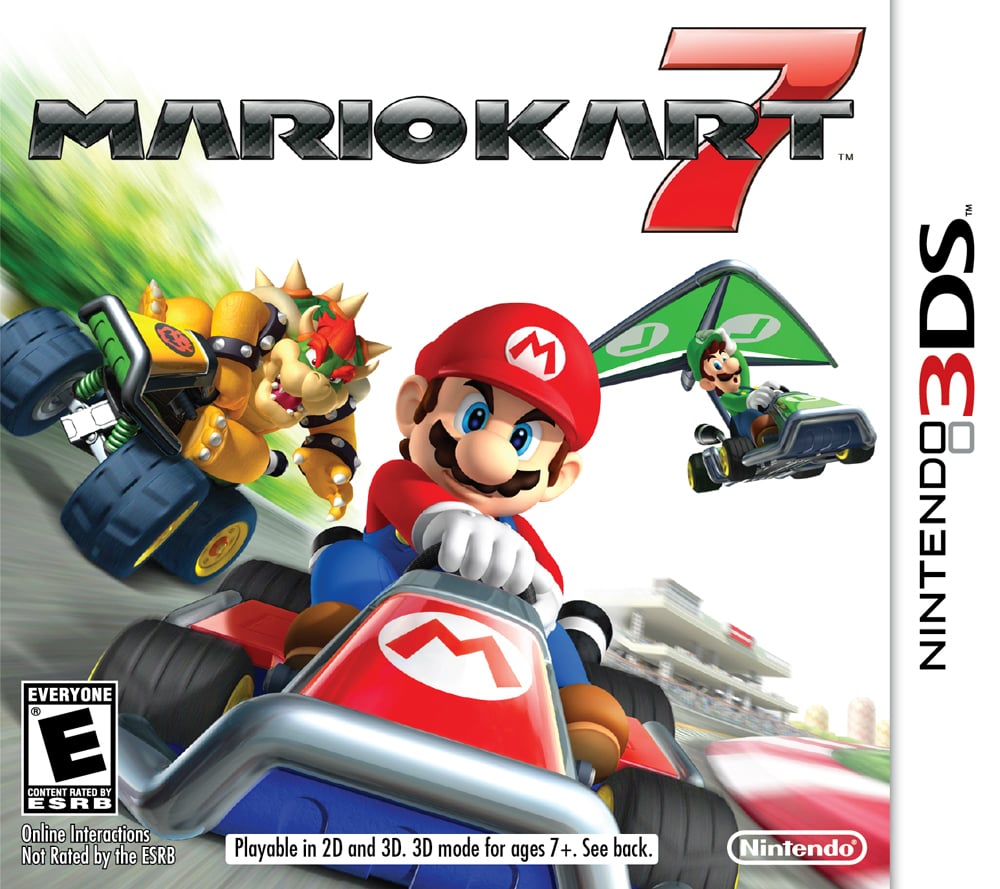
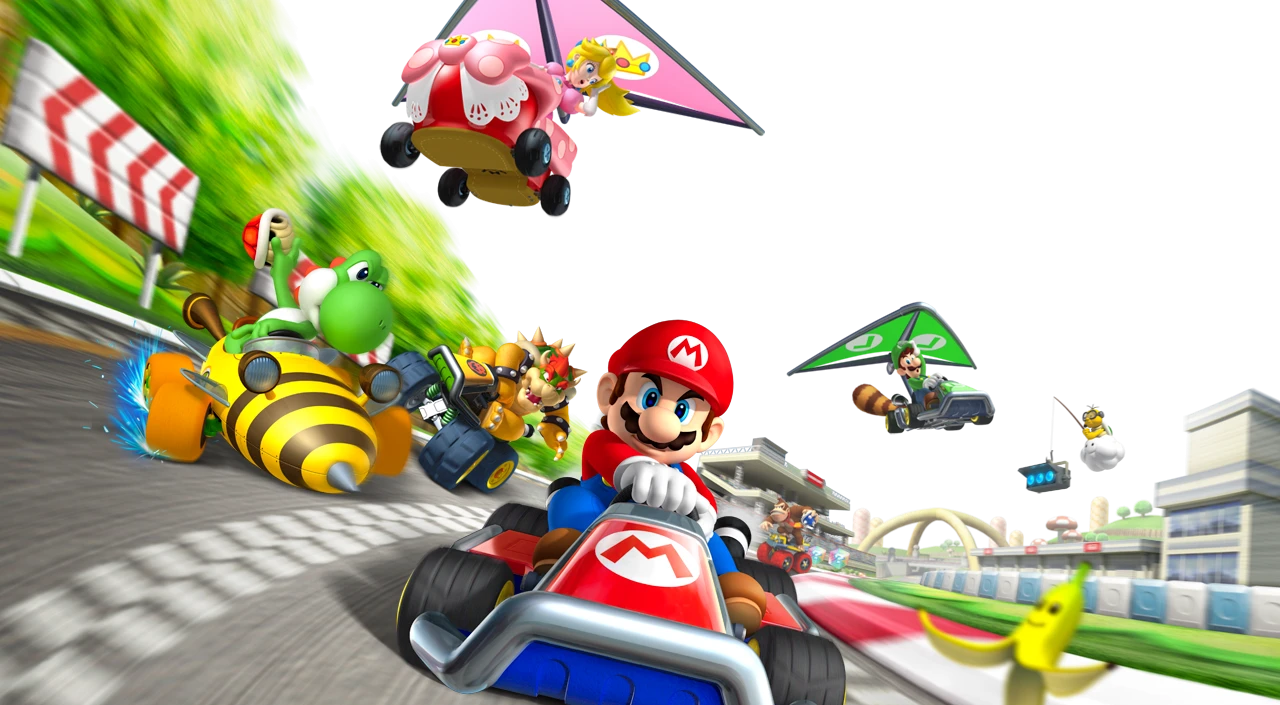
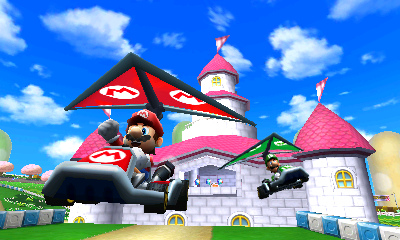
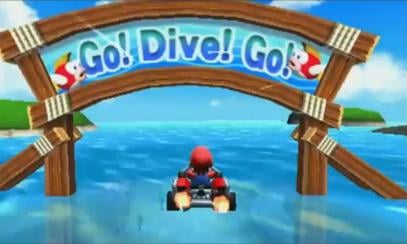
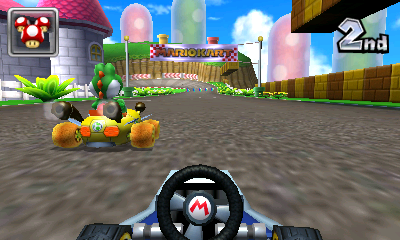
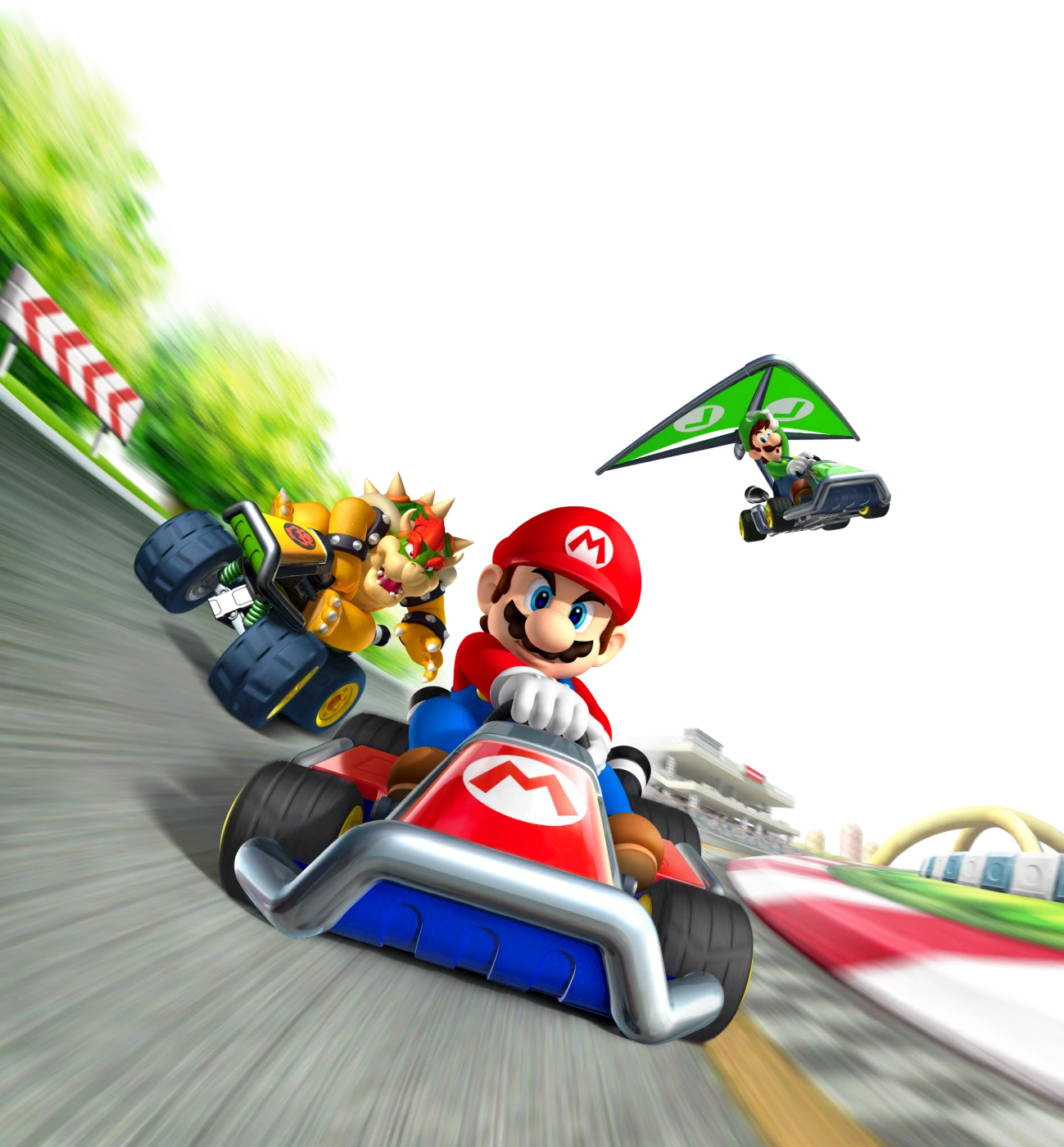

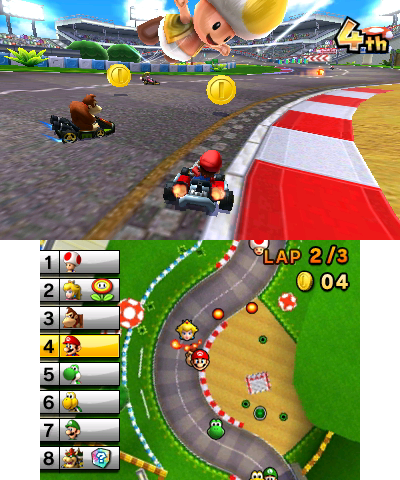
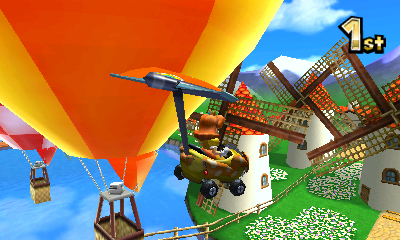
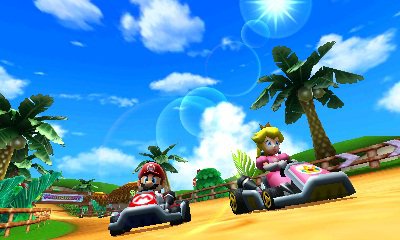
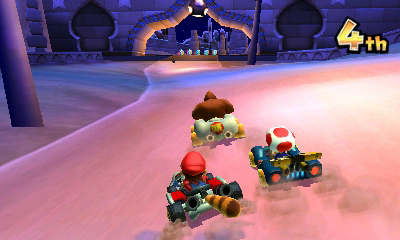

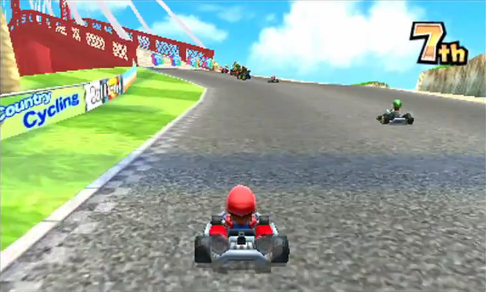
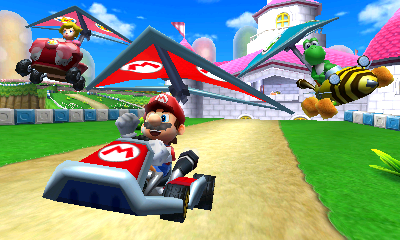
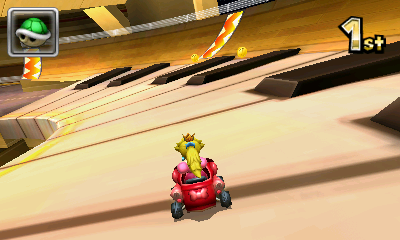
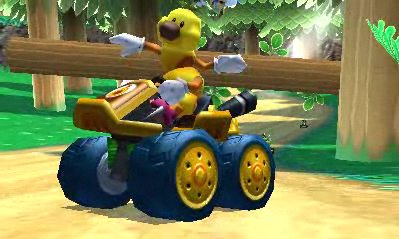

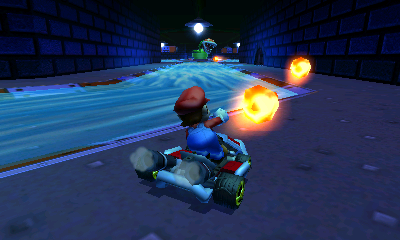
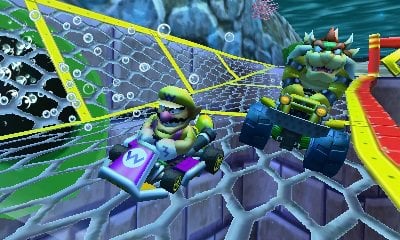
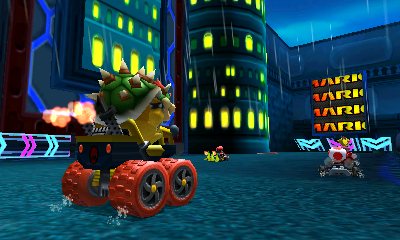
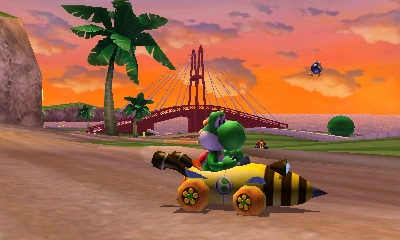

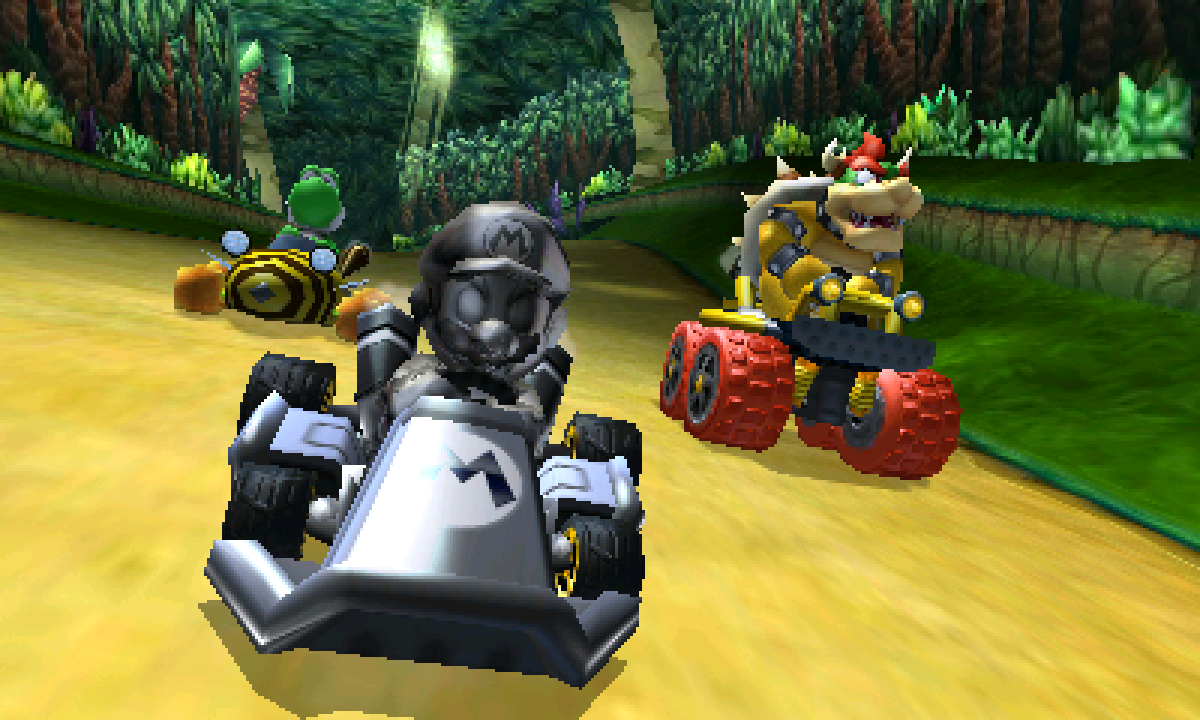
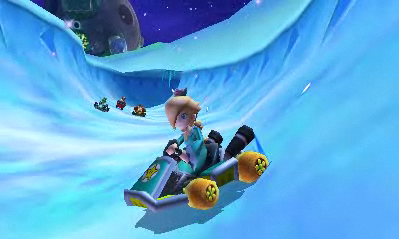
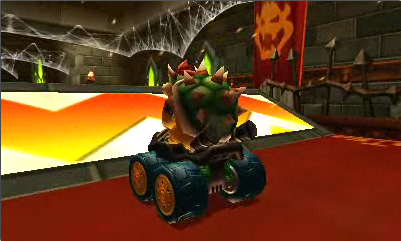
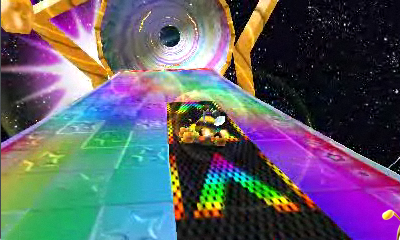

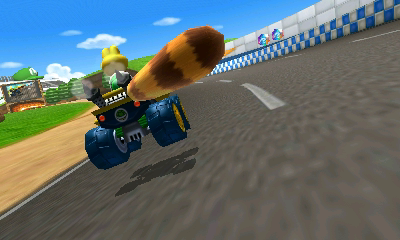
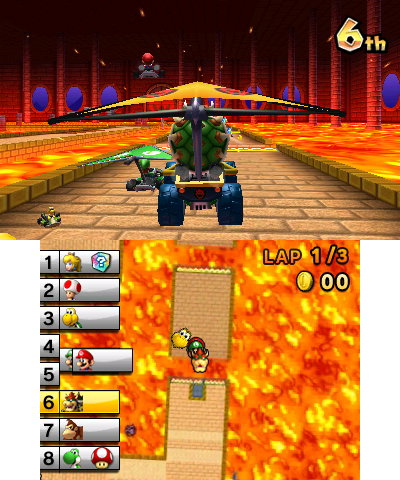
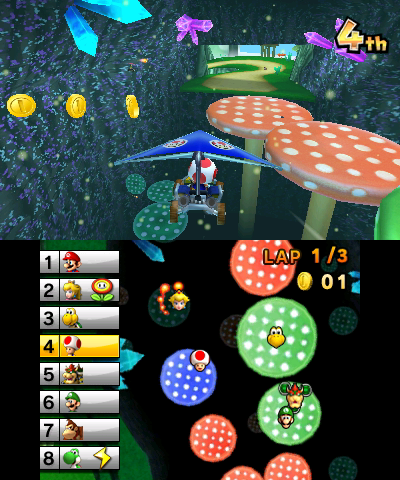
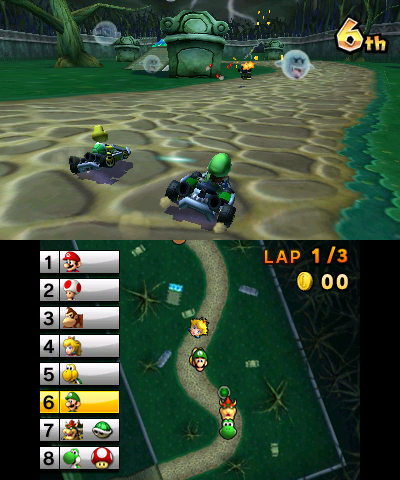

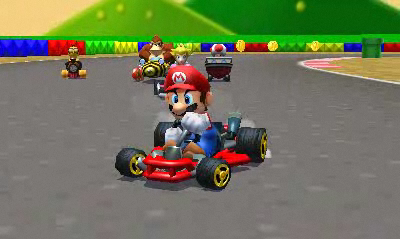
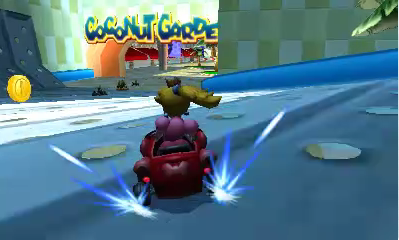
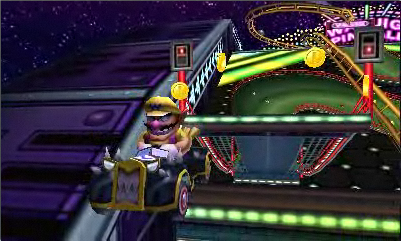

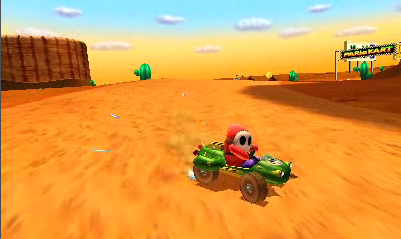
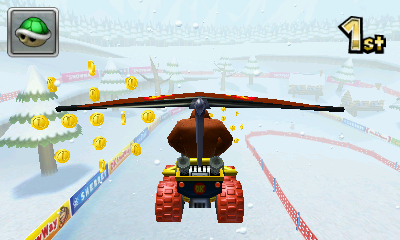
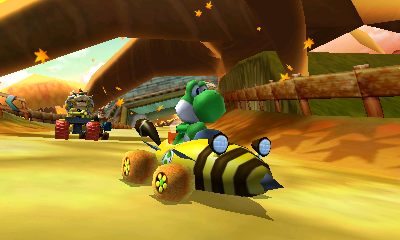

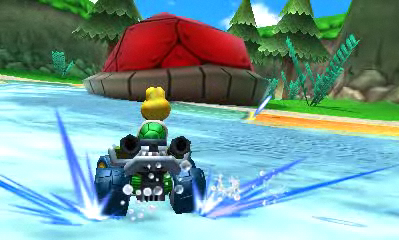
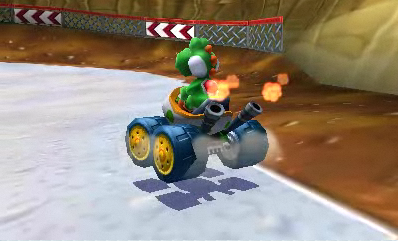
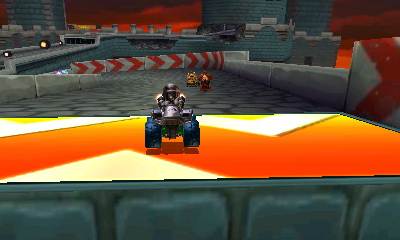
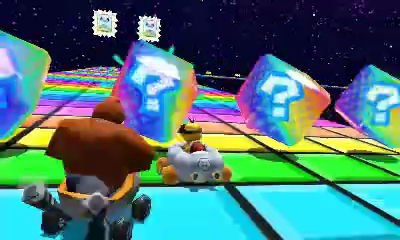
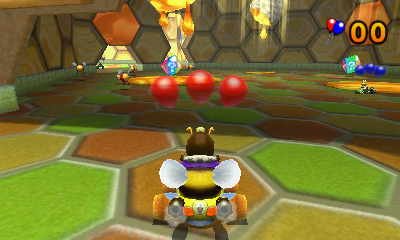
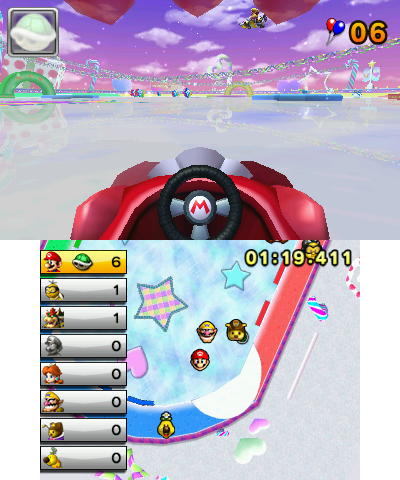
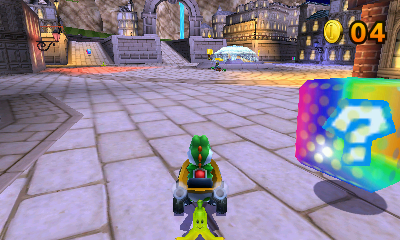
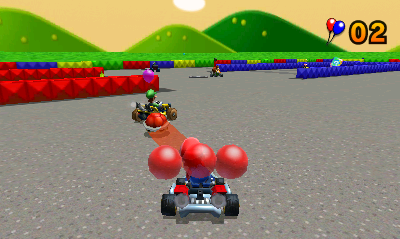
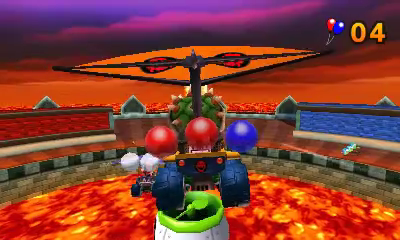
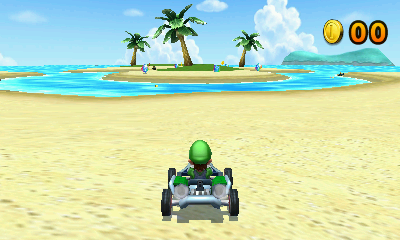
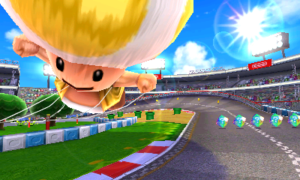 Toad CircuitMushroom Cup · new · later in Mario Kart Tour and 8 DeluxeA simple loop with one Glide Ramp over a flyover, watched by three giant Toad balloons.
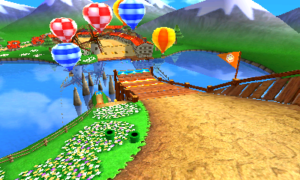 Daisy HillsMushroom Cup · new · later in Mario Kart TourAn Alpine village with goats on the road and hot-air balloons over the lake.
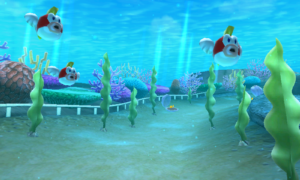 Cheep Cheep LagoonMushroom Cup · new · UK: Cheep Cheep Cape · later in Mario Kart TourThe first underwater drive in the game, past clams that snap shut on the unwary.
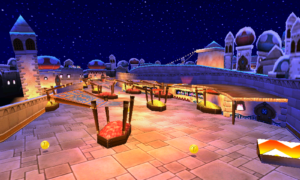 Shy Guy BazaarMushroom Cup · new · later in Mario Kart Tour and WorldA night market of jars, snakes and Shy Guys on flying carpets.
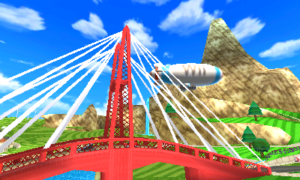 Wuhu LoopFlower Cup · new · UK: Wuhu Island Loop · never remadeOne lap of Wuhu Island in three sections, shared with ordinary traffic.
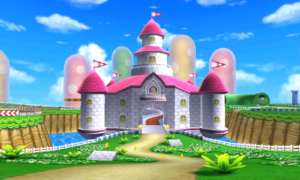 Mario CircuitFlower Cup · new · later in Mario Kart TourUp through Peach’s Castle, off the roof by glider and home through a giant pipe.
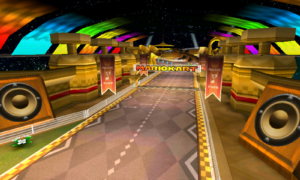 Music ParkFlower Cup · new · UK: Melody Motorway · later in Mario Kart 8 and 8 DeluxePiano keys, tambourine trampolines and bouncing notes that squash you.
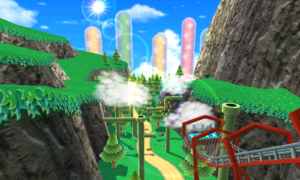 Rock Rock MountainFlower Cup · new · UK: Alpine Pass · later in Mario Kart Tour and 8 DeluxeA cave of Swoops, a long glide and a climb against rolling boulders.
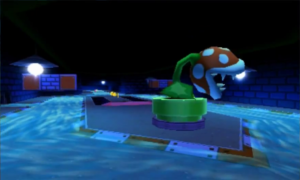 Piranha Plant SlideStar Cup · new · UK: Piranha Plant Pipeway · later in Mario Kart 8, 8 Deluxe and TourThe underground of Super Mario Bros. as a water slide, with blue Goombas and a flooded pipe.
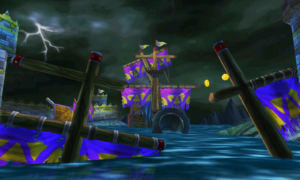 Wario ShipyardStar Cup · new · UK: Wario’s Galleon · later in Mario Kart Tour and WorldA graveyard of wrecked ships, much of it under water, with a swinging anchor and Fish Bones.
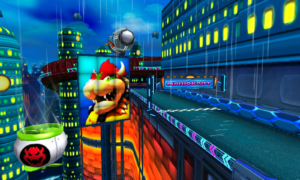 Neo Bowser CityStar Cup · new · UK: Koopa City · later in Mario Kart 8 (DLC), 8 Deluxe and TourA neon city in the rain, with puddles waiting on the final bend.
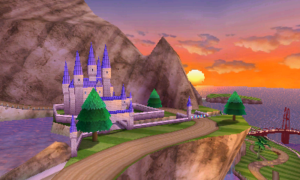 Maka WuhuStar Cup · new · UK: Wuhu Mountain Loop · never remadeBeach to volcano in three sections, and the home of the game’s most famous glitch.
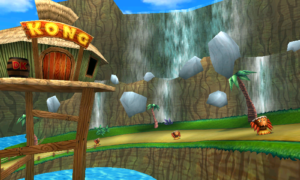 DK JungleSpecial Cup · new · later in Mario Kart 8 and 8 DeluxeRetro Studios’ tribute to Donkey Kong Country Returns, Tikis and all.
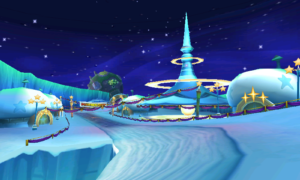 Rosalina’s Ice WorldSpecial Cup · new · later in Mario Kart Tour and 8 DeluxePenguins, icicles and a dive under the ice. The only new course without a glide.
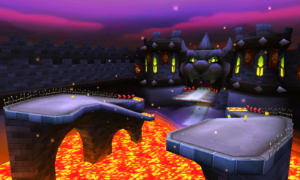 Bowser’s CastleSpecial Cup · new · later in Mario Kart TourThwomps on the stairs, a paddle-wheel tunnel and a lake fed by lava.
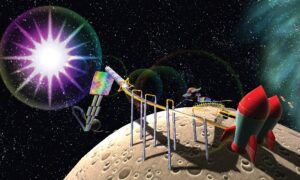 Rainbow RoadSpecial Cup · new · later in Mario Kart Tour and 8 DeluxeOne lap in three sections: the rings of a planet, the surface of a moon and a spinning tube.
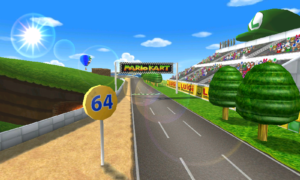 N64 Luigi RacewayShell Cup · classic · from Mario Kart 64The 1996 opener, with no gliding or diving at all.
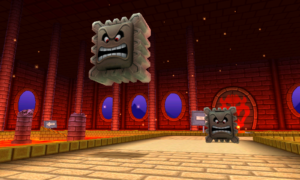 GBA Bowser Castle 1Shell Cup · classic · from Mario Kart: Super CircuitThwomps, Lava Bubbles and a new glide across the lava jumps.
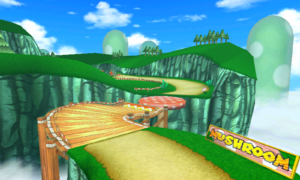 Wii Mushroom GorgeShell Cup · classic · from Mario Kart WiiBouncy toadstools over a canyon, one of them now a glider launch.
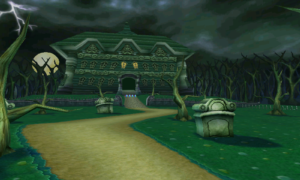 DS Luigi’s MansionShell Cup · classic · from Mario Kart DSThrough the haunted house and out past the walking trees.
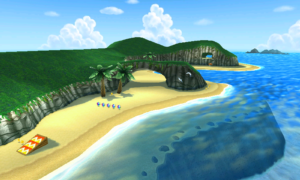 N64 Koopa Troopa BeachBanana Cup · classic · from Mario Kart 64 · UK: N64 Koopa BeachSun, sand and Sidesteppers.
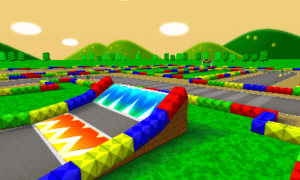 SNES Mario Circuit 2Banana Cup · classic · from Super Mario KartThe 1992 circuit with real height and a glider on its big jump.
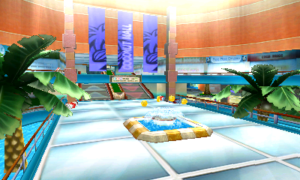 Wii Coconut MallBanana Cup · classic · from Mario Kart WiiEscalators, shop fronts and a car park full of bad drivers.
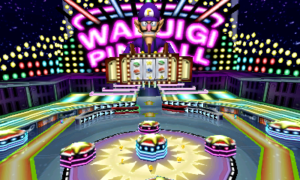 DS Waluigi PinballBanana Cup · classic · from Mario Kart DSA pinball table from the inside. Its owner is absent.
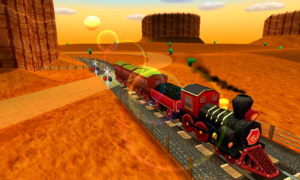 N64 Kalimari DesertLeaf Cup · classic · from Mario Kart 64Two trains, two crossings and two new glides over the rails.
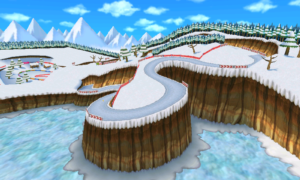 DS DK PassLeaf Cup · classic · from Mario Kart DSA snowy mountain road with rolling snowballs.
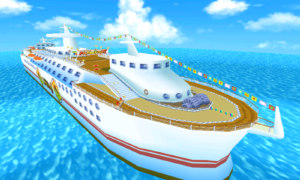 GCN Daisy CruiserLeaf Cup · classic · from Mario Kart: Double Dash!!A cruise liner whose pool and hold you can now drive through under water.
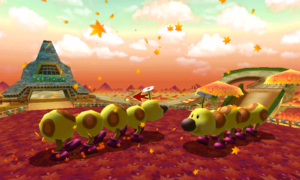 Wii Maple TreewayLeaf Cup · classic · from Mario Kart WiiAutumn leaves, a cannon and giant Wigglers in the treetops.
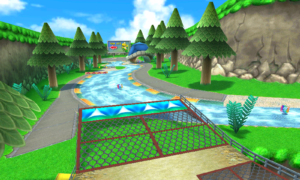 Wii Koopa CapeLightning Cup · classic · from Mario Kart WiiA river, a waterfall and an underwater tunnel without its roof.
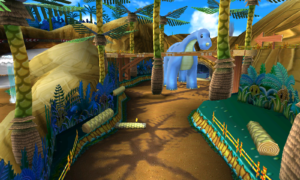 GCN Dino Dino JungleLightning Cup · classic · from Mario Kart: Double Dash!!Geysers, rope bridges and a dinosaur with heavy feet.
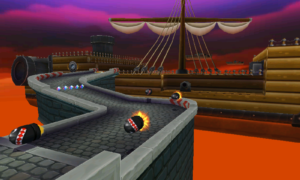 DS Airship FortressLightning Cup · classic · from Mario Kart DSBanzai Bills, Rocky Wrenches, flame jets and a glide to the tower.
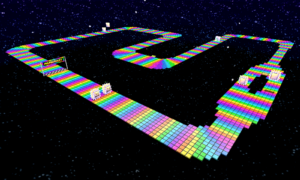 SNES Rainbow RoadLightning Cup · classic · from Super Mario KartNo walls, no mercy and seven outsized Thwomps.
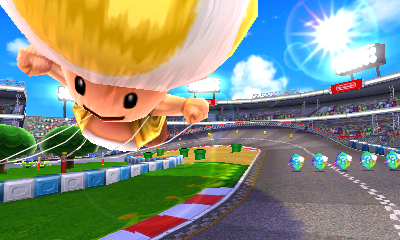
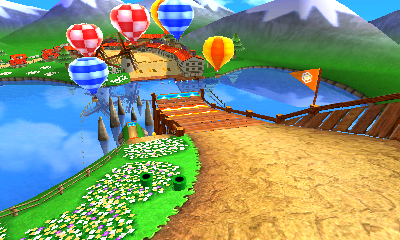
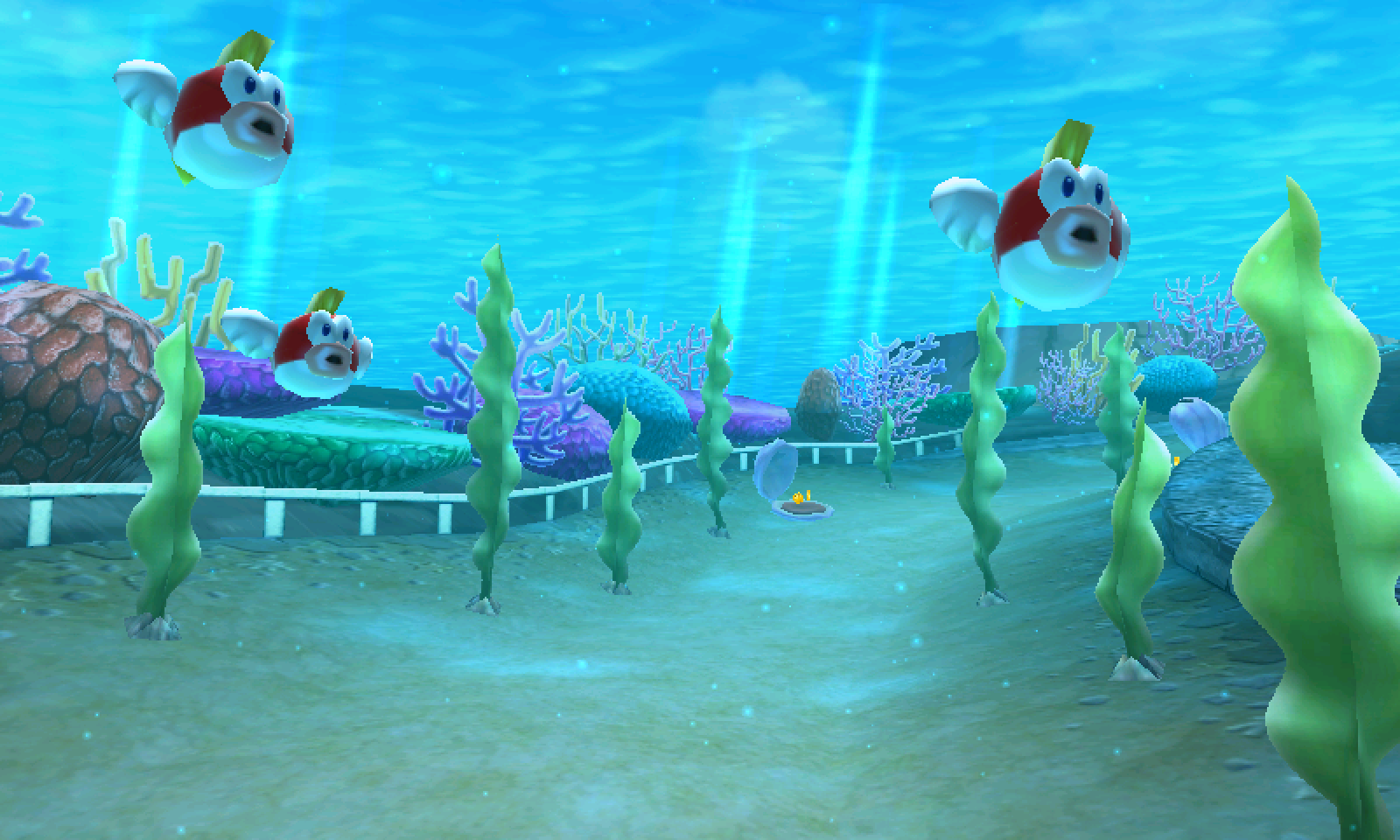
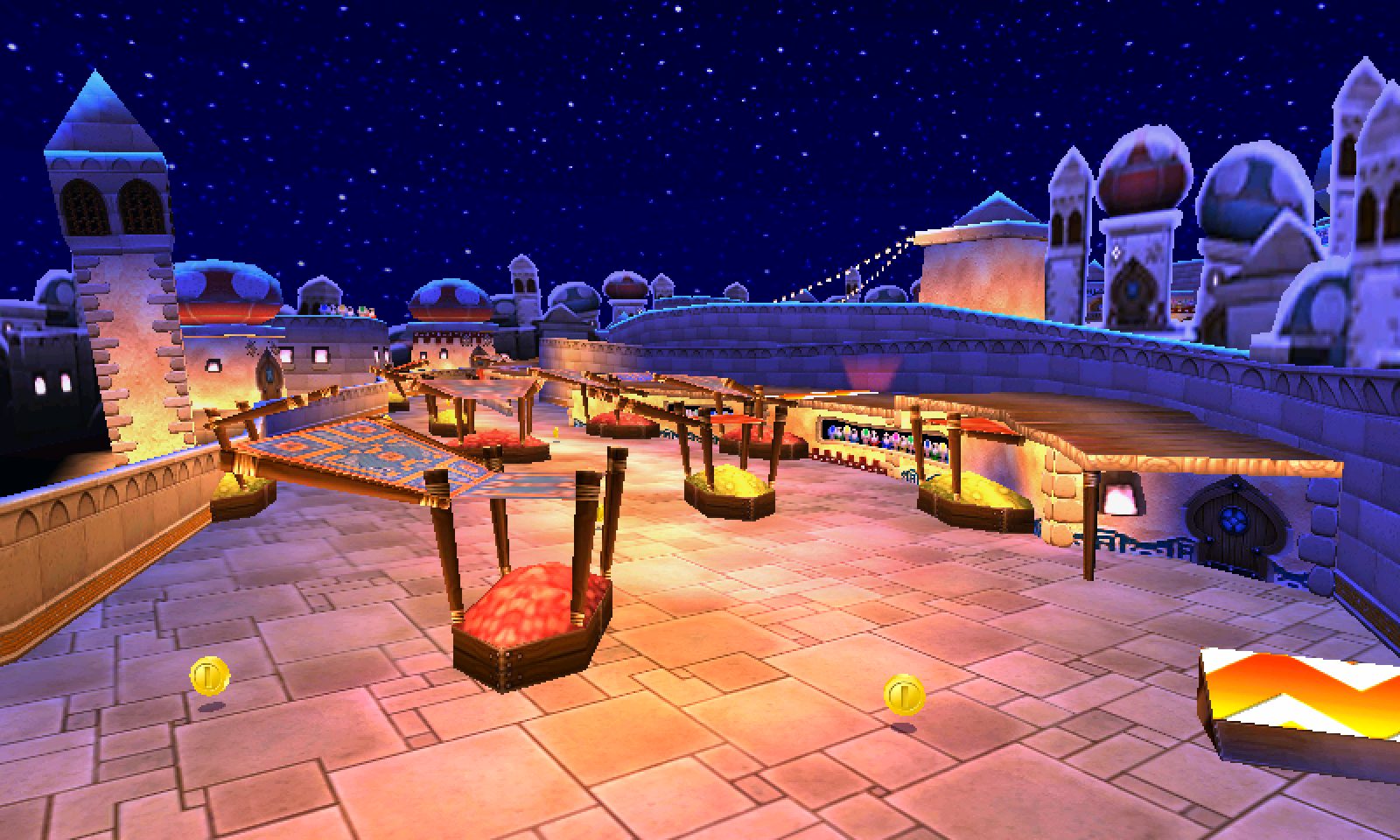
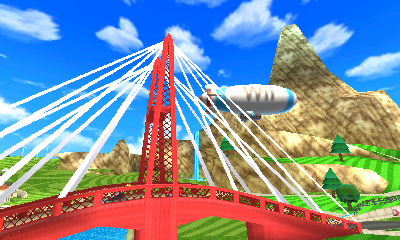
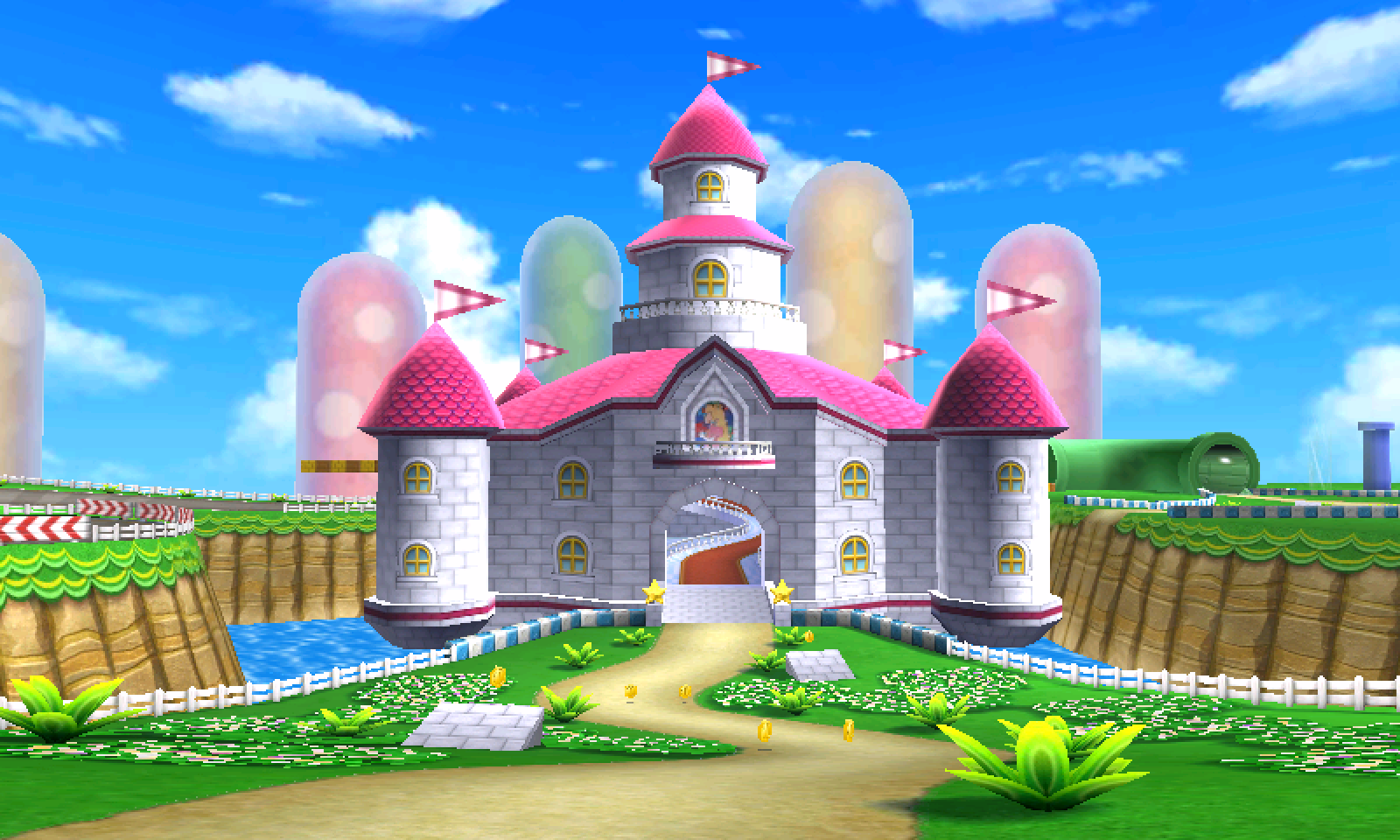
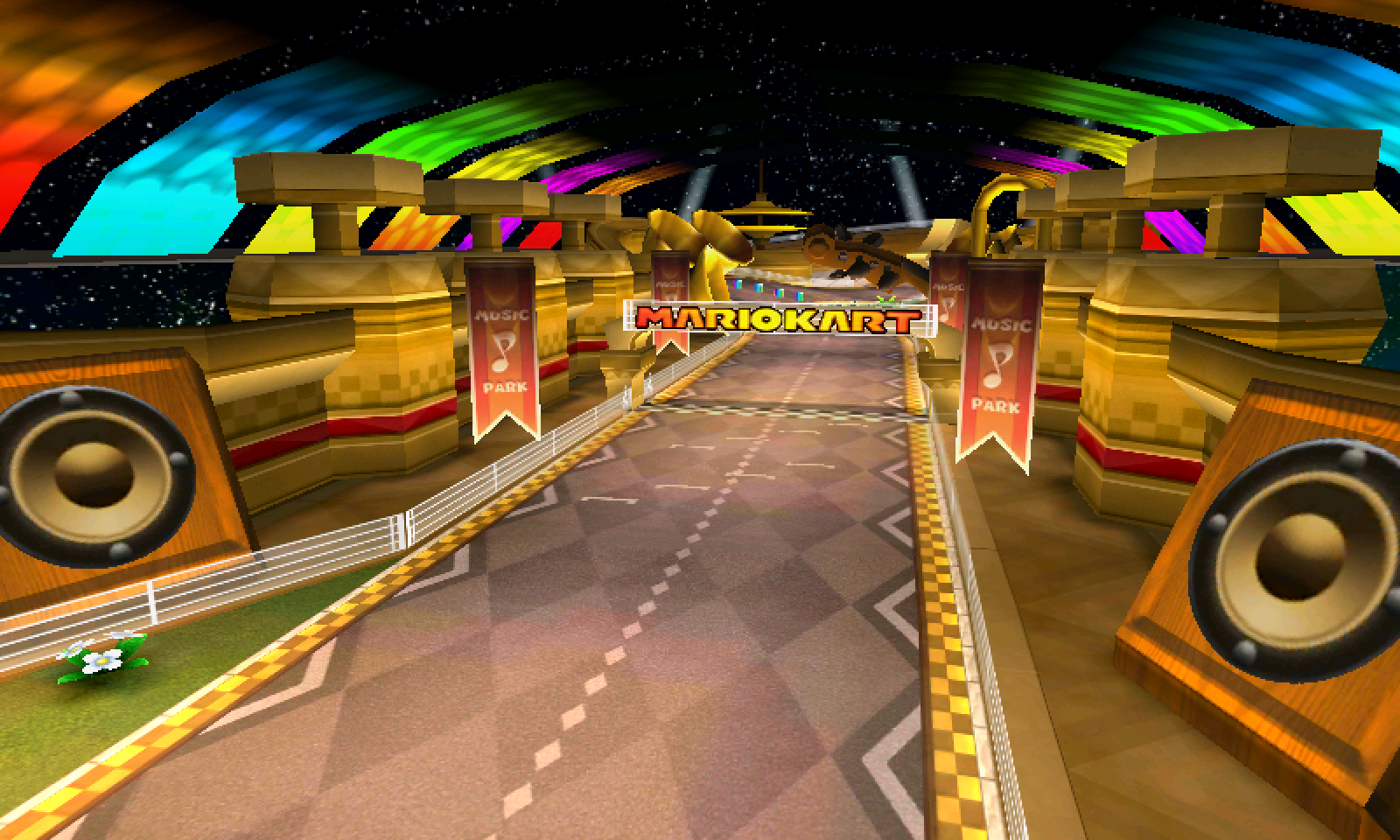
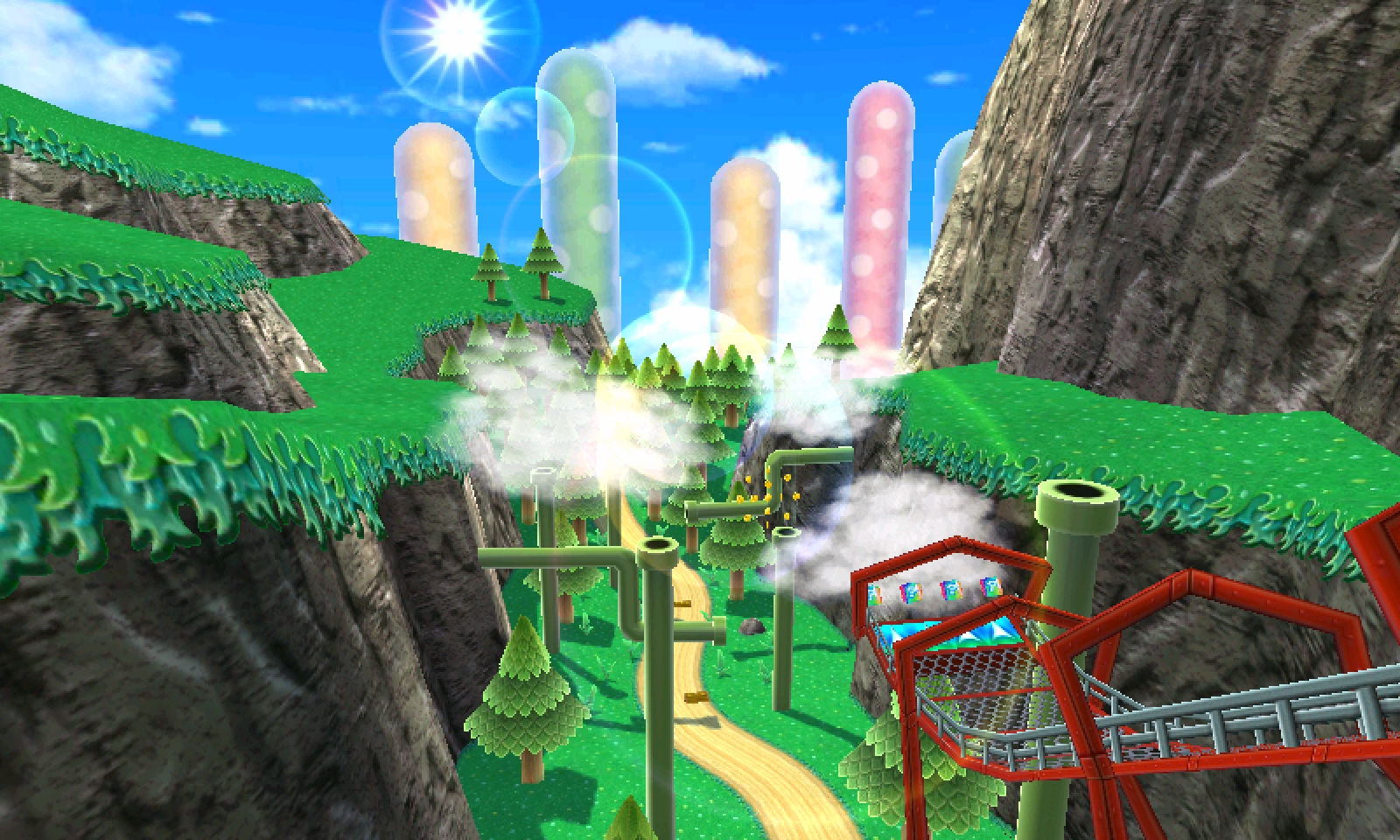
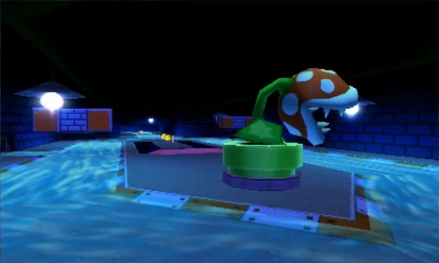
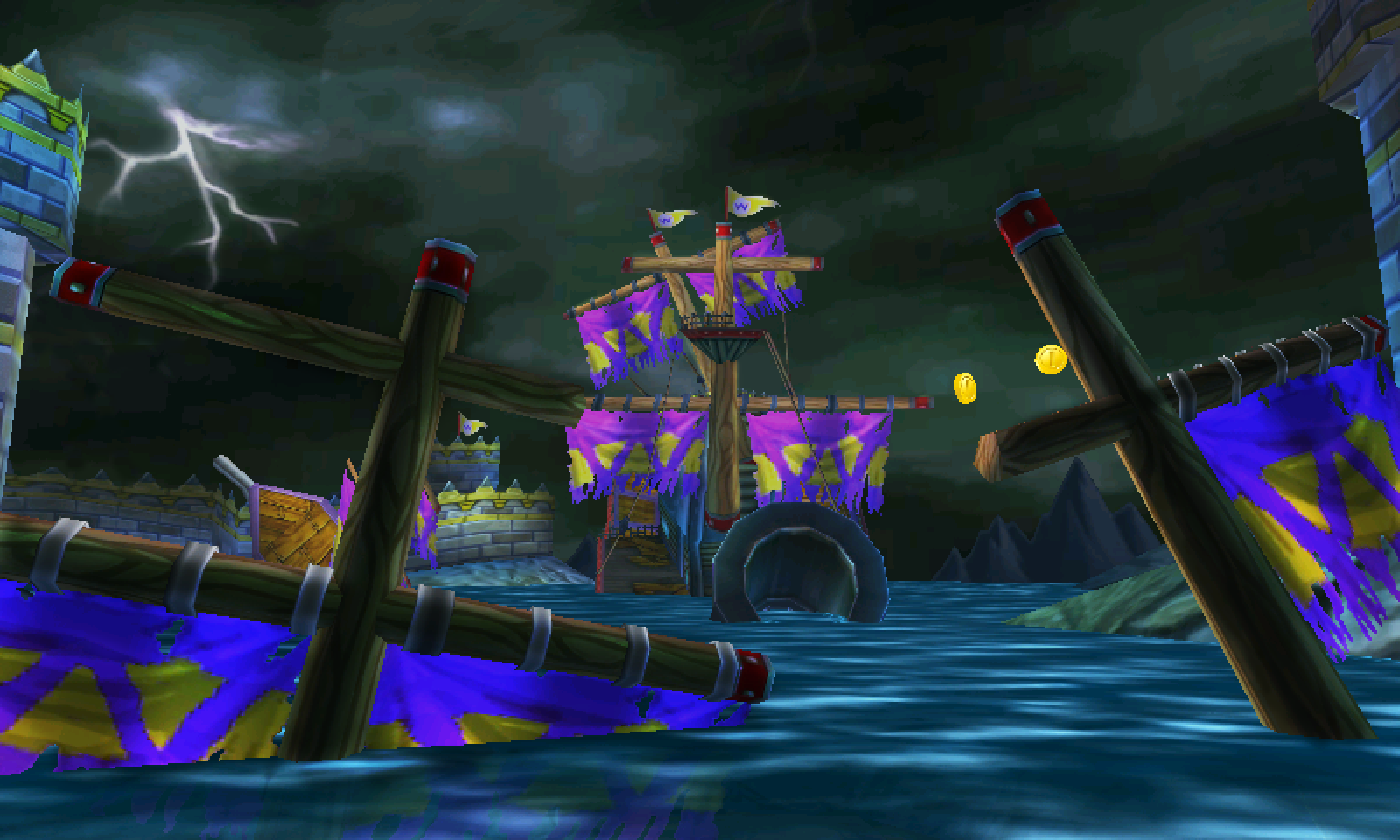
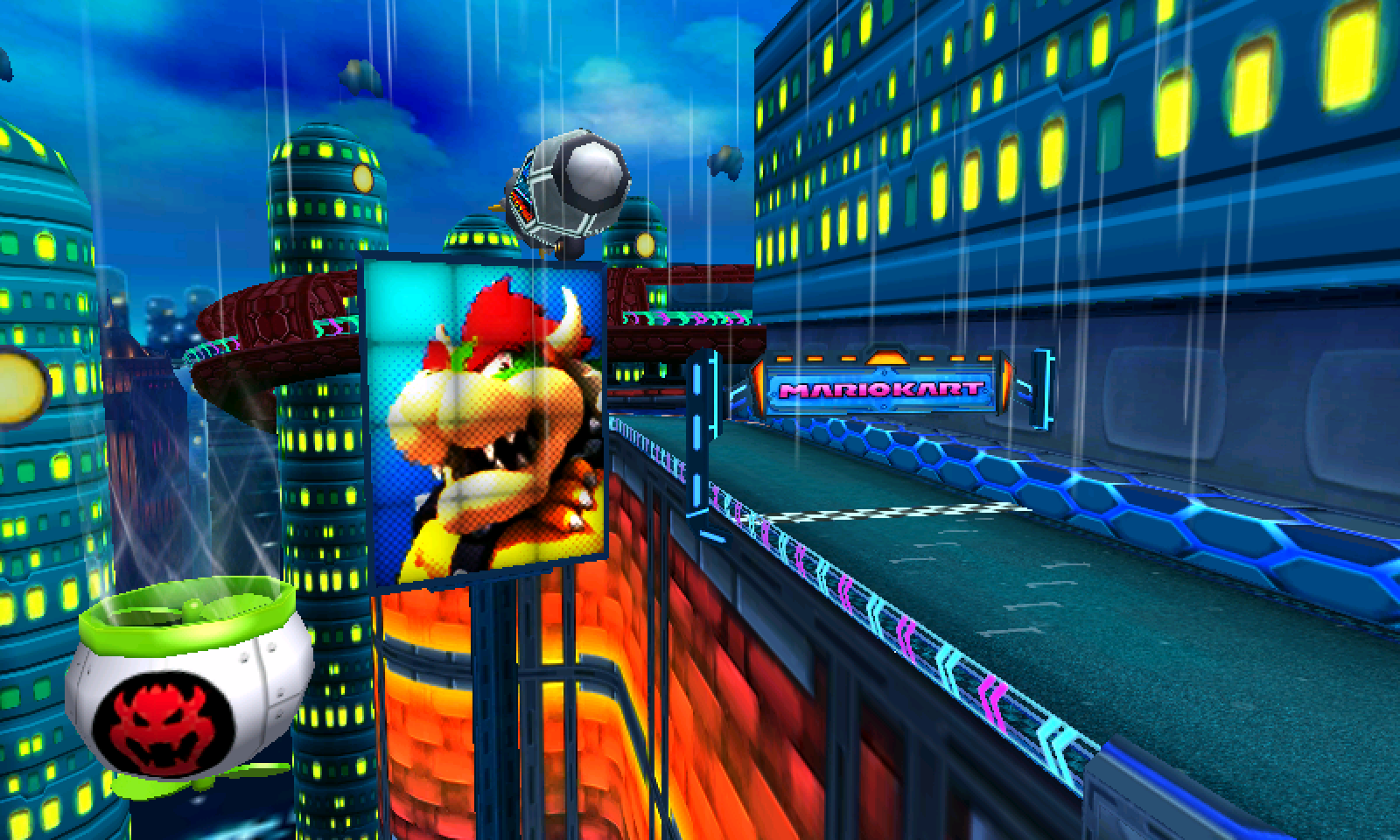
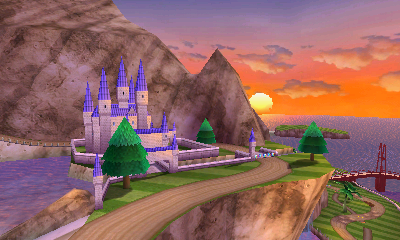
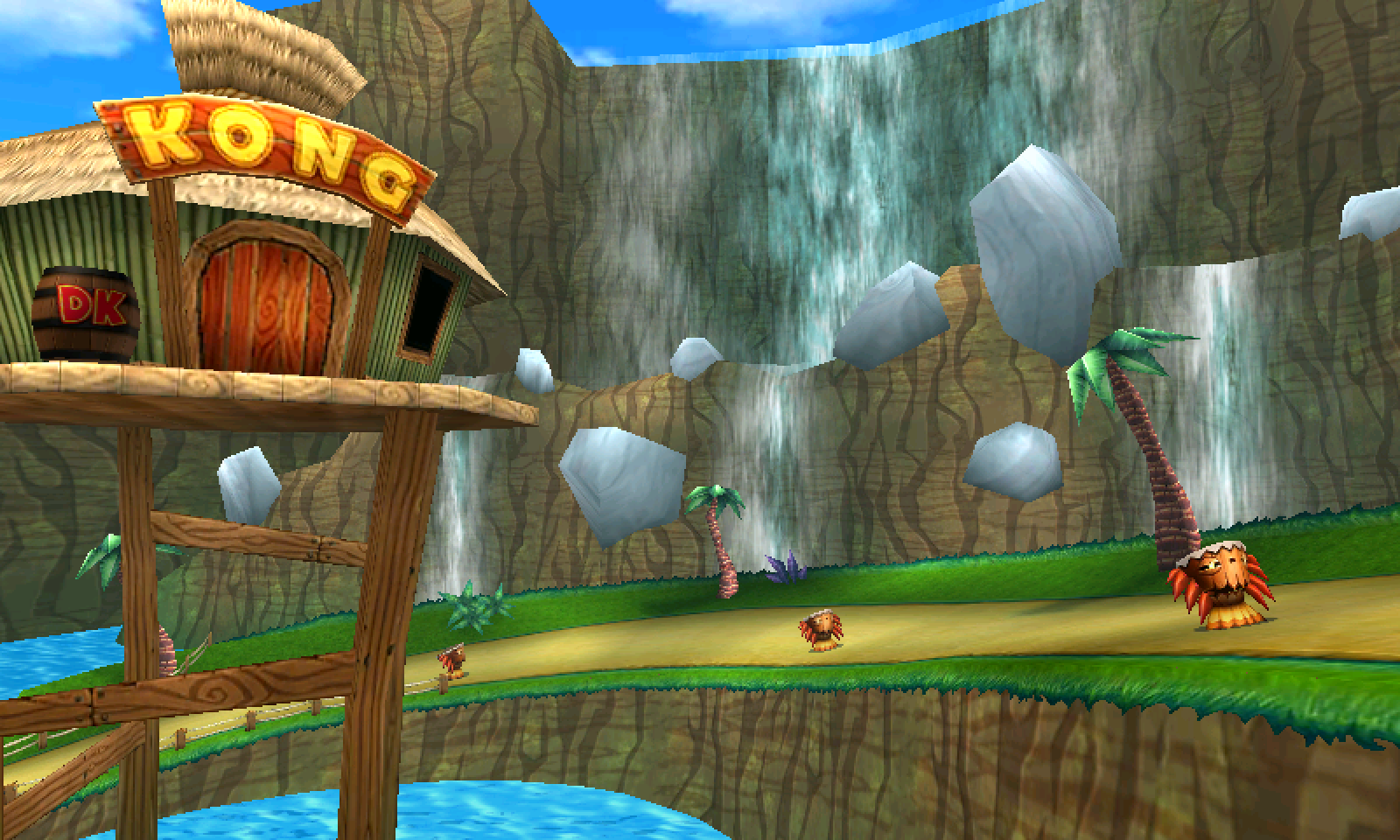
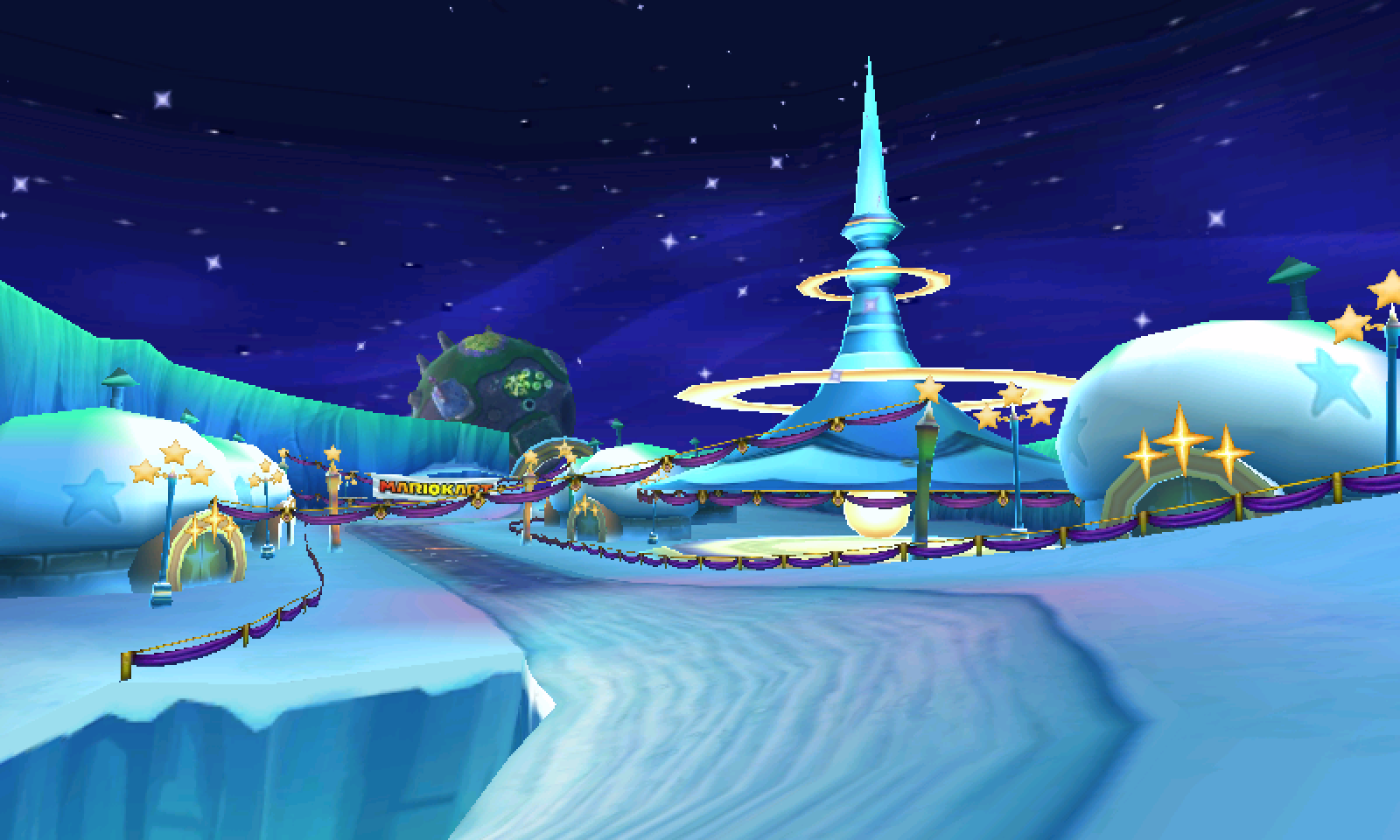
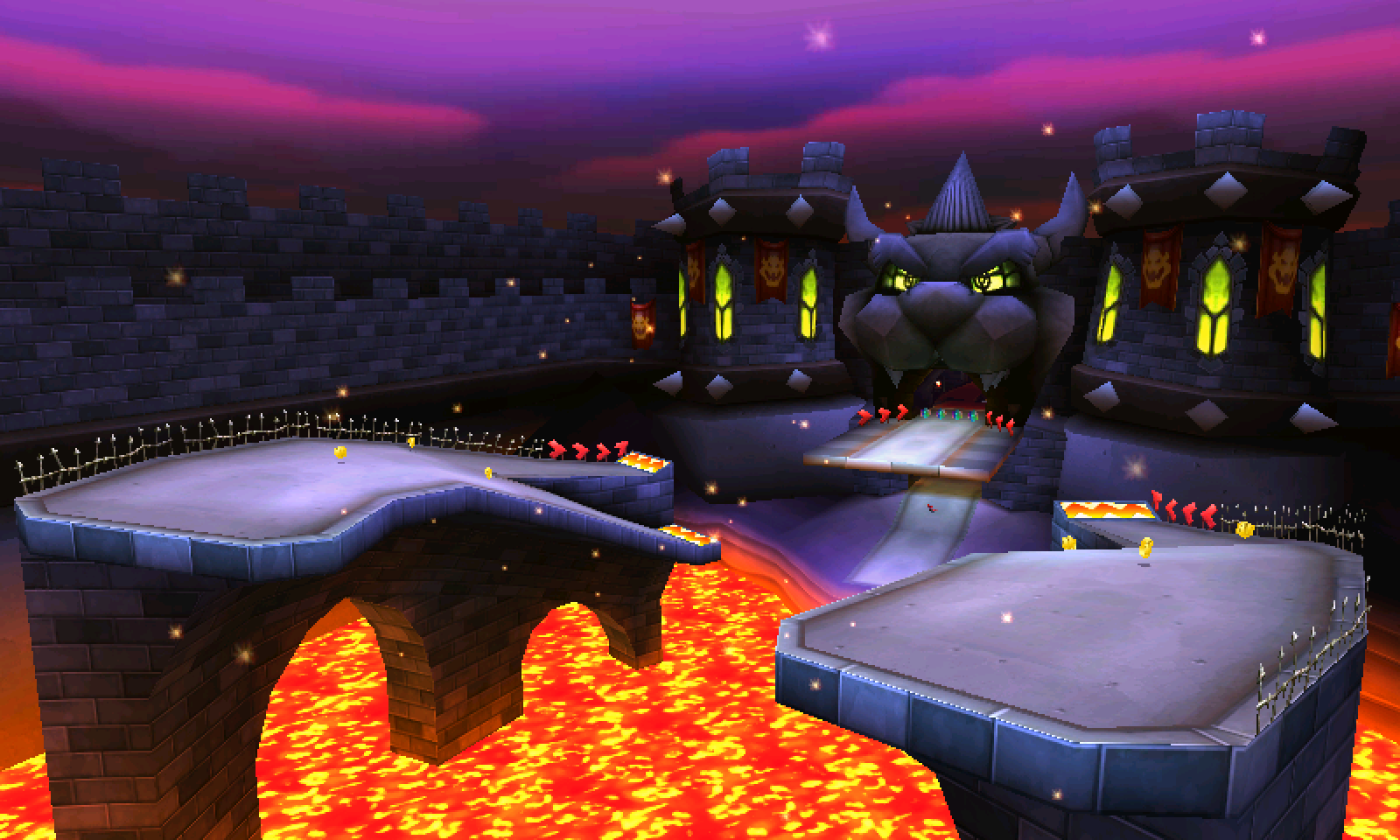
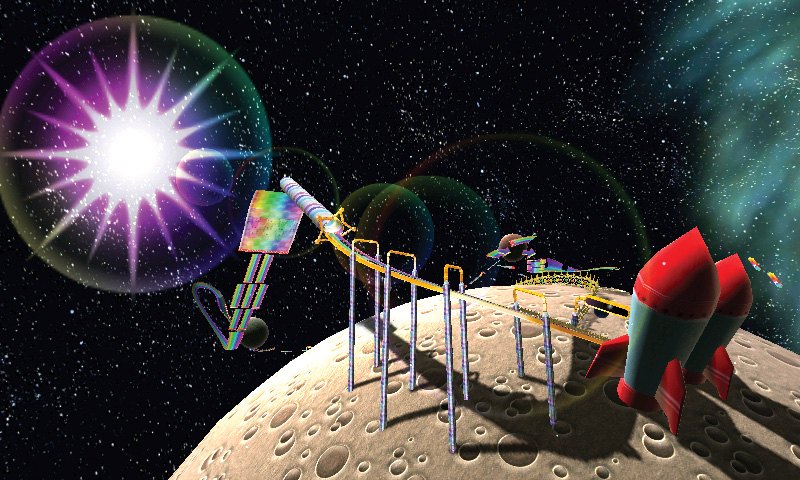
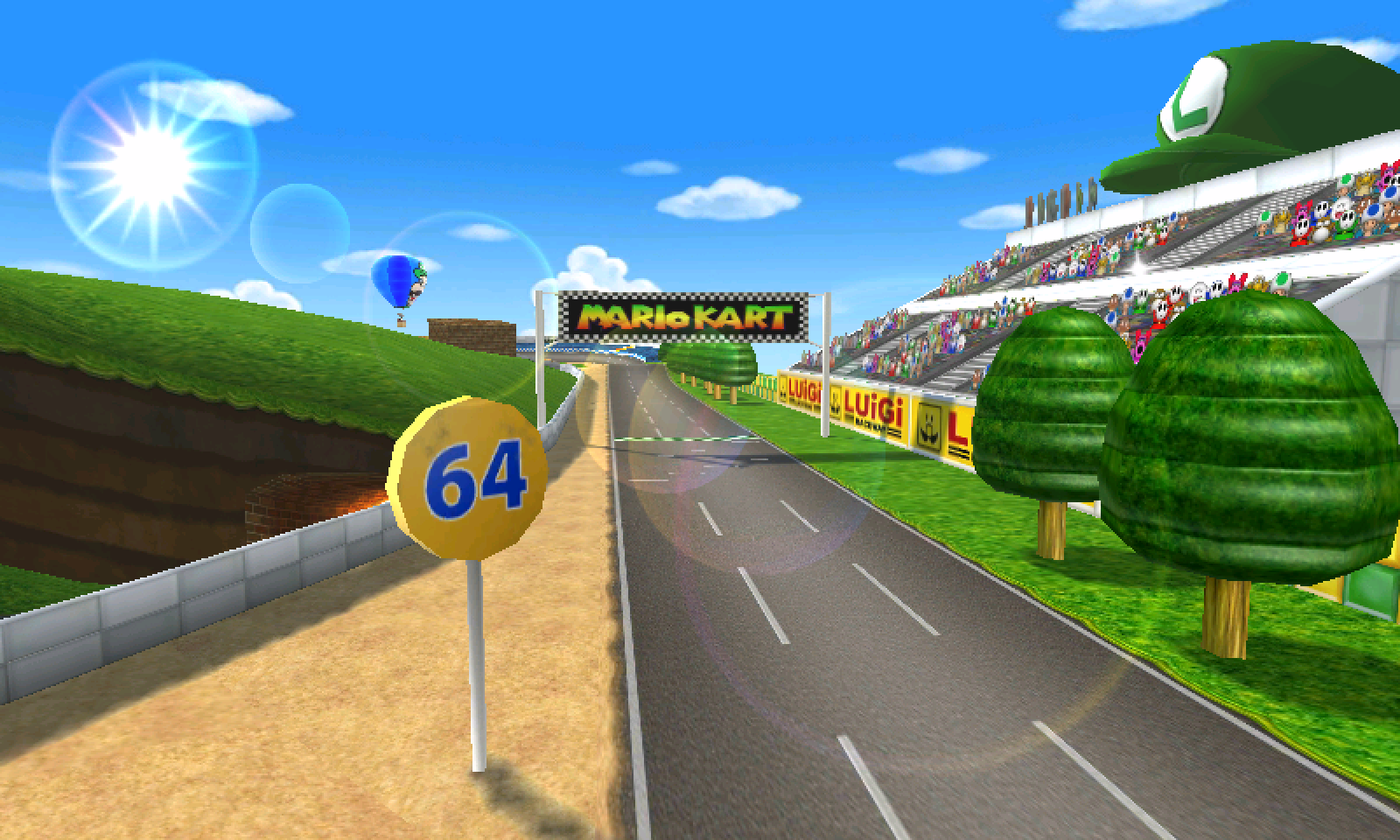
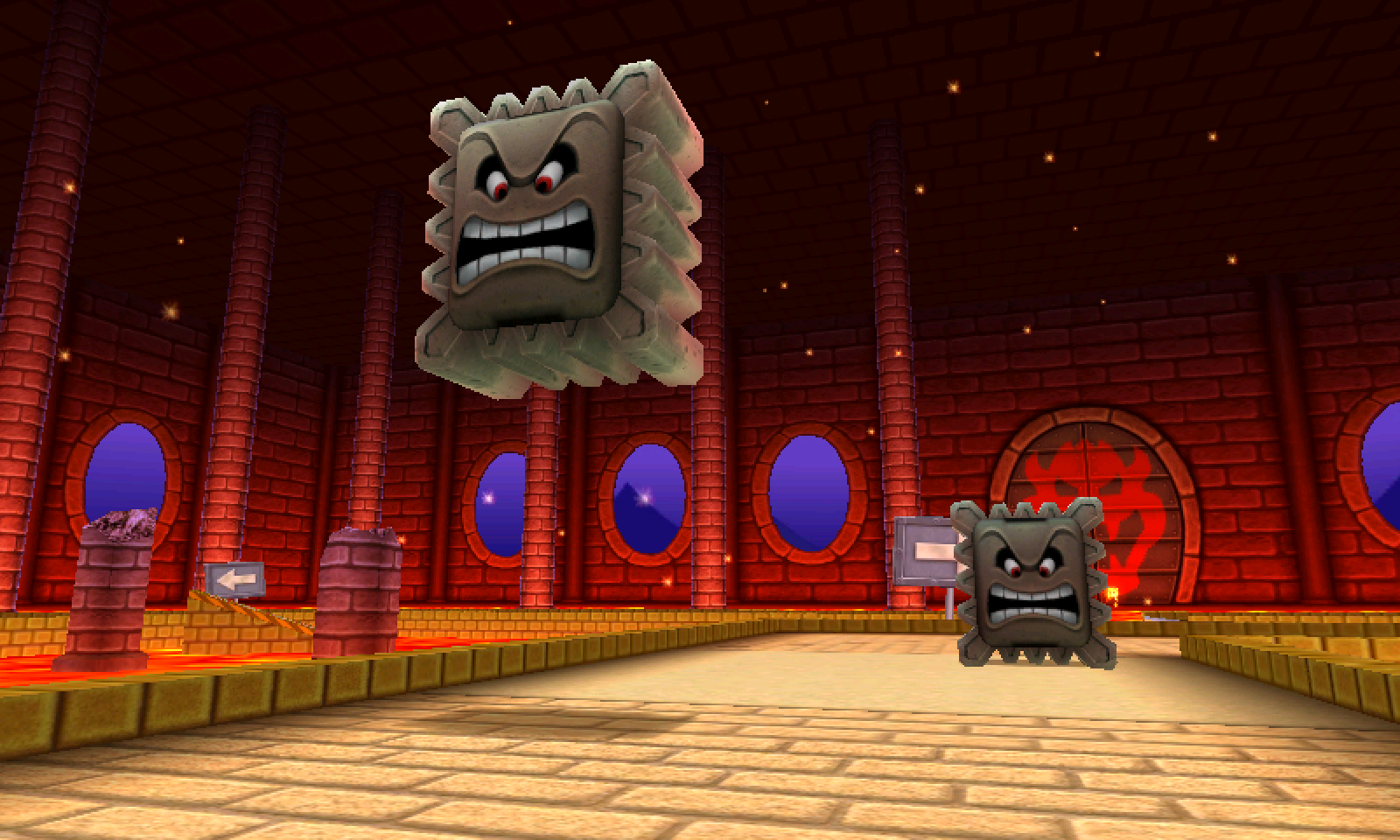
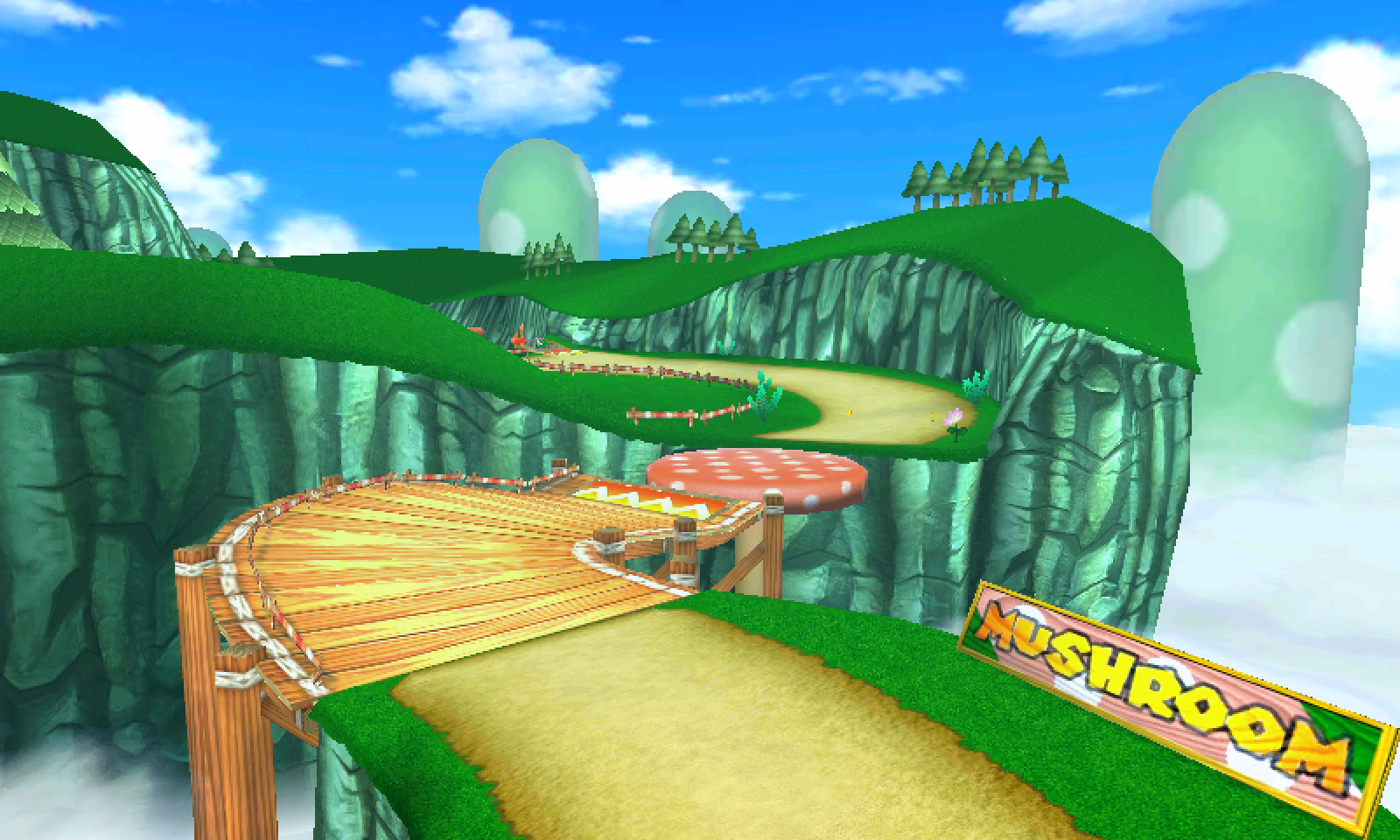
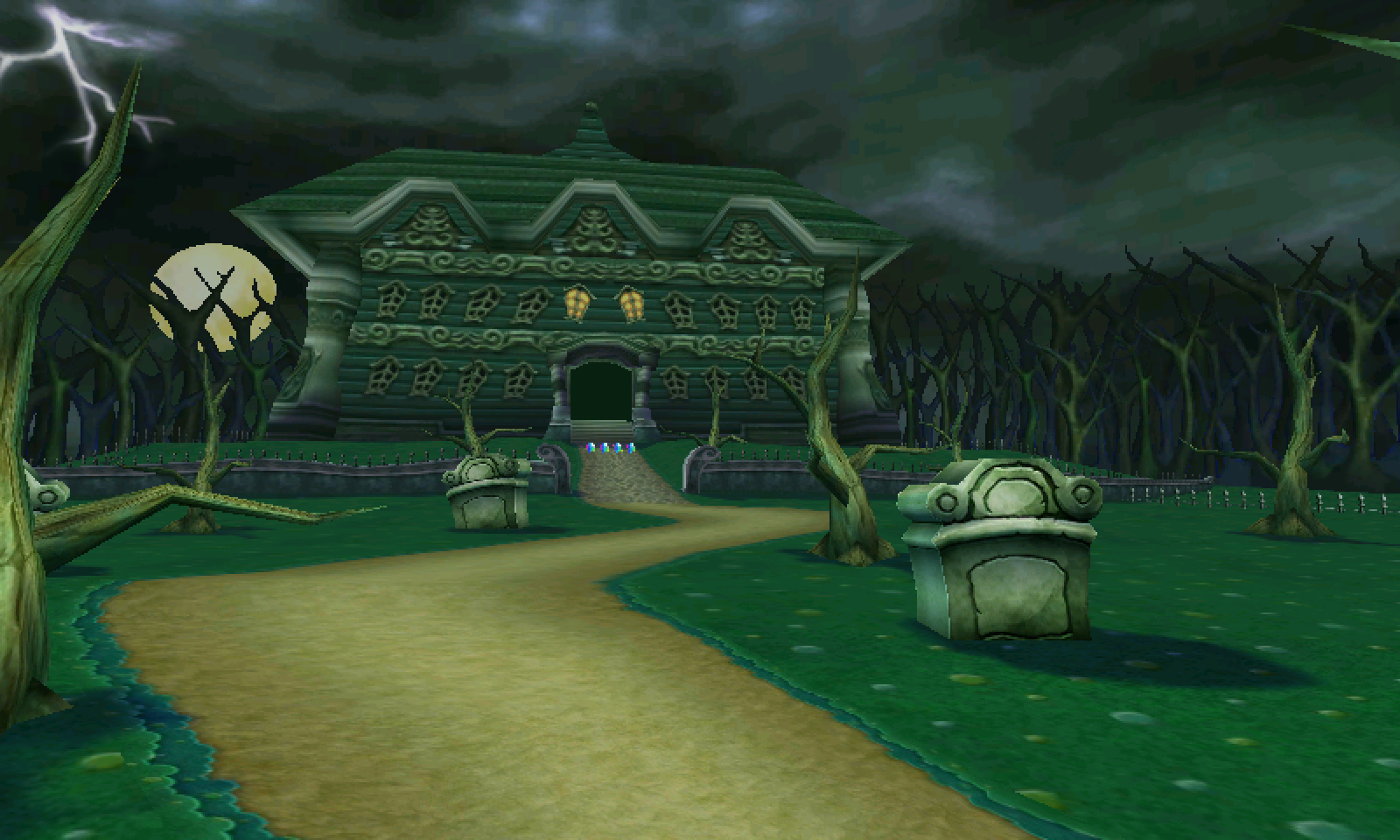
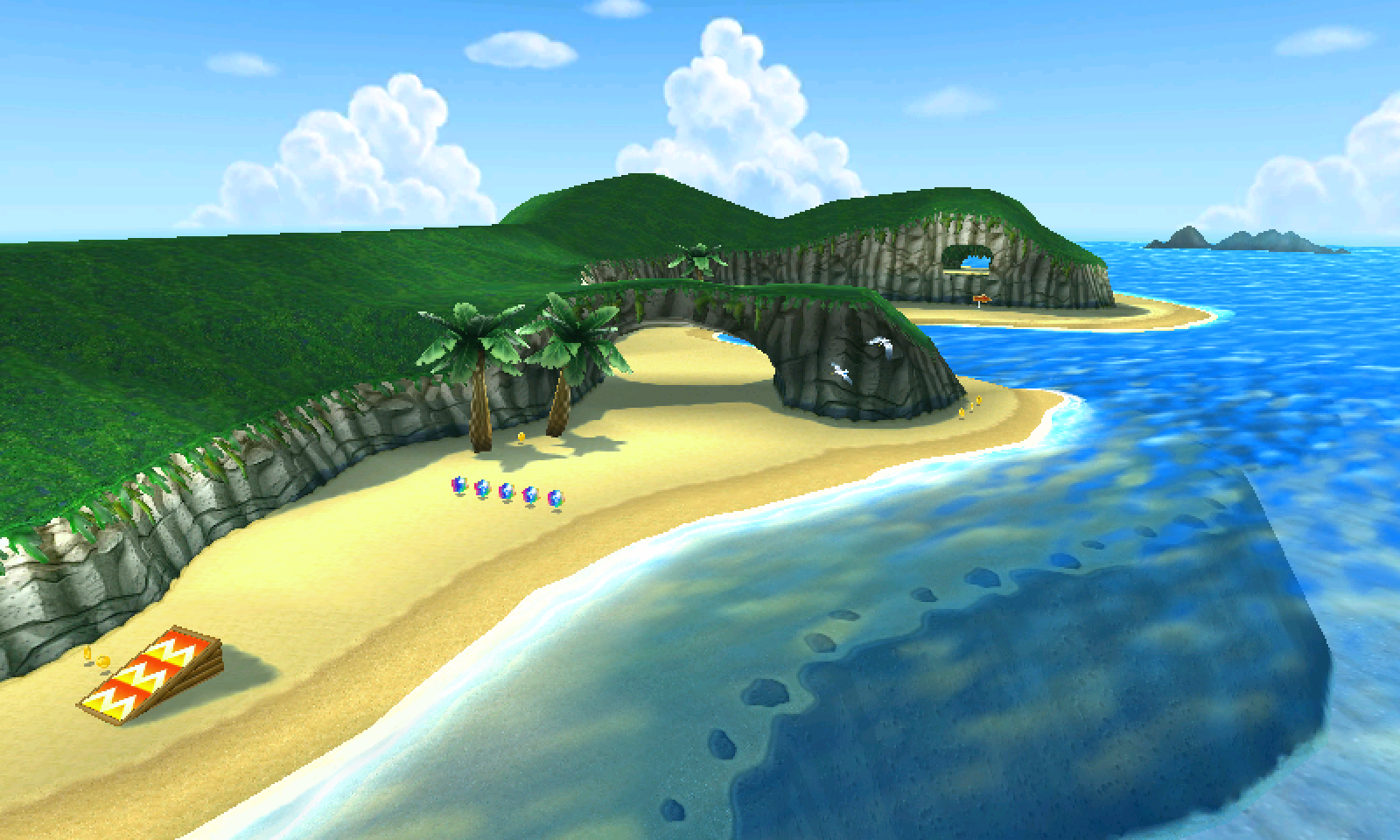
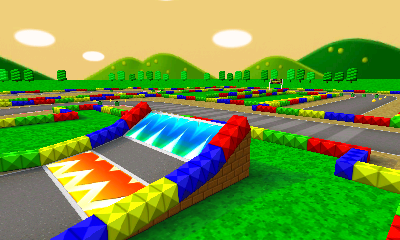
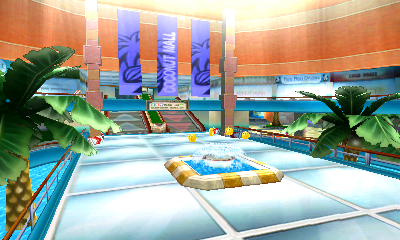
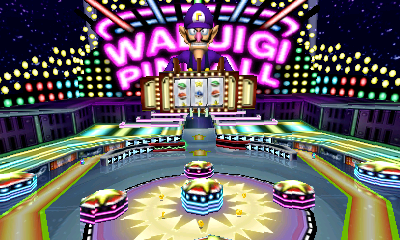
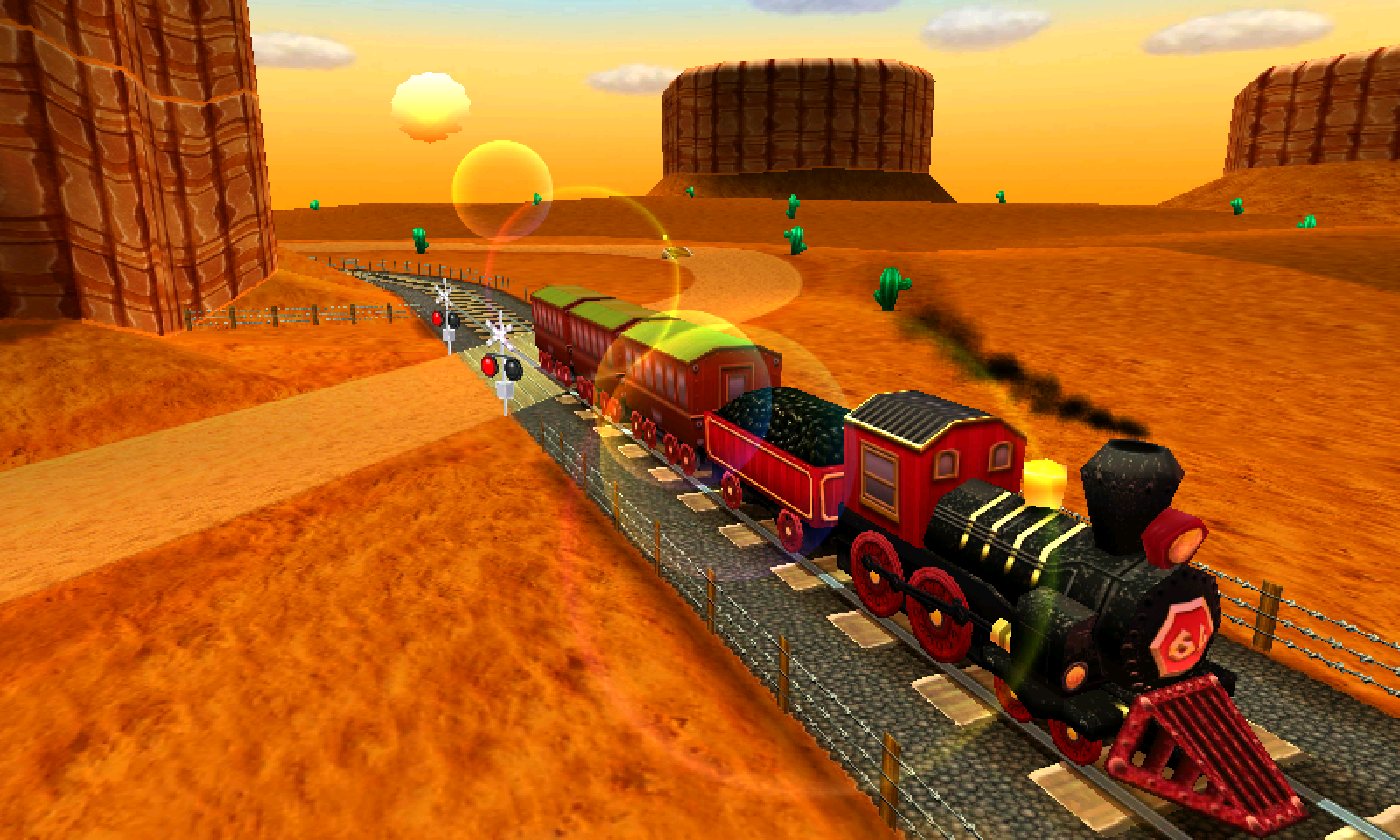
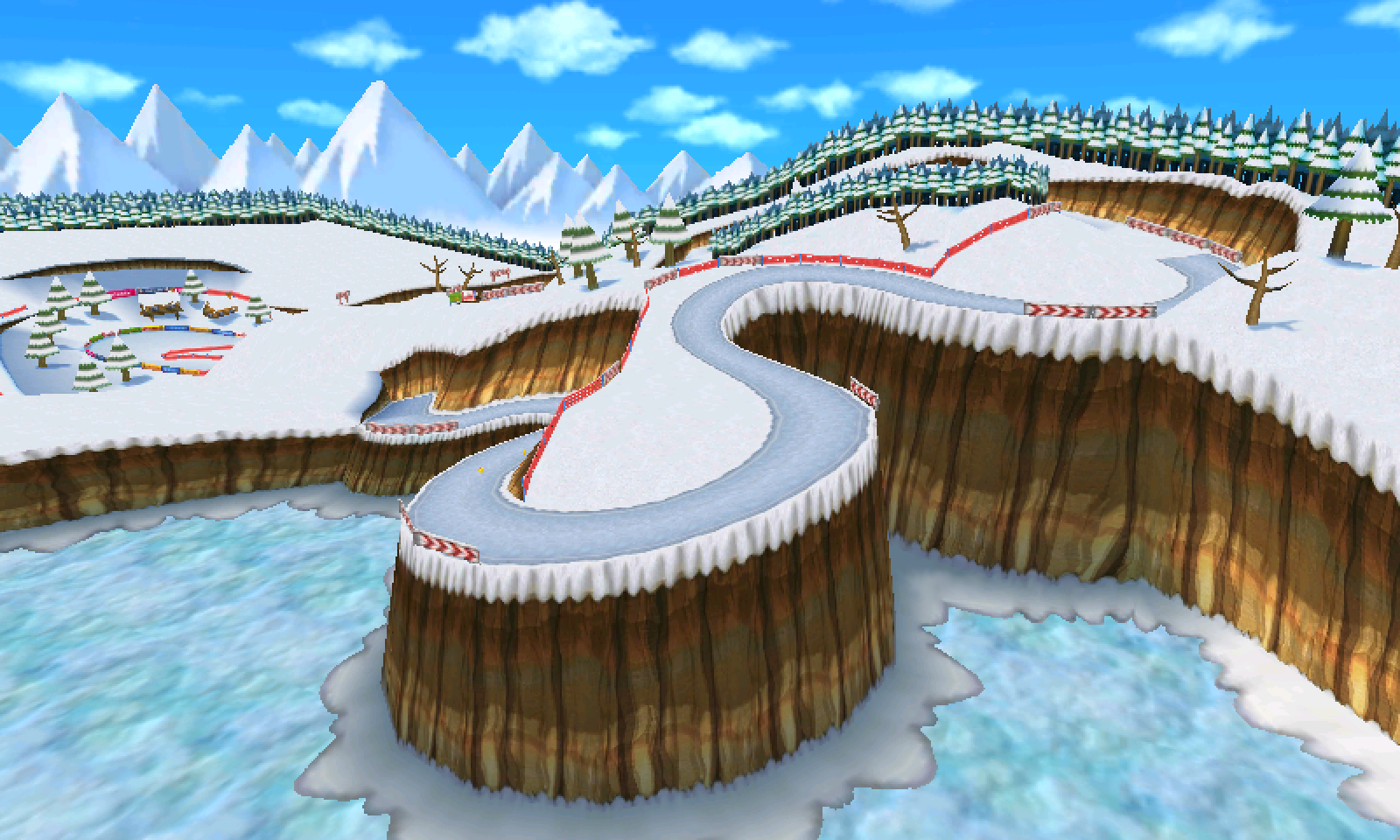
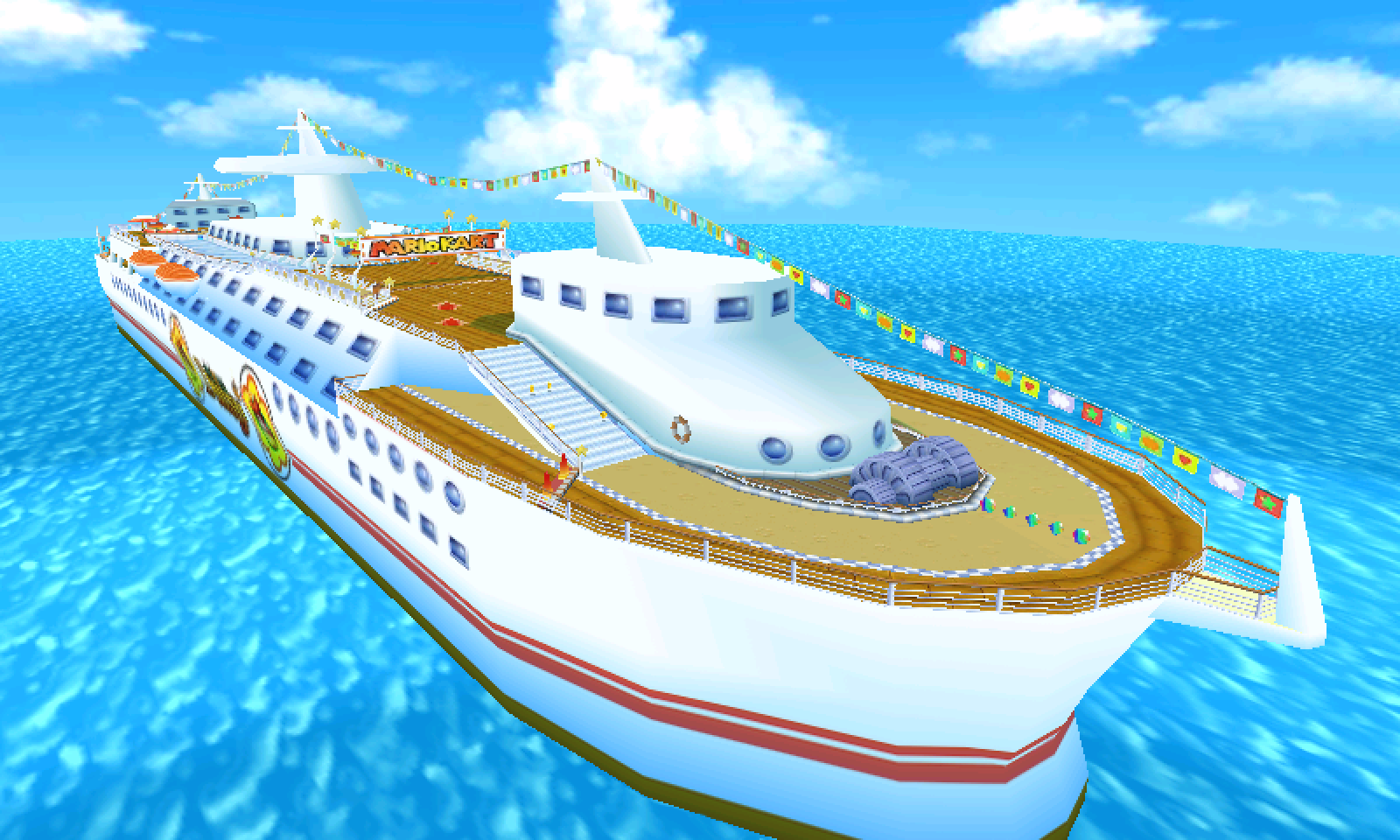
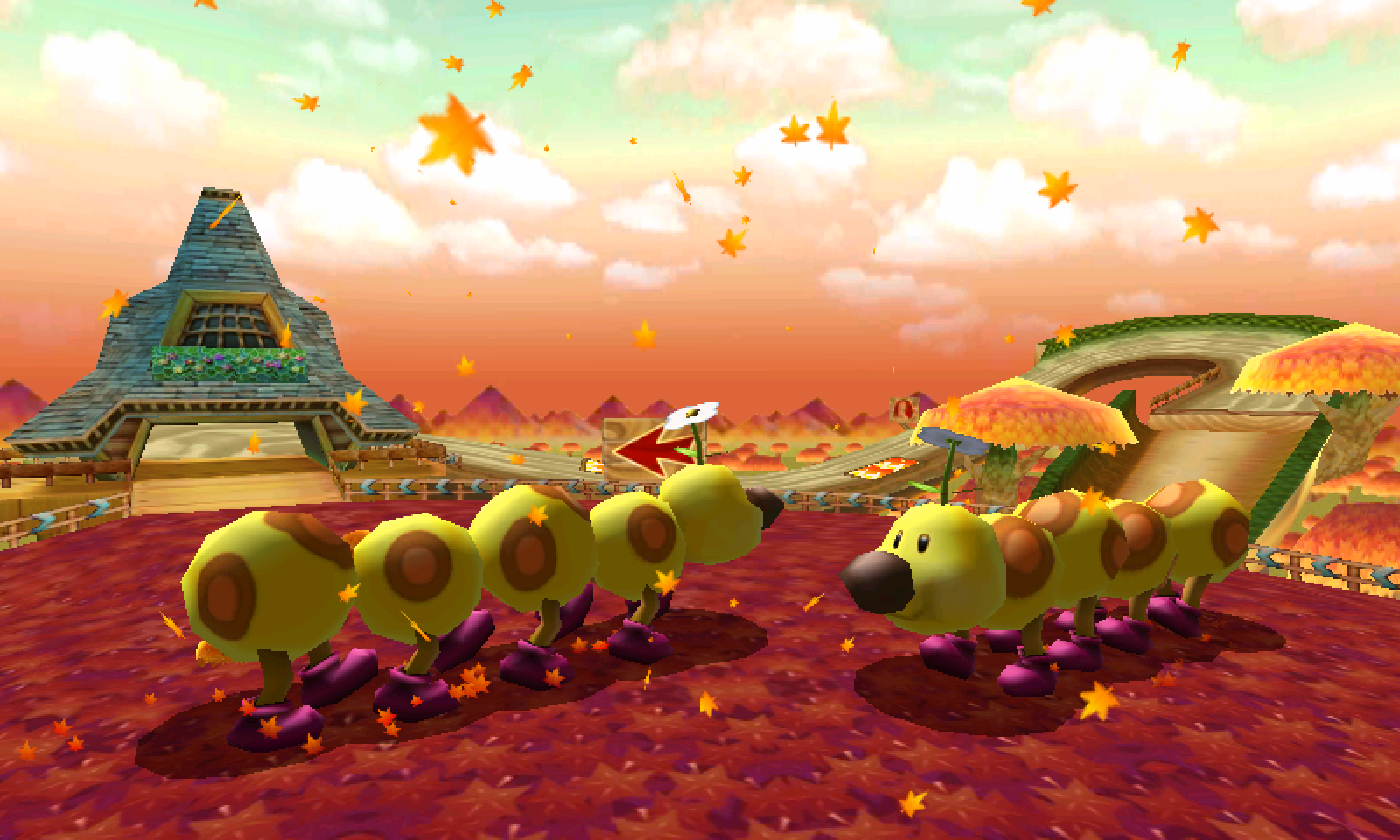
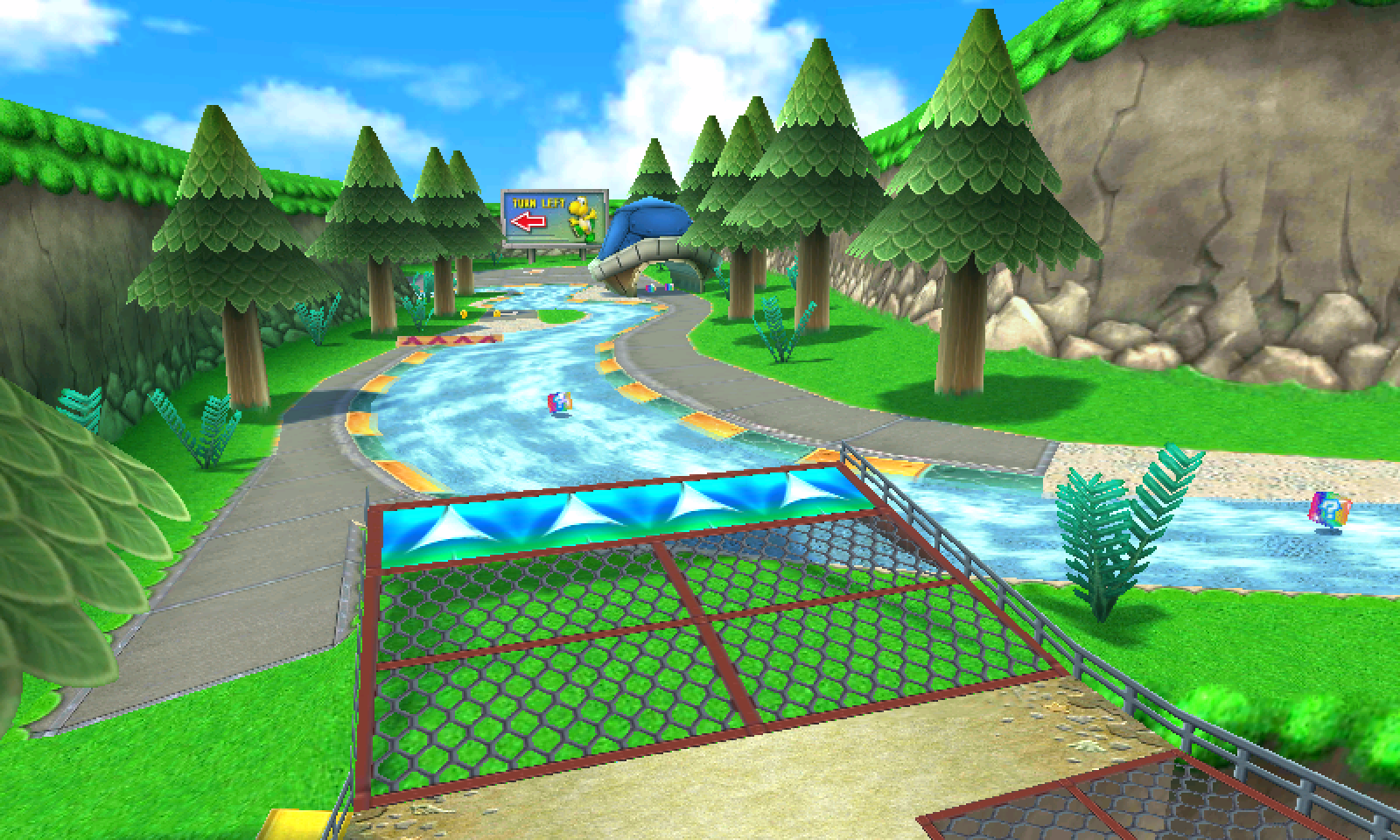
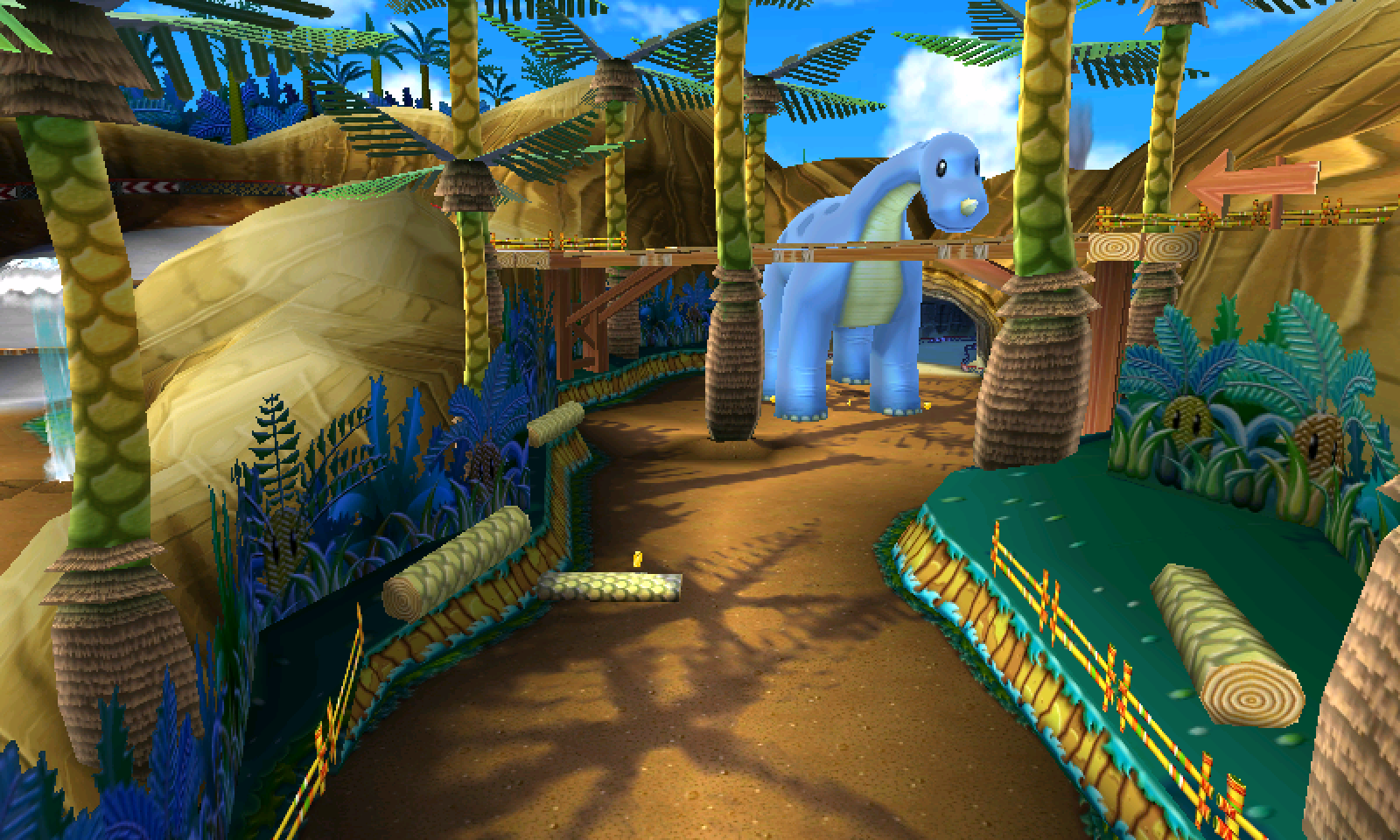
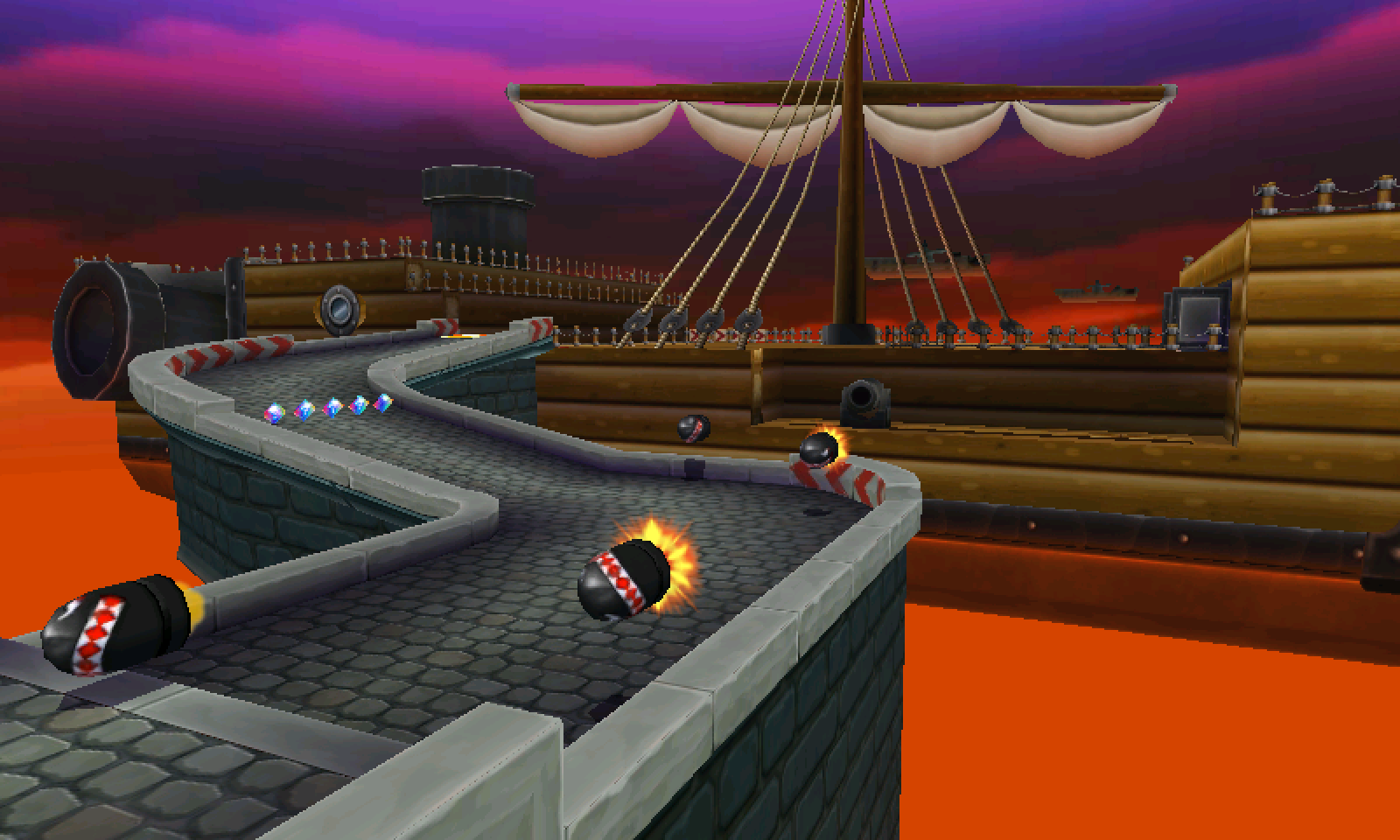
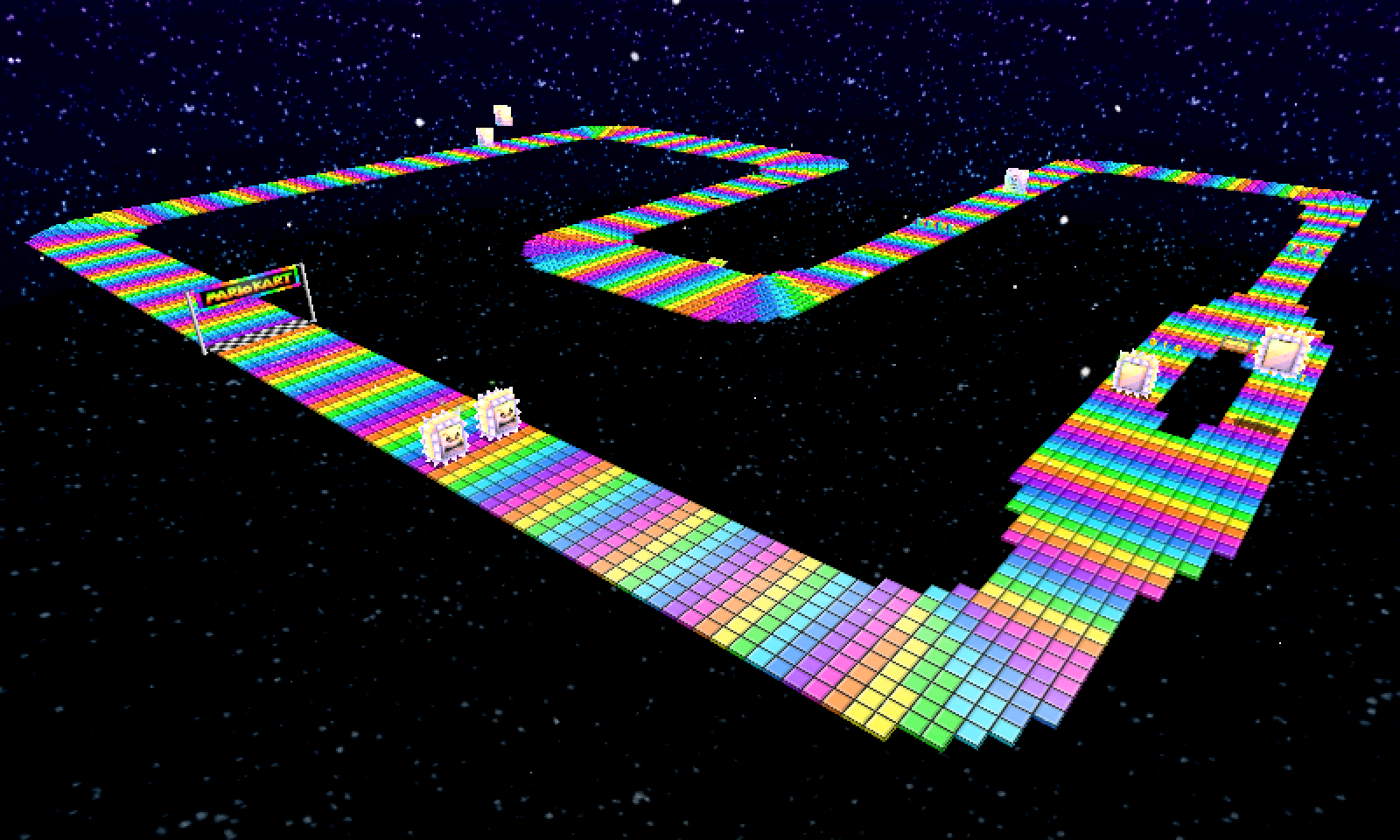
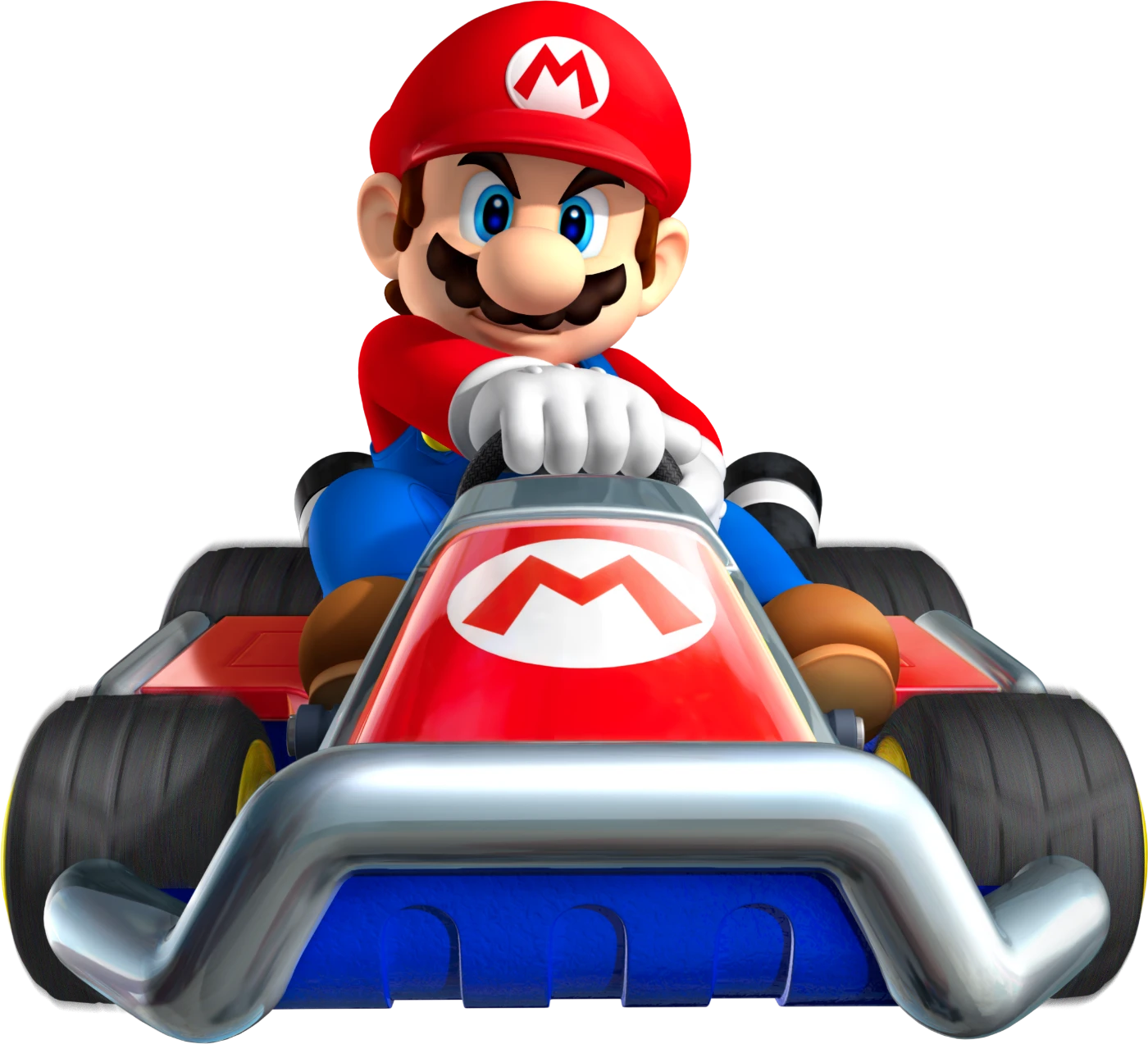
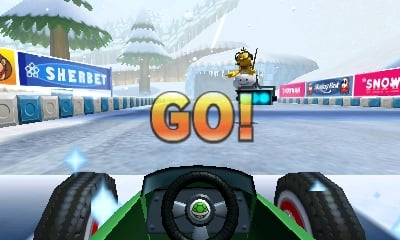
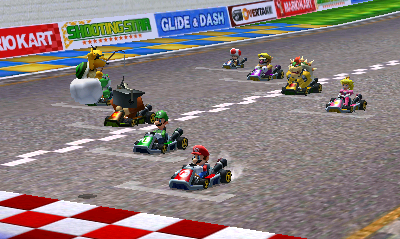
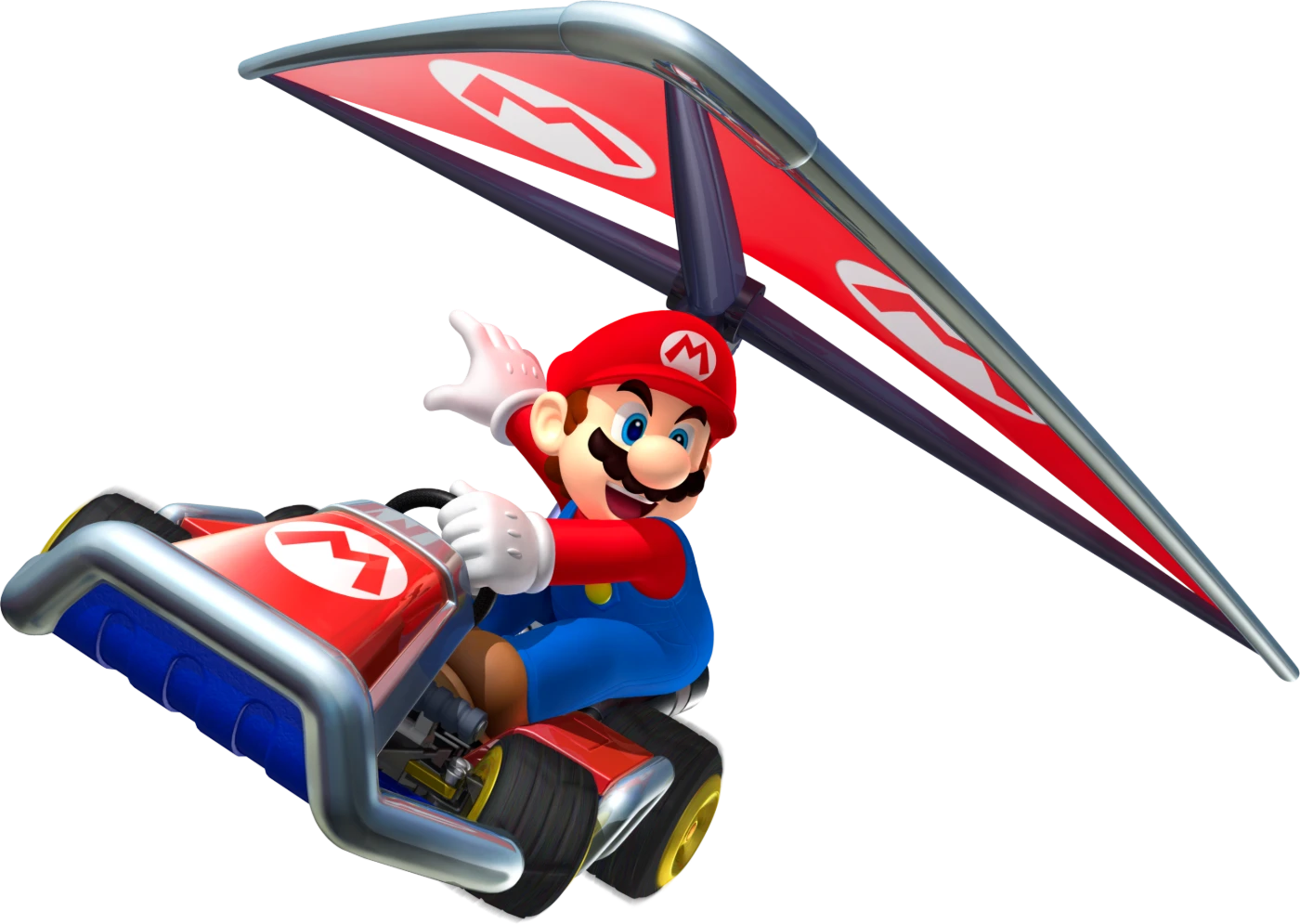
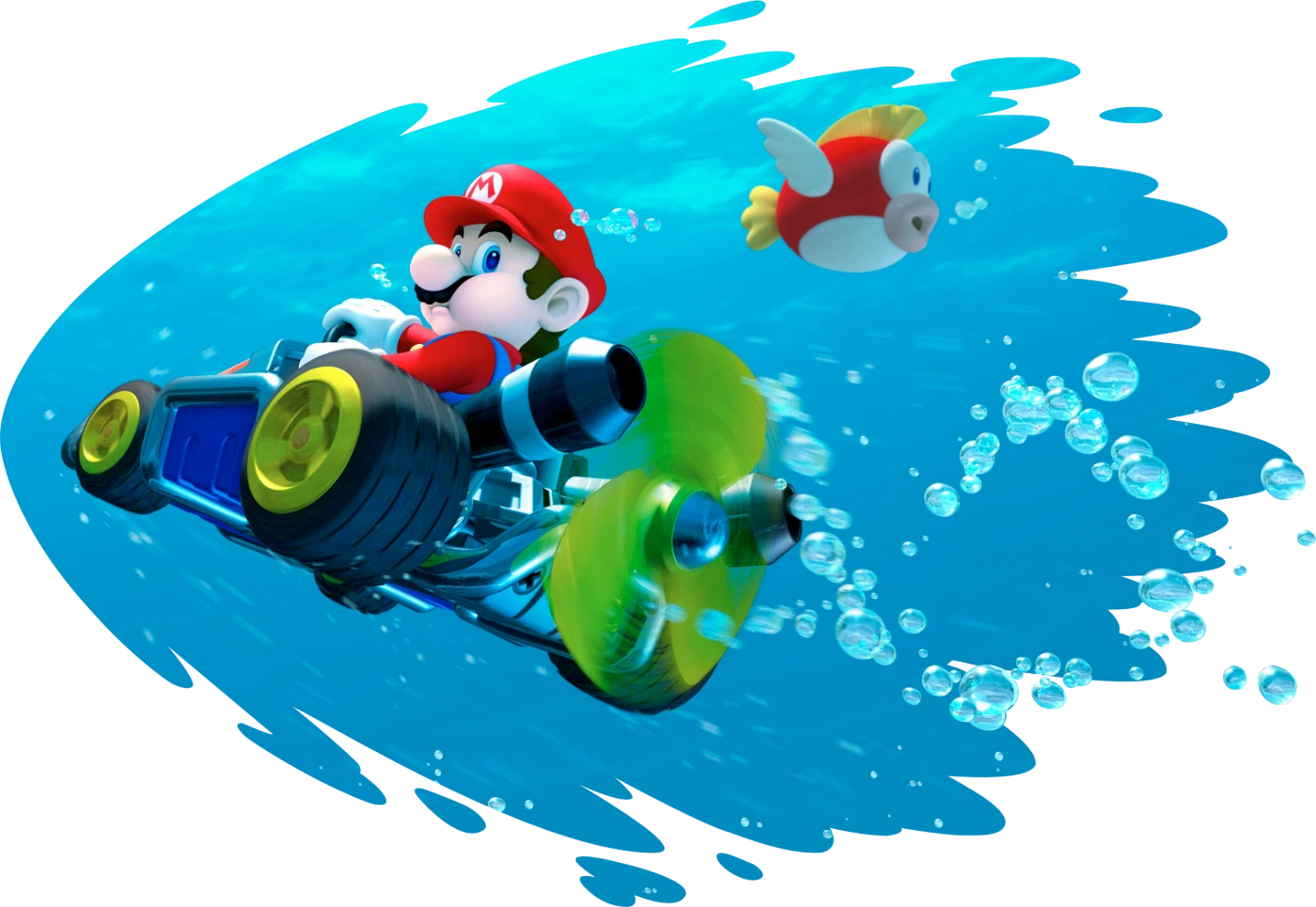
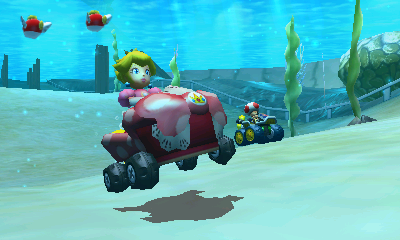
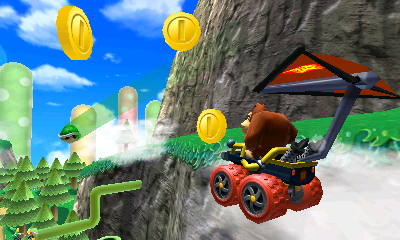
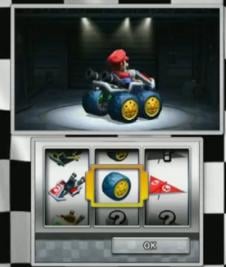
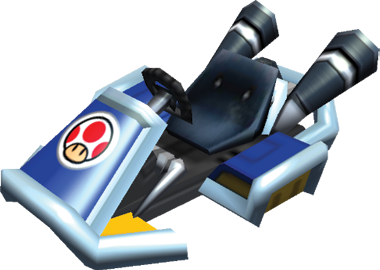
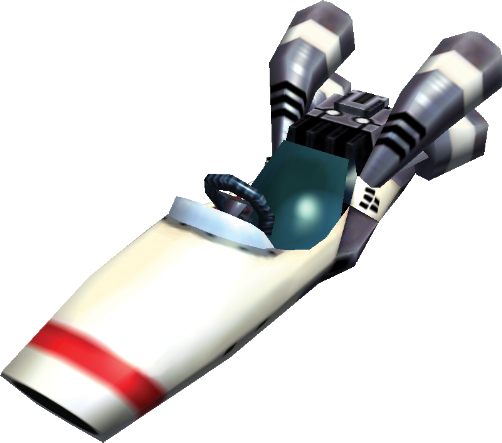
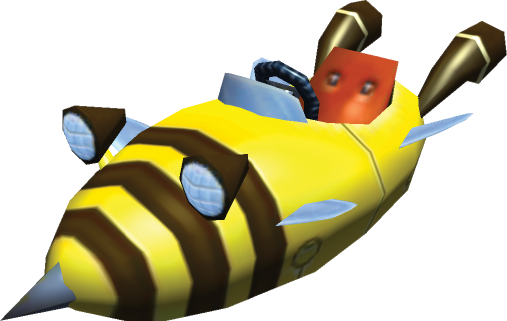
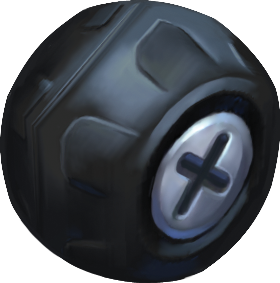
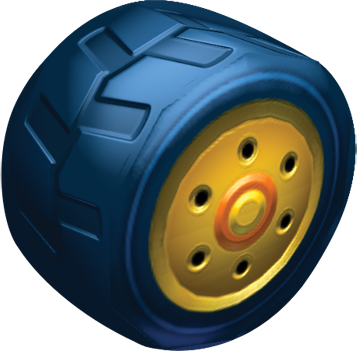

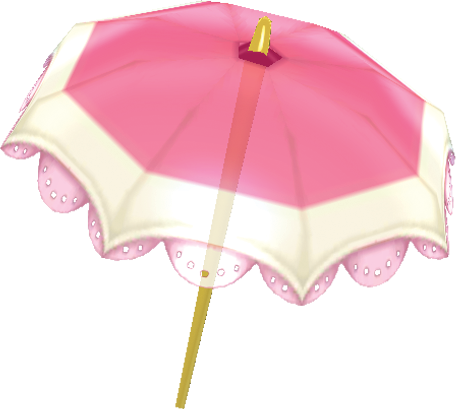
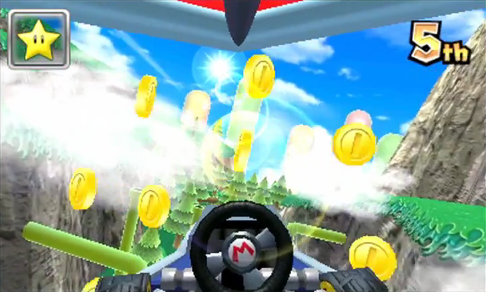
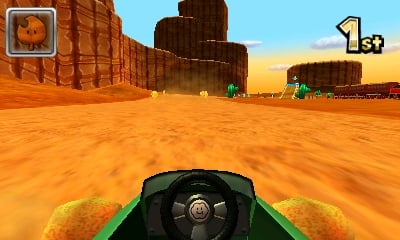
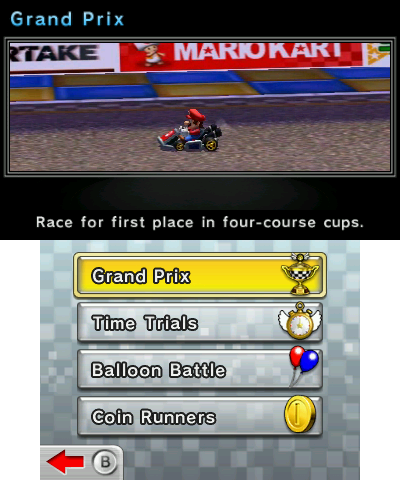
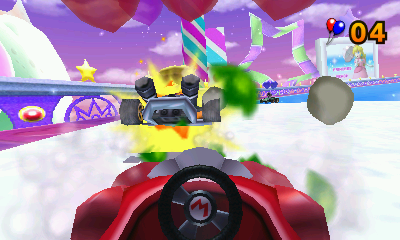
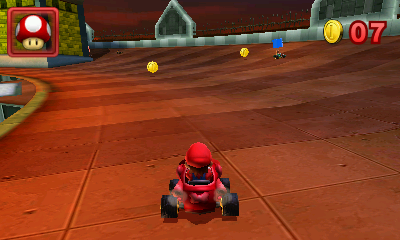
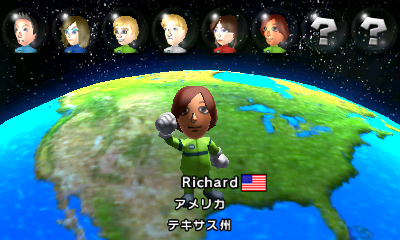
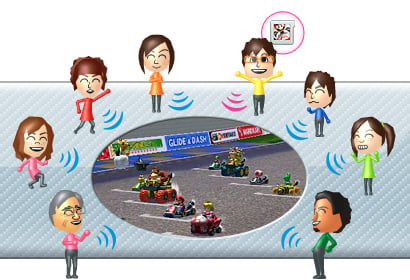
 CoinFound on the course, not in boxes. Each one adds a little top speed, up to ten.
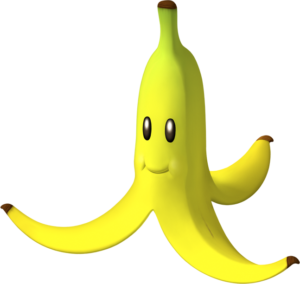 BananaDrop it or hold it behind you as a shield.
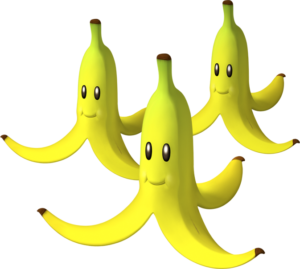 Triple BananasThree peels trailing behind the kart.
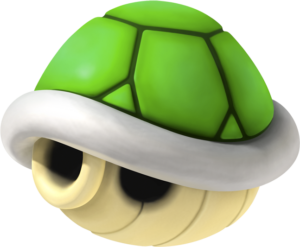 Green ShellFlies straight and bounces off walls.
 Triple Green ShellsThree shells circling the kart until fired.
 Red ShellHomes in on the next kart ahead.
 Triple Red ShellsThree homing shells in orbit.
 Spiny ShellHunts the leader along the ground and explodes. Never appears in the first 30 seconds.
 Bob-ombThrow it forwards or drop it behind. Blows up whoever is near.
 MushroomOne burst of speed that ignores rough ground.
 Triple MushroomsThree boosts. What you are given in Time Trials.
 Golden MushroomAs many boosts as you can press for in seven and a half seconds.
 Bullet BillTurns you into a rocket on autopilot that flattens everything.
 BlooperSquirts ink over the screens of everyone ahead.
 LightningShrinks and slows every rival and makes them drop their items.
 Super StarSeven and a half seconds of speed and invincibility.
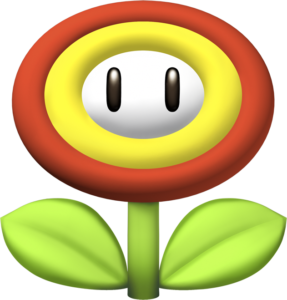 Fire FlowerNew. Throw up to ten bouncing fireballs, forwards or backwards.
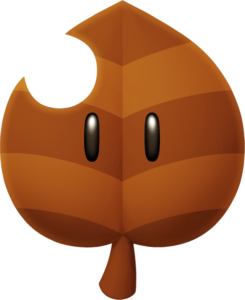 Super LeafNew. A raccoon tail that swats karts, deflects items and sweeps up coins.
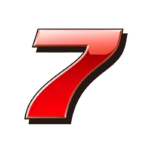 Lucky SevenNew. Seven items circle your kart at once: Mushroom, Banana, Green Shell, Red Shell, Blooper, Bob-omb and Star.
 Item BoxDrive through one to spin the roulette. The further back you are, the better the odds.

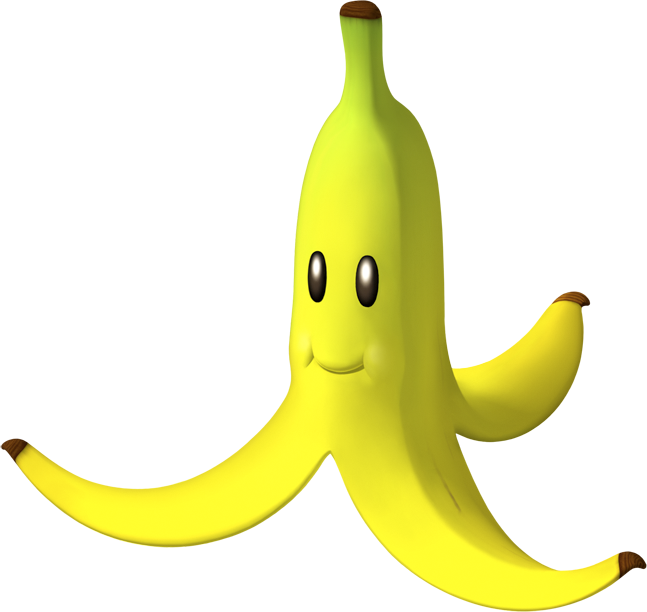
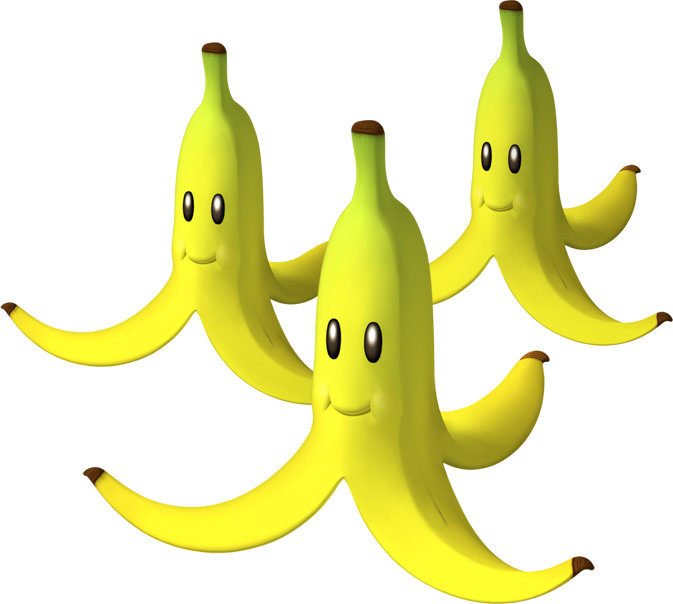
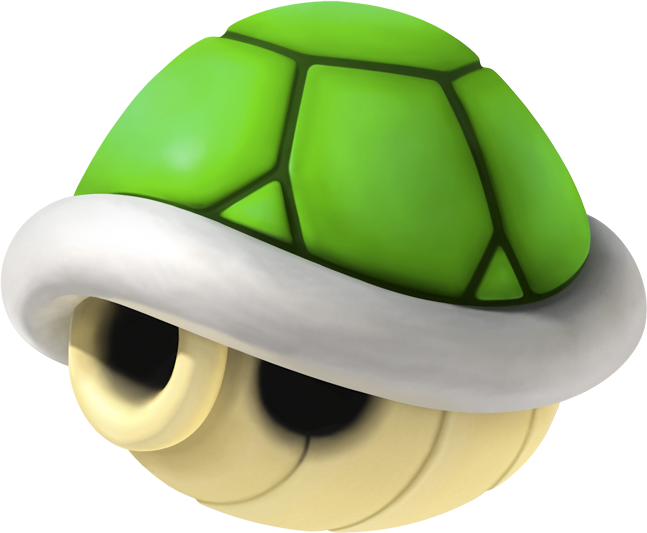
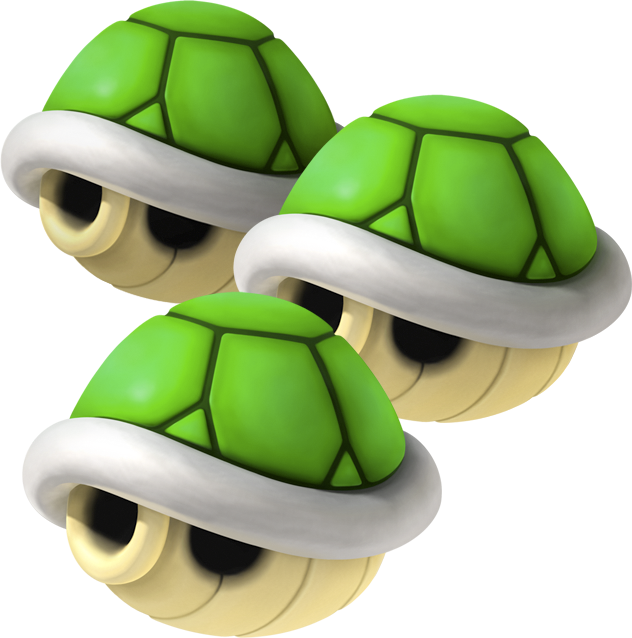
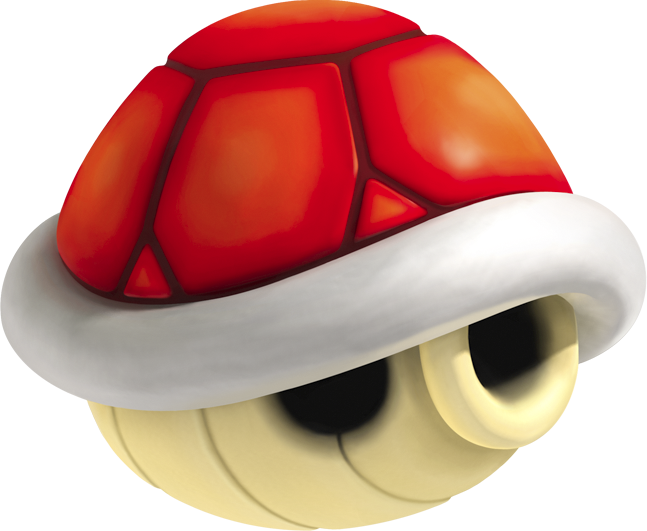
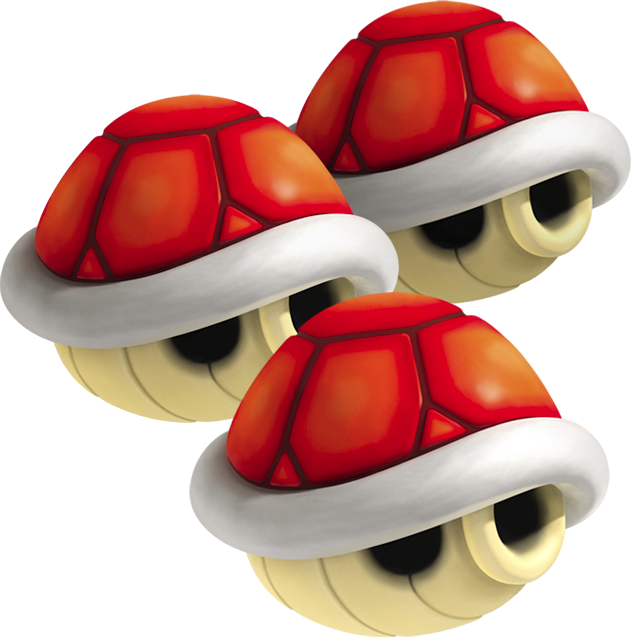
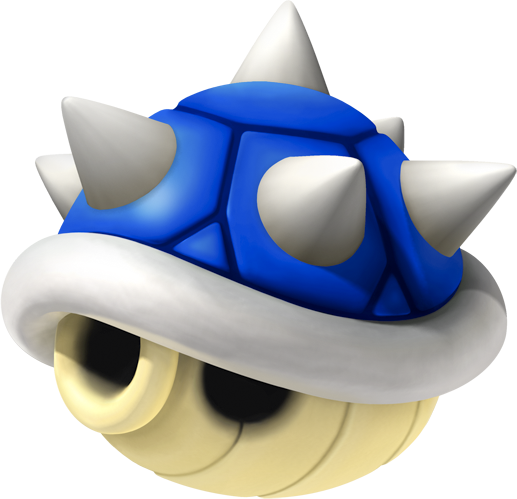


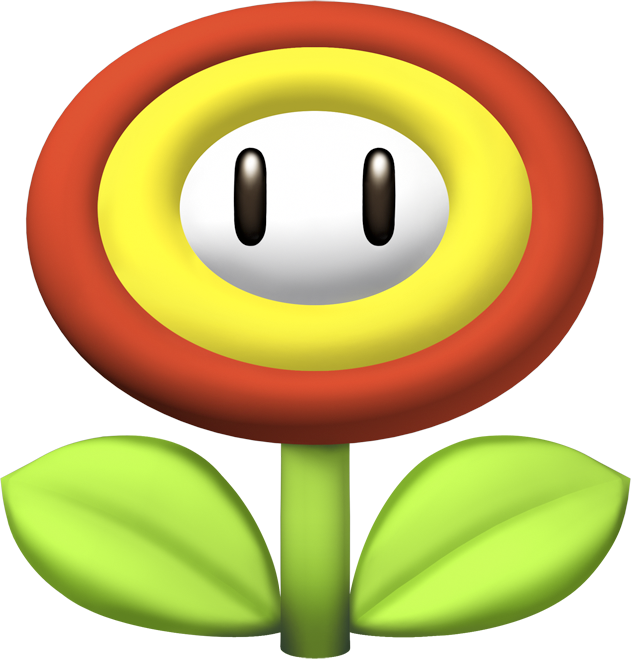
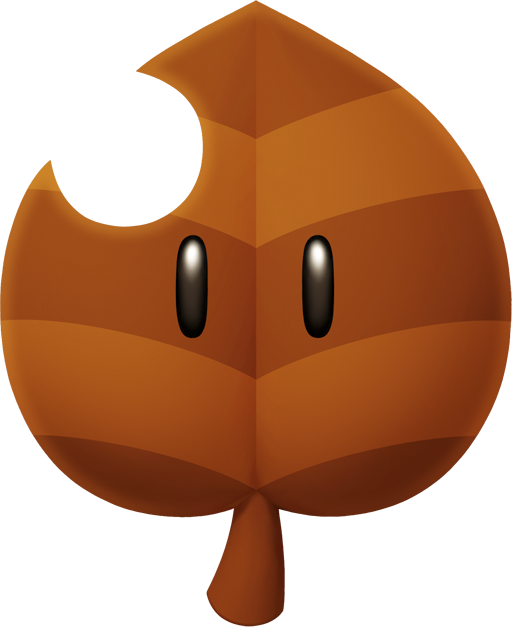

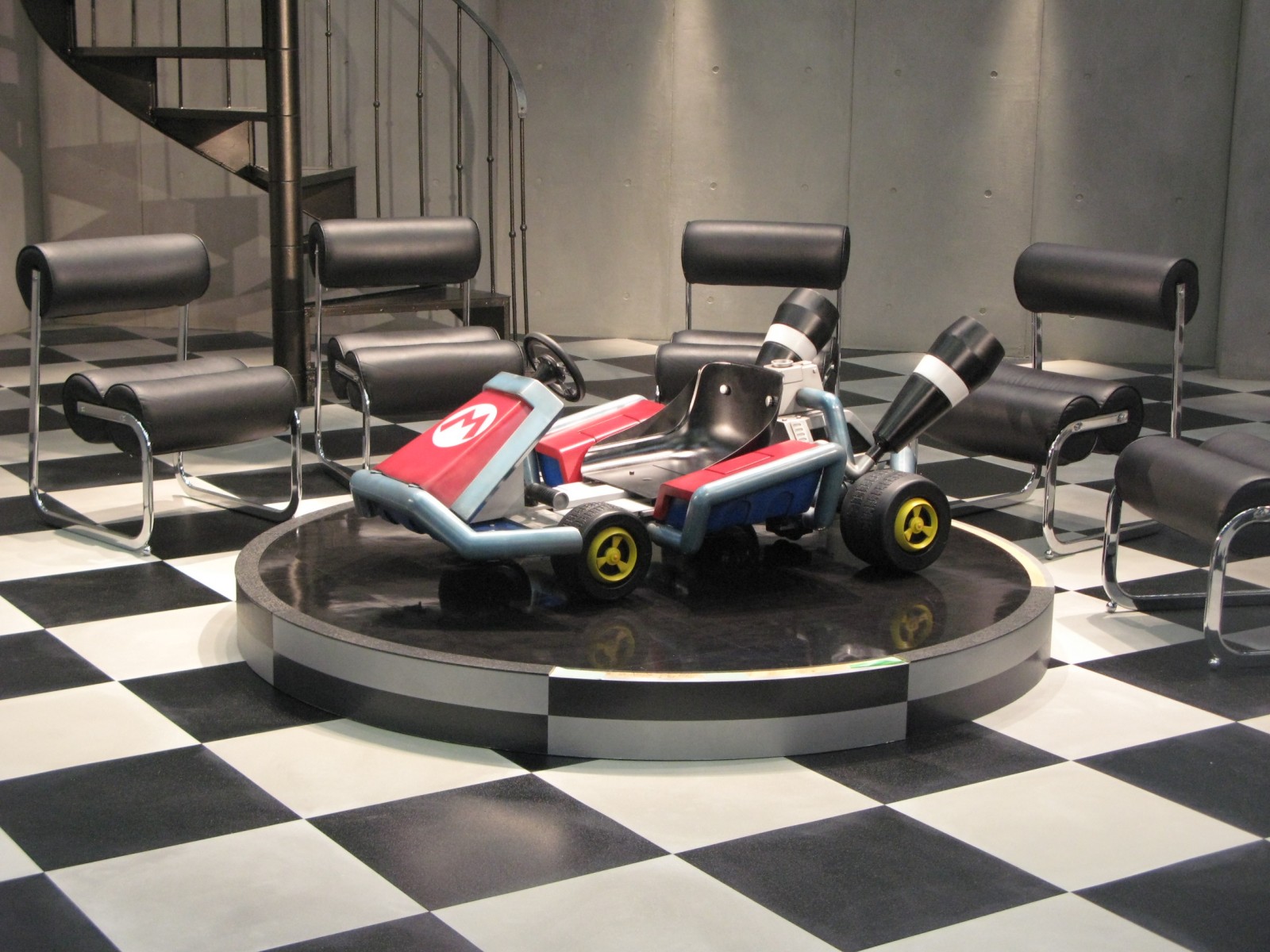 Japanese television advertsAdvertising · 2011For its Japanese commercials Nintendo had a full-size Standard kart built as a prop by the model makers Takahashi Art.
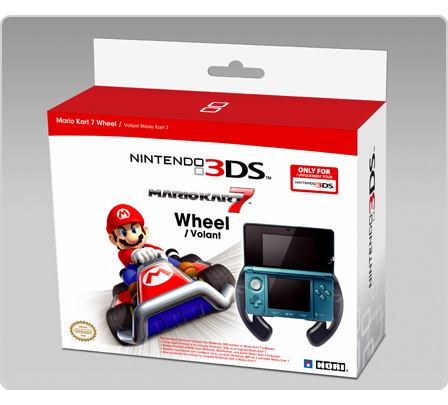 Wheels, bundles and a guideMerchandiseThe game was sold in Japan and Europe in a pack with a steering-wheel accessory. It was later pre-installed on blue Nintendo 3DS XL consoles in Canada, south-east Asia and the Middle East and on a New Nintendo 2DS LL in Japan, and paired with Mario & Luigi: Paper Jam in a Japanese double pack. Prima Games published the official guide.
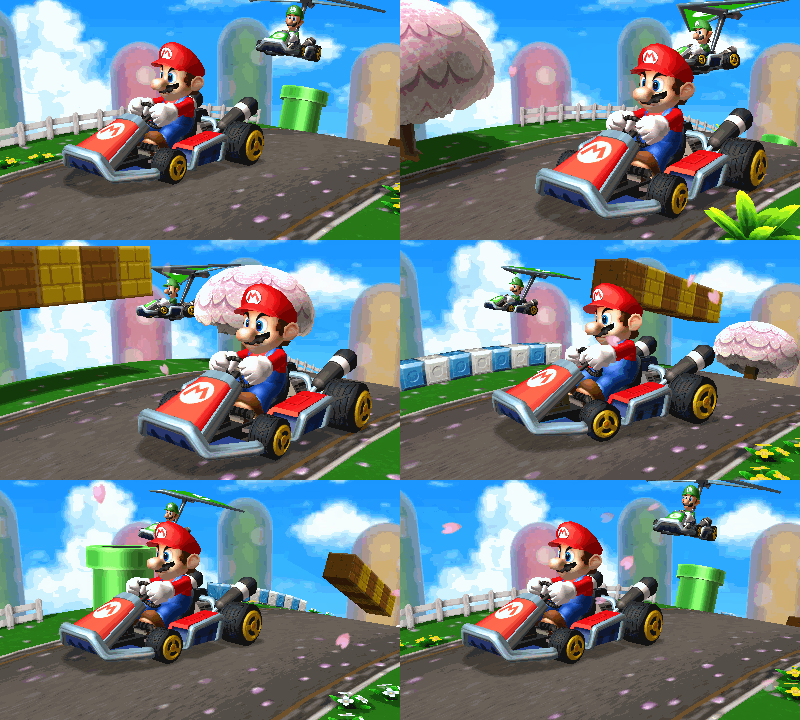 StreetPass Mii PlazaCameo · Puzzle SwapA Mario Kart 7 picture was added to Puzzle Swap, the jigsaw game inside StreetPass Mii Plaza.
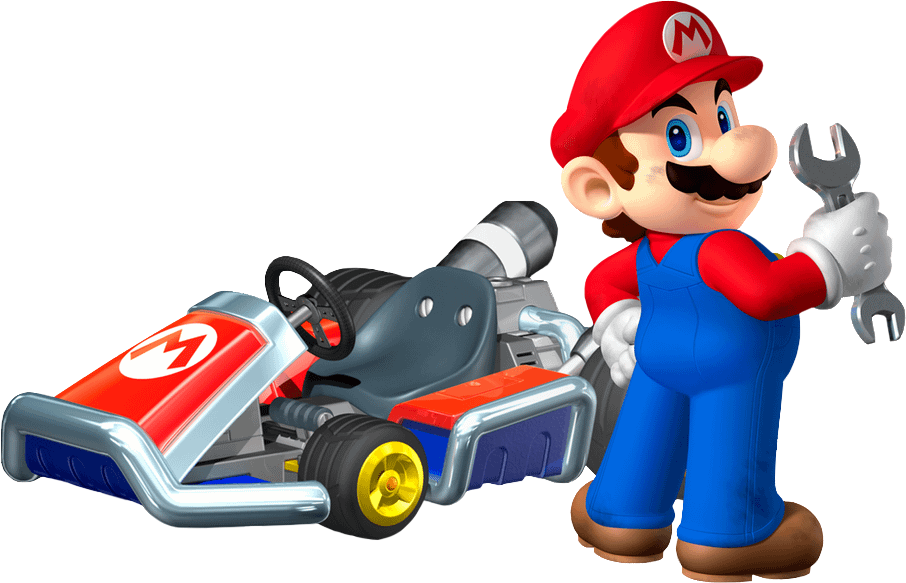 MarioMedium · starter
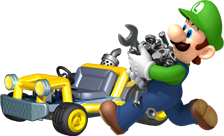 LuigiMedium · starter
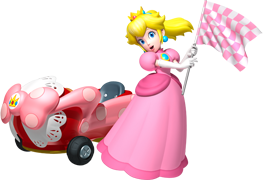 PeachLight · starter
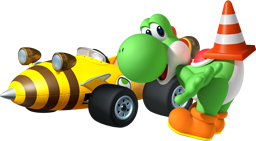 YoshiLight · starter
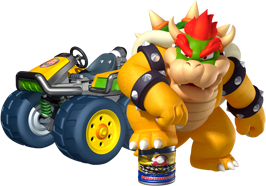 BowserHeavy · starter
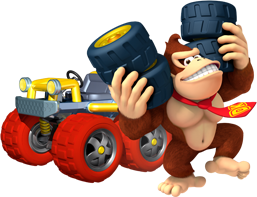 Donkey KongCruiser · starter
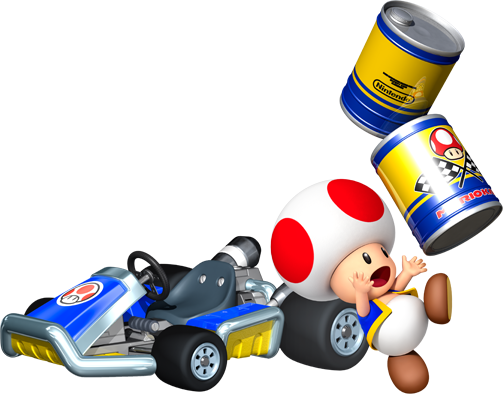 ToadFeather · starter
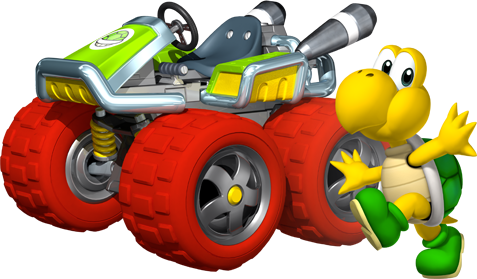 Koopa TroopaFeather · starter
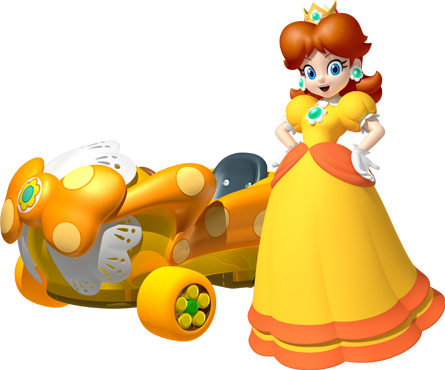 DaisyLight · unlock: win the 150cc Mushroom Cup
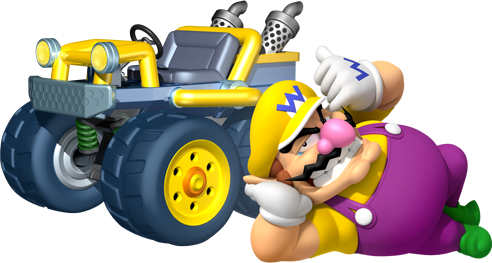 WarioHeavy · unlock: win the 150cc Flower Cup
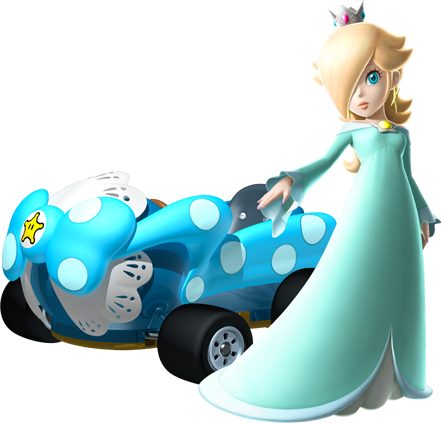 RosalinaCruiser · unlock: win the 150cc Star Cup
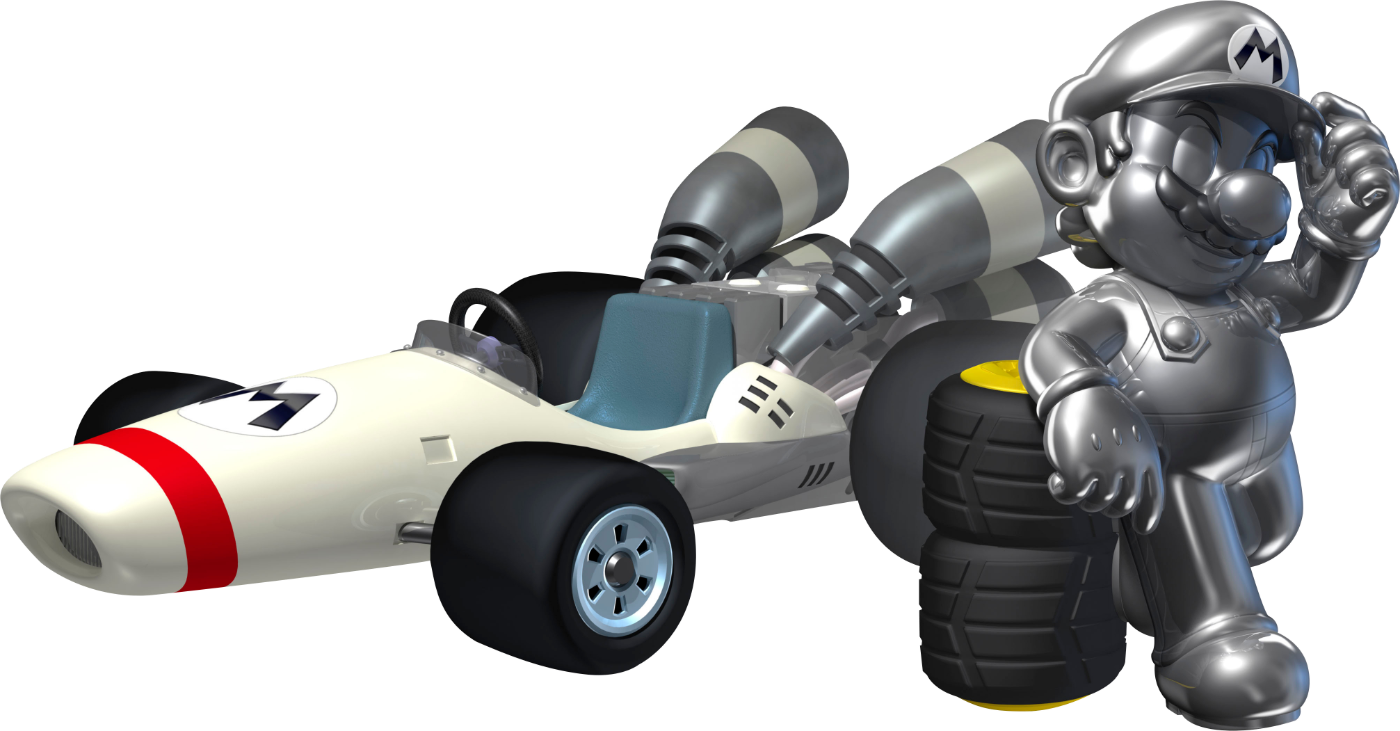 Metal MarioHeavy · new · unlock: win the 150cc Special Cup
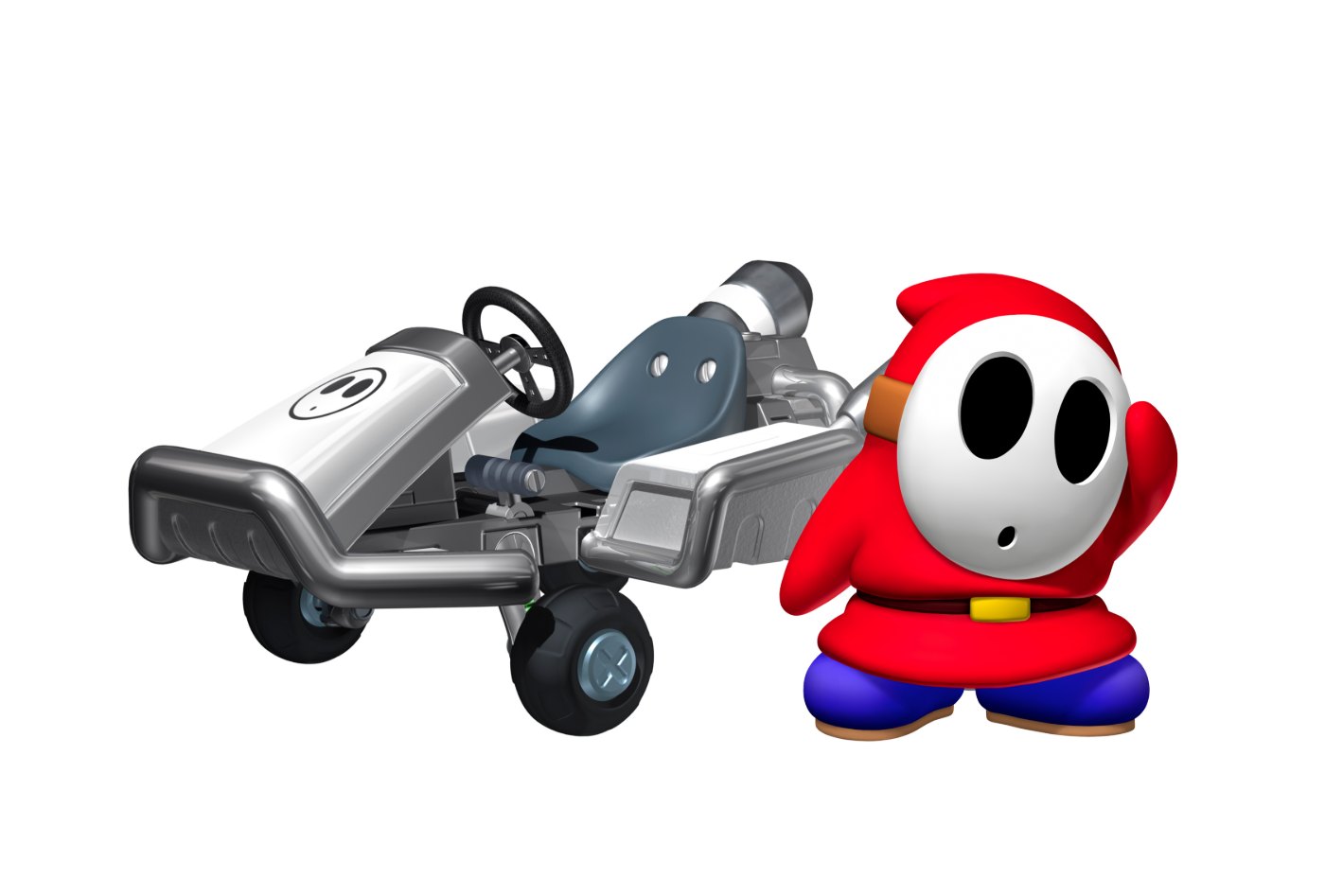 Shy GuyFeather · unlock: win the 150cc Shell Cup
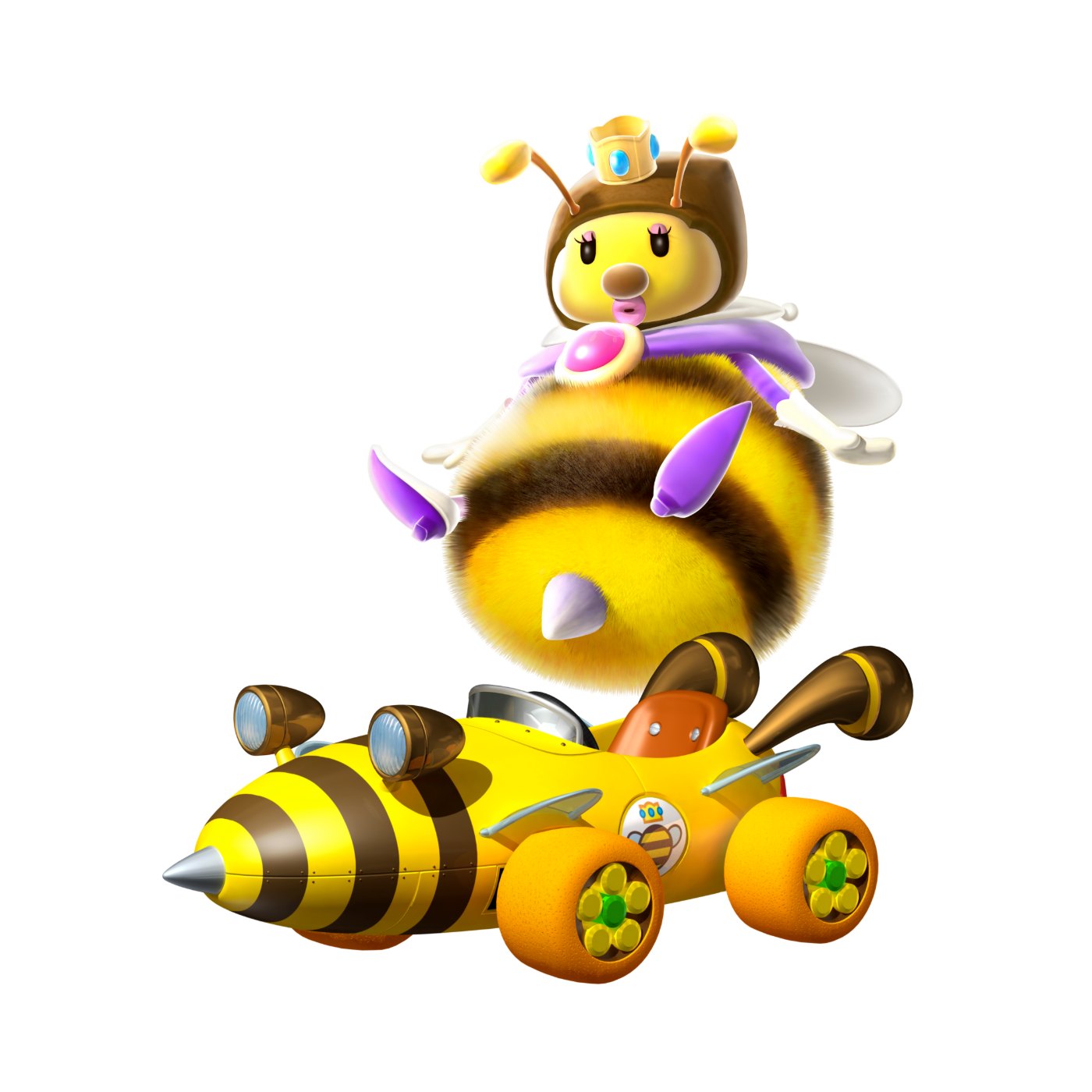 Honey QueenHeavy · new · unlock: win the 150cc Banana Cup
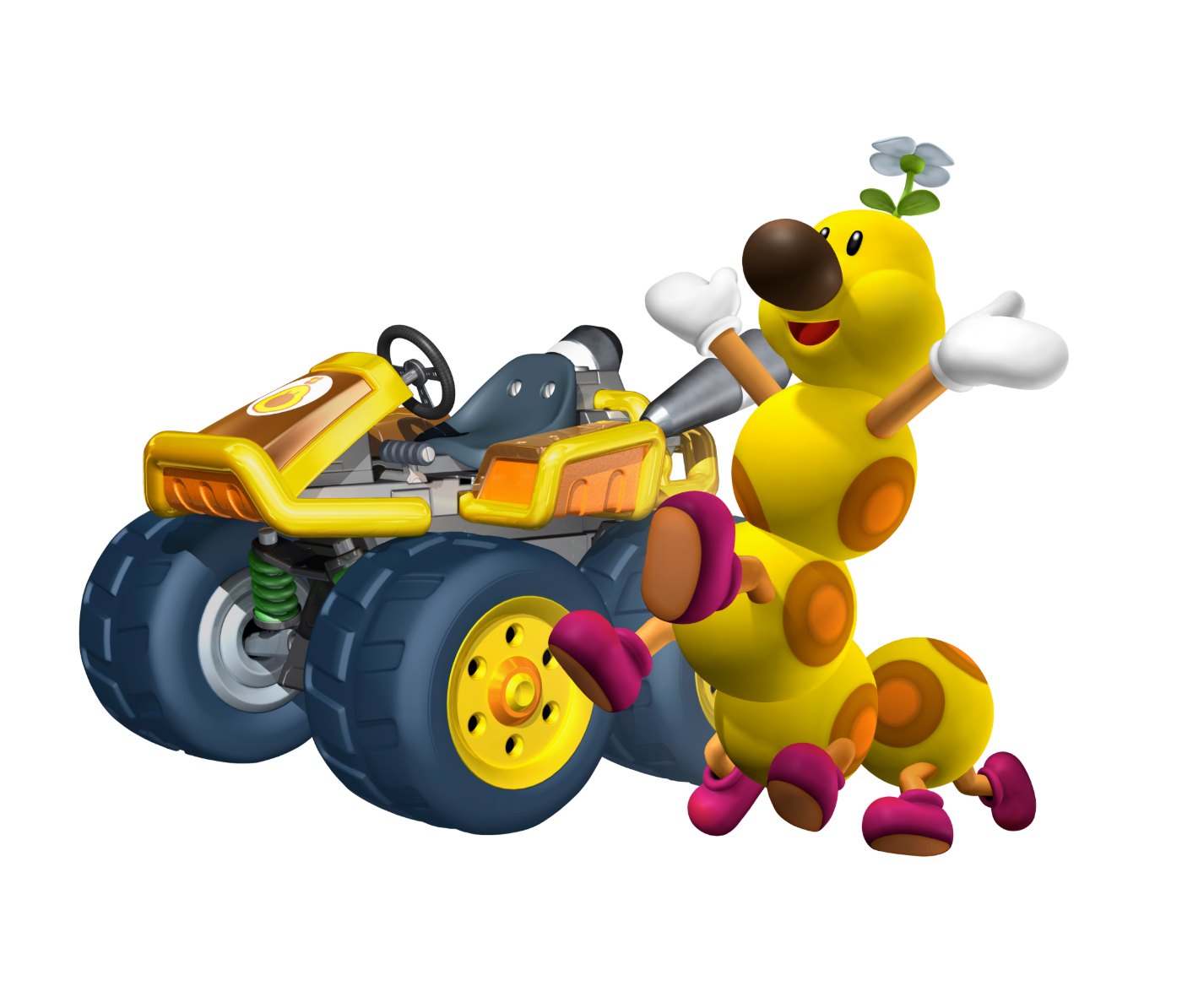 WigglerCruiser · new · unlock: win the 150cc Leaf Cup
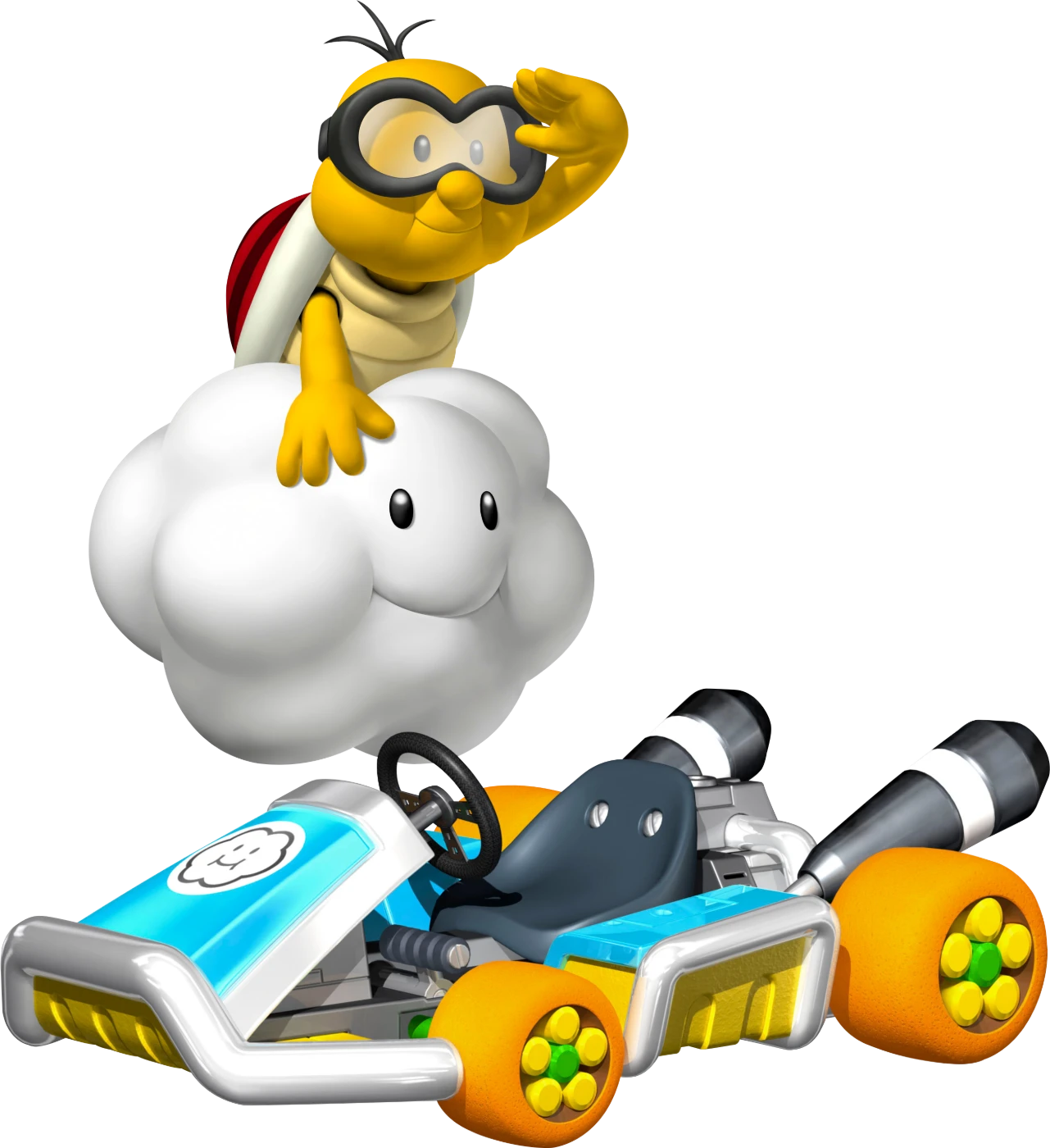 LakituFeather · new · unlock: win the 150cc Lightning Cup
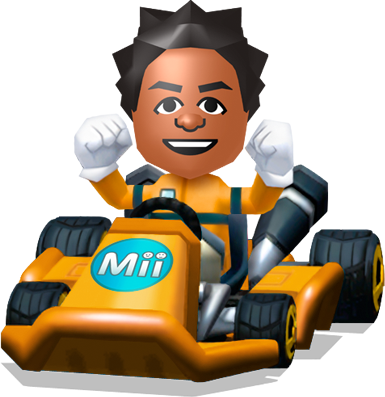 MiiMedium · unlock: finish every cup in one engine class
 GoombaMario Circuit, Piranha Plant Slide, Mushroom Gorge, Koopa CapeWaddles to and fro. Hit one with a shell and it leaves a Mushroom.
 Piranha PlantMusic Park, Piranha Plant SlideLunges at anything that passes too close.
 Mountain GoatDaisy HillsRoams the hillside and bowls over anyone who hits it.
 Hot-air balloonDaisy HillsBounces gliders off, sometimes usefully.
 ClampyCheep Cheep Lagoon, Daisy CruiserA giant clam that may hold an item, and may close on you.
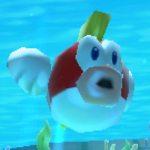 Cheep CheepCheep Cheep Lagoon, Koopa CapeSwims about under water and nudges karts aside.
 SidestepperCheep Cheep Lagoon, Koopa Troopa Beach, Palm ShoreA crab that shuffles across the road and spins you out.
 Flying Shy GuyShy Guy BazaarRides a carpet through the gliding section and gets in the way.
 Snake jarShy Guy BazaarA jar with a snake in it that slides round the market.
 CarWuhu Loop, Coconut MallOrdinary traffic on Wuhu Island, and reversing shoppers at the mall.
 Bouncing NoteMusic ParkHops in time and squashes karts. Quicker on the last lap.
 SwoopRock Rock MountainBats in the cave that slow you down.
 BoulderRock Rock Mountain, Maka WuhuRolls down the mountain and flips whatever it meets.
 Fish BoneWario ShipyardA skeletal fish that patrols the first tunnel.
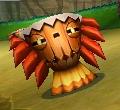 Tiki GoonDK JungleA walking drum from Donkey Kong Country Returns.
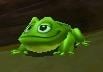 FrogoonDK JungleHops across the road before the temple.
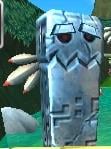 Screaming PillarDK JungleA stone face whose shriek pushes karts and gliders back.
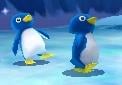 PenguinRosalina’s Ice World, Sherbet RinkSlides about on the ice. You bounce off.
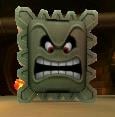 ThwompBowser’s Castle, GBA Bowser Castle 1Blocks the way and flattens anyone underneath.
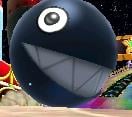 ChompRainbow RoadRolls in circles on the moon, as on the Nintendo 64.
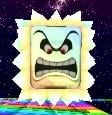 Super ThwompSNES Rainbow RoadSeven big ones. Their landings send a wave along the track.
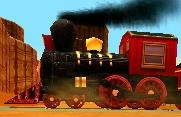 TrainN64 Kalimari DesertTwo of them circle the course on a loop of track.
 PinballDS Waluigi PinballSteel balls the size of a kart, batted about by flippers.
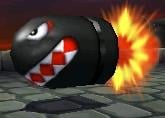 Banzai BillDS Airship FortressFired down the opening straight in place of the DS game’s Bullet Bills.
 Rocky WrenchDS Airship Fortress, GBA Battle Course 1Pops out of a manhole and flips passing karts.
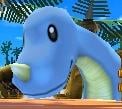 NossieGCN Dino Dino JungleA dinosaur whose feet stamp like Thwomps.
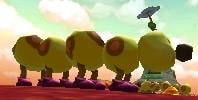 Giant WigglerWii Maple TreewayStrolls along the treetop. You bounce off without crashing.
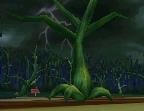 Walking TreeDS Luigi’s MansionPlods across the last stretch and stops karts dead.
 SnowballDS DK PassRolls down the mountain road.
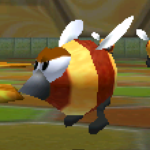 StingbyHoneybee HiveA swarm of bees patrolling the battle arena.
 BarrelWario Shipyard, DK JungleSmash it for a banana, Mushroom, Green Shell or Star.
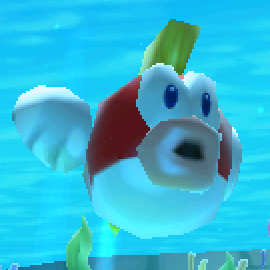
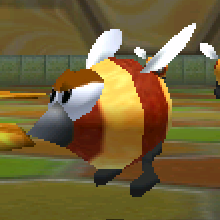
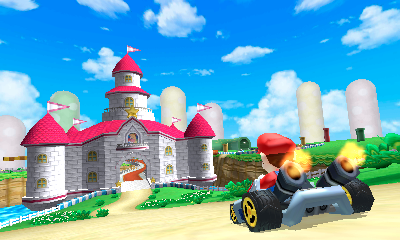
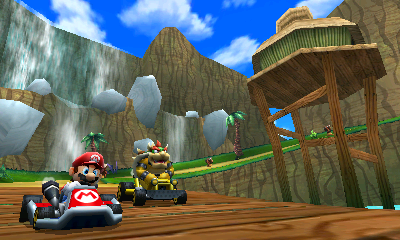
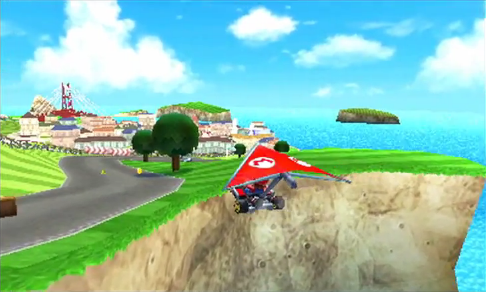
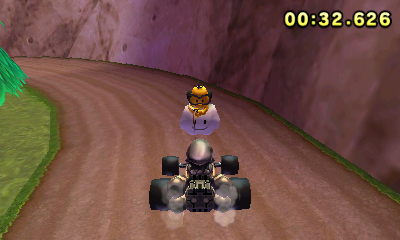
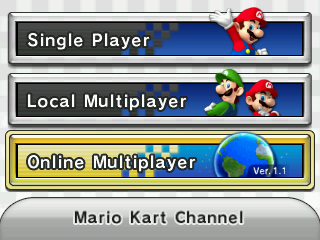
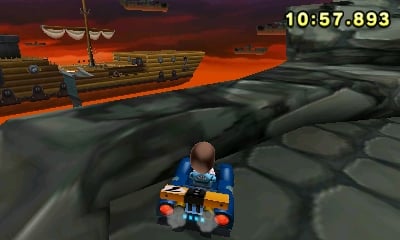

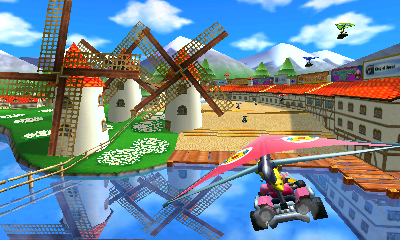
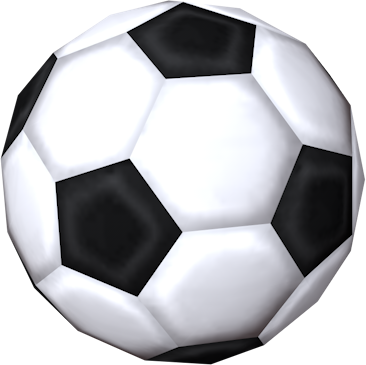

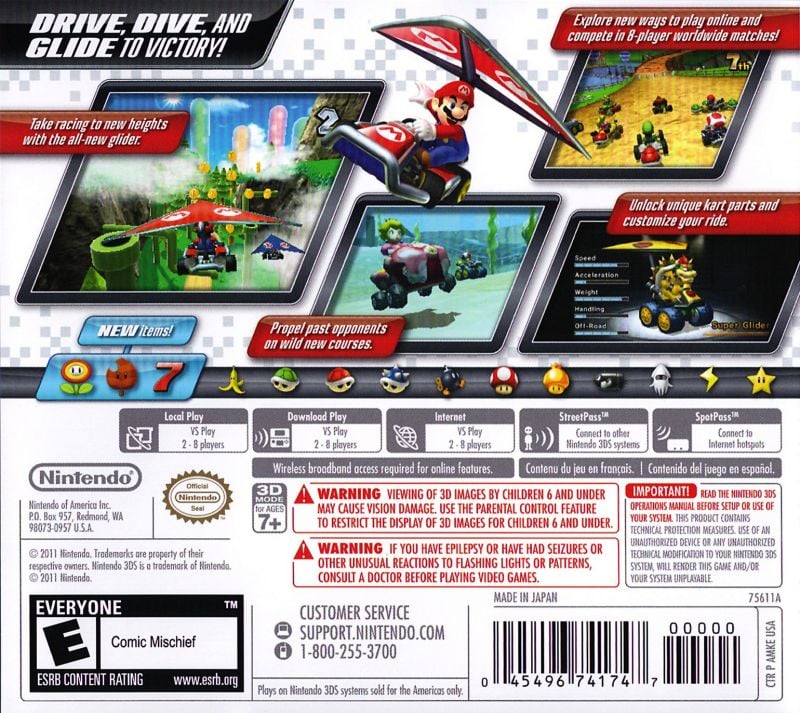
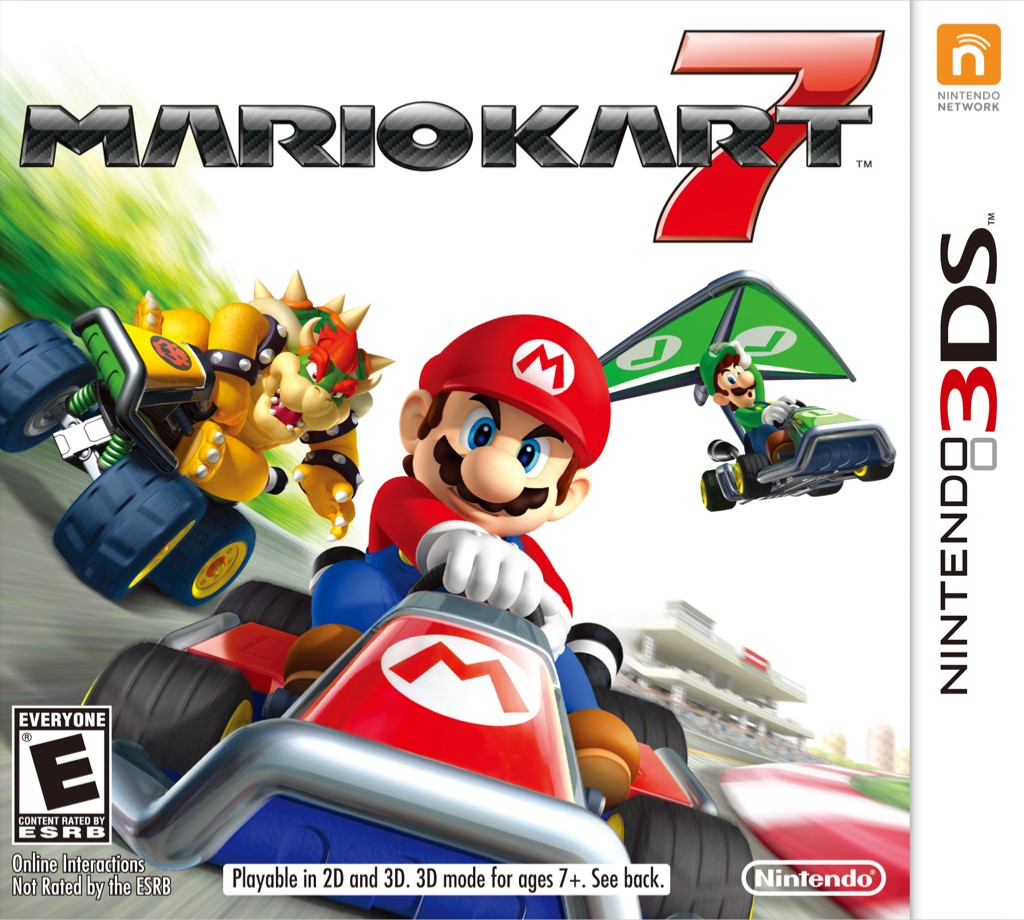
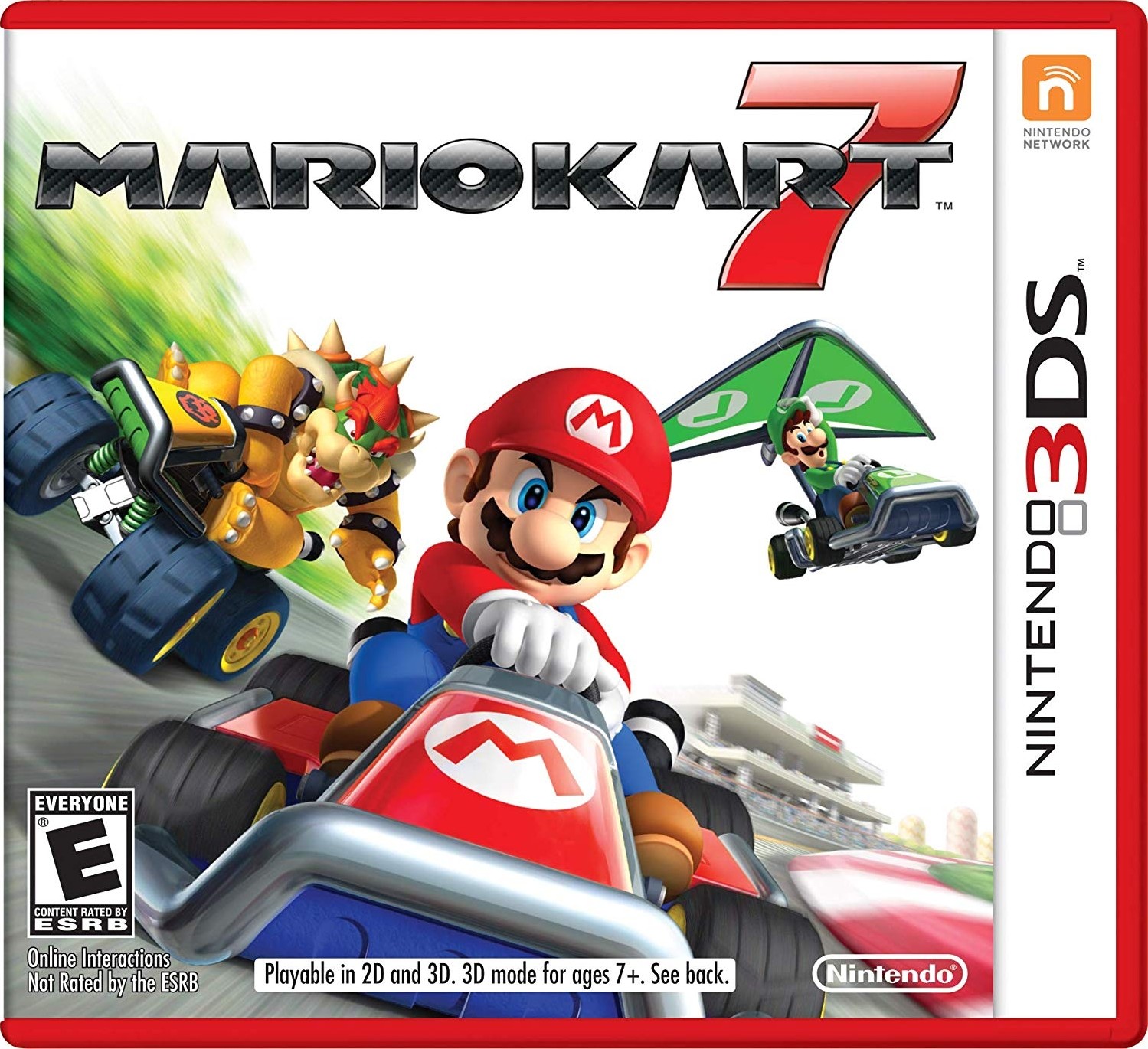
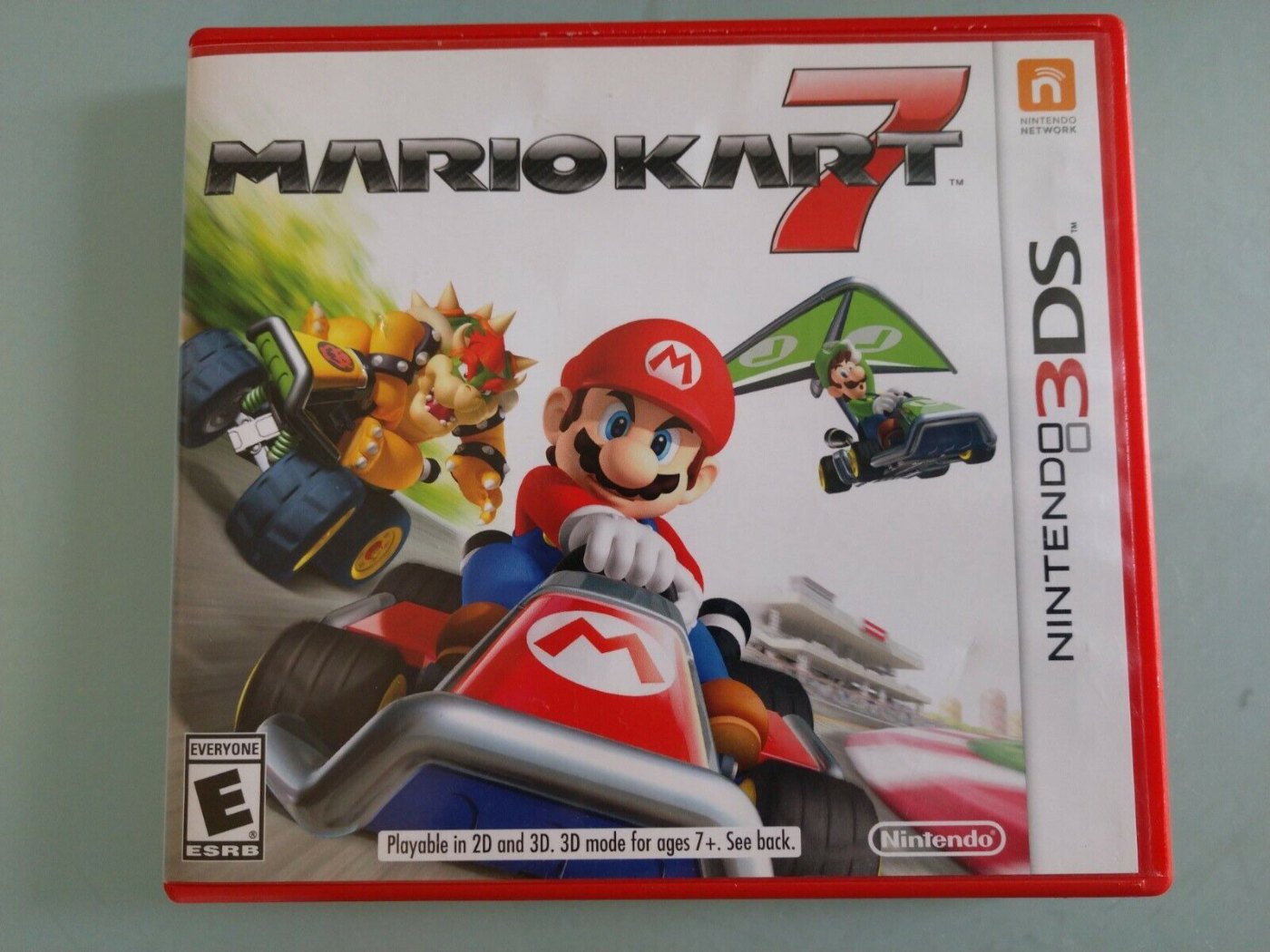
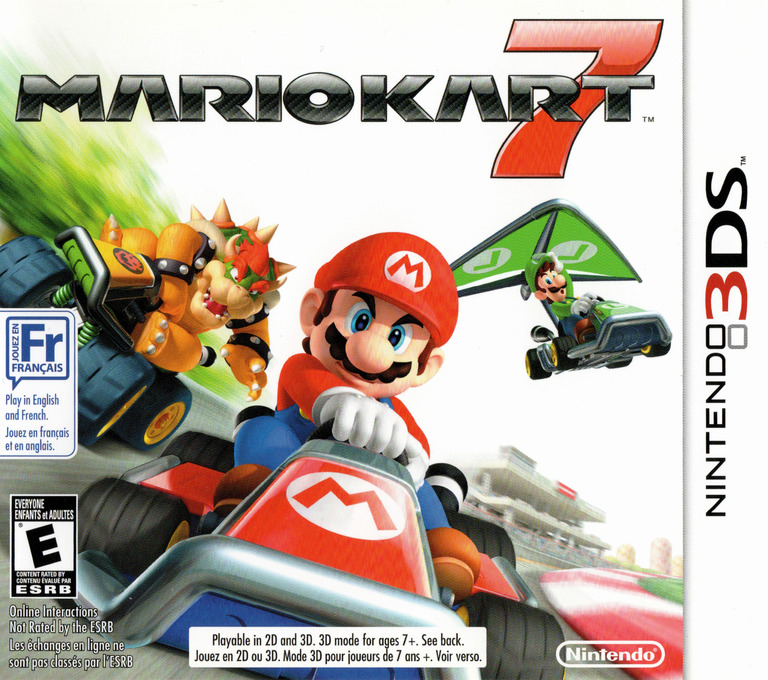
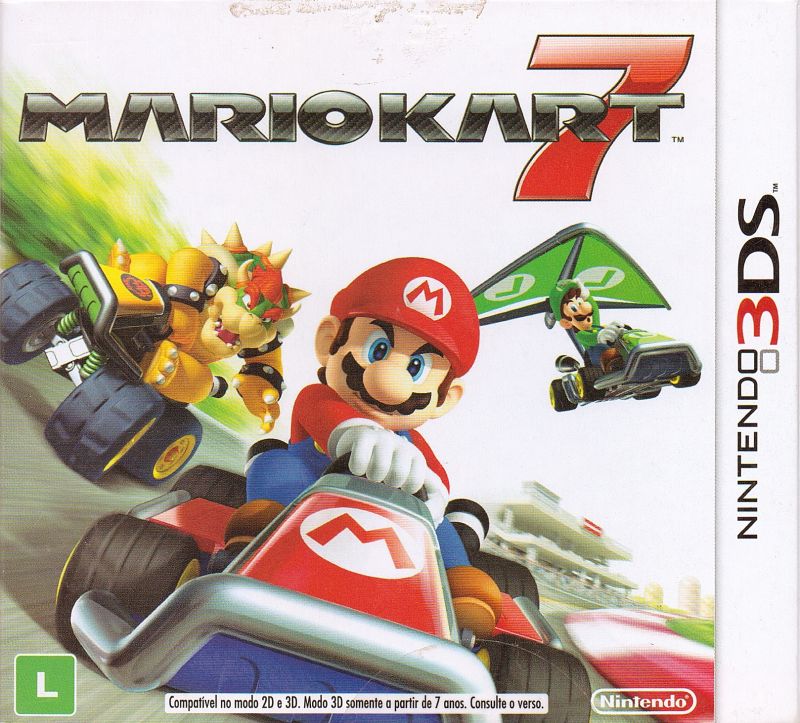
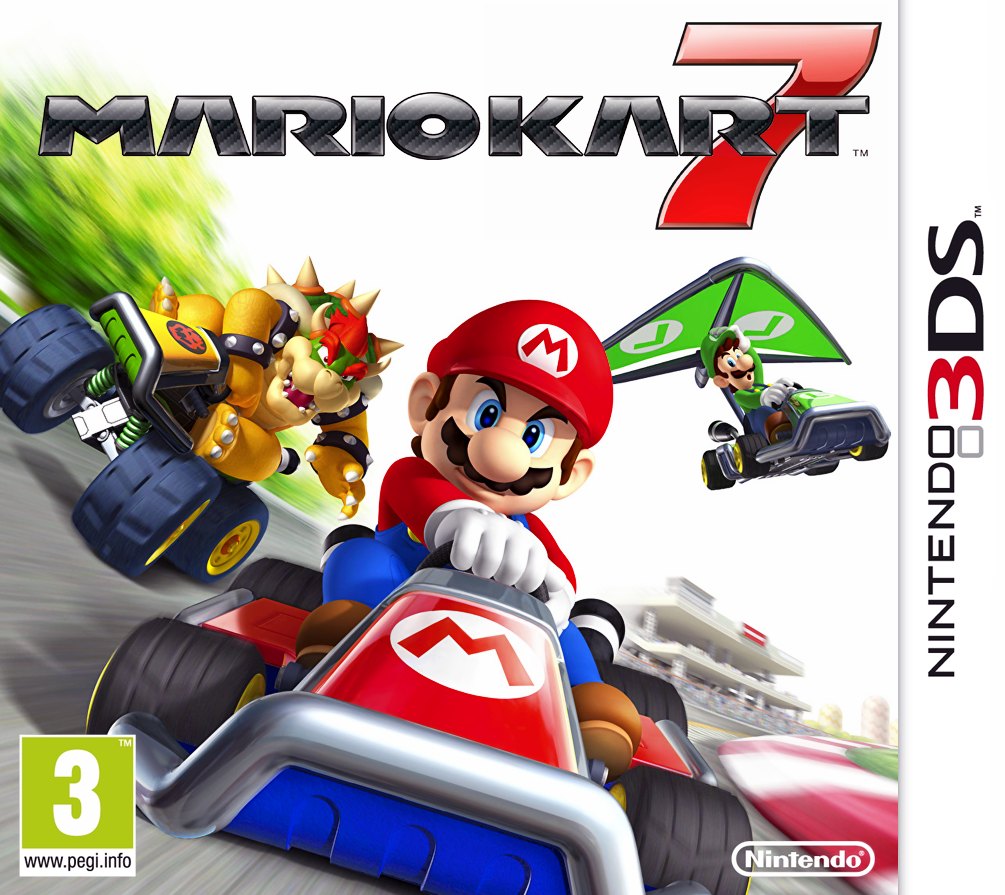
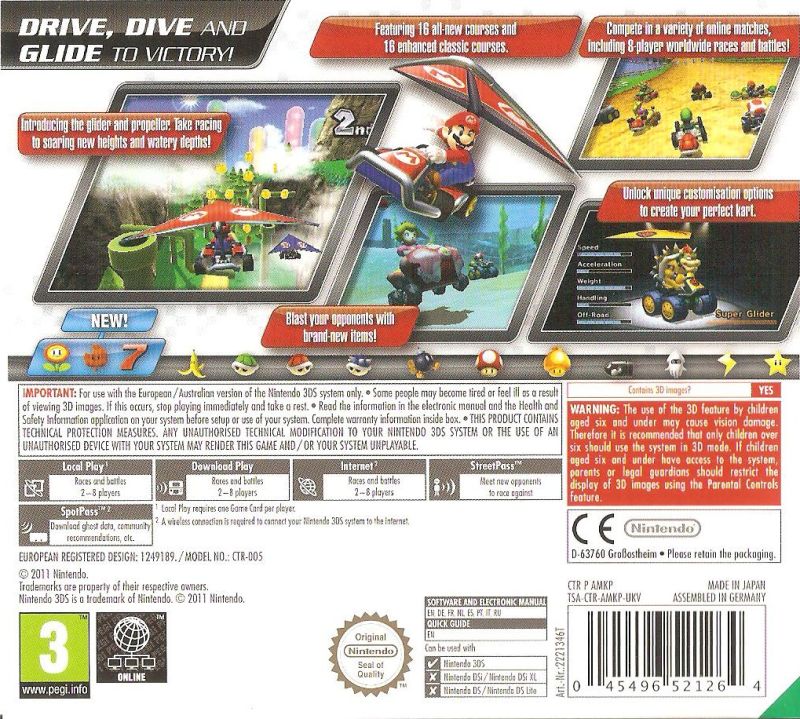
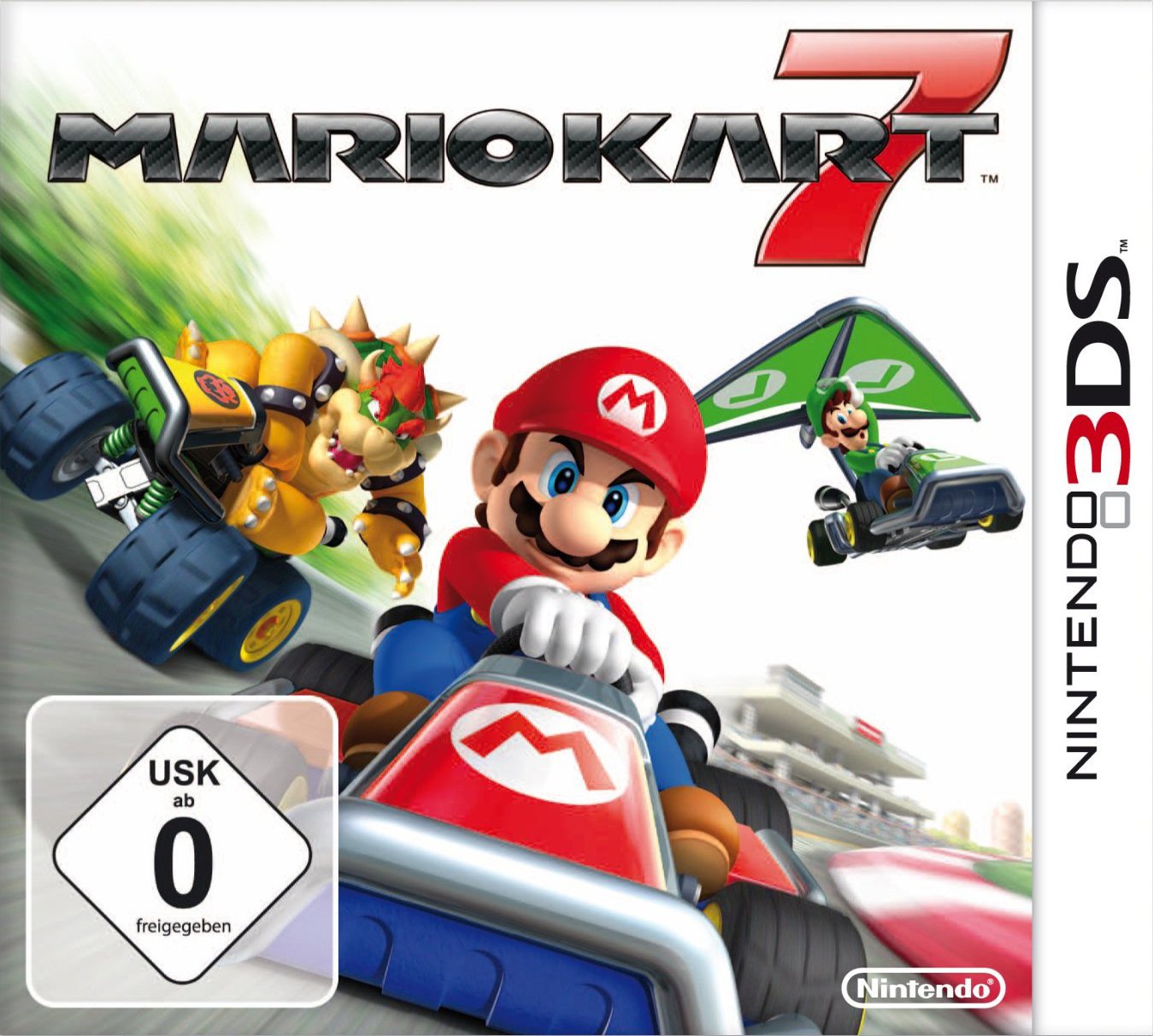
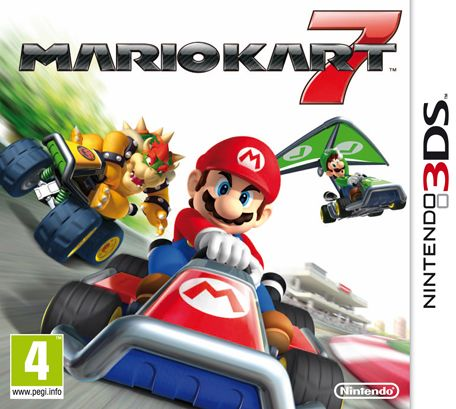
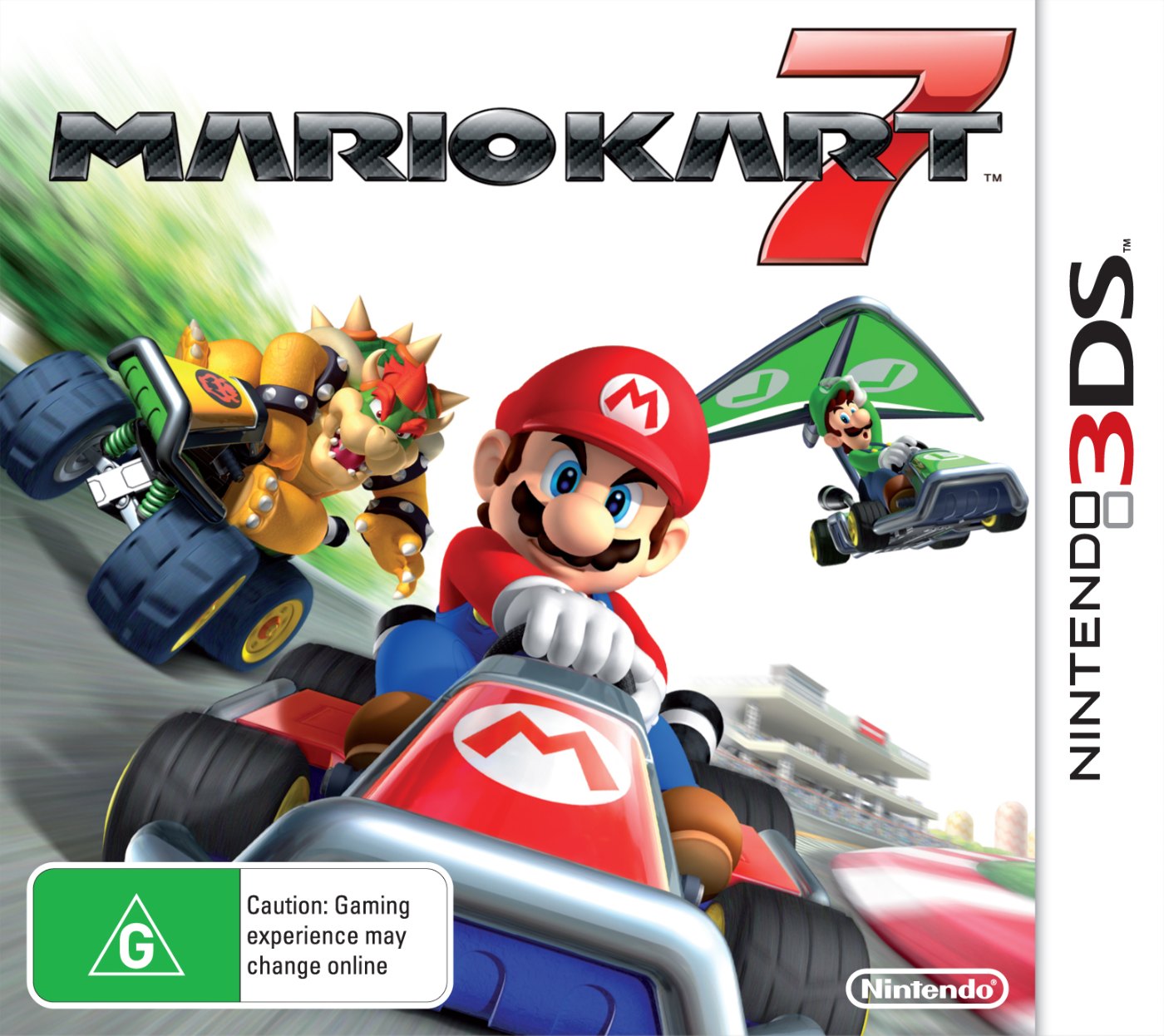
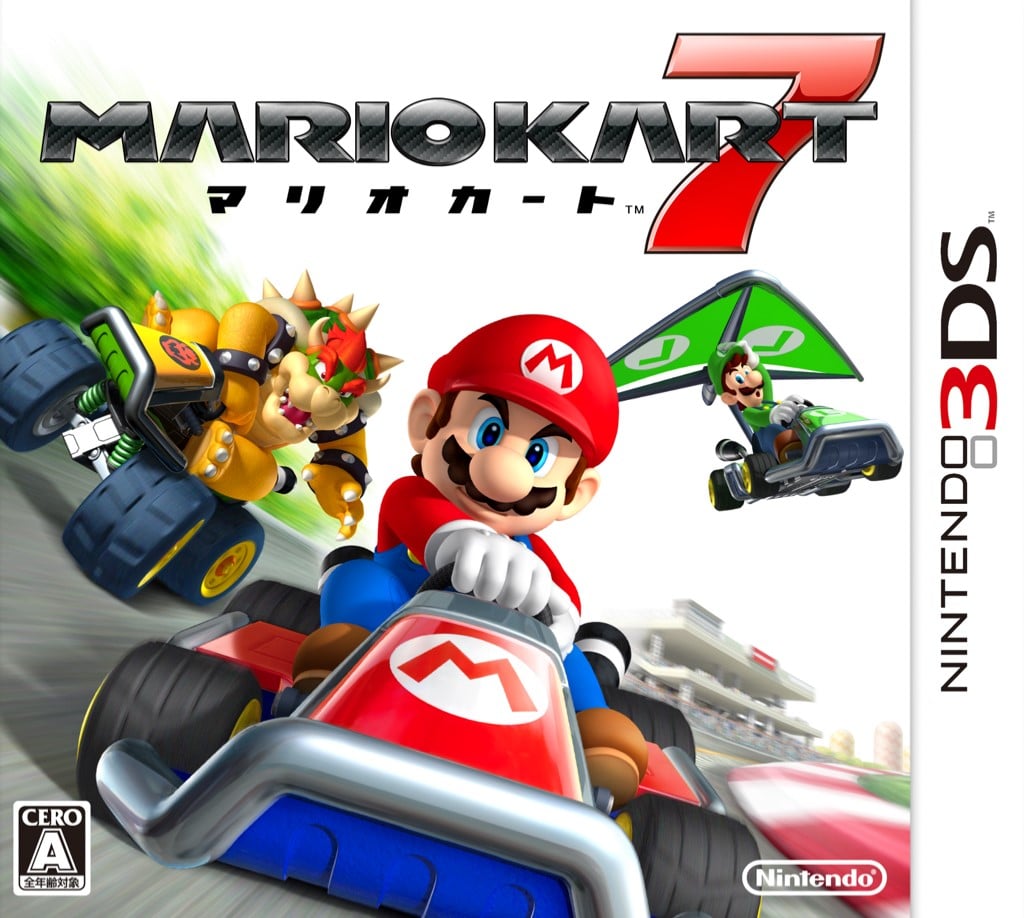
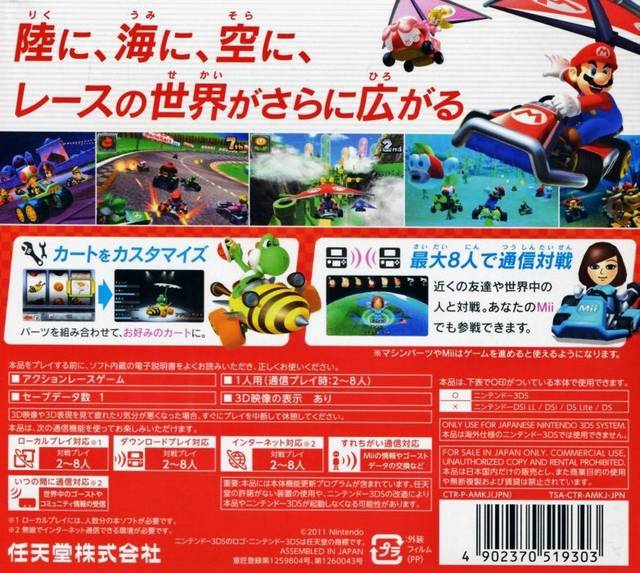
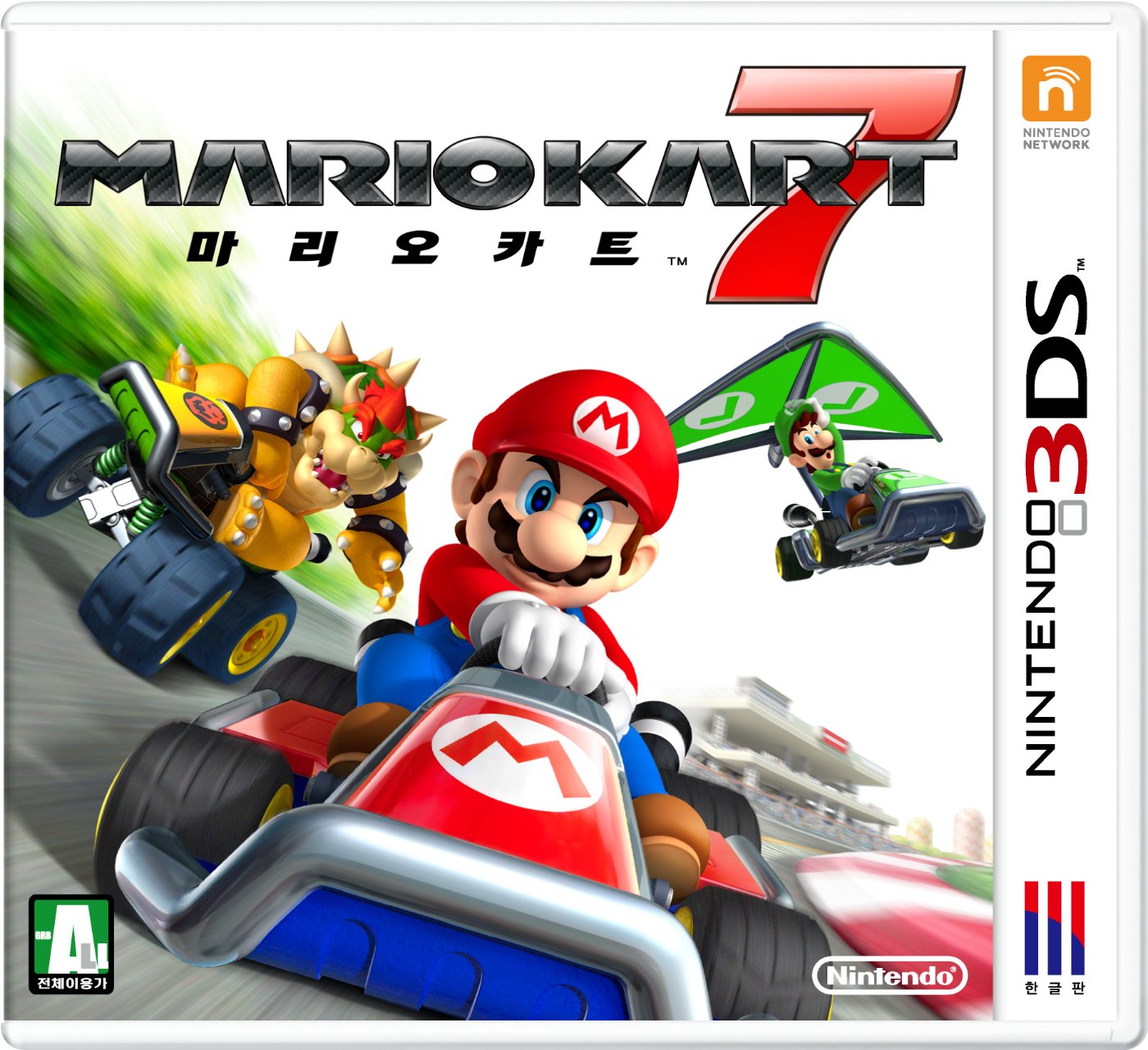
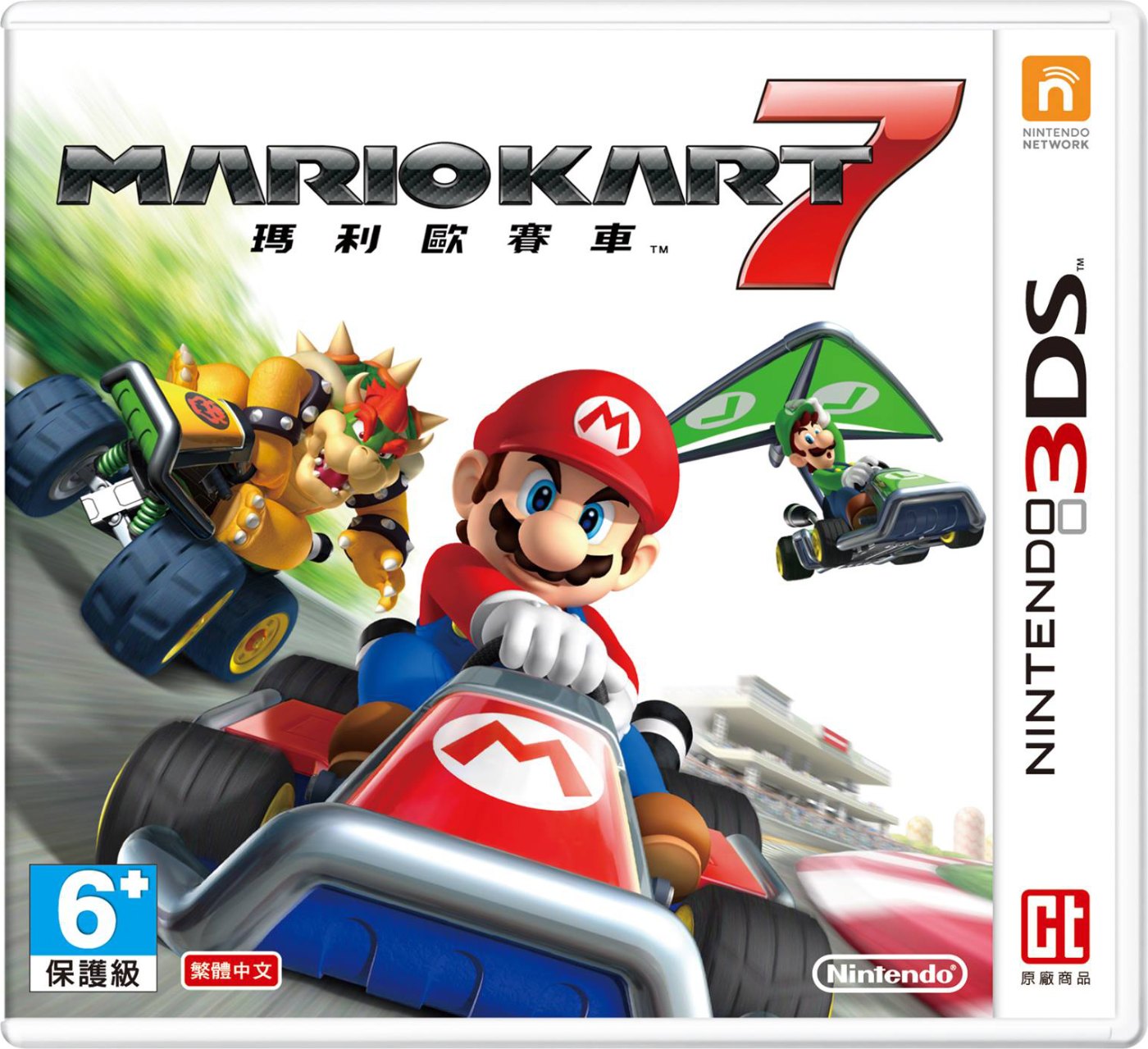
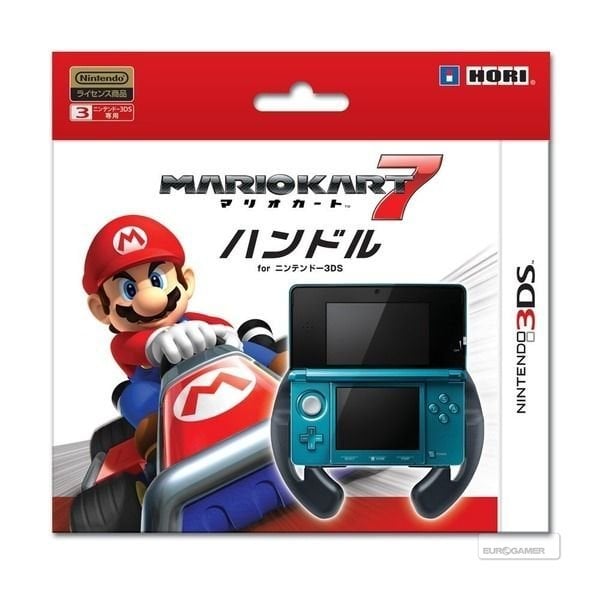
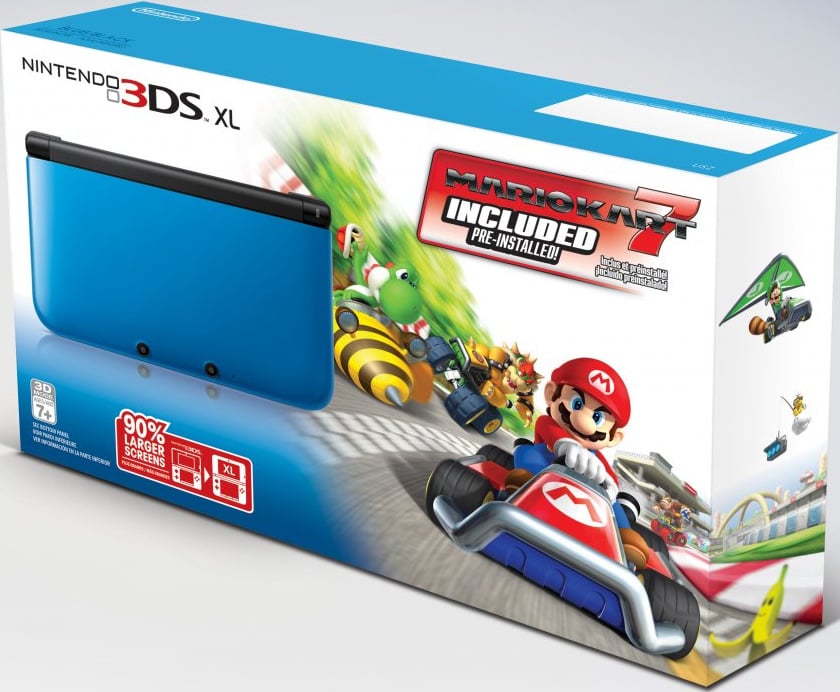
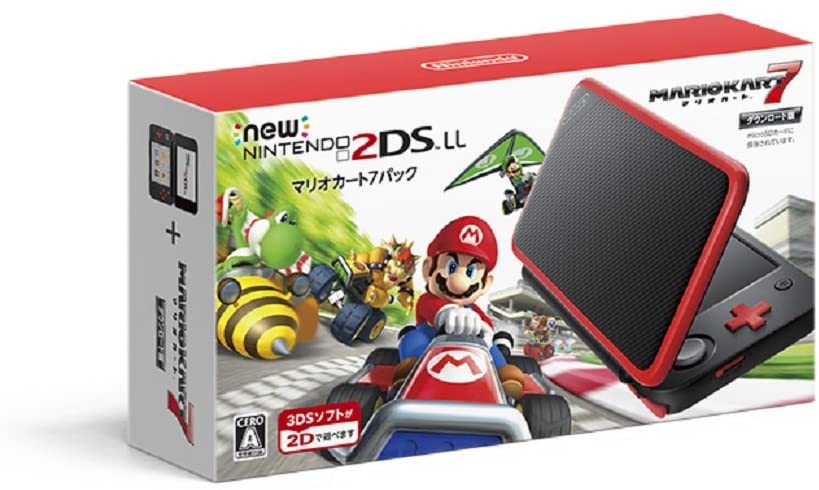
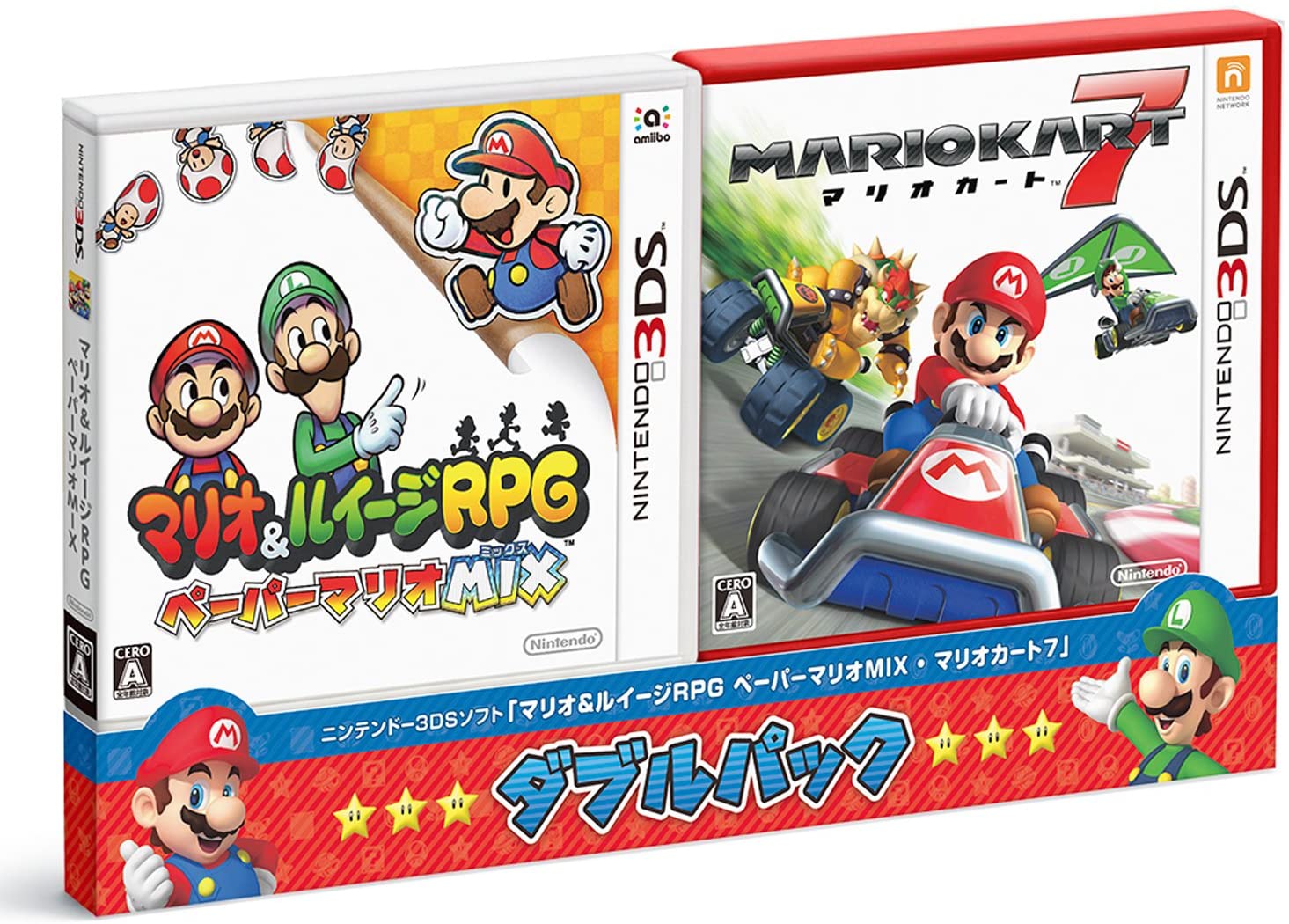
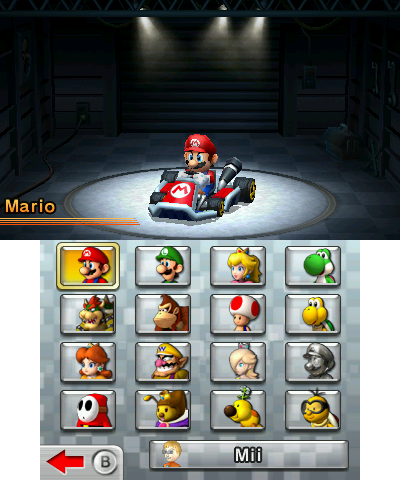
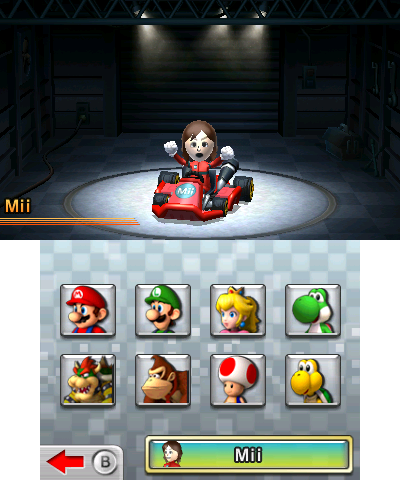
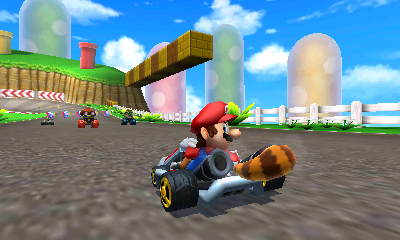
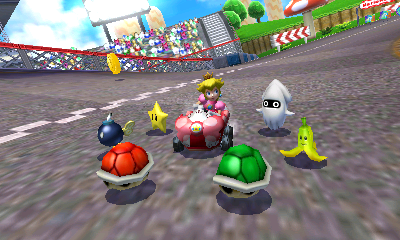
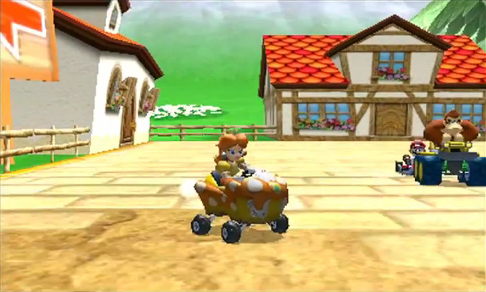
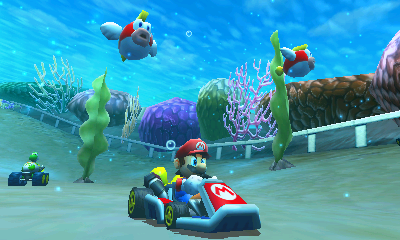
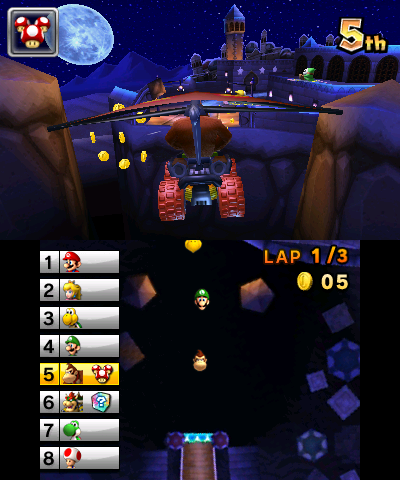
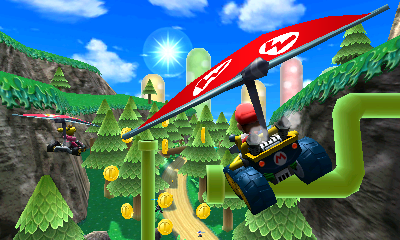
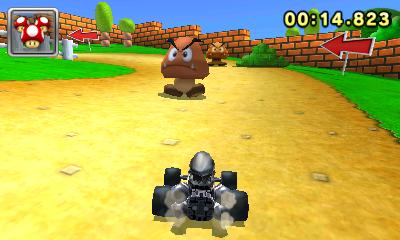
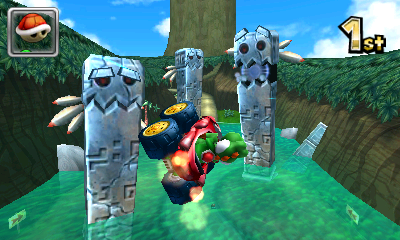
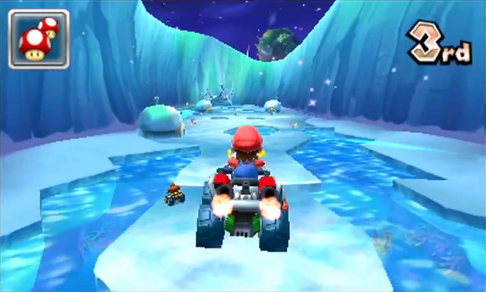
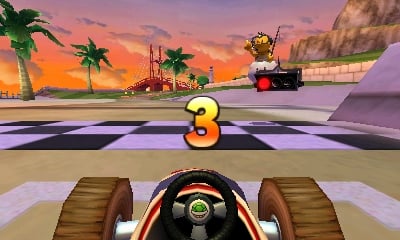
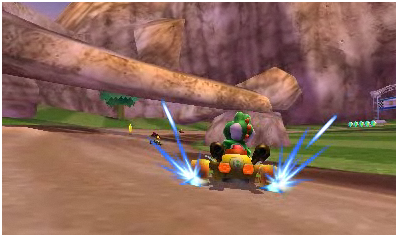
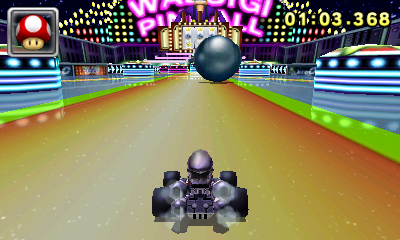
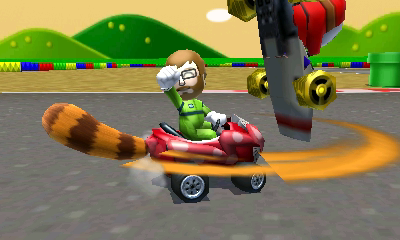
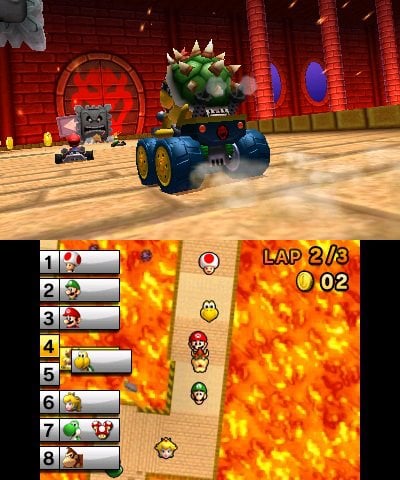
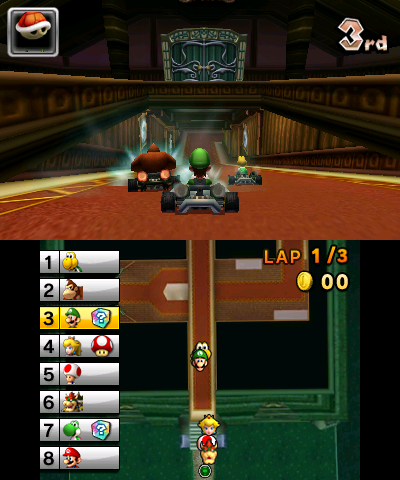
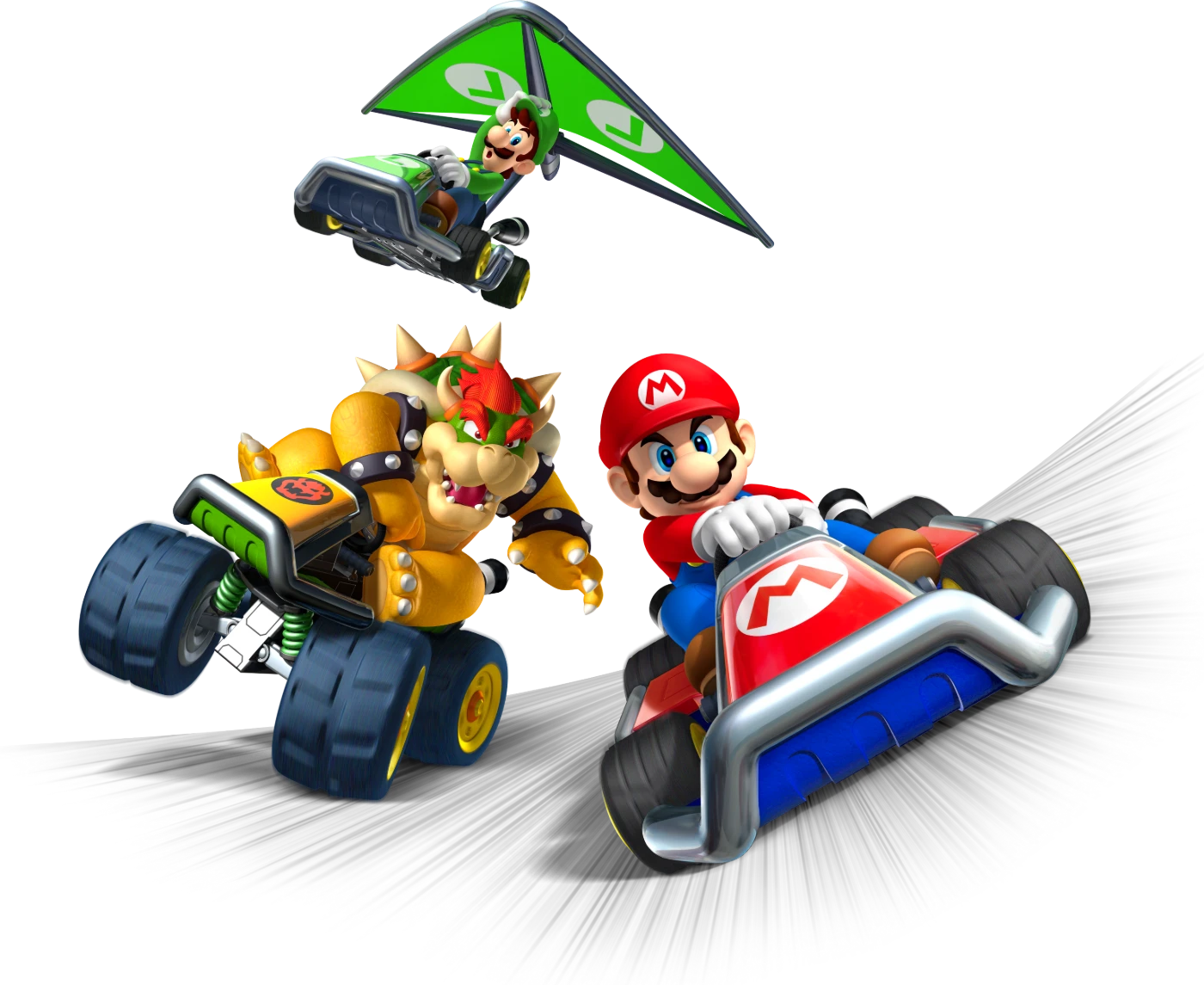
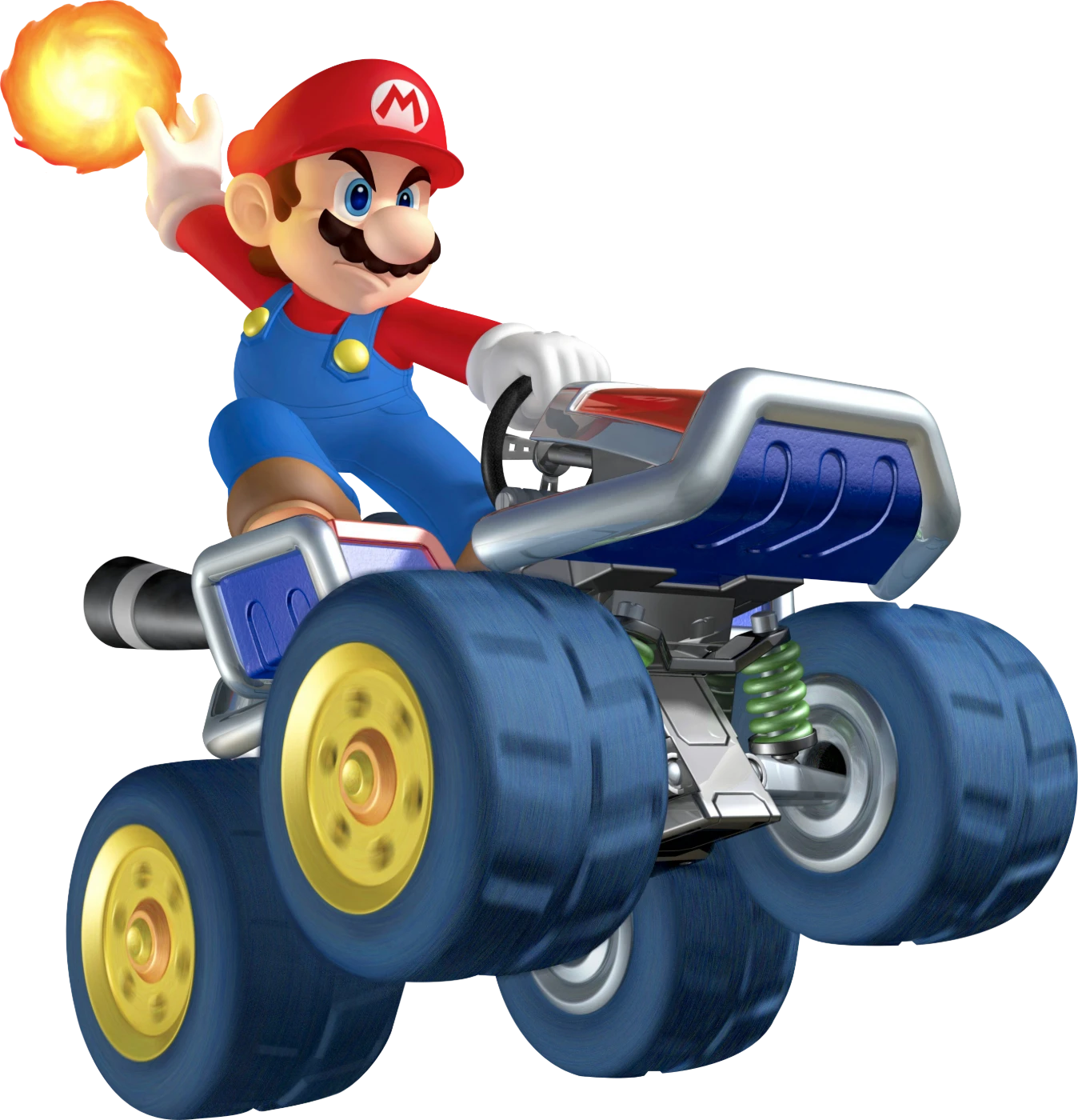
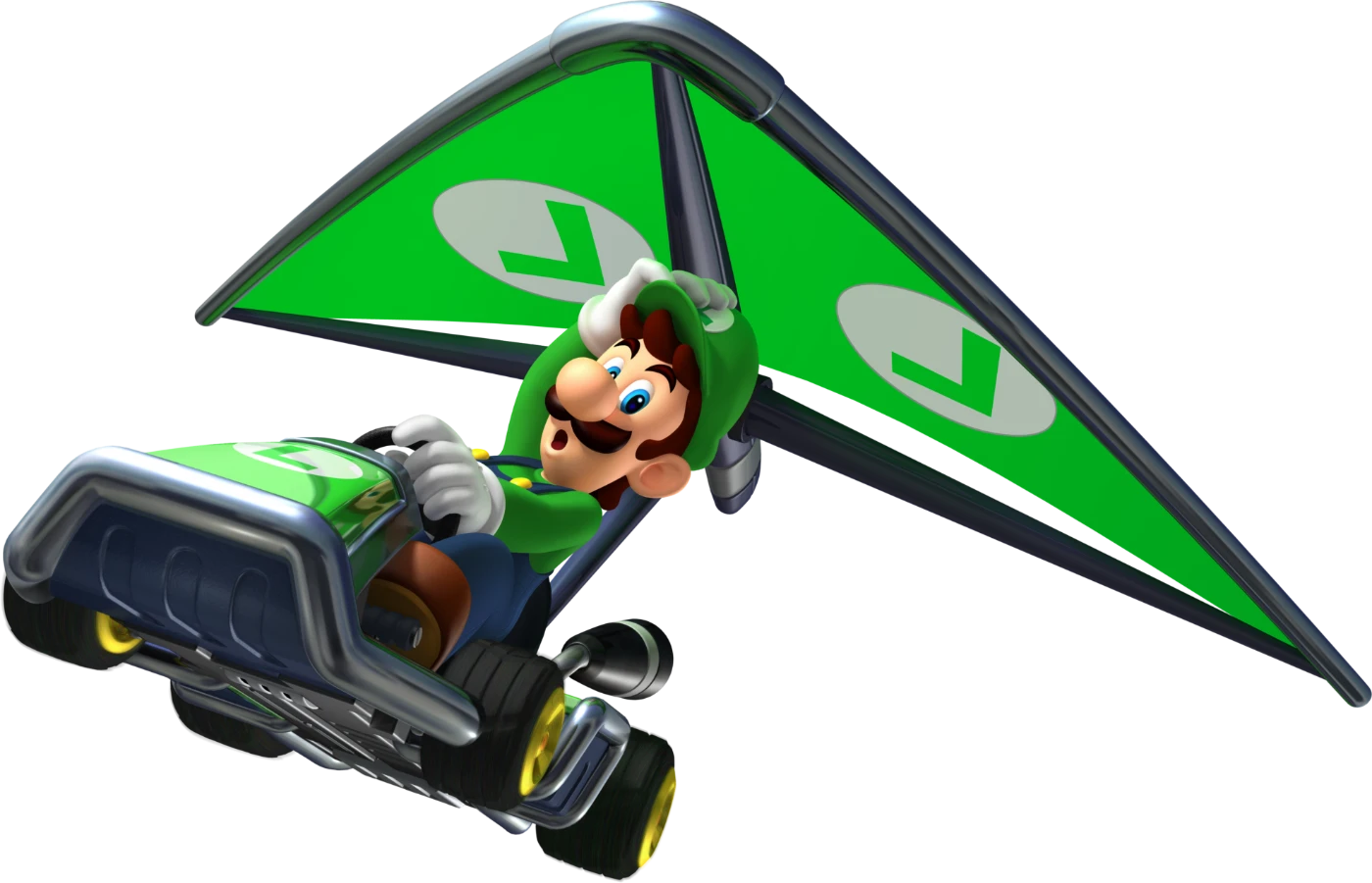
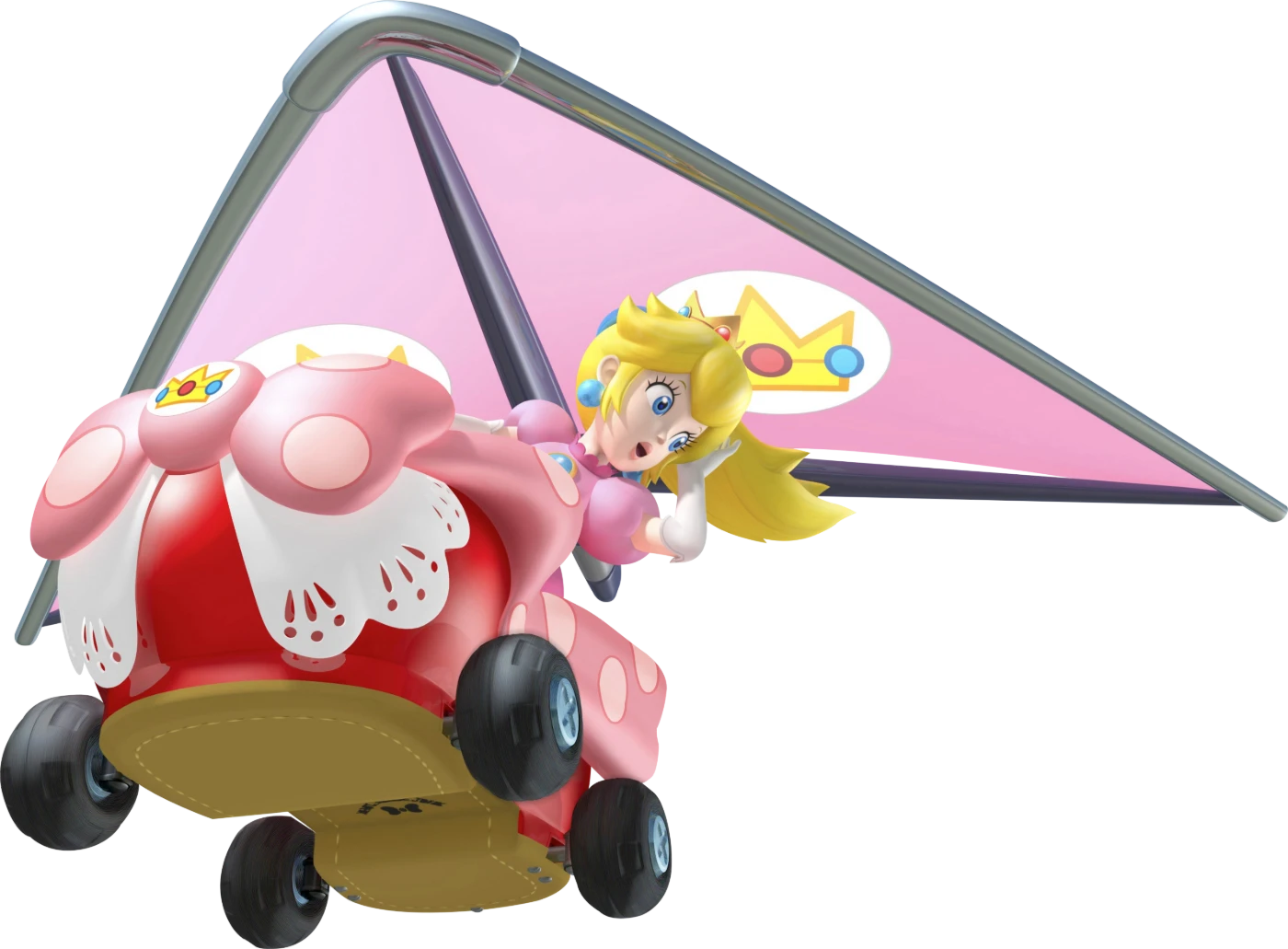
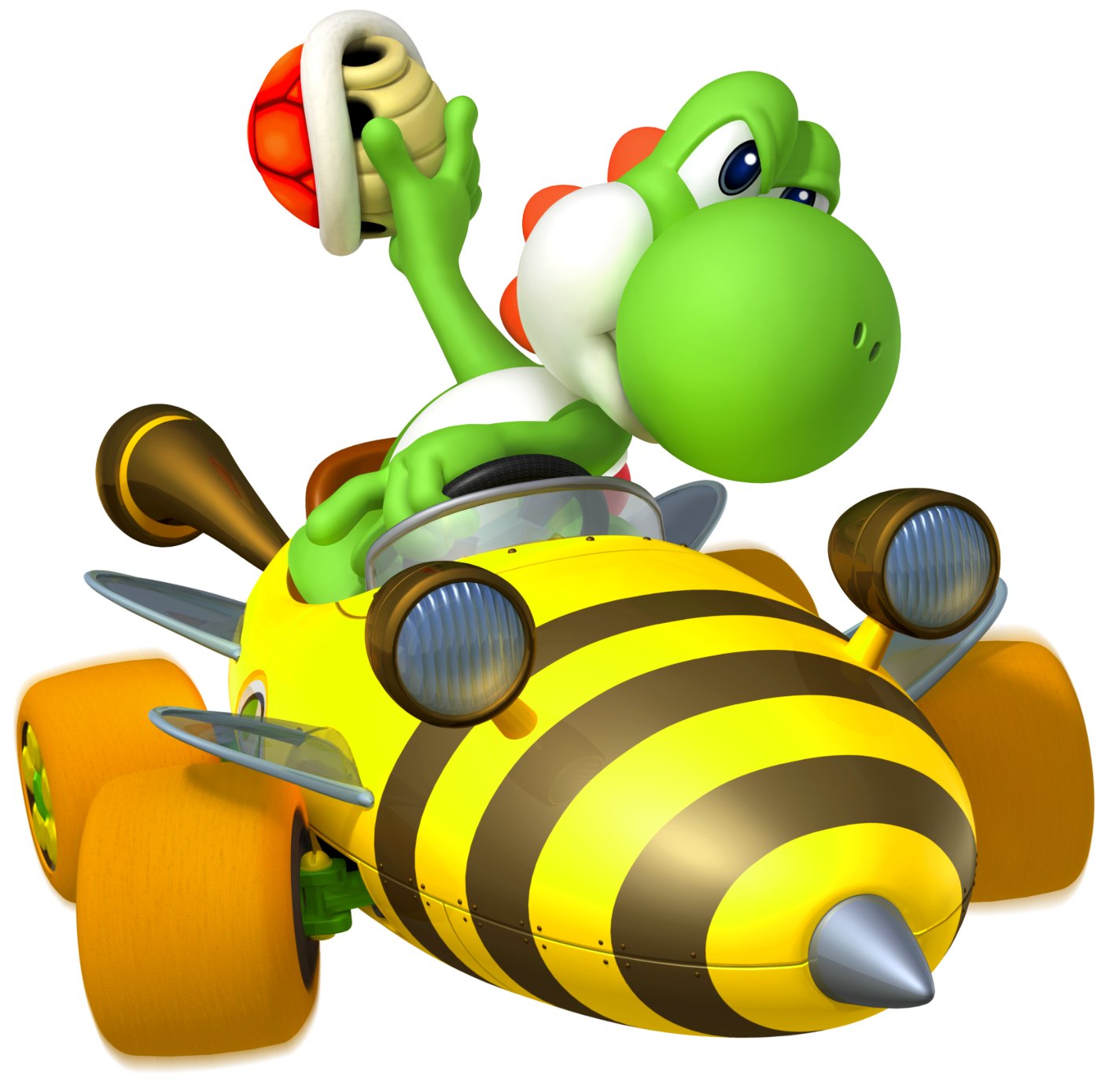
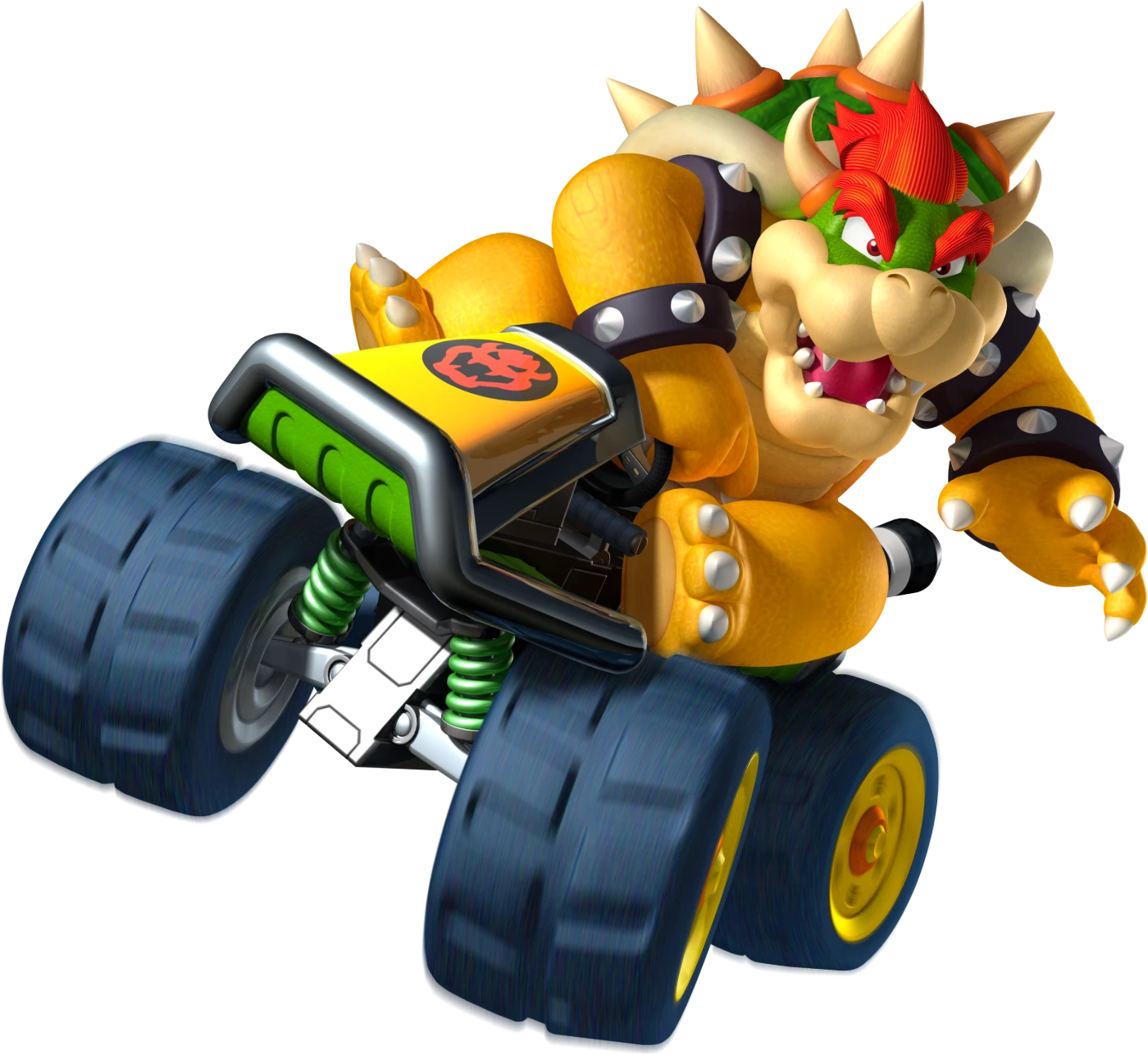
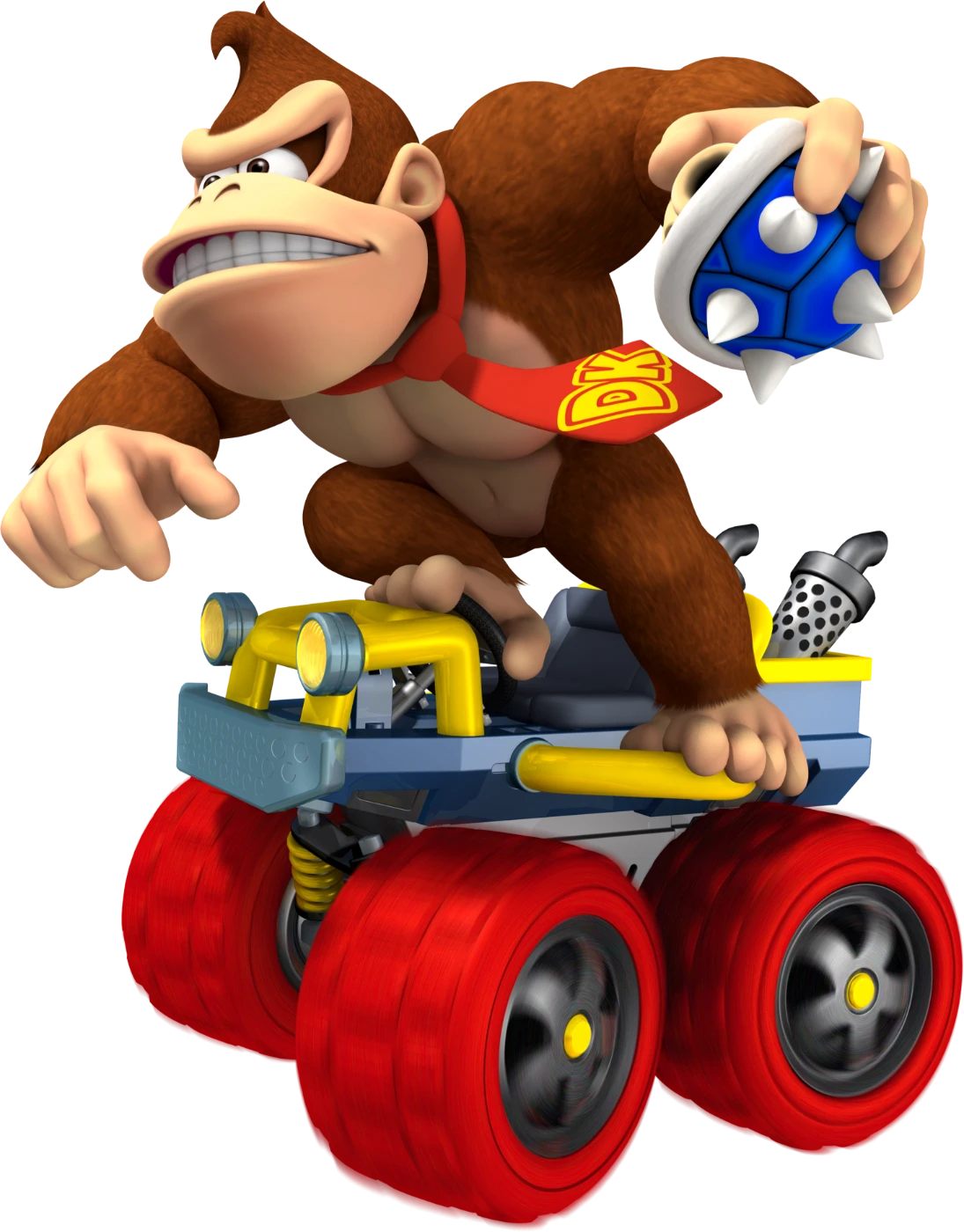
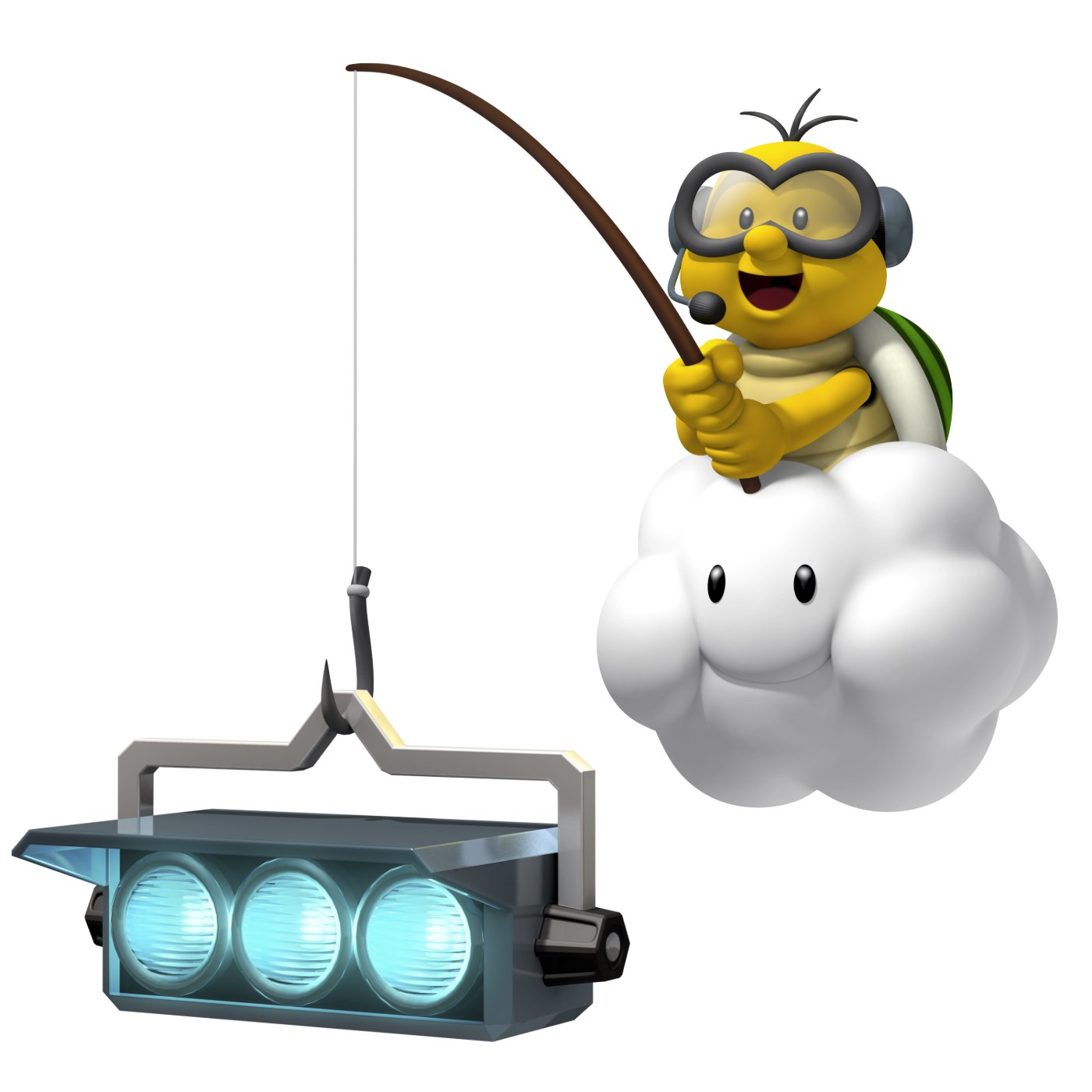
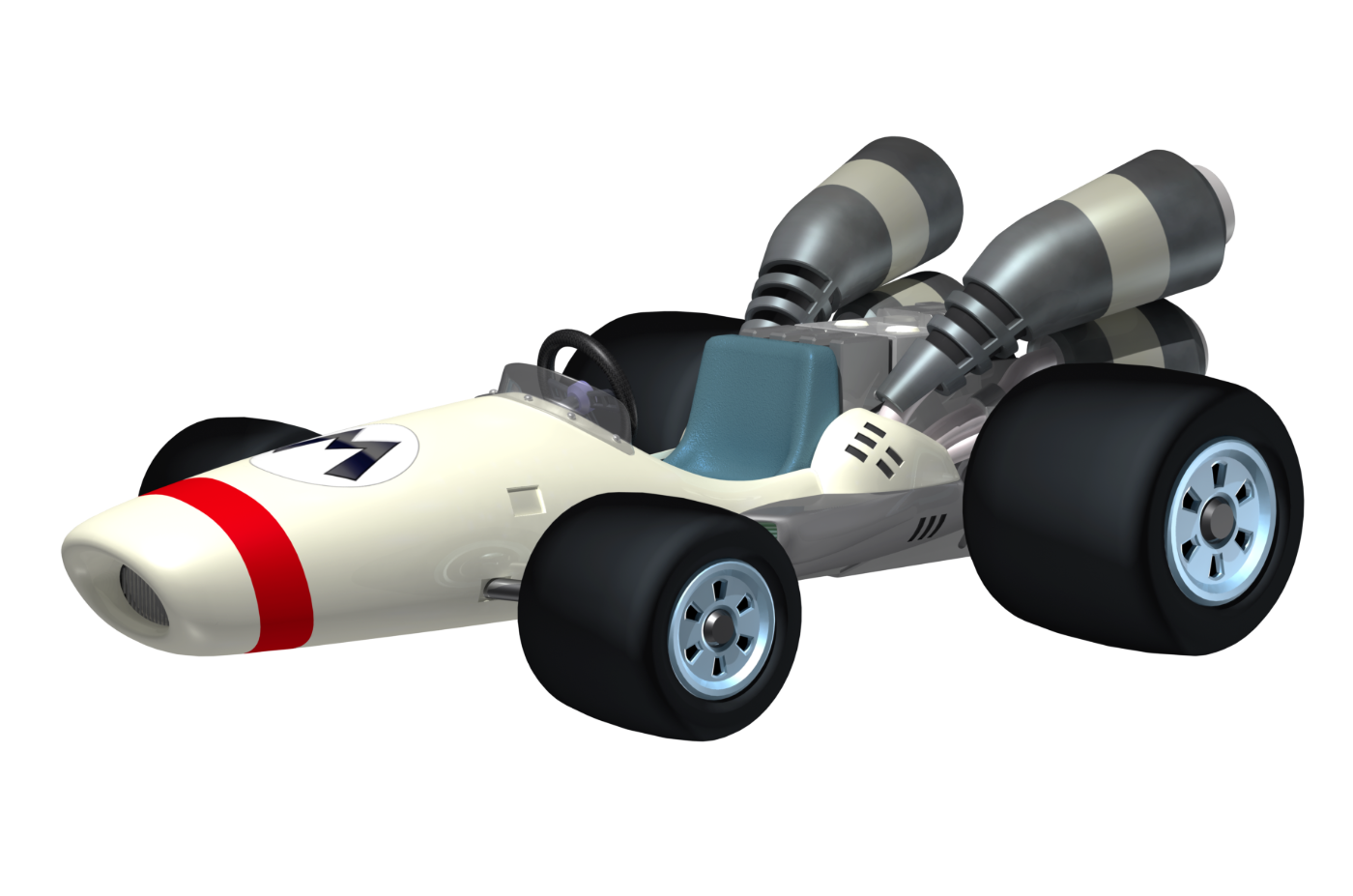
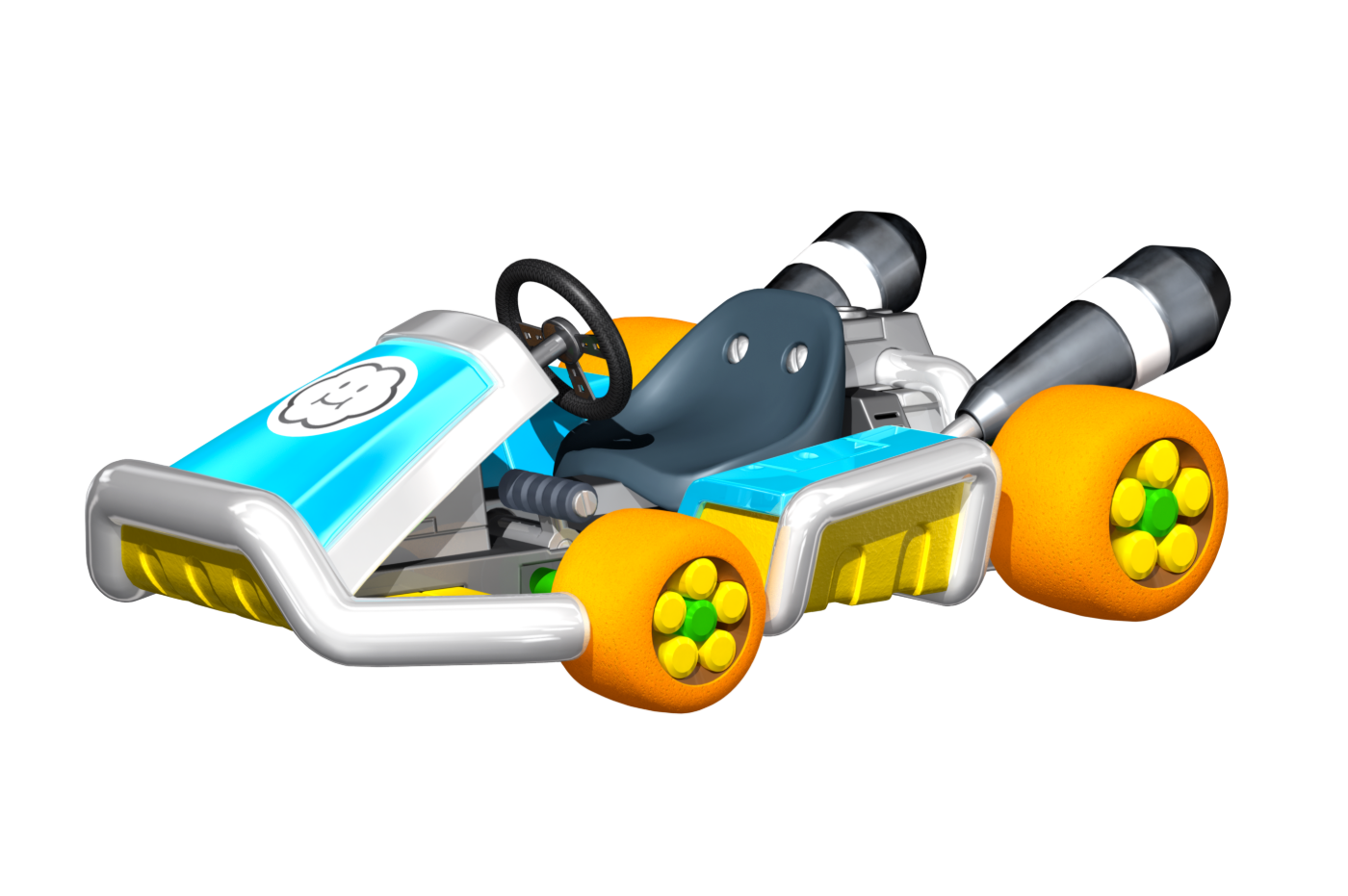
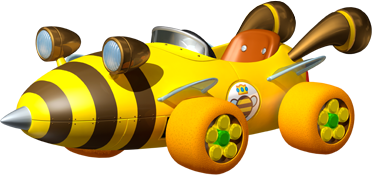
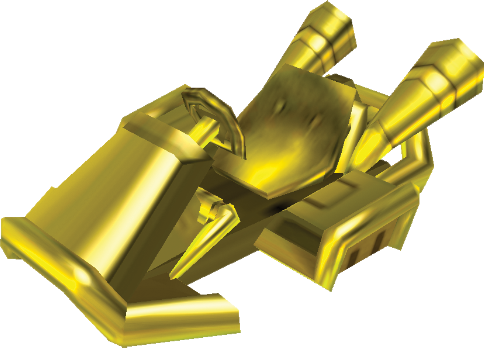
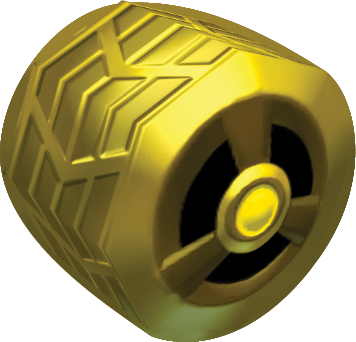
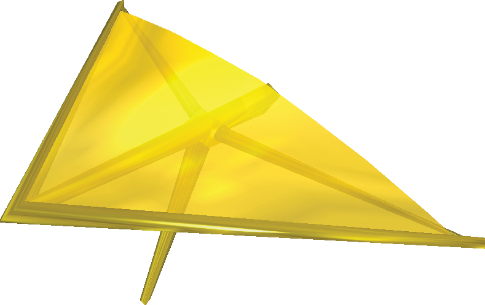
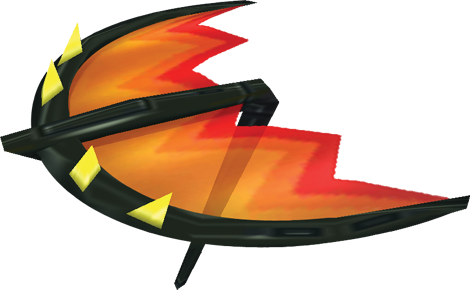
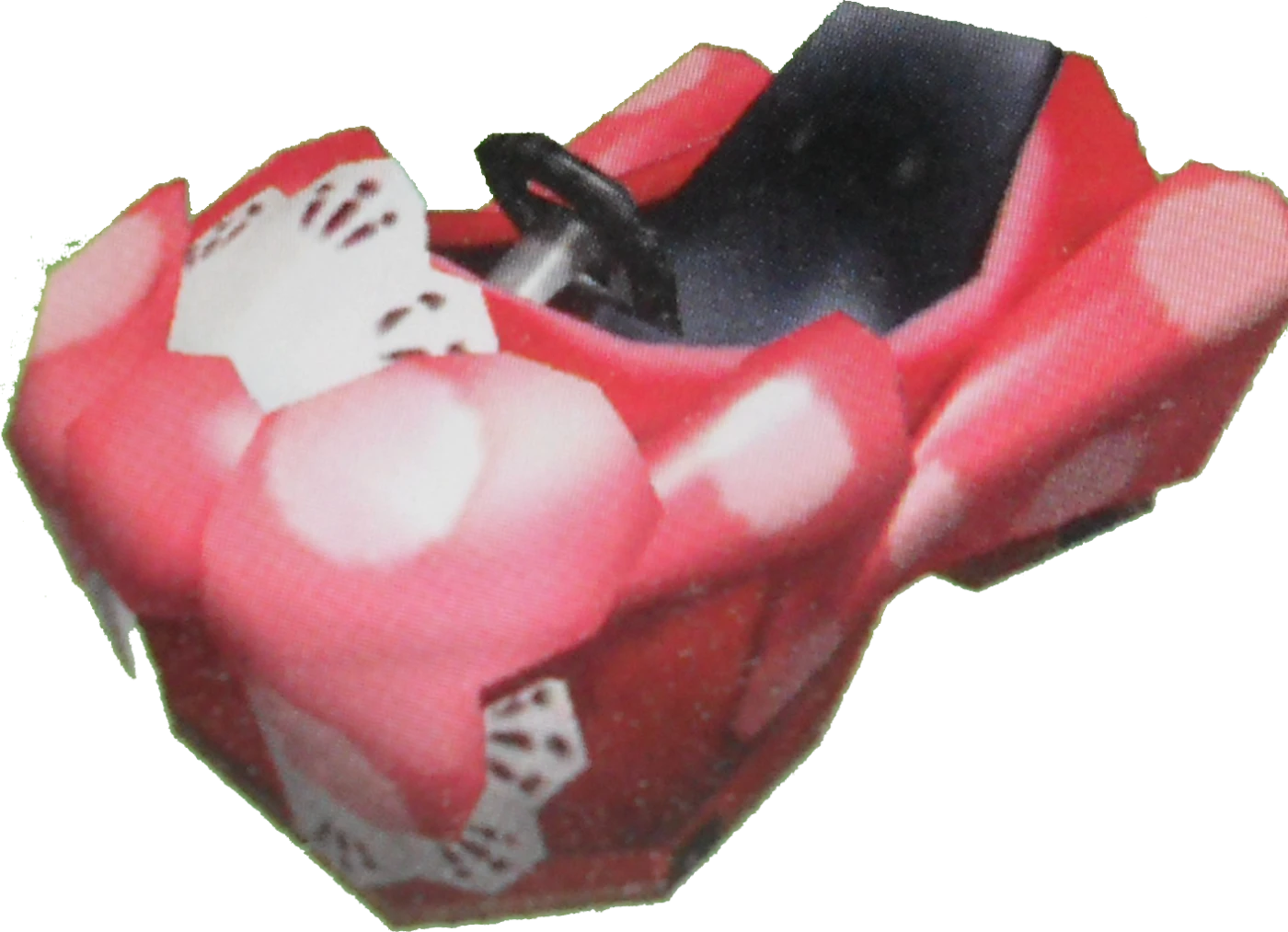
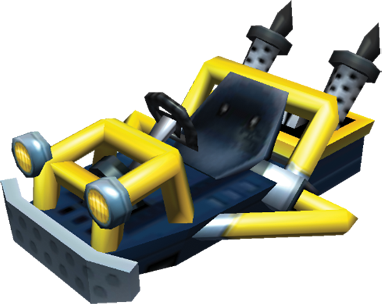
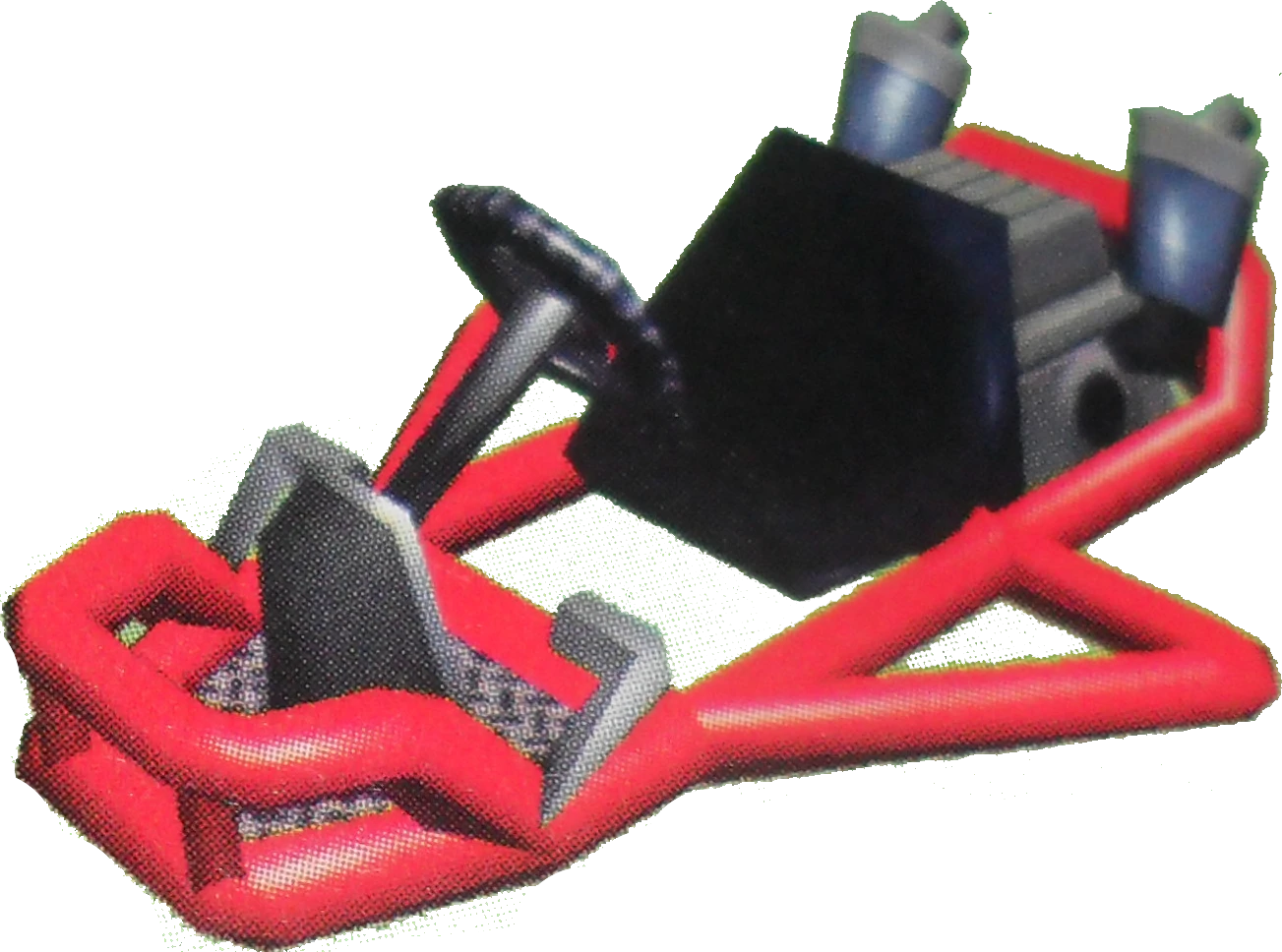
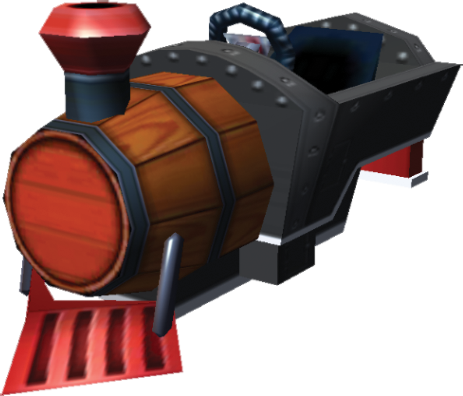
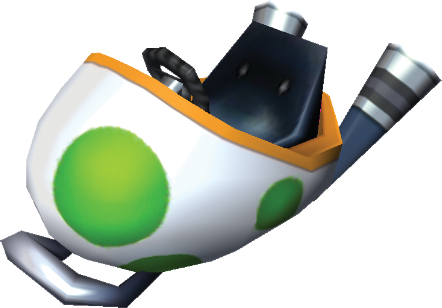
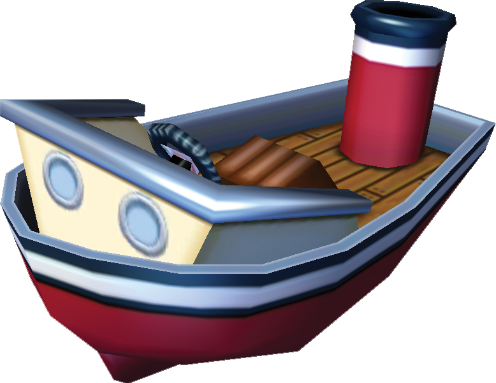
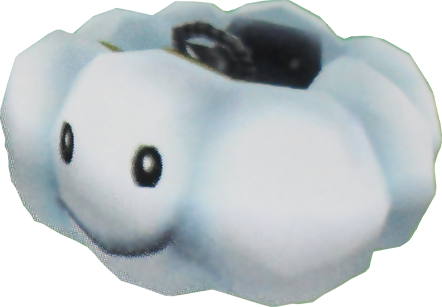
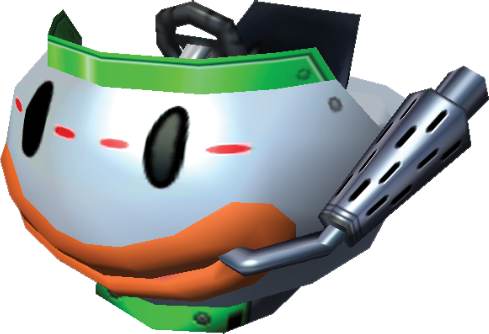
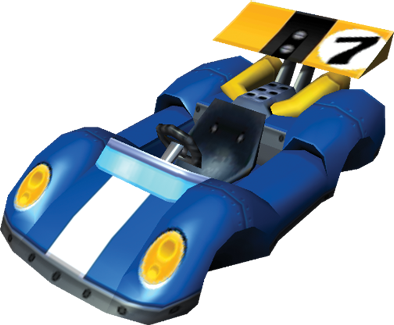
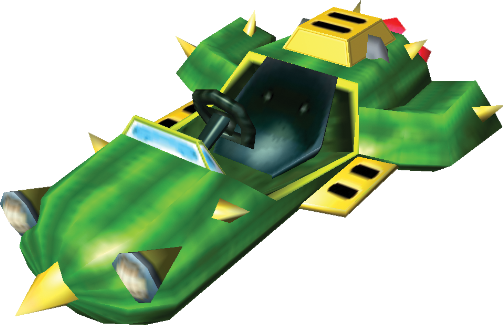
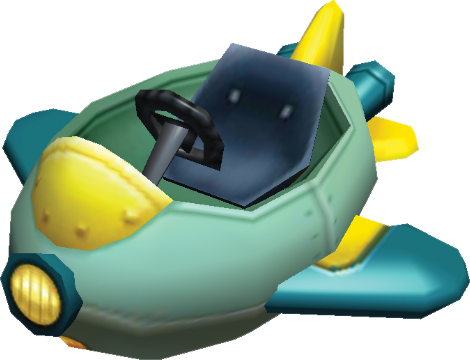
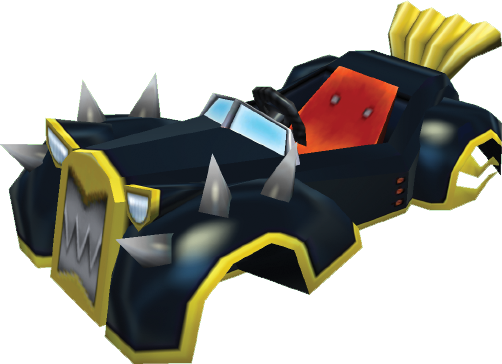
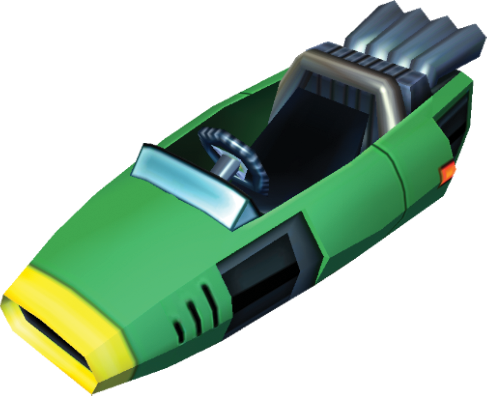
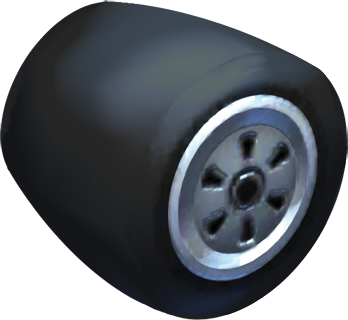

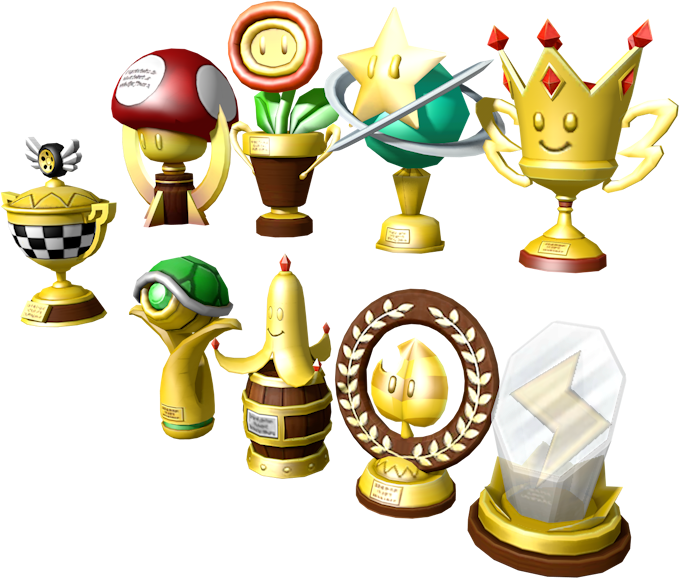
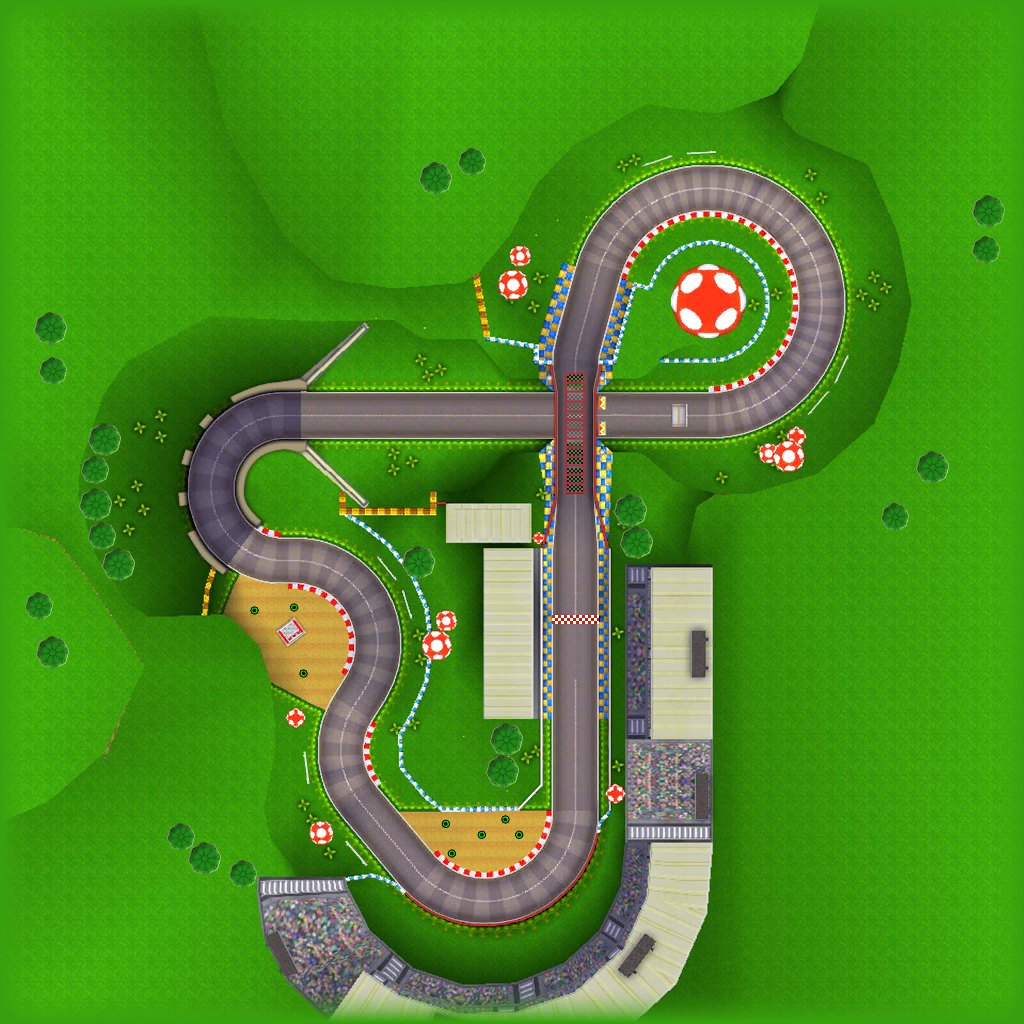
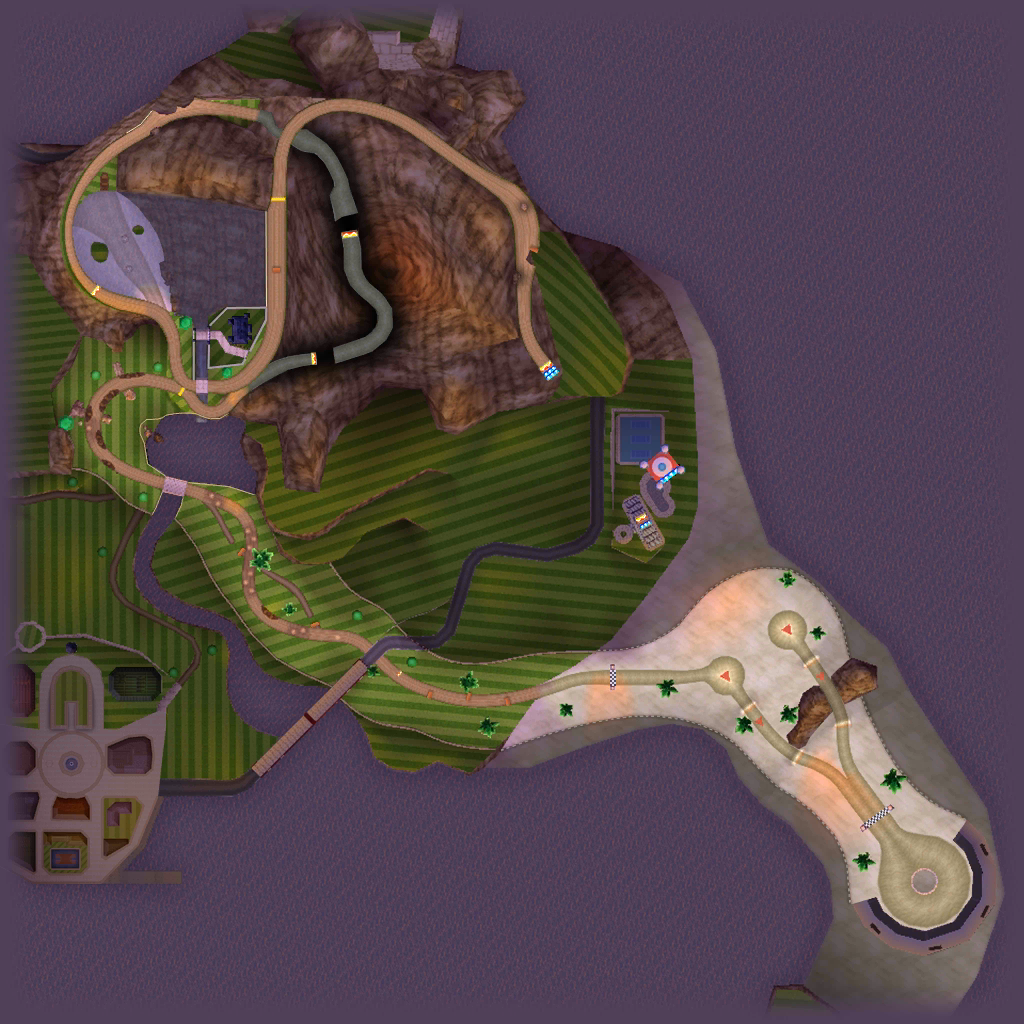
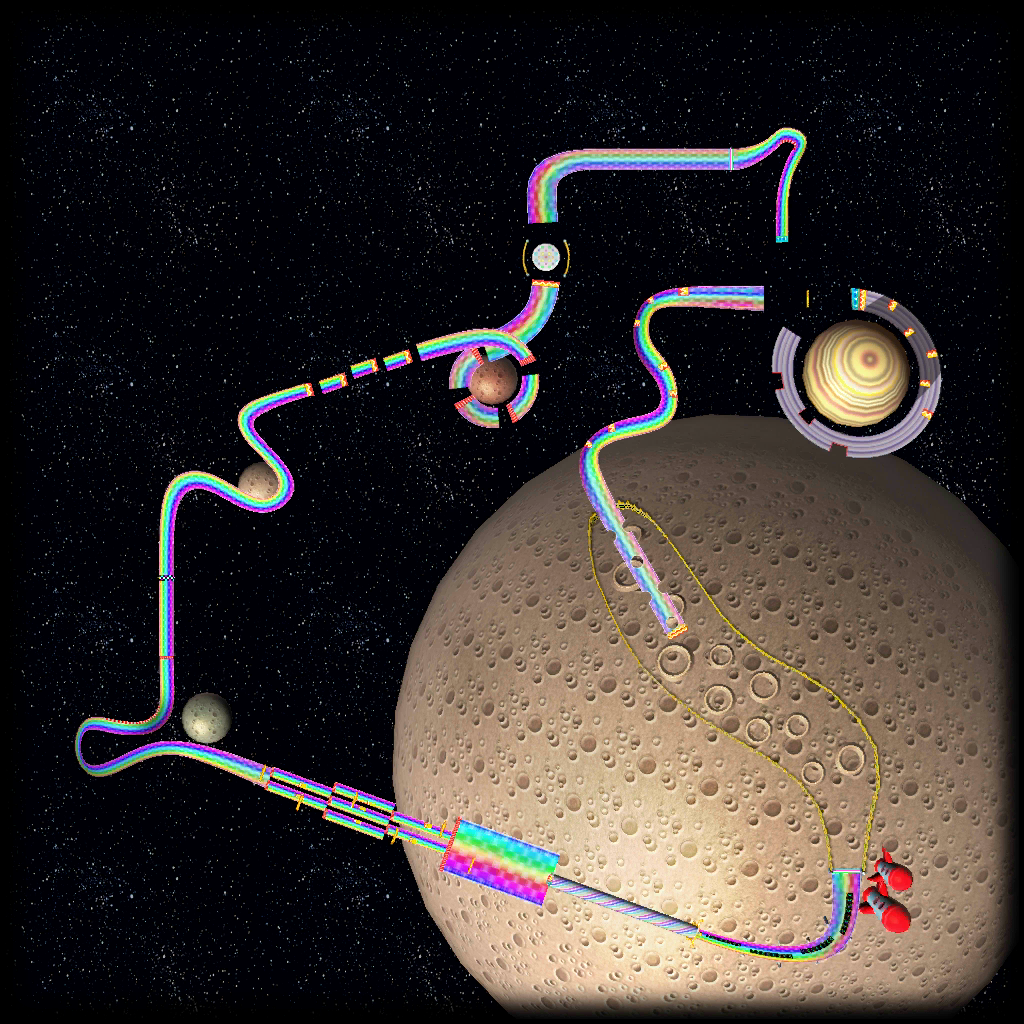
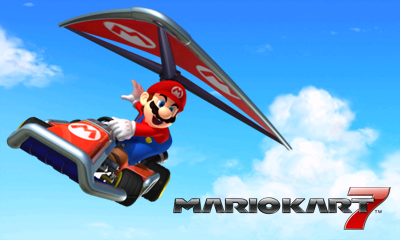
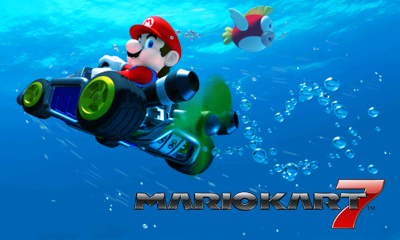
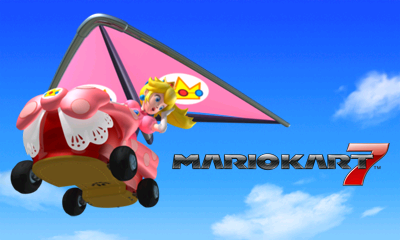
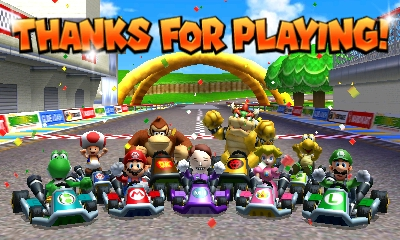
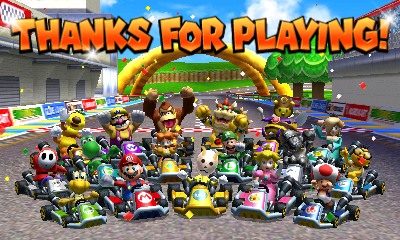
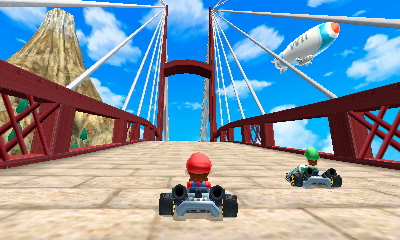
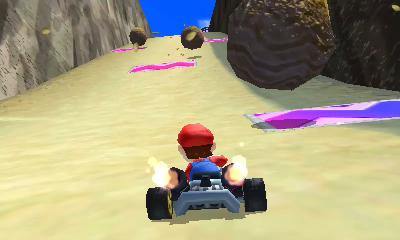
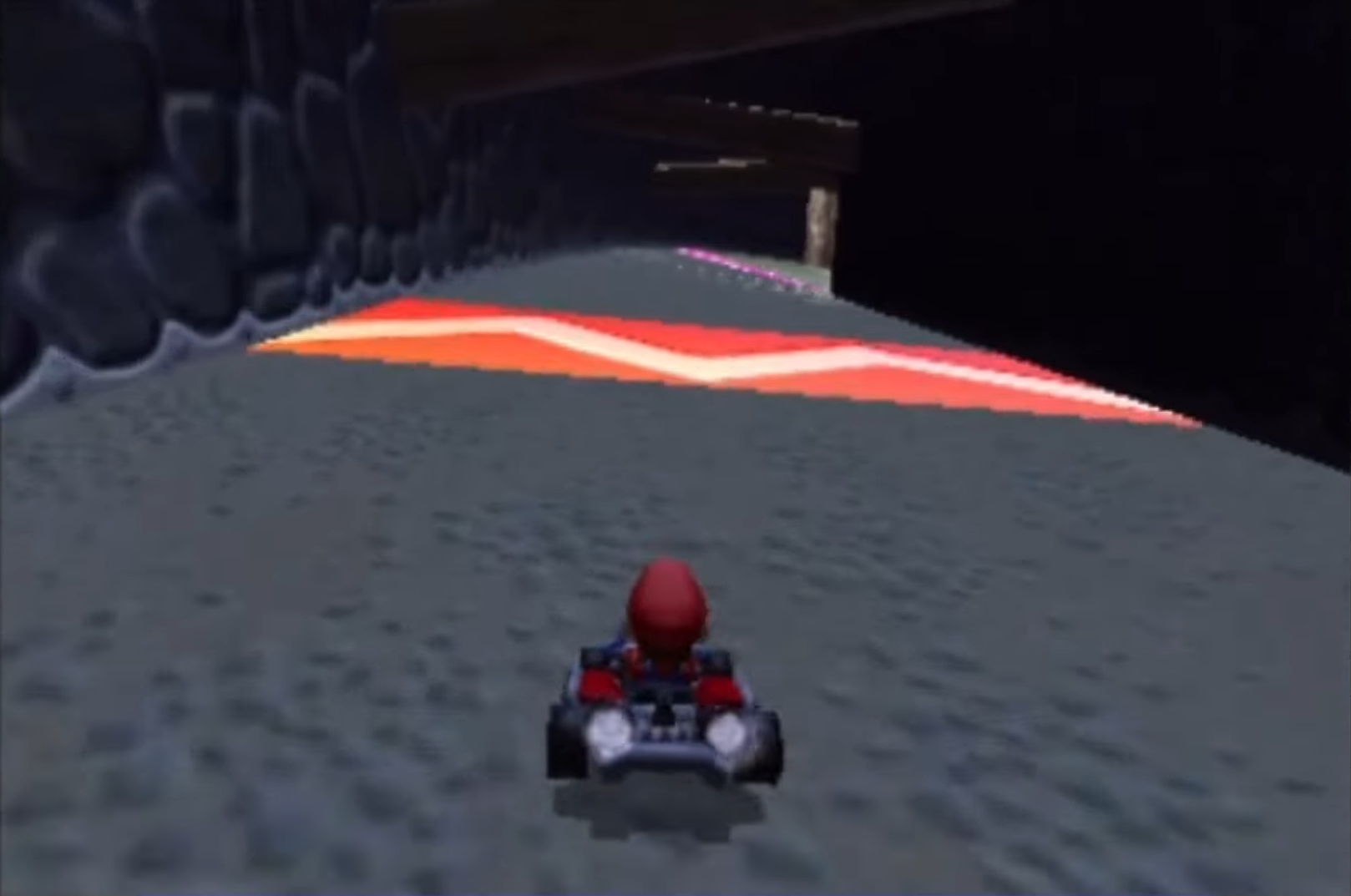
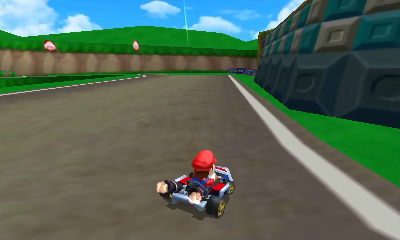
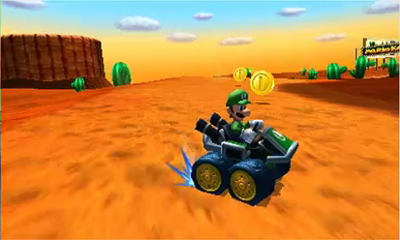
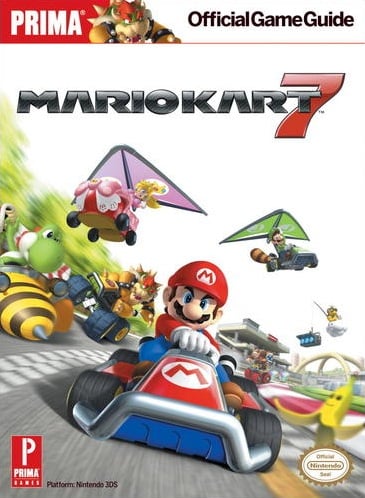
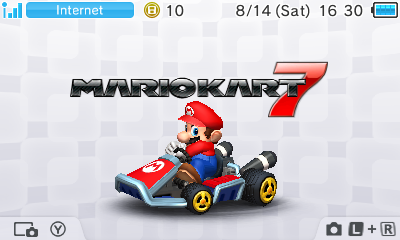
 MarioMedium
 LuigiMedium
 Princess PeachLight
 YoshiLight
 BowserHeavy
 Donkey KongCruiser
 ToadFeather
 Koopa TroopaFeather
 DaisyLight · Mushroom Cup 150cc
 WarioHeavy · Flower Cup 150cc
 RosalinaCruiser · Star Cup 150cc
 Metal Mario ★Heavy · Special Cup 150cc
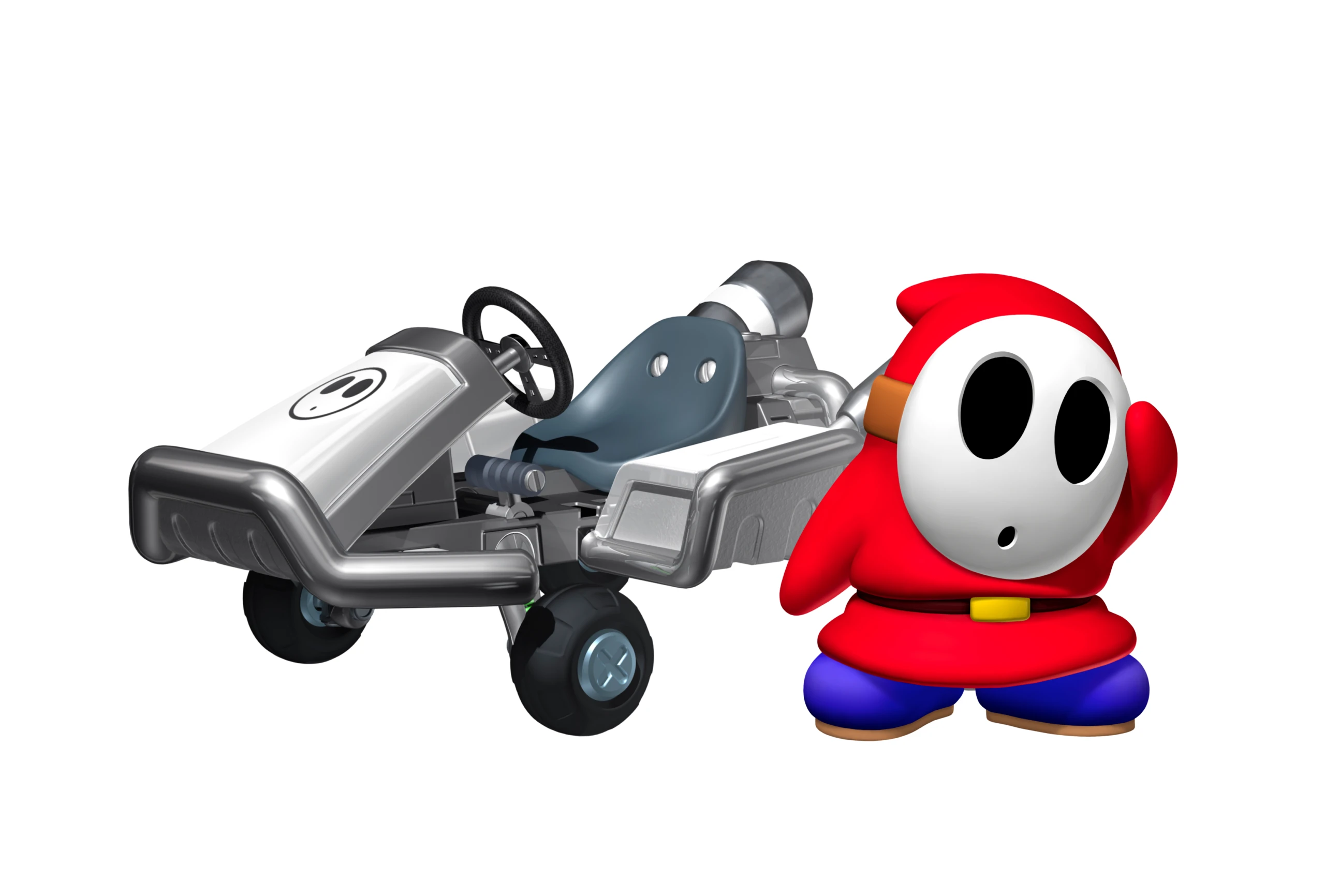 Shy GuyFeather · Shell Cup 150cc
 Honey Queen ★Heavy · Banana Cup 150cc
 Wiggler ★Cruiser · Leaf Cup 150cc
 Lakitu ★Feather · Lightning Cup 150cc
 MiiMedium · Clear every cup in one class


 Balloon Battle — pop opponents’ balloons to earn points
 Coin Runners — collect the most coins before time runs out


