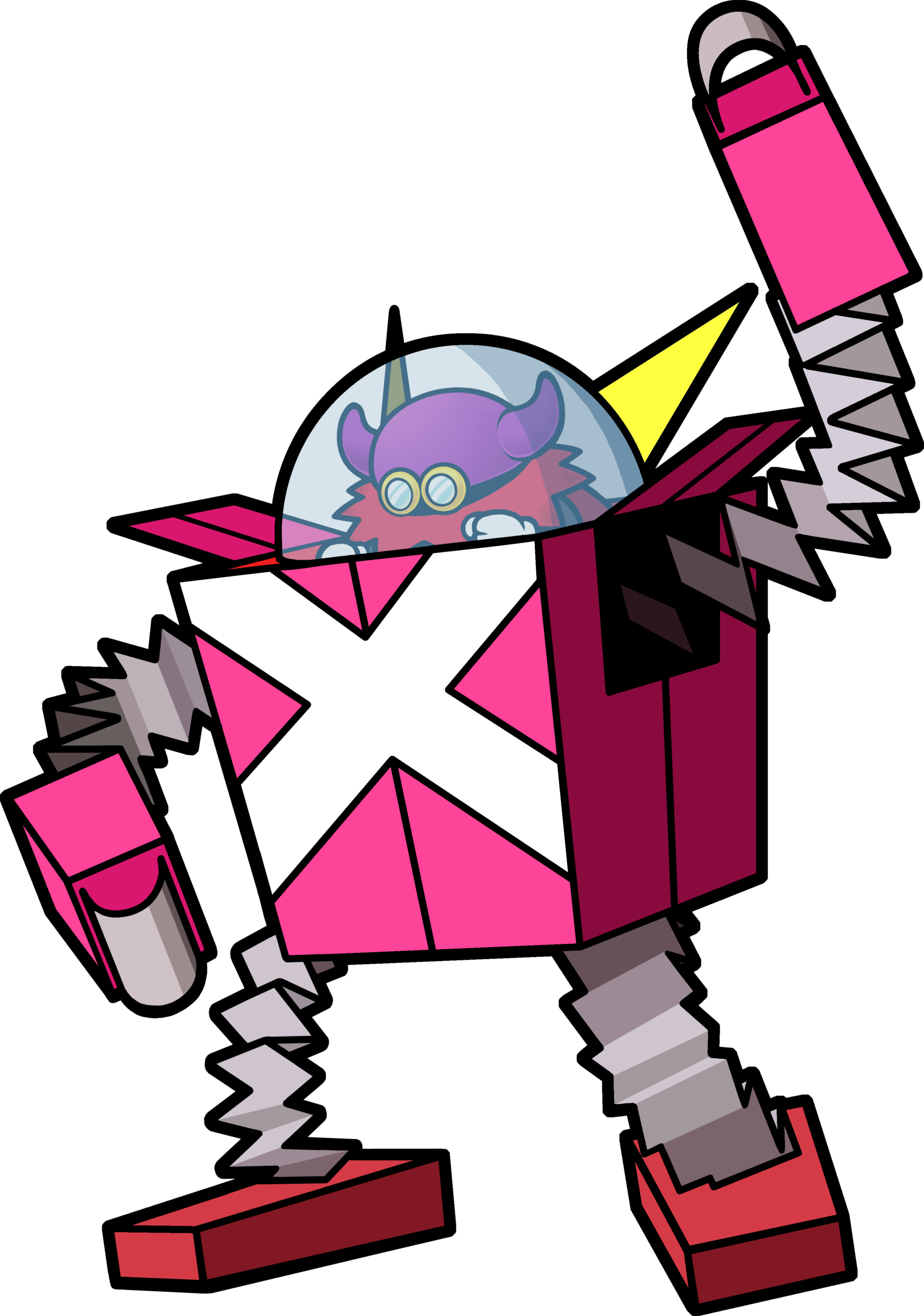
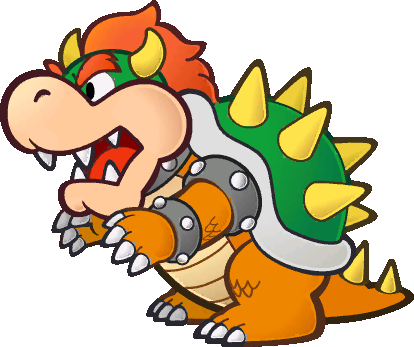
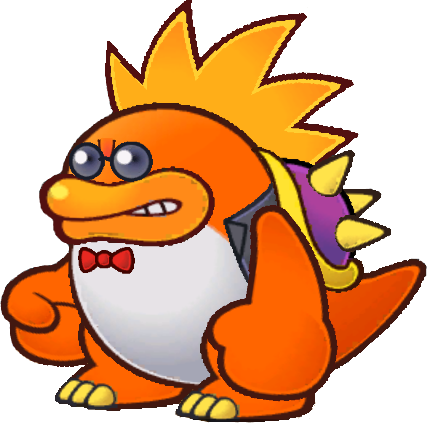
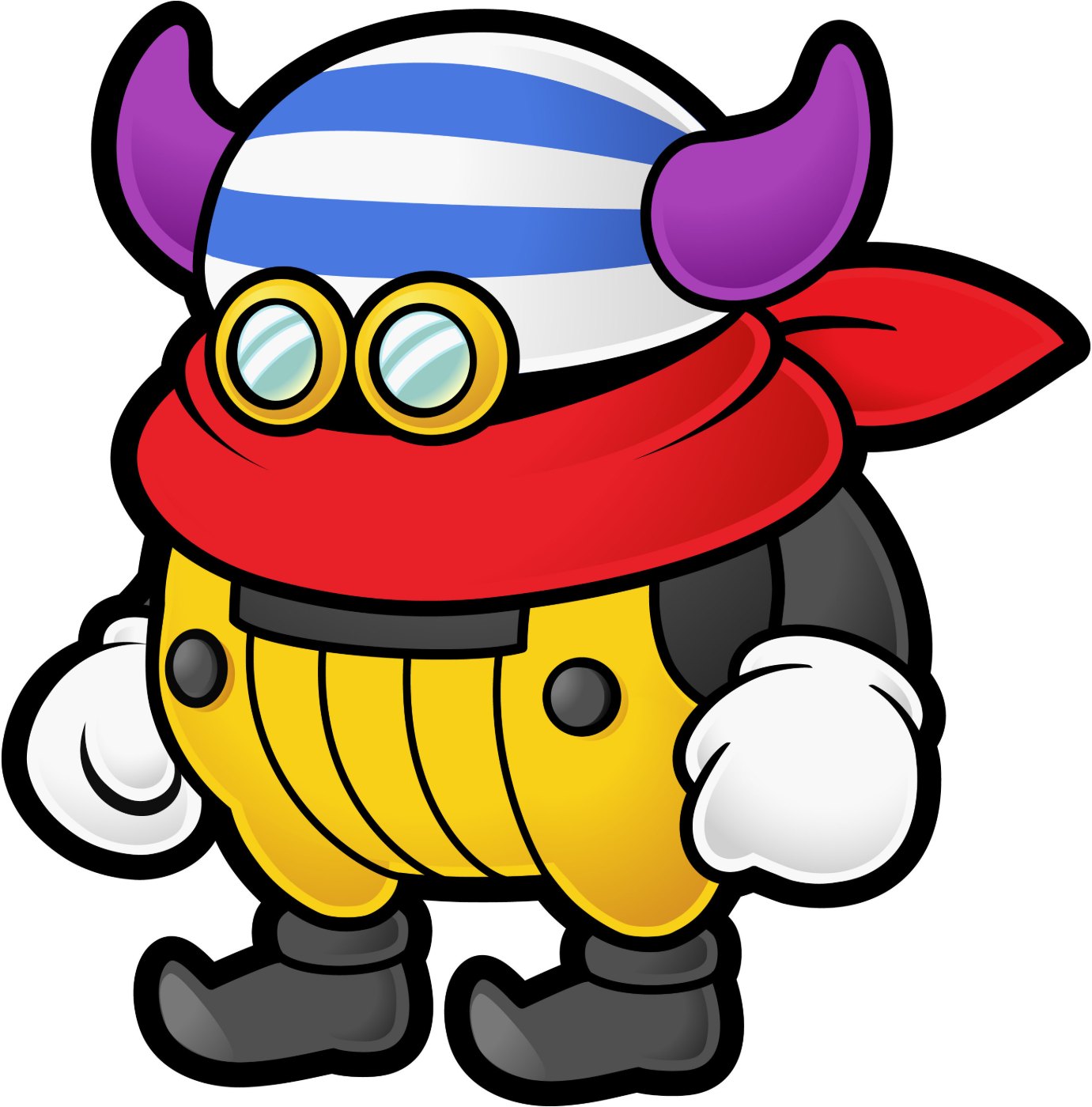
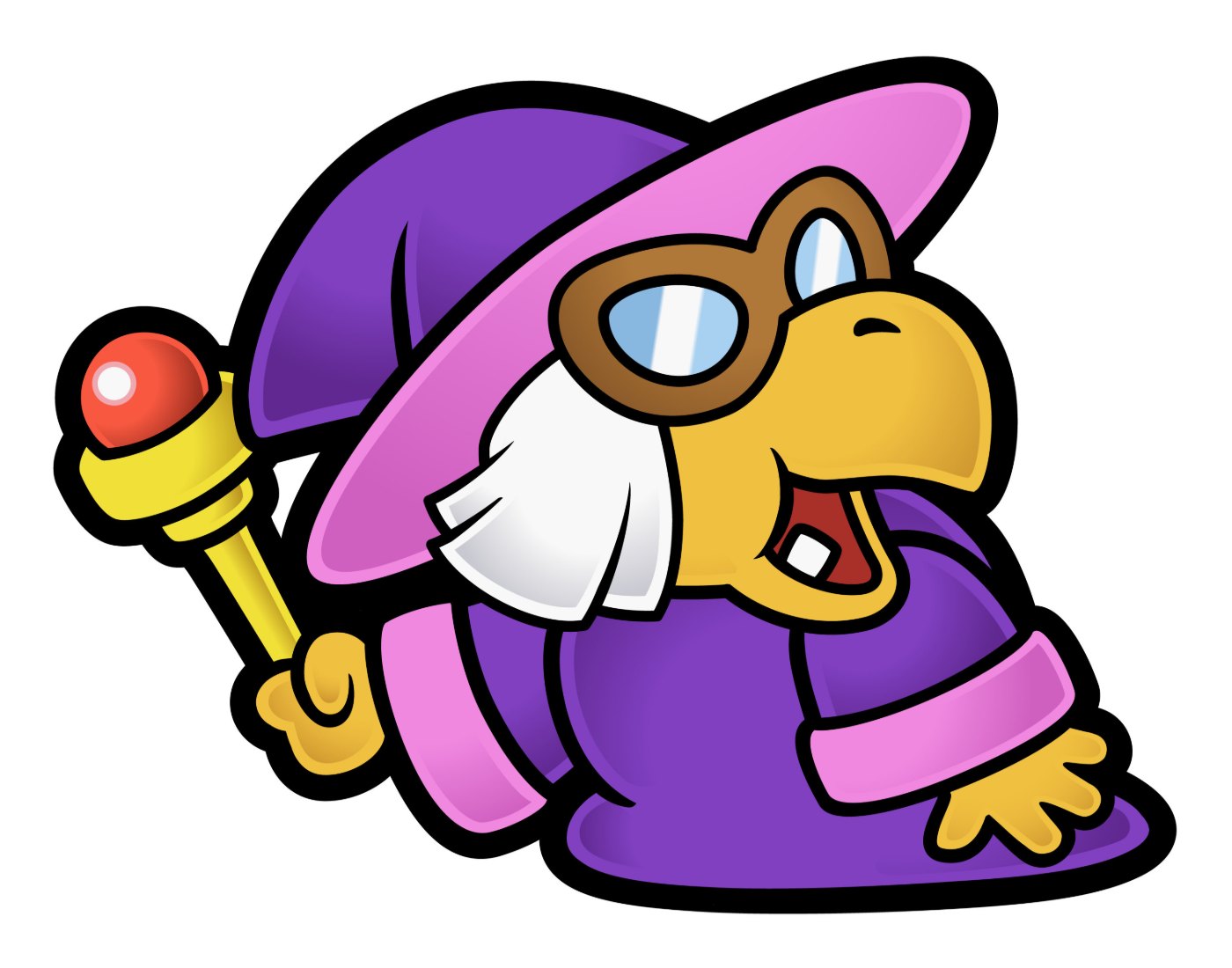
Nintendo GameCube2004Role-playing gameIntelligent SystemsPrologue + 8 chapters7 partners85 badgesPit of 100 TrialsMetacritic 87
Paper Mario: The Thousand-Year Door
A treasure map in the post, a princess gone missing and a harbour town run by thieves: the second Paper Mario starts as it means to go on. Released for Nintendo GameCube in Japan on 22 July 2004 as Paper Mario RPG, and in Europe on 12 November 2004, The Thousand-Year Door sends Mario to Rogueport to collect seven Crystal Stars before the masked X-Nauts can, across a prologue and eight chapters that take in a dragon’s castle, a wrestling league in the clouds, a murder-mystery train and the Moon. Battles are turn-based but never passive: every blow has an Action Command, every fight is played on a stage in front of an audience that cheers, heckles and throws things, and Mario himself can be cursed into a paper aeroplane, a tube or a boat. Seven partners join him, from the bookish Goombella to the shadow-dwelling Vivian, while Peach befriends a lovesick computer and Bowser stomps through his own side-scrolling interludes. Made by Intelligent Systems under director Ryota Kawade, it took the Interactive Achievement Award for Console Role-Playing Game of the Year and was remade for Nintendo Switch in 2024.
Developer:Intelligent Systems
Publisher:Nintendo
Platform:Nintendo GameCube
Genre:Role-playing game
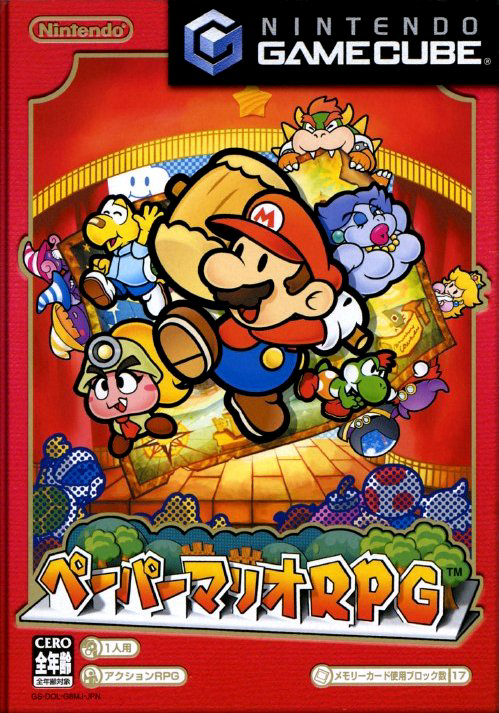
Japan:22 July 2004 (as Paper Mario RPG)
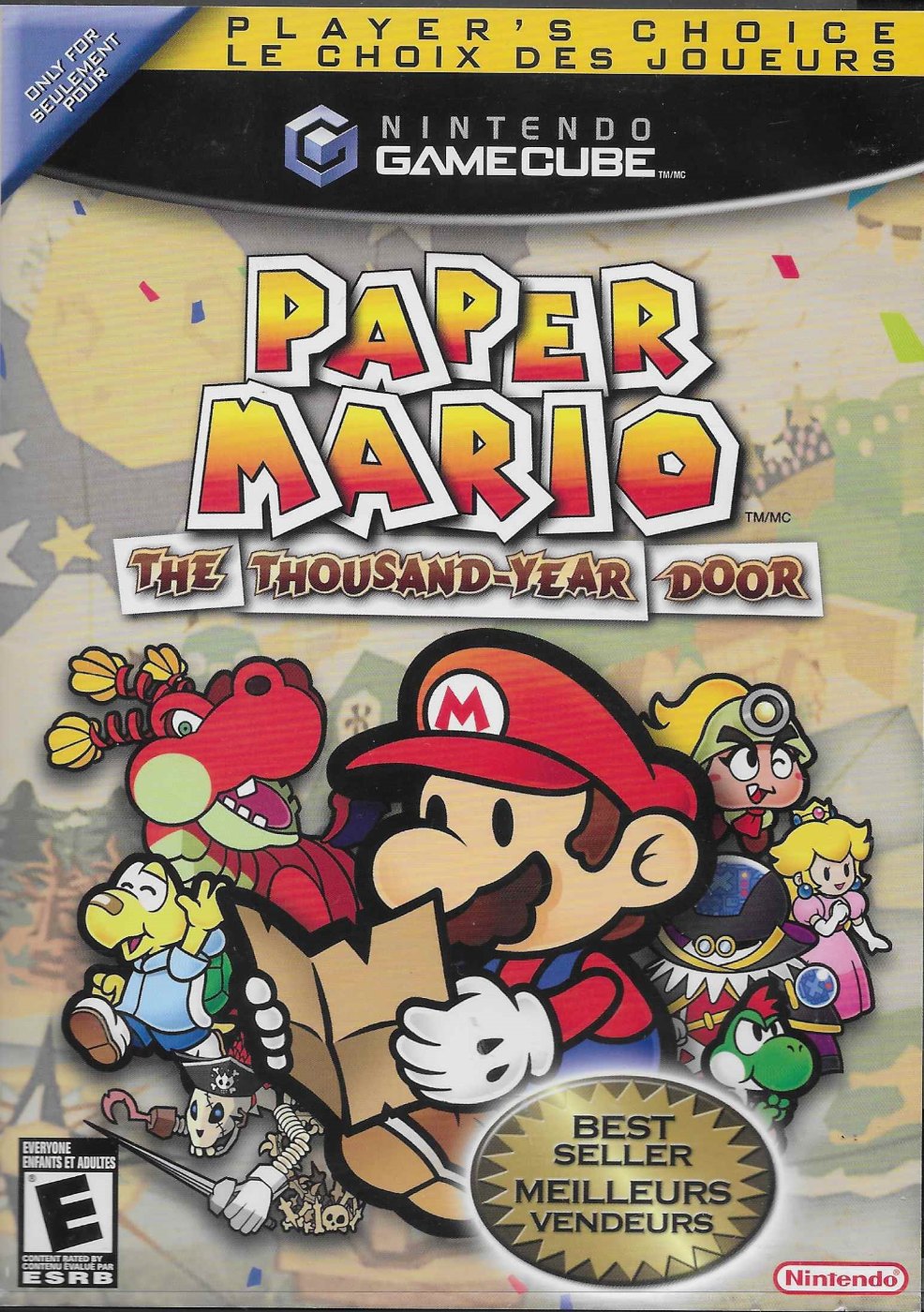
N. America:11 October 2004 (Player’s Choice: 24 April 2006)
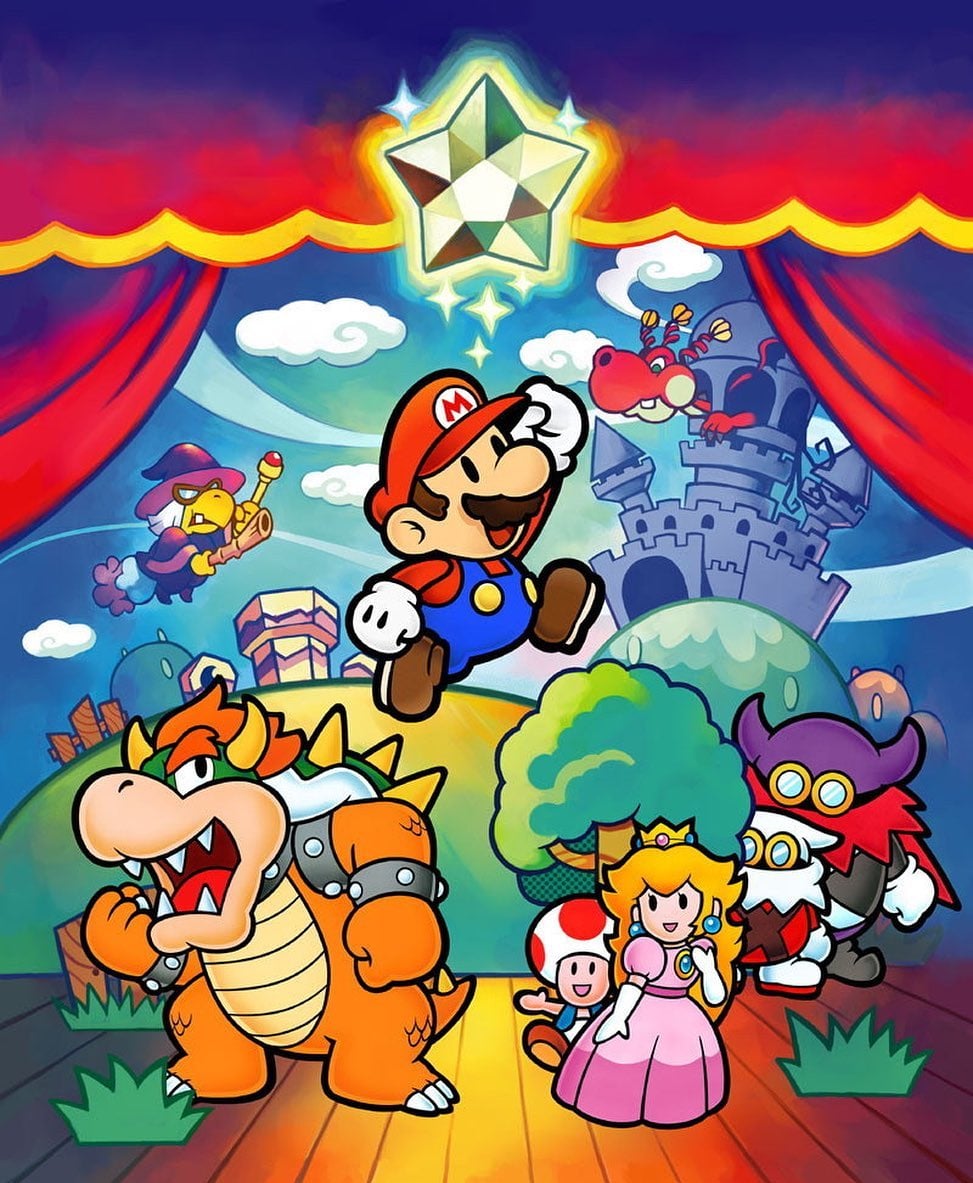
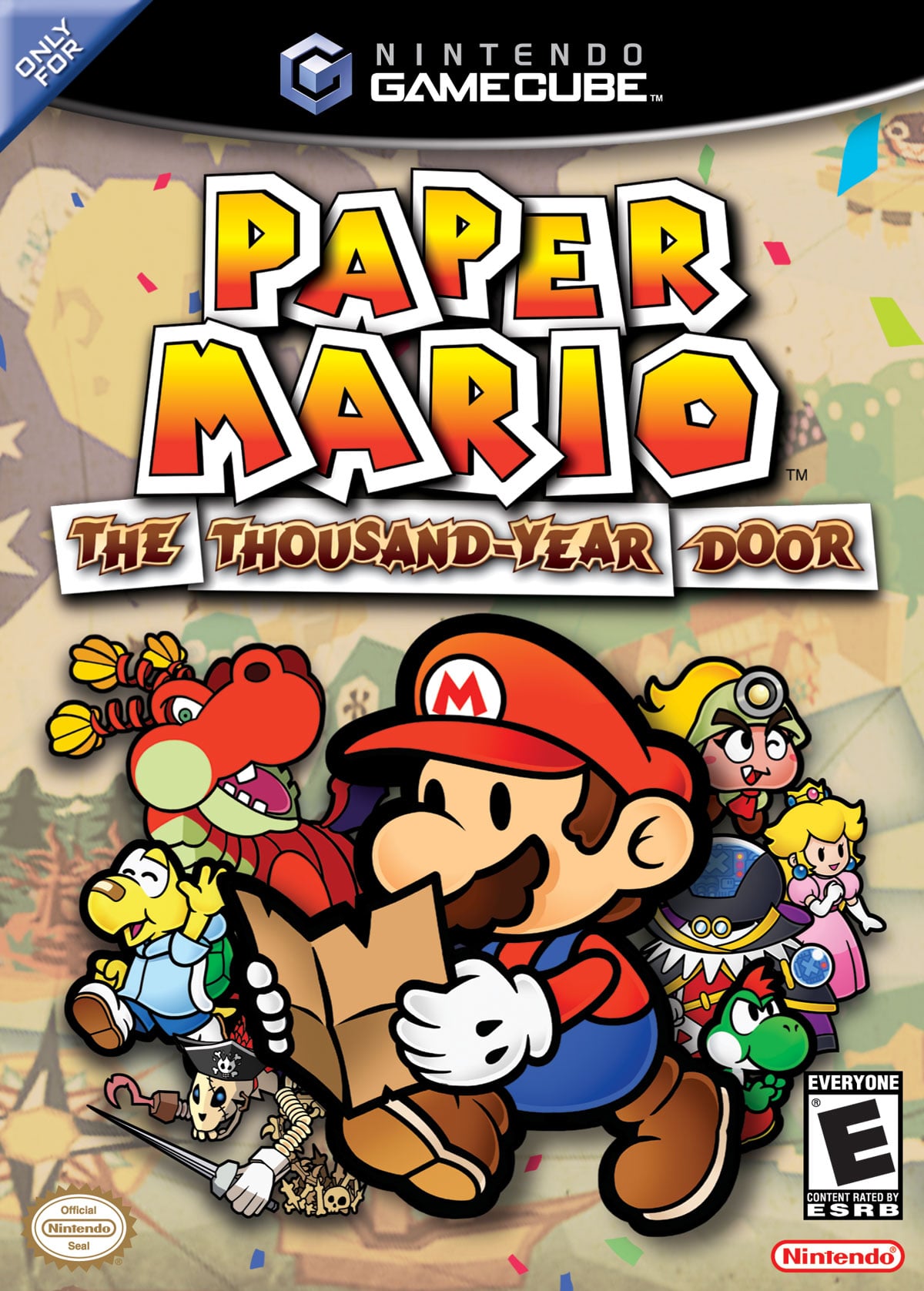
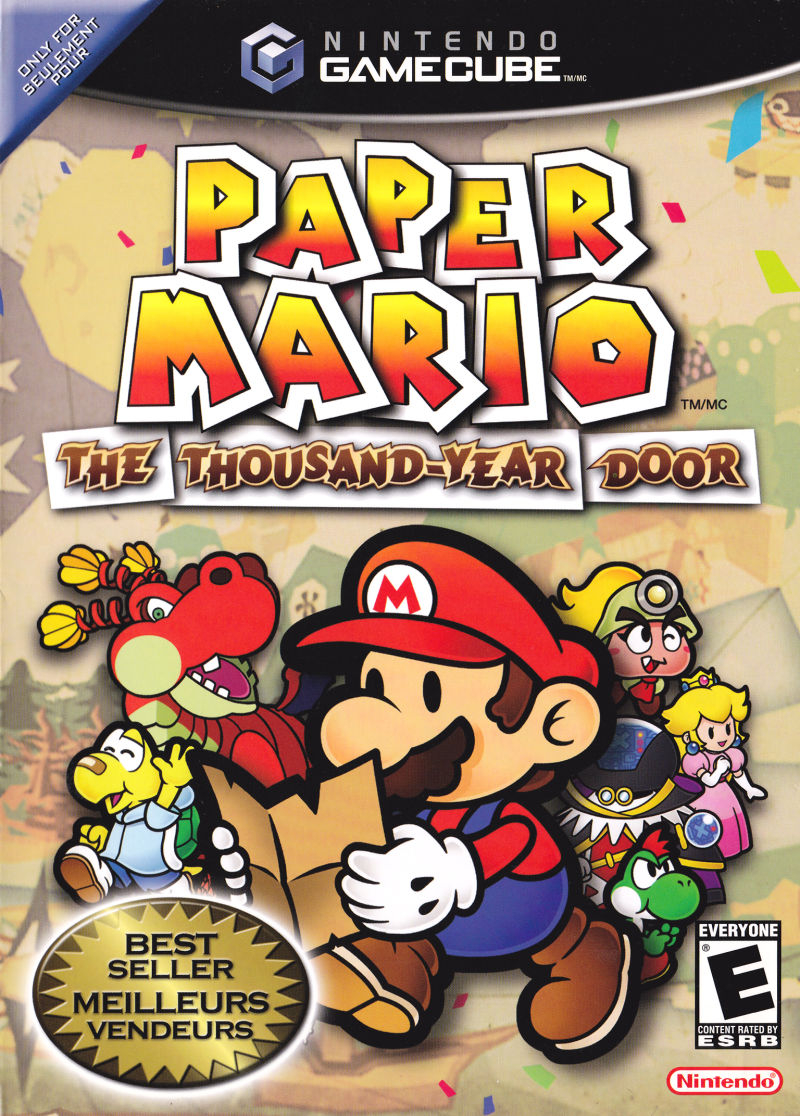
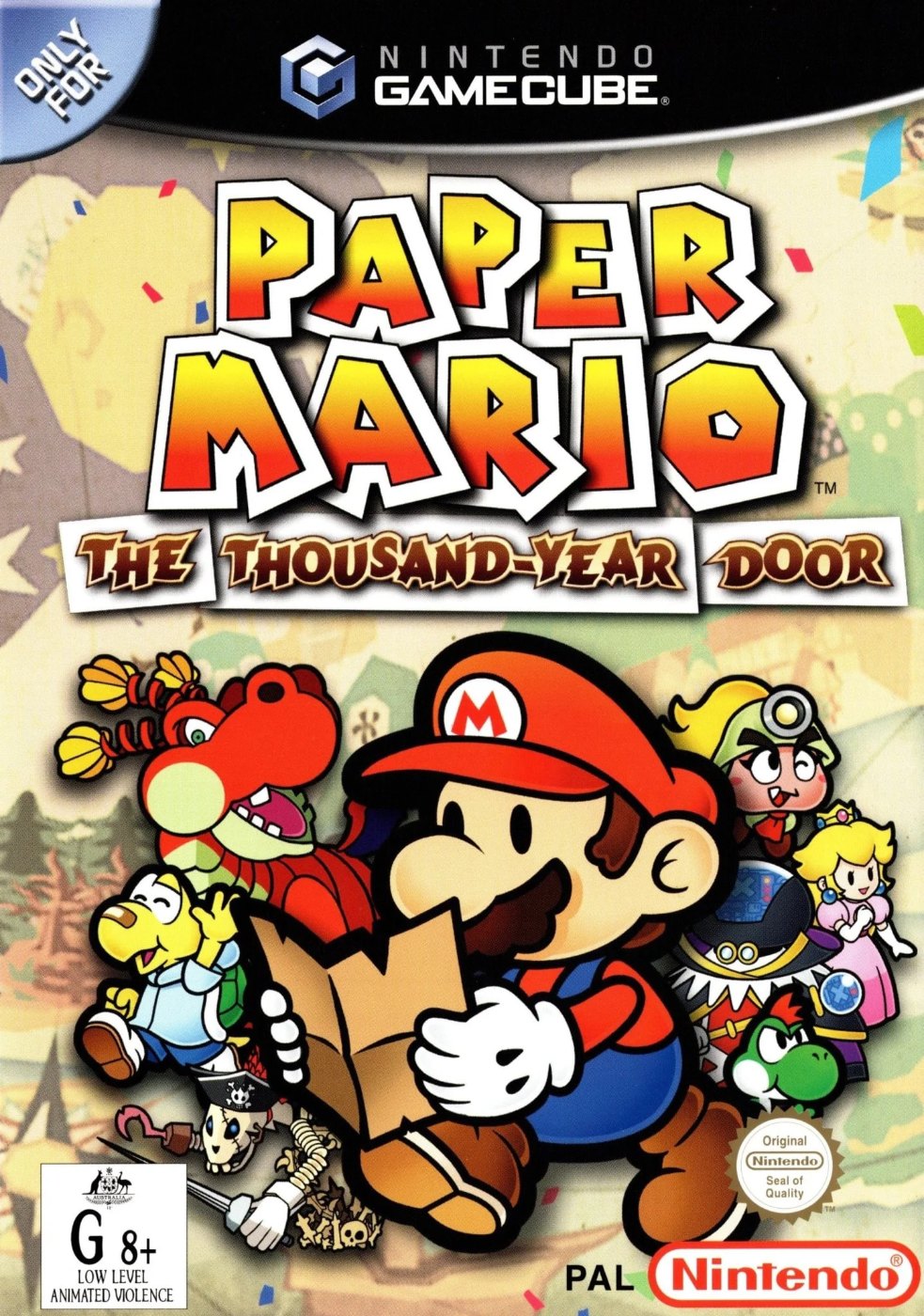
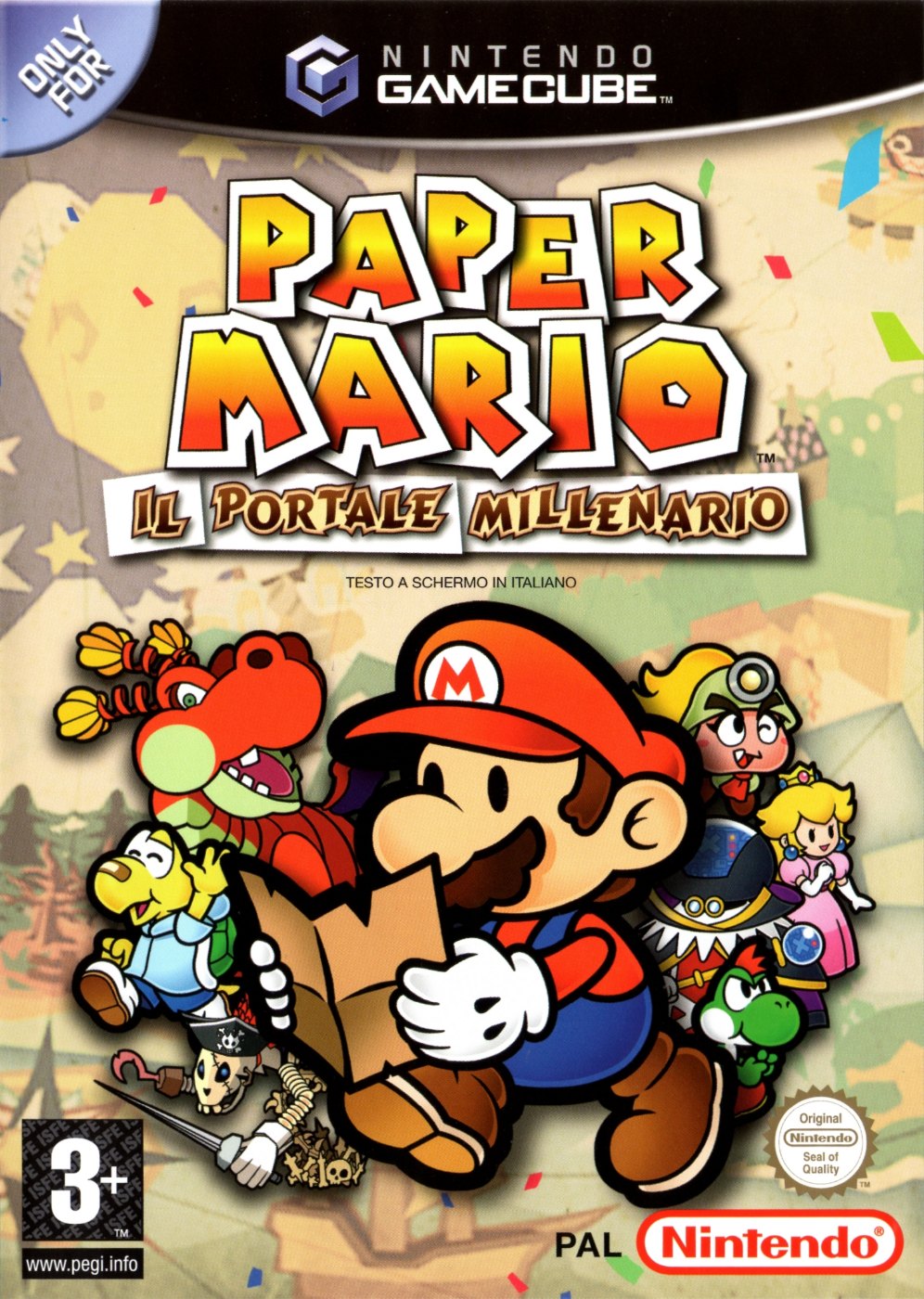
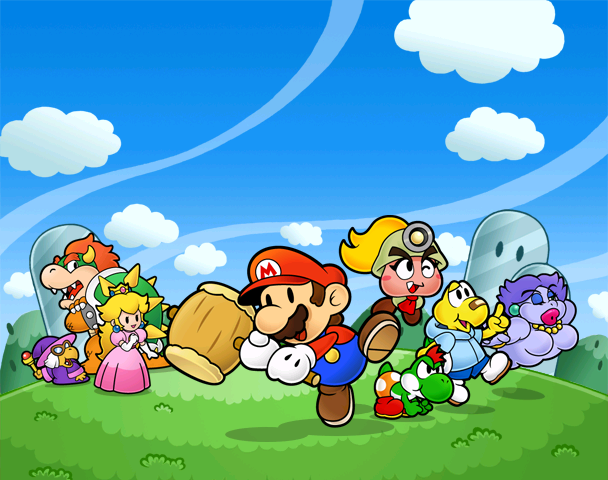
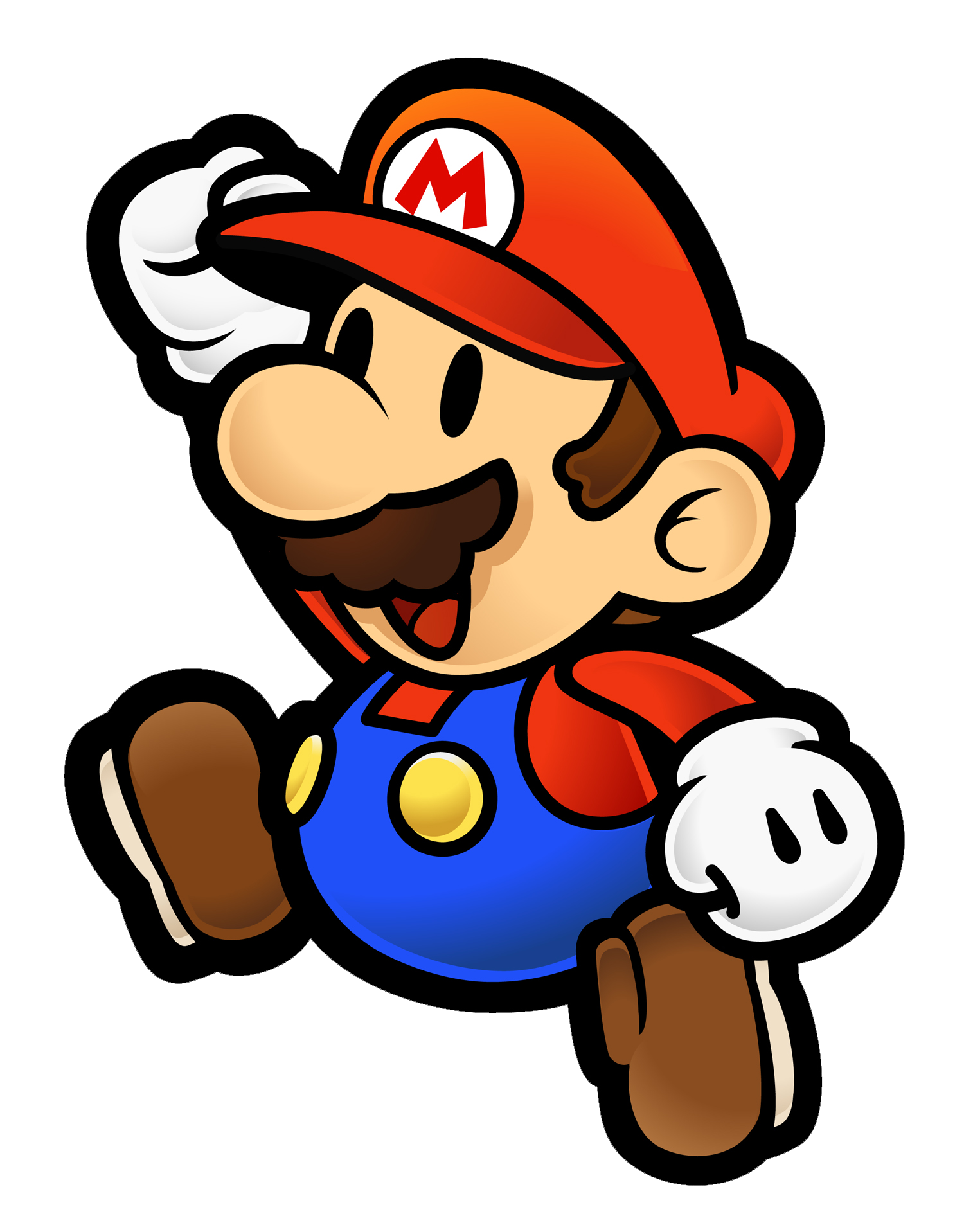
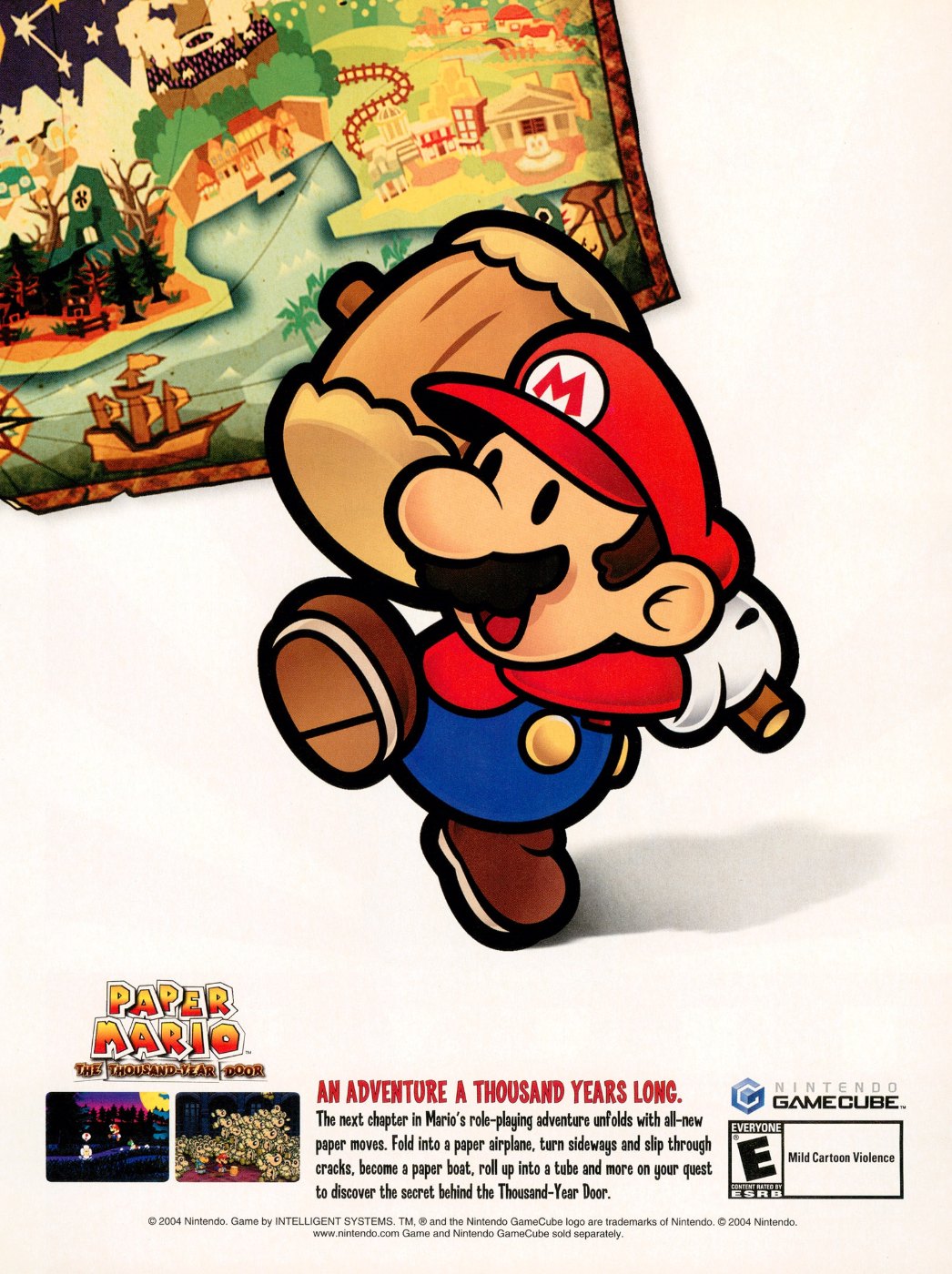
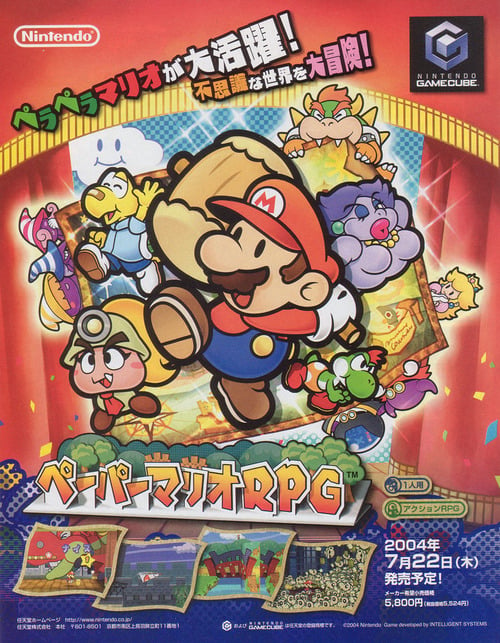
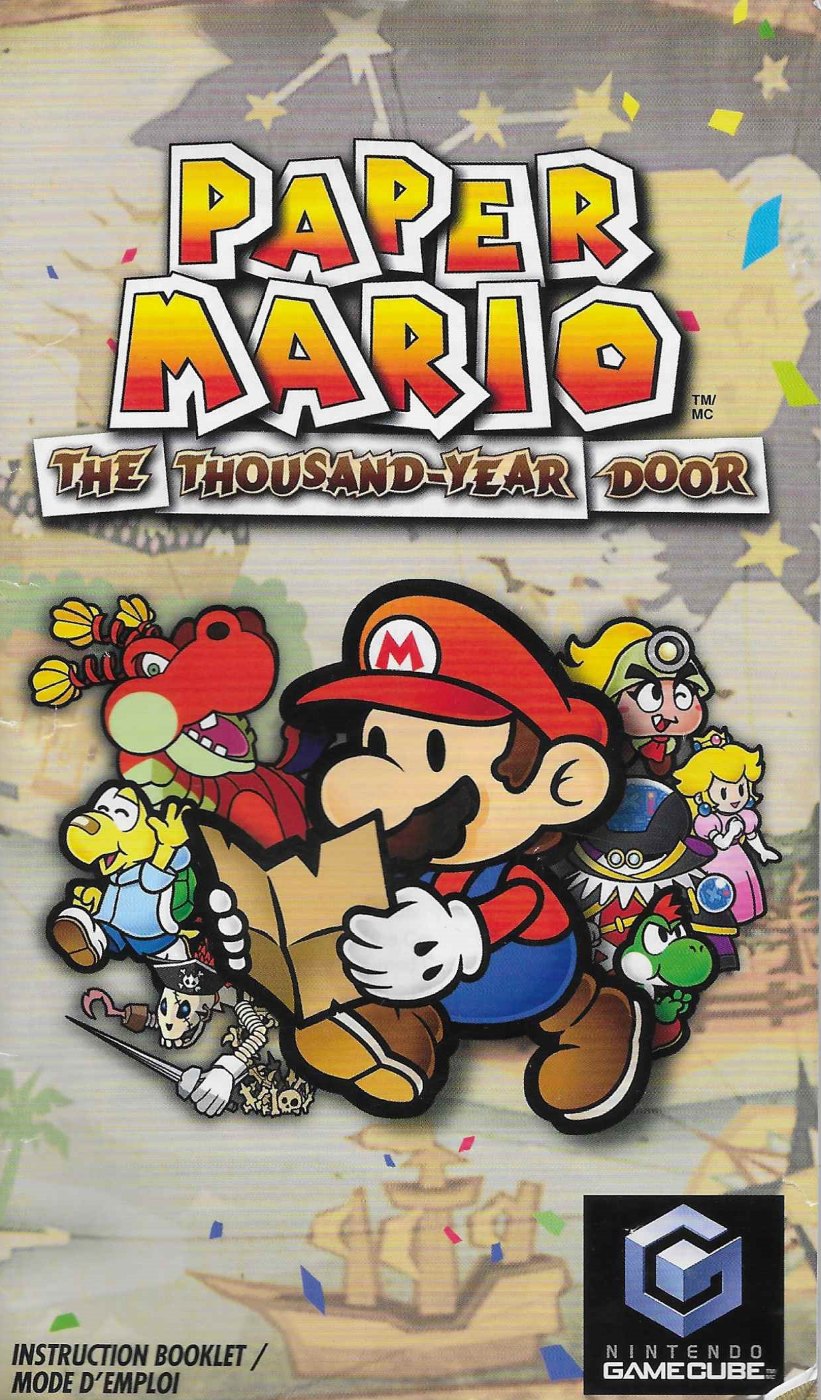
Mario and the main cast in the official group artwork.
Paper Mario: The Thousand-Year Door is the second entry in the line that began on Nintendo 64 with Paper Mario, and like the first it was made by Intelligent Systems with Ryota Kawade in charge. It came out in Japan in July 2004 under the plain title Paper Mario RPG, reached North America that October and Europe and Australia in November, and has a strong claim to being the game people mean when they say they wish Nintendo still made Mario role-playing games like it used to.
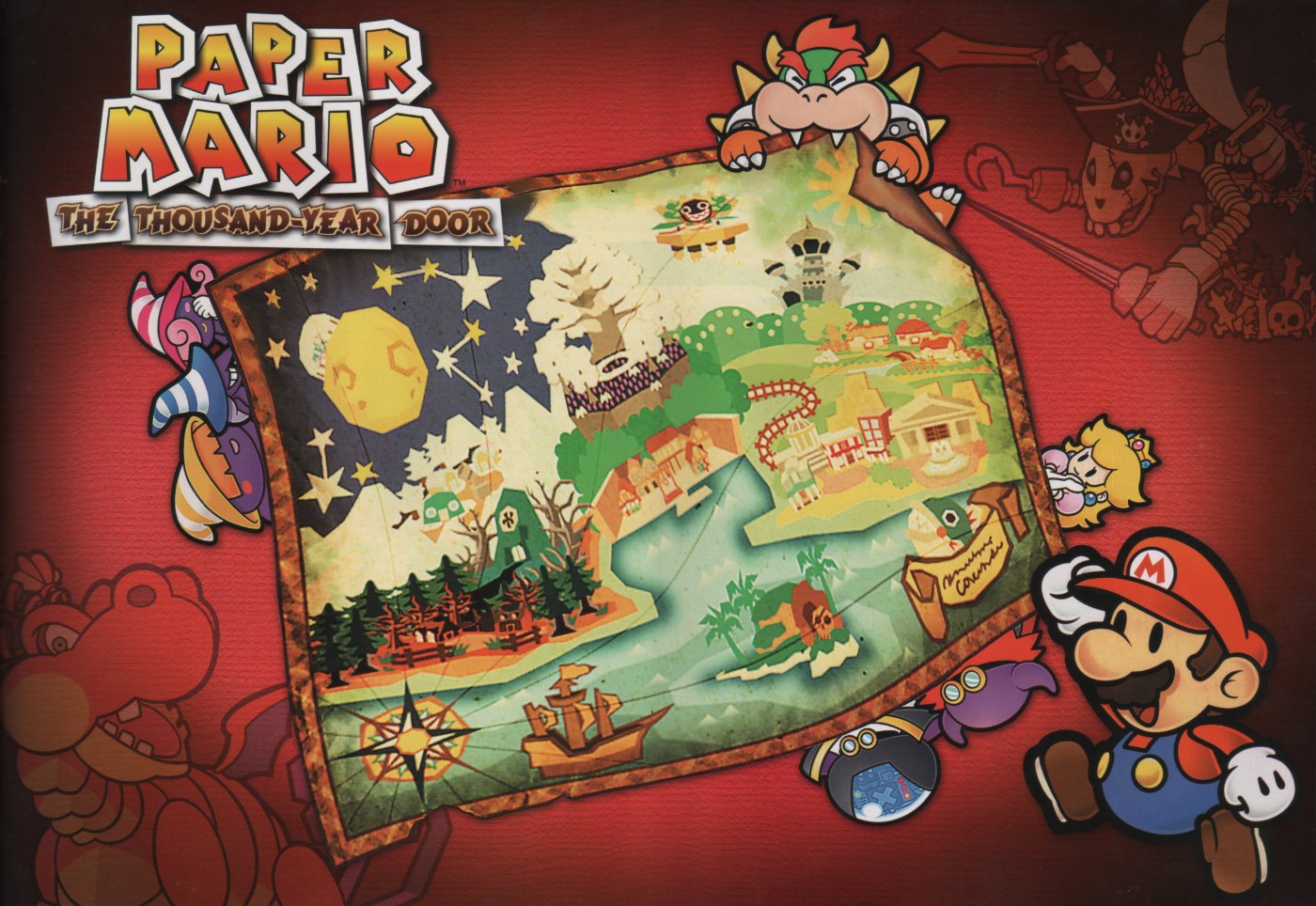
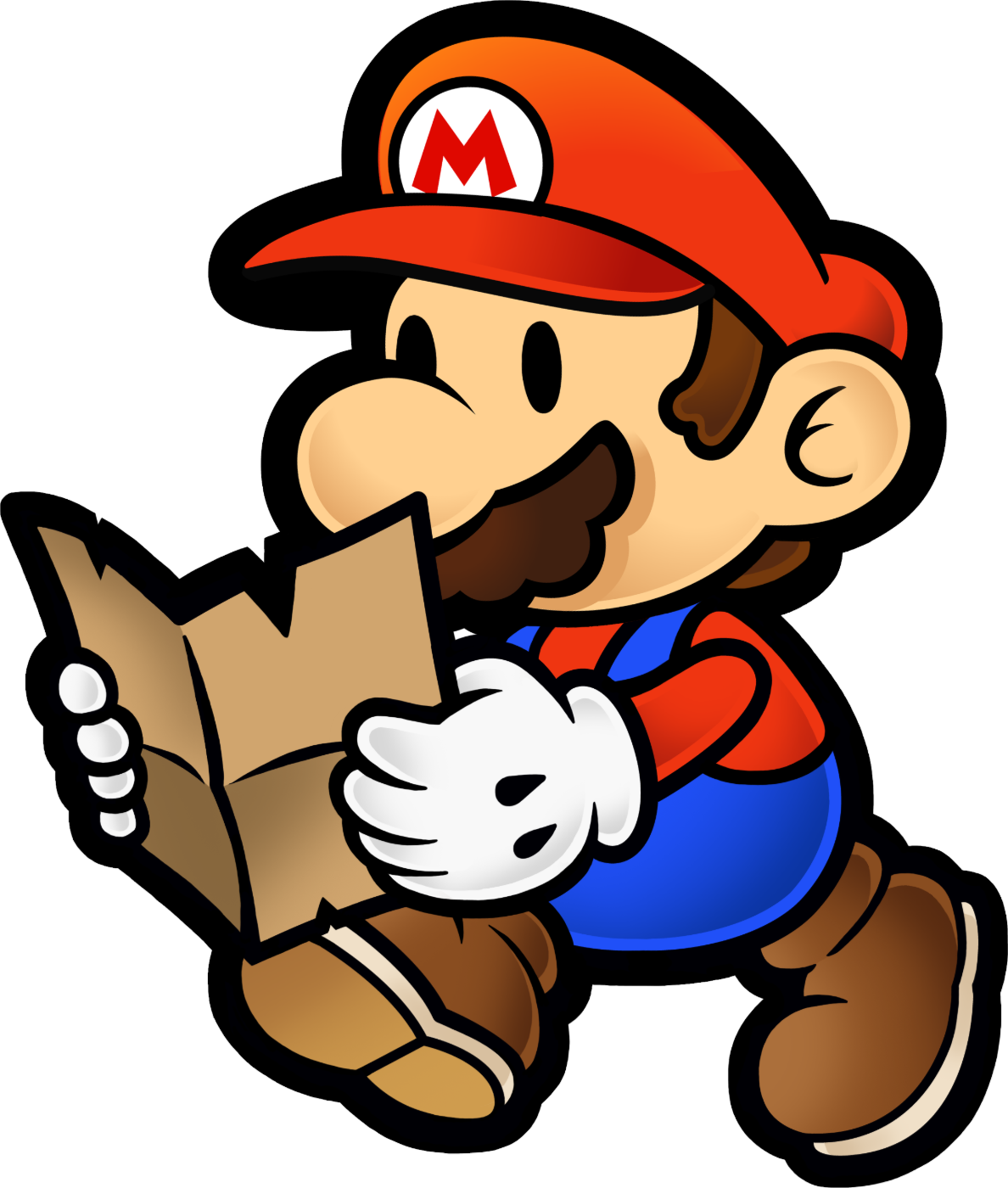
The set-up is a postcard. Princess Peach, on holiday in the rough harbour town of Rogueport, is sold a box by a hooded street trader. Inside is a map to a legendary treasure. She posts it to Mario and promptly vanishes. When Mario steps off the boat he finds a town of thieves built on top of a drowned city, a sealed door in the sewers that is said to open once every thousand years, and a gang of costumed goons called the X-Nauts who want what is behind it. Seven Crystal Stars will open the door. The map shows where they are, one at a time.
Each star is a chapter and each chapter is its own little genre: a storybook dragon hunt, an ecological siege inside a tree, a wrestling drama, a ghost story in which Mario loses his own name, a pirate yarn, an Agatha Christie pastiche on a sleeper train and a science-fiction raid on a Moon base. Between chapters the game cuts away to Peach, who is being held by the X-Nauts and courted by their computer, and to Bowser, who has heard about the treasure and is perpetually one town behind.
The fighting is the first game’s timed-hit system with a theatre built around it. Battles take place on a stage. A crowd fills the seats, grows as Mario levels up and supplies the Star Power for his special moves, and scenery can fall on anyone. Partners now have health of their own. A risky new block, the Superguard, cancels an attack entirely if the B Button is pressed inside a window of three frames. Around all this sit 85 kinds of badge, a hundred Star Pieces, thirty odd jobs at the Trouble Center and a hundred-floor dungeon with a dragon at the bottom.
Critics were delighted (Metacritic’s average is 87) and the game sold 1.91 million copies by the trade body CESA’s count. It was the last Paper Mario of its kind: Super Paper Mario turned the series into a platformer three years later, and by most reckonings no later entry has shared the battle system of the first two games. In 2024 it was remade for Nintendo Switch.
Origami antics aplenty with Mario as the indefatigable plumber returns for another bite of the RPG cherry on GameCube!
Fold Mario’s uniquely flexible features into the shape of a plane to take to the skies, or turn him sideways to slip through slender gaps as you strive to rescue the kidnapped Princess Peach. Search for Star Crystals by exploring a vast world, hooking up with old chums and older enemies – and make sure to impress the watching audience when battling the bad guys, or they’ll start getting antsy!
— Official description (Nintendo UK, 2004)
Why The Thousand-Year Door matters to Mario fans
It is the high-water mark of the story-driven Mario RPG: a full cast of original characters with their own troubles, a script that is funny in every town, and a battle system that later Paper Mario games walked away from. It introduced Goombella, Vivian, Admiral Bobbery, Doopliss, Rawk Hawk and the Shadow Queen, gave the series its first Pit of 100 Trials, and let Luigi have an entire off-screen adventure that he will not stop talking about. When fans asked for “a real Paper Mario” for the next two decades, this is the game they meant.
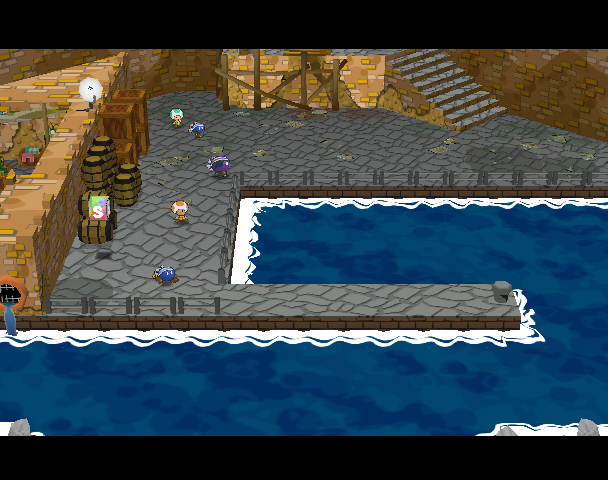
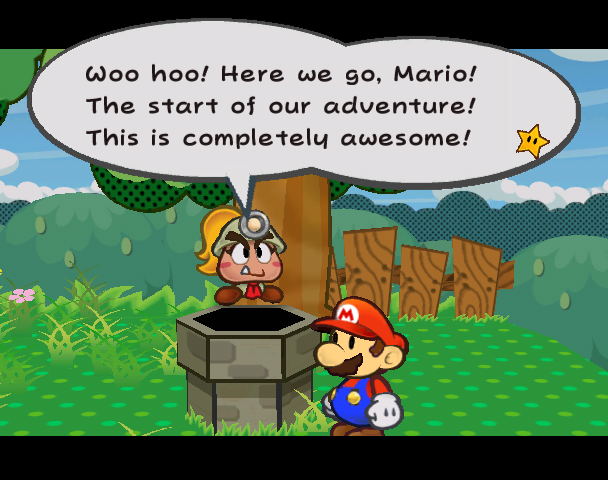
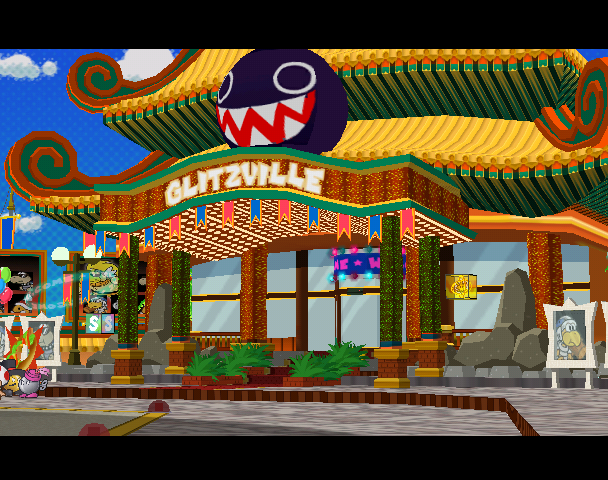
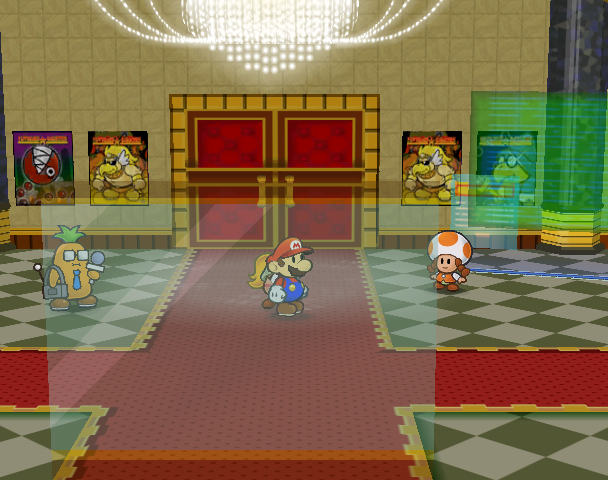
Rogueport, as the prologue introduces it.An ordinary battle: a stage, a curtain and a paying crowd.Plane Mode in Hooktail Castle.Mario and Koops meet Hooktail.
“I didn’t think anyone would be interested in reading a book about Luigi…”
Luigi, in Rogueport.
While Mario is saving the world, Luigi is off on a quest of his own in the Waffle Kingdom, and turns up in Rogueport between chapters to tell his brother all about it. His adventures are eventually published in five volumes as the Super Luigi series. This is his verdict on them.
Quick Answers
The questions people ask most about The Thousand-Year Door, answered briefly here and in depth further down the page.
When did Paper Mario: The Thousand-Year Door come out?
On Nintendo GameCube in Japan on 22 July 2004, North America on 11 October 2004, Europe on 12 November 2004 and Australia on 18 November 2004. The Nintendo Switch remake followed on 23 May 2024. More →
How many chapters are there?
A prologue (“A Rogue’s Welcome”) and eight chapters. Each of the first seven chapters ends with a Crystal Star and is followed by a Peach intermission and a Bowser intermission; the eighth is the Palace of Shadow behind the Thousand-Year Door. The game can be continued after the final boss. More →
Who are the partners?
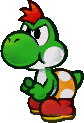
Seven: Goombella (prologue), Koops (Chapter 1), Madame Flurrie (Chapter 2), a newly hatched Yoshi (Chapter 3), Vivian (Chapter 4), Admiral Bobbery (Chapter 5) and the optional Ms. Mowz. Each has a field ability, four battle moves and two rank-ups bought from Merlon with Shine Sprites. More →
How do you get Ms. Mowz?
After Chapter 4 an anonymous request called “Elusive badge!” appears at the Trouble Center in east Rogueport. Find the Attack FX B badge in a hidden chest in Hooktail’s room and hand it over, and the client turns out to be Ms. Mowz, who joins the party. More →
What are the Crystal Stars?
Seven star-shaped gems (Diamond, Emerald, Gold, Ruby, Sapphire, Garnet and Crystal) that open the Thousand-Year Door. Each one adds a unit to Mario’s Star Power gauge and teaches a special move, from Earth Tremor to Supernova. The Magical Map itself supplies an eighth, Sweet Treat. More →
Who is the final boss?
The Shadow Queen, the demon sealed behind the door, who possesses Princess Peach. She has 150 HP, cannot be hurt at all in her true form until the Crystal Stars and the cheers of everyone Mario has met break her invincibility, and comes straight after fights with Grodus and with Bowser and Kammy Koopa. More →
What is the Pit of 100 Trials?
An optional hundred-floor dungeon reached by a pipe in the Rogueport Sewers, west of the Thousand-Year Door. There is no saving inside. Every tenth floor has a treasure chest and a way out, and the hundredth holds the bone dragon Bonetail (200 HP), who guards the Return Postage badge. More →
What was changed in the English version?
Quite a lot of small things. The English and German scripts wrote out any mention of Vivian being transgender, the waitresses Peeka and Lahla swapped bunny ears for cat ears, TEC’s red eye became blue, a chalk outline and bloodstains were removed from a house in Rogueport, and a bottle of Vintage Red became Chuckola Cola. The Japanese version also has fewer Stylish moves and a Shadow Queen whose attacks cannot be Superguarded. More →
Is it called something else in Japan?
Yes: Paper Mario RPG. The first game was Mario Story there, and during development this one was Mario Story 2 for Japan and Paper Mario 2 for the West. More →
How well did it sell?
About 159,000 copies in its first week in Japan, where it topped the chart, and 1.91 million worldwide by December 2007 according to CESA. The 2024 Switch remake had reached 2.1 million by 31 March 2025 on Nintendo’s own figures. More →
Story
The storybook that opens the game.
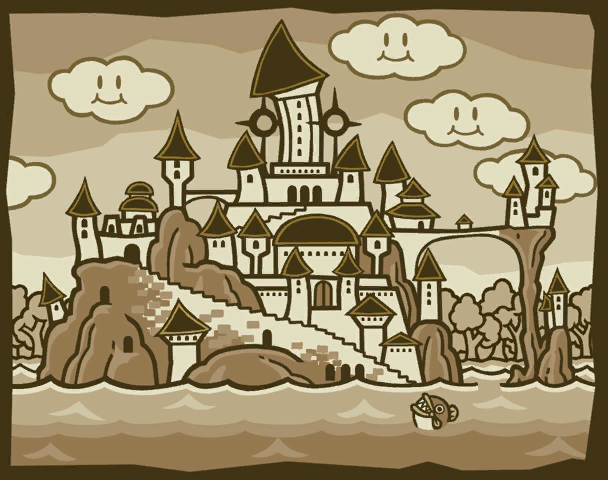
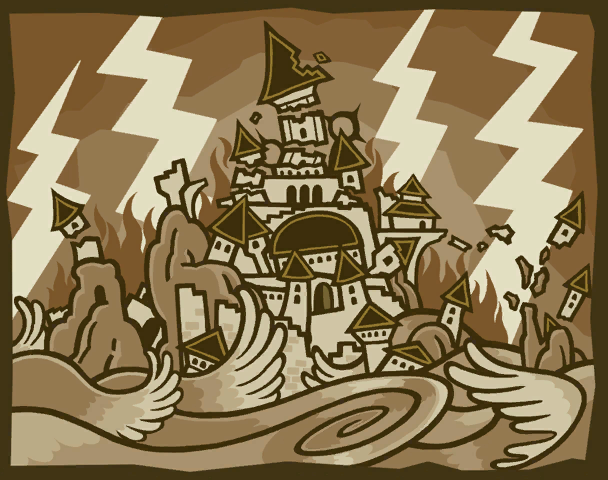
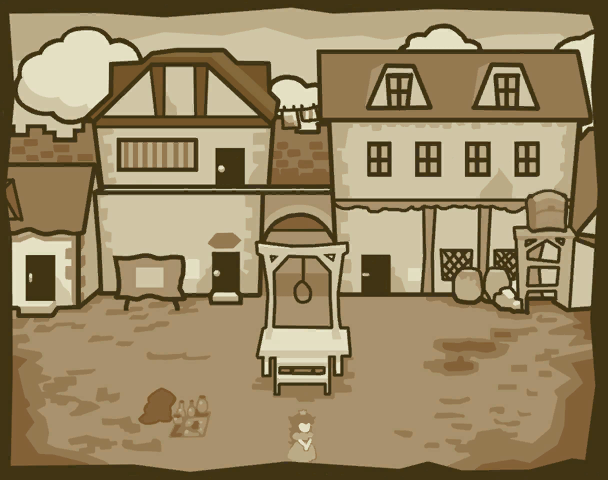
The game begins with a book. A narrator turns the pages: long ago a prosperous town stood in a far-off land, until a great cataclysm struck and it sank into the earth. In time a new town was built on top. Rumours persisted that the old city was still down there, and that it held a magnificent treasure.
The new town is Rogueport, and Princess Peach has stopped there on holiday with Toadsworth. Slipping away on her own, she meets a hooded woman with a stall, who shows her a box that will open only for someone pure of heart. It opens. Inside is a map. Peach posts it to Mario with a letter asking for his help, and that is the last anyone sees of her.
What follows is the whole plot, chapter by chapter, with every twist given away.
Prologue: A Rogue’s Welcome
Parakarry delivers the letter to the Mario Bros.’ house, exactly as he did at the start of the first game, and Mario takes ship for Rogueport. He has barely set foot on the dock when he walks into an argument: Lord Crump, a general of the X-Nauts, is demanding that a Goomba girl tell him what she knows about the Crystal Stars. Mario steps in, Crump is flattened in the tutorial fight, and when he whistles up an entire platoon of X-Nauts to “PUNISH HIM!” the two slip away in the scrum.
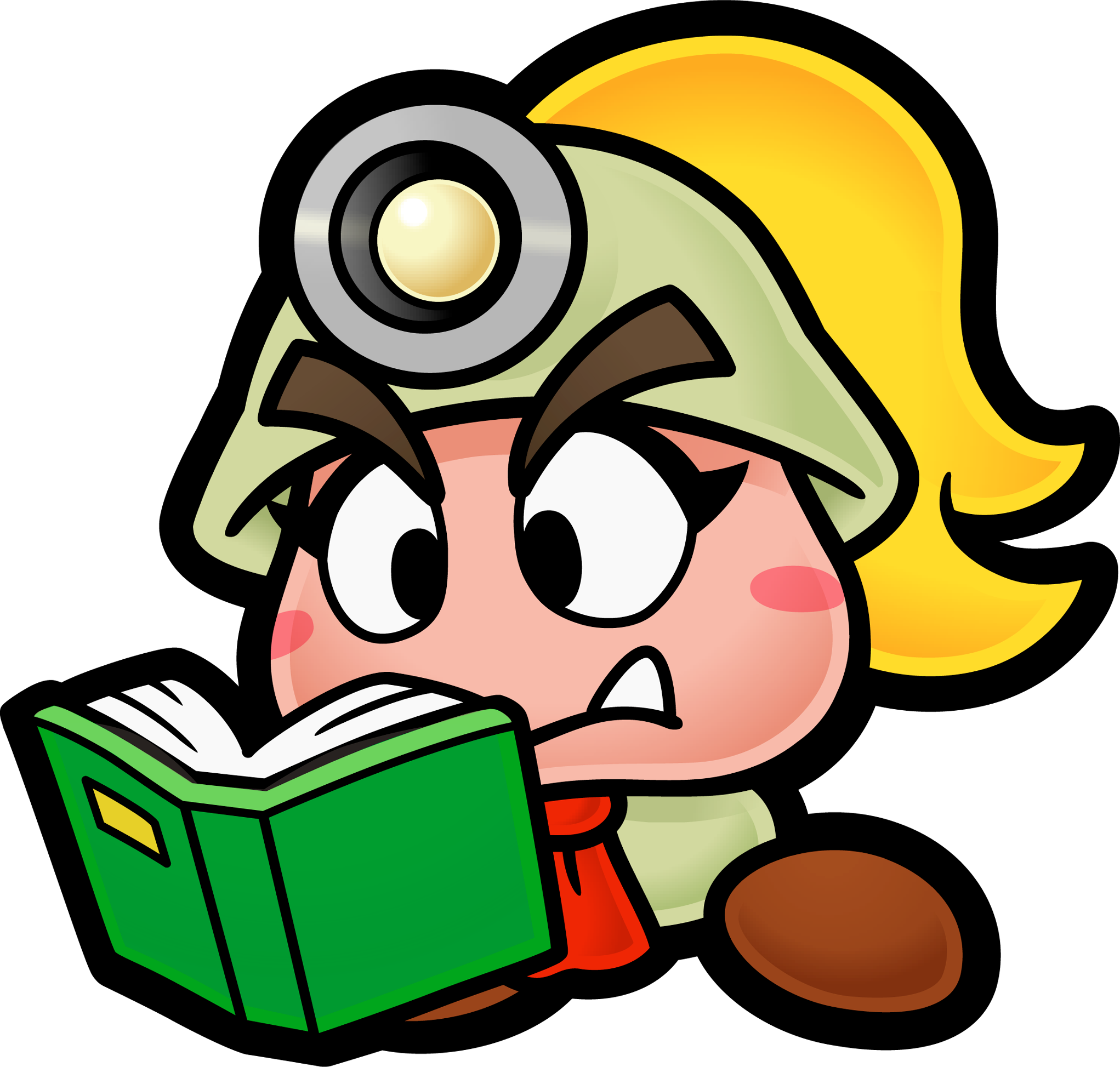
The girl is Goombella, a student at the University of Goom, and she is after the same treasure. Toadsworth, found in the town, reports that the princess is missing. Goombella takes Mario to Professor Frankly, a scholar who lives in Rogueport, who explains that the treasure lies behind the Thousand-Year Door in the ruins under the town, and that the door will open only for someone holding all seven Crystal Stars.
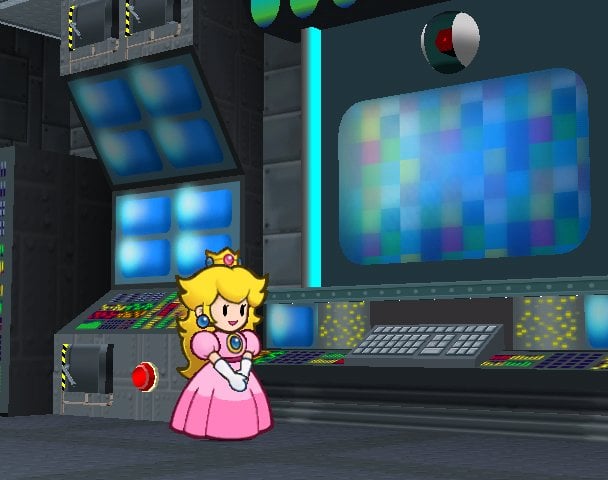
Down in the sewers a black chest lays the first “curse” on Mario, the ability to fold into a paper aeroplane, and with it he reaches the door. When he holds the Magical Map up on the pedestal in front of it, a picture appears: a castle, and a star. Frankly identifies the place as Petal Meadows. The pipe that leads there is guarded by a Blooper, the game’s first proper boss.
Peach opens the box that only the pure of heart can open.Lord Crump calls for back-up on Rogueport’s dock.Goombella joins the party.The Thousand-Year Door.
Chapter 1: Castle and Dragon
Petal Meadows is all green hills and sunshine, with a dragon wheeling in the distance. In the Koopa village of Petalburg the elderly mayor, Kroop, explains that Hooktail has been terrorising the village, and that the way to her castle is sealed by two stone keys kept in Shhwonk Fortress. The fortress means a quiz from a Thwomp and a fight with a Gold Fuzzy and its horde of relations.
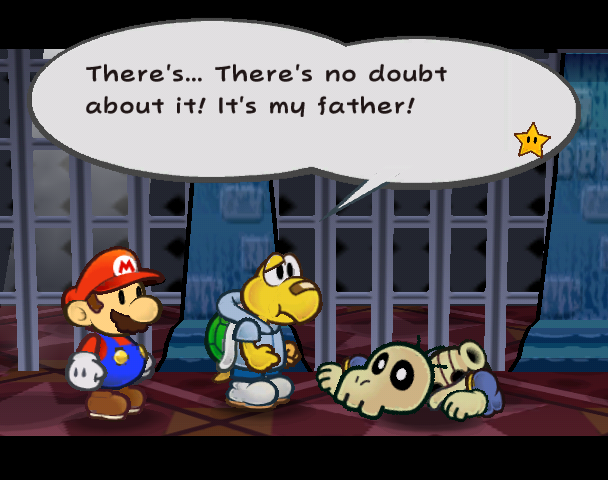
On the way back a shy young Koopa named Koops asks to come along. His father, Koopley, went to fight the dragon years ago and never came home, and Koops means to finish the job. Hooktail Castle is littered with the bones of earlier challengers, one of whom Koops mistakes for his father. A second black chest teaches Mario to turn sideways and slip through bars, a mouse called Ms. Mowz turns up hunting for badges and steals a kiss, and at the top of the tower waits the dragon.
Hooktail is beaten with the help of a badge that makes Mario’s attacks chirp like a cricket, a sound she cannot stand. She pleads for mercy, snacks on the audience, and finally keels over and coughs up a shell with Koopley inside it, alive and well and holding the Diamond Star.
Meanwhile. Peach is a prisoner of the X-Nauts. Their leader, Sir Grodus, learns from a slip of her tongue that the map has gone to Mario and sends three witches, the Shadow Sirens, to get it back. A door in her quarters slides open by itself and she finds the base’s computer, TEC-XX, which has been watching her on the security cameras and has developed a feeling it cannot identify. It will let her send an e-mail if she will teach it about love. In his castle, Bowser hears from Kammy Koopa that somebody else has kidnapped the princess and that Mario is hunting treasure, throws a tantrum and sets off in the Koopa Clown Car to take both.
Petalburg, the Koopa village in Hooktail’s shadow.Koops joins the party.Mario winds up his hammer against Hooktail.Koops and Koopley, reunited.
Chapter 2: The Great Boggly Tree
The second star is in a strange, quiet forest, Boggly Woods, inside an enormous tree that is home to a timid race of little creatures called Punies. One of them, Punio, has come to Rogueport for help: the X-Nauts have occupied the tree, locked up his people and made allies of the Punies’ old enemies, the Jabbies.
In the woods Mario passes the Shadow Sirens, who have lost the sketch that shows what he looks like and fail to recognise him; the eldest, Beldam, blames the youngest, Vivian, as she always does. The tree’s secret entrance needs someone who can blow away a false wall. That is Madame Flurrie, a retired actress and wind spirit who will not leave her house without her necklace, and the necklace has been picked up by the Sirens. One battle later Flurrie joins.
Inside, Mario frees the Punies from their cages, leads them about in a crowd with the Puni Orb, wins the Super Boots and routs the Jabbies. At the roots Lord Crump snatches the Emerald Star and sets a time bomb. The countdown is stopped with seconds to spare, and Crump climbs into a robot, Magnus von Grapple. When it explodes he drops the Emerald Star and the X-Nauts pull out.
Meanwhile. Grodus begins to suspect that Mario has the map. TEC asks Peach to dance and conjures a hologram of the princess for her to dance with, which she finds extremely odd. Bowser, told that Peach is in Petalburg, plays his first side-scrolling level to get there and makes a speech to what turns out to be a poster.
Boggly Woods.The Shadow Sirens: Beldam, Marilyn and Vivian.Flurrie joins, necklace restored.Lord Crump at the controls of Magnus von Grapple.
Chapter 3: Of Glitz and Glory
The third star is on the champion’s belt at the Glitz Pit, a fighting arena in Glitzville, a town that floats in the sky. The only way up is a blimp, and the ticket comes from Don Pianta, a Rogueport boss who deals in favours. Mario signs on as a fighter with the promoter, Grubba, is given the ring name the Great Gonzales, and starts at rank 20.
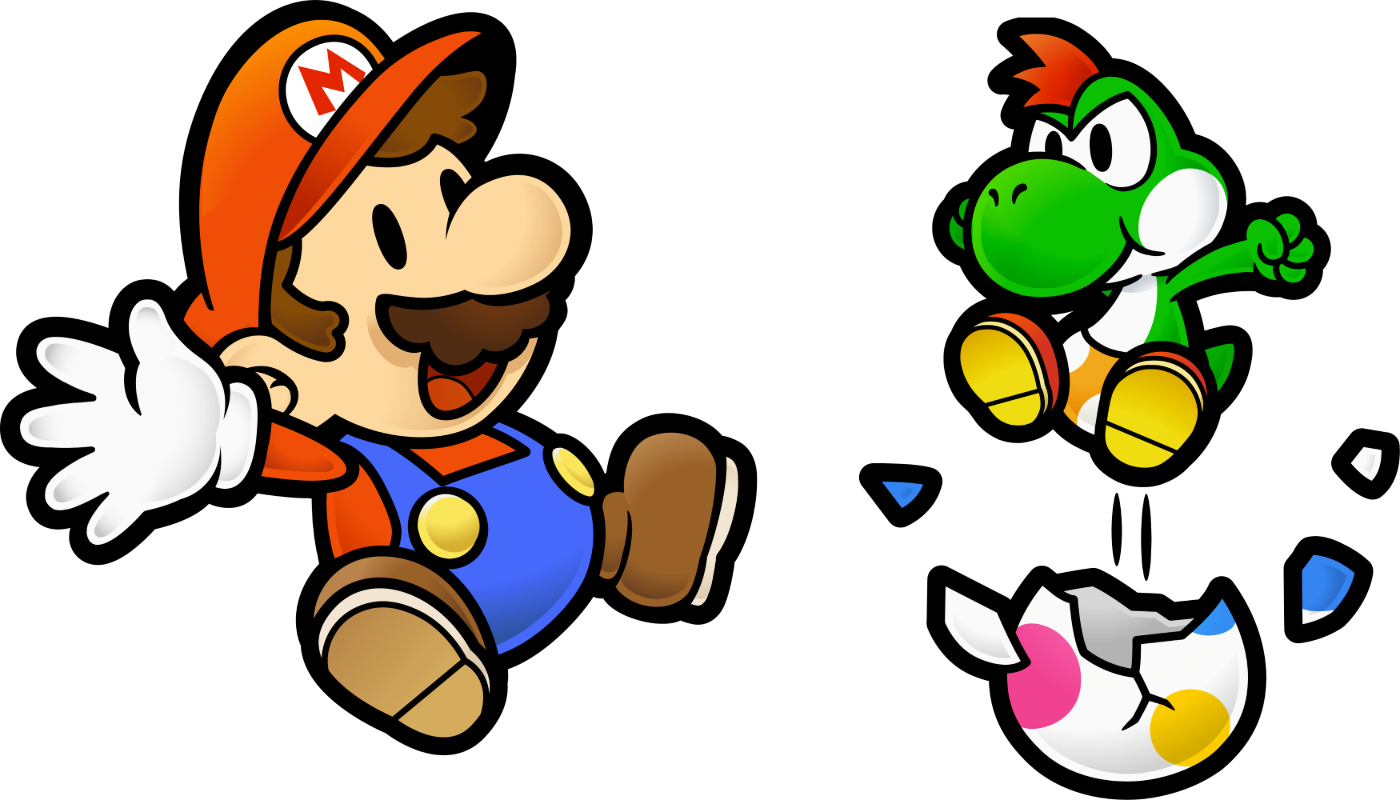
The climb is the chapter. Between bouts an egg rescued from the hot-dog stand outside hatches into a baby Yoshi, whom the player gets to name and whose Gulp attack turns out to be the only thing that can hurt the armoured Iron Adonis Twins. Fighters keep disappearing. Anonymous e-mails signed “X” steer Mario towards the truth. Bowser arrives in the ring uninvited and is sent packing, and the preening champion, Rawk Hawk, has Mario locked in a locker room before the title match and loses anyway. The star on his belt is a fake.
The real one is in Grubba’s keeping, powering a machine that drains his fighters’ energy for his own use. Exposed, he turns it on himself and becomes Macho Grubba. With him beaten, “X” steps forward: Grubba’s assistant Jolene, sister of the Pit’s vanished first champion, Prince Mush. Brother and sister are reunited, and Mario leaves with the Gold Star.
Meanwhile. Beldam promises Grodus a new weapon. Peach, in an X-Naut uniform borrowed for the purpose, overhears Grodus describing how he will use the Crystal Stars to conquer the world. Bowser reaches the Great Tree to find the star gone, and Kammy has a blazing row with the Puni elder.
The Cheep Blimp to Glitzville.The ring of the Glitz Pit.The egg hatches.Macho Grubba.
Chapter 4: For Pigs the Bell Tolls
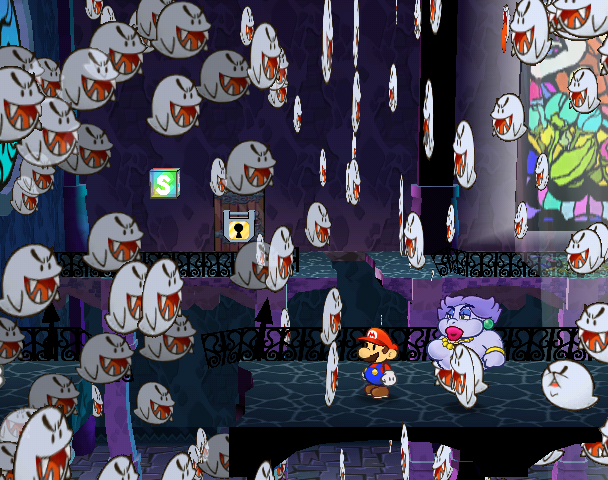
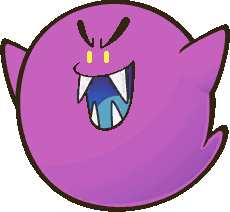
Twilight Town lives in permanent dusk and in fear of a bell. Every time it tolls in the Creepy Steeple, out past the woods, another villager turns into a pig. The steeple is reached along Twilight Trail, where the third black chest hands over Tube Mode, and it is infested with Boos (their giant relation, the Atomic Boo, is an optional boss). In the belfry is the culprit, a ghost who fights and loses, and the Ruby Star is there for the taking. It all seems rather easy.
It is the game’s best trick. On the way back to town Mario discovers that he is a featureless shadow. The ghost has stolen his body, his name and his friends, and has walked off with all three and the star besides; Mario’s partners follow the impostor without a second glance, and Twilight Town takes him for the hero. The thief dares Mario to guess its name, which cannot be spelt without a letter that has gone missing.
His one ally is Vivian, the youngest Shadow Siren, who has lost the Superbombomb that Beldam meant to use on Mario and is being blamed for it again. The nameless stranger helps her, and she agrees to help him in return, not knowing who he is. Together they recover the missing letter “p” and eavesdrop on a parrot in the steeple that keeps repeating its master’s name: Doopliss. Named, the ghost loses his hold and flees to the steeple, where Mario and Vivian beat him a second time. Mario gets back his body, his name and the star, and Vivian stays with him, sisters or no sisters.
Meanwhile. Grodus is told that the seal on the door is weakening and is delighted. TEC puts Peach through an unsettling quiz that lets slip what the X-Nauts are really after: the “treasure” is the soul of a demon, and Grodus means to wake it. Bowser’s Clown Car breaks down over Glitzville and he swims home.
Twilight Town’s pig problem.The front yard of the Creepy Steeple.Mayor Dour chats to “Mario”.Vivian becomes Mario’s only partner.
Chapter 5: The Key to Pirates
The fifth star is in a pirate’s hoard on Keelhaul Key, far to the south. An expedition is being got up by the vain, treasure-minded Flavio, who has a ship, and it needs Admiral Bobbery, a retired Bob-omb sailor who has to be talked back to sea with a letter from his late wife. The crew that sails includes a suspiciously familiar bespectacled sailor called Four-Eyes.
Within sight of the island the ship is attacked by spectral flames, the Embers of the pirate king Cortez, and wrecked. The survivors make camp. When the Embers return Bobbery holds them off alone so the others can run, and Mario finds him stuck up a tree, apparently breathing his last and asking for one final sip of Chuckola Cola. He is in fact asleep. Once woken, he joins the party.
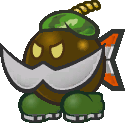
Flavio’s precious Skull Gem opens Pirate’s Grotto, a flooded cave system where the last black chest grants Boat Mode. In the deepest cavern the pirate king’s ship, the Black Skull, lies at anchor, and aboard it is Cortez himself, a ghost who has to be beaten three times over. He gives up the Sapphire Star. Then Four-Eyes drops his disguise. He is Lord Crump, an X-Naut warship is in the bay, and it will shell the island unless the star is surrendered. Cortez, of all people, offers his ship, and pirates, castaways and plumber board the enemy and beat Crump on his own deck.
Meanwhile. TEC needs a data disk from Grodus’s room, so Peach brews an invisibility potion, discovers it does not work on dresses, and tiptoes in without one. Bowser and Kammy run into Lord Crump in Twilight Town, the Koopa Troop and the X-Nauts start brawling, and Bowser sets off the Superbombomb with his own breath.
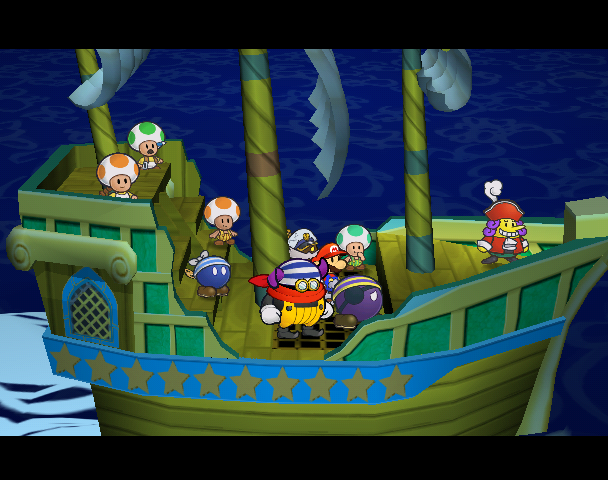
Flavio, merchant and legend in his own mind.Mario and Yoshi on Keelhaul Key.Admiral Bobbery joins.The battle against Lord Crump’s ship.
Chapter 6: 3 Days of Excess
The sixth star is in a museum, Poshley Sanctum, in the smart resort of Poshley Heights, three days away by the luxurious Excess Express. Don Pianta, who is retiring, provides the ticket.
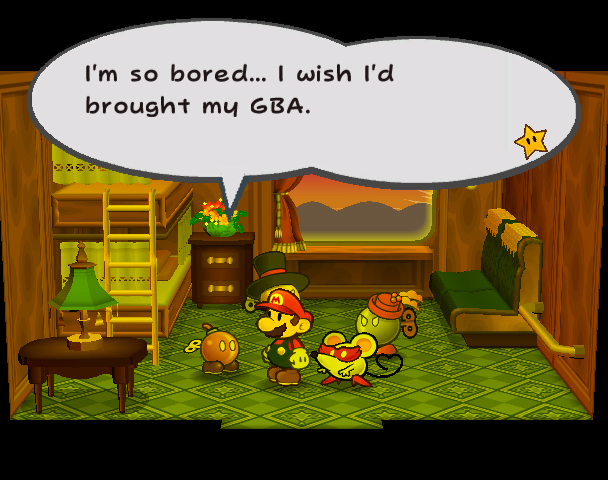
The journey is a detective story. On the first day things go missing up and down the train (a galley pot, some vital papers) and someone threatens to blow it up. A self-appointed sleuth, Pennington, the “Penguin with the Improbably Large Brain”, lends a flipper. On the second day the pair unmask a passenger calling himself Zip Toad. It is Doopliss, working for the Sirens now, and he gets away when the train halts at Riverside Station, where something has raised the drawbridge. That something is a swarm of small creatures, Smorgs, which Mario clears from the station’s machinery, collecting the Ultra Boots on the way. On the third day the Smorgs, which have stowed away, overrun the train, carry off the passengers and mass into a single monster, Smorg.
At Poshley Sanctum the Shadow Sirens get to the display case first and vanish with the star. Pennington, who turns out to be the Sanctum’s keeper, is unmoved: that one was a decoy. He shows Mario where the real Garnet Star is hidden.
Meanwhile. Grodus learns that Mario has six stars and that his own computer has been helping the prisoner. TEC has just time to tell Peach where she is (on the Moon), and to say “I love you”, before Grodus has its memory erased. Her last e-mail arrives cut off in mid-sentence. Bowser fights through his third level into Rawk Hawk’s gym, finds only the glass star, and sits on the champion.
The Excess Express.Pennington on the case.Mario meets the Smorgs.Poshley Sanctum: the wrong star is stolen.
Chapter 7: Mario Shoots the Moon
The last star is on the Moon, and the only way to get there is to be fired out of a cannon. The cannon is under the snowbound Bob-omb village of Fahr Outpost, and it can be used only with the blessing of two worthies: Goldbob, who is easily found, and General White, who is not. Mario chases reports of him through Petalburg, Keelhaul Key, the Great Tree and Twilight Town, always a few minutes behind, and finally finds him back at Fahr Outpost, asleep in his own house.
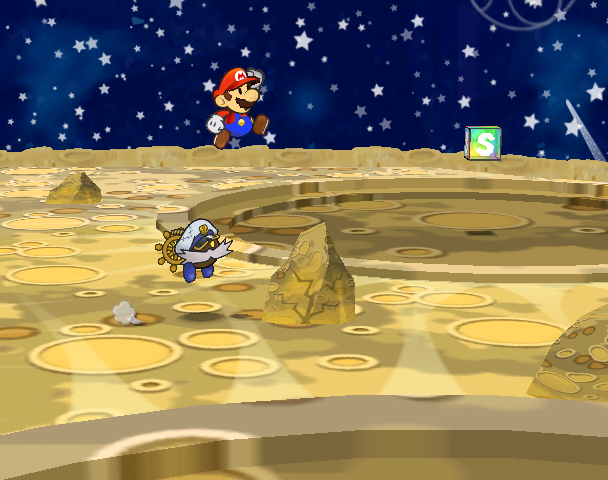
The Moon has low gravity and a pipe hidden under a rock, and beneath it is the X-Naut Fortress: card keys, electrified floors, a quiz, and a garrison of Elite X-Nauts and X-Naut PhDs. In the hangar Lord Crump unveils Magnus von Grapple 2.0, which fires its fists and, when it runs short of ammunition, members of the audience. The wreckage gives up the Crystal Star. Mario has all seven.
But Peach is not there. Every door in the base locks except one, and behind it is TEC, running on emergency power with most of its memory gone. It remembers enough: Grodus has taken the princess to the Palace of Shadow, behind the Thousand-Year Door. TEC opens a transporter to Rogueport and stays at its post as the fortress blows itself up. In the sewers Professor Frankly is waiting, unusually keen for Mario to open the door at once. It is not Frankly.
Meanwhile. In Poshley Sanctum a Paragoomba tells Bowser that Mario has every star and is heading for the door. If he cannot have the stars, Bowser decides, he will have the treasure.
General White, run to ground at last.The great cannon of Fahr Outpost.Magnus von Grapple 2.0 powers up.TEC’s last message.
Chapter 8: The Thousand-Year Door
The seven stars open the door, and behind it is the Palace of Shadow, a quarter of the drowned city that the demon kept for herself. It is a long dungeon of fire bars and spike traps, with a looping corridor borrowed from the last castle of the very first Super Mario Bros. Dark Bones and a squad of Dry Bones bar the way; so does Gloomtail, Hooktail’s elder brother, who has to be beaten for the key to the Riddle Tower; and so do Beldam, Marilyn and Vivian’s replacement, Doopliss, in a three-against-two rematch.
In the throne room Grodus is waiting with Peach. He fights and loses, then takes the princess hostage and orders Mario not to lift a finger, at which point Bowser and Kammy Koopa drop in from above, late as ever and wanting the treasure. While Mario deals with them, Grodus drags Peach down the last staircase.
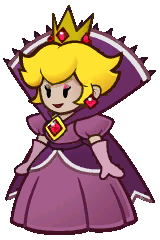
In the crypt below he opens a coffin and wakes the thing inside: the Shadow Queen, who destroyed the old city a thousand years ago. Darkness spreads over the whole world. Grodus expects obedience. He gets a lightning bolt that leaves nothing of him but his head. Beldam steps from the shadows to explain that everything, from the rumour of treasure to the hooded woman with the box, was her doing: her mistress needed the door opened and a pure maiden to wear. The Queen takes Peach’s body.
She offers Mario a place at her side (accept, and the game ends on the spot). Refuse, and the fight begins, and goes well until she drops the disguise and takes her true form, against which nothing works at all. Then the Crystal Stars fly off across the world to the places they came from, to Hooktail Castle, the Great Tree, the Glitz Pit, and everyone Mario has helped is heard cheering him on. The Queen’s shield breaks. Peach, fighting her from the inside, gives Mario the last of her strength, and he and his partners put the demon back in the dark for good.
The first corridor of the Palace of Shadow.Sir Grodus.The Shadow Queen takes Princess Peach.The final battle.
Epilogue and after the credits
Peach wakes unharmed. The real Professor Frankly hurries in to report that there was a treasure after all, in a chest on the way down, and the whole company says its goodbyes at Rogueport’s harbour. The epilogue brings Mario up to date. Goombella is working with Frankly, and says what was in the chest is a secret. Koops plans to run for Petalburg’s mayor. Flurrie is back on stage in a play called “Paper Mario”, with Doopliss in the title role. The Yoshi is battling in the Glitz Pit under the name the Great Gonzales Jr. Vivian has forgiven her sisters and settled in Twilight Town, Bobbery has gone back to sea with Cortez, and Ms. Mowz is still behind the counter of the Lovely Howz of Badges. Lord Crump, the X-Nauts and what is left of Grodus are living quietly in Poshley Heights. TEC, it turns out, survived, and hopes to see the princess again.
In the final scene Peach calls at the Mario Bros.’ house with another treasure map, to Mario’s visible surprise.
The save file carries on after the credits. The last three jobs appear at the Trouble Center, Lady Bow and Bootler from the first game can be found holidaying in Poshley Heights, the final volumes of Luigi’s memoirs go on sale, and the bottom of the Pit of 100 Trials is still waiting.
Peach says goodbye to Mario’s friends.Flurrie’s comeback, with Doopliss as the hero.The X-Nauts in retirement in Poshley Heights.Lady Bow and Bootler on holiday.
Every chapter and place in The Thousand-Year Door
The hub, the eight chapters and the optional dungeon, in the order the story reaches them, with the Crystal Star each chapter awards and the boss who holds it.
RogueportHub · Prologue · Lord Crump, Gus (optional)A port full of thieves, with a plaza, a harbour and an east and west side. Home of Professor Frankly, Merlon, Zess T., the Trouble Center, the Pianta Parlor and the Lovely Howz of Badges.
Rogueport SewersHub · Plane Mode · Boss: BlooperThe ruins of the old city, under the new one. Pipes to Petal Meadows and beyond, Dazzle, Merlee, Merluvlee, Chet Rippo, the Thousand-Year Door itself and the way down to the Pit.
Petal Meadows and PetalburgChapter 1Storybook countryside and a village of Koopas. Koops joins here.
Shhwonk FortressChapter 1 · Sun and Moon Stones · Mini-boss: Gold Fuzzy and the Fuzzy HordeA small ruin with a quiz-setting Thwomp, the 65th Super Fun Quirk Quiz, and the keys to the castle road.
Hooktail CastleChapter 1 · Diamond Star · Paper Mode · Boss: HooktailA dragon’s keep carpeted in Dull Bones, with a spiked ceiling that comes down on the slow.
Boggly WoodsChapter 2 · Mini-boss: the Shadow SirensThe quiet forest around the Great Tree, where the Shadow Sirens lie in wait. Flurrie’s house is here.
The Great TreeChapter 2 · Emerald Star · Super Boots · Boss: Magnus von GrappleThe Punies’ home, occupied by X-Nauts. Mario marches a crowd of Punies through it behind the Puni Orb.
Glitzville and the Glitz PitChapter 3 · Gold Star · Super Hammer · Boss: Macho GrubbaA floating town built around a fight arena, reached by blimp. Twenty ranks, a hot-dog stand and a juice bar.
Twilight Town and Twilight TrailChapter 4 · Tube ModeA village in endless dusk whose people are being turned into pigs, and the dark wood between it and the steeple.
Creepy SteepleChapter 4 · Ruby Star · Bosses: Doopliss, Atomic Boo (optional)A haunted steeple with a swarm of Boos, an optional giant among them, and a parrot that knows too much.
Keelhaul KeyChapter 5 · Mini-boss: three EmbersA jungle island with Keel Mangoes on the trees and a Whacka minding its own business.
Pirate’s GrottoChapter 5 · Sapphire Star · Boat Mode · Bosses: Cortez, Lord CrumpFlooded caves of waves and Bill Blasters, ending at Cortez’s ship, the Black Skull.
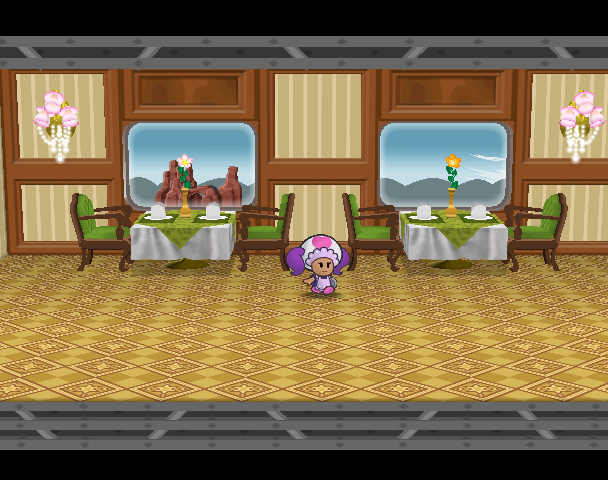
Excess ExpressChapter 6 · Boss: SmorgA three-day sleeper train with a dining car, a ghost in cabin 004 and a mystery on every carriage.
Riverside StationChapter 6 · Ultra BootsA deserted station whose drawbridge mechanism is clogged with Smorgs.
Poshley Heights and Poshley SanctumChapter 6 · Garnet StarThe smartest address in the game, and the museum where the star is hidden behind a decoy.
Fahr OutpostChapter 7A snowed-in Bob-omb village guarding a cannon big enough to reach the Moon.
The MoonChapter 7Low gravity, Moon Clefts and a pipe hidden under a rock.
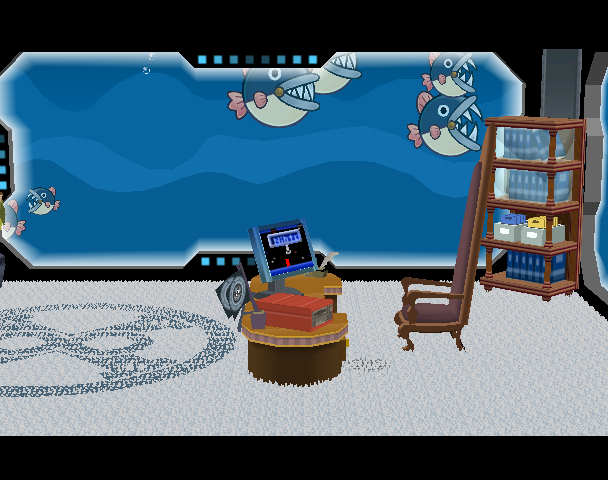
X-Naut FortressChapter 7 · Crystal Star · Boss: Magnus von Grapple 2.0Grodus’s base and Peach’s prison, seen from both sides. A changing room turns the party into 8-bit sprites.
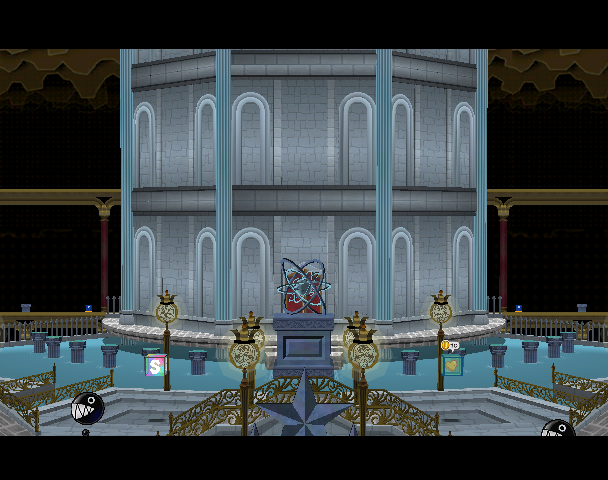
Palace of ShadowChapter 8 · Bosses: Dark Bones, Gloomtail, the Shadow Sirens, Grodus, Bowser and Kammy, the Shadow QueenThe demon’s palace behind the Thousand-Year Door. It contains the Riddle Tower, whose puzzle rooms give up eight Palace Keys.
Pit of 100 TrialsOptional · Return Postage · Boss: BonetailA hundred floors beneath the sewers with no saving. According to the storyteller Grifty, the Shadow Queen built it to dispose of people she disliked.
Mario also sees the inside of the Mario Bros.’ house at each end of the story, and Bowser’s three side-scrolling levels (World 1, 2 and 3) and Peach’s wing of the X-Naut Fortress are visited only in the intermissions.
Advertisement
Gameplay & Controls
On the map it is a gentle platform adventure: Mario runs about towns and dungeons made of card and paper, hammers blocks, jumps on switches and talks to everybody. Enemies are visible, and touching one (or better, hitting it first) pulls back a curtain on a turn-based battle. Some pipes lead into the scenery itself, where the game becomes a flat side-scroller for a room or two.
Nearly everything from the first game returns, usually with a twist, and the page below takes it in order: the battle system, the stage and its audience, the Crystal Star moves, badges, the paper curses, levelling up, and the many ways to waste time in Rogueport.
Action Commands, Guard and Superguard
Mario’s side goes first each turn, Mario and his active partner acting one after the other; Y swaps their order, which also decides who stands in front and takes most of the punishment. Each can attack, use an item, or pick from Tactics: change partner (which costs the turn unless the Quick Change badge is worn), Appeal to the crowd, Defend, Charge or run away. Only Mario can use Special moves.
Every attack has an Action Command, a button press, hold or stick movement that makes the move hit harder and brings in Star Power. Unlike the first game they are available from the very first fight. Landing a blow on an enemy in the field earns a free First Strike before the battle proper; being touched first hands the enemy the same advantage.
Defence is where the game finds its nerve. Pressing A just before an enemy connects is a Guard: one point less damage and protection from status effects, with a generous window of eight frames. Pressing B instead is a Superguard, which wipes out the attack altogether and bounces 1 HP of damage back at anything that touched Mario. The window is three frames, a twentieth of a second, and a miss means taking the hit in full.
Choosing an action against Magnus von Grapple.A successful Guard.A Superguard finishes off the Gold Fuzzy.
Stylish moves, the stage and the audience
Every battle is a performance. The seats in front of the stage fill with Toads, Shy Guys, Hammer Bros. and even off-duty X-Nauts, and the bigger Mario’s reputation the more of them turn up: his star rank climbs from Rising Star to B-List Star at level 10, A-List Star at level 20 and Superstar at level 30, and each rank raises the size of the house. The crowd is the source of Star Power. Good Action Commands please it, an Appeal milks it, and Stylish moves, extra presses of A at just the right instant in the middle of an attack, bring the house down. The game never shows when to press for a Stylish unless the Timing Tutor badge is worn.
The audience answers back. Some spectators throw useful items; others throw rubbish, and can be stopped by pressing X to wade in and clout them first. Some climb on stage to pull down scenery or turn a fighter invisible. Props and backdrops can topple when the boards are shaken, and the stage has its own tricks: fire and frost nozzles, falling objects and a stage light. Several bosses treat the stalls as a buffet. Hooktail eats spectators to win back 10 HP, Cortez and the Shadow Queen feed on them too, and Magnus von Grapple 2.0 loads them into its cannon.
Successful commands also light up icons beside the Star Power gauge. Match two and the next good command sets a Bingo reel spinning for a bonus.
Every kind of audience member, in one unlikely house.Bingo!Hooktail helps herself to the front row.A Shy Guy in the audience: not a good sign.
Star Power and the Crystal Star moves
Mario’s Special moves are paid for from the Star Power gauge, which starts with a single unit from the Magical Map and gains one for each Crystal Star, to a maximum of eight. Each star teaches one move, and each move has an Action Command of its own, the oddest being Art Attack, in which the player draws rings round the enemy with the Control Stick.
The eight are listed with their costs under Special moves, gear and badges below. Two are healers (Sweet Treat and Sweet Feast), two are bombs (Earth Tremor and Supernova, both of which ignore defence), and the rest bend the rules: Clock Out freezes the other side, Power Lift raises attack and defence, and Showstopper removes ordinary enemies with 12 HP or fewer from the stage in one go.
Sweet Treat.Earth Tremor.Art Attack.Supernova.
HP, FP, BP and levelling up
Mario begins with 10 Heart Points, 5 Flower Points (spent on special jump and hammer attacks and on partners’ moves) and 3 Badge Points. Beaten enemies drop Star Points, fewer and fewer as Mario outgrows them, and every hundred is a level and a choice: 5 more HP, 5 more FP or 3 more BP. The ceiling is level 99, against 27 in the first game, with HP and FP capped at 200 and BP at 99, though there are not enough levels to max all three.
Partners do not level with Mario. They are promoted by Merlon in east Rogueport for three Shine Sprites a time, to Super Rank and then (once Mario has shown him the Up Arrow from Hooktail Castle, which jogs his memory about an Ultra Stone) to Ultra Rank, gaining HP and a new move at each step. There are 42 Shine Sprites, enough to take all seven partners to the top. Mario’s own gear improves by treasure chest: Super Boots in the Great Tree and Ultra Boots at Riverside Station add the Spin Jump and Spring Jump, and the Super Hammer from Glitzville and Ultra Hammer from Rogueport break bigger blocks.
A shady character called Chet Rippo, in the sewers once Bobbery has joined, will rearrange Mario’s stats for 39 coins, raising one and lowering another. He is the key to the most famous build in the game, of which more under Cheats.
Level up: HP, FP or BP.Merlon promotes a partner for three Shine Sprites.A Shine Sprite on a roof in east Rogueport.
The paper curses
The game’s best joke on its own art style is that Mario finally notices he is made of paper. Four black chests hold four so-called curses, each bestowed with relish by the voice inside the box. Plane Mode, from the Rogueport Sewers, folds Mario into a paper aeroplane on marked panels to glide over gaps. Paper Mode, from Hooktail Castle, turns him side-on (hold R) to slip between bars and through cracks. Tube Mode, from Twilight Trail, rolls him up to trundle under low walls. Boat Mode, from Pirate’s Grotto, makes him a paper boat at the water’s edge.
They sit alongside each partner’s field ability on the X Button (Koops’s shell, Flurrie’s gale, Bobbery’s fuse) as the keys to the world’s puzzles, and the Pianta Parlor in Rogueport has a minigame for each of them.
A black chest in the Rogueport Sewers.Paper Mode: thin enough for the bars of Hooktail Castle.Tube Mode on Twilight Trail.Boat Mode in Pirate’s Grotto.
Playing as Peach and Bowser
After each of the first seven chapters the game changes hands twice. First comes Princess Peach, a prisoner in the X-Naut Fortress, who wanders its corridors running errands for the base computer, TEC-XX, in exchange for the chance to send Mario an e-mail. Her scenes are gentle adventure-game interludes: a dance, a quiz, a disguise, a potion to mix.
Then comes Bowser, with Kammy Koopa in tow, arriving wherever Mario was a chapter ago and finding the Crystal Star already gone. After Chapters 2, 4 and 6 his scenes turn into short side-scrolling levels in the manner of Super Mario Bros., numbered World 1, 2 and 3, with a 180-second timer and a flagpole. Bowser stomps, breathes fire and eats lumps of meat to grow through four sizes, the largest of which flattens pipes and blocks alike.
Peach meets TEC-XX.Bowser in World 1.Fire breath, as nature intended.
Rogueport’s side shows
Between chapters there is a town to plunder. The Trouble Center in east Rogueport posts thirty requests over the course of the game, to be taken one at a time (cancelling costs 30 coins); the rewards are a surprise until the job is done, and four of them are membership cards for the casino. That is the Pianta Parlor in west Rogueport, where coins are changed for Pianta tokens to spend on prizes and on four minigames, one for each curse, unlocked in turn by the Special, Silver, Gold and Platinum Cards.
Zess T., a Toad cook in the plaza, will turn one ingredient into a dish once Mario has brought her a new Contact Lens, and two ingredients once she has her Cookbook, a job she posts at the Trouble Center after Chapter 4. A hundred Star Pieces are hidden around the world, some under panels that only a Spin Jump will flip and some in the gift of other characters, and Dazzle in the sewers swaps them for badges. Merluvlee sells hints to where they are, Merlee sells spells that trigger at random in battle, Charlieton sells rarities at silly prices, and Lucky runs the Happy Lucky Lottery, about which there is a secret.
Then there is the Glitz Pit. Chapter 3’s wrestling league has twenty ranked teams, a minor league from 20 to 11 and a major league from 10 to 1, and Mario, fighting as the Great Gonzales, has to climb the lot. Every bout comes with a condition from the promoter (appeal to the crowd three times, do not use your hammer, win in five turns) and a win that ignores it pays only a token fee (4 coins in the minor league, 10 in the major) and does not move Mario up the rankings. After the chapter the league stays open for as long as you care to keep fighting.
Inside the Trouble Center.The Pianta Parlor.Zess T. at the stove.The Happy Lucky Lottery.
Controls
Mario and his hammer.
On the map the Control Stick moves Mario, A jumps and talks, B swings the hammer and X uses the partner’s ability. Hold R for Paper Mode, or hold R and rotate the stick for Tube Mode; press Y on a marked panel for Plane or Boat Mode. With the right boots, A twice in the air is a Spin Jump and A with a rotation of the stick is a Spring Jump; the Super Hammer is charged by holding B and rotating the stick. Start opens the menu. In battle A confirms, performs most Action Commands and Guards; B cancels and Superguards; Y swaps the order of Mario and his partner; and X sends Mario after a troublemaker in the audience. Peach only walks and interacts. Bowser jumps with A (twice for a ground pound) and breathes fire with B.
Regional differences
The Japanese game came first and the versions that followed three and four months later are slightly more polished. International copies reportedly heal the party after every chapter except the last (Japan only after Chapter 1), add Stylish moves, sharpen the eyesight of Fuzzies, move a few items and treasure chests, and change what a dozen of Zess T.’s ingredient pairs make. In Japan the Shadow Queen’s attacks cannot be Superguarded at all, and her first form transforms after 39 points of damage and not 61. Enemy statistics are the same everywhere, although the American Tattle Log misreports two of them (Rawk Hawk’s attack and defence and the Red Spike Top’s defence), which the European version put right.
The cosmetic changes are the famous ones. In the Japanese script Vivian is implied to be a transgender woman, although her sister Beldam and the game’s own profile of her call her a boy. The French and Spanish scripts keep this and the Italian is the most explicit (she says she is proud to have become a woman); the English and German scripts refer to her as female throughout and drop the subject entirely. The Pianta Parlor hostesses Peeka and Lahla have bunny ears in Japan and cat ears elsewhere. TEC-XX’s camera eye was changed from red to blue, which makes him look a little less like HAL 9000. A Toad-shaped chalk outline and bloodstains were scrubbed from a house in Rogueport, the Vintage Red that Bobbery asks for became a purple Chuckola Cola, and flashing lights were toned down in two cutscenes. Hooktail’s secret weakness is the sound of frogs in Japanese and crickets in English.
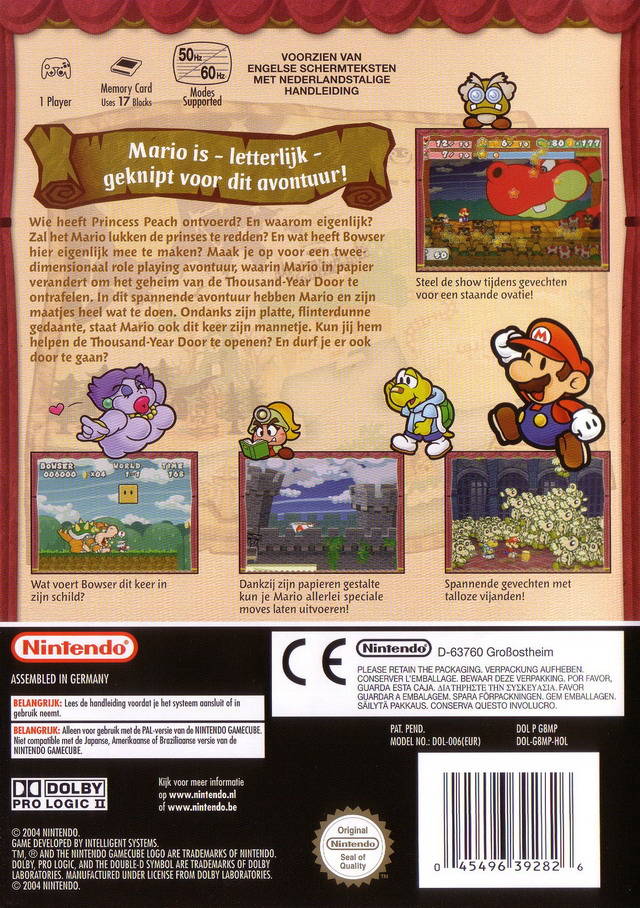
European discs add a 50Hz mode and French, German, Spanish and Italian text chosen by the console’s language setting; progressive scan is on the NTSC discs only.
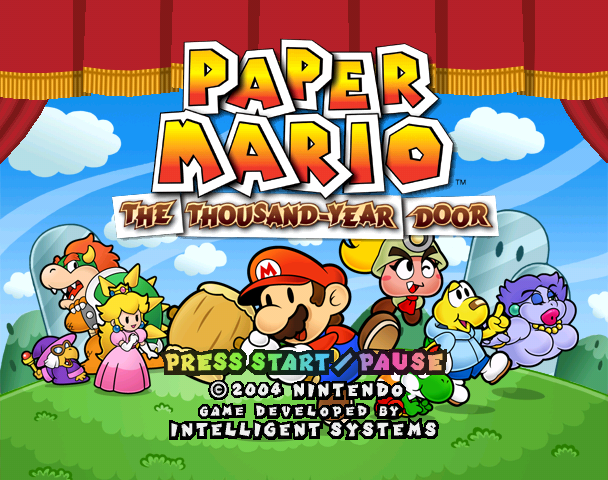
The Japanese design, with bunny ears.The same hostess in the localised versions, with cat ears.The crime scene in Rogueport.The Japanese title screen: Paper Mario RPG.
Special moves, gear and badges
The eight Crystal Star moves, Mario’s boots, hammers and curses, and a selection of three dozen of the 85 kinds of badge: the ones players ask about most. Badges marked P have a twin that does the same job for the partner.
Sweet Treat (Magical Map)1 SP. Restores up to 7 HP to Mario and his partner and 8 FP, and cures most ailments.
Earth Tremor (Diamond Star)2 SP. An earthquake that ignores defence. A perfect command does 6 damage to every enemy, wherever it is.
Clock Out (Emerald Star)2 SP. Immobilises every enemy for a few turns if it works.
Power Lift (Gold Star)3 SP. Raises attack and defence for Mario and his partner for a few turns.
Art Attack (Ruby Star)4 SP. Circle enemies with the Control Stick; every loop is damage that ignores defence.
Sweet Feast (Sapphire Star)5 SP. Restores up to 24 HP and 24 FP to both party members.
Showstopper (Garnet Star)2 SP. Instantly defeats every ordinary enemy with 12 HP or fewer. No use on bosses.
Supernova (Crystal Star)6 SP. Up to 15 damage to everything on stage, ignoring defence.
Super BootsThe Great Tree, Chapter 2. Adds the Spin Jump, which breaks through weak floors and presses big switches.
Ultra BootsRiverside Station, Chapter 6. Adds the Spring Jump for reaching pipes and bars overhead.
Super HammerGlitzville, Chapter 3. Smashes big yellow blocks; in battle it knocks one enemy into the next.
Ultra HammerRogueport, once Mario has the Ultra Boots. Breaks stone blocks.
Power Rush (P)1 BP. +2 attack while Mario is in Danger (5 HP or fewer). 50 coins at the Lovely Howz of Badges, or 34 Pianta tokens.
Mega Rush (P)1 BP. +5 attack in Peril, at exactly 1 HP. Sold by Charlieton.
Close Call (P)1 BP. Enemies sometimes miss when Mario is in Danger.
Last Stand (P)1 BP. Halves damage taken in Danger. One is in the Glitz Pit hallway.
Power Plus (P)6 BP. +1 attack, always. Creepy Steeple, or 15 Star Pieces from Dazzle.
Defend Plus (P)5 BP. +1 defence, always.
Quick Change7 BP. Swap partners without losing the turn. 8 Star Pieces from Dazzle.
Power Bounce3 BP. Keep jumping on one enemy until a command is missed. Hooktail Castle.
Multibounce1 BP. Jump on every enemy in turn. Shhwonk Fortress.
Power Smash1 BP. A heavier hammer blow for 2 FP. A present from Professor Frankly.
Quake Hammer2 BP. Hits everything on the ground and the ceiling. Boggly Woods.
Fire Drive3 BP. A rolling fireball that burns every enemy on the ground. Floor 20 of the Pit.
Spike Shield3 BP. Lets Mario jump on spiked enemies. Rogueport Sewers.
Ice Power1 BP. Lets Mario jump on fiery enemies and hits them harder. Keelhaul Key.
Zap Tap3 BP. Electrifies Mario, hurting anything that touches him. Floor 30 of the Pit.
Flower Saver (P)4 BP. Every move costs 1 FP less.
Happy Heart (P)2 BP. Slowly restores HP during battle. Petal Meadows.
HP Plus (P)3 BP. +5 maximum HP. Hooktail Castle and elsewhere.
FP Plus3 BP. +5 maximum FP.
Double Dip (P)3 BP. Use two items in a turn for 4 FP. Wear both copies for Triple Dip.
Charge (P)1 BP. Spend a turn to add 2 to the next attack. The Great Tree.
Jumpman2 BP. +1 to jumps, but no hammer. Named after what Mario was called in Donkey Kong.
Hammerman2 BP. +1 to the hammer, but no jumping.
Timing Tutor1 BP. Shows when to press A for Stylish moves. Sold by Charlieton.
Peekaboo2 BP. Shows every enemy’s HP without a Tattle. 7 Star Pieces.
Simplifier and Unsimplifier1 BP each. Easier Action Commands for less Star Power, or harder ones for more.
Feeling Fine (P)4 BP. Blocks most status ailments. X-Naut Fortress.
Lucky Day7 BP. Enemies miss more often. Floor 90 of the Pit.
Lucky Start4 BP. A random boost at the start of each battle. The prize for beating the Atomic Boo.
Money Money5 BP. Doubles the coins won in battle. Pianta Parlor.
Bump Attack5 BP. Walk into weak enemies to beat them without a fight. Floor 80 of the Pit.
Return Postage7 BP. Anything that touches Mario takes half the damage it dealt. Bonetail’s treasure, floor 100.
L Emblem0 BP. Dresses Mario in Luigi’s colours. Poshley Sanctum.
W Emblem0 BP. Wario’s colours; worn with the L Emblem it gives Waluigi’s. Sold by Charlieton.
Attack FX R0 BP. Makes Mario’s attacks chirp like a cricket, which Hooktail cannot bear. Hooktail Castle.
Double Pain and Slow Go0 BP. Handicaps for show-offs: double damage taken, and a Mario who cannot run. Sold by Charlieton.
Cartoons, Comics & Other Media
The Thousand-Year Door was sold with paper aeroplanes and a thousand real doors, and it has been quoted by Mario games ever since.
The letter commercialNintendo of America · television, 2004The American television advert follows a letter across a string of landscapes as it refolds itself into an aeroplane and a boat, and finally drops into a letterbox marked with Mario’s M, to Hans Zimmer’s “You’re So Cool” from the film True Romance. It is embedded further down this page. In June 2008 the film’s producer, Morgan Creek, sued Nintendo over the music, and dropped the case six days later when it emerged that the advertising agency, Leo Burnett, had licensed the song.
The giant Mario advertsNintendo · Japan and France, 2004The Japanese commercials each showed an enormous Mario demonstrating one of the black-chest abilities before cutting to the game. The same films were shown in France.
Fold your own MarioPrint advertising · North America and MexicoThe magazine advert ran across two pages, and the facing page could be cut out and folded into a Mario paper aeroplane.
A thousand doorsNintendo of America · November 2004To mark the launch, Nintendo of America gave 1,000 doors to Habitat for Humanity’s affiliates in Florida. The first was fitted in Pensacola, with someone in a Mario costume on hand to help carry it.
Official Nintendo Power Player’s GuideNintendo Power · 2004Nintendo’s own strategy guide. Its text has a joke the game does not: the X-Nauts, it says, have underestimated a man with long experience of “a certain ape”.
Interactive Multi-Game Demo Disc Version 18Nintendo GameCube · 2004A fifteen-minute demo on a GameCube promotional disc, built before the English script was finished. X-Nauts are “Boomer Gangers”, Glitzville still has its Japanese name of Oolong Town, Rogueport is spelt “Roqueport”, and Goombella, asked for a Tattle, apologises that she is waiting for the final version.
Super Mario-kunYukio Sawada · ShogakukanThe Shadow Queen also turns up in Yukio Sawada’s long-running gag manga.
Super Paper MarioNintendo Wii · 2007The sequel is full of souvenirs. All seven partners are Catch Cards, won in the Duel of 100. The collector Francis owns plush toys of Vivian, Bobbery, Pennington and Yoshi in every colour, wants a Ms. Mowz doll “with real-smooching action” and a Magnus von Grapple figure, and watches Starship X-Naut. The robot dragons Fracktail and Wracktail are tributes to Hooktail and Bonetail.
Super Smash Bros.Brawl (2008), for Nintendo 3DS (2014), Ultimate (2018)Brawl has a Goombella trophy and stickers of Goombella, Yoshi, Vivian and Rawk Hawk. The Paper Mario stage in the 3DS game sails on the S.S. Flavion with the prologue’s Blooper looming behind, to an arrangement of the Rogueport theme. In Ultimate, Vivian and the Shadow Queen are spirits.
Later Paper Mario games2012–2020A rubbish heap in Sticker Star contains a paper by Goombella on the Chomp Ruins. In The Origami King a Bob-omb at a ship’s wheel confides that he dreams of being an admiral, and a photograph shows Peach as she looked in this game.
Elsewhere in the Mushroom KingdomSuper Mario 3D World · Mario & Luigi: Paper JamThe Fuzzy Horde, which first swarmed in Shhwonk Fortress, chases Mario through two levels of Super Mario 3D World. In Mario & Luigi: Paper Jam, Paper Mario brings his Plane and Paper Modes, rolls into a tube and does a Spring Jump.
The Super Mario Galaxy MovieFilm · 2026Two books in Rosalina’s library look familiar: one with the ringed star from the cover of this game’s opening storybook, and one with a star pattern like those on the walls of the Palace of Shadow.
Characters
Hardly anyone in The Thousand-Year Door is a stock Mario character. The partners, the villains and most of the townsfolk were invented for this game, and nearly all of them want something. The party comes first, then the villains, then the people Mario meets along the way.
Character
Who they are
In this game
Abilities & notes
MarioThe Great Gonzales
The hero, as silent as ever, summoned to Rogueport by a letter and a map.
Collects the seven Crystal Stars, picks up four paper “curses” and, in Chapter 4, loses his name and body to a ghost. Competes in the Glitz Pit under the name the Great Gonzales.
Starts with 10 HP, 5 FP, 3 BP
Level cap 99; up to 8 units of Star Power
Voiced by Charles Martinet
GoombellaPartner 1 · Rogueport, prologue
A bright Goomba student from the University of Goom who is hunting the same treasure as Mario. Kurisuchīnu (Christine) in Japan.
Joins after Mario rescues her from Lord Crump. Press X and she will Tattle on any person, place or enemy; in battle her Tattle reveals an enemy’s HP and fills in the Tattle Log.
HP 10 / 20 / 30
Headbonk (0 FP), Tattle (0)
Super Rank: Multibonk (3)
Ultra Rank: Rally Wink (4), which gives Mario a second action
KoopsPartner 2 · Petalburg, Chapter 1
A timid Koopa Troopa determined to prove he is no coward by facing the dragon that took his father. Nokotarō in Japan.
His shell can be kicked out to hit switches and fetch items, or held in place and released while Mario stands somewhere else. The only partner with a point of defence.
HP 10 / 15 / 25, Defence 1
Shell Toss (0), Power Shell (3)
Super: Shell Shield (4)
Ultra: Shell Slam (6), which ignores defence
Madame FlurriePartner 3 · Boggly Woods, Chapter 2
A wind spirit and actress who has left the stage for a house in the woods. Her Japanese name is Kurauda.
Joins when Mario returns her lost necklace. Her breath blows away the loose paper that hides secret passages and leaves enemies dizzy.
HP 15 / 25 / 35
Body Slam (0), Gale Force (4), which blows enemies clean out of the battle
Super: Lip Lock (3), which drains HP
Ultra: Dodgy Fog (4)
YoshiPartner 4 · Glitzville, Chapter 3
A new-born Yoshi, hatched from an egg rescued in Glitzville. The player names him. The remake calls him Yoshi Kid.
Mario rides him: he runs faster than Mario walks and can flutter across gaps. His colour depends on how long the egg was carried before it hatched.
HP 10 / 20 / 30
Ground Pound (0), Gulp (4), which ignores defence
Super: Mini-Egg (3)
Ultra: Stampede (6)
VivianPartner 5 · Twilight Town, Chapter 4
The youngest of the three Shadow Sirens, bullied by her eldest sister Beldam. She changes sides after helping a stranger who turns out to be Mario.
Pulls Mario down into the shadows, where enemies and hazards pass harmlessly overhead. Her fire burns.
HP 15 / 20 / 30
Shade Fist (0), Veil (1), which hides both for a turn
Super: Fiery Jinx (6), fire on every enemy, ignoring defence
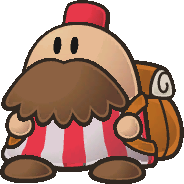
A retired Bob-omb admiral who still mourns his late wife. Bareru in Japan.
Joins on Keelhaul Key after his last request for Chuckola Cola turns out to be a nap. He can be set down or thrown to blow open cracked walls and trip distant switches.
HP 20 / 30 / 40
Bomb (0), Bomb Squad (3)
Super: Hold Fast (4)
Ultra: Bob-ombast (9)
Ms. MowzPartner 7 · optional
A Squeek, a cat burglar and a badge collector who runs the Lovely Howz of Badges in Rogueport. Chuchurīna in Japan.
Crosses Mario’s path in Hooktail Castle and joins only if he completes her anonymous Trouble Center request after Chapter 4. Sniffs out hidden items, and is the first Paper Mario partner the story can be finished without.
HP 15 / 20 / 25
Love Slap (0), which ignores defence; Kiss Thief (2), which steals items and badges
Super: Tease (3)
Ultra: Smooch (10), which heals Mario
Princess PeachPrisoner of the X-Nauts
The only person in Rogueport pure-hearted enough to open the box with the map in it, which is exactly why it was offered to her.
Playable after each of the first seven chapters. Held on the Moon, she teaches a computer about love, disguises herself as an X-Naut, turns invisible and e-mails everything she learns to Mario. In the finale she is possessed by the Shadow Queen.
Sings the Super Mario Bros. themes in the shower
Voiced by Jen Taylor
TEC-XXThe X-Nauts’ computer
The machine that runs the X-Naut Fortress. A malfunction while watching Peach on its cameras leaves it in love, a concept it does not understand.
Trades e-mail access for lessons in feeling, turns against Grodus, has its memory wiped, and uses its last power to send Mario after the princess. The epilogue reveals that it survived.
Camera eye is red in Japan, blue elsewhere
Its messages reach Mario through the Mailbox SP
Bowser and Kammy KoopaThird in a two-horse race
The Koopa King and his elderly Magikoopa adviser. For once he has kidnapped nobody, and he is furious about it.
Playable in the intermissions, always one town behind Mario. Bowser gatecrashes the Glitz Pit in Chapter 3 and the pair fall into the Palace of Shadow in Chapter 8, just in time to be beaten again.
Bowser: 30 HP in the Glitz Pit, 70 HP in the palace
Kammy Koopa: 50 HP
Bowser voiced by Scott Burns
Professor FranklyThe man who reads the map
An elderly scholar who lives in Rogueport and knows the legends of the Thousand-Year Door. Kolorado, the explorer of the first game, was once his student.
Explains the Crystal Stars and the door, interprets the Magical Map after every chapter, and pieces together who the Shadow Queen was. Doopliss impersonates him at the end of Chapter 7.
Gives Mario the Power Smash badge
The rubbish bin by his house refills missed Tattle Log entries
LuigiHero of the Waffle Kingdom
Mario’s brother, who stays behind at the start and then has an epic of his own that nobody sees.
Summoned by Minister Crepe to rescue Princess Eclair from the Chestnut King, he hunts the seven pieces of the Marvelous Compass and returns to Rogueport after each chapter with a new companion and a long story. The companions tell it rather differently.
Partners: Blooey, Jerry, Torque, Hayzee, Screamy
Five Super Luigi books at the Toad Bros. Bazaar
Sir GrodusLeader of the X-Nauts
The ruler of the X-Nauts, who directs the hunt for the stars from a fortress on the Moon. Batsugarufu in Japan.
Has Peach kidnapped, means to wake the Shadow Queen and rule the world through her, and is reduced to a talking head by the first thing she does. Last seen retired to Poshley Heights.
50 HP, attack 7, defence 1
Protected by Grodus Xs (3 HP each)
Inflicts Burn and Immobilized; uses Payback
Lord CrumpX-Naut general
Grodus’s loud, clumsy field commander and the villain Mario meets most often. Pekedā in Japan.
Fought on the dock in the prologue, in two Magnus von Grapple robots, and aboard his warship off Keelhaul Key, which he reaches by joining Flavio’s crew as “Four-Eyes”.
5 HP in the prologue, 30 HP in Chapter 5
Magnus von Grapple: 30 HP; version 2.0: 70 HP
Beldam and MarilynThe Shadow Sirens
Three shadow-dwelling sisters who serve Grodus, or appear to. Beldam, the eldest, gives the orders; Marilyn follows them; Vivian takes the blame.
Ambush Mario in Boggly Woods, lose the Superbombomb in Twilight Town, steal the wrong star in Poshley Sanctum and, with Doopliss in Vivian’s place, make a last stand in the palace. Beldam is revealed as the Shadow Queen’s servant and the author of the whole plot.
Chapter 2: Beldam 9 HP, Marilyn 12 HP, Vivian 10 HP
Chapter 8: Beldam 30 HP, Marilyn 40 HP
Beldam freezes and shrinks; Marilyn powers up and casts lightning
DooplissThe Creepy Steeple’s ghost
A shape-shifting ghost whose bell turns Twilight Town’s people into pigs. In Japan he is Ranperu, and the letter missing from his name is “n”.
Steals Mario’s identity in Chapter 4, impersonates Zip Toad on the Excess Express and Professor Frankly in the sewers, and replaces Vivian in the Shadow Sirens. Ends the game on stage, playing Mario.
40 HP, attack 4 in Chapter 4
40 HP, attack 6 in Chapter 8
The Shadow QueenWhat is behind the door
The demon who sank the old city a thousand years ago, made the Crystal Stars and built the Pit of 100 Trials for her enemies. A Toad, a Goomba, a Koopa and a Boo, four heroes in all, turned the stars against her and sealed her in a coffin. Kage no Joō, “Queen of Shadows”, in Japan.
Woken by Grodus, she possesses Peach and is the final boss. Her dragons were Hooktail, Gloomtail and Bonetail.
150 HP, attack 7, defence 1
Hands that drain HP; lightning; Poison, Confused and Allergic
Feeds on the audience
Rawk HawkChampion of the Glitz Pit
The Pit’s swaggering title-holder, billed on GameCube as the Feral Nuclear Reactor. Gold Hawk in Japan.
Trash-talks Mario in the corridors, has him locked up before the title match, and loses a belt whose star was only ever glass. Bowser later sits on him.
40 HP, attack 4, defence 0
The American Tattle Log wrongly gives attack 3, defence 1
Grubba and JolenePromoter and assistant
The folksy promoter of the Glitz Pit, and his assistant.
Grubba is draining his fighters with the Gold Star and becomes the boss Macho Grubba. Jolene is the mysterious “X” who e-mails Mario, sister of the missing champion Prince Mush, and takes over the Pit afterwards.
Macho Grubba: 60 HP, attack 4
Raises his own attack, defence and speed
CortezPirate king of Keelhaul Key
The ghost of a pirate, guarding his hoard aboard the Black Skull in Pirate’s Grotto.
Boss of Chapter 5, then an unexpected ally: he lends his ship against the X-Nauts and ferries Mario home. Bobbery ends the game sailing with him.
20 HP, three times over; attack 4, defence 1
Feeds on the audience; his hook poisons
FlavioOwner of the S.S. Flavion
A boastful, treasure-minded adventurer first met at a bar in Rogueport.
Organises the voyage to Keelhaul Key and owns the Skull Gem that opens Pirate’s Grotto. A glitch can make him a permanent member of the party.
Travels with Mario for part of Chapter 5
Only eats tropical food
PenningtonPenguin with the Improbably Large Brain
A penguin detective travelling on the Excess Express.
Investigates the thefts of Chapter 6 alongside Mario, then turns out to be the keeper of the Garnet Star at Poshley Sanctum.
Successor to Herringway, the penguin of the first game’s mystery
Don PiantaBoss of west Rogueport
A Pianta whose office is reached by giving a password at the item shop. Francesca and Frankie, whose romance troubles him, are named after Romeo and Juliet in the Italian version.
Supplies the blimp ticket for Chapter 3 and, on retiring, the train ticket for Chapter 6.
Piantas come from Super Mario Sunshine
Bosses & enemies
Every boss and mini-boss in story order, with HP, attack and defence from the Tattle Log, followed by a selection of the 98 ordinary enemies: the ones that define each chapter and the monsters of the Pit.
Lord Crump (boss)Prologue · Rogueport · 5 HPThe tutorial fight, which VGFacts says cannot be lost.
Gus (boss)Prologue · Rogueport · optional · 20 HP, ATK 3A Craw in Rogueport. Fighting him is optional.
Blooper (boss)Prologue · Rogueport Sewers · 12 HPGuards the pipe to Petal Meadows.
Gold Fuzzy and the Fuzzy Horde (boss)Chapter 1 · Shhwonk Fortress · 10 HP and 20 HPA golden Fuzzy that calls in a seething mass of its friends.
Red Bones (boss)Chapter 1 · Hooktail Castle · 5 HP, ATK 3A red skeleton Koopa backed by four Dull Bones.
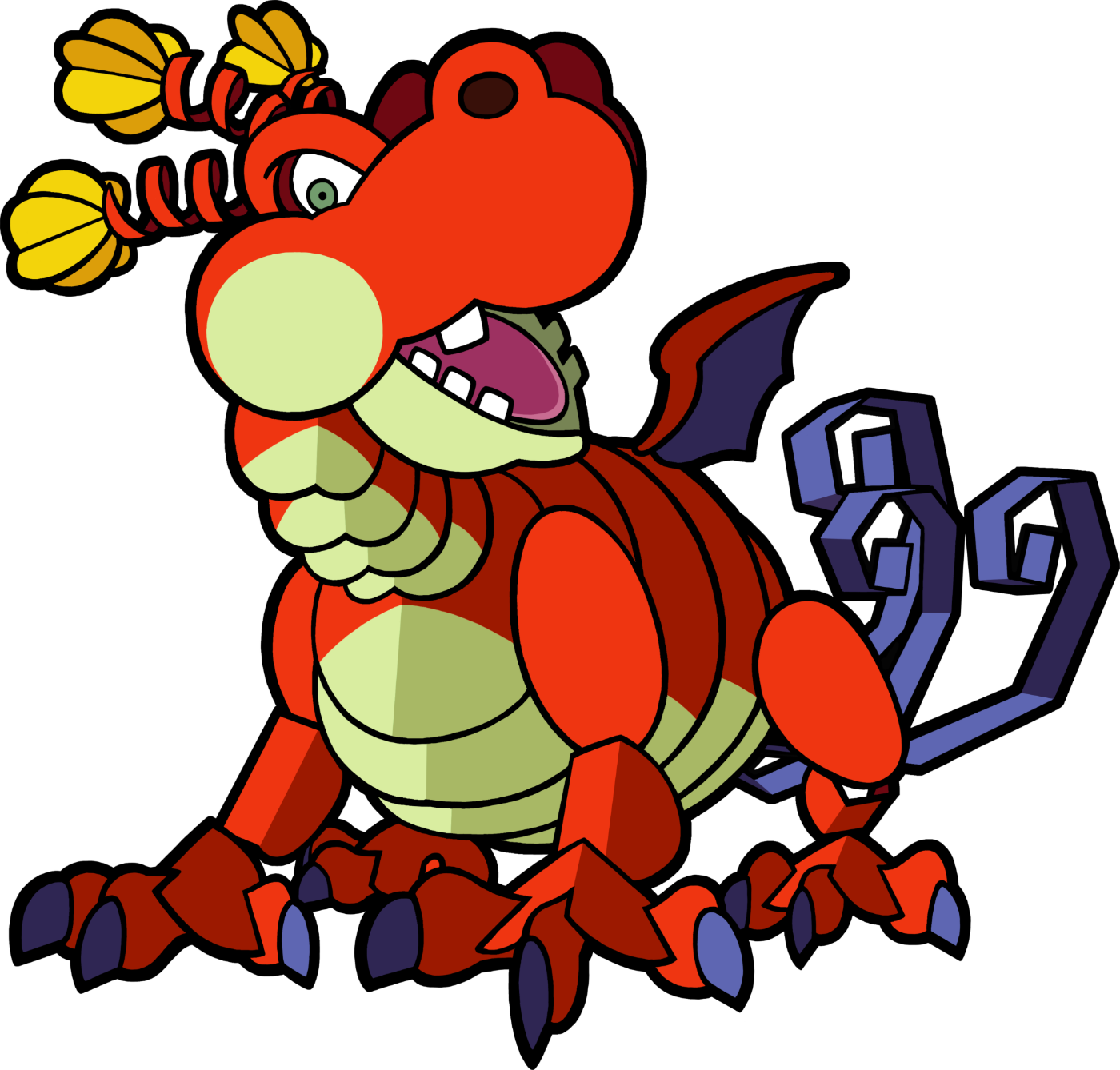
Hooktail (boss)Chapter 1 · Hooktail Castle · 20 HP, ATK 5, DEF 1The dragon. Hates the sound of crickets, eats the audience for 10 HP.
The Shadow Sirens (boss)Chapter 2 · Boggly Woods · 9, 12 and 10 HPBeldam, Marilyn and Vivian, fought for Flurrie’s necklace.
Magnus von Grapple (boss)Chapter 2 · The Great Tree · 30 HP, ATK 2, DEF 1Lord Crump’s robot, with a mighty stomp.
The Iron Adonis Twins (boss)Chapter 3 · Glitz Pit, rank 10 · 6 HP eachTwo Iron Clefts that nothing can scratch, except each other, courtesy of Yoshi’s Gulp.
Bowser (boss)Chapter 3 · Glitz Pit · 30 HP, ATK 3, DEF 1Climbs into the ring uninvited after the rank 5 bout.
Doopliss (boss)Chapter 4 · Creepy Steeple · 40 HP, ATK 4, twiceFirst as himself, then wearing Mario’s face.
Three Embers (boss)Chapter 5 · Keelhaul Key · 8 HP eachCortez’s ghostly flames, which Bobbery holds off alone.
Cortez (boss)Chapter 5 · Pirate’s Grotto · 20 HP × 3, ATK 4, DEF 1Three forms, a poisoned hook and a taste for spectators.
Lord Crump and the X-Nauts (boss)Chapter 5 · the X-Naut ship · 30 HPCrump fights behind stacks and hordes of his own men.
Smorg (boss)Chapter 6 · Excess Express · 50 HP, ATK 5, DEF 1A swarm of Smorgs in the shape of one monster.
Magnus von Grapple 2.0 (boss)Chapter 7 · X-Naut Fortress · 70 HP, ATK 6, DEF 2The upgrade. Uses the audience as ammunition.
Dark Bones (boss)Chapter 8 · Palace of Shadow · 20 HP, ATK 5, DEF 2A dark skeleton Koopa with four Dry Bones in attendance.
Gloomtail (boss)Chapter 8 · Palace of Shadow · 80 HP, ATK 8, DEF 2Hooktail’s elder brother. Poison breath; drops the key to the Riddle Tower.
Beldam, Marilyn and Doopliss (boss)Chapter 8 · Palace of Shadow · 30, 40 and 40 HPThe Sirens’ rematch, with a new third member.
Sir Grodus (boss)Chapter 8 · Palace of Shadow · 50 HP, ATK 7, DEF 1Surrounds himself with Grodus Xs, pictured, which have 3 HP each.
Bowser and Kammy Koopa (boss)Chapter 8 · Palace of Shadow · 70 HP and 50 HPStraight after Grodus. Bowser poisons; Kammy casts every boost she knows.
The Shadow Queen (boss)Chapter 8 · Palace of Shadow · 150 HP, ATK 7, DEF 1The final boss, first in Peach’s body and then in her own.
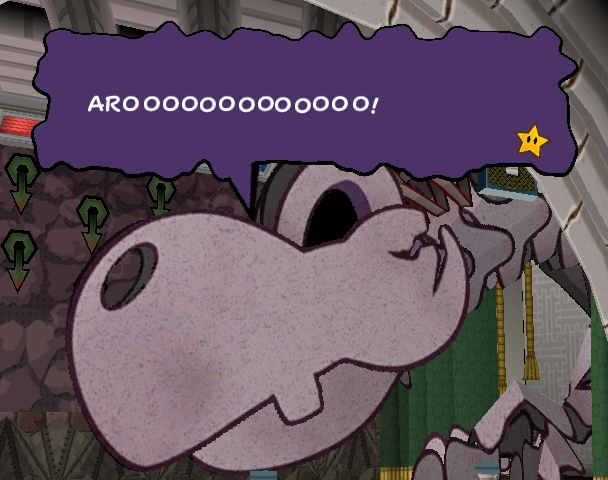
Bonetail (boss)Pit of 100 Trials, floor 100 · 200 HP, ATK 8, DEF 2The third dragon, long dead and still fighting. Freezes, shrinks and sends the party to sleep.
GoombaSewers, Petal Meadows · 2 HPWith Paragoombas and Spiky Goombas, the first things Mario fights.
Koopa TroopaPetal Meadows · 4 HP, DEF 1The rank and file of Petal Meadows and Hooktail Castle.
CleftPetal Meadows, Boggly Woods · 2 HP, DEF 2A spiked rock. Bald Clefts, Hyper Clefts and Moon Clefts are its cousins.
BristlePetal Meadows · 2 HP, DEF 4A spiked stone with four points of defence.
FuzzyShhwonk Fortress · 3 HPShort-sighted in Japan; international versions gave it better eyes.
Dull BonesHooktail Castle · 1 HP, DEF 1Skeleton Koopas. Called “Koopa Skeletons” in the demo.
SpiniaRogueport Sewers · 3 HPThe first of a family: Spania and the fearsome Spunia (12 HP, attack 7) follow.
Pale PiranhaBoggly Woods · 4 HPThe Piranha Plant of Boggly Woods; the demo simply called it a Piranha Plant.
Dark PuffBoggly Woods · 3 HPA storm cloud that electrifies itself.
X-NautThe Great Tree, X-Naut Fortress · 4 HP, ATK 3Grodus’s foot soldiers. Elite X-Nauts and PhDs staff the fortress.
YuxThe Great Tree, X-Naut Fortress · 3 HPA security drone that hides behind Mini-Yuxes. Z-Yux and X-Yux are the later models.
PiderThe Great Tree · 5 HPA spider. Arantula is the Pit version.
KP KoopaGlitz Pit · 4 HPKing K’s team in the minor league.
BanditGlitz Pit · 5 HPSteals coins and runs. Only Ms. Mowz can steal them back.
PokeyGlitz Pit · 4 HP, ATK 3Throws parts of itself, which a Superguard will send straight back.
Dark WizzerdPalace of Shadow · 10 HP, ATK 5, DEF 2A sorcerer that makes itself huge. Wizzerds and Elite Wizzerds live in the Pit.
GloombaPit of 100 Trials, floors 1–9 · 7 HPThe Pit’s Goomba, with winged and spiked versions further down.
Badge BanditPit, floors 51–59 · 12 HPSteals a badge. Beat it before it flees and it drops what it took.
ArantulaPit, floors 81–89 · 16 HP, ATK 7The Pit’s answer to the Pider.
Piranha PlantPit, floors 81–89 · 15 HP, ATK 9Attack 9, the highest of any ordinary enemy bar the Amazy Dayzee.
Elite WizzerdPit, floors 91–99 · 12 HP, ATK 8, DEF 5Boosts its own attack and defence and electrifies itself.
SwampirePit, floors 91–99 · 20 HPThe last of the bats. Sometimes drops Lucky Day.
Bob-ulkPit, floors 91–99 · 10 HPAn even bulkier Bulky Bob-omb.
Key staff
From the game’s credits, as listed by Wikipedia.
Ryota KawadeChief directorAlso chief director of the Nintendo 64 Paper Mario, and director of Super Paper Mario after this.
Shigeru Miyamoto, Ryoichi KitanishiProducersThe two producers credited.
Satoru IwataExecutive producerNintendo’s president at the time.
Hironobu SuzukiScript directorHead writer.
Misao FukudaScriptCo-writer.
Chie KawabeArt directorLed a team with separate character, map, 2-D and “paper effect” designers.
Kaoru Kita, Toshiyuki NagaharaAssistant directorsTwo of the three assistant directors credited.
Tadao NakayamaProgrammerCredited for main programming; Wikipedia’s infobox lists him as the programmer.
Yoshito Hirano, Yuka TsujiyokoMusicThe two composers credited.
Koji KondoMario series theme musicCredited for the classic themes the score quotes.
Charles MartinetVoice of MarioMario’s exclamations; nobody in the game speaks a line aloud.
Jen Taylor, Scott BurnsVoices of Peach and BowserCredited alongside Martinet.
Advertisement
How It Was Made
What follows is drawn from the credits, from the news reports of 2003 and 2004, and from what has been found on the disc itself.
The same studio, the same director
Promotional artwork of Mario and his partners.
The Thousand-Year Door was developed by Intelligent Systems, the studio behind the first game and Fire Emblem, with Ryota Kawade as chief director, the post he had held on the Nintendo 64 game. Shigeru Miyamoto and Ryoichi Kitanishi produced, Satoru Iwata was executive producer, Hironobu Suzuki directed the script, Chie Kawabe directed the art, and the music was by Yoshito Hirano and Yuka Tsujiyoko.
It is a true sequel. In structure the two games are close to mirror images, and the list of echoes is long: a Goomba know-all and a Koopa as the first two partners, a fortress on a green plain in Chapter 1, a tropical island and a multi-form boss in Chapter 5, a penguin detective, a snowy seventh chapter, a princess who dresses as one of her captors and is helped by an admirer. What changed was scale (the level cap went from 27 to 99) and staging: partners with their own HP, the audience, the Superguard and the paper transformations are all new.
From Paper Mario 2 to The Thousand-Year Door
The Paper Mario 2 logo, as shown before E3 2004.
A GameCube Paper Mario was public knowledge by August 2003, when IGN reported on it. It was then called Paper Mario 2 in the West and Mario Story 2 in Japan, after the first game’s Japanese title, and its logo was modelled on the original’s. At the end of March 2004 it was confirmed as a direct sequel; RPGFan published the first 27 screenshots two days later, along with word that Mario could now fold himself into a paper aeroplane and that North America would get the game in the last quarter of the year.
It was playable at E3 in May 2004, where the demo offered Hooktail Castle and one of Bowser’s side-scrolling levels (dialogue files on the finished disc still carry “for E3” labels). The first trailer shows a slightly different game: item shops marked with a Mushroom sign where the final game has a Fire Flower, a snail as the icon for the Slow status, an HP Plus badge on a ledge by the Thousand-Year Door that no longer exists, and the jump and partner-swap sounds of the Nintendo 64 game.
Japan got it first, on 22 July 2004, as Paper Mario RPG, and it was the country’s best-selling game that week. The English title, The Thousand-Year Door, was already in use by E3 (IGN’s preview of 14 May 2004 carries it); the North American release followed on 11 October.
Left on the disc
Goombario, redrawn for a game he is not in.
The game’s files are a small museum. Six partners from the first Paper Mario who do not appear in this one have sprites all the same: Goombario, Kooper, Bombette, Watt, Sushie and Lakilester were drawn in the new style and never used. There are early designs for Vivian and Bobbery, a Bonetail head that still has eyes, an early Shadow Queen, a “Dark” Atomic Boo in three poses, red Buzzy Beetles, an unfinished robot enemy, and a Luigi for the audience with the Poltergust 3000 from Luigi’s Mansion on his back.
Some of it shows roads not taken. Seventy battle conditions were written for the Glitz Pit and fifteen are used. Every partner has a line for being promoted there, though only Yoshi ever says his, and all five then available have a goodbye for the Chapter 4 scene that only Vivian plays. There is a set of unused badges, among them Super Charge and “Mega” versions of the jump, hammer and quake attacks, an attack-lowering status with its own message, and dialogue for a version of the ending in which Mario starts the post-game alone.
A debug mode survives in every version: press X, B, R, B, Y, L on the title screen, then hold Z to see the date the build was made.
From Gorotsuki Town to Rogueport
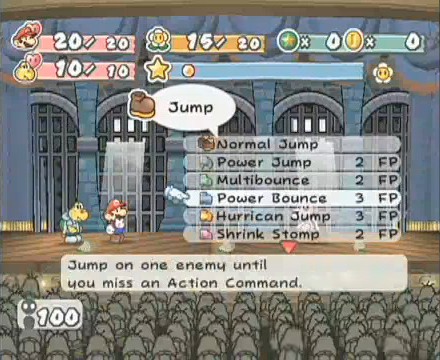
A pre-release battle in Hooktail Castle, with “Hurrican Jump” on the menu.
The English script is a re-imagining as much as a translation, and the names show it. Rogueport is Gorotsuki Town (“Rogue Town”) in Japanese, Petalburg is Hanahana Village, Twilight Town is Usugura (“Dim”) Village, Keelhaul Key is Tropico Island, the Excess Express is the Rich Rich Express, and Glitzville is Oolong Town. The Crystal Stars are Star Stones and the X-Nauts are the Megabatten. Goombella is Christine, Koops is Nokotarō, Doopliss is Ranperu, Hooktail and Bonetail are Gonbaba and Zonbaba, and Rawk Hawk is Gold Hawk. Goombella’s university was “Kuriforunia” before it was Goom.
A demo issued on Interactive Multi-Game Demo Disc Version 18 catches the translation half-done. X-Nauts are Boomer Gangers, Petal Meadows is both “Star Crystal Field” and “Petal Fields”, Twilight Town is Spectralia, Merlee is Sando, the Life Shroom is still an Emergency Shroom, and Goombella’s biography mentions “Goomelda, wisest of female Goombas”. Hooktail, in the demo, is afraid of frogs, as she is in Japanese; the finished English game changed them to crickets.
The European version followed on 12 November 2004 with French, German, Spanish and Italian scripts, and corrected two wrong figures in the American Tattle Log on the way.
Series Firsts
What the second Paper Mario added, checked against the Nintendo 64 original.
1The first Pit of 100 TrialsThe hundred-floor endurance dungeon starts here, under Rogueport. Super Paper Mario built two more, in Flipside and Flopside.
2Partners with their own healthIn the first game partners had no HP of their own. Here each has HP, can be targeted, can use items, and can stand in front of Mario to take the hits.
3The stage and the audienceBattles on a theatre stage, a crowd that supplies Star Power, Stylish moves, falling scenery and Bingo are all new to this game. Appeal replaces the first game’s Focus.
4The SuperguardThe B-Button counter that cancels an attack outright is introduced here. It may have been inspired by the counter-attacks of Mario & Luigi: Superstar Saga, released the year before.
5Paper transformationsPlane, Paper, Tube and Boat Modes are new to this game; the Nintendo 64 Mario never folded. Plane and Paper Modes return in Mario & Luigi: Paper Jam.
6An optional partnerMs. Mowz is, by most reckonings, the first Paper Mario partner the game can be finished without.
7Badges for partnersThe “P” badges, which apply an effect to the partner and not to Mario, did not exist in the first game.
8A much higher ceilingThe level cap rises from 27 to 99, maximum HP and FP from 50 to 200 and BP from 30 to 99, and the Strange Sack doubles the item pouch from 10 to 20.
9The Fuzzy HordeThe swarm of Fuzzies that fights as one makes its debut in Shhwonk Fortress, and came back nine years later in Super Mario 3D World.
10A new castGoombella, Koops, Flurrie, Vivian, Bobbery, Ms. Mowz, Professor Frankly, the X-Nauts, the Shadow Sirens, Doopliss, Rawk Hawk and the Shadow Queen all make their first appearances here.
Cheats & Secrets
There are no cheat codes to speak of, but the game keeps a great many secrets, and one way of playing it that turns the final boss into a formality.
Recruiting Ms. Mowz
After Chapter 4, take the anonymous job “Elusive badge!” at the Trouble Center. The badge is Attack FX B, in a hidden chest in Hooktail’s room at the top of Hooktail Castle. Hand it over and Ms. Mowz joins. In the field she can smell hidden items and Star Pieces, and her Kiss Thief is the only way to get stolen coins back from a Bandit.
The second rank-up
Merlon will promote each partner once for three Shine Sprites. To unlock Ultra Rank, show him the Up Arrow from Hooktail Castle; it reminds him that he has an Ultra Stone at home. All 42 Shine Sprites are needed to take seven partners to the top.
Hooktail and the cricket
The Attack FX R badge, found in Hooktail Castle, costs no BP and makes Mario’s attacks sound like a cricket. Hooktail cannot stand the noise, and wearing it makes the fight far easier. (In the Japanese game, and the remake, it is frogs she fears.)
The Atomic Boo
An optional boss haunts the Creepy Steeple, where a swarm of Boos can be let loose. It has 40 HP, and beating it earns Lucky Start, a badge that hands out a random boost at the start of every battle.
The Pit of 100 Trials, floor by floor
The chests on the rest floors hold, in order: Sleepy Stomp (10), Fire Drive (20), Zap Tap (30), Pity Flower (40), the Strange Sack (50), Double Dip (60), Double Dip P (70), Bump Attack (80), Lucky Day (90) and, from Bonetail, Return Postage (100). The Strange Sack doubles the item pouch to 20, so floor 50 is worth reaching early. A Mover sometimes waits on a rest floor and will, for a fee, take Mario back up or skip him two or five floors down; Charlieton turns up too, charging even more than usual. First Attack and Bump Attack do not work in the Pit.
Danger Mario
The best-known player strategy turns Mario into glass. Chet Rippo, in the sewers after Chapter 5, will swap stats around for 39 coins a time; have him cut Mario’s maximum HP to 5 and Mario is permanently in Danger. Then stack Power Rush, a 1 BP badge that adds 2 to attack in Danger, as many times as the BP will allow. Copies cost 34 Pianta tokens each at the Pianta Parlor once Frankie’s job “Important thing!” has earned the Gold Card after Chapter 6. Guides such as Samurai Gamers’ recommend pairing it with Multibounce and Power Bounce, with which ordinary enemies never get a turn and bosses can fall in one.
The lottery knows what day it is
Lucky’s Happy Lucky Lottery, open after Chapter 1, is not luck. The game reads the GameCube’s clock from the day the ticket was bought, and each prize has a window of days in which it can be won; the top prize cannot come up for at least 335 days. Put the console’s clock back and Lucky notices, and charges 500 coins to start again.
Dress as Luigi, Wario or Waluigi
The L Emblem (Poshley Sanctum) recolours Mario as Luigi and the W Emblem (from Charlieton) as Wario. Wear both and he is Waluigi. They cost no BP.
Choose your Yoshi
The colour of the Yoshi who hatches in Chapter 3 is decided by how many minutes pass between getting the egg and the hatching.
The 8-bit changing room
A changing room in the X-Naut Fortress turns Mario and his partner into NES-style sprites while the Super Mario Bros. ground theme plays, just as a room in Boo’s Mansion did in the first game.
Triple Dip
There are two Double Dip badges (one on a ledge below the Trouble Center in east Rogueport, reached from a boat panel, one on floor 60 of the Pit). Wear both and a Triple Dip option appears: three items in one turn for 8 FP.
Whacka
The Whacka on Keelhaul Key drops a Whacka Bump every time it is hit, and disappears for good after the eighth.
Fill in the Tattle Log
One-off battles cannot be repeated. If you forget to Tattle, the bin outside Professor Frankly’s house supplies the missing entries for one-off battles.
Debug mode
On the title screen press X, B, R, B, Y, L. Holding Z then shows the build date, and a crash will produce a report. It works on every version of the GameCube game.
Luigi’s Super Luigi books go on sale at the Toad Bros. Bazaar as the story advances: Volume 1 for 64 coins after Chapter 4, Volumes 2 to 4 for 128 coins each, and Volume 5 for 256 coins after the credits.
Glitches & Oddities
The GameCube game has some 45 known glitches. These are the ones worth knowing, for good or ill.
Flavio, permanent party member
Reach Keelhaul Key early with one of the sequence breaks below and Flavio, who is only supposed to tag along for part of Chapter 5, never leaves. He walks behind Mario for the rest of the game and turns up in cutscenes. The price is that the Excess Express can never be boarded.
Ms. Mowz buffering
Use Ms. Mowz beside water and close her text box while she is in the air, and Mario can be steered in mid-flight to places he should not reach yet. It can also leave the game impossible to finish.
Hazard respawn
Touch a hazard in a room where the game has not yet recorded a safe spot to put Mario back, and he flies out and drops at the room’s origin point. It is used to break the sequence of the game.
Goombella buffer clip and text storage
For a few frames at the start of a Tattle, Mario can still move, far enough to slip past a loading zone. Done with a full inventory, the text box stays open while he walks about, which combines with Yoshi to teleport him.
Paper Mode item jump
Buffering a jump while using an item in Paper Mode lets Mario jump again and again in mid-air, over walls that are meant to stop him.
The Pirate’s Grotto softlock
A harmless one: the back of a Rogueport house turns black when Mario stops half-way into a Tube Mode hole.
If the Gate Handle is obtained early and the game is saved after the gate is opened, the file is stuck for good. Only hacking will rescue it.
The Petalburg freeze
Walking into Petalburg for the first time can freeze the game, depending on which character Mario last spoke to before the Koopa at the gate addresses him.
Rawk Hawk leaves the building
Superguard Rawk Hawk’s charge when he has 1 HP left and he ends up off the screen, with his speech bubble still open.
The Yux that would not die
Burn a Yux to death while its Mini-Yuxes are alive and the battle carries on until they are beaten too, leaving its shield hanging in the air.
Small oddities
Koops makes a splash on dry land if his shell is held off-screen during a conversation near water. Selling an L or W Emblem while wearing it leaves Mario in costume until he changes area. Two Bulky Bob-ombs in Pirate’s Grotto puff themselves up and then forget to light their fuses. A particular sequence of Paper Mode and jumps makes Mario moonwalk.
Videos
Nintendo of America’s television commercial from 2004, and a detailed look at the mechanics the game never explains.
Nintendo of America’s 2004 television advert, in which a letter folds its way to Mario’s letterbox. Uploaded by Japancommercials4U2.
Bringle on Superguard timing, the differences between the Japanese and Western versions, how the lottery really works and what the audience is up to.
Trivia & Interesting Facts
The Japanese title, Paper Mario RPG, follows the same pattern as Mario & Luigi: Superstar Saga, which is Mario & Luigi RPG in Japan: an English subtitle abroad, plain “RPG” at home.
The remains of Kolorado’s father in Hooktail Castle.The crumpled Dull Bones that Koops takes for his father in Hooktail Castle is someone else’s: he is the father of Kolorado, the explorer from the first Paper Mario, who in turn was once a student of Professor Frankly.
The voices in the four black chests are not demons at all. According to the legend Professor Frankly uncovers, the Shadow Queen’s dying curse shut the four heroes who defeated her inside black chests, where they waited a thousand years to pass on their “curses”.
A parrot under the Creepy Steeple squawks “Shine get!”, the notorious Japanese-English victory message of Super Mario Sunshine. Sunshine also supplied the game’s Piantas and Shine Sprites.
The Famicom Disk System start-up screen in Grodus’s office.When Peach sneaks into Grodus’s office, his computer screen is showing Mario and Luigi squabbling over a light switch: the start-up animation of the Famicom Disk System when no disk is inserted.
Peach’s e-mails arrive to the title theme of Super Mario World, and in the X-Naut Fortress shower she sings the ground and underwater themes of Super Mario Bros. and “Inside the Castle Walls” from Super Mario 64.
Like Super Mario Bros. 3, the whole adventure is framed as a stage play, the princess sends a letter of advice after every world, and her last letter is intercepted by the villain.
After the credits, Lady Bow and her butler Bootler from the first game are on holiday in Poshley Heights, and Jr. Troopa can be spotted in the background of the photograph attached to Zip Toad’s e-mail.
A crow in Twilight Town is planning a property website to be called Luigi’s Mansion. His friend is sure he has heard the name somewhere.
A games-mad Toad in Petalburg says in the Japanese and French versions that his favourite game is Super Mario Bros. Later he has been playing the first Paper Mario, and declares Bow “the cutest Boo of ALL TIME!!”
When Mario reaches Rawk Hawk for the second time, someone in the Glitz Pit crowd shouts “Jumpman”, the name Mario went by in Donkey Kong. In the Spanish version Rawk Hawk’s victory speech name-checks Super Smash Bros. Melee.
TEC-XX is widely taken to be a nod to HAL 9000 of 2001: A Space Odyssey, and his single red camera eye was recoloured blue outside Japan.
The letter on the Power Rush badge is different in each language. It is a P in Japan and a D in the American version, whose data still contains the others.
The English descriptions of the Zess Frappe and the Icicle Pop say they restore HP. They restore FP.
Bowser has thirty different things to say at the start of his side-scrolling levels, one for each of the first thirty attempts. After that it is always “Gotta do it!” The coins in those levels are worth 500 points each and do nothing whatsoever.
The Thwomp’s quiz in Shhwonk Fortress asks English-speaking players what a Mr. Softener and a Fire Flower cost. Every other language, and the American demo, asks about a Mushroom and a Fire Flower.
In the Japanese game the final issue of the RDM newsletter has a hidden passage that only appears if you keep scrolling. The English translation removed the passage but left in the hint that it is there.
The Shadow Queen and Bonetail, the two hardest fights in the game, are each worth exactly one Star Point.
Bub and his Game Boy Advance.One of the Excess Express passengers, a boy called Bub, is playing a Game Boy Advance.
The American rating is E for Mild Cartoon Violence. The 2024 remake kept the E, with the descriptors Mild Fantasy Violence and Mild Suggestive Themes.
Luigi, telling the story of Circuit Break Island, mentions that he signed up for a kart race because he had driven karts before.
Chuckola Cola, which replaced the Japanese version’s Vintage Red, is the drink of the Chucklehuck Woods in Mario & Luigi: Superstar Saga.
Regional Box Art
The same artwork of Mario unrolling from a sheet of paper was used in every region; Japan’s box carries the title Paper Mario RPG. Fifteen fronts, backs and reissues are shown here.
EuropeEuropeBack of the box.North AmericaNorth AmericaBack of the box.North AmericaBest Seller reissue.North AmericaPlayer’s Choice, 24 April 2006.CanadaBest Seller reissue.CanadaPlayer’s Choice.JapanPaper Mario RPG.JapanBack of the box.AustralasiaFranceGermanySpainItaly
Screenshots
From the title screen to the bottom of the Pit.
The English title screen.Rogueport’s harbour in the prologue.Petal Meadows: the adventure unfolds.Outside the Glitz Pit.The Glitz Pit lobby.The Boos of the Creepy Steeple, unleashed.The crew of the S.S. Flavion by night.The dining car of the Excess Express.Touchdown on the Moon, where gravity is low.The Riddle Tower in the Palace of Shadow.Bonetail, on the hundredth floor.Game over.
Artwork & Media Gallery
Official artwork, sprites, the opening storybook, advertising and things that never made it off the disc.
English logo.Japanese logo: Paper Mario RPG.Group artwork.Poster artwork.Mario jumping.Mario with the Magical Map.Mario riding Yoshi.Goombella, reading.Hooktail.Kammy Koopa.Beldam.Marilyn.An X-Naut.Jolene.Punio.A treasure chest.Goombella’s sprite.Koops.Flurrie.Yoshi.Vivian.Admiral Bobbery.Ms. Mowz.Merlon.Zess T.Dazzle.Charlieton.Chet Rippo.Whacka.Blooey, Luigi’s first partner.Jerry.Torque.Hayzee.Screamy.Super Luigi, Volume 1.The storybook: the ancient town.The great cataclysm.Princess Peach at Rogueport.Pre-release: an HP Plus badge on a ledge that was removed.Pre-release: an early TEC.An early Vivian sprite.An early Bobbery.The unused Dark Atomic Boo.An unused audience Luigi with the Poltergust 3000.An early Shadow Queen.North American print advertisement.Japanese print advertisement.The North American game disc.The memory card save icon.The official American website.Canadian instruction booklet.
Legacy & Re-releases
For twenty years The Thousand-Year Door existed on one console. The only releases are the GameCube disc, its Player’s Choice reprint and the 2024 remake.
Announcements, releases and the remake
First reportsAugust 2003IGN reports on a GameCube Paper Mario.
Paper Mario 231 March 2004Confirmed as a direct sequel, under the working titles Paper Mario 2 and Mario Story 2.
E3 2004May 2004Playable with Hooktail Castle and a Bowser level.
Nintendo GameCube (Japan)22 July 2004Released as Paper Mario RPG; best-selling game of its first week.
Nintendo GameCube (North America)11 October 2004Released as Paper Mario: The Thousand-Year Door.
Nintendo GameCube (Europe)12 November 2004With English, French, German, Spanish and Italian text.
Nintendo GameCube (Australia)18 November 2004Australian release.
Player’s Choice (North America)24 April 2006Budget reissue.
Remake announced14 September 2023Revealed in a Nintendo Direct.
Nintendo Switch remake23 May 2024Released worldwide.
The 2024 remake
The game returned on 23 May 2024 as a full remake for Nintendo Switch, developed by Intelligent Systems. It has its own page on Super Luigi Bros; in brief, it redraws everything in a more detailed paper style with new lighting, re-arranges the whole soundtrack (a Nostalgic Tunes badge brings back the GameCube music), and runs at 30 frames per second where the original ran at 60.
The additions are mostly kindnesses: a partner ring on the L Button, a room of pipes that returns Mario quickly to each chapter’s area, hints from partners, skippable cutscenes, a bigger item pouch, a Battle Master to practise on, and art and sound galleries. There are two new secret bosses, Prince Mush in the Glitz Pit and Whacka at the bottom of the Pit of 100 Trials, and ten more Tattle Log entries, for 134. The script was revisited as well. Vivian is now explicitly a transgender woman in both the Japanese and English scripts, where the Japanese original only implied it and the first English script dropped the subject; Hooktail is afraid of frogs again; and the Yoshi is officially “Yoshi Kid”. It had sold 2.1 million copies by 31 March 2025.
The road not taken
The direct sequel, Super Paper Mario (Wii, 2007), kept the director and the humour and threw out the turn-based battles for side-scrolling platforming. When the series returned to turns with Sticker Star on 3DS, it was a different kind of game by design. In Nintendo’s Iwata Asks interview, director Naohiko Aoyama recalled that when Shigeru Miyamoto tried an early version after E3 2010 he said it amounted to a port of the GameCube game, and the team rethought it from there. Partners, experience points and original characters went, and stayed gone through Color Splash and, in large part, The Origami King.
That history is why this game’s reputation grew as it did. For players who wanted the series the way it was, The Thousand-Year Door became the standard everything after it was measured against, and its remake the nearest thing to a new one.
Where the cast went next
None of the partners has been a partner again, but they have not been forgotten. All seven are Catch Cards in Super Paper Mario, whose villain Francis collects their merchandise and whose robot dragons Fracktail and Wracktail are Hooktail and Bonetail in chrome. Goombella has a trophy in Super Smash Bros. Brawl; she, Yoshi, Vivian and Rawk Hawk are stickers there; and Vivian and the Shadow Queen are spirits in Super Smash Bros. Ultimate. Goombella is the author of a paper found in Sticker Star, and a Bob-omb in The Origami King dreams aloud of making admiral.
Reviews & Sales
Sales figures
In Japan the game sold about 159,000 copies in its first week and was the best-seller of that week; its Japanese total is put at 409,000 by the Japan Game Charts archive, and The Magic Box’s chart of American million-sellers credits it with 1.23 million in North America (both as cited by Wikipedia). The worldwide figure usually quoted is 1.91 million copies as of December 2007, from the 2008 Games White Paper of the Japanese trade body CESA, as cited by Wikipedia. It was reissued in North America as a Player’s Choice title on 24 April 2006.
The 2024 Nintendo Switch remake overtook that almost at once: 1.76 million by the end of June 2024 and 2.1 million by 31 March 2025, on Nintendo’s own figures.
1.91mGameCube, worldwide, to December 2007 (CESA)
1.23mNorth America
409,000Japan
159,000first week in Japan
2.1mSwitch remake, to 31 March 2025 (Nintendo)
87Metacritic
Reception and review scores
Metacritic’s average for the GameCube game is 87 and GameRankings closed on 88.05 per cent. The scores below are as listed in Wikipedia’s reception table.
GameSpotGreg Kasavin
9.2/10
IGNPeer Schneider · 11 October 2004
9.1/10
Nintendo PowerUS · four reviewers gave 4.5, one gave 5
4.5/5
EurogamerTom Bramwell · 12 November 2004
9/10
1UP.comJeremy Parish
8.5/10
GameSpyMiguel Lopez
4/5
Nintendo LifeTrevor Chan · retrospective review, 2010
8/10
Game InformerLisa Mason · November 2004
6.75/10
The praise was for the writing and the fighting. IGN’s Peer Schneider called it “an absolute blast to play” and the best Mario RPG yet, while finding the first chapter slow and the Punies of Chapter 2 clumsy to herd. GameSpot and Eurogamer both singled out the plot; Eurogamer’s Tom Bramwell judged it “every bit as good as Intelligent Systems could make it” and thought the sheer quantity of text the only real stumbling block. 1UP’s Jeremy Parish described it as “willfully charming”.
The complaints were about pace and repetition. GameSpy’s Miguel Lopez marked it down for the amount of backtracking, which is a fair description of the General White chase. Some reviewers thought the visuals too modest an advance on the Nintendo 64 game, IGN wondered at the lack of voice acting, and RPGamer named the endlessly repeated battle music as one of its biggest flaws. Game Informer was the outlier at 6.75.
Its reputation has only grown. Wikipedia records that it is often called the best game in the series, and that the later entries, which dropped its battle system, have regularly been compared with it to their cost.
Honours
Interactive Achievement Awards · 8th annualConsole Role-Playing Game of the YearWinner, at the awards now known as the D.I.C.E. Awards.
GameSpot Best and Worst of 2004Three nominationsBest Story, Best Graphics (Artistic) and Funniest Game.
Official Nintendo Magazine100 Greatest Nintendo GamesRanked 56th.
Edge · 2007100 best video gamesRanked 93rd.
Time Extension · 2023Best JRPGs of All TimeIncluded in the list.
SLB User Reviews
Paper Mario: The Thousand-Year Door has yet to receive a community review on Super Luigi Bros.
If you’ve played Paper Mario: The Thousand-Year Door and would like to submit a review, please get in touch.
More from the Super Luigi Bros Guide
These reference lists and tables come from the earlier Super Luigi Bros guide to Paper Mario: The Thousand-Year Door and are kept here in full.
Status Effects
Combat throws a wide variety of status effects at both sides. Most resolve at battle’s end automatically.
Status
Effect
Duration
Allergic
Immune to all status effects, positive and negative
Variable
Burn
Loses 1 HP per turn. Cleared by Frozen or falling water stage effect
2-3 turns
Frozen
Cannot act. Cleared by Burn
1-3 turns
Poison
Loses 1 HP per turn during action
2-5 turns
Sleep
Cannot act. Wakes on damage
Variable
Dizzy
50% chance to miss next action
2-3 turns
Confuse
Random target including own party
2-3 turns
Soft
Defence reduced to 0
3-5 turns
Tiny
Attack reduced
3-5 turns
Slow
Acts every other turn only
3 turns
Stop
Cannot act at all
1-3 turns
Charge
Next attack does massively boosted damage
Until used
Power Up
Attack increased
3-5 turns
Defense Up
Defence increased
3-5 turns
Electrified
Direct-contact attackers take 1 HP damage
3-5 turns
Dodgy
50% chance to dodge incoming attacks
3 turns
Invisible
Untargetable for non-AoE attacks
2-3 turns
HP Regen
Recover HP each turn
3-5 turns
FP Regen
Recover FP each turn
3-5 turns
Immobilized
Cannot move (worse than Stop). Persists between fights
Permanent until cured
Reference / Information
Sub-pages, guides, and walkthroughs for Paper Mario: The Thousand-Year Door.
To provide the best experiences, we use technologies like cookies to store and/or access device information. Consenting to these technologies will allow us to process data such as browsing behavior or unique IDs on this site. Not consenting or withdrawing consent, may adversely affect certain features and functions.
Functional
Always active
The technical storage or access is strictly necessary for the legitimate purpose of enabling the use of a specific service explicitly requested by the subscriber or user, or for the sole purpose of carrying out the transmission of a communication over an electronic communications network.
Preferences
The technical storage or access is necessary for the legitimate purpose of storing preferences that are not requested by the subscriber or user.
Statistics
The technical storage or access that is used exclusively for statistical purposes.The technical storage or access that is used exclusively for anonymous statistical purposes. Without a subpoena, voluntary compliance on the part of your Internet Service Provider, or additional records from a third party, information stored or retrieved for this purpose alone cannot usually be used to identify you.
Marketing
The technical storage or access is required to create user profiles to send advertising, or to track the user on a website or across several websites for similar marketing purposes.

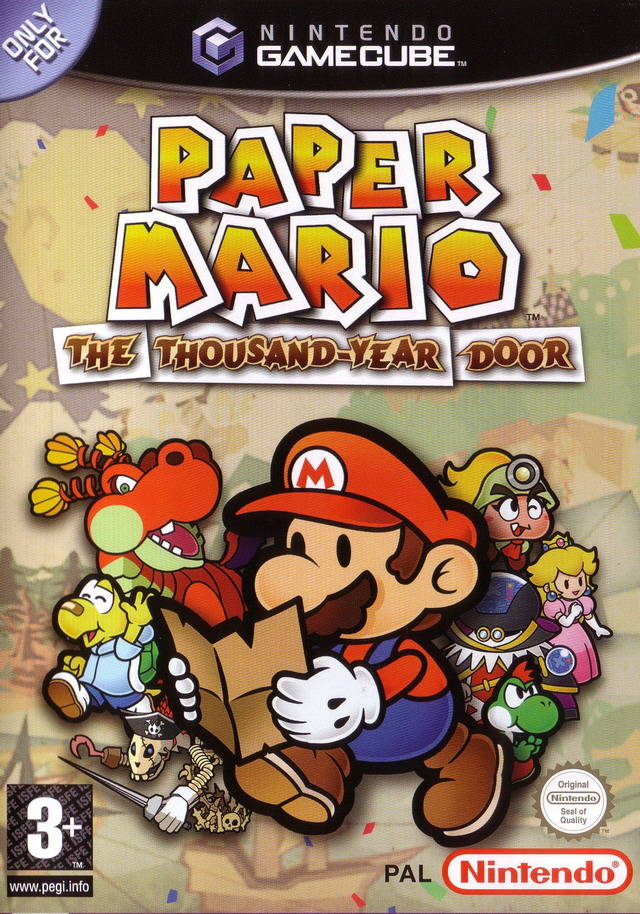
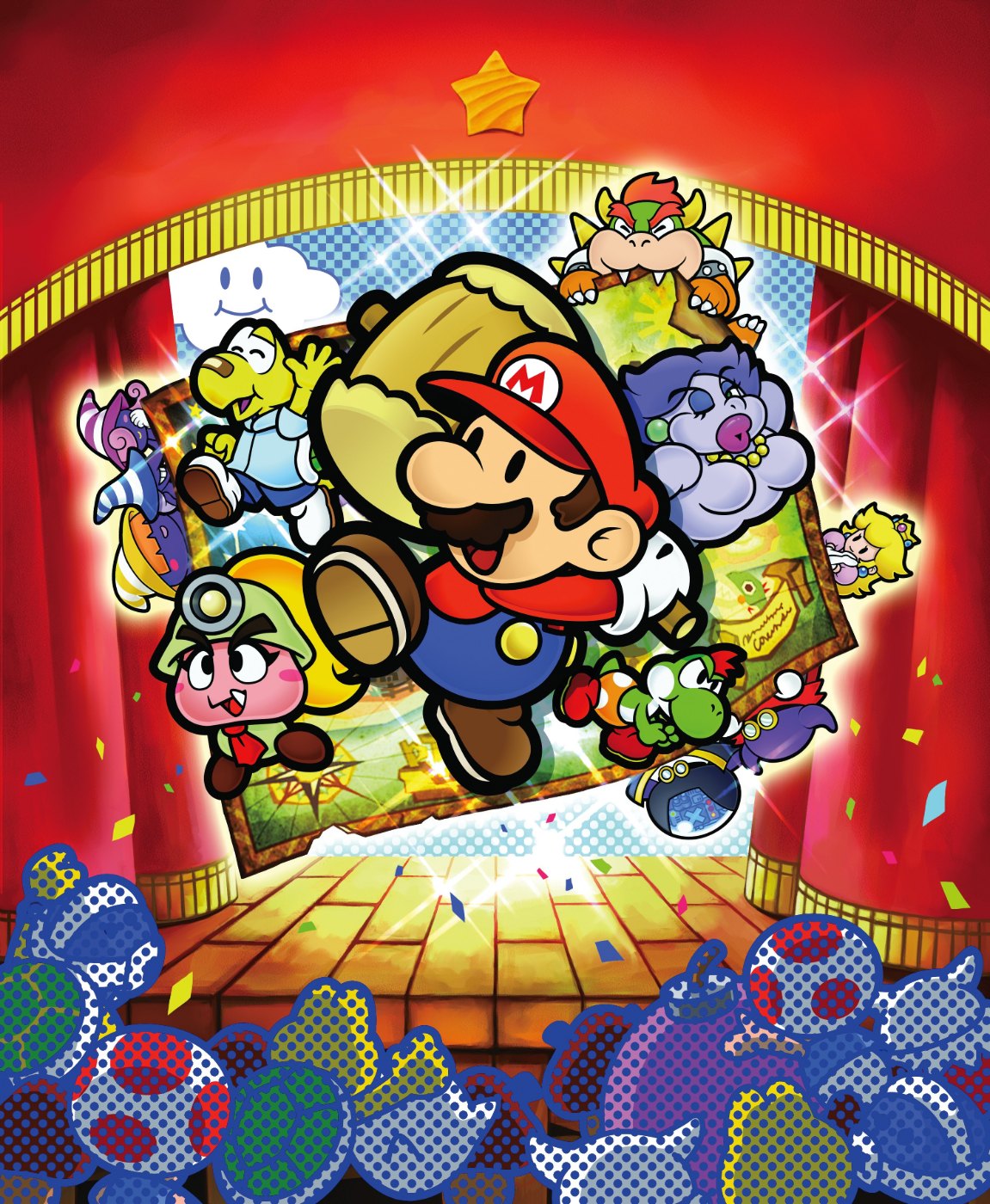
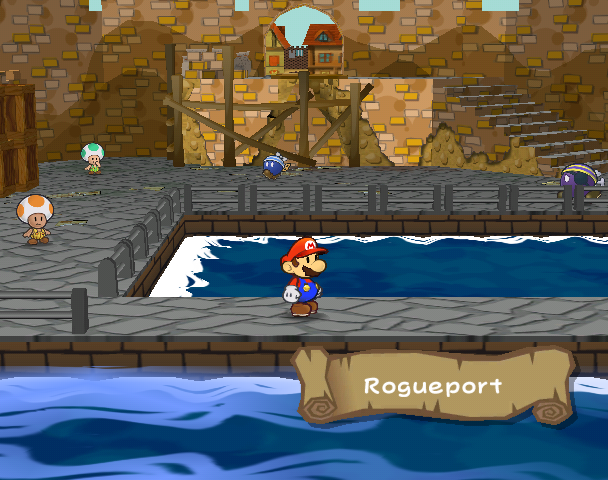
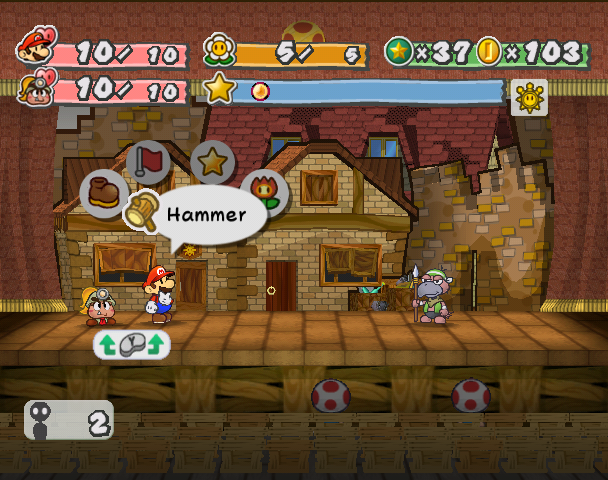
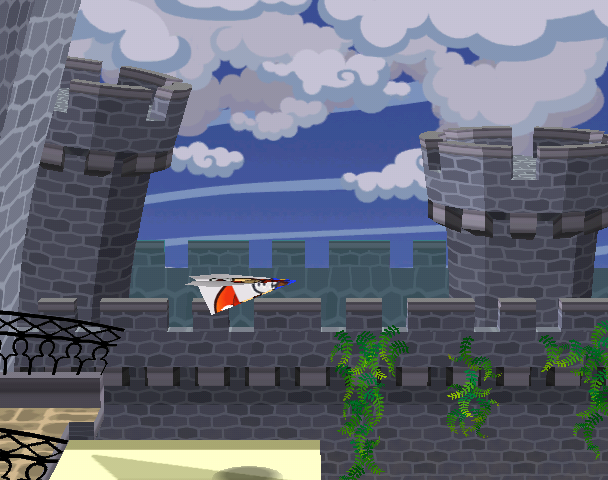
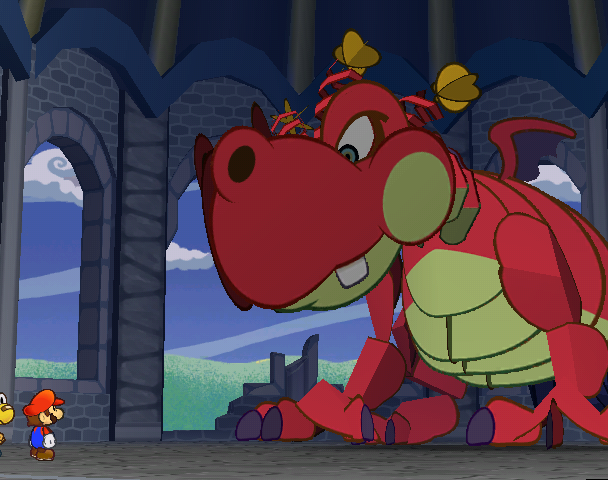
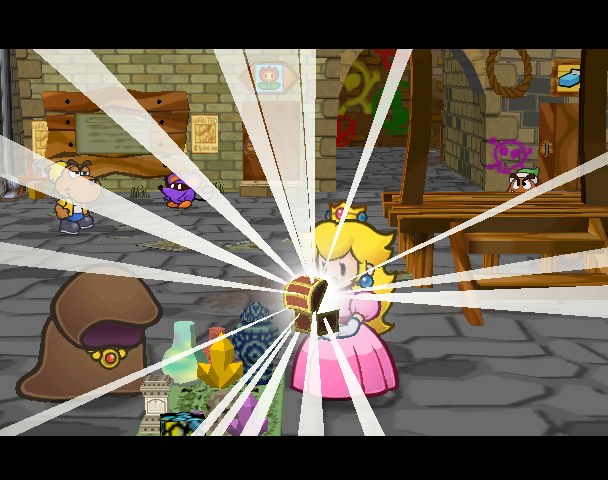
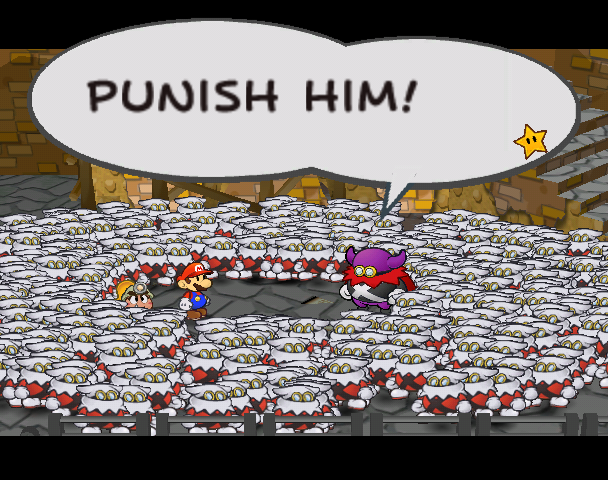
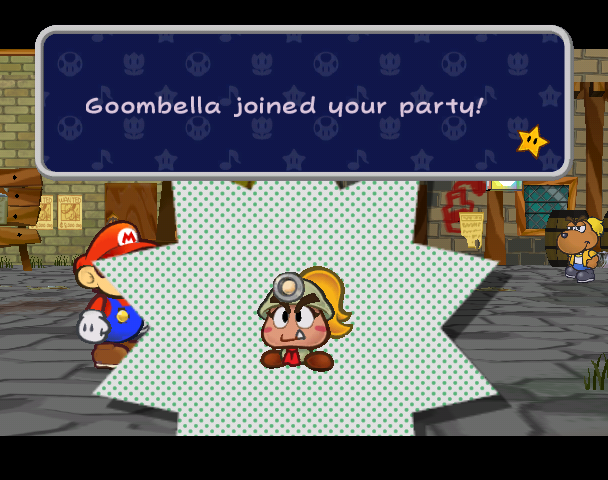
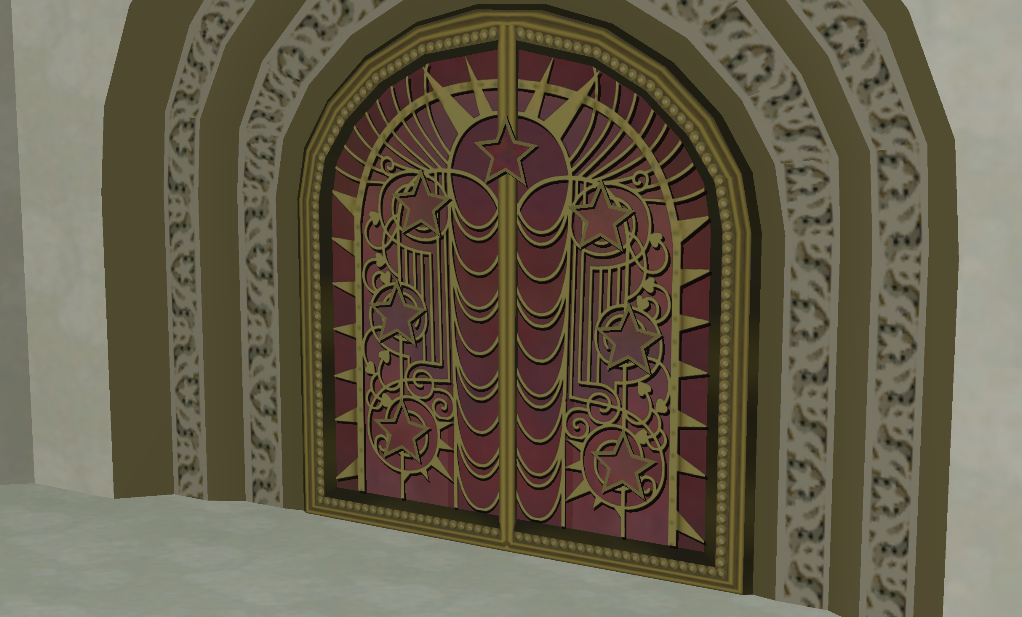
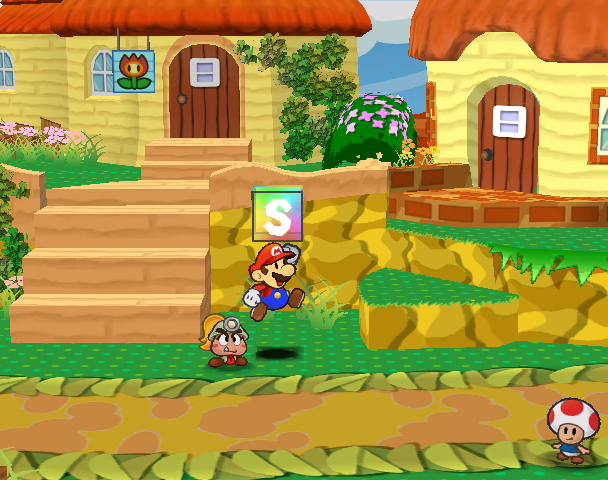
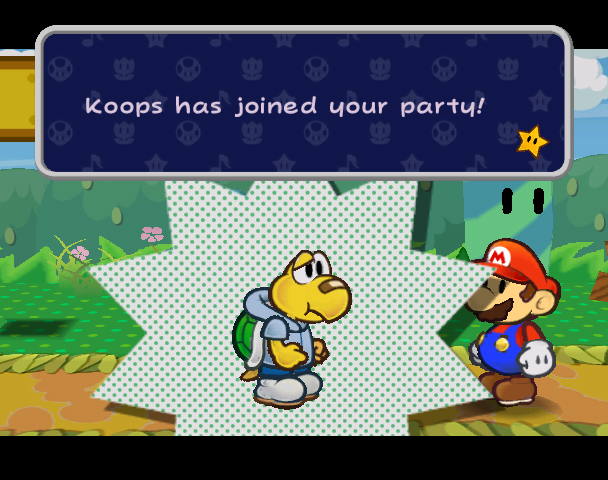
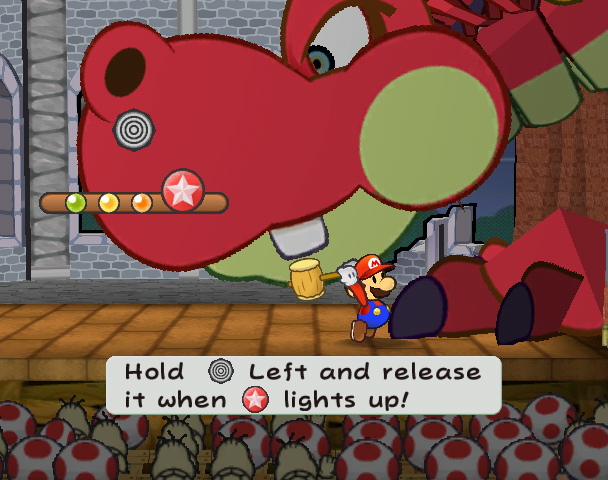
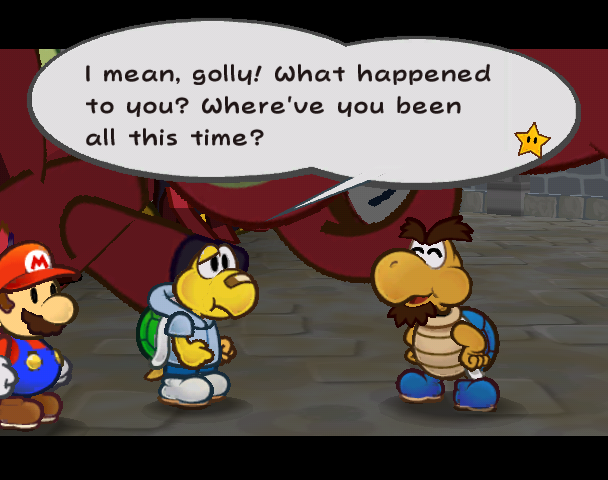
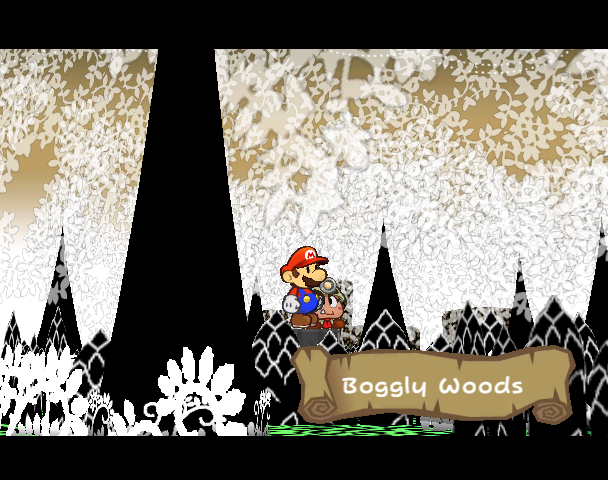
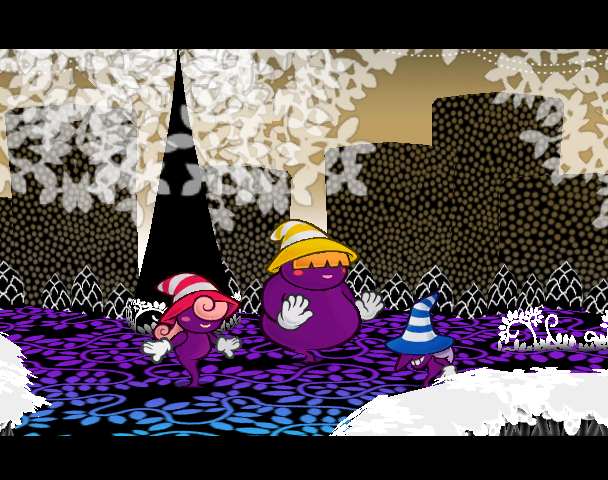
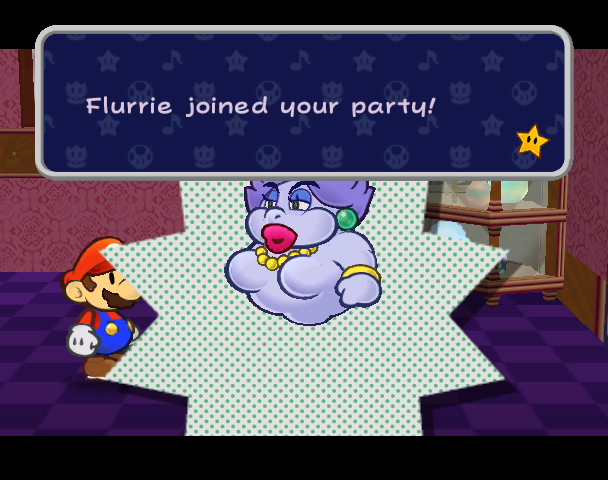
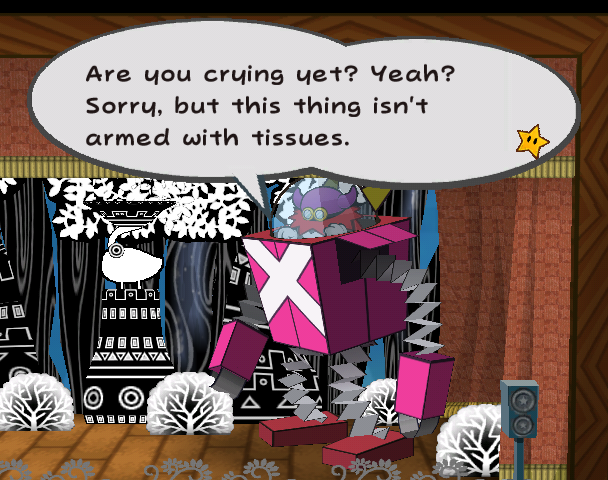
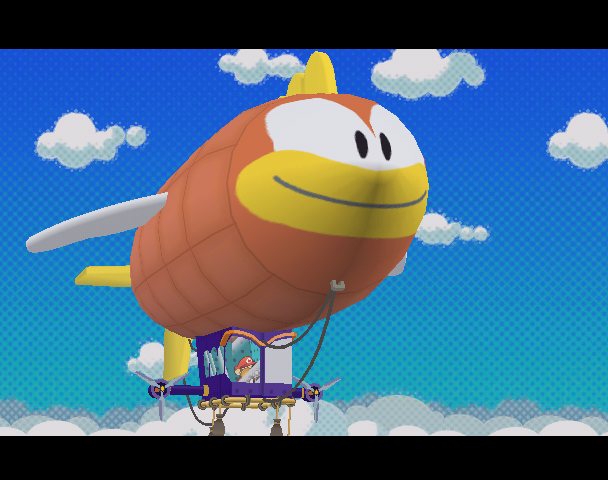
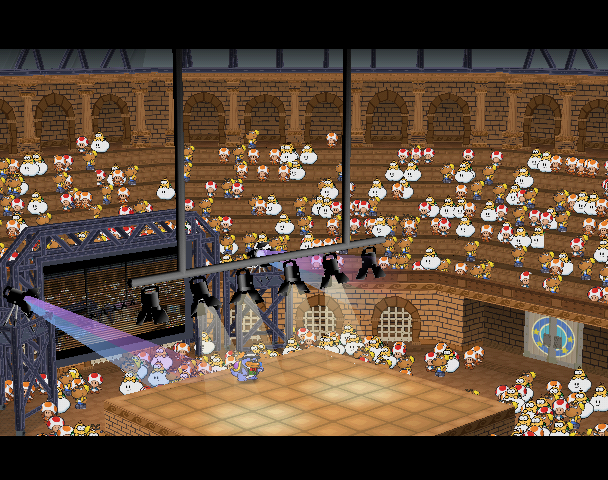
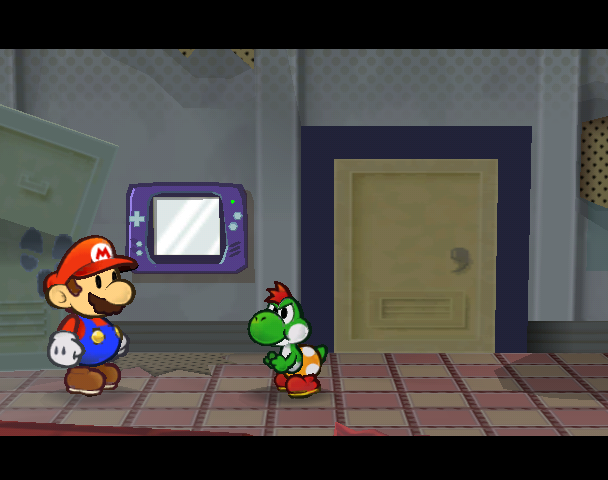
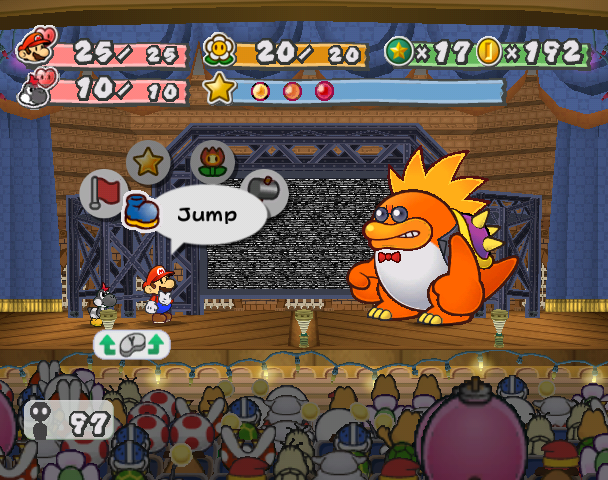
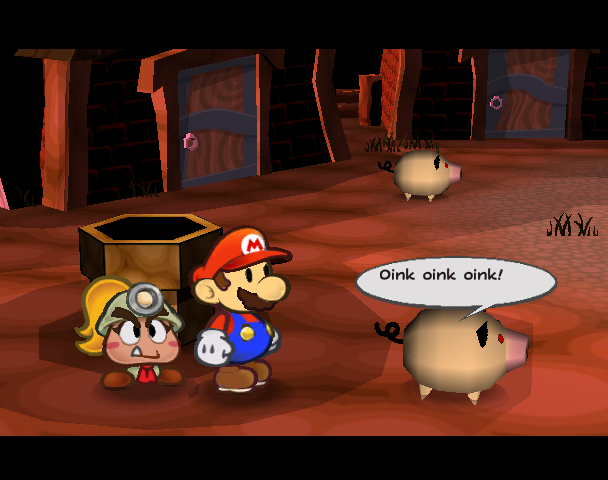
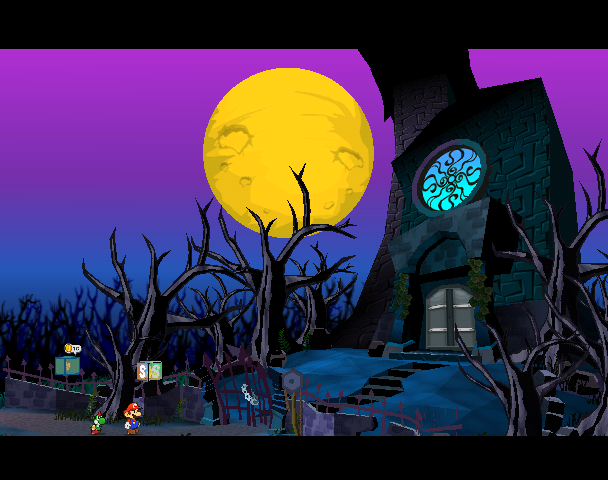
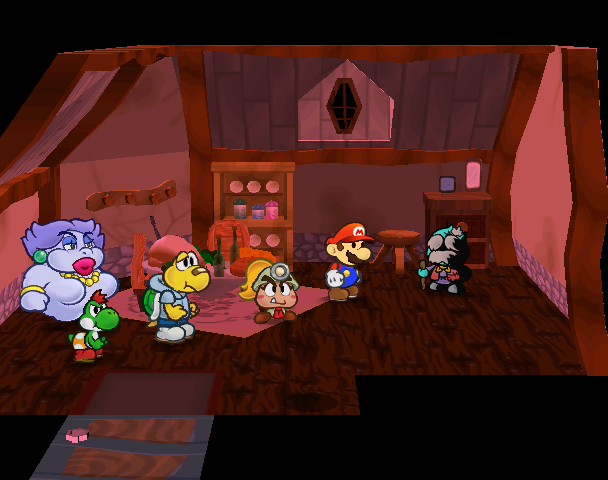
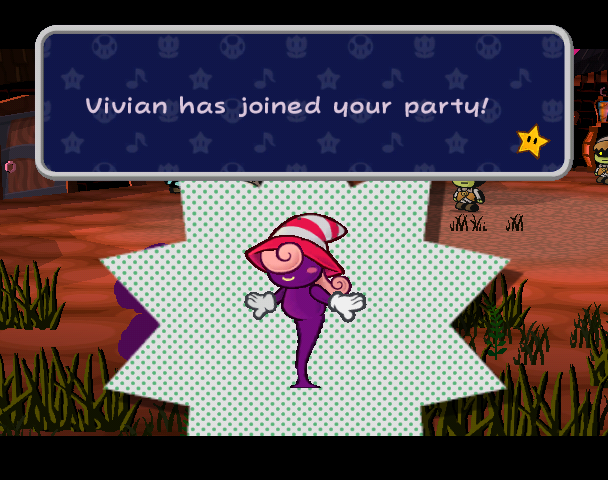
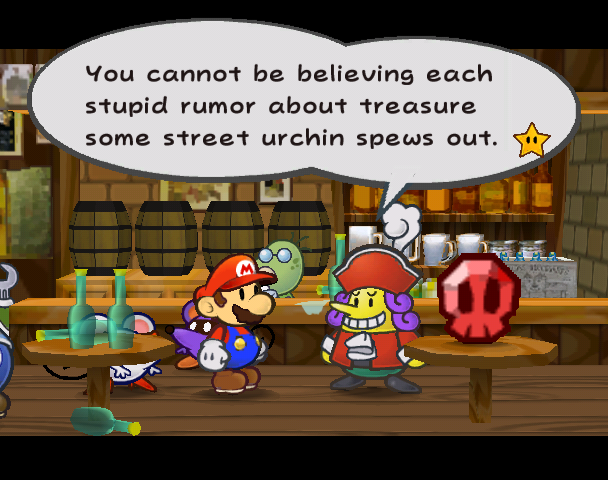
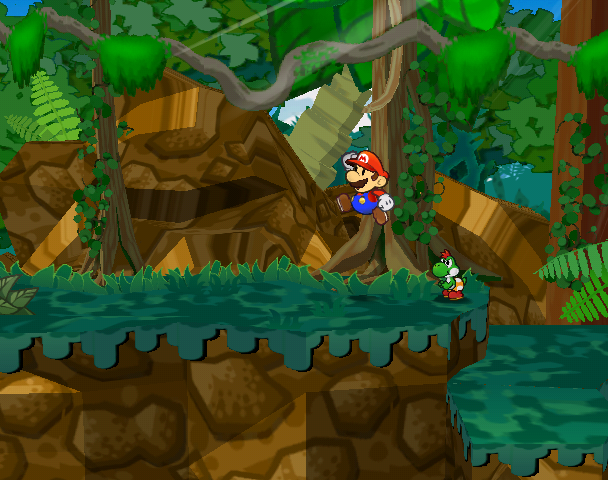
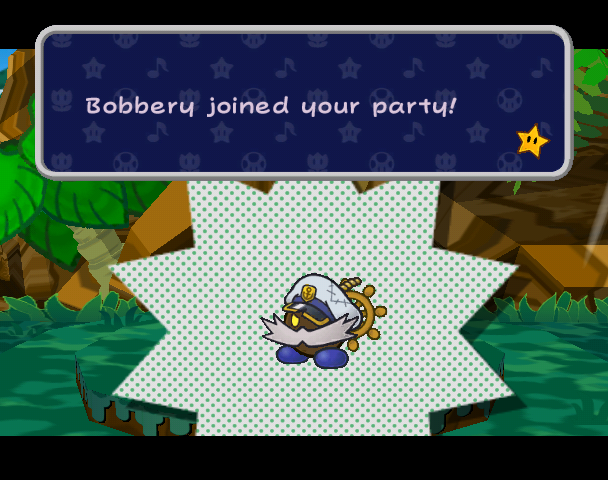
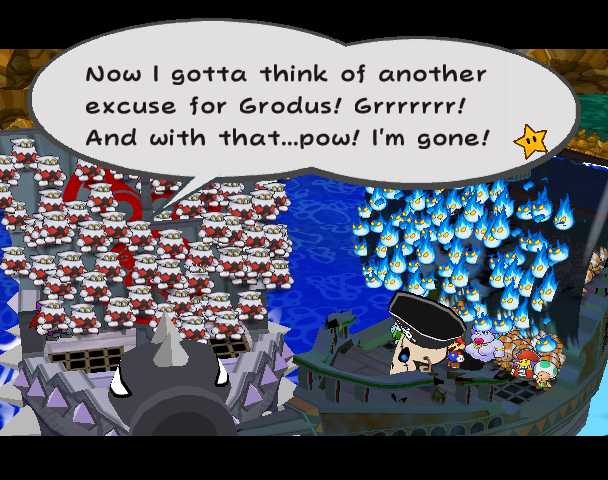
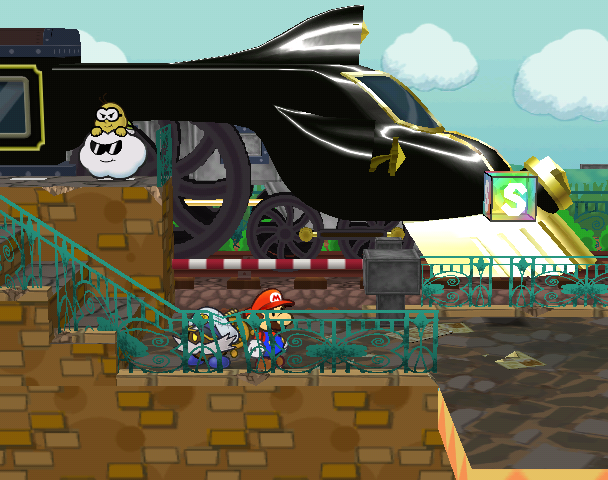
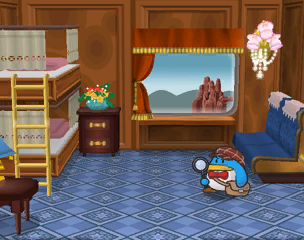
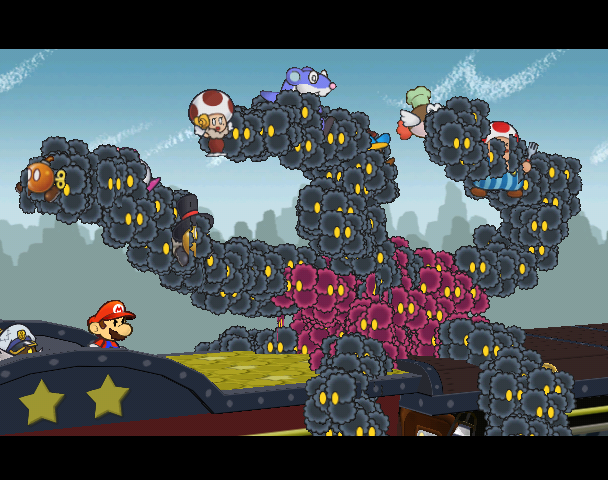
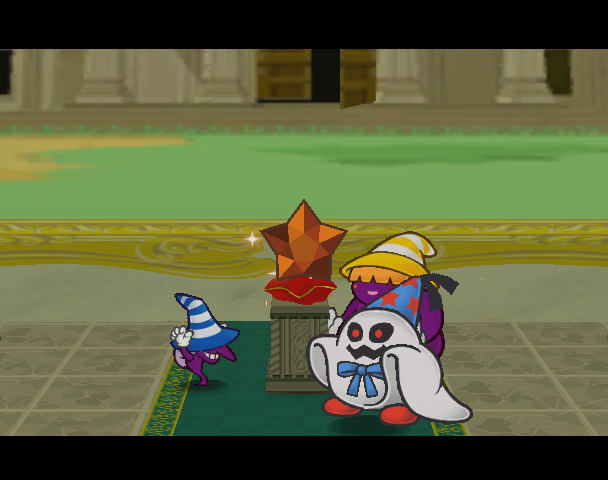
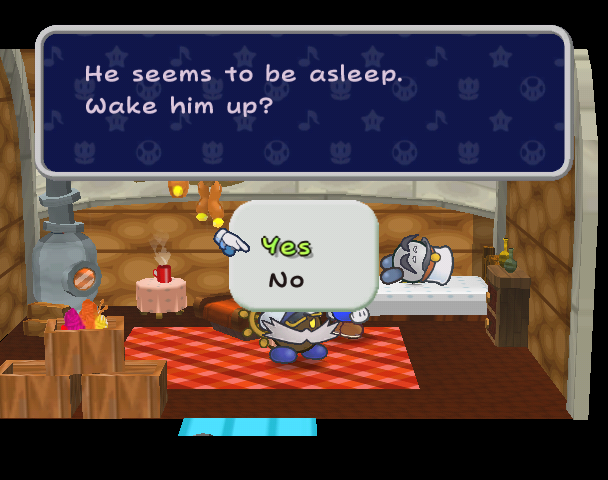
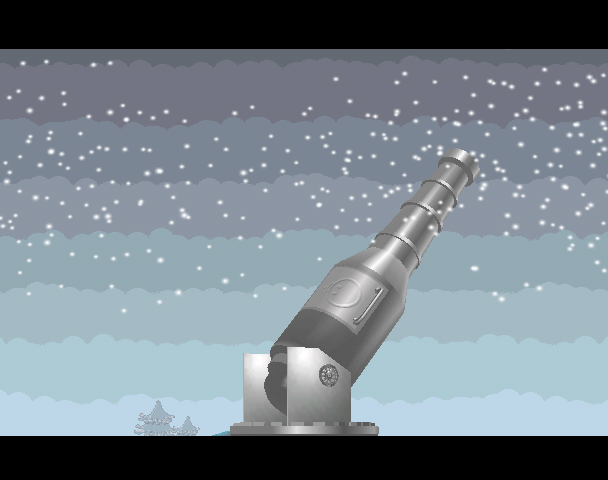
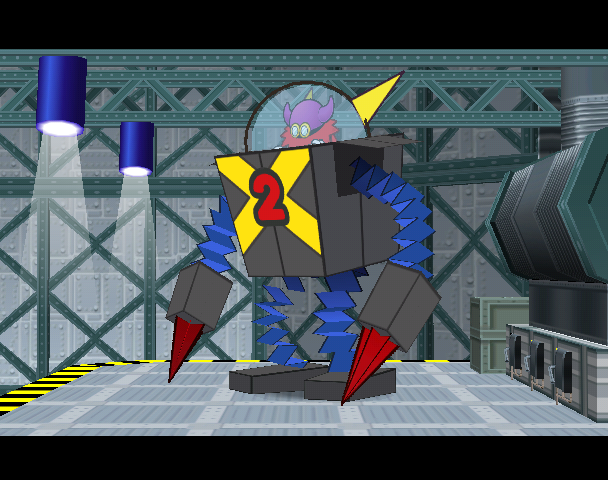
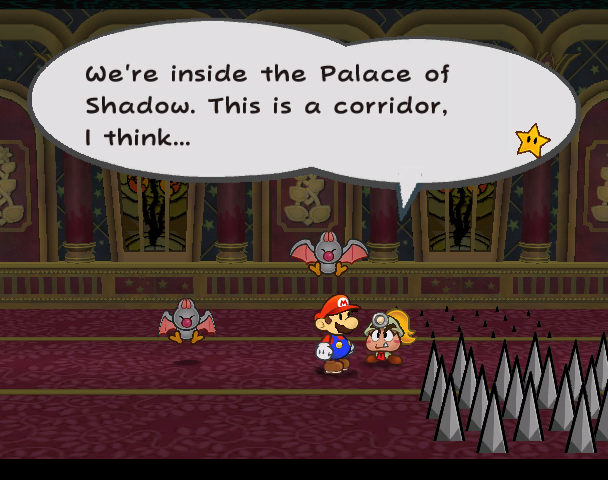
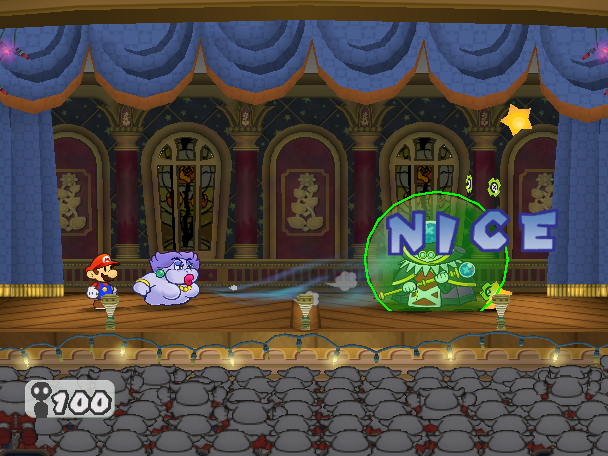
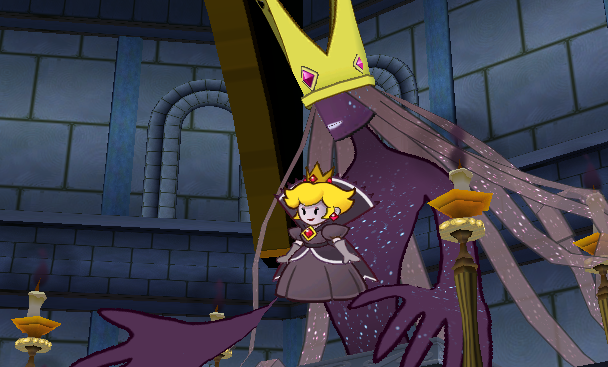
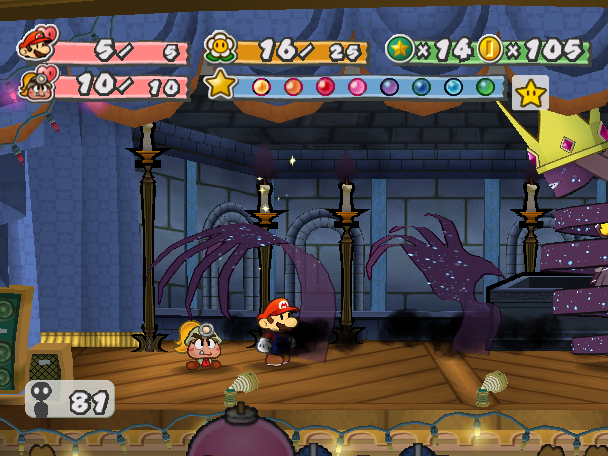
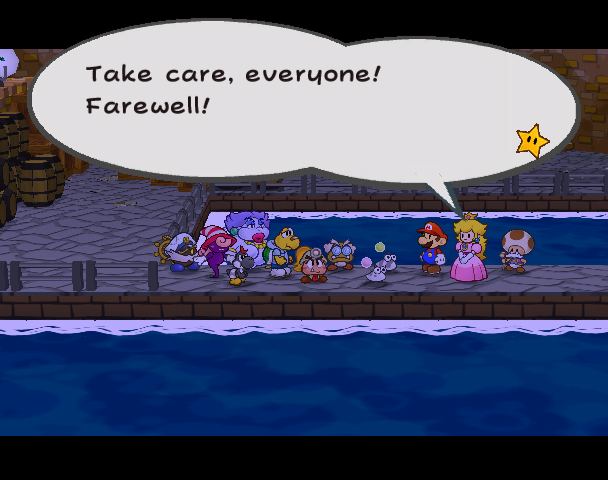
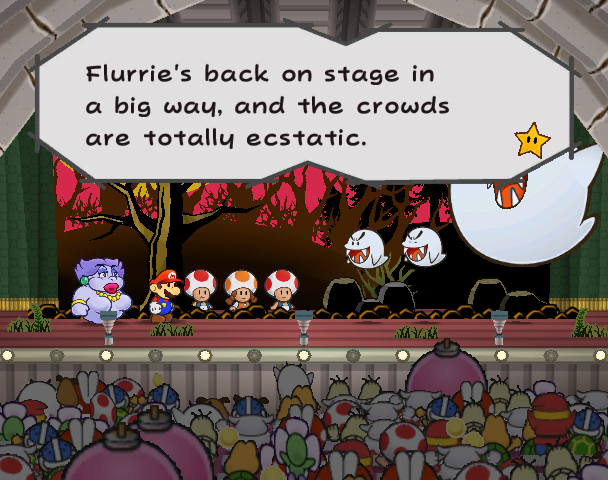
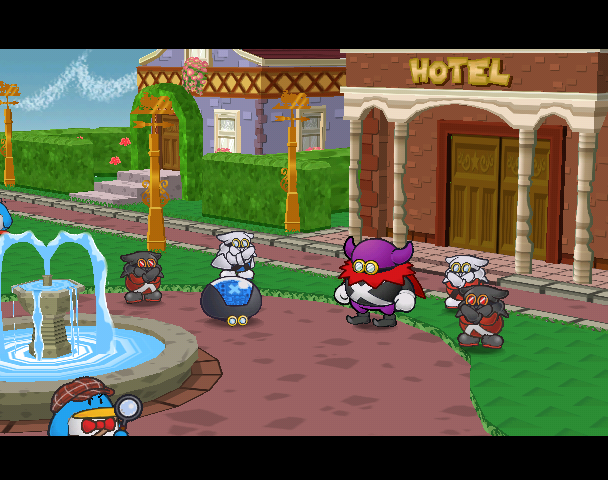
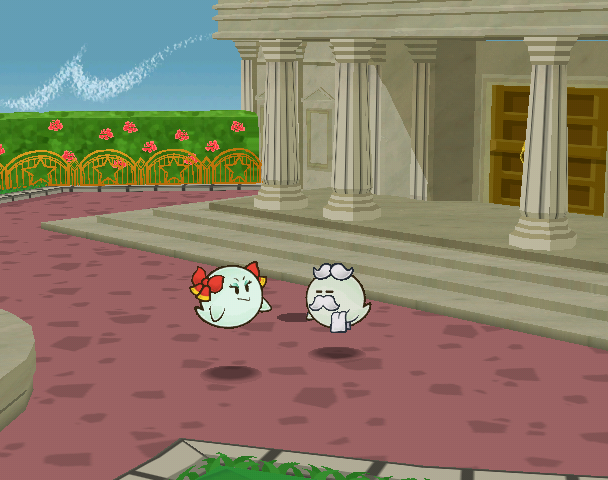
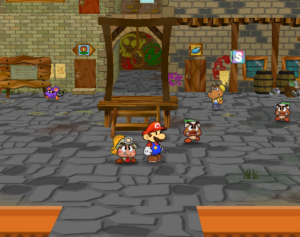 RogueportHub · Prologue · Lord Crump, Gus (optional)A port full of thieves, with a plaza, a harbour and an east and west side. Home of Professor Frankly, Merlon, Zess T., the Trouble Center, the Pianta Parlor and the Lovely Howz of Badges.
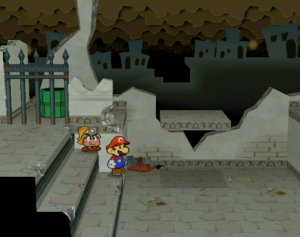 Rogueport SewersHub · Plane Mode · Boss: BlooperThe ruins of the old city, under the new one. Pipes to Petal Meadows and beyond, Dazzle, Merlee, Merluvlee, Chet Rippo, the Thousand-Year Door itself and the way down to the Pit.
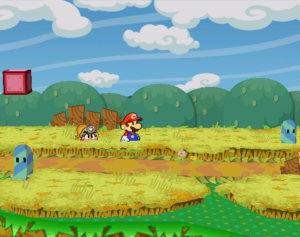 Petal Meadows and PetalburgChapter 1Storybook countryside and a village of Koopas. Koops joins here.
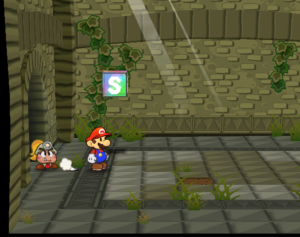 Shhwonk FortressChapter 1 · Sun and Moon Stones · Mini-boss: Gold Fuzzy and the Fuzzy HordeA small ruin with a quiz-setting Thwomp, the 65th Super Fun Quirk Quiz, and the keys to the castle road.
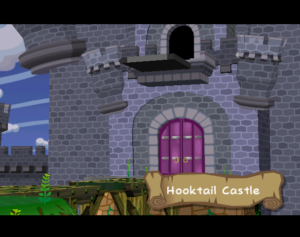 Hooktail CastleChapter 1 · Diamond Star · Paper Mode · Boss: HooktailA dragon’s keep carpeted in Dull Bones, with a spiked ceiling that comes down on the slow.
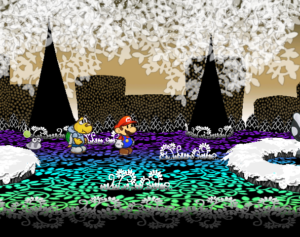 Boggly WoodsChapter 2 · Mini-boss: the Shadow SirensThe quiet forest around the Great Tree, where the Shadow Sirens lie in wait. Flurrie’s house is here.
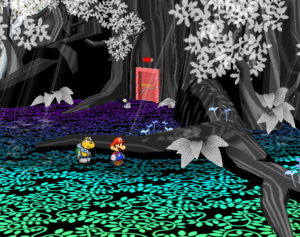 The Great TreeChapter 2 · Emerald Star · Super Boots · Boss: Magnus von GrappleThe Punies’ home, occupied by X-Nauts. Mario marches a crowd of Punies through it behind the Puni Orb.
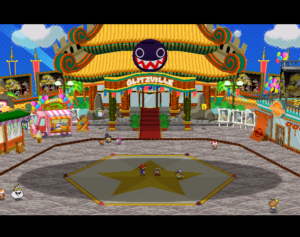 Glitzville and the Glitz PitChapter 3 · Gold Star · Super Hammer · Boss: Macho GrubbaA floating town built around a fight arena, reached by blimp. Twenty ranks, a hot-dog stand and a juice bar.
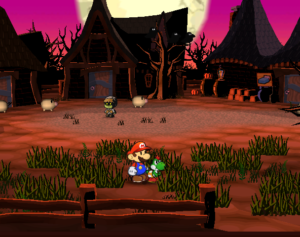 Twilight Town and Twilight TrailChapter 4 · Tube ModeA village in endless dusk whose people are being turned into pigs, and the dark wood between it and the steeple.
 Creepy SteepleChapter 4 · Ruby Star · Bosses: Doopliss, Atomic Boo (optional)A haunted steeple with a swarm of Boos, an optional giant among them, and a parrot that knows too much.
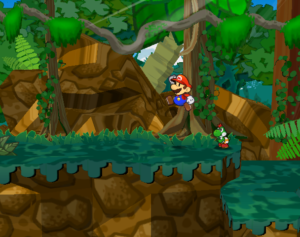 Keelhaul KeyChapter 5 · Mini-boss: three EmbersA jungle island with Keel Mangoes on the trees and a Whacka minding its own business.
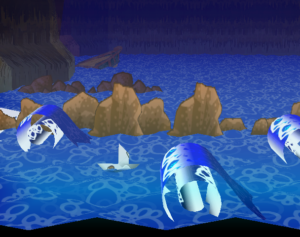 Pirate’s GrottoChapter 5 · Sapphire Star · Boat Mode · Bosses: Cortez, Lord CrumpFlooded caves of waves and Bill Blasters, ending at Cortez’s ship, the Black Skull.
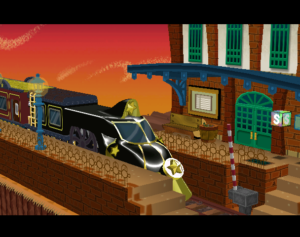 Excess ExpressChapter 6 · Boss: SmorgA three-day sleeper train with a dining car, a ghost in cabin 004 and a mystery on every carriage.
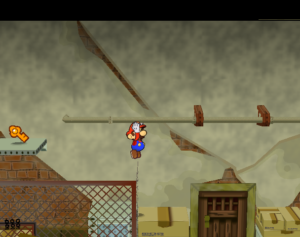 Riverside StationChapter 6 · Ultra BootsA deserted station whose drawbridge mechanism is clogged with Smorgs.
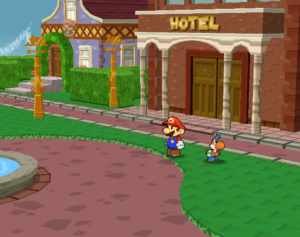 Poshley Heights and Poshley SanctumChapter 6 · Garnet StarThe smartest address in the game, and the museum where the star is hidden behind a decoy.
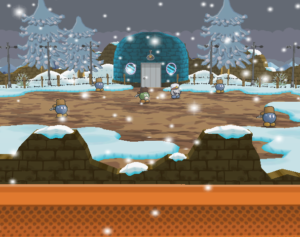 Fahr OutpostChapter 7A snowed-in Bob-omb village guarding a cannon big enough to reach the Moon.
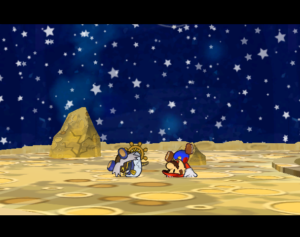 The MoonChapter 7Low gravity, Moon Clefts and a pipe hidden under a rock.
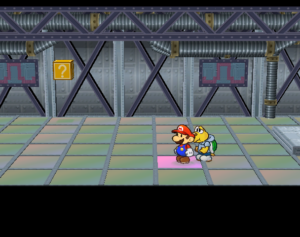 X-Naut FortressChapter 7 · Crystal Star · Boss: Magnus von Grapple 2.0Grodus’s base and Peach’s prison, seen from both sides. A changing room turns the party into 8-bit sprites.
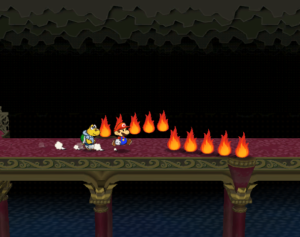 Palace of ShadowChapter 8 · Bosses: Dark Bones, Gloomtail, the Shadow Sirens, Grodus, Bowser and Kammy, the Shadow QueenThe demon’s palace behind the Thousand-Year Door. It contains the Riddle Tower, whose puzzle rooms give up eight Palace Keys.
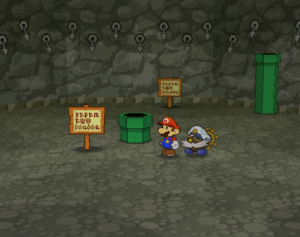 Pit of 100 TrialsOptional · Return Postage · Boss: BonetailA hundred floors beneath the sewers with no saving. According to the storyteller Grifty, the Shadow Queen built it to dispose of people she disliked.
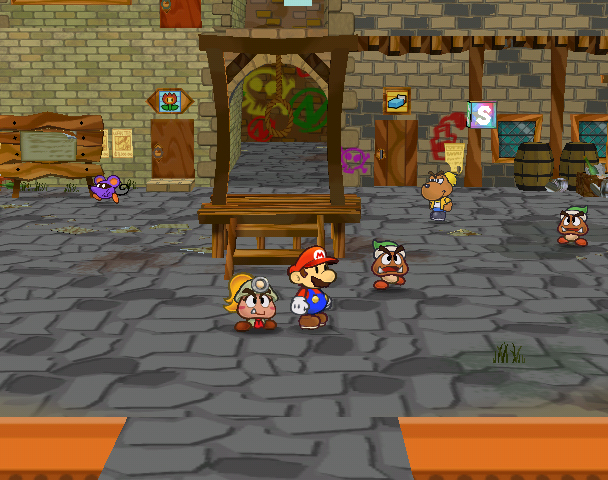
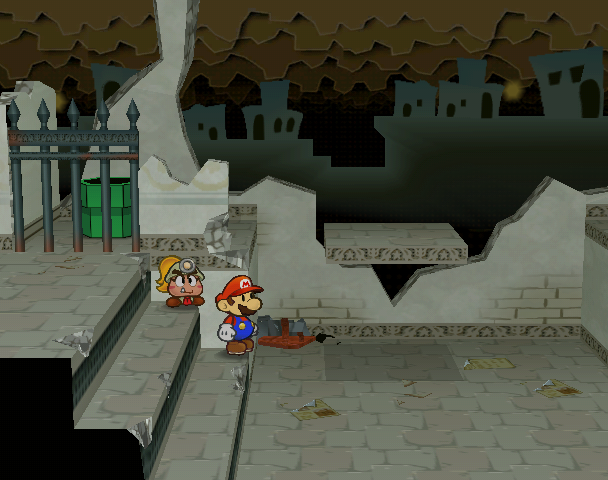
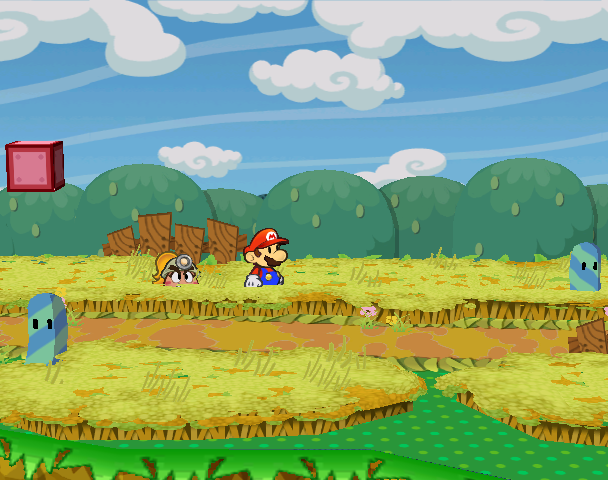
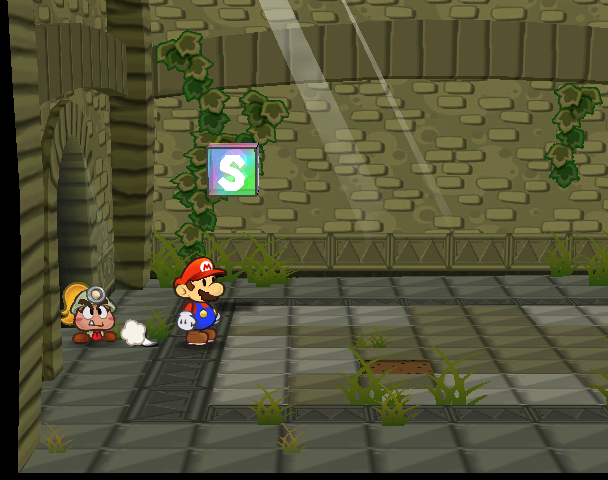
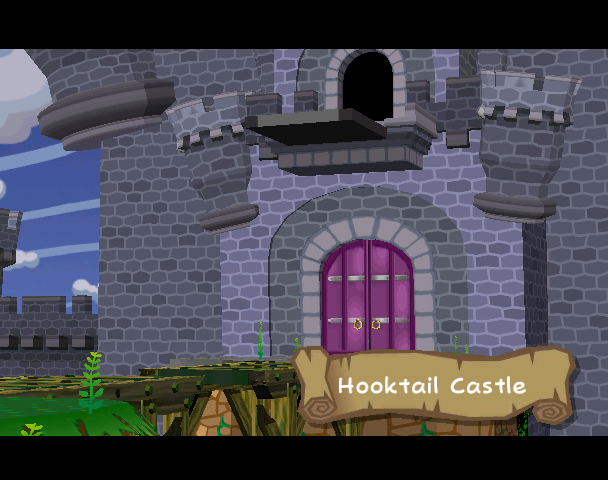
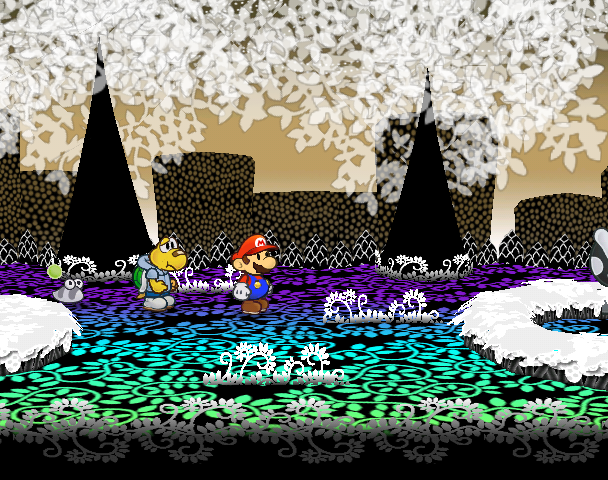
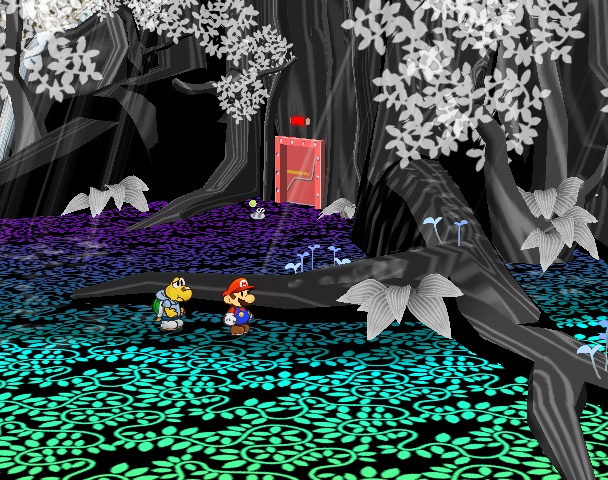
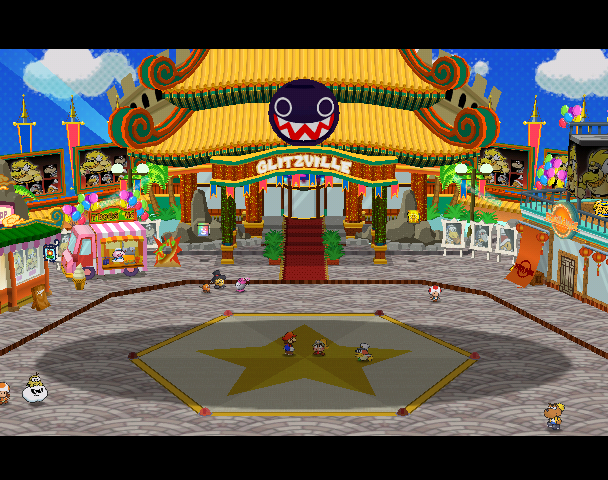
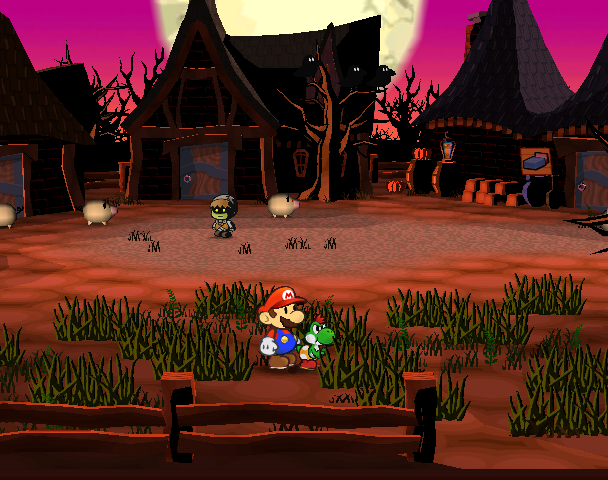
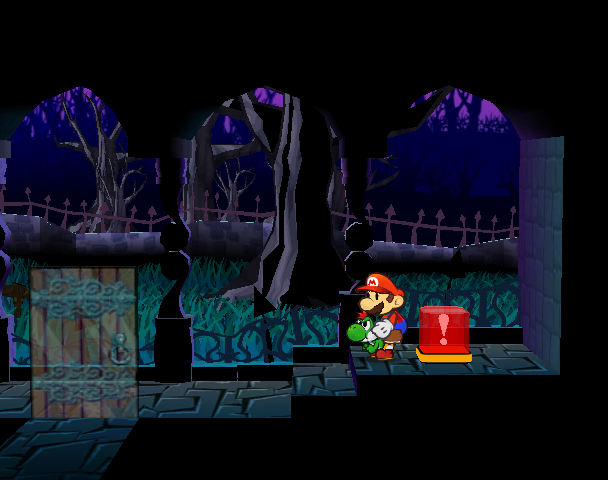
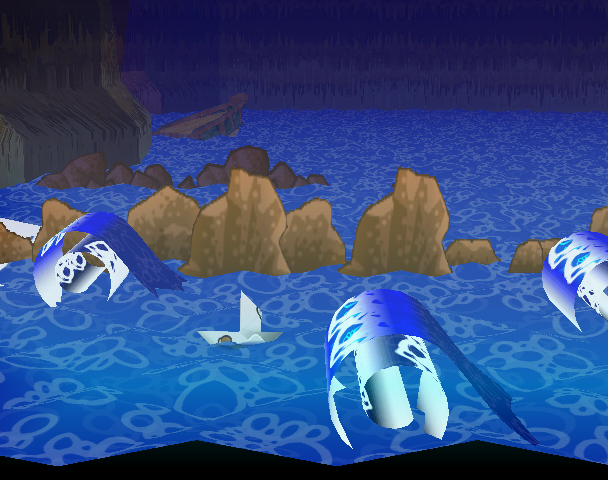
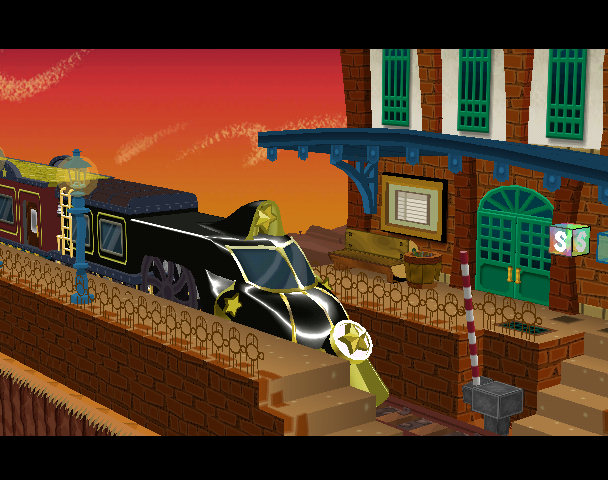
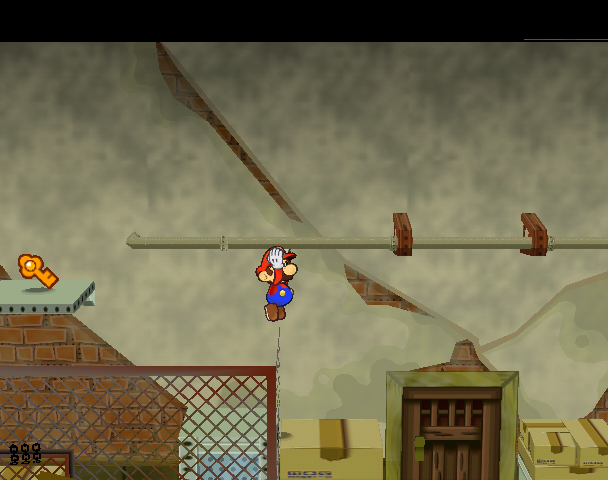
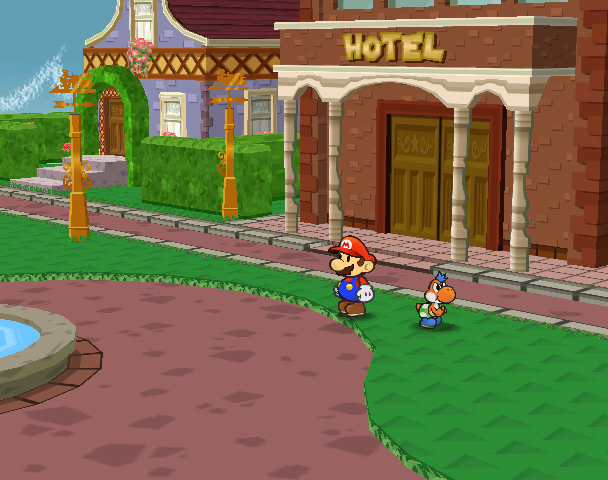
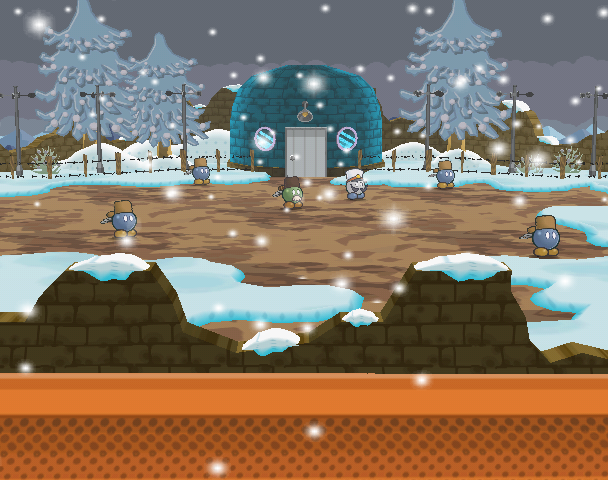
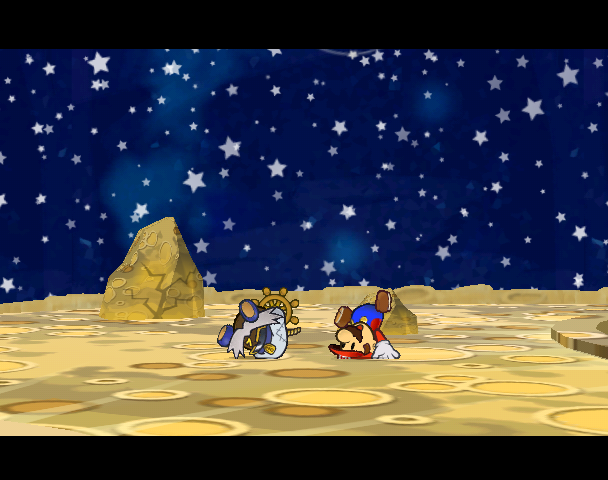
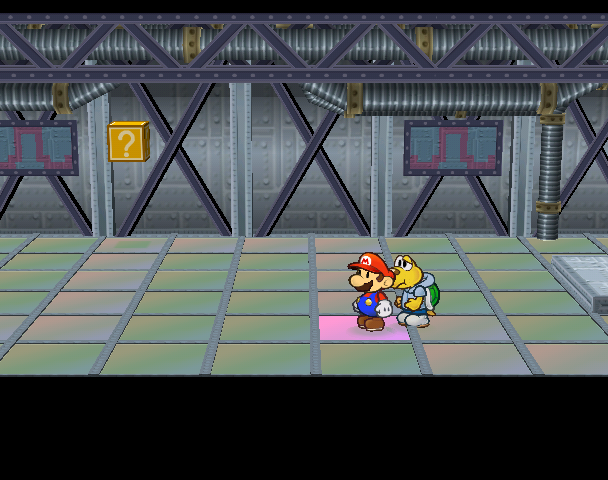
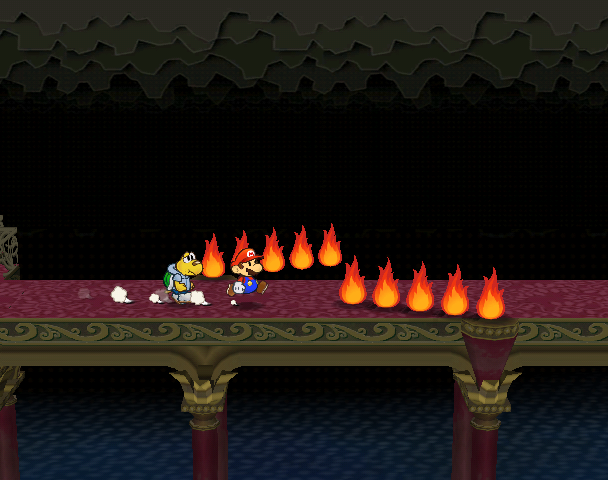
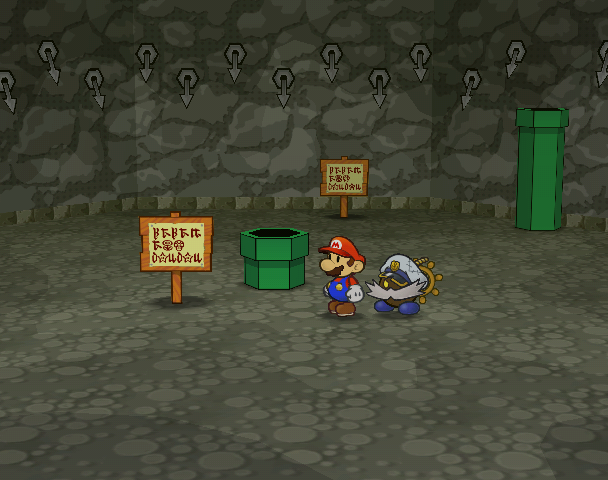
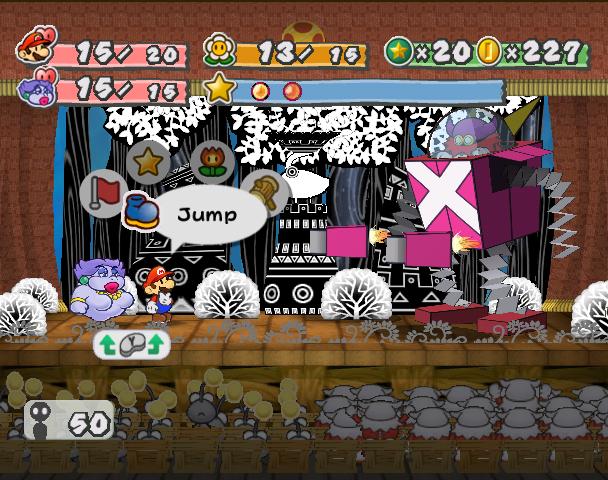
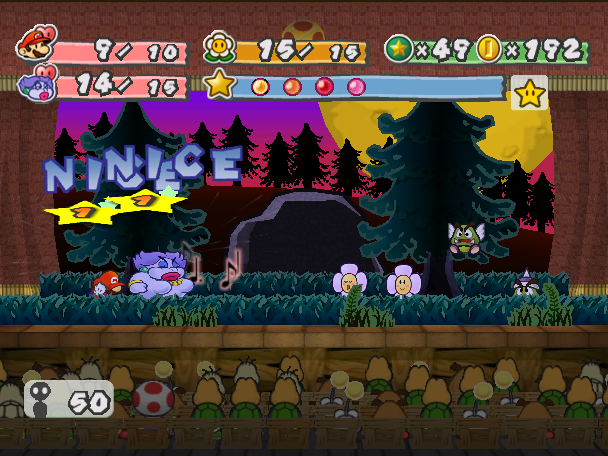
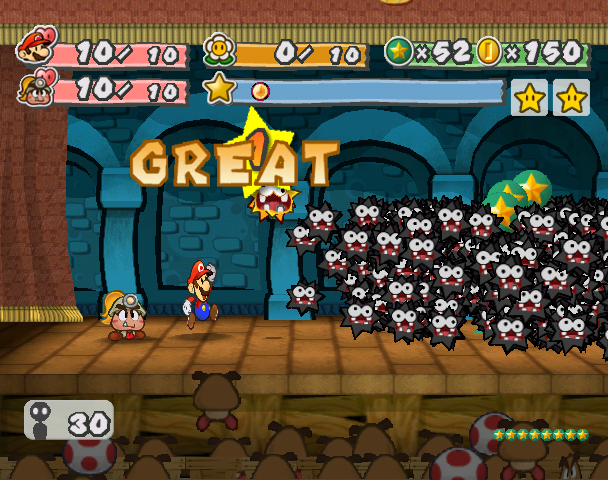
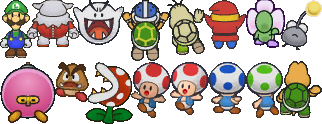
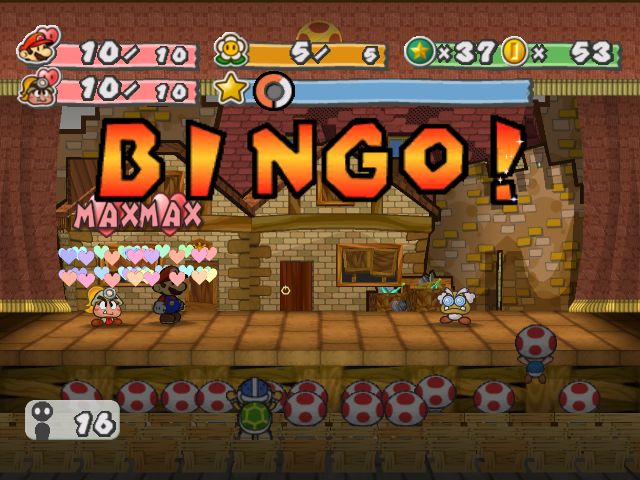
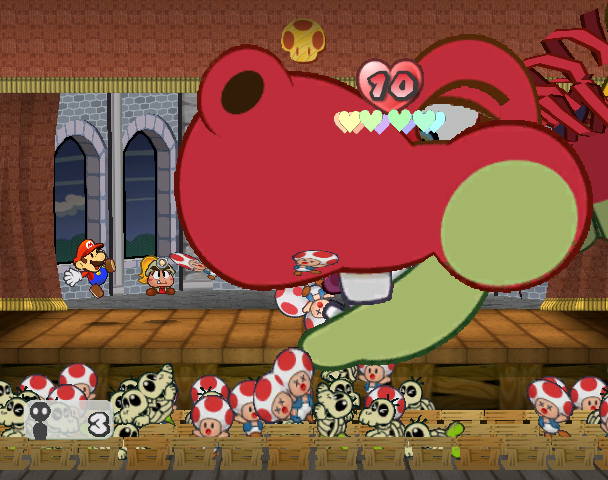
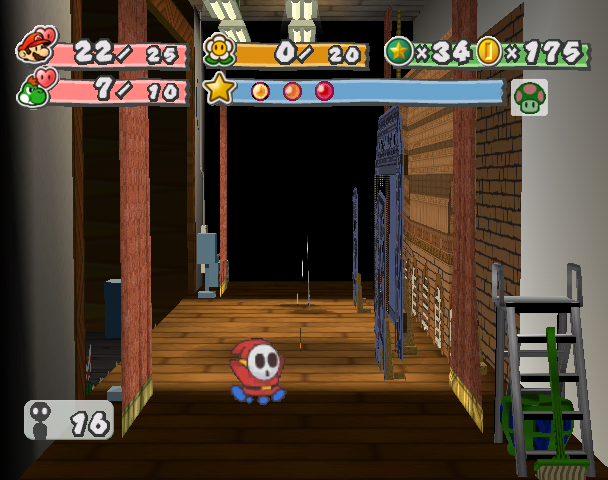
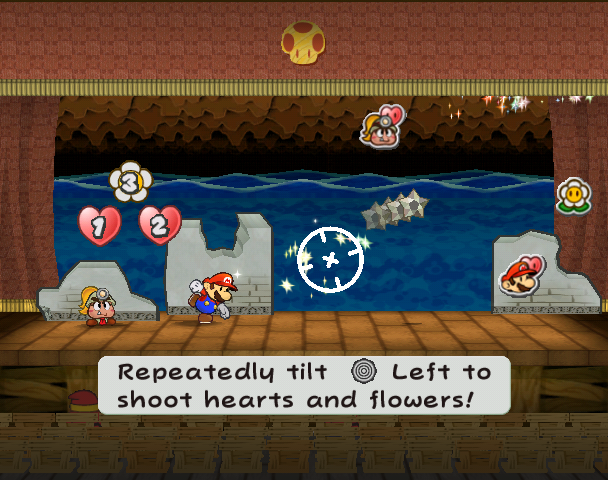
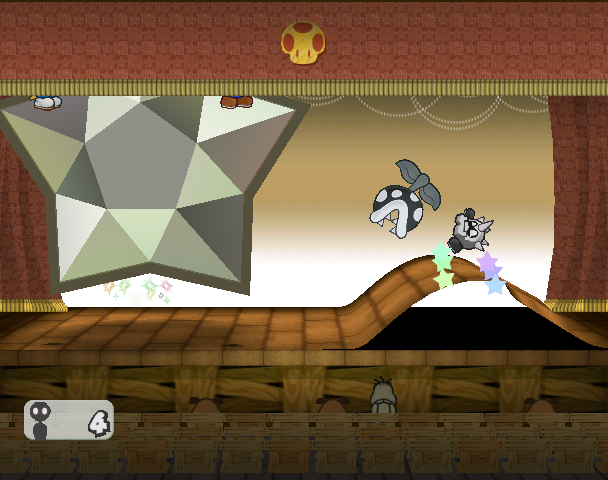
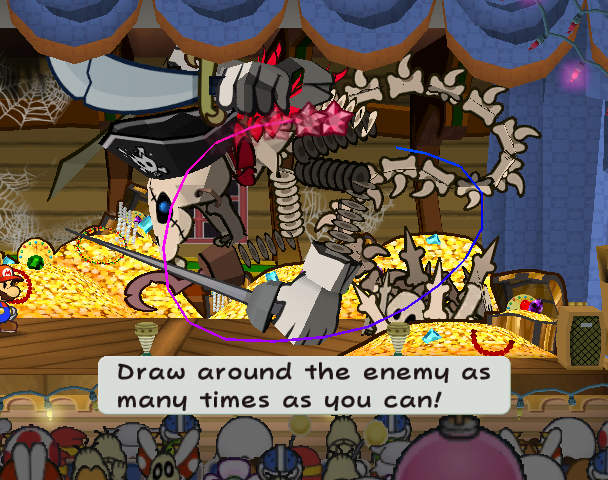
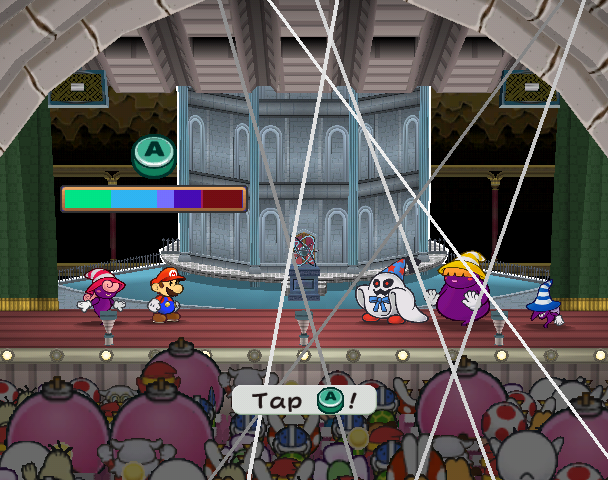
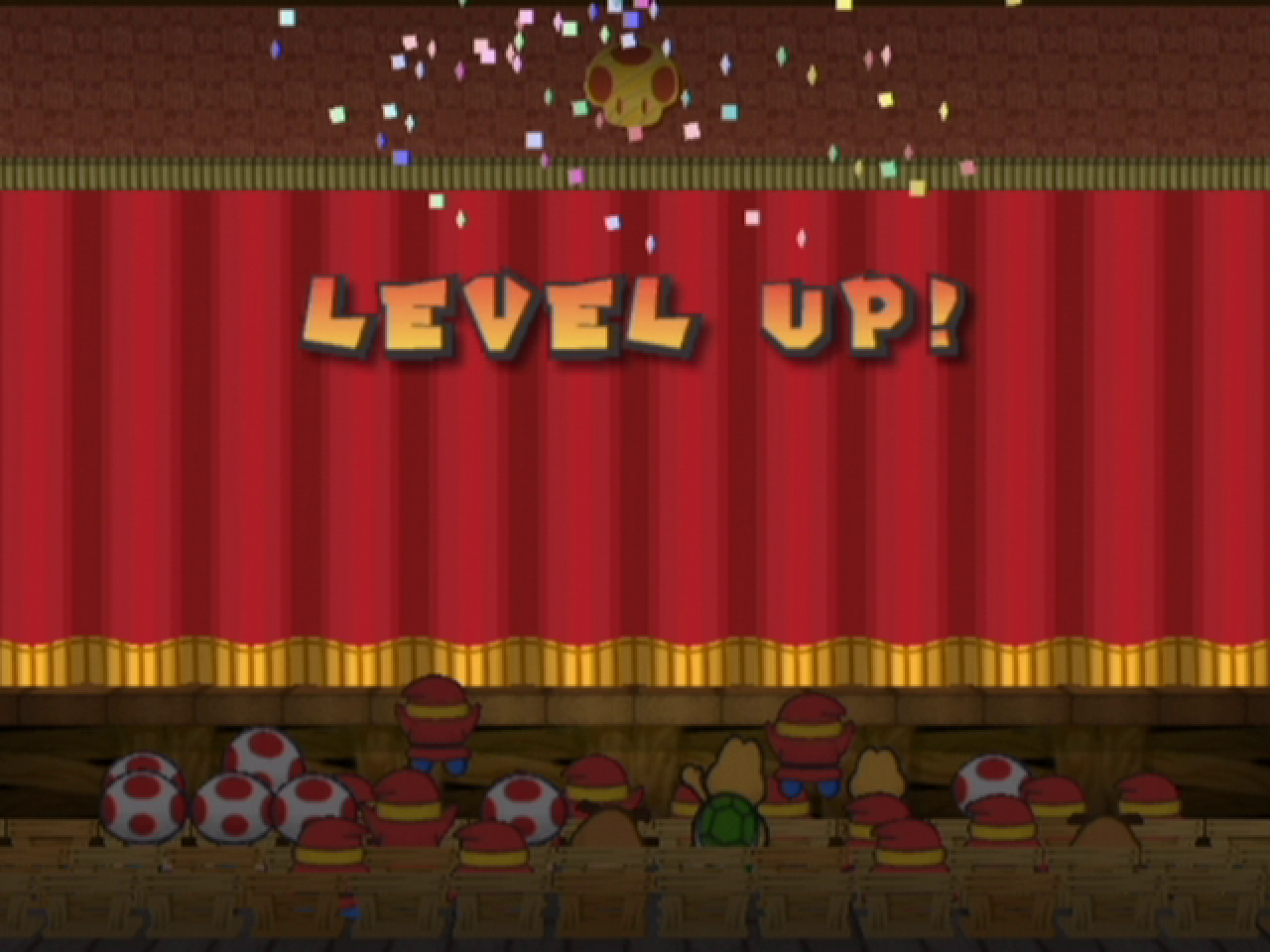
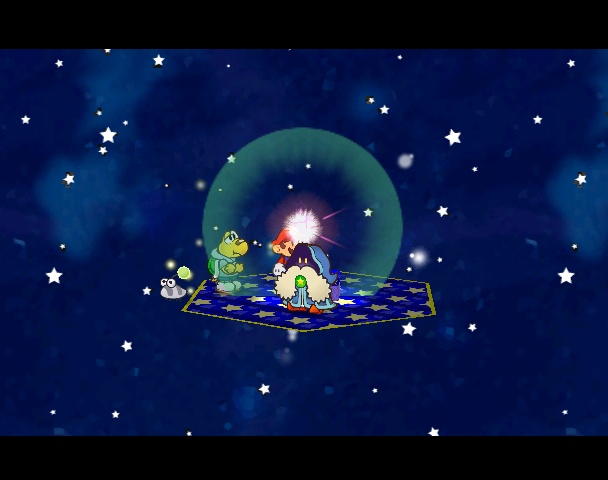
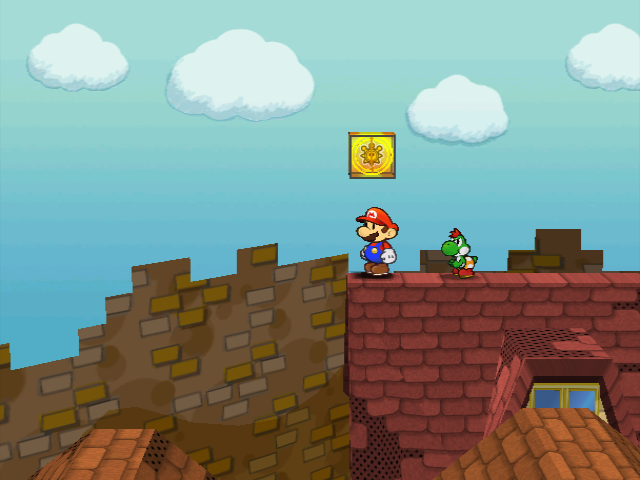
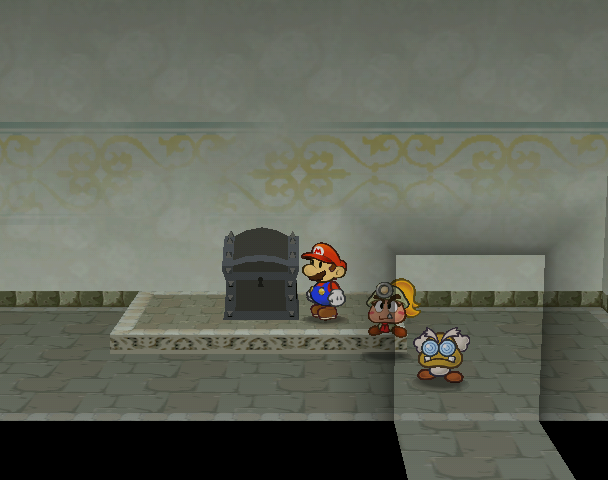
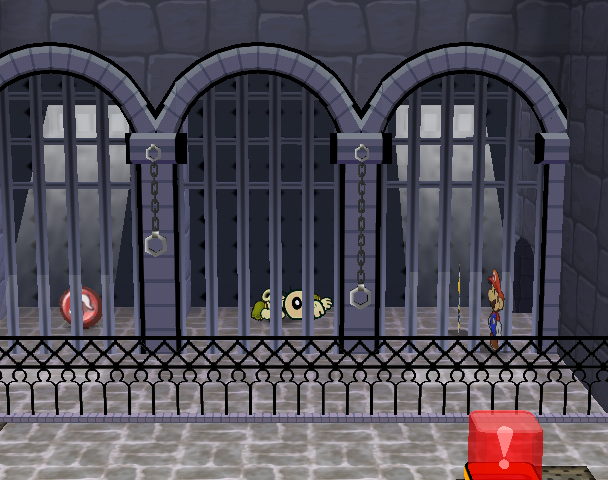
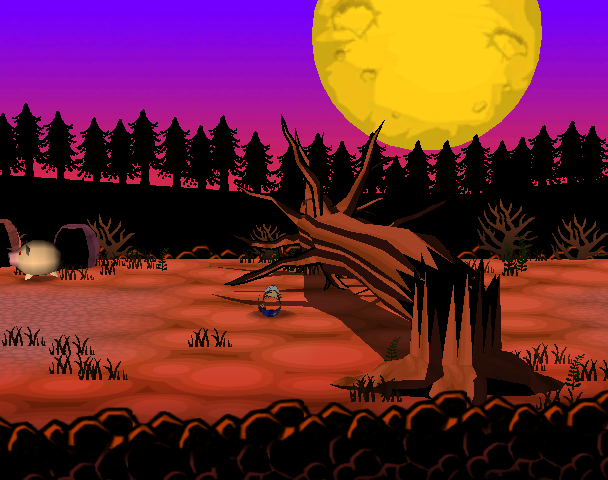
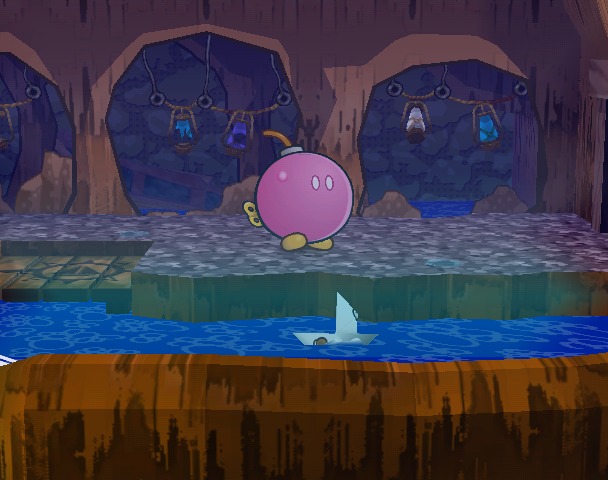
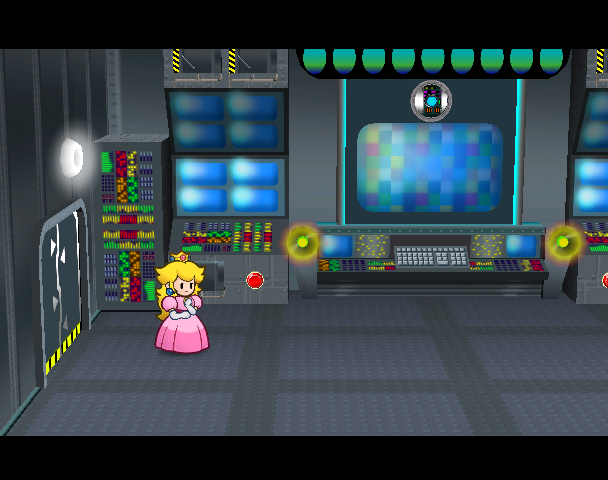
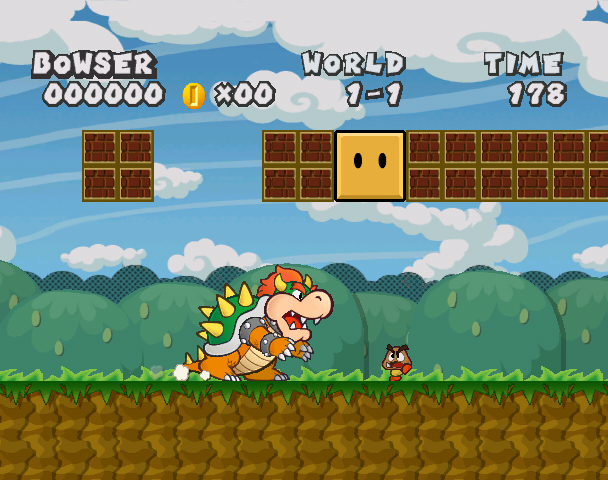
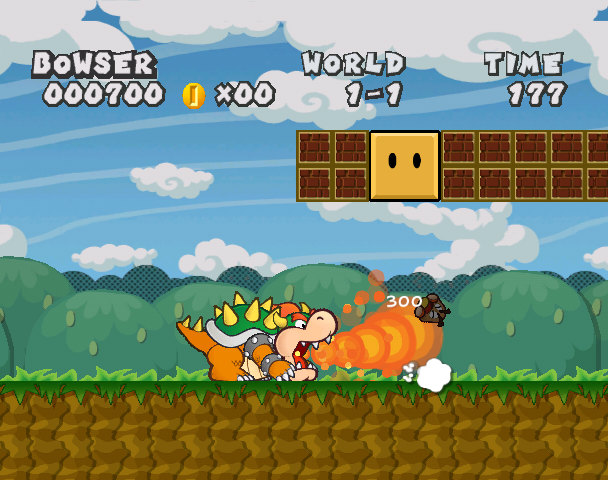
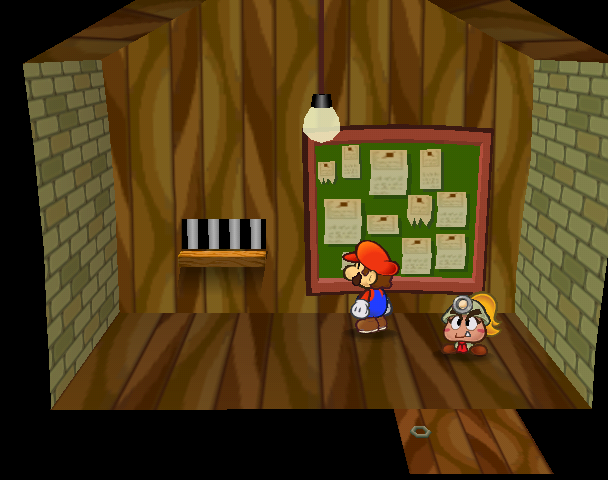
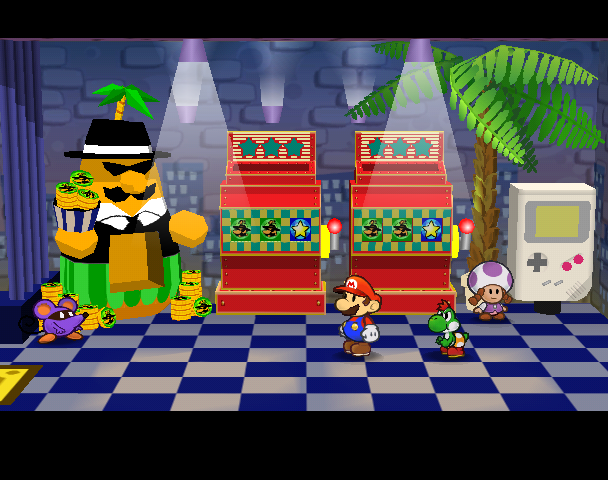
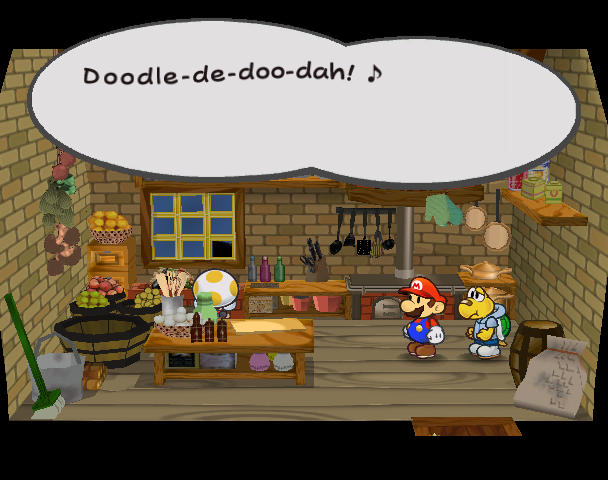
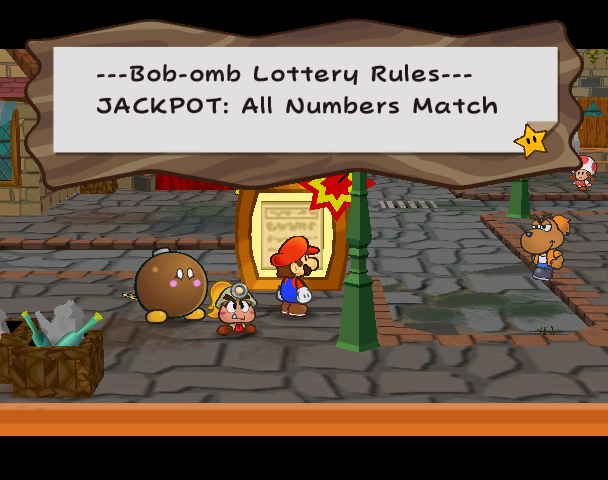
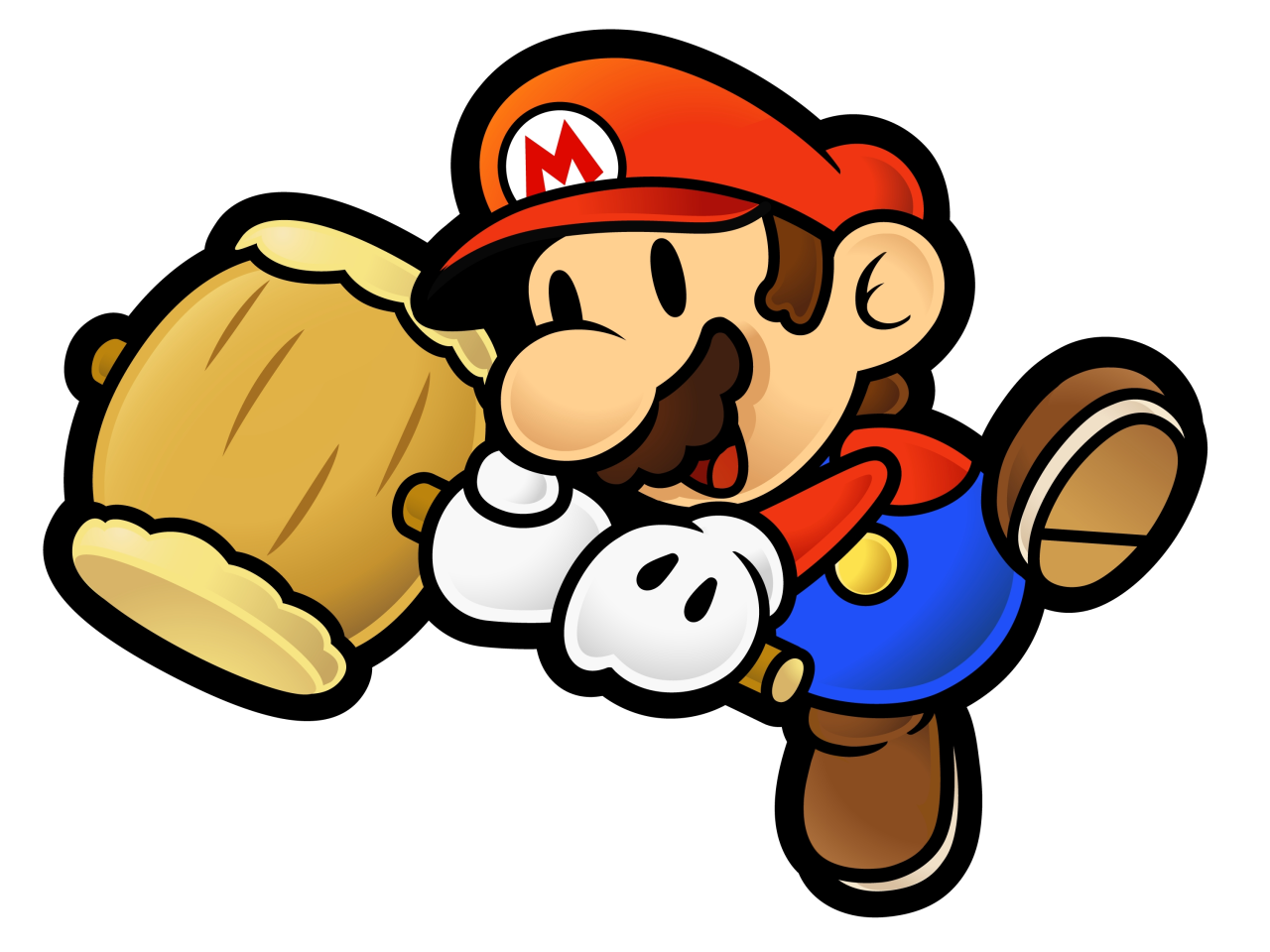


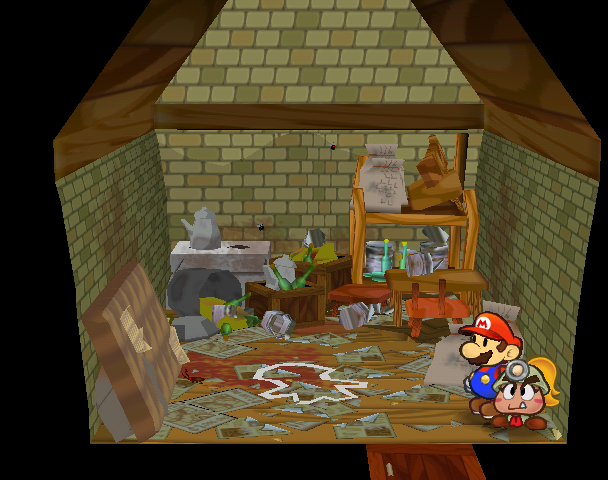
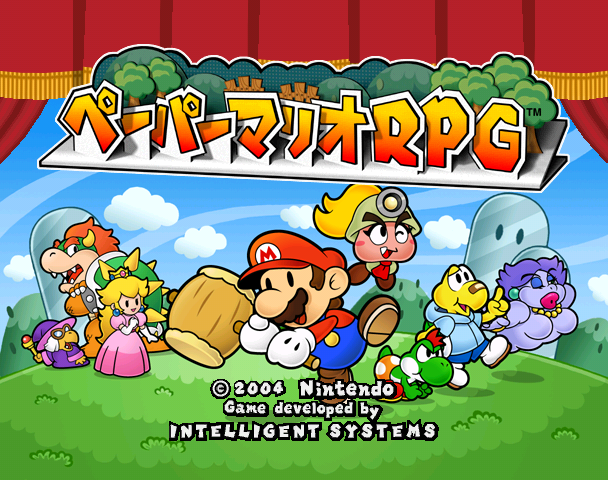
 Sweet Treat (Magical Map)1 SP. Restores up to 7 HP to Mario and his partner and 8 FP, and cures most ailments.
 Earth Tremor (Diamond Star)2 SP. An earthquake that ignores defence. A perfect command does 6 damage to every enemy, wherever it is.
 Clock Out (Emerald Star)2 SP. Immobilises every enemy for a few turns if it works.
 Power Lift (Gold Star)3 SP. Raises attack and defence for Mario and his partner for a few turns.
 Art Attack (Ruby Star)4 SP. Circle enemies with the Control Stick; every loop is damage that ignores defence.
 Sweet Feast (Sapphire Star)5 SP. Restores up to 24 HP and 24 FP to both party members.
 Showstopper (Garnet Star)2 SP. Instantly defeats every ordinary enemy with 12 HP or fewer. No use on bosses.
 Supernova (Crystal Star)6 SP. Up to 15 damage to everything on stage, ignoring defence.
 Super BootsThe Great Tree, Chapter 2. Adds the Spin Jump, which breaks through weak floors and presses big switches.
 Ultra BootsRiverside Station, Chapter 6. Adds the Spring Jump for reaching pipes and bars overhead.
 Super HammerGlitzville, Chapter 3. Smashes big yellow blocks; in battle it knocks one enemy into the next.
 Ultra HammerRogueport, once Mario has the Ultra Boots. Breaks stone blocks.
 Plane ModeFirst curse. Rogueport Sewers, prologue.
 Paper ModeSecond curse. Hooktail Castle, Chapter 1.
 Tube ModeThird curse. Twilight Trail, Chapter 4.
 Boat ModeFourth curse. Pirate’s Grotto, Chapter 5.
 Power Rush (P)1 BP. +2 attack while Mario is in Danger (5 HP or fewer). 50 coins at the Lovely Howz of Badges, or 34 Pianta tokens.
 Mega Rush (P)1 BP. +5 attack in Peril, at exactly 1 HP. Sold by Charlieton.
 Close Call (P)1 BP. Enemies sometimes miss when Mario is in Danger.
 Last Stand (P)1 BP. Halves damage taken in Danger. One is in the Glitz Pit hallway.
 Power Plus (P)6 BP. +1 attack, always. Creepy Steeple, or 15 Star Pieces from Dazzle.
 Defend Plus (P)5 BP. +1 defence, always.
 Quick Change7 BP. Swap partners without losing the turn. 8 Star Pieces from Dazzle.
 Power Bounce3 BP. Keep jumping on one enemy until a command is missed. Hooktail Castle.
 Multibounce1 BP. Jump on every enemy in turn. Shhwonk Fortress.
 Power Smash1 BP. A heavier hammer blow for 2 FP. A present from Professor Frankly.
 Quake Hammer2 BP. Hits everything on the ground and the ceiling. Boggly Woods.
 Fire Drive3 BP. A rolling fireball that burns every enemy on the ground. Floor 20 of the Pit.
 Spike Shield3 BP. Lets Mario jump on spiked enemies. Rogueport Sewers.
 Ice Power1 BP. Lets Mario jump on fiery enemies and hits them harder. Keelhaul Key.
 Zap Tap3 BP. Electrifies Mario, hurting anything that touches him. Floor 30 of the Pit.
 Flower Saver (P)4 BP. Every move costs 1 FP less.
 Happy Heart (P)2 BP. Slowly restores HP during battle. Petal Meadows.
 HP Plus (P)3 BP. +5 maximum HP. Hooktail Castle and elsewhere.
 FP Plus3 BP. +5 maximum FP.
 Double Dip (P)3 BP. Use two items in a turn for 4 FP. Wear both copies for Triple Dip.
 Charge (P)1 BP. Spend a turn to add 2 to the next attack. The Great Tree.
 Jumpman2 BP. +1 to jumps, but no hammer. Named after what Mario was called in Donkey Kong.
 Hammerman2 BP. +1 to the hammer, but no jumping.
 Timing Tutor1 BP. Shows when to press A for Stylish moves. Sold by Charlieton.
 Peekaboo2 BP. Shows every enemy’s HP without a Tattle. 7 Star Pieces.
 Simplifier and Unsimplifier1 BP each. Easier Action Commands for less Star Power, or harder ones for more.
 Feeling Fine (P)4 BP. Blocks most status ailments. X-Naut Fortress.
 Lucky Day7 BP. Enemies miss more often. Floor 90 of the Pit.
 Lucky Start4 BP. A random boost at the start of each battle. The prize for beating the Atomic Boo.
 Money Money5 BP. Doubles the coins won in battle. Pianta Parlor.
 Bump Attack5 BP. Walk into weak enemies to beat them without a fight. Floor 80 of the Pit.
 Return Postage7 BP. Anything that touches Mario takes half the damage it dealt. Bonetail’s treasure, floor 100.
 L Emblem0 BP. Dresses Mario in Luigi’s colours. Poshley Sanctum.
 W Emblem0 BP. Wario’s colours; worn with the L Emblem it gives Waluigi’s. Sold by Charlieton.
 Attack FX R0 BP. Makes Mario’s attacks chirp like a cricket, which Hooktail cannot bear. Hooktail Castle.
 Double Pain and Slow Go0 BP. Handicaps for show-offs: double damage taken, and a Mario who cannot run. Sold by Charlieton.
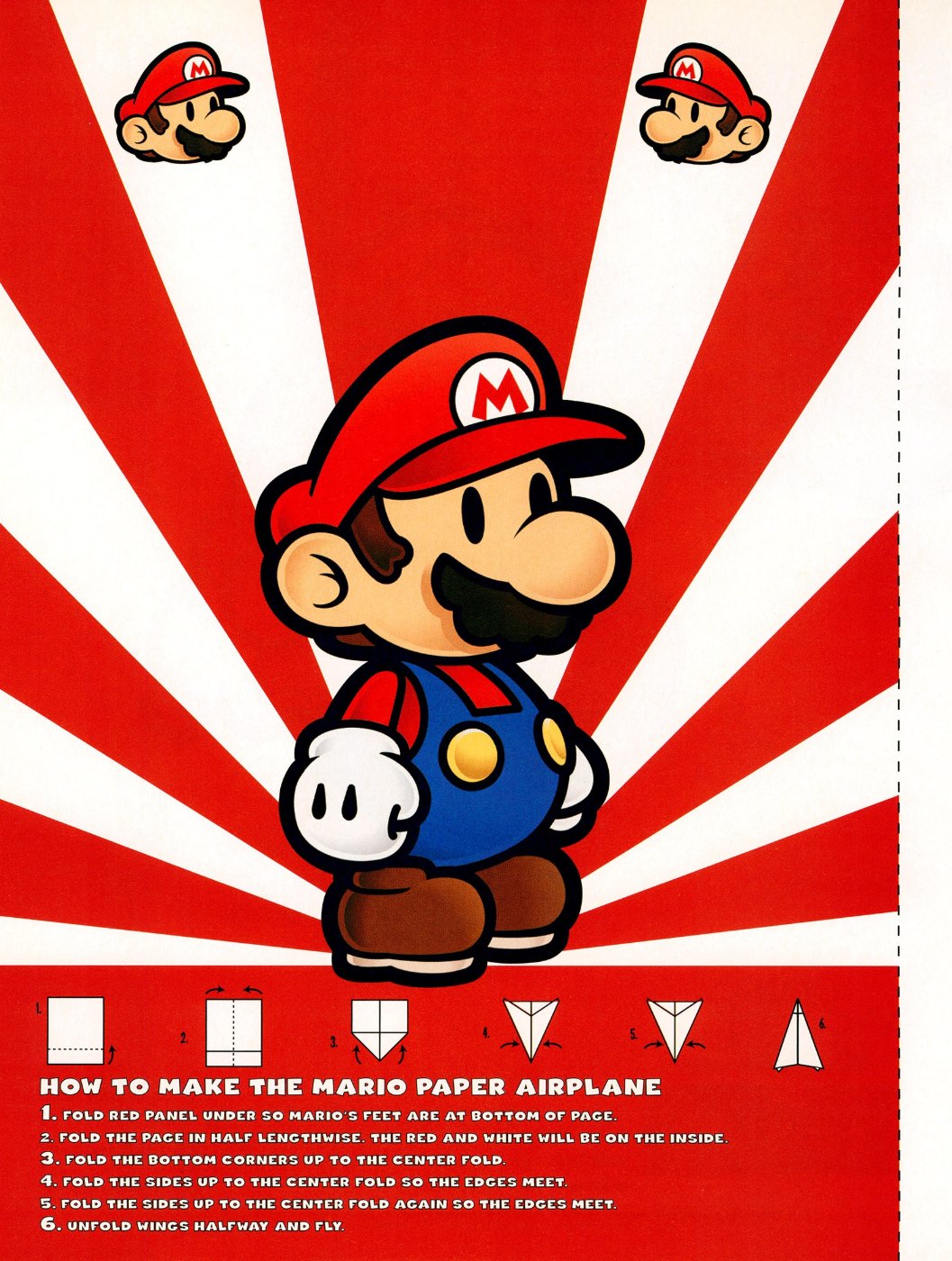 Fold your own MarioPrint advertising · North America and MexicoThe magazine advert ran across two pages, and the facing page could be cut out and folded into a Mario paper aeroplane.
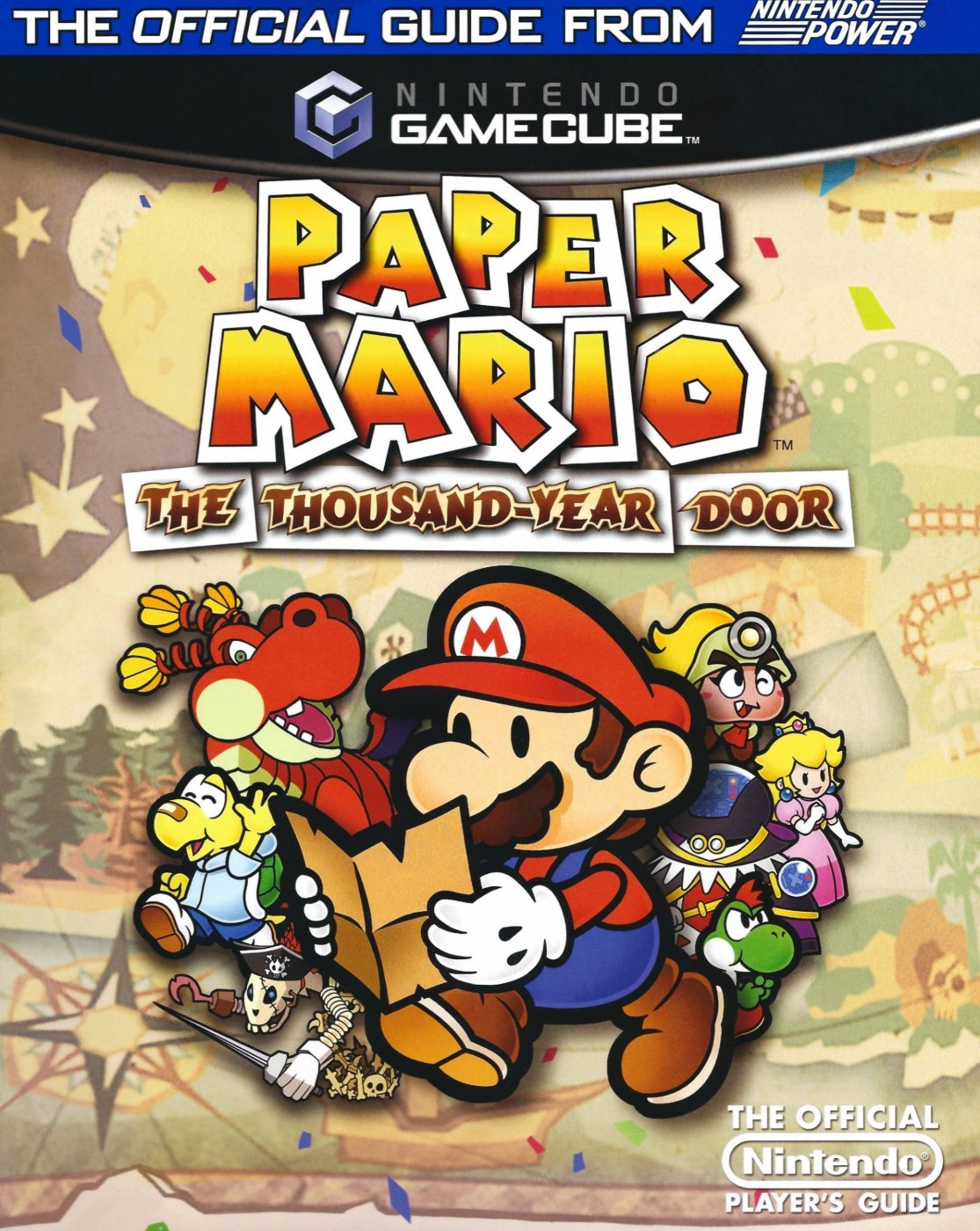 Official Nintendo Power Player’s GuideNintendo Power · 2004Nintendo’s own strategy guide. Its text has a joke the game does not: the X-Nauts, it says, have underestimated a man with long experience of “a certain ape”.
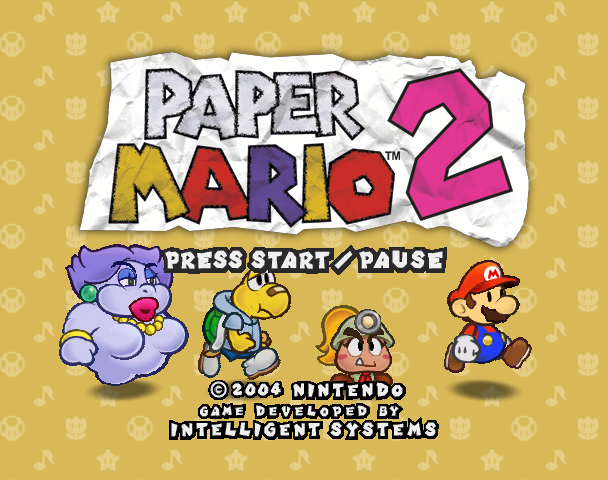 Interactive Multi-Game Demo Disc Version 18Nintendo GameCube · 2004A fifteen-minute demo on a GameCube promotional disc, built before the English script was finished. X-Nauts are “Boomer Gangers”, Glitzville still has its Japanese name of Oolong Town, Rogueport is spelt “Roqueport”, and Goombella, asked for a Tattle, apologises that she is waiting for the final version.
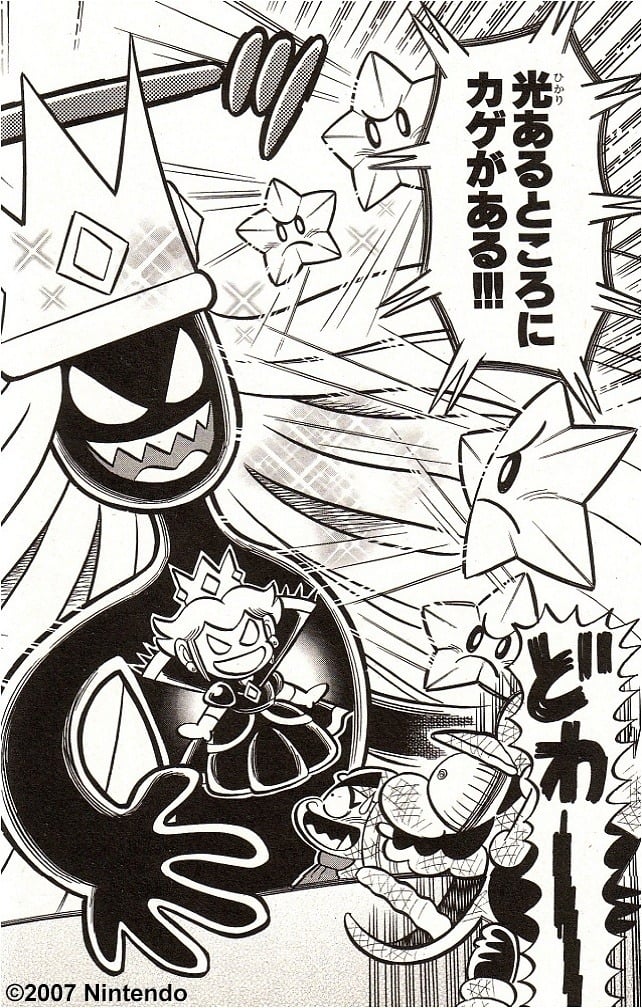 Super Mario-kunYukio Sawada · ShogakukanThe Shadow Queen also turns up in Yukio Sawada’s long-running gag manga.
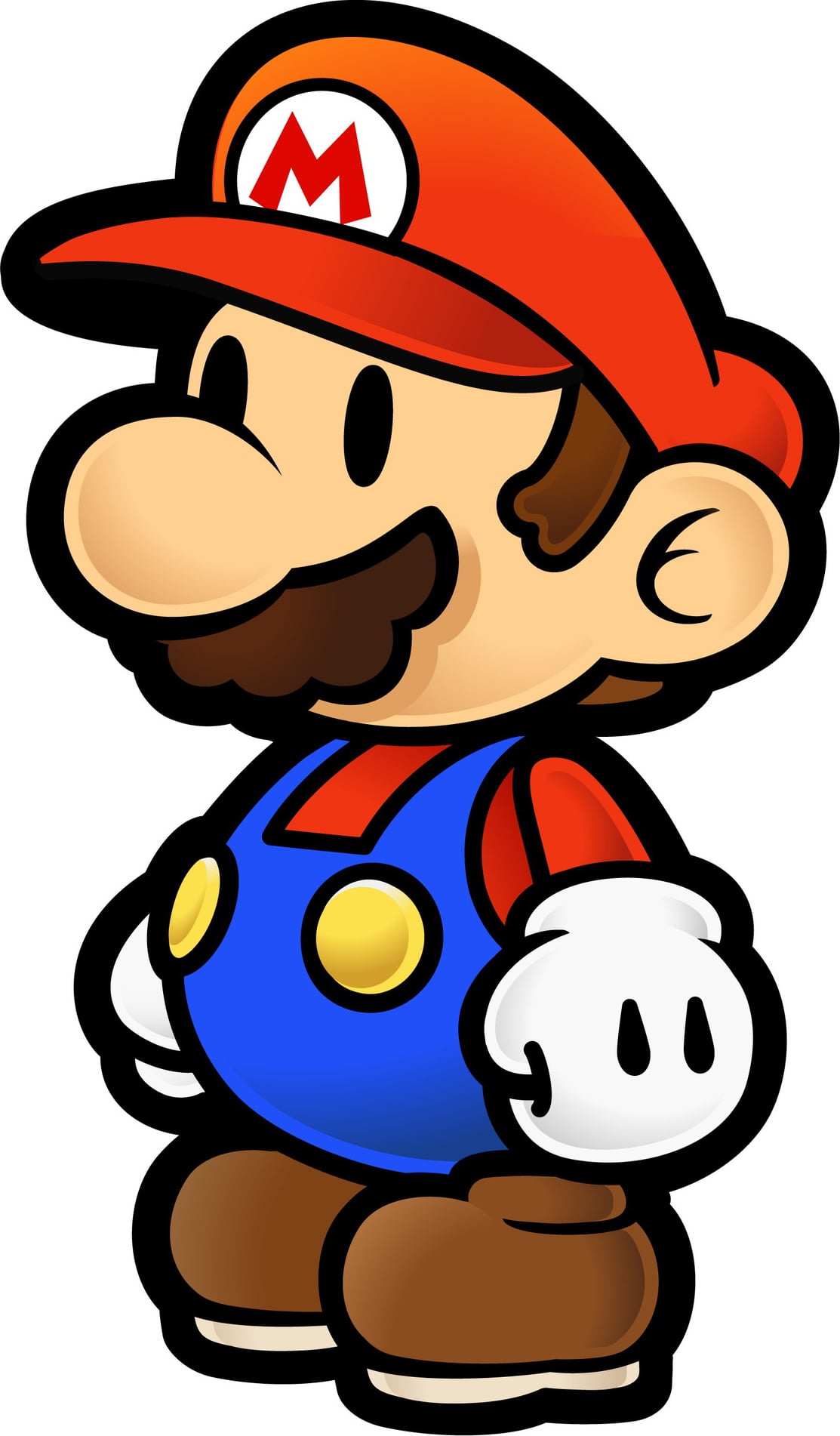 MarioThe Great Gonzales
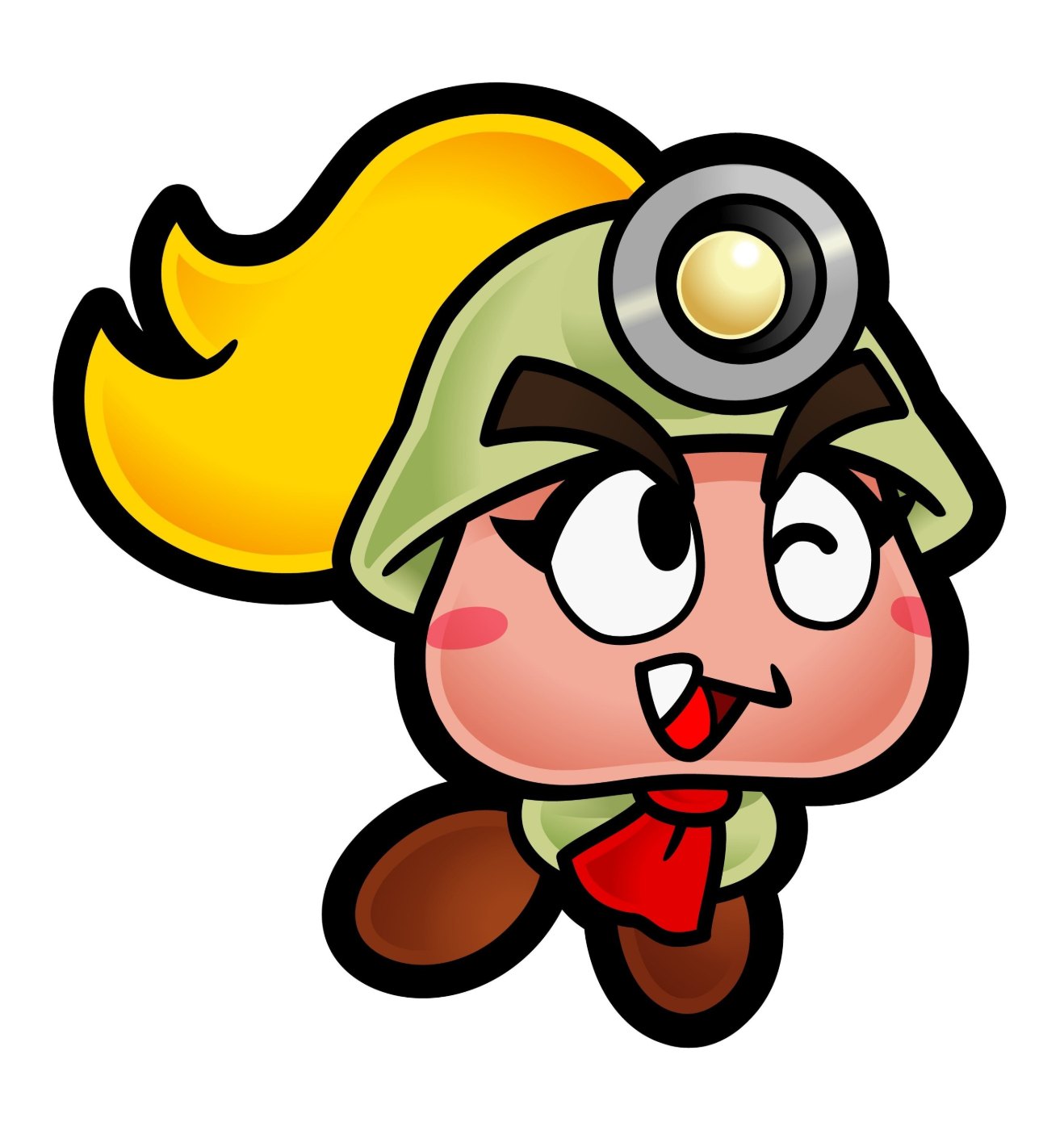 GoombellaPartner 1 · Rogueport, prologue
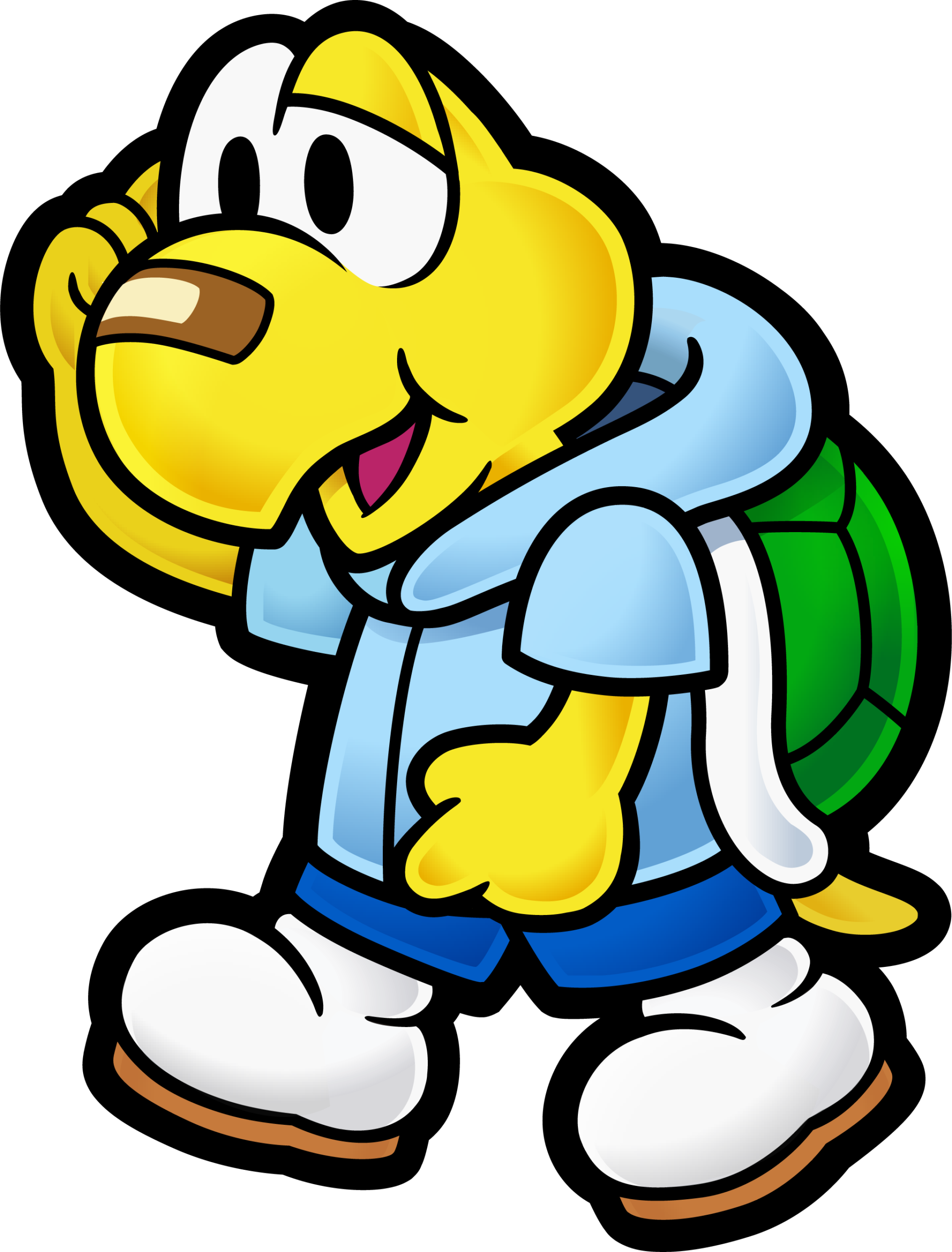 KoopsPartner 2 · Petalburg, Chapter 1
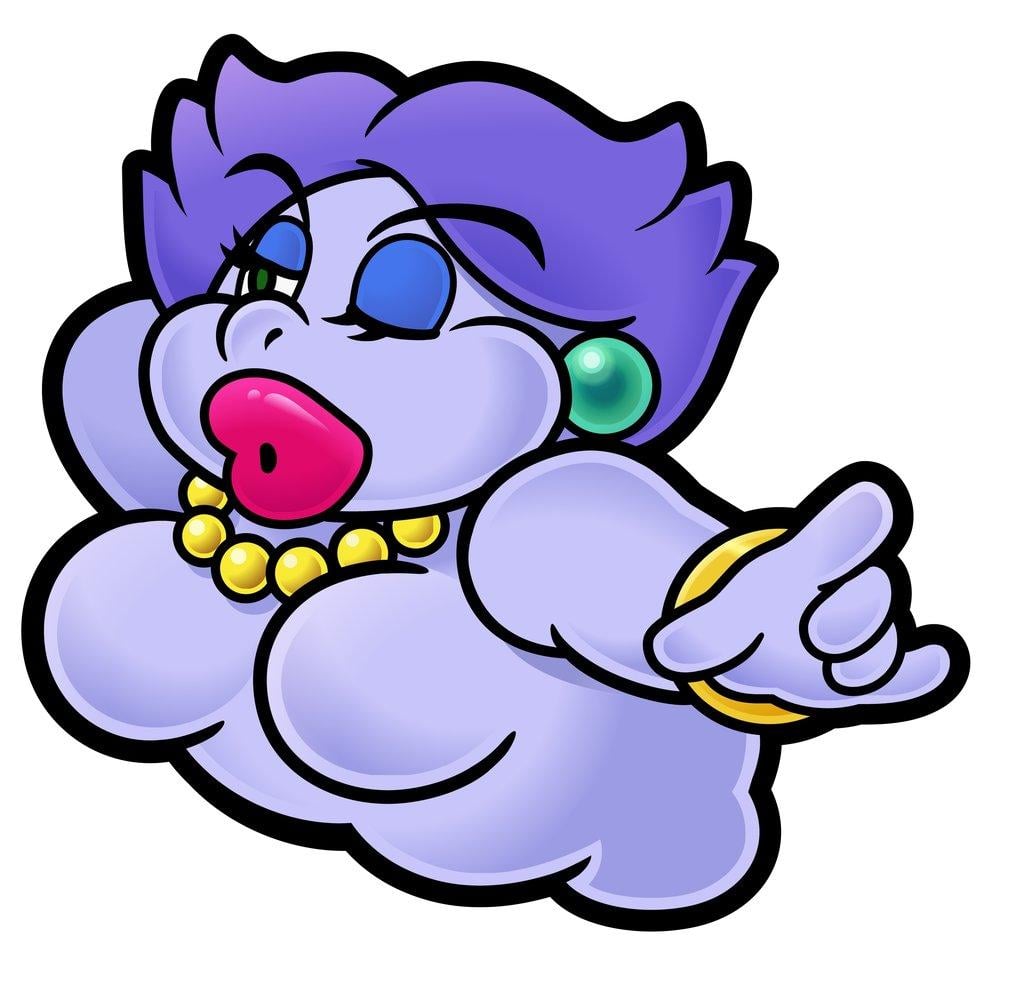 Madame FlurriePartner 3 · Boggly Woods, Chapter 2
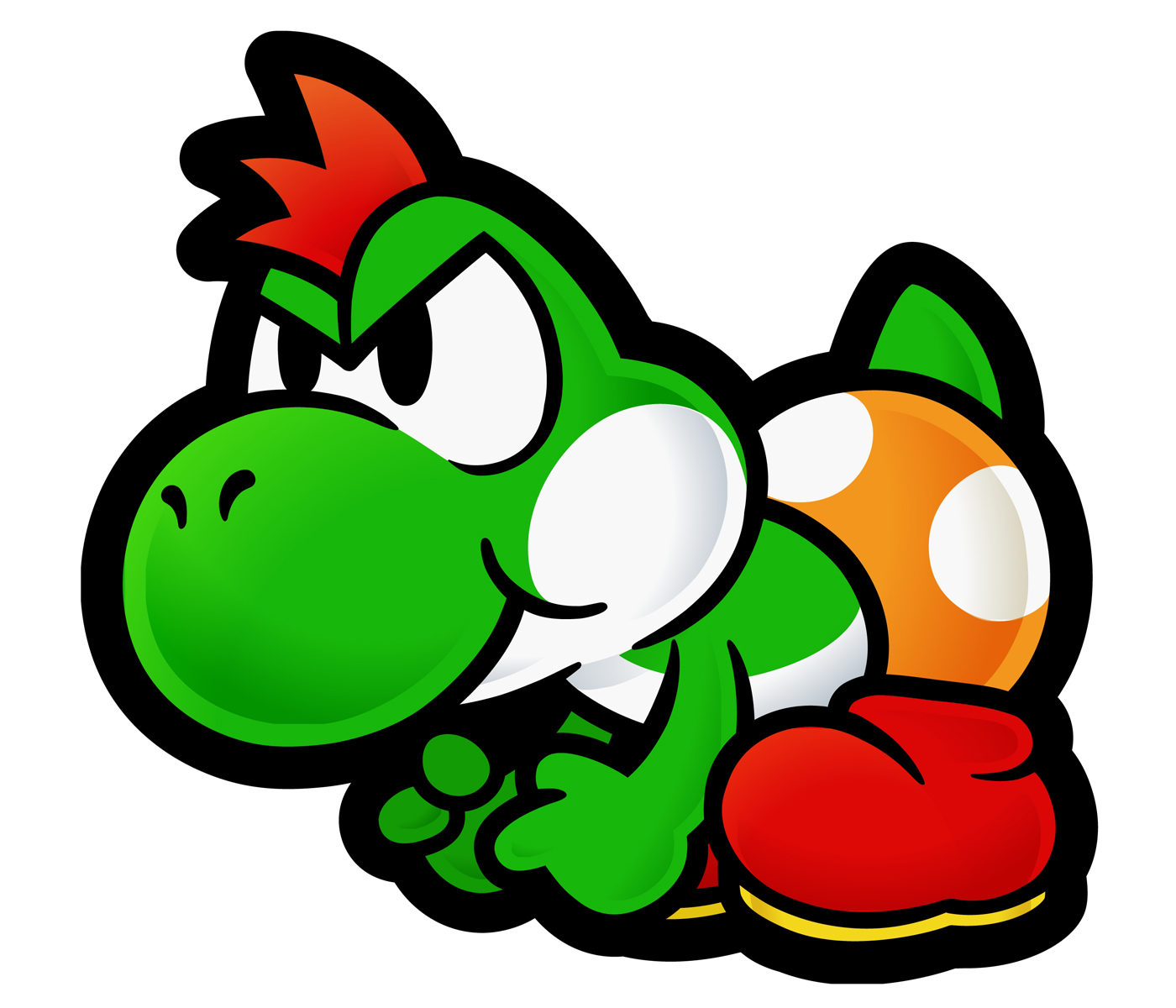 YoshiPartner 4 · Glitzville, Chapter 3
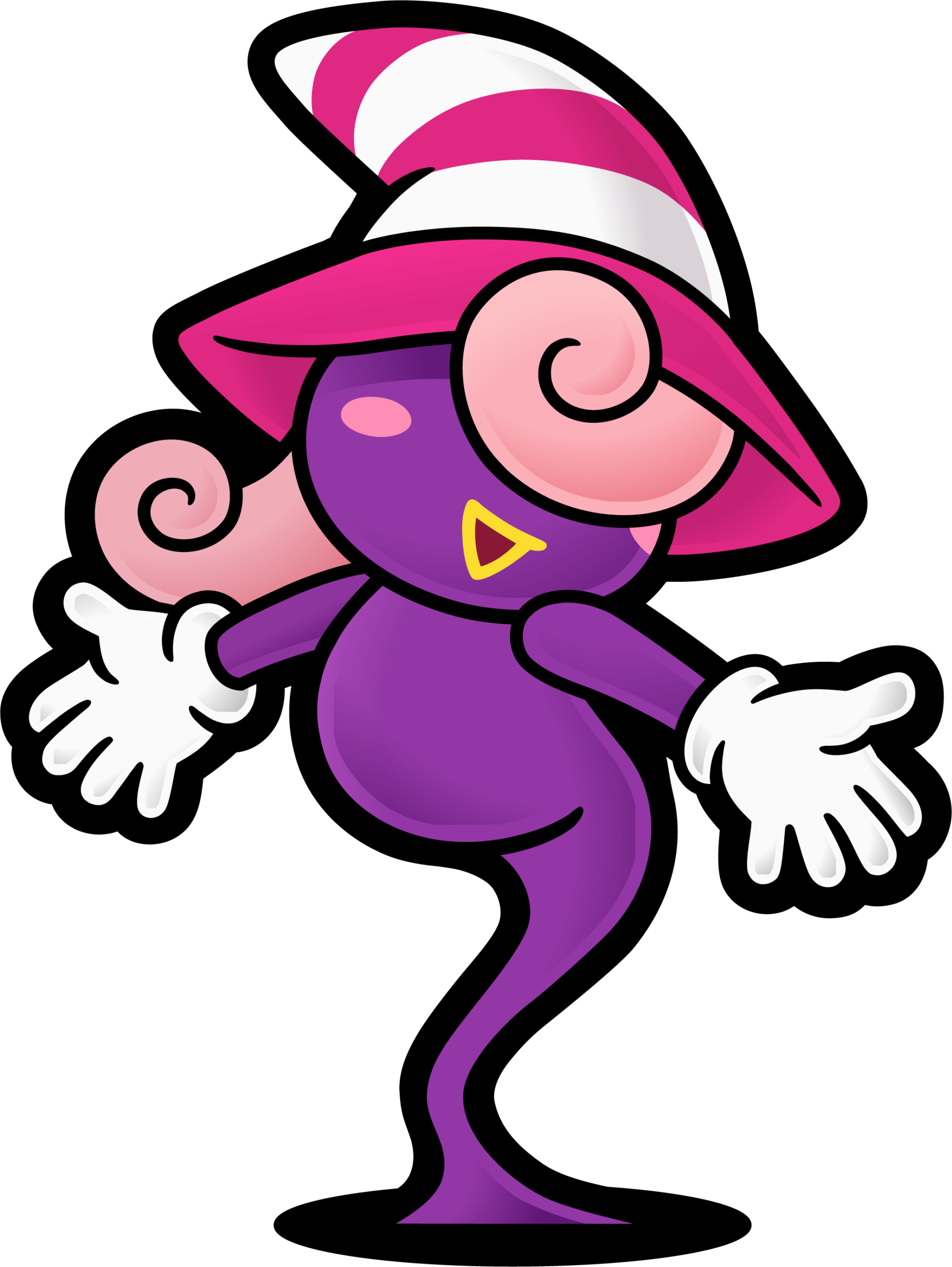 VivianPartner 5 · Twilight Town, Chapter 4
 Admiral BobberyPartner 6 · Keelhaul Key, Chapter 5
 Ms. MowzPartner 7 · optional
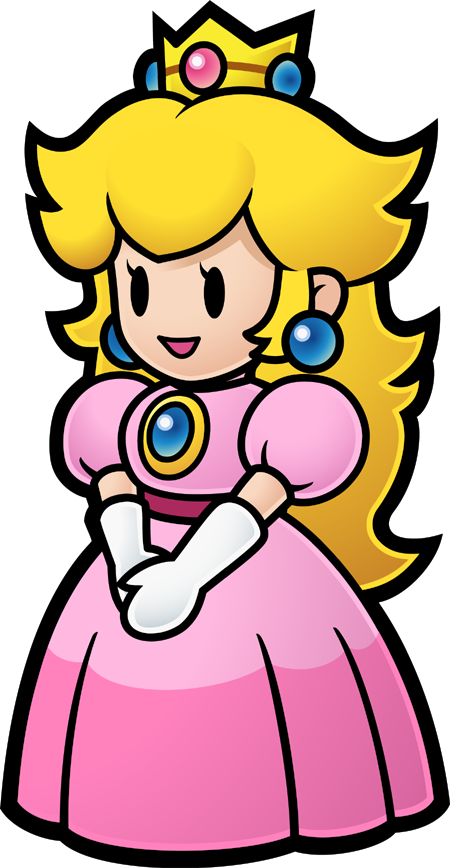 Princess PeachPrisoner of the X-Nauts
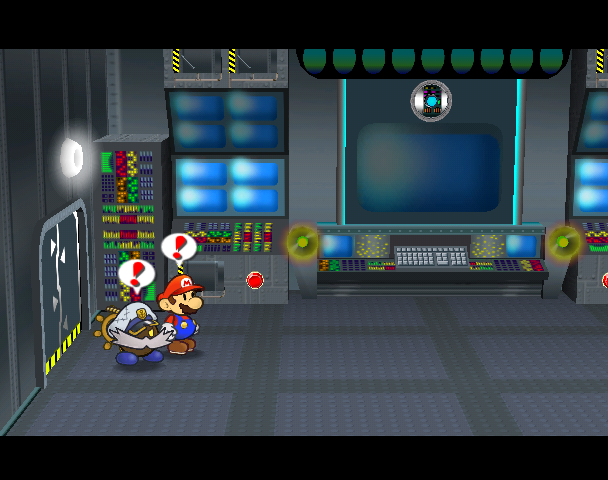 TEC-XXThe X-Nauts’ computer
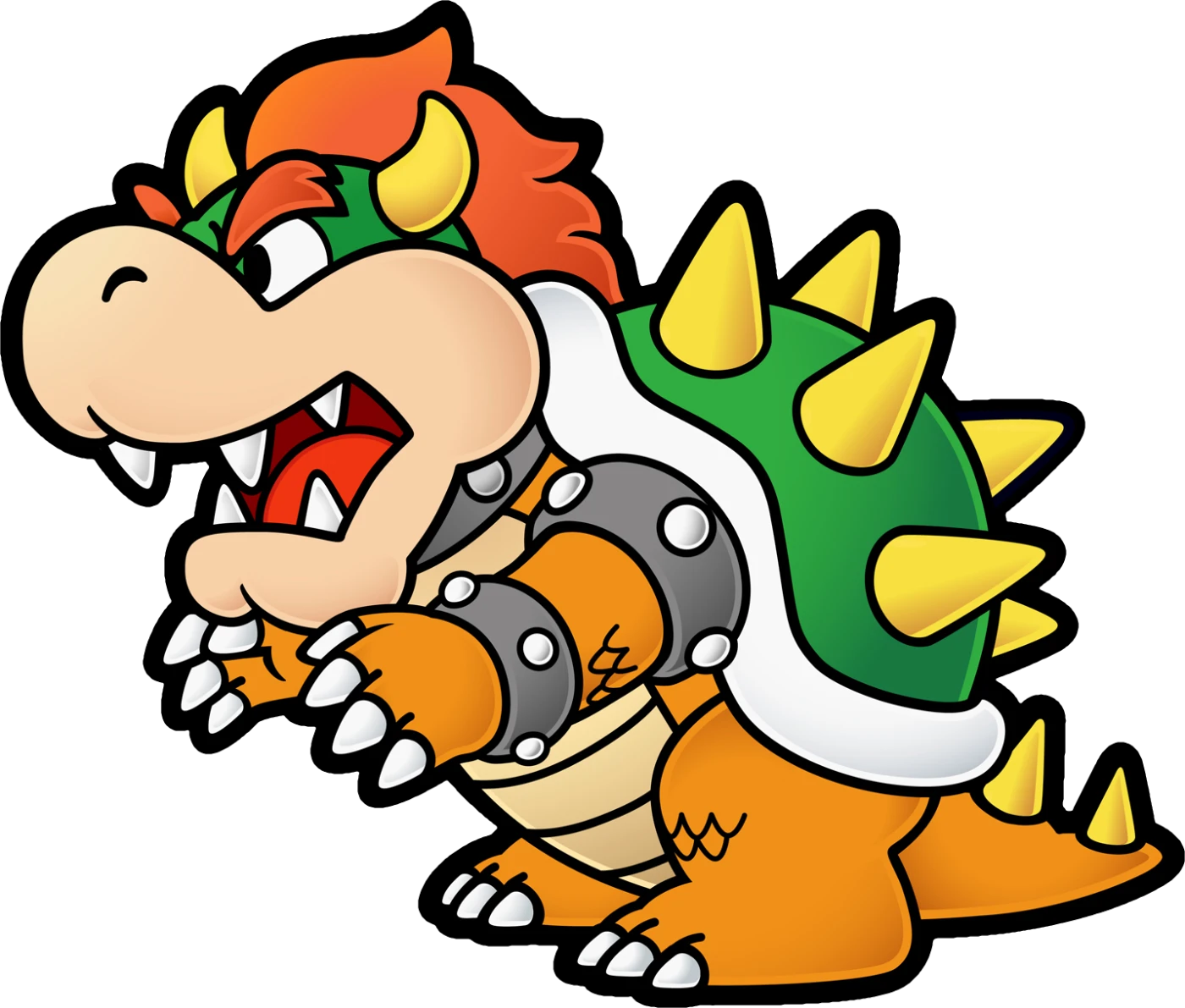 Bowser and Kammy KoopaThird in a two-horse race
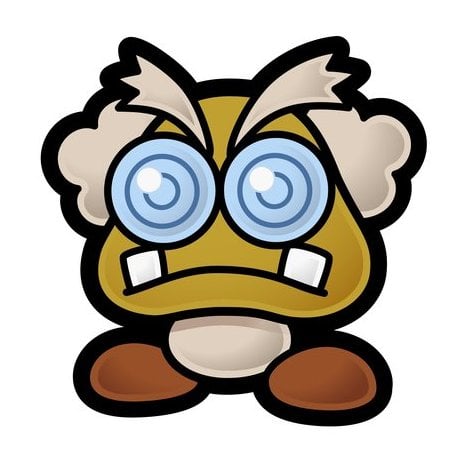 Professor FranklyThe man who reads the map
 LuigiHero of the Waffle Kingdom
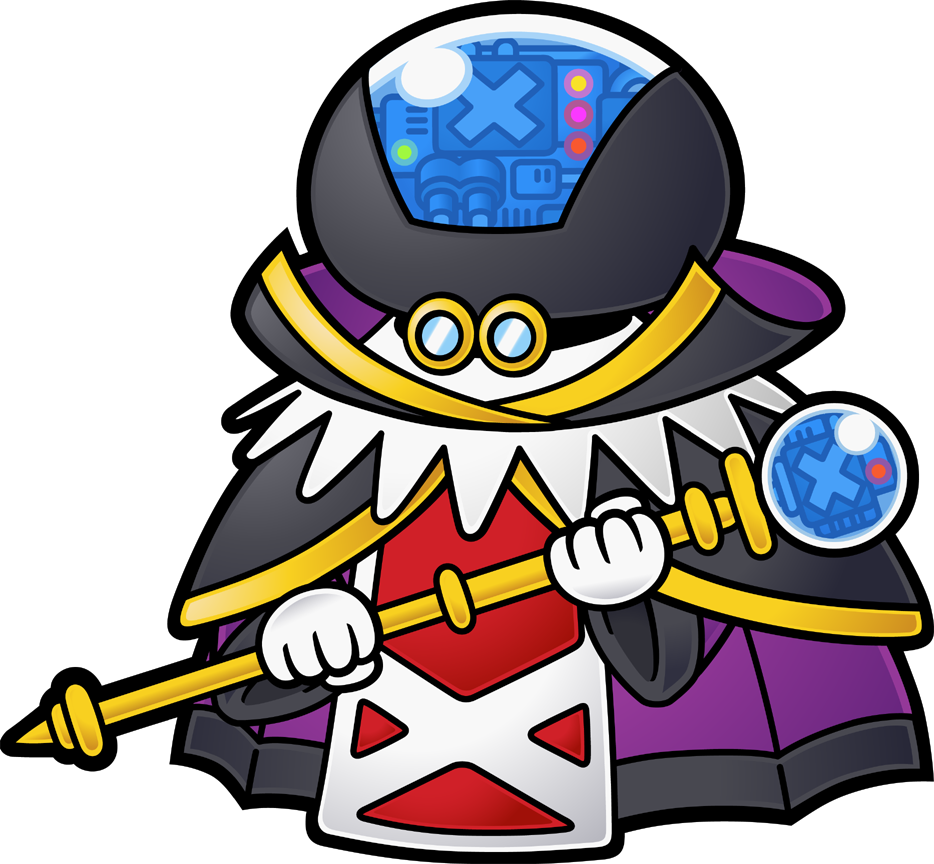 Sir GrodusLeader of the X-Nauts
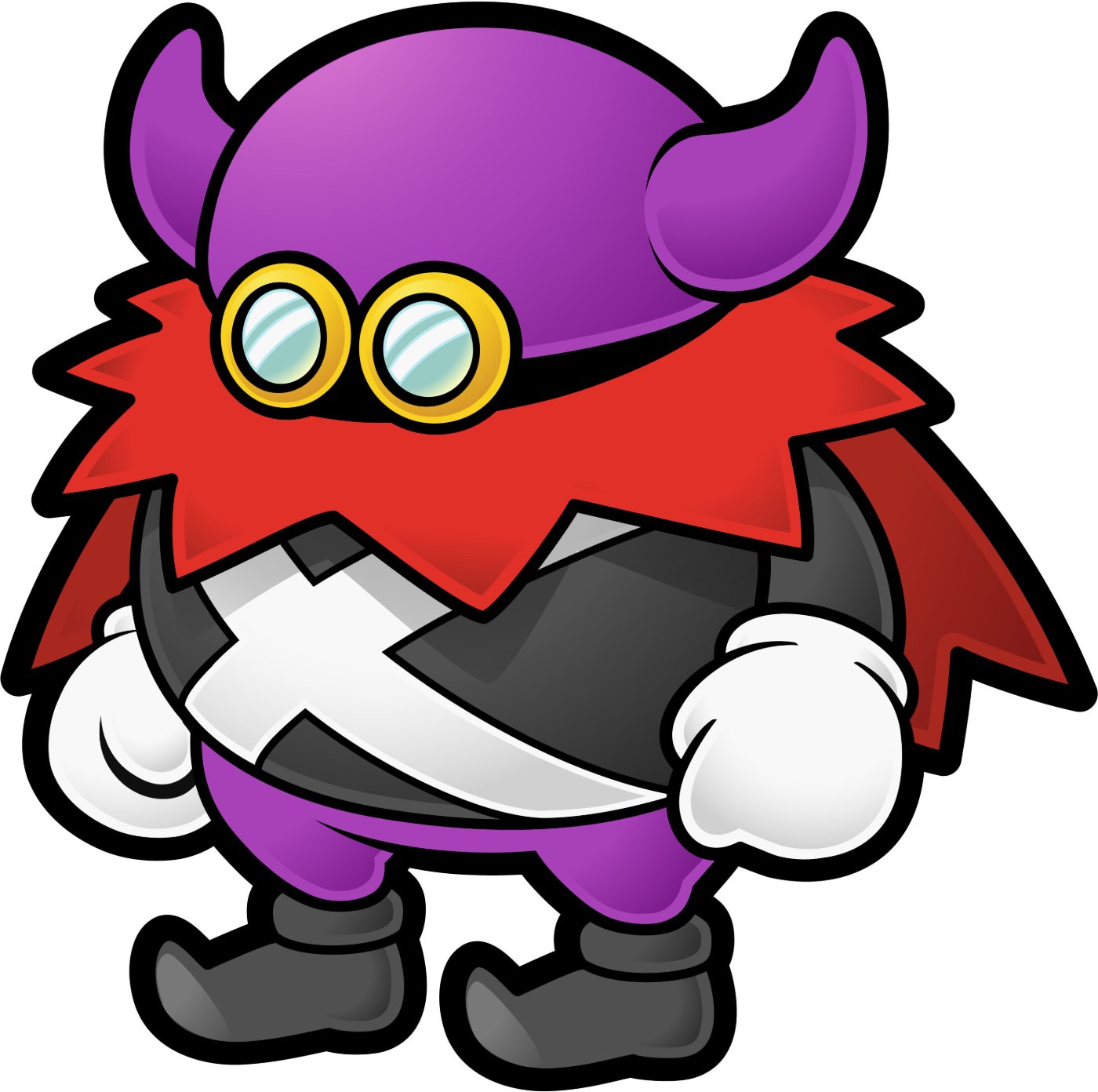 Lord CrumpX-Naut general
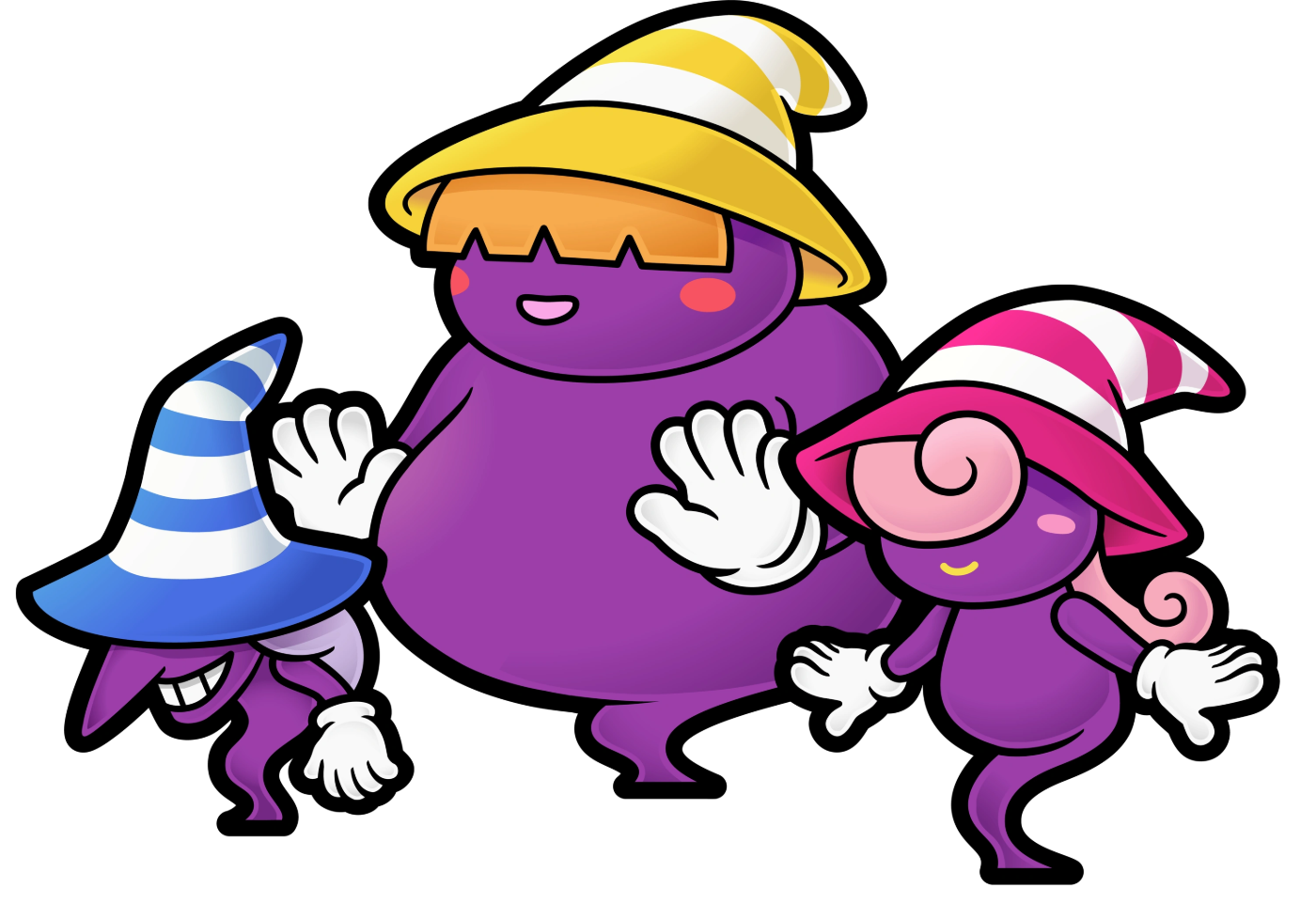 Beldam and MarilynThe Shadow Sirens
 DooplissThe Creepy Steeple’s ghost
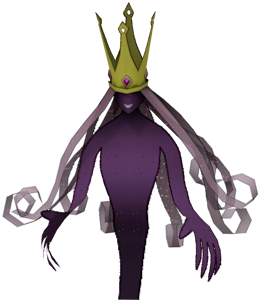 The Shadow QueenWhat is behind the door
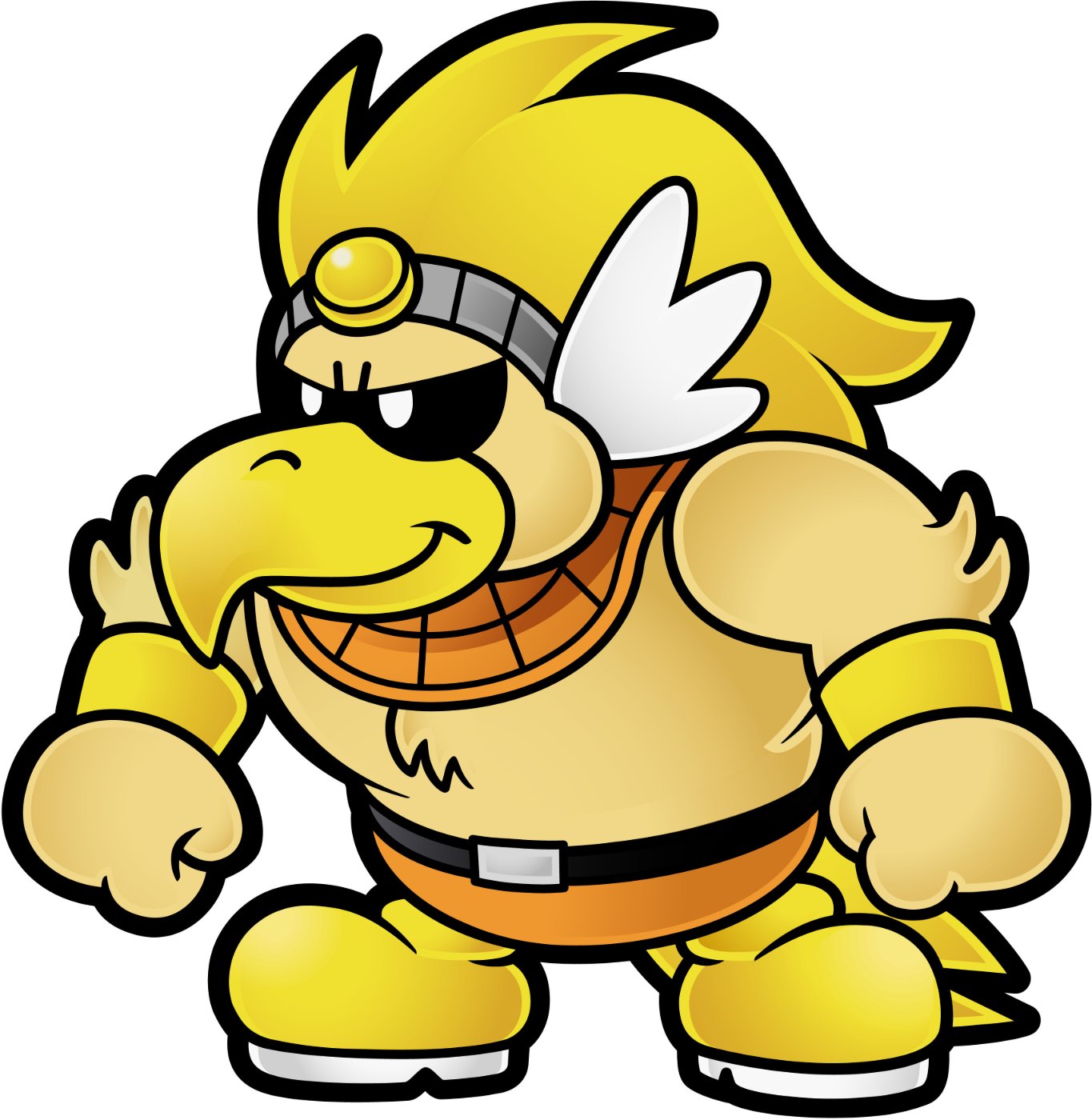 Rawk HawkChampion of the Glitz Pit
 Grubba and JolenePromoter and assistant
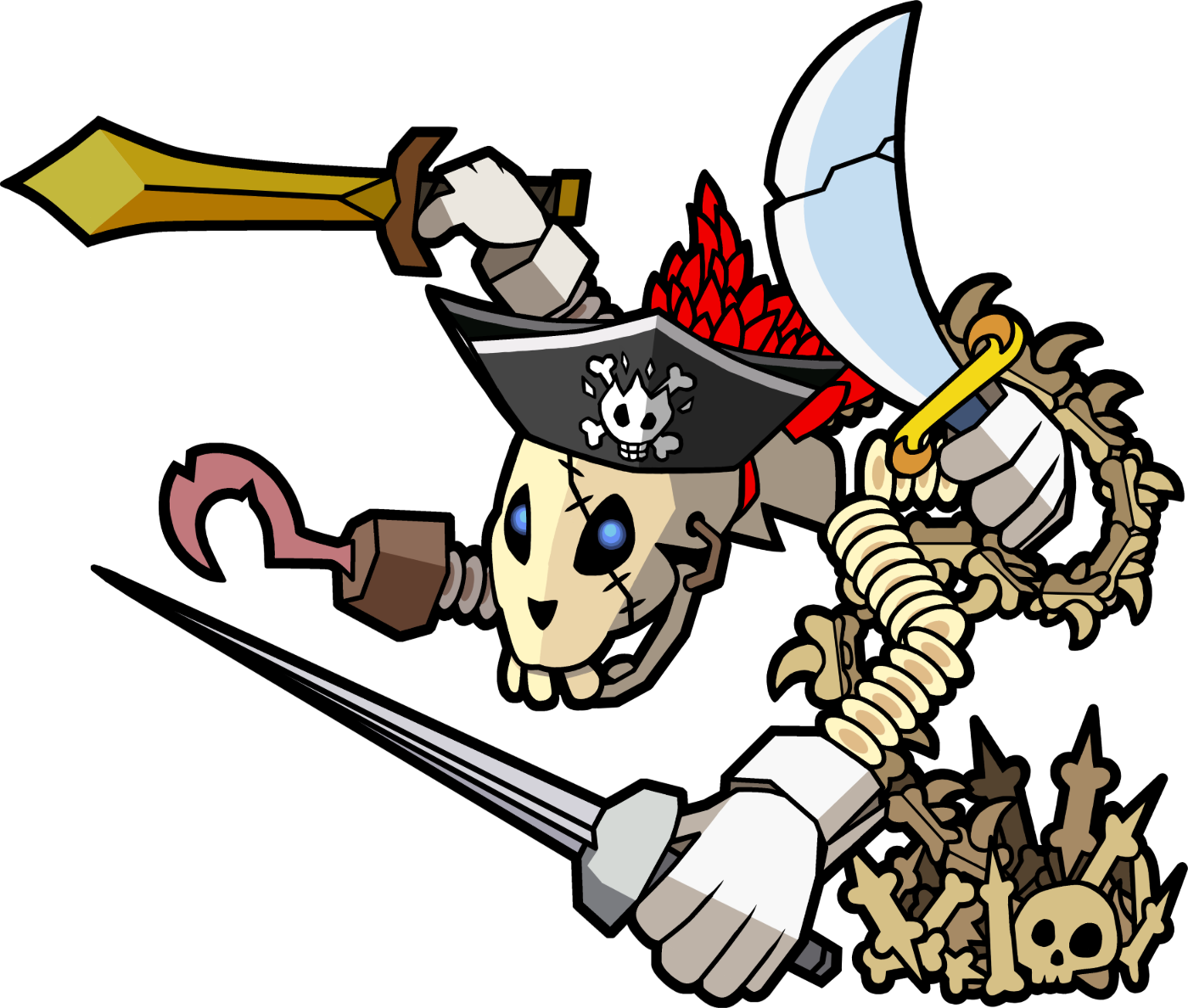 CortezPirate king of Keelhaul Key
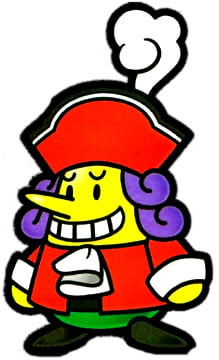 FlavioOwner of the S.S. Flavion
 PenningtonPenguin with the Improbably Large Brain
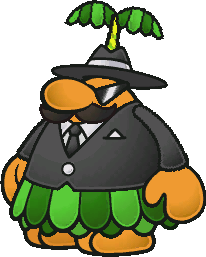 Don PiantaBoss of west Rogueport
 Lord Crump (boss)Prologue · Rogueport · 5 HPThe tutorial fight, which VGFacts says cannot be lost.
 Gus (boss)Prologue · Rogueport · optional · 20 HP, ATK 3A Craw in Rogueport. Fighting him is optional.
 Blooper (boss)Prologue · Rogueport Sewers · 12 HPGuards the pipe to Petal Meadows.
 Gold Fuzzy and the Fuzzy Horde (boss)Chapter 1 · Shhwonk Fortress · 10 HP and 20 HPA golden Fuzzy that calls in a seething mass of its friends.
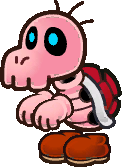 Red Bones (boss)Chapter 1 · Hooktail Castle · 5 HP, ATK 3A red skeleton Koopa backed by four Dull Bones.
 Hooktail (boss)Chapter 1 · Hooktail Castle · 20 HP, ATK 5, DEF 1The dragon. Hates the sound of crickets, eats the audience for 10 HP.
 The Shadow Sirens (boss)Chapter 2 · Boggly Woods · 9, 12 and 10 HPBeldam, Marilyn and Vivian, fought for Flurrie’s necklace.
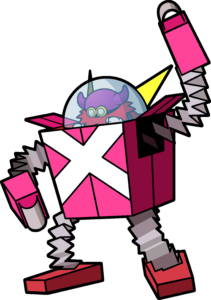 Magnus von Grapple (boss)Chapter 2 · The Great Tree · 30 HP, ATK 2, DEF 1Lord Crump’s robot, with a mighty stomp.
 The Iron Adonis Twins (boss)Chapter 3 · Glitz Pit, rank 10 · 6 HP eachTwo Iron Clefts that nothing can scratch, except each other, courtesy of Yoshi’s Gulp.
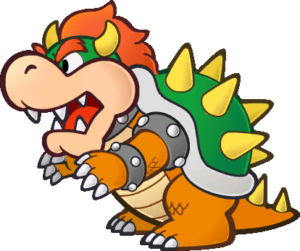 Bowser (boss)Chapter 3 · Glitz Pit · 30 HP, ATK 3, DEF 1Climbs into the ring uninvited after the rank 5 bout.
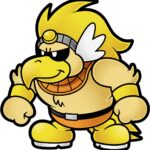 Rawk Hawk (boss)Chapter 3 · Glitz Pit · 40 HP, ATK 4The champion.
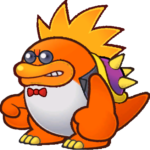 Macho Grubba (boss)Chapter 3 · Glitz Pit · 60 HP, ATK 4Grubba, pumped up by the Gold Star. Boosts his attack and defence and takes extra turns.
 Atomic Boo (boss)Chapter 4 · Creepy Steeple · optional · 40 HP, ATK 4A colossal Boo. Confuses and immobilises; leaves the Lucky Start badge.
 Doopliss (boss)Chapter 4 · Creepy Steeple · 40 HP, ATK 4, twiceFirst as himself, then wearing Mario’s face.
 Three Embers (boss)Chapter 5 · Keelhaul Key · 8 HP eachCortez’s ghostly flames, which Bobbery holds off alone.
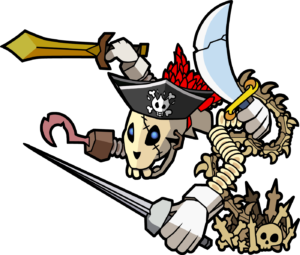 Cortez (boss)Chapter 5 · Pirate’s Grotto · 20 HP × 3, ATK 4, DEF 1Three forms, a poisoned hook and a taste for spectators.
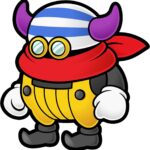 Lord Crump and the X-Nauts (boss)Chapter 5 · the X-Naut ship · 30 HPCrump fights behind stacks and hordes of his own men.
 Smorg (boss)Chapter 6 · Excess Express · 50 HP, ATK 5, DEF 1A swarm of Smorgs in the shape of one monster.
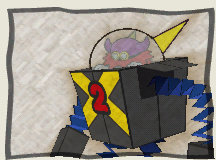 Magnus von Grapple 2.0 (boss)Chapter 7 · X-Naut Fortress · 70 HP, ATK 6, DEF 2The upgrade. Uses the audience as ammunition.
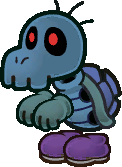 Dark Bones (boss)Chapter 8 · Palace of Shadow · 20 HP, ATK 5, DEF 2A dark skeleton Koopa with four Dry Bones in attendance.
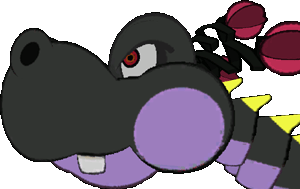 Gloomtail (boss)Chapter 8 · Palace of Shadow · 80 HP, ATK 8, DEF 2Hooktail’s elder brother. Poison breath; drops the key to the Riddle Tower.
 Beldam, Marilyn and Doopliss (boss)Chapter 8 · Palace of Shadow · 30, 40 and 40 HPThe Sirens’ rematch, with a new third member.
 Sir Grodus (boss)Chapter 8 · Palace of Shadow · 50 HP, ATK 7, DEF 1Surrounds himself with Grodus Xs, pictured, which have 3 HP each.
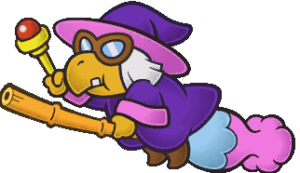 Bowser and Kammy Koopa (boss)Chapter 8 · Palace of Shadow · 70 HP and 50 HPStraight after Grodus. Bowser poisons; Kammy casts every boost she knows.
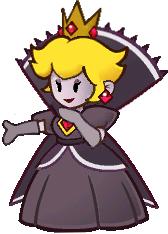 The Shadow Queen (boss)Chapter 8 · Palace of Shadow · 150 HP, ATK 7, DEF 1The final boss, first in Peach’s body and then in her own.
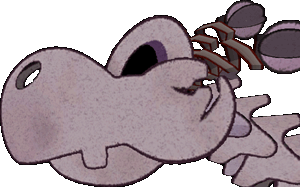 Bonetail (boss)Pit of 100 Trials, floor 100 · 200 HP, ATK 8, DEF 2The third dragon, long dead and still fighting. Freezes, shrinks and sends the party to sleep.
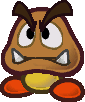 GoombaSewers, Petal Meadows · 2 HPWith Paragoombas and Spiky Goombas, the first things Mario fights.
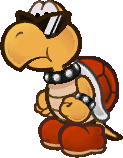 Koopa TroopaPetal Meadows · 4 HP, DEF 1The rank and file of Petal Meadows and Hooktail Castle.
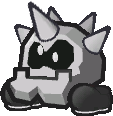 CleftPetal Meadows, Boggly Woods · 2 HP, DEF 2A spiked rock. Bald Clefts, Hyper Clefts and Moon Clefts are its cousins.
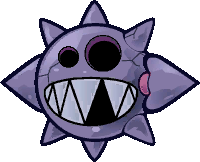 BristlePetal Meadows · 2 HP, DEF 4A spiked stone with four points of defence.
 FuzzyShhwonk Fortress · 3 HPShort-sighted in Japan; international versions gave it better eyes.
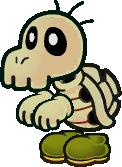 Dull BonesHooktail Castle · 1 HP, DEF 1Skeleton Koopas. Called “Koopa Skeletons” in the demo.
 SpiniaRogueport Sewers · 3 HPThe first of a family: Spania and the fearsome Spunia (12 HP, attack 7) follow.
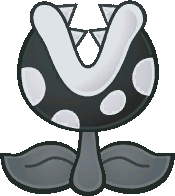 Pale PiranhaBoggly Woods · 4 HPThe Piranha Plant of Boggly Woods; the demo simply called it a Piranha Plant.
 Dark PuffBoggly Woods · 3 HPA storm cloud that electrifies itself.
 X-NautThe Great Tree, X-Naut Fortress · 4 HP, ATK 3Grodus’s foot soldiers. Elite X-Nauts and PhDs staff the fortress.
 YuxThe Great Tree, X-Naut Fortress · 3 HPA security drone that hides behind Mini-Yuxes. Z-Yux and X-Yux are the later models.
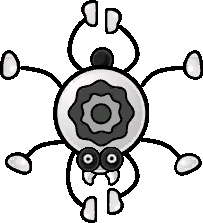 PiderThe Great Tree · 5 HPA spider. Arantula is the Pit version.
 KP KoopaGlitz Pit · 4 HPKing K’s team in the minor league.
 BanditGlitz Pit · 5 HPSteals coins and runs. Only Ms. Mowz can steal them back.
 PokeyGlitz Pit · 4 HP, ATK 3Throws parts of itself, which a Superguard will send straight back.
 LakituGlitz Pit · 5 HPThrows Spinies (3 HP, defence 3).
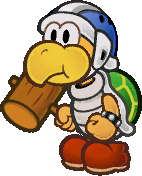 Hammer BroGlitz Pit · 7 HP, ATK 4Fights as Hamma, with Bamma the Boomerang Bro and Flare the Fire Bro.
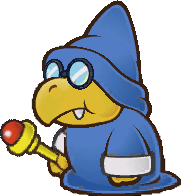 MagikoopaGlitz Pit, Rogueport Sewers · 7 HP, ATK 4Red, white and green ones fight as the Magikoopa Masters.
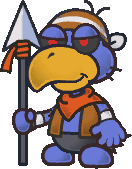 Dark CrawGlitz Pit, rank 4 · 20 HP, ATK 6Fights alone as Craw-Daddy.
 Red ChompGlitz Pit, rank 2 · 6 HP, ATK 5, DEF 3Chomp Country.
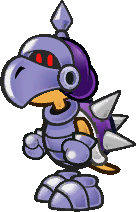 Dark KoopatrolGlitz Pit, rank 1 · 25 HP, ATK 5, DEF 2The Koopinator, the last fighter before the champion.
 Hyper GoombaTwilight Trail · 8 HPCharges up its attack before it strikes.
 Crazee DayzeeTwilight Trail · 7 HPSends the party to sleep.
 Amazy DayzeeTwilight Trail, Pit of 100 Trials · 20 HP, ATK 20Rare, and capable of 20 damage in one go.
 BooCreepy Steeple · 7 HPTurns itself and its friends invisible.
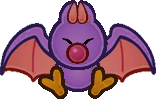 SwooperCreepy Steeple · 6 HPA bat. Swoopula and Swampire are its bigger relations.
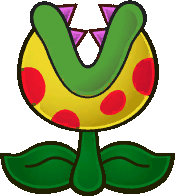 Putrid PiranhaKeelhaul Key · 8 HPIts breath poisons.
 Lava BubblePirate’s Grotto · 6 HP, ATK 4A fireball that burns. Ice Power makes it safe to stamp on.
 Bill BlasterPirate’s Grotto · 5 HP, DEF 2Fires Bullet Bills until it is destroyed.
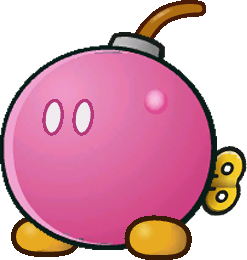 Bulky Bob-ombPirate’s Grotto · 6 HPSwells up and powers up before it blows.
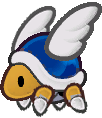 ParabuzzyPirate’s Grotto · 5 HP, DEF 4A flying Buzzy Beetle. The spiky kind arrives at Riverside Station.
 Poison PokeyRiverside Station · 8 HPA Pokey that poisons.
 Dark BooPoshley Sanctum · 8 HP, ATK 5A stronger Boo that now and then drops the Money Money badge.
 Ice PuffFahr Outpost · 9 HPA snow cloud that freezes.
 Frost PiranhaFahr Outpost · 10 HP, ATK 5Its bite can freeze.
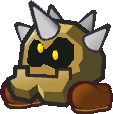 Moon CleftThe Moon · 6 HP, ATK 5, DEF 5The toughest Cleft of all.
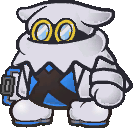 X-Naut PhDX-Naut Fortress · 9 HPBurns, shrinks and makes its allies dodgy.
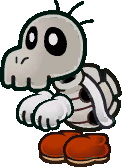 Dry BonesPalace of Shadow · 8 HP, ATK 5, DEF 2The palace’s rank and file.
 Chain-ChompPalace of Shadow · 7 HP, ATK 6, DEF 5Nearly immune to anything that does not pierce defence.
 Phantom EmberPalace of Shadow · 10 HP, ATK 5A stronger Ember.
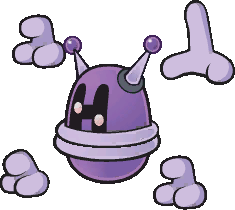 Dark WizzerdPalace of Shadow · 10 HP, ATK 5, DEF 2A sorcerer that makes itself huge. Wizzerds and Elite Wizzerds live in the Pit.
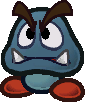 GloombaPit of 100 Trials, floors 1–9 · 7 HPThe Pit’s Goomba, with winged and spiked versions further down.
 Badge BanditPit, floors 51–59 · 12 HPSteals a badge. Beat it before it flees and it drops what it took.
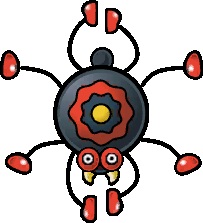 ArantulaPit, floors 81–89 · 16 HP, ATK 7The Pit’s answer to the Pider.
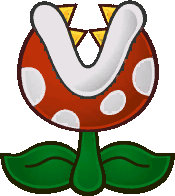 Piranha PlantPit, floors 81–89 · 15 HP, ATK 9Attack 9, the highest of any ordinary enemy bar the Amazy Dayzee.
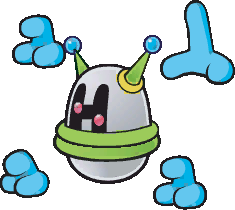 Elite WizzerdPit, floors 91–99 · 12 HP, ATK 8, DEF 5Boosts its own attack and defence and electrifies itself.
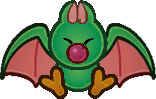 SwampirePit, floors 91–99 · 20 HPThe last of the bats. Sometimes drops Lucky Day.
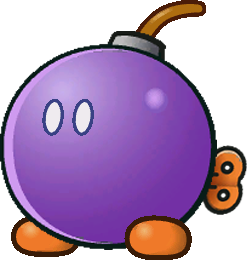 Bob-ulkPit, floors 91–99 · 10 HPAn even bulkier Bulky Bob-omb.