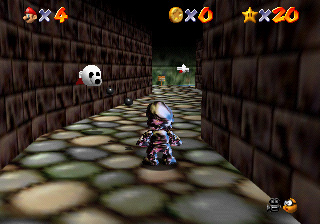
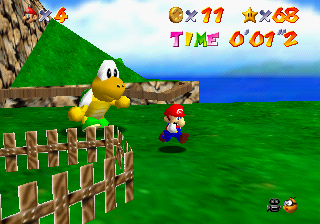
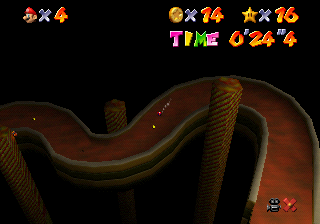
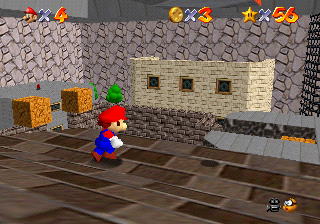
Nintendo 6419963D platformerNintendo EADLaunch title120 Power Stars11.9 million soldEdge’s first 10/10Mario’s 3D debut
Super Mario 64
Princess Peach has baked a cake, and the invitation is the last normal thing that happens. Super Mario 64 launched the Nintendo 64 on 23 June 1996 in Japan and 29 September 1996 in North America, and with it the idea of a fully three-dimensional Mario: an analogue stick for walking, jogging and sprinting, a camera you steer yourself, and a plumber who can triple jump, wall kick, long jump, dive and swim through 15 painting-worlds hanging in Peach’s castle. There are 120 Power Stars to find, three fights with Bowser that end with him swung by the tail, and a cast of Boos, Bob-ombs, penguins and a rabbit named after a microprocessor.
Directed by Shigeru Miyamoto with a team of fewer than twenty, it sold 11.91 million copies, became the first game to earn a 10 from Edge, and taught every 3D platformer that followed how to move. Nintendo has re-released it on Wii, Wii U, Switch and in a 2004 DS remake with Yoshi, Luigi and Wario.
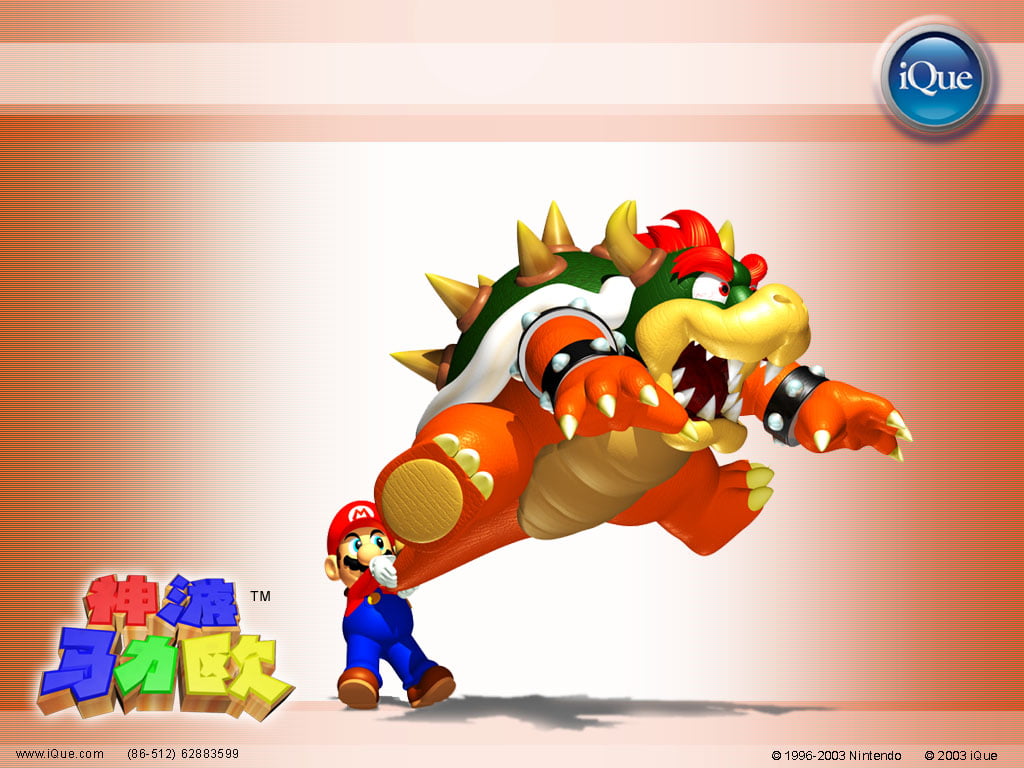
Re-releases:iQue Player (2003), Wii VC (2006), Wii U VC (2015), Super Mario 3D All-Stars (2020), Nintendo Switch Online (2021)
Advertisement
Overview
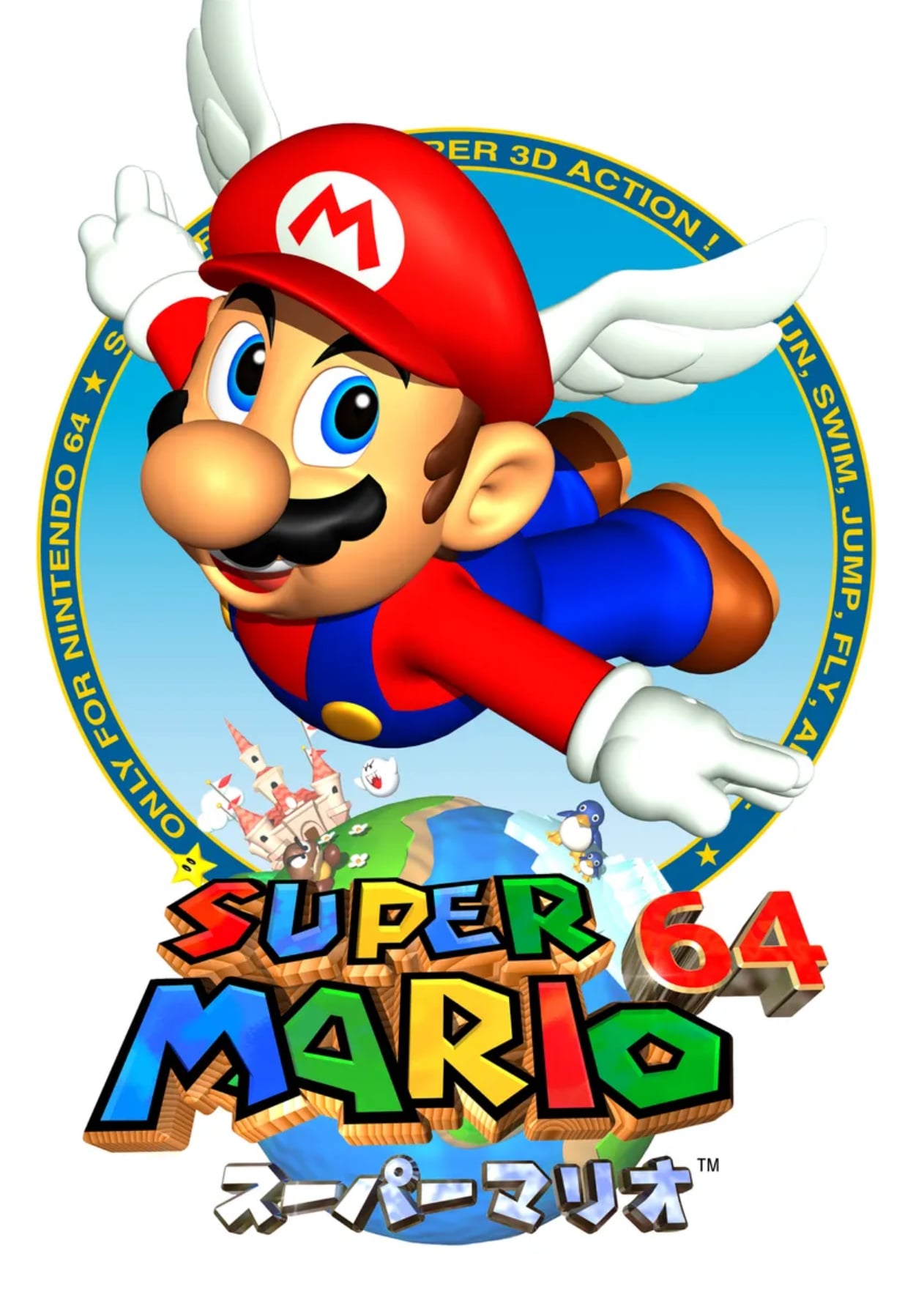
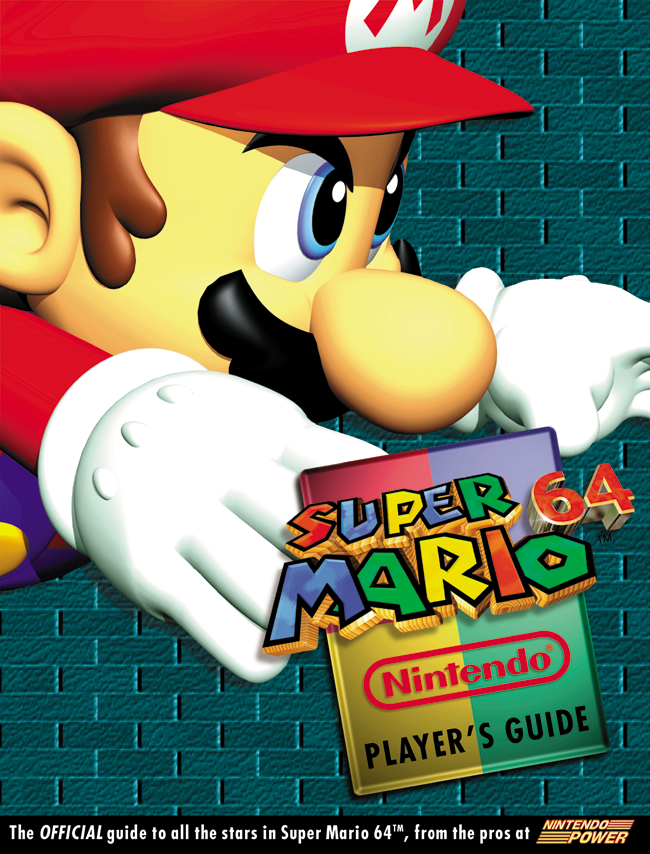
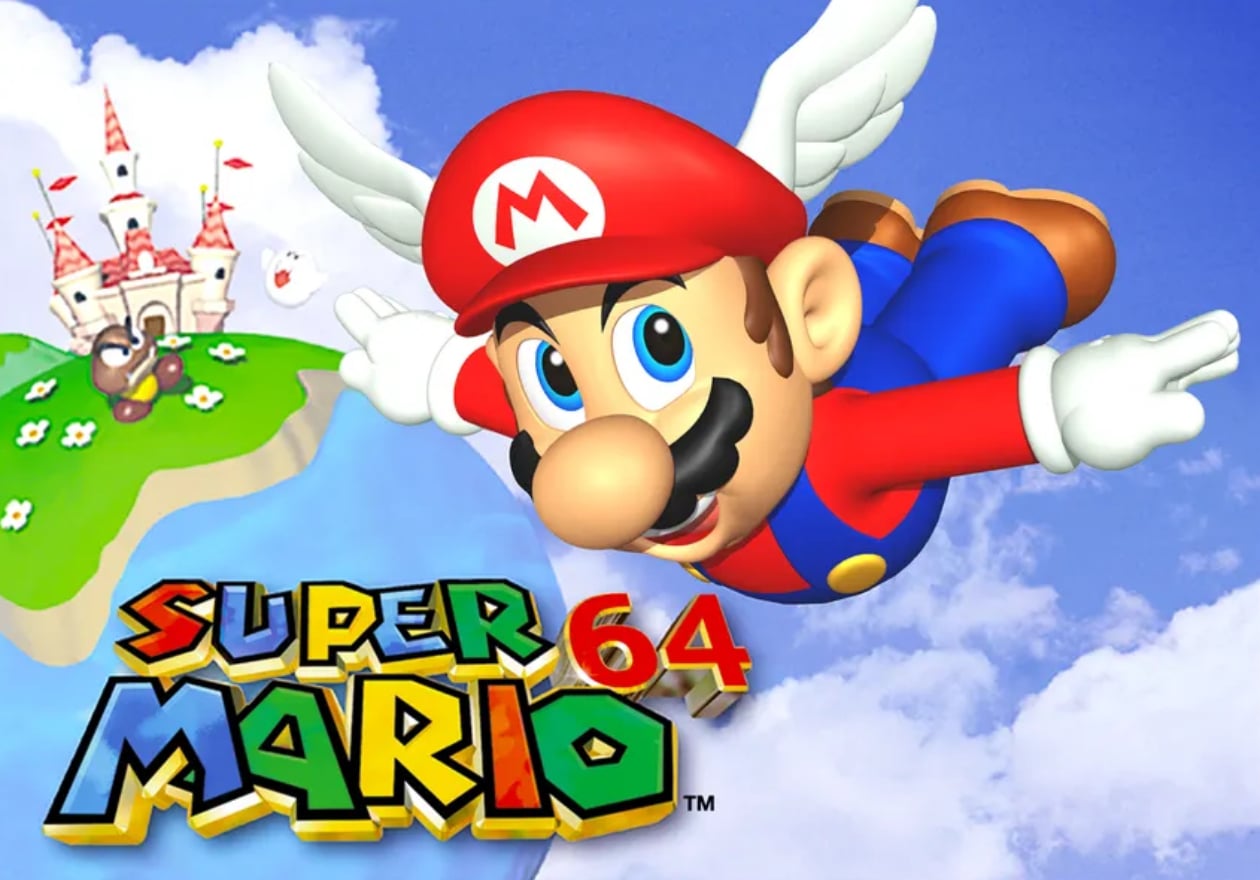
Mario on top of the world: Nintendo’s key artwork for the N64 launch.
There is a moment, a few seconds into Super Mario 64, that people who were there in 1996 still talk about. Mario pops out of a pipe on the castle lawn, you nudge the Nintendo 64’s strange new analogue stick, and he walks. Push further and he jogs, then runs; let go and he skids to a halt. Nobody had moved a character through a 3D world like this before, and Nintendo knew it: the whole game is a playground built to make you want to move.
The set-up could not be simpler. Peach invites Mario round for cake, Bowser has got there first, and the Power Stars that protect the castle have been stolen and scattered through the paintings on its walls. Jump into a picture and you land in a course, each one a compact, self-contained world with six named missions and a seventh star for collecting 100 coins. Pick a mission from the menu, go and get its star (or any other you can reach), and come back to the castle, where new doors open as your total climbs. Seventy stars and three bouts with Bowser finish the story; 120 is the full set, and a familiar green dinosaur is waiting on the roof for anyone who manages it.
Miyamoto directed with a team he put at fifteen to twenty people, building the game alongside the console and its controller. Yoshiaki Koizumi animated Mario and designed the camera system that put a Lakitu cameraman on the player’s shoulder; Koji Kondo wrote a score that ranges from the bouncing Bob-omb Battlefield theme to the drowsy underwater waltz of Dire, Dire Docks; and Charles Martinet, in his first major game, gave Mario a voice that went “Wahoo!”.
It launched the N64 in every region, sold 11.91 million copies to become the console’s best-seller, was the first game to receive a 10 from Edge, and sits in or near the top ten of almost every all-time list ever compiled. The 1997 Japanese Shindou revision added Rumble Pak support and removed the backwards long jump; a 2004 DS remake added three more heroes; and Super Mario 3D All-Stars and Nintendo Switch Online brought it to modern televisions. Speedrunners, modders and the makers of Banjo-Kazooie, Psychonauts and Half-Life have all acknowledged the debt.
Invited to Princess Peach’s castle, Mario discovers that she has once again been kidnapped by Bowser and his minions. However, something has changed… This time the adventure is in 3D!
Leaping through pictures hanging from the walls, Mario searches for 120 Power Stars stashed away in vast, magical worlds teeming with daunting obstacle courses, hidden items, puzzles and an army of enemies! Mario has a huge repertoire of moves, including running, jumping, swimming, stomping and punching, and performing a backward somersault that can help him reach even the highest platforms. Special caps give him short-lived powers, including the ability to fly – and if troublemakers swipe Mario’s cap, he’ll have to grab it back!
— Official description (Nintendo UK, 2006)
Why Super Mario 64 matters to Mario fans
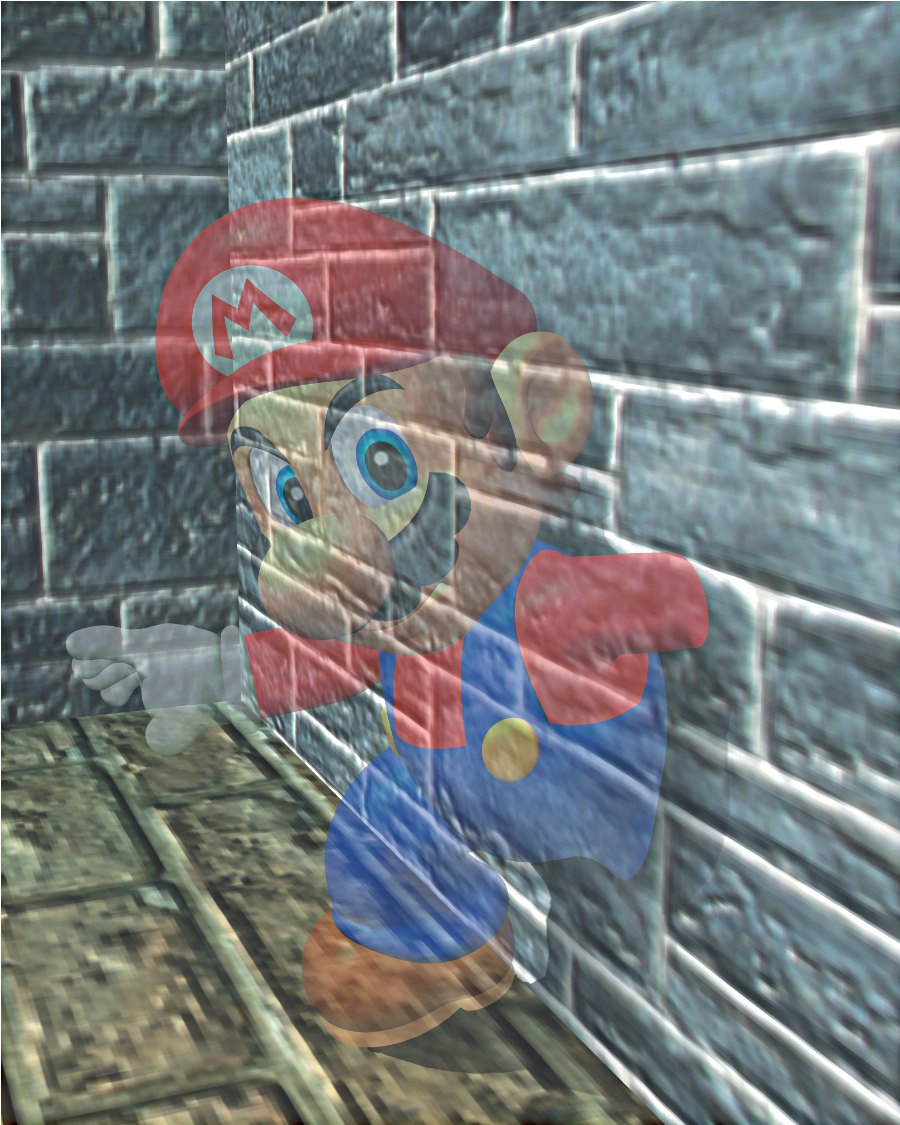
This is the hinge of the whole series. Everything before it is flat; everything after it, from Sunshine and Galaxy to Odyssey, is built on the moves, the camera and the hub-and-missions structure invented here. It is also where Peach’s castle, Charles Martinet’s voice, Mario’s triple jump and wall kick, and the Lakitu cameraman all enter the canon. And it is the first home-console Super Mario adventure in which Luigi does not appear at all, a fact that kept fans arguing for 24 years.
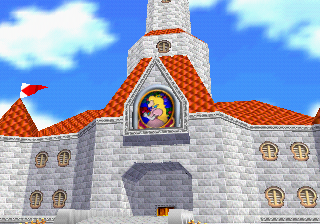
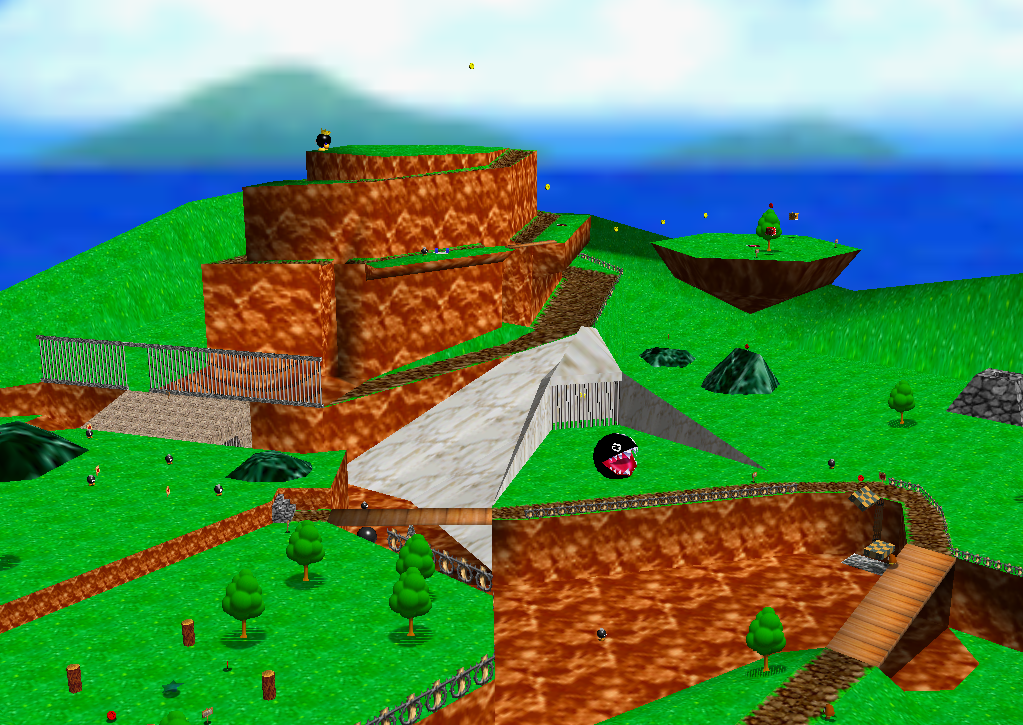
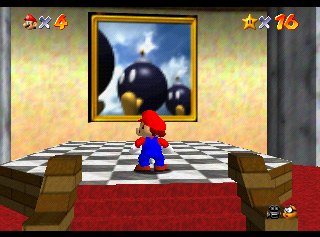
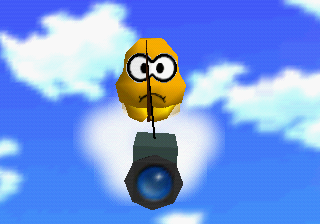
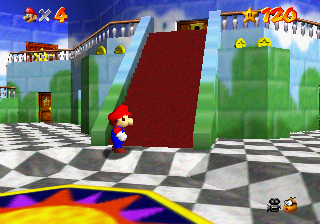
Peach’s castle, the hub for the whole adventure.Bob-omb Battlefield, the first course and the first level the team finished.Mario dives into the Bob-omb Battlefield painting.The Lakitu Bros. report live from the castle grounds.
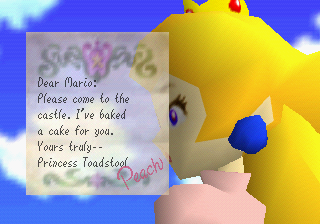
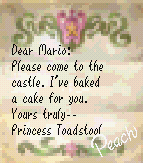
“Dear Mario: Please come to the castle. I’ve baked a cake for you. Yours truly, Princess Toadstool”
In-game text: Nintendo, Super Mario 64 (1996), opening letter, signed “Peach”.
Peach’s letter opens the game and is just about the only written set-up it needs. Everything else is told through the castle itself: a locked door, a voice booming from nowhere, a Toad who has seen what Bowser did to the paintings.
Quick Answers
The questions people ask most about Super Mario 64, answered here and in depth below.
When did Super Mario 64 come out?
It launched with the Nintendo 64 in each region: Japan on 23 June 1996, North America on 29 September 1996, and Europe and Australia on 1 March 1997. More →
How many stars are there, and how many do you need?
120 Power Stars in all: 105 in the fifteen main courses (seven each), and 15 more from the Bowser courses, the secret courses and the castle. Seventy are enough to climb the endless staircase and finish the game. More →
How many courses are there?
Fifteen main courses reached through paintings and portals, three Bowser courses, three Cap Switch courses and three other secret courses (the Princess’s Secret Slide, the Secret Aquarium and Wing Mario Over the Rainbow). More →
What do you get for 120 stars?
A cannon opens outside the castle that fires Mario onto the roof, where Yoshi hands over 100 extra lives and a sparkling new triple jump. Bowser also has a different speech if you fight him again. More →
Where is Luigi?
Not in the game. He was part of the project until February 1996, in a planned two-player mode, and was cut for memory reasons. He finally joined the adventure in Super Mario 64 DS in 2004. More →
What is the backwards long jump?
A glitch: long jumping backwards up a staircase or slope while tapping A builds absurd speed, enough to break through the endless staircase and reach Bowser with far fewer than 70 stars. Nintendo removed it in the 1997 Shindou version and in 3D All-Stars. More →
What is the Shindou version?
A Japanese re-release from 18 July 1997 with Rumble Pak support, the English voice acting, bug fixes (including the backwards long jump) and a few changed lines. Super Mario 3D All-Stars is based on it. More →
Is Super Mario 64 DS the same game?
Mostly. The 2004 remake has the same castle and courses, but adds Yoshi, Luigi and Wario as playable characters, 30 extra stars for 150, new bosses, touch-screen minigames and wireless multiplayer. More →
Where can I play it today?
On Nintendo Switch through Nintendo Switch Online + Expansion Pack (Nintendo 64 library, since October 2021), or in Super Mario 3D All-Stars if you bought it before it was withdrawn in March 2021. More →
Is it true a copy sold for over a million dollars?
Yes. A sealed North American copy fetched $1.56 million at Heritage Auctions in July 2021, at the time the most ever paid for a video game. More →
Story
Peach’s letter, the only invitation Mario ever needed.
Super Mario 64 tells its story in a letter, a few lines from Toads and Bowser, and three fights. Here is all of it, including the parts that happen in the castle while you are busy collecting stars.
An invitation to tea
Princess Toadstool (the letter adds “Peach”, the name that became standard in the West from this game on) writes to invite Mario to the castle for cake. He sets off, the Lakitu Bros. pick him up on camera as he arrives through a warp pipe on the lawn, and he strolls across the bridge and through the front doors into a hall that is completely, eerily empty. A voice thunders a warning: nobody is home, and he should leave. It is Bowser, and he has already won.
The Toads who venture out of the walls explain the rest. The castle is protected by Power Stars; Bowser has stolen them, hidden them inside the castle’s paintings and sealed Peach and her attendants into the walls. He has let his minions loose in the painting-worlds, and he is using the stars to keep the castle’s doors locked. The only way in is to do what Mario does best: jump.
The Lakitu Bros., cameramen to the Mushroom Kingdom.Mario in the castle lobby.The painting of Bob-omb Battlefield, the way in.
The ground floor
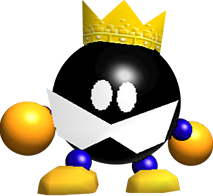
Mario’s first stop is Bob-omb Battlefield, where the pink Bob-omb Buddies are losing a war to the black Bob-ombs and their king, who has planted himself on the summit with a Power Star. Stars from the battlefield, Whomp’s Fortress, the sunken galleon of Jolly Roger Bay and the slopes of Cool, Cool Mountain open the castle’s starred doors one by one, and a Big Boo in the courtyard, carrying a birdcage, turns out to hold a haunted house inside it.
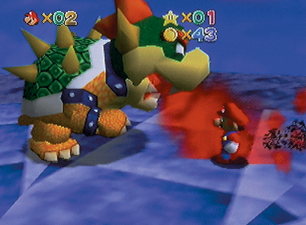
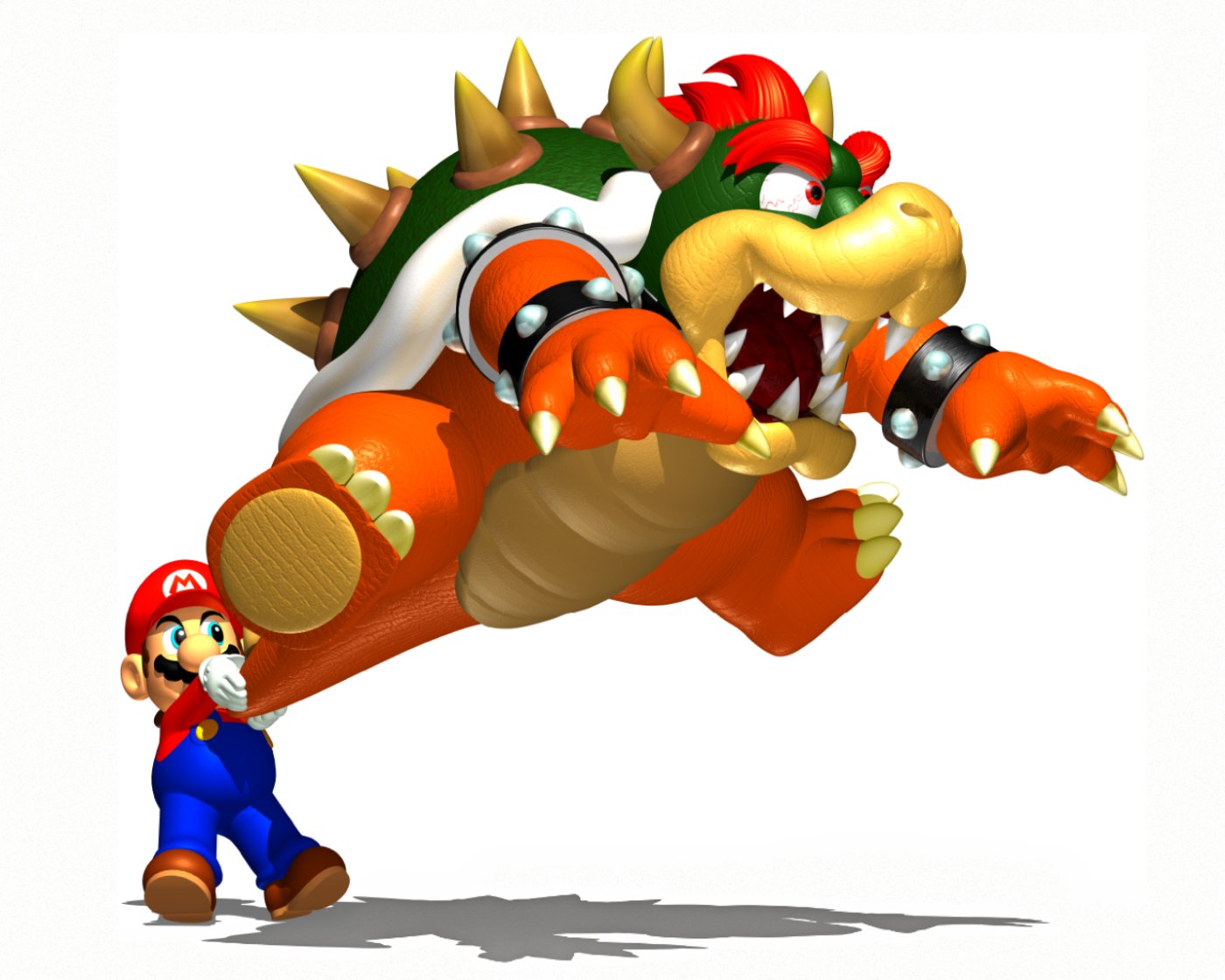
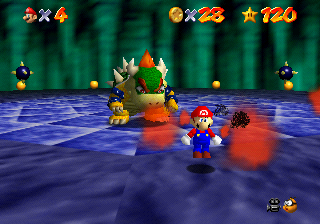
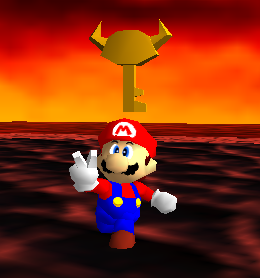
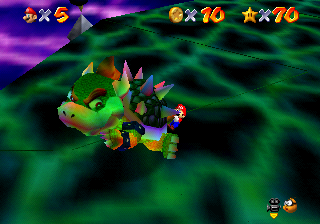
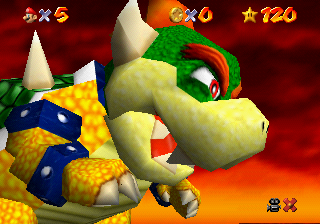
Eight stars open the door at the back of the hall and the steps down into Bowser in the Dark World, a platform course in the void that ends on an arena ringed with spiked bombs. Bowser is enormous, breathes fire and leaps about, but Mario can run behind him, grab his tail, swing him round with the stick and let fly. One bomb is enough. Bowser escapes, but drops the key to the basement, and Mario celebrates with a little dance.
King Bob-omb, the first boss, who insists on a fair fight.Bowser in the Dark World: the first of three.Mario’s key dance after Bowser in the Fire Sea. In Japan, he twirled the key round his finger.
The basement and the second key
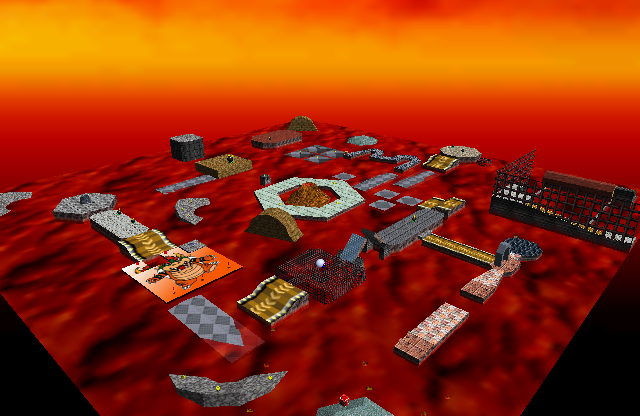
The basement is a different castle: dark corridors, a toxic maze under Hazy Maze Cave, Lethal Lava Land’s volcano, the pyramid of Shifting Sand Land behind a hidden wall, and a big star door that needs 30 stars to open on Dire, Dire Docks, where Bowser’s submarine is moored. Boarding it reveals the pit that leads down to Bowser in the Fire Sea.
The second duel adds a tilting arena, teleporting and a Bowser who hops to rock the platform under Mario’s feet. One good throw sends him packing again, with the key to the upper floors. Back in the docks, the submarine has gone, and the route to the second floor is open.
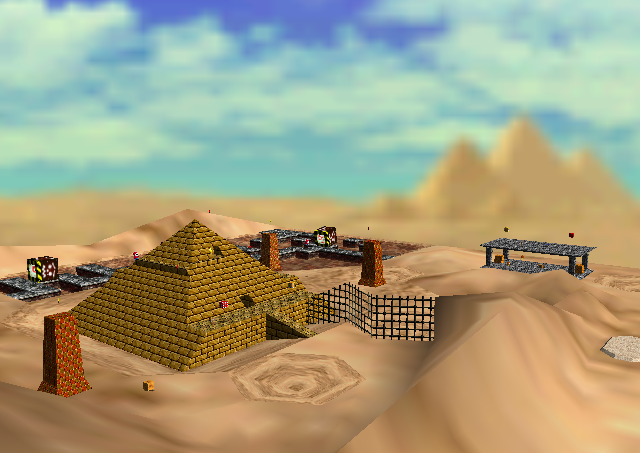
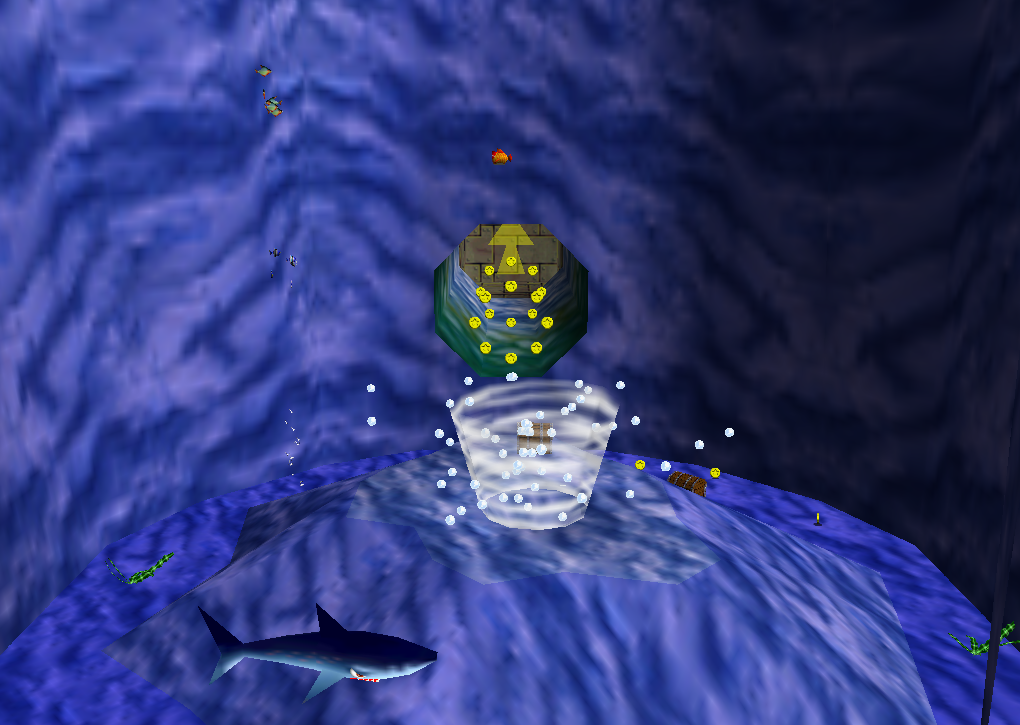
Bowser’s submarine in Dire, Dire Docks.Bowser in the Fire Sea.The pyramid of Shifting Sand Land, home to Eyerok.
Upstairs, and the endless staircase
The second floor holds the game’s strangest worlds: a snow course hidden in a mirror, the flooded ruins of Wet-Dry World, Tall, Tall Mountain and the two-sized Tiny-Huge Island. Fifty stars open the way to the third floor, where a grandfather clock is the door to Tick Tock Clock and a hole in a small room leads up to Rainbow Ride.
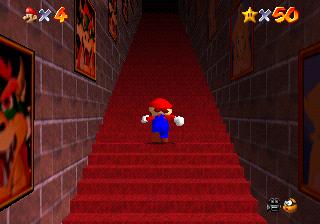
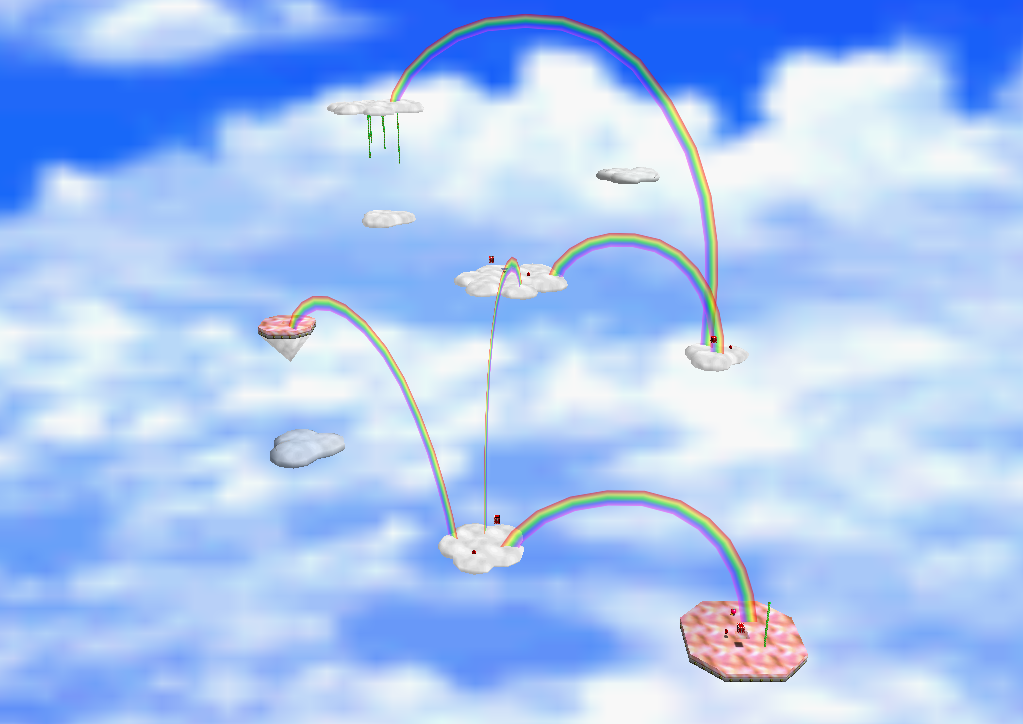
Beyond them is the staircase. Climb it with fewer than 70 stars and it loops forever, to a piece of music that never resolves. Reach 70 and the spell breaks; at the top is the roof, and Bowser in the Sky.
Mario in the mirror room on the castle’s second floor.The endless staircase. Seventy stars, or forever.Rainbow Ride, the last of the fifteen.
Bowser in the Sky
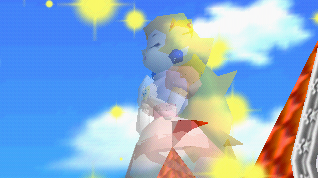
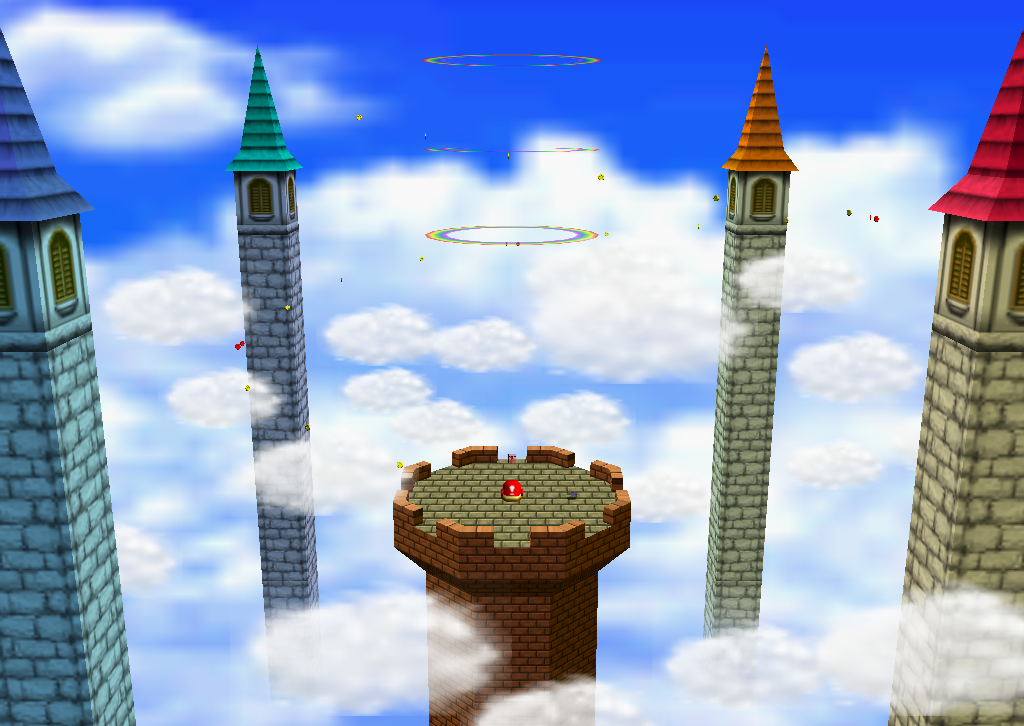
The final course climbs through the clouds to an arena that Bowser smashes into a star shape as the fight goes on. He needs throwing three times, and each throw is harder as the floor shrinks beneath you. When he finally falls he leaves behind a Jumbo Star that carries Mario back to the castle lawn, where the stained-glass window above the door glows and Princess Peach floats down out of it.
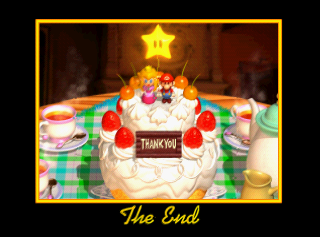
She thanks Mario, kisses him on the nose and, with Toads cheering, leads everyone inside to bake the cake she promised. Mario waves, the Lakitu Bros. pull back for the final shot, and the credits roll over a tour of the courses. The cake does appear, on the final screen, with “Thank you” written on it and little statues of Mario and Peach on top.
The last battle: three throws, and the floor keeps shrinking.Peach is freed from the stained glass.The cake, at last.
Epilogue on the roof
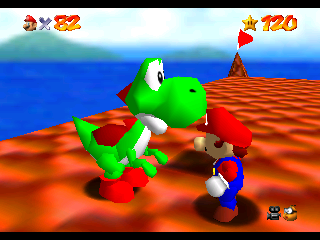
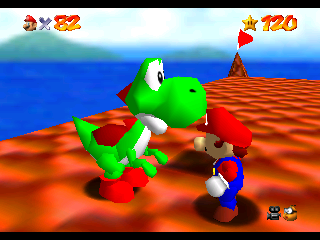
Collect all 120 stars and a cannon beside the castle opens. Fire Mario onto the roof and Yoshi is waiting, with a message that has become famous for its typo (“Mario!!! It that really you???”), 100 extra lives and an upgraded triple jump that sprinkles sparkles. Then he leaps off the roof, which is more or less where Super Mario 64 DS would pick up eight years later.
Yoshi on the roof, the reward for 120 stars.
Courses and Power Stars
Fifteen main courses, each with six missions plus a star for 100 coins, and nine smaller courses. Mission names are listed in order; the course artwork is Nintendo’s own.
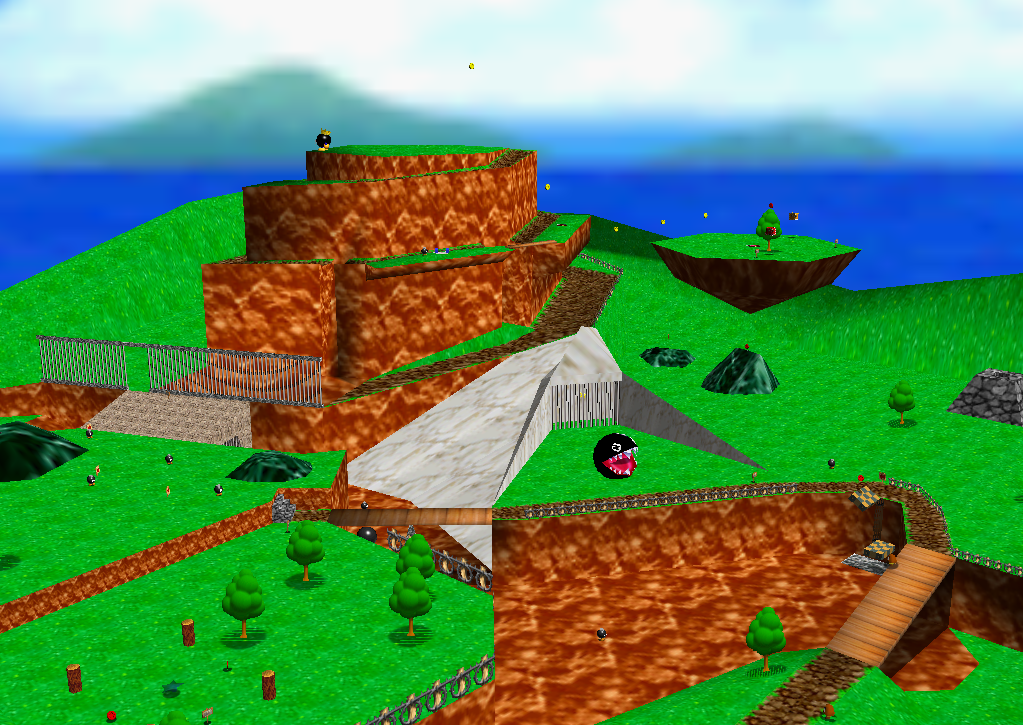
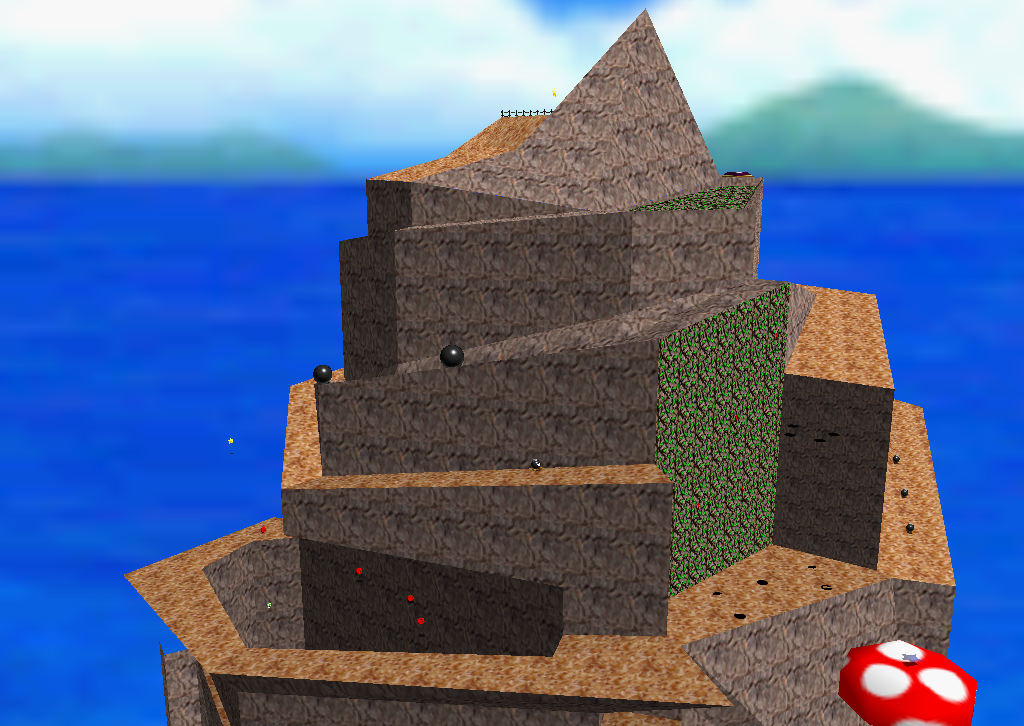
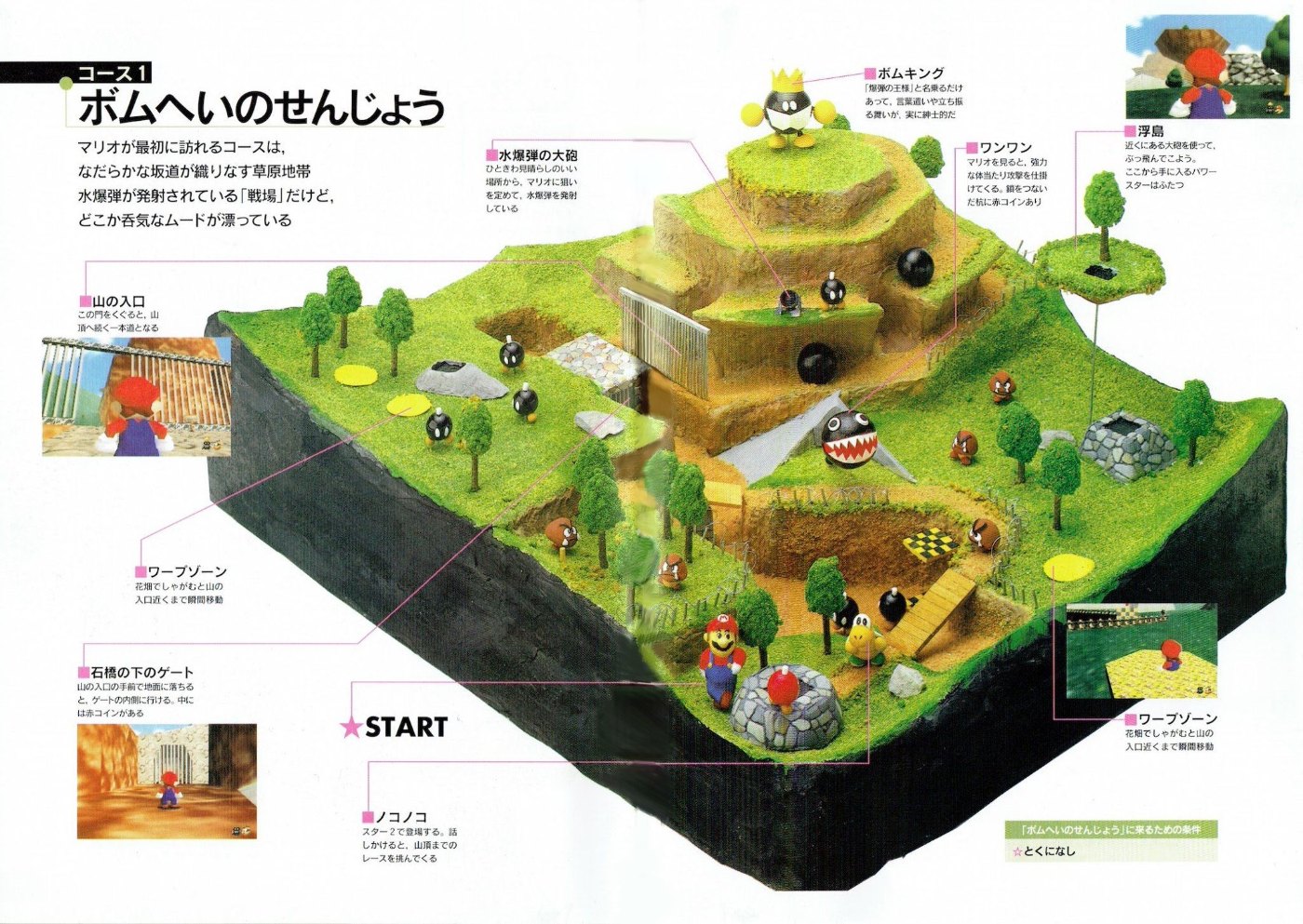
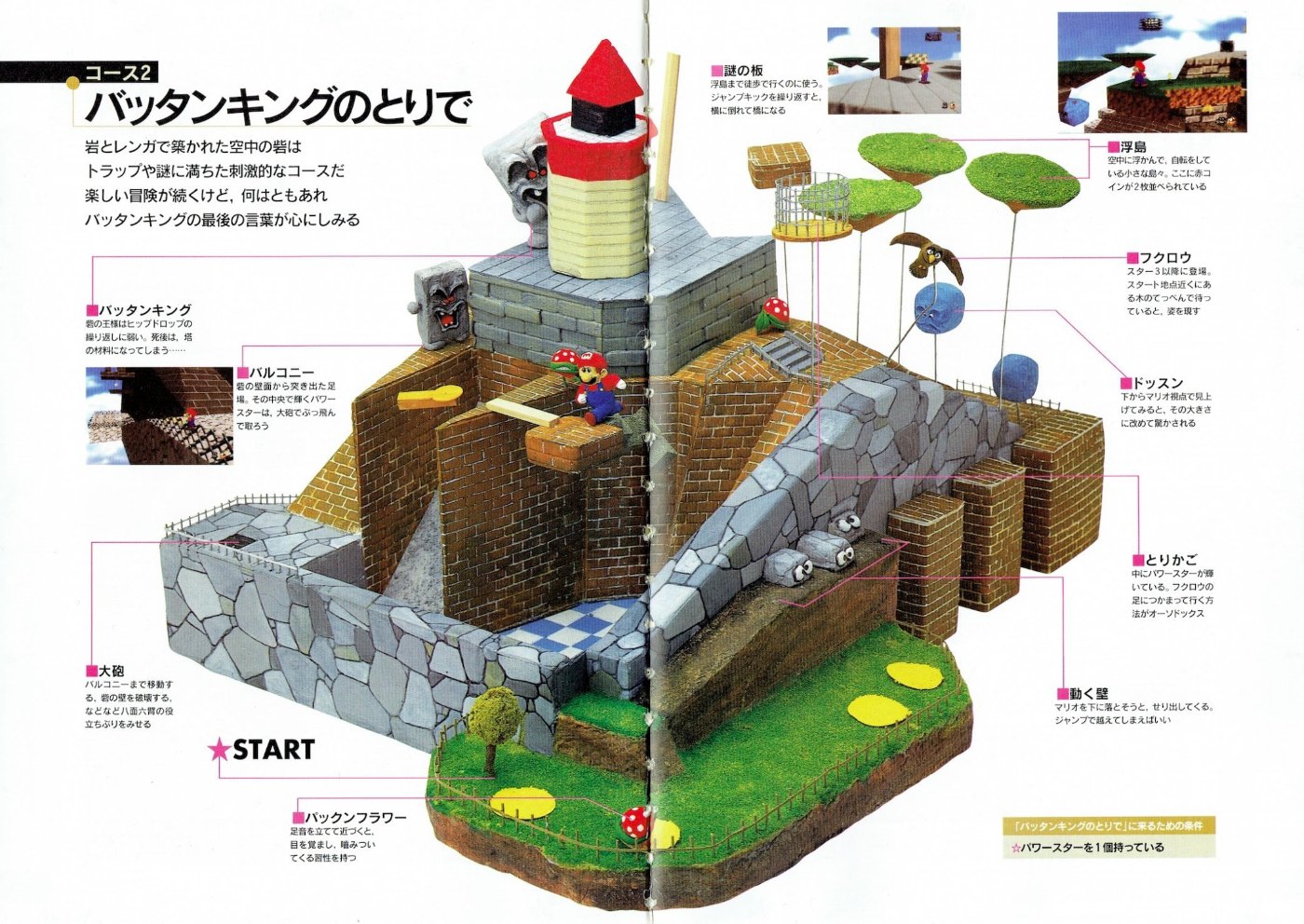
1. Bob-omb BattlefieldGround floor · no stars needed · boss King Bob-ombBig Bob-omb on the Summit; Footrace with Koopa the Quick; Shoot to the Island in the Sky; Find the 8 Red Coins; Mario Wings to the Sky; Behind Chain Chomp’s Gate. A grassy hillside at war, and the first course the team finished.
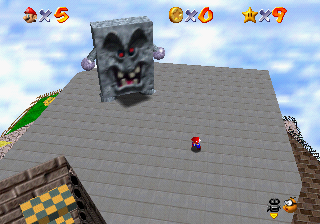
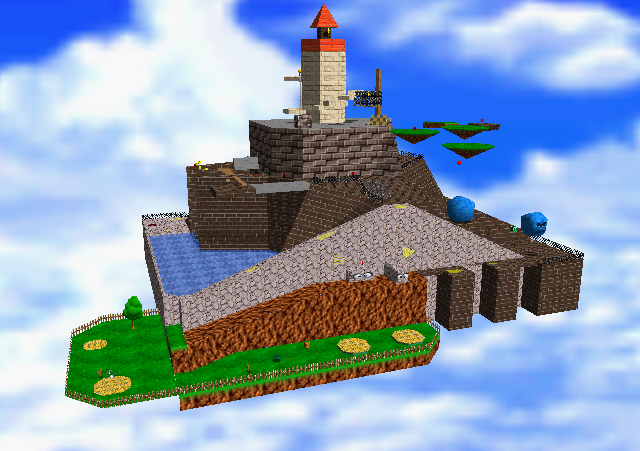
2. Whomp’s FortressGround floor · 1 star · boss Whomp KingChip Off Whomp’s Block; To the Top of the Fortress; Shoot into the Wild Blue; Red Coins on the Floating Isle; Fall onto the Caged Island; Blast Away the Wall. A stone tower in the sky that grows taller once its king is beaten; remade as Throwback Galaxy in Super Mario Galaxy 2.
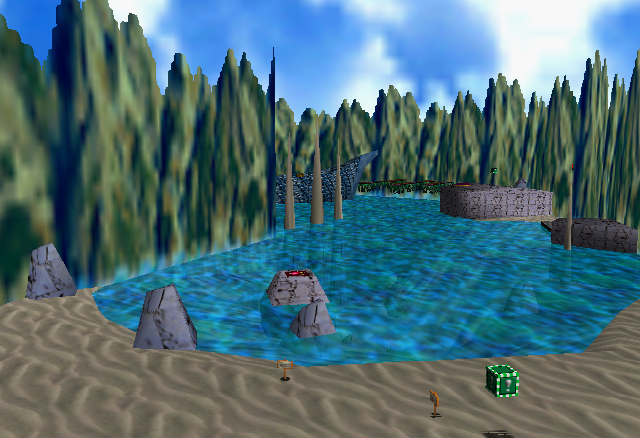
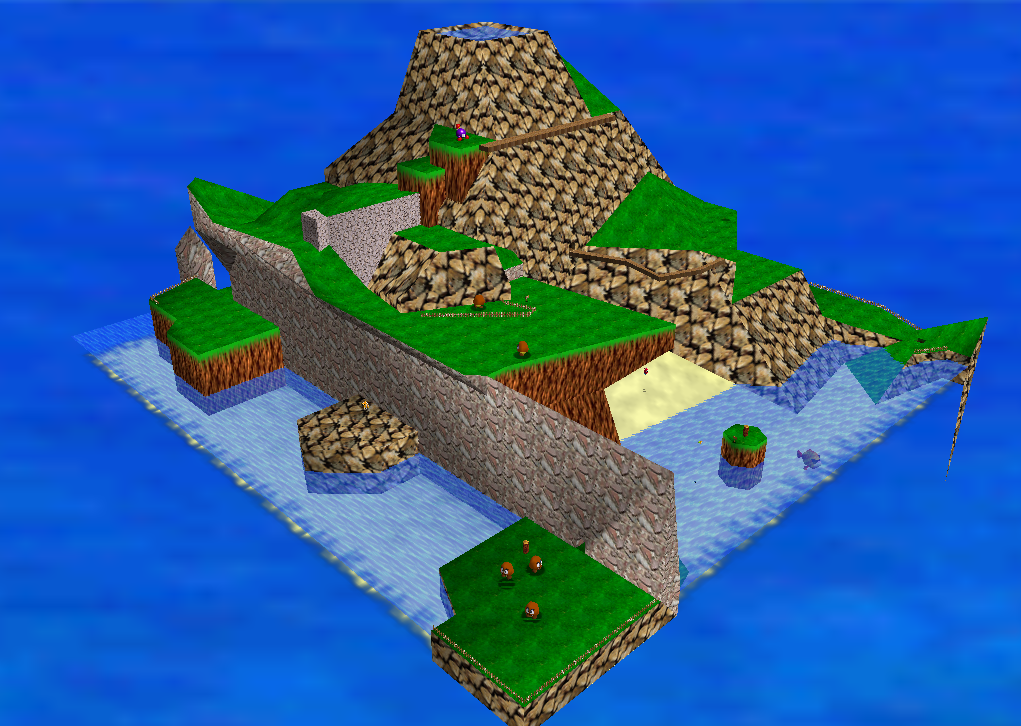
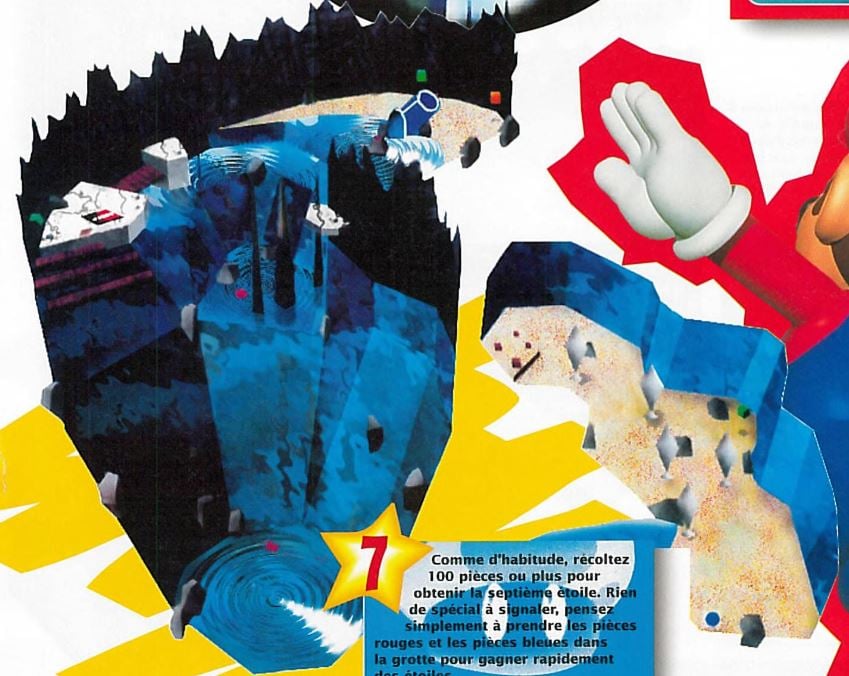
3. Jolly Roger BayGround floor · 3 stars · Unagi the eelPlunder in the Sunken Ship; Can the Eel Come Out to Play?; Treasure of the Ocean Cave; Red Coins on the Ship Afloat; Blast to the Stone Pillar; Through the Jet Stream. A deep bay with a wrecked galleon and the eel that gave a generation nightmares.
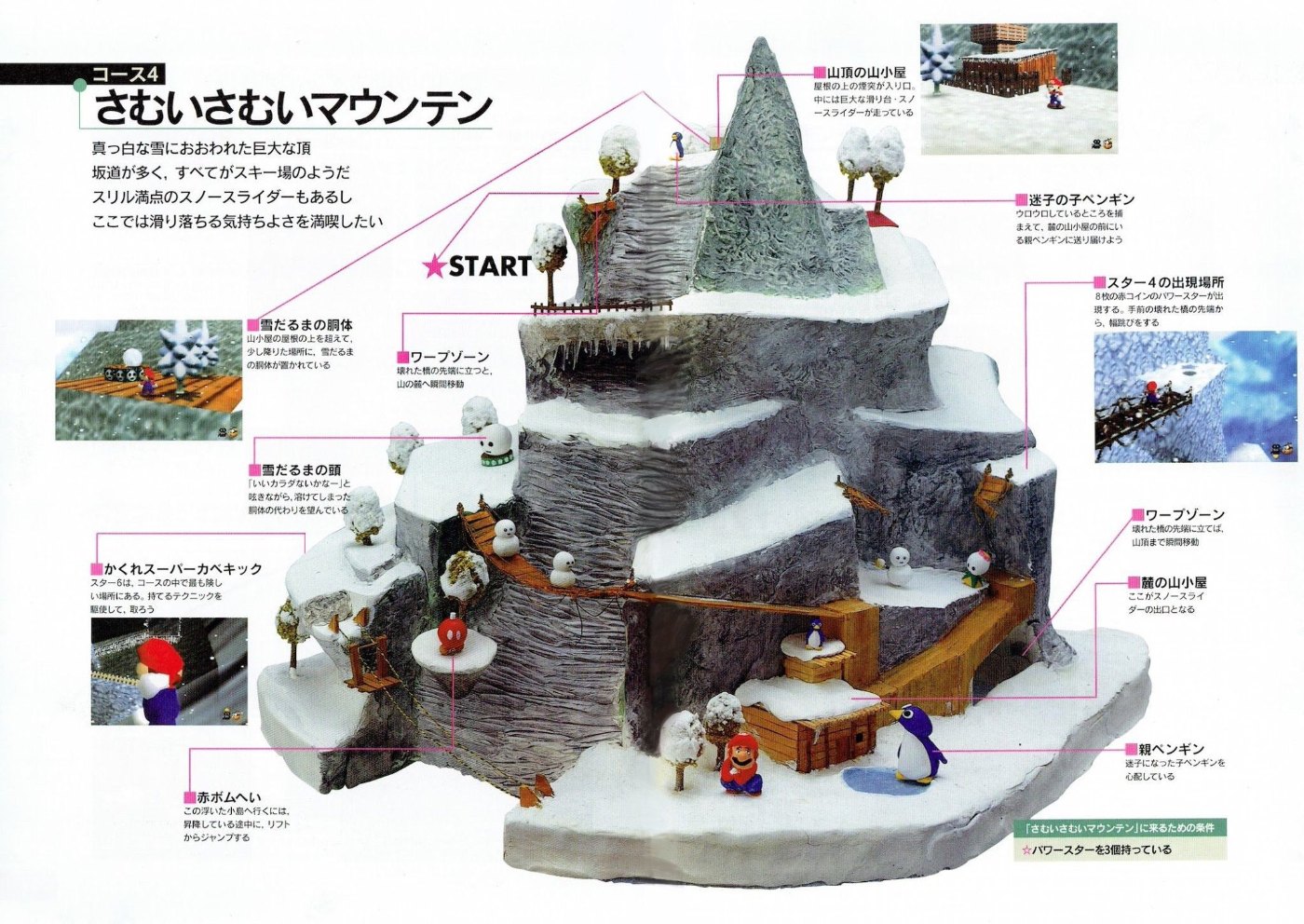
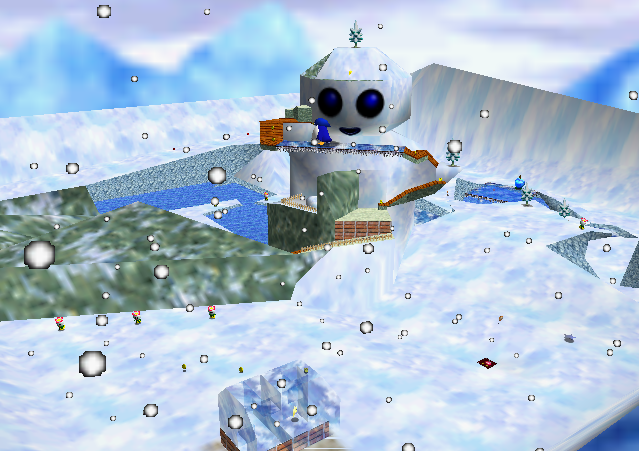
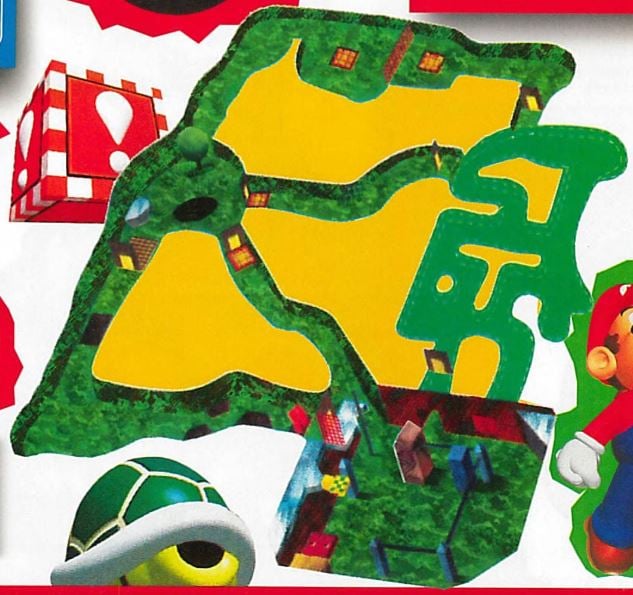
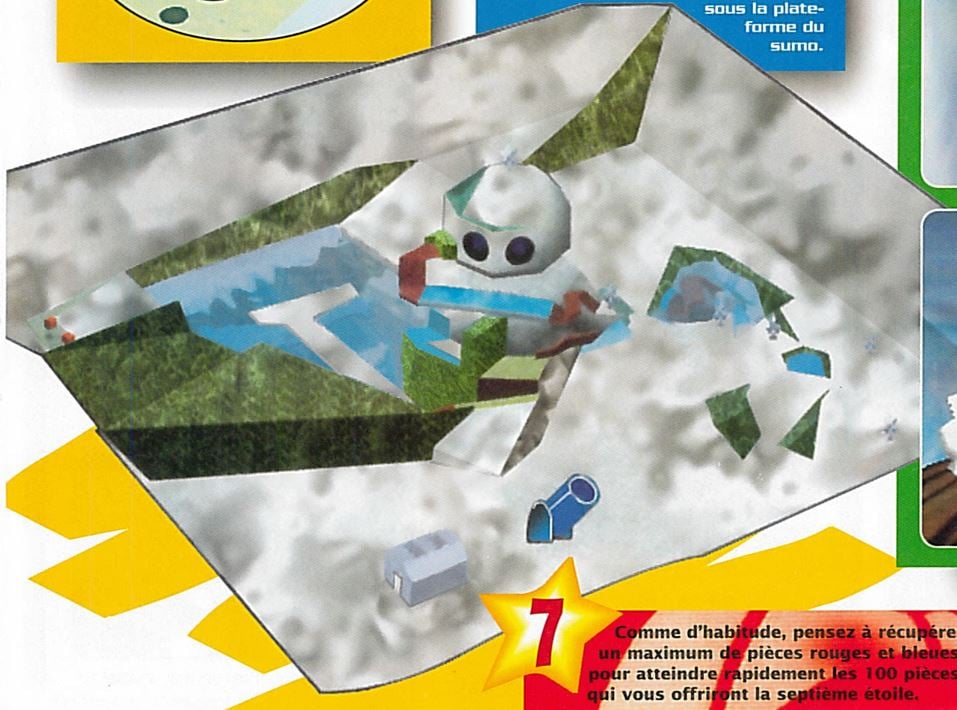
4. Cool, Cool MountainGround floor · 3 stars · the Big Penguin raceSlip Slidin’ Away; Li’l Penguin Lost; Big Penguin Race; Frosty Slide for 8 Red Coins; Snowman’s Lost His Head; Wall Kicks Will Work. A snowy peak with a cottage slide, a lost baby penguin and a snowman looking for his head.
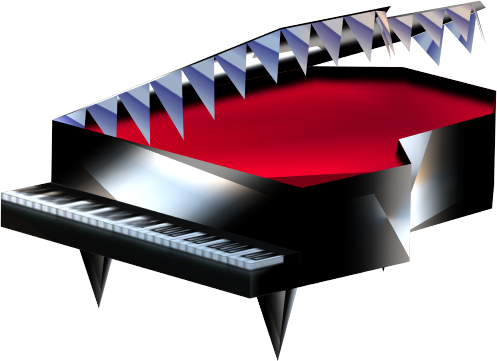
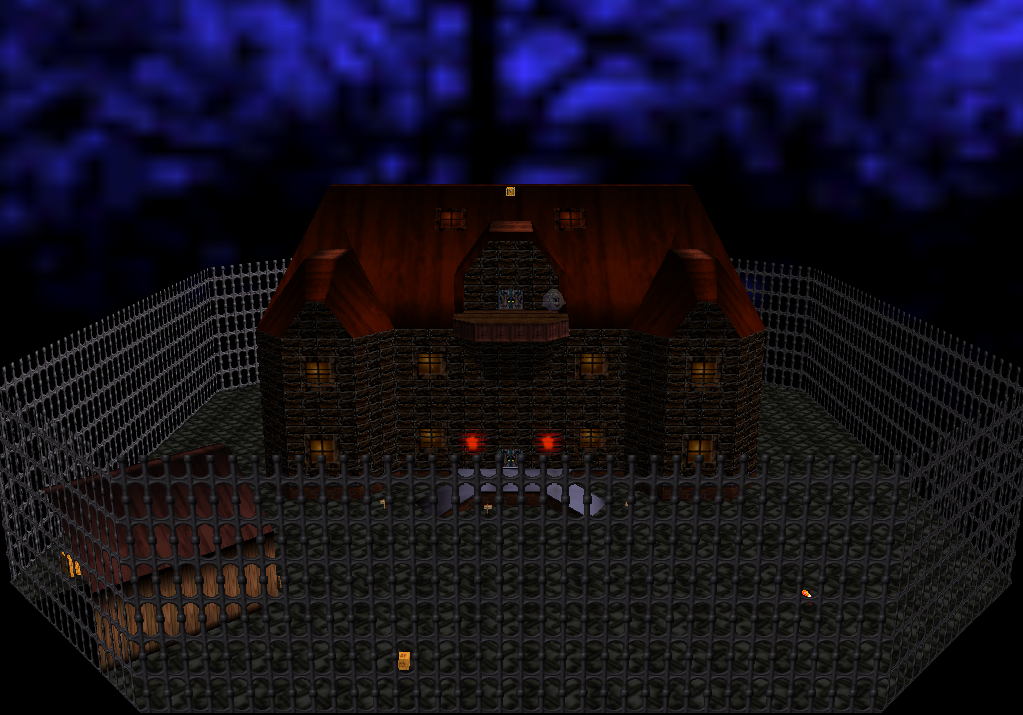
5. Big Boo’s HauntCourtyard · 12 stars · boss Big BooGo on a Ghost Hunt; Ride Big Boo’s Merry-Go-Round; Secret of the Haunted Books; Seek the 8 Red Coins; Big Boo’s Balcony; Eye to Eye in the Secret Room. A haunted mansion inside a birdcage, with a Mad Piano, Bookends and a merry-go-round in the cellar.
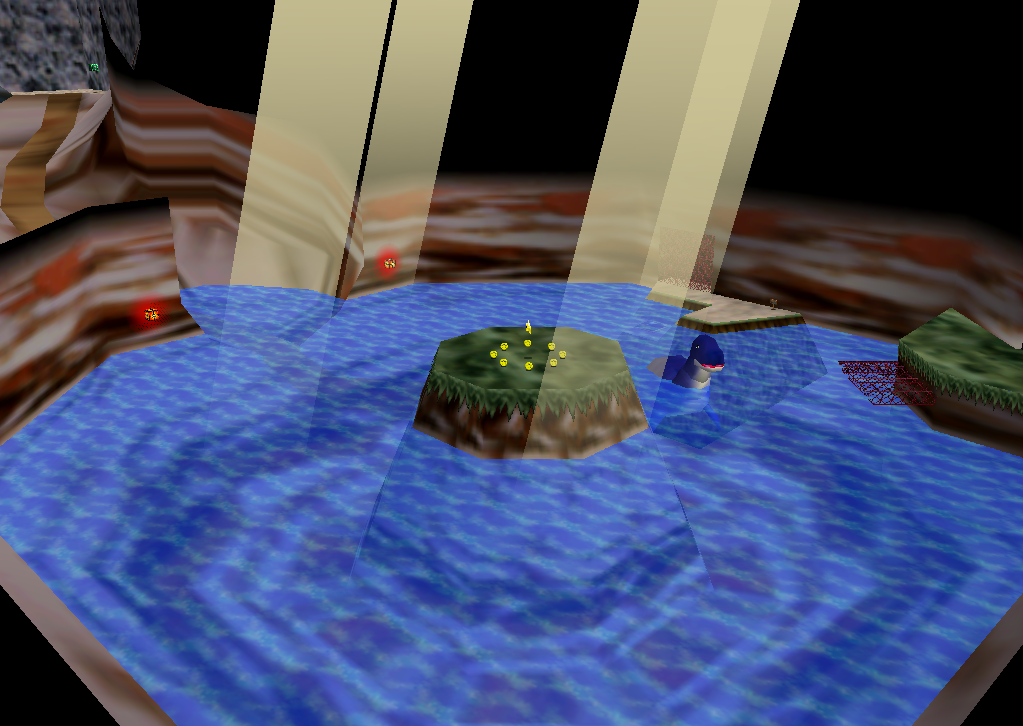
6. Hazy Maze CaveBasement · first key · DorrieSwimming Beast in the Cavern; Elevate for 8 Red Coins; Metal-Head Mario Can Move!; Navigating the Toxic Maze; A-Maze-Ing Emergency Exit; Watch for Rolling Rocks. A cave of poison gas and rolling boulders, with a gentle sea monster to ride and the way to the Metal Cap.
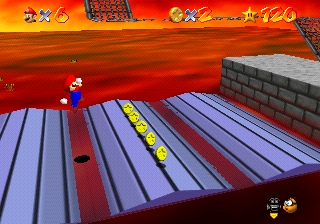
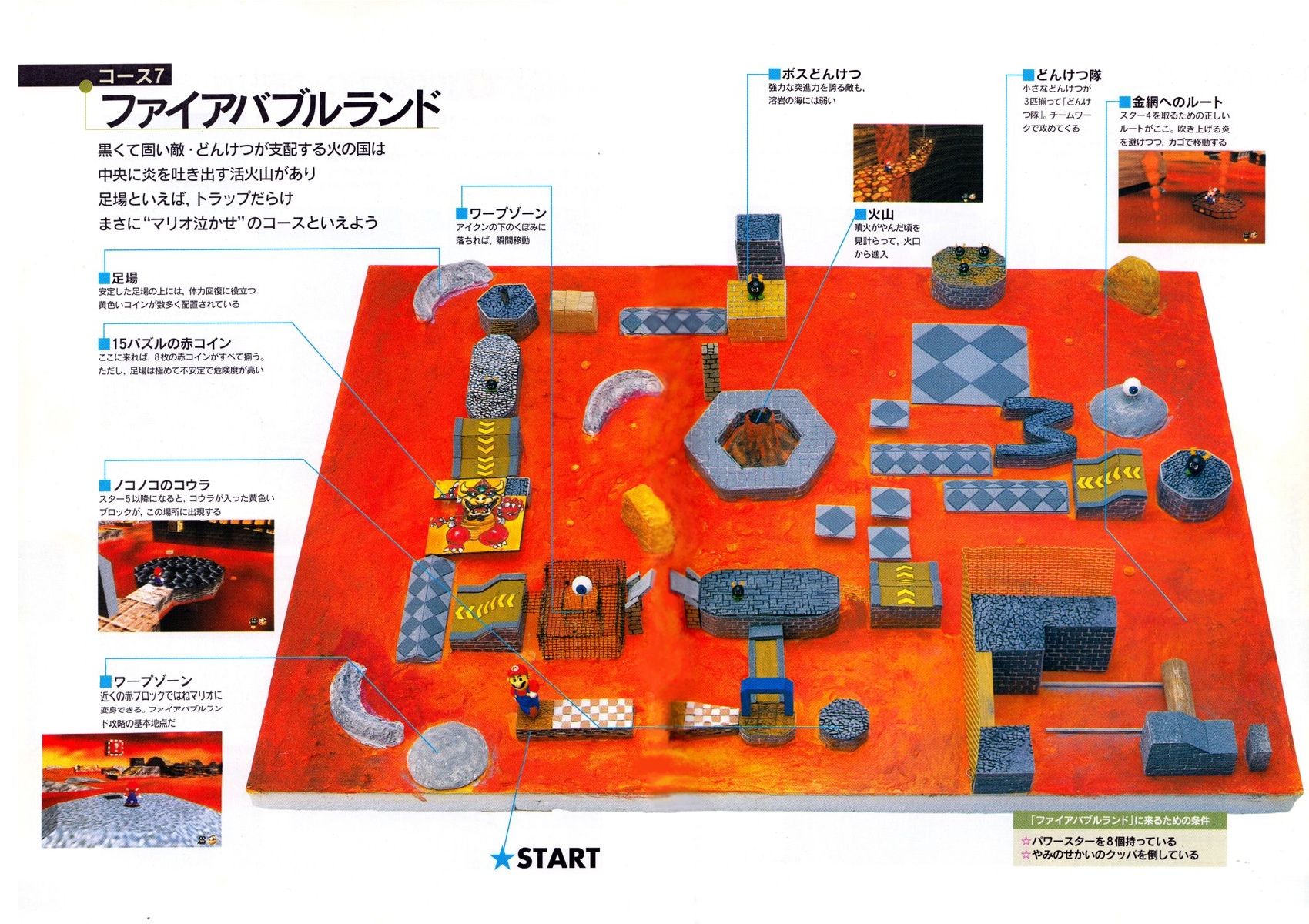
7. Lethal Lava LandBasement · first key · boss Big BullyBoil the Big Bully; Bully the Bullies; 8-Coin Puzzle with 15 Pieces; Red-Hot Log Rolling; Hot-Foot-It into the Volcano; Elevator Tour in the Volcano. Platforms over lava, a sliding Bowser puzzle and a volcano you can climb inside.
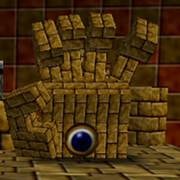
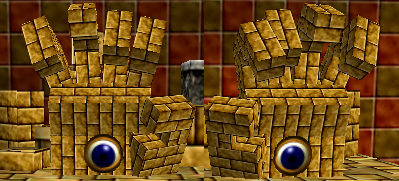
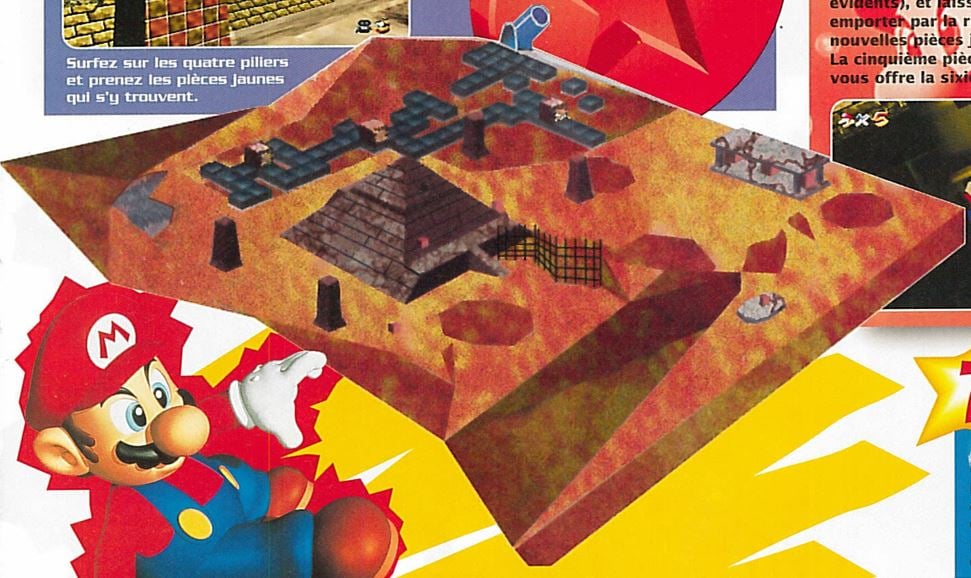
8. Shifting Sand LandBasement · first key · boss EyerokIn the Talons of the Big Bird; Shining Atop the Pyramid; Inside the Ancient Pyramid; Stand Tall on the Four Pillars; Free Flying for 8 Red Coins; Pyramid Puzzle. A desert with quicksand, Pokeys, a cap-stealing vulture and a pair of giant stone hands inside the pyramid.
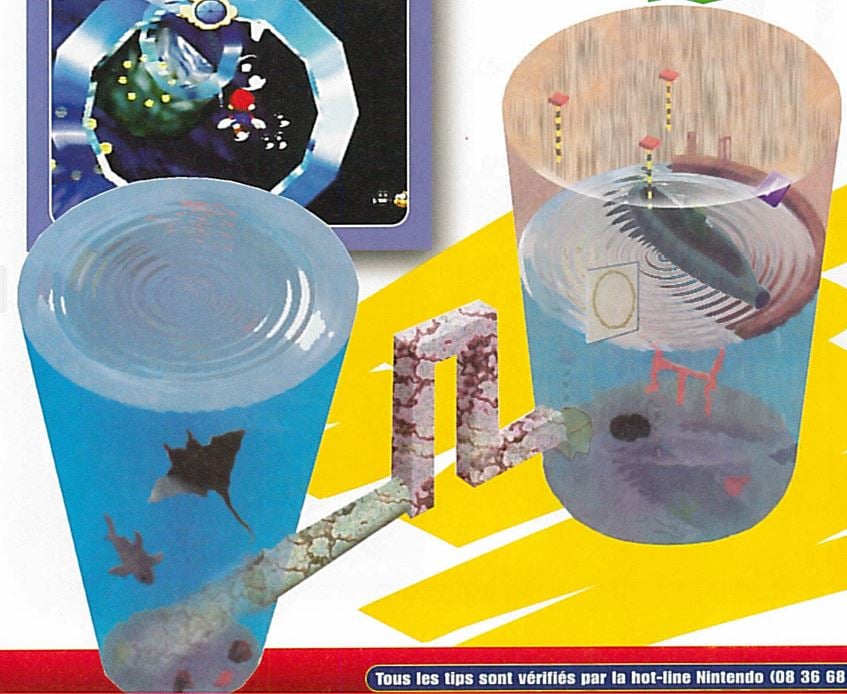
9. Dire, Dire DocksBasement · 30 stars · Bowser’s submarineBoard Bowser’s Sub; Chests in the Current; Pole-Jumping for Red Coins; Through the Jet Stream; The Manta Ray’s Reward; Collect the Caps…. Mostly underwater, with a manta ray to follow and the only place both Metal and Vanish caps can be worn together.
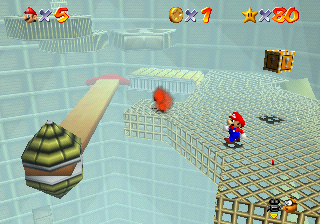
10. Snowman’s LandSecond floor · second key · boss Chill BullySnowman’s Big Head; Chill with the Bully; In the Deep Freeze; Whirl from the Freezing Pond; Shell Shreddin’ for Red Coins; Into the Igloo. Entered through a mirror; a mountain shaped like a snowman that blows Mario off its bridge.
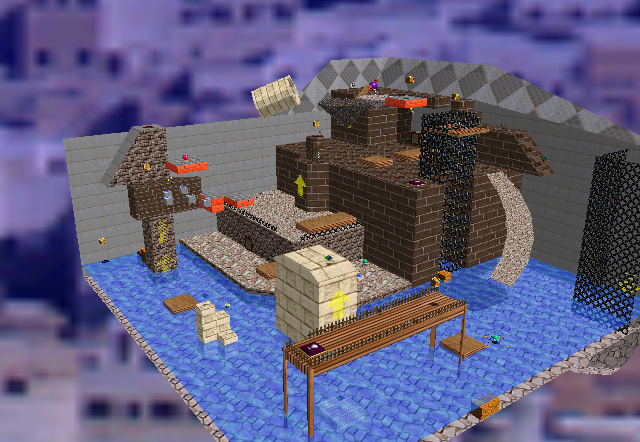
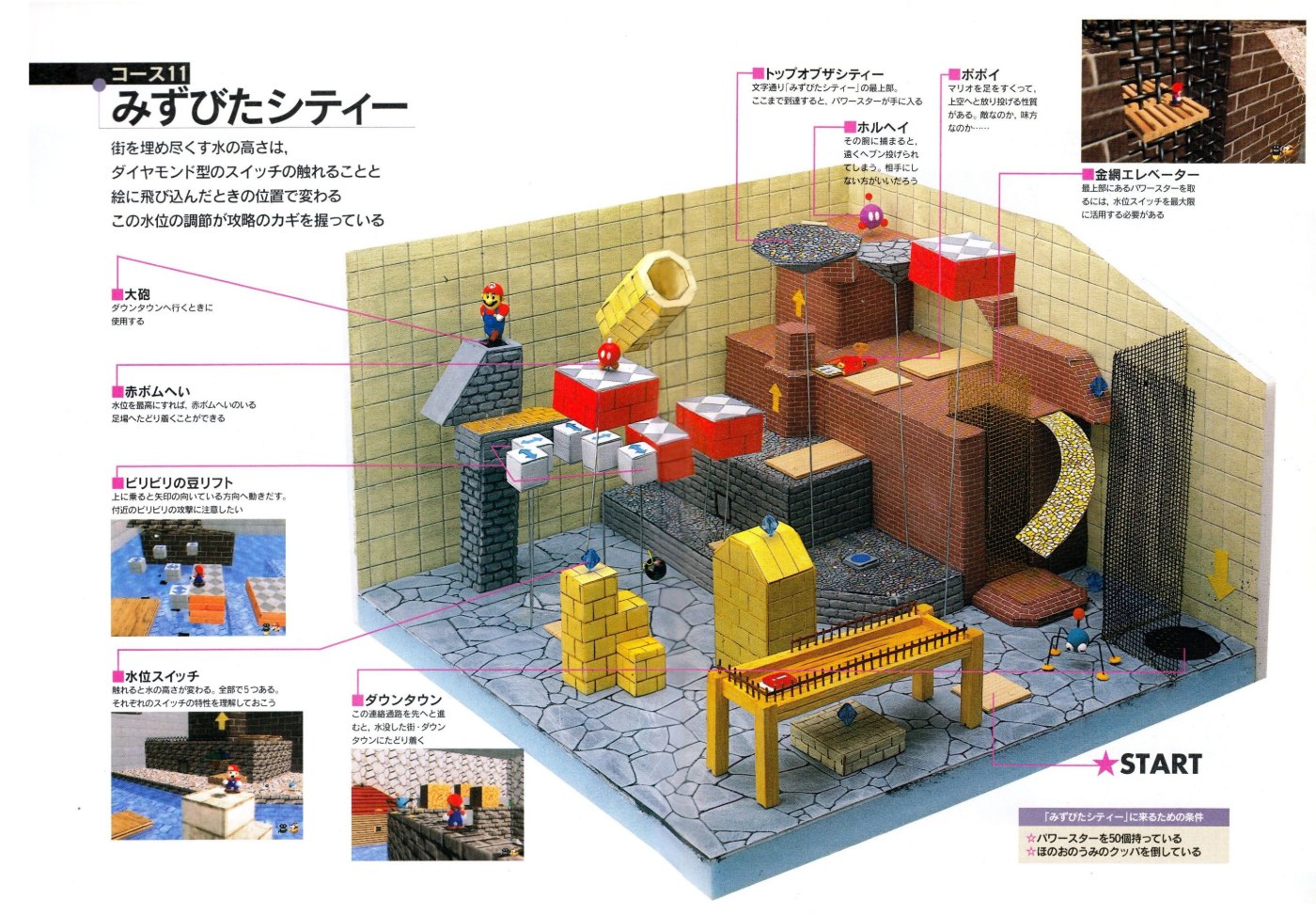
11. Wet-Dry WorldSecond floor · second keyShocking Arrow Lifts!; Top o’ the Town; Secrets in the Shallows & Sky; Express Elevator–Hurry Up!; Go to Town for Red Coins; Quick Race Through Downtown!. Flooded ruins whose water level depends on how high you jump into the painting.
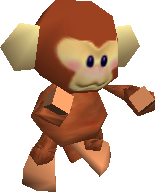
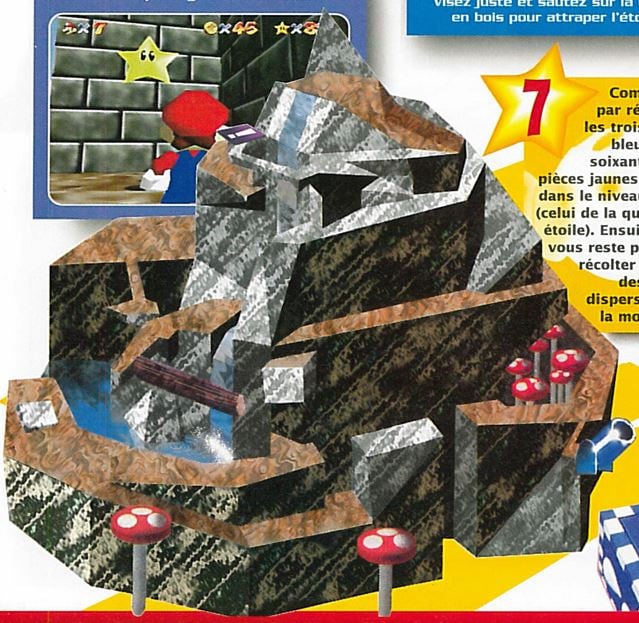
12. Tall, Tall MountainSecond floor · second keyScale the Mountain; Mystery of the Monkey Cage; Scary ’Shrooms, Red Coins; Mysterious Mountainside; Breathtaking View from Bridge; Blast to the Lonely Mushroom. A climb past Ukiki the cap-thief, a Fwoosh and a hidden slide.
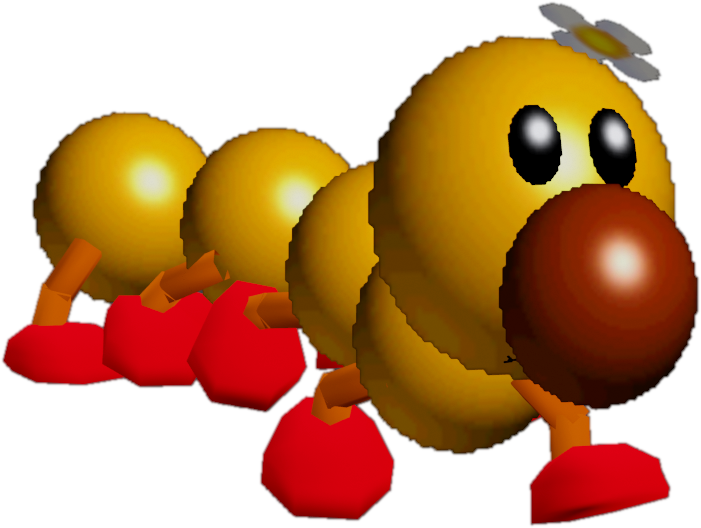
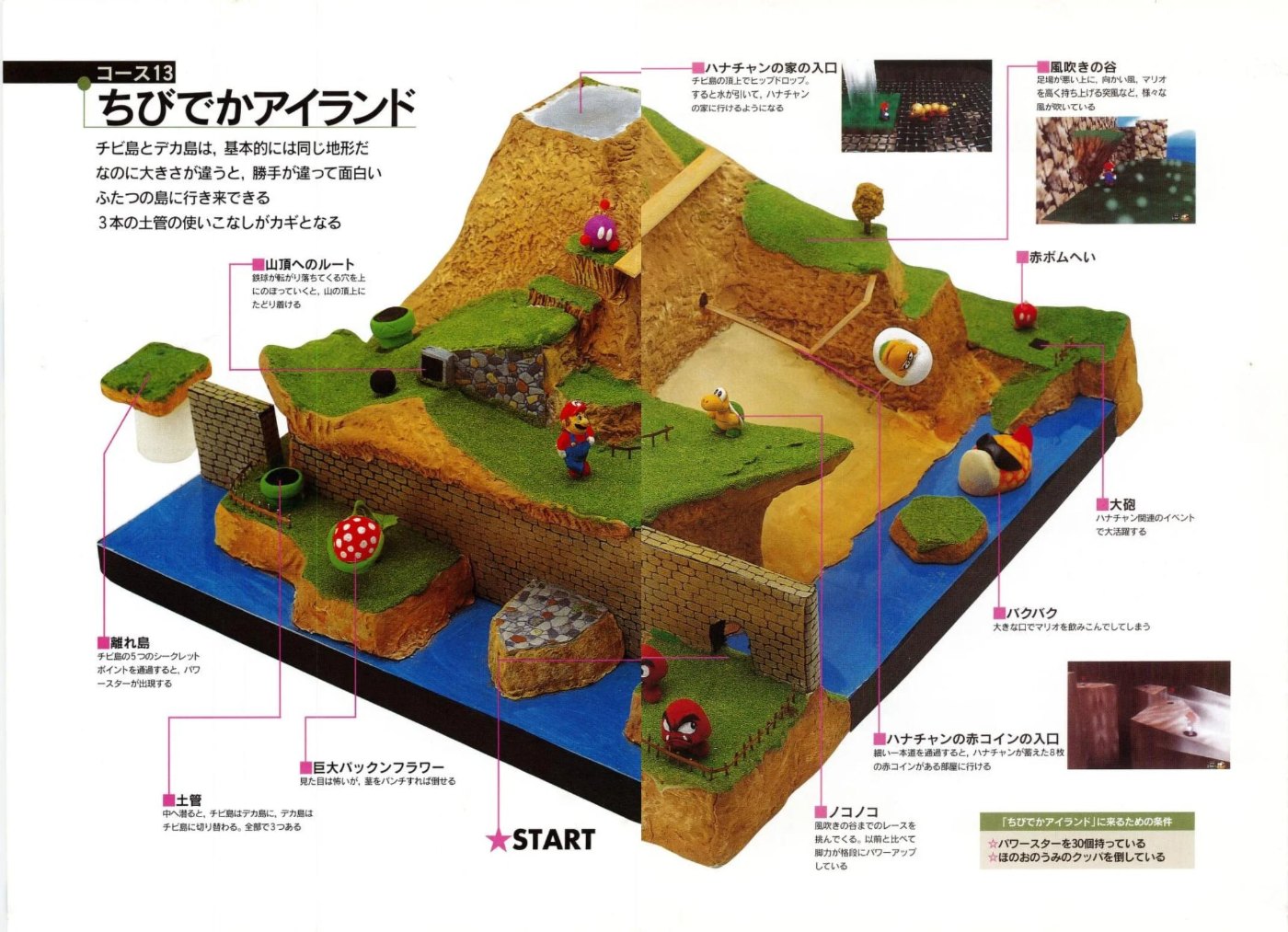
13. Tiny-Huge IslandSecond floor · second key · boss WigglerPluck the Piranha Flower; The Tip Top of the Huge Island; Rematch with Koopa the Quick; Five Itty Bitty Secrets; Wiggler’s Red Coins; Make Wiggler Squirm. Two paintings, one island: Mario is either a giant among Goombas or an ant among them.
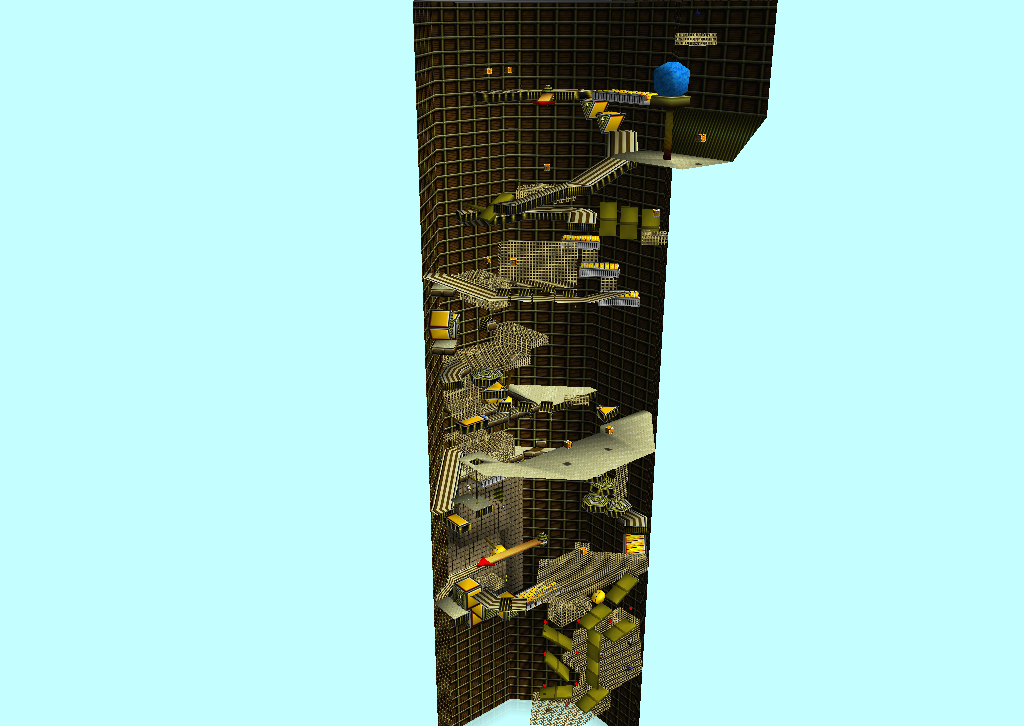
14. Tick Tock ClockThird floor · 50 starsRoll into the Cage; The Pit and the Pendulums; Get a Hand; Stomp on the Thwomp; Timed Jumps on Moving Bars; Stop Time for Red Coins. Inside a grandfather clock whose machinery runs fast, slow or not at all depending on the minute hand when you jump in.
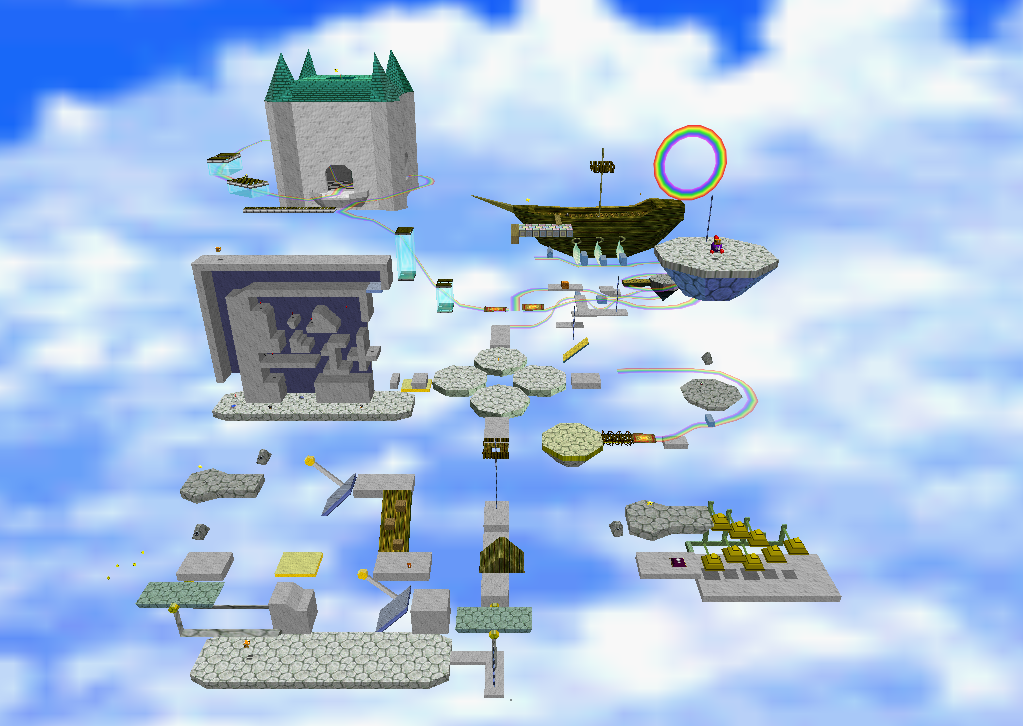
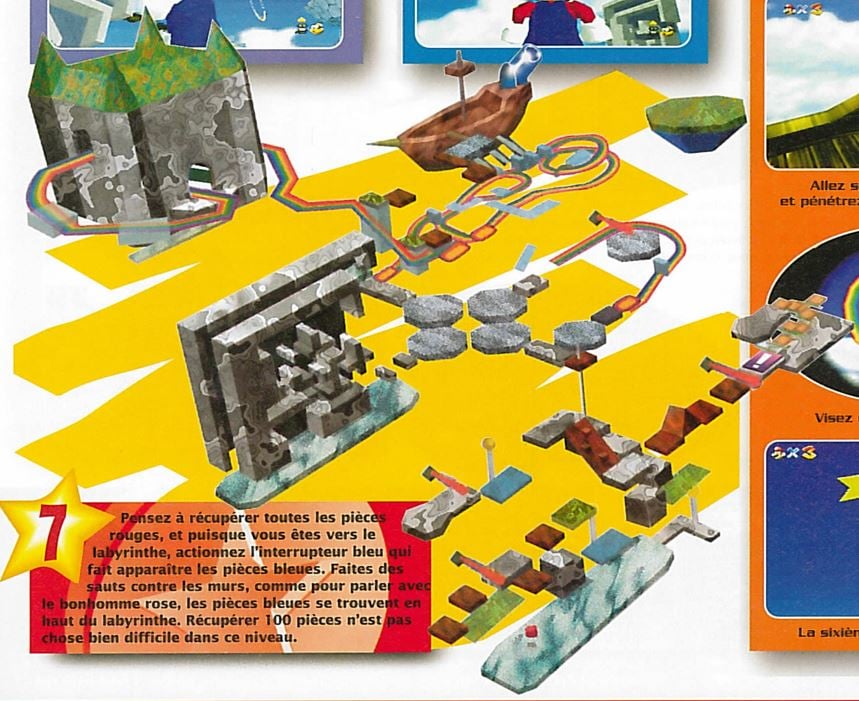
15. Rainbow RideThird floor · 50 starsCruiser Crossing the Rainbow; The Big House in the Sky; Coins Amassed in a Maze; Swingin’ in the Breeze; Tricky Triangles!; Somewhere Over the Rainbow. Magic carpets on rainbow rails between floating islands, a flying ship and a house in the clouds.
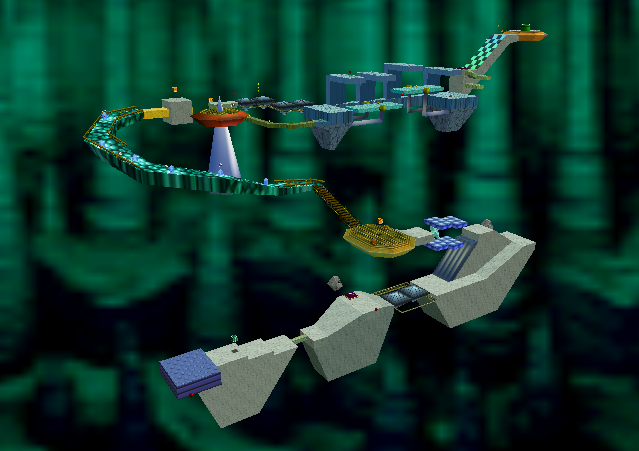
Bowser in the Dark WorldGround floor · 8 stars · 1 star (red coins) + keyA platforming gauntlet in the void, then the first tail-swinging duel. One throw.
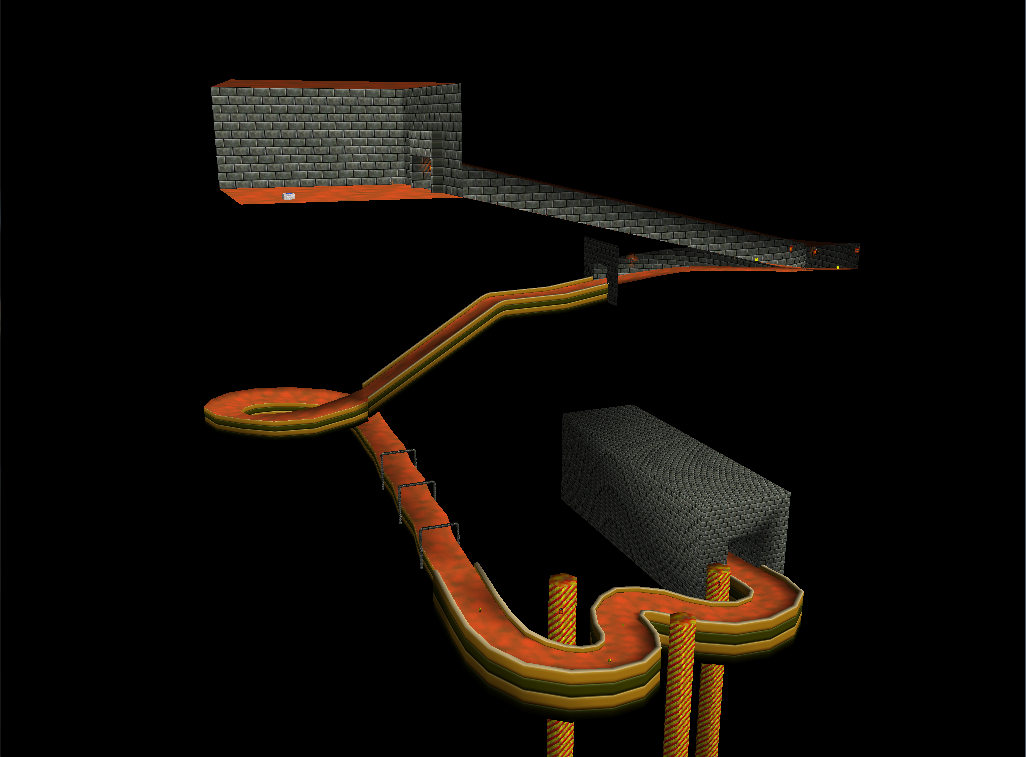
Bowser in the Fire SeaBasement · via Dire, Dire Docks · 1 star + keyMesh and stone over a lava lake; Bowser tilts the arena and teleports. One throw.
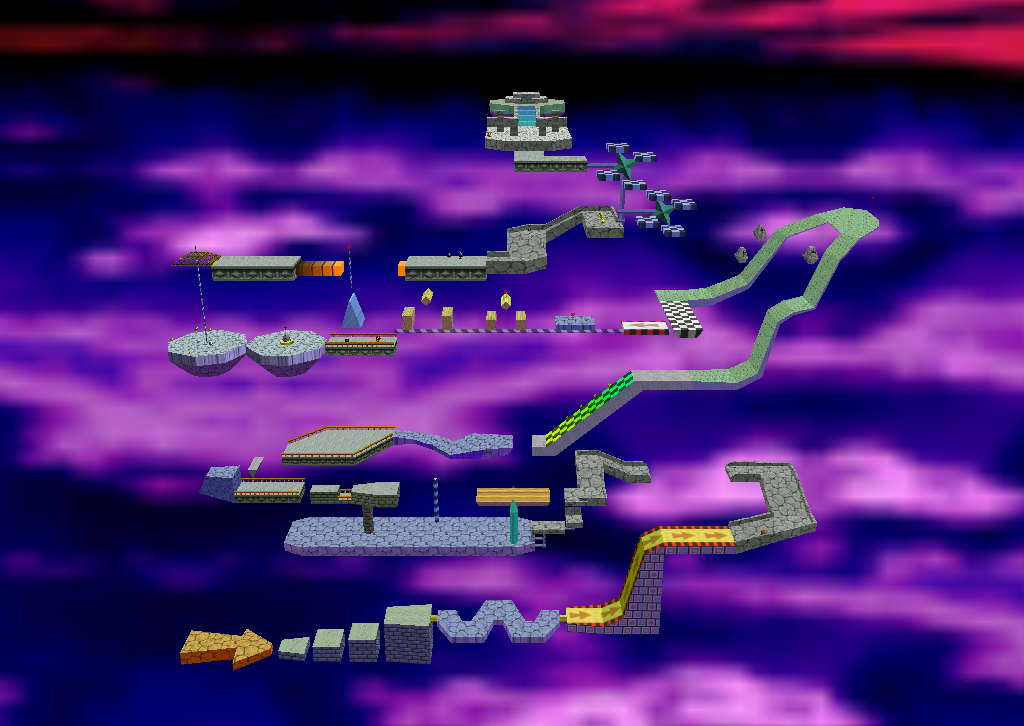
Bowser in the SkyEndless staircase · 70 stars · 1 star + Jumbo StarThe long climb to the final battle. Three throws.
The Princess’s Secret SlideGround floor · 1 star to enter · 2 starsBehind the Peach stained glass upstairs. One star for finishing, another for beating 21 seconds.
The Secret AquariumGround floor · 1 starA hidden tank off the Jolly Roger Bay room with eight red coins and no floor to stand on.
Tower of the Wing CapLobby light beam · 10 stars · red switch + 1 starLook up into the sun mosaic to fly here and collect eight red coins in the clouds.
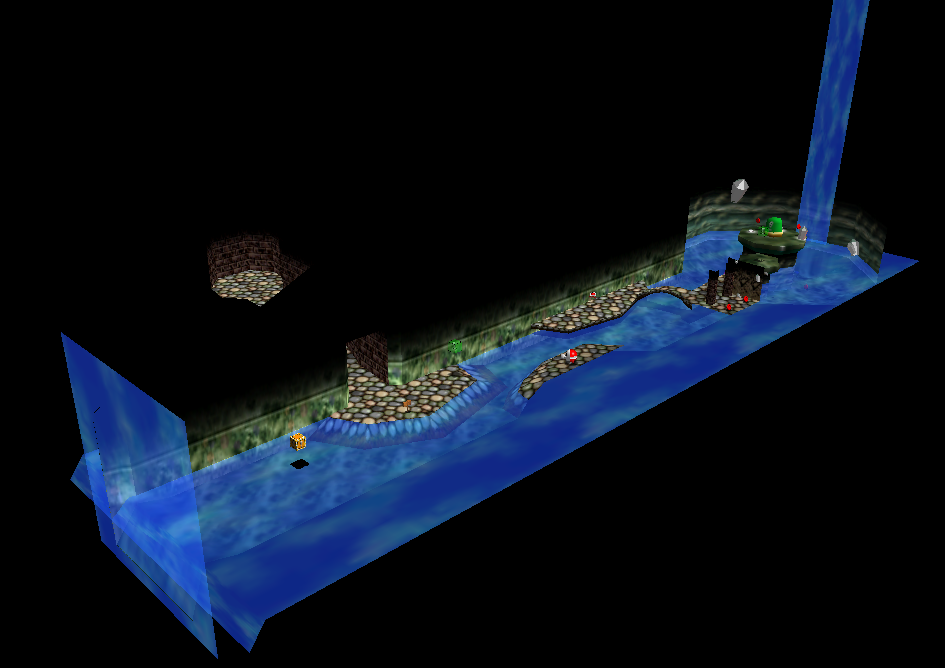
Cavern of the Metal CapHazy Maze Cave · green switch + 1 starRide Dorrie to the double doors and drop into the pool of liquid metal; the way out is over the castle waterfall. Metal Mario strolls along the riverbed for red coins.
Vanish Cap Under the MoatDrained moat · blue switch + 1 starGround-pound the two pillars in the basement to drain the moat and drop in.
Wing Mario Over the RainbowThird floor · 1 starA cannon-and-Wing-Cap hunt for red coins among floating islands.
The remaining five stars are in the castle itself: three from Toads (at 12, 25 and 35 stars) and two from MIPS the rabbit (at 15 and 50).
Advertisement
Gameplay & Controls
Mario games had always been about jumping. Super Mario 64 is about moving: the analogue stick gives Mario a walk, a jog and a run, and from that flows a repertoire of jumps, flips and dives that Nintendo’s programmers counted at 193 separate animations. Learning them is the game.
Around that core sits a structure the series had never tried: a hub castle, worlds entered through paintings, a menu of missions per world, and a star count that gates your progress instead of a world map.
The moves
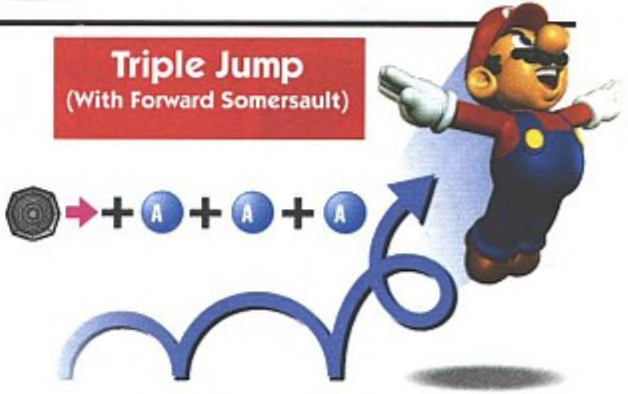
A jumps, and timing three in a row while running produces the triple jump, a soaring somersault that is the key to most high ledges. Press Z to crouch and A to backflip; crouch while running for a long jump that clears wide gaps; turn sharply and jump for a side somersault; jump at a wall and press A again as you touch it for a wall kick. In the air, Z slams Mario down in a ground pound (a move borrowed from Yoshi in Yoshi’s Island) that opens cork boxes and finishes off fallen Whomps.
B punches: tap it three times for a punch-punch-kick combo, press it while running for a dive, or in mid-air for a kick. Mario can grab and throw Bob-ombs, crates and even Bowser (hold B, spin the stick, let go), hang from ledges, climb poles and trees, shimmy along wire fences, and swim with a stroke for every tap of A. Koizumi remembers Miyamoto sprawled across a desk at two or three in the morning, miming the stroke he wanted. The animations were all hand-made after motion-capture tests were rejected; Koizumi added flourishes such as the sweep kick and the way Mario dozes off if you leave him alone.
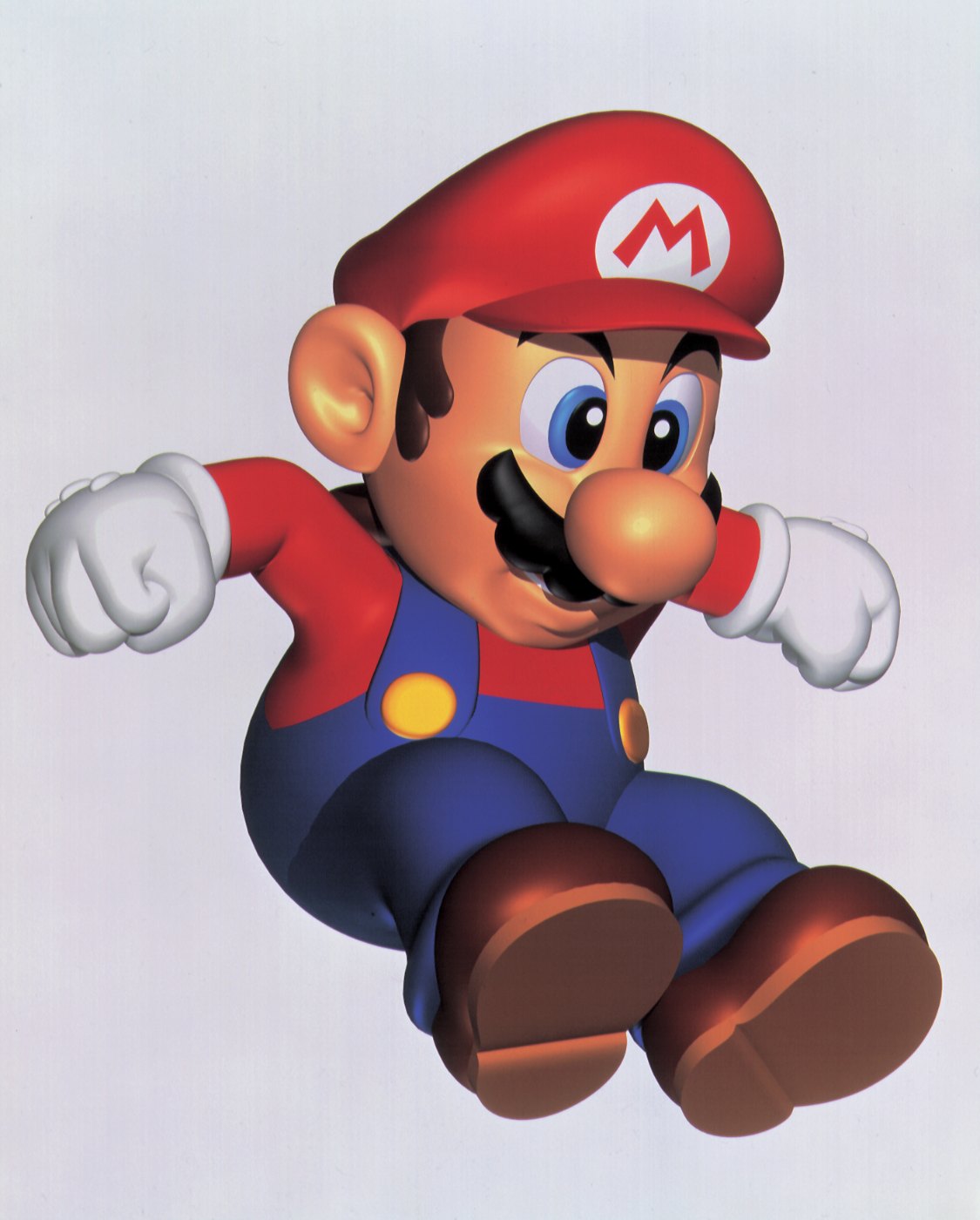
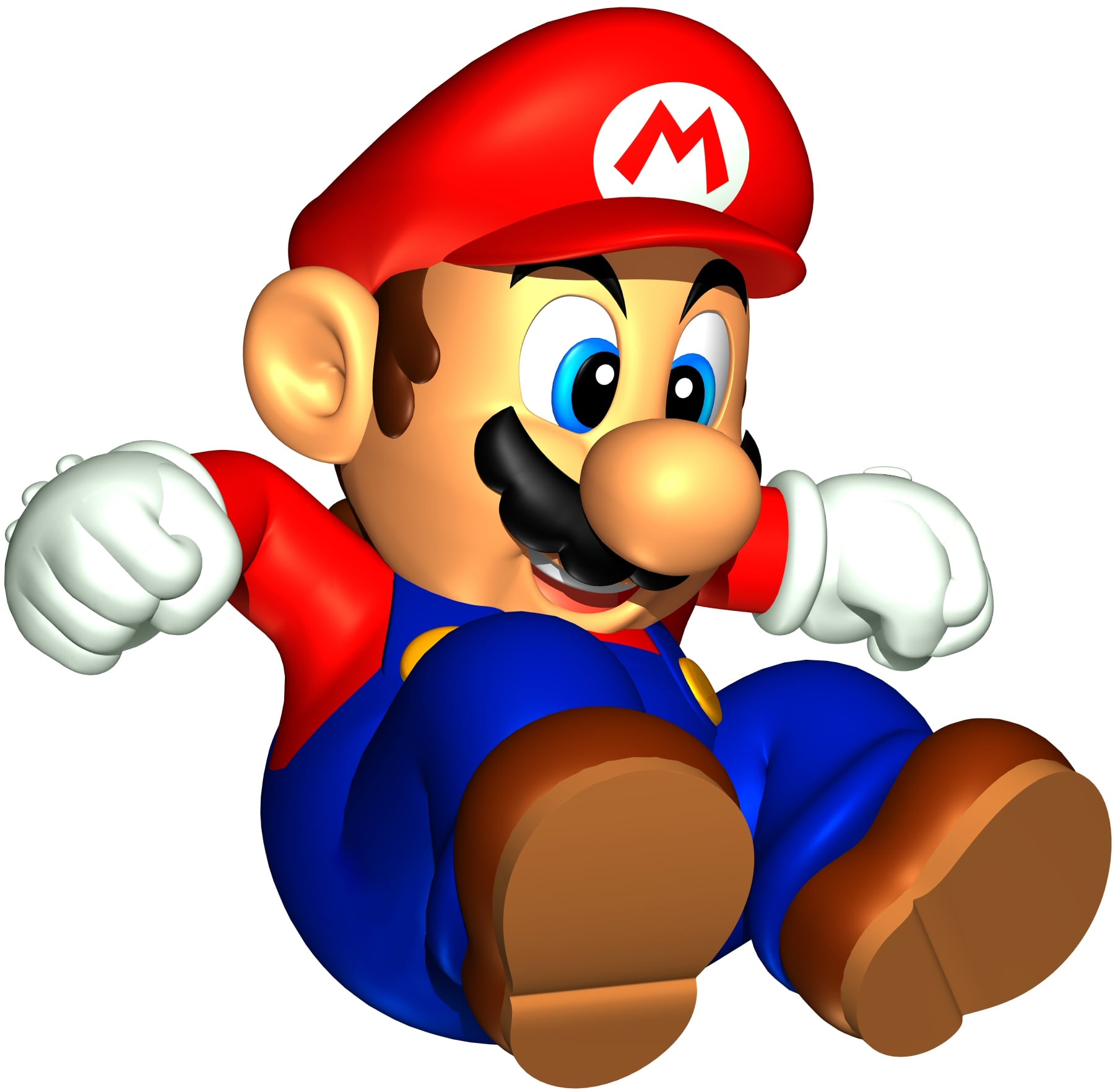
The triple jump, from Nintendo’s instructional artwork.The long jump: crouch while running, then A.The ground pound, new to Mario in this game.
The camera and the Lakitu Bros.
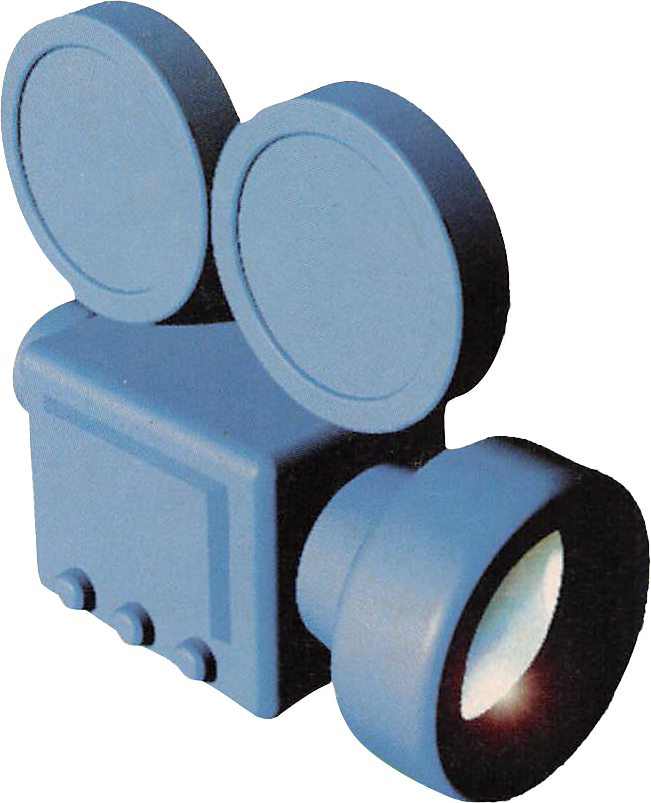
The camera icon from the manual: Lakitu’s view or Mario’s.
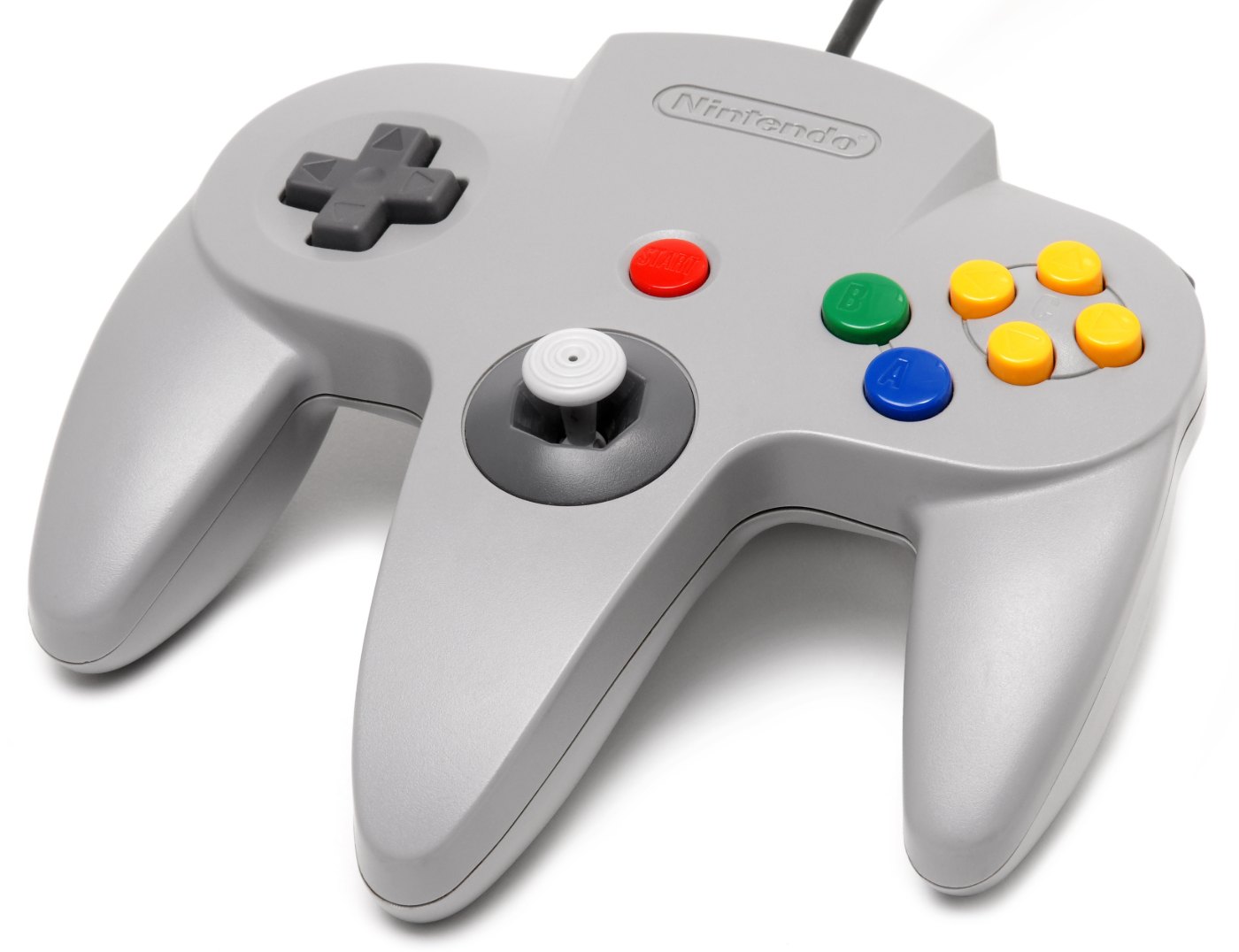
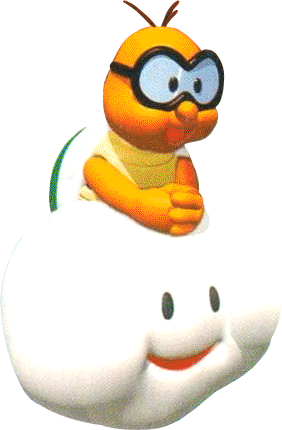
Rather than hide the camera, Nintendo made it a character. The Lakitu Bros. are a pair of cloud-riding cameramen who, the Player’s Guide says, work for the Kingdom News Network; one introduces the game by filming Mario’s arrival and then follows him for the rest of it, visible as a reflection in mirrors and in the opening and closing scenes. The yellow C buttons rotate and zoom the view, C-Up gives a first-person look around, and R switches between the Lakitu camera and a tighter Mario camera that stays behind him.
It was the most criticised part of the game in 1996 and, by modern standards, is still the hardest part to love. But it was also the first serious attempt to solve a problem nobody had faced before, and Takumi Kawagoe, who programmed it after working on Star Fox 2, gave it a vocabulary of fixed, tracking and free modes that every 3D game since has drawn on.
Health, coins and lives
No mushrooms this time. Mario has a Power Meter of eight wedges that drains when he is hit, burnt or left underwater too long, and refills from coins (yellow one, red two, blue five), from spinning hearts and from surfacing for air. Lose it all and Mario loses a life and is bounced back to the castle. He starts with four lives; 1-Up Mushrooms and every 50 coins in a course add more, and a Game Over simply returns you to the title screen with your saved stars intact.
Coins matter more than ever. Each course has eight red coins hidden around it for a Power Star, a handful of blue coins worth five, and a seventh star for anyone who can gather 100 coins in a single visit. Mario’s cap matters too: lose it to Klepto, a Ukiki or a gust of wind and he takes half as much damage again until he gets it back.
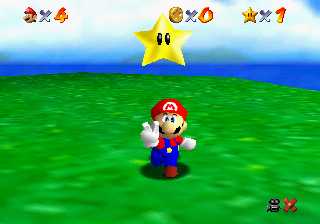
The Power Star. There are 120.Mario grabs a Power Star in Bob-omb Battlefield.
The three caps
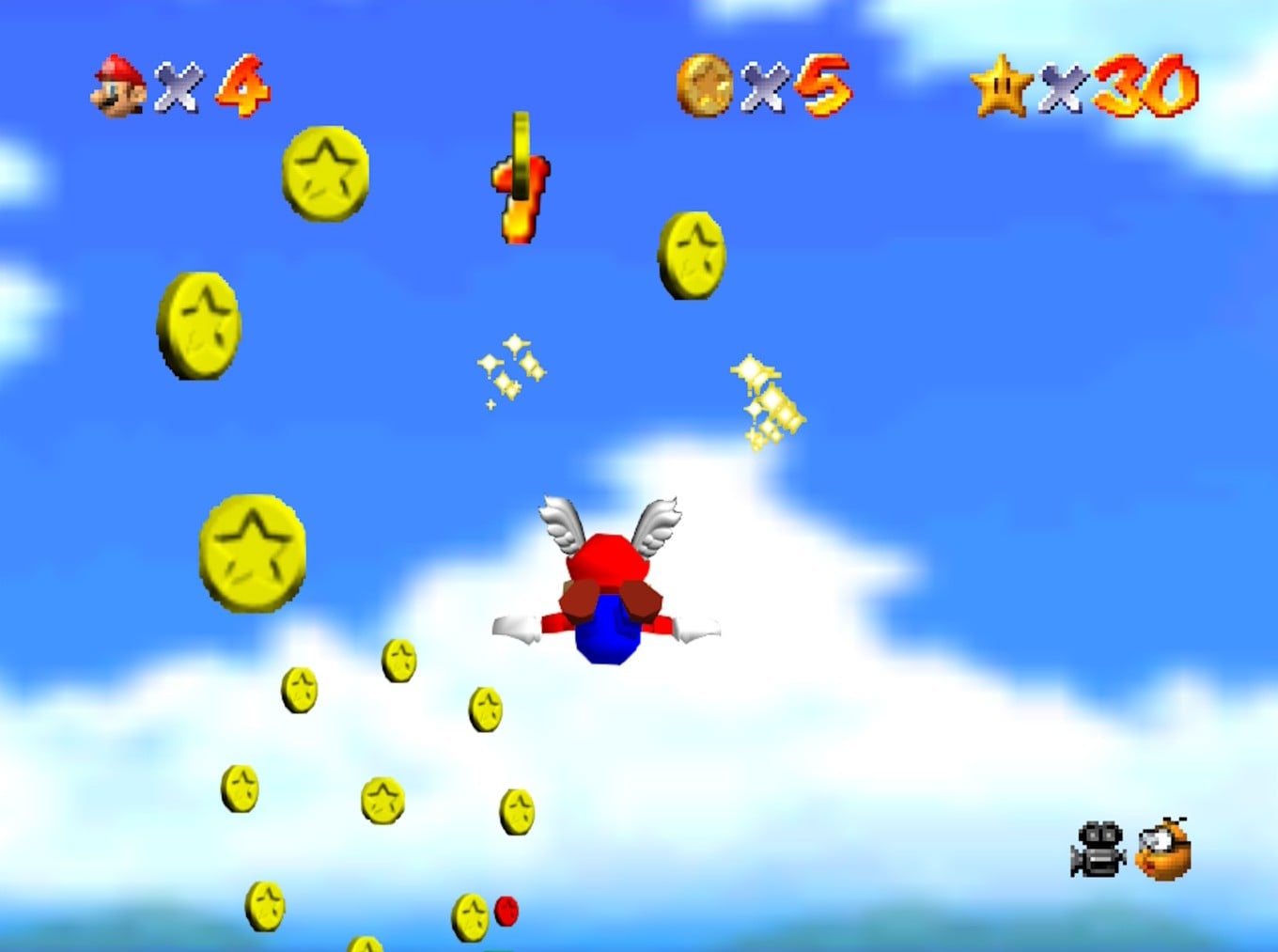
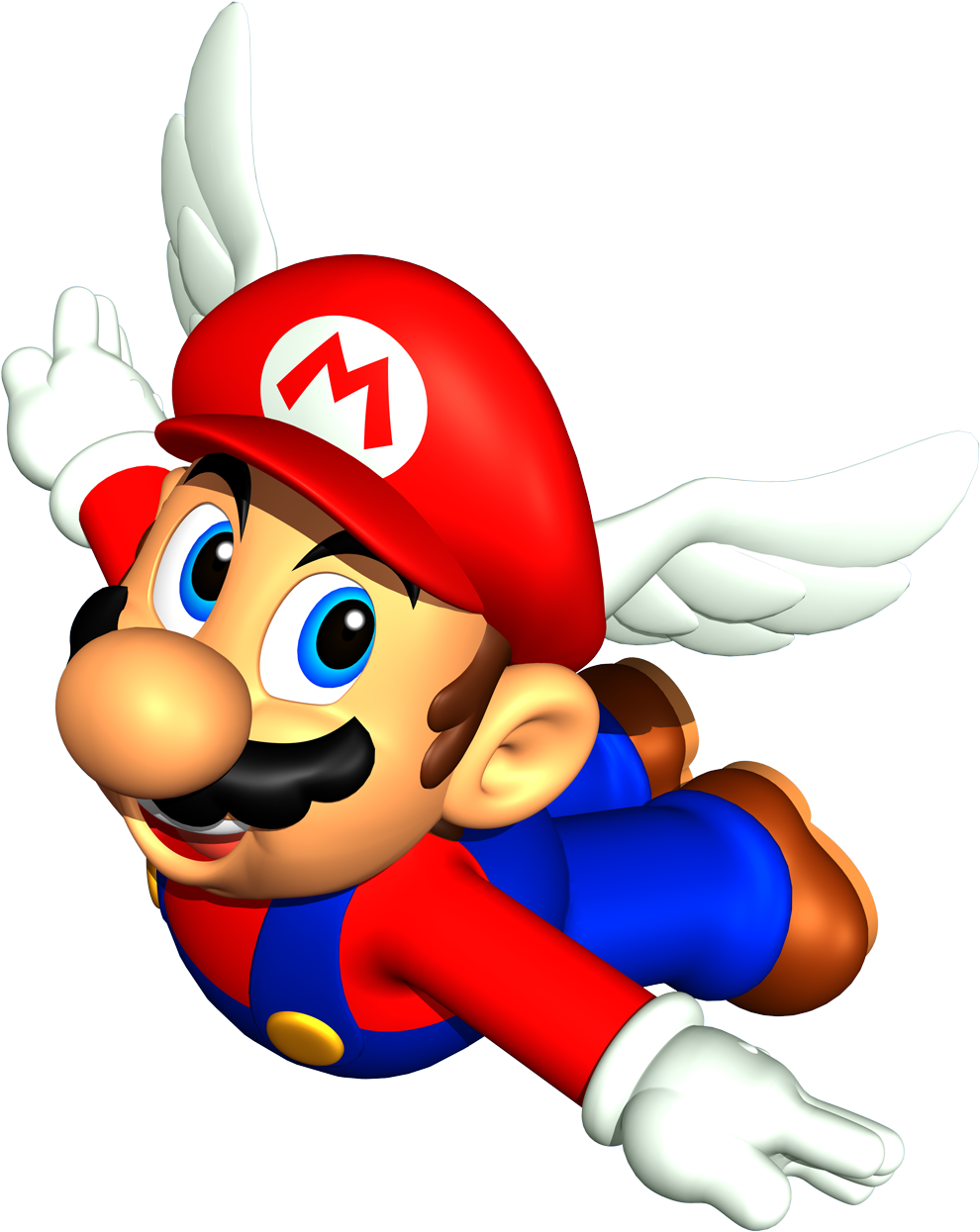
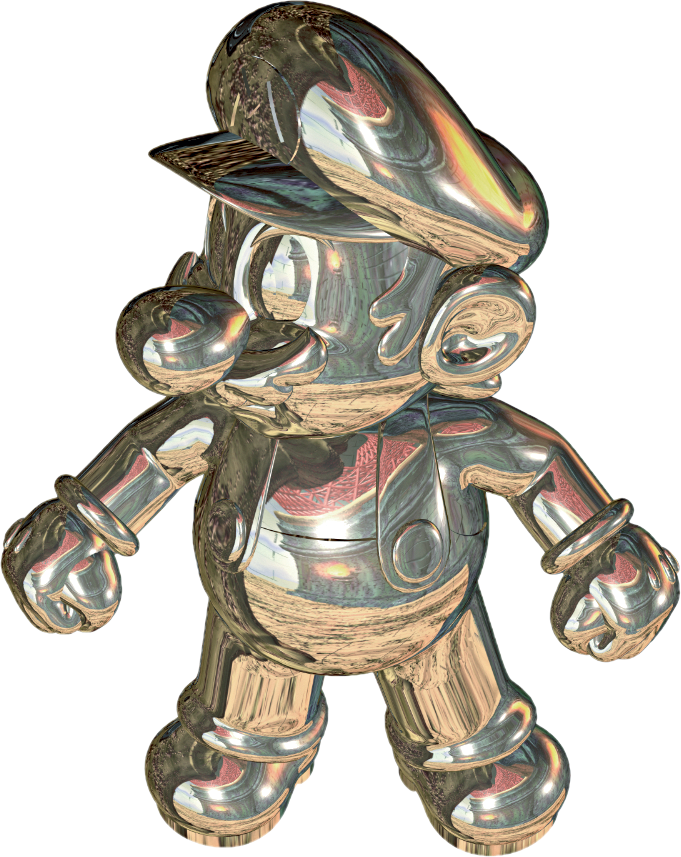
Fire Flowers are gone; in their place are three coloured Cap Blocks, each switched on by finding a hidden course and stomping its giant switch. The red Wing Cap (whose switch is in the Tower of the Wing Cap, reached through a beam of light in the castle lobby once you have ten stars) lets Mario fly for about a minute after a triple jump or a cannon shot. The green Metal Cap (Cavern of the Metal Cap, through the double doors Dorrie can carry Mario to in Hazy Maze Cave) turns him into an invulnerable, heavy Metal Mario for about twenty seconds, walking along the bottom of lakes without breathing. The blue Vanish Cap (Vanish Cap Under the Moat, reached by draining the moat) makes him a see-through ghost for a similar spell, able to pass through wire mesh and certain walls.
Dire, Dire Docks is the one place where a Metal block and a Vanish block sit side by side, so a quick player can wear both at once.
Wing Mario.Metal Mario, with his own heavy-metal theme.Vanish Mario.
The castle: a hub with locked doors
Mario in the castle lobby.
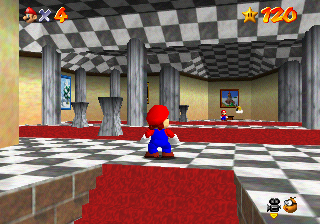
Peach’s castle is the game’s world map. The ground floor holds the first four paintings and the courtyard; doors marked with a star open when you have one, three or eight stars, and the eight-star door leads to the first Bowser course. Beating Bowser earns a key to the basement, with its own courses and the 30-star door to Dire, Dire Docks and the second Bowser fight. That key opens the upper floors: the second floor’s paintings and mirror room, a 50-star door to the third floor, and finally the endless staircase, which stops being endless at 70 stars and leads to the roof and Bowser in the Sky.
Toads scattered through the castle hand over three stars of their own at 12, 25 and 35 stars, and MIPS the rabbit can be caught in the basement at 15 and again at 50. Outside, 120 stars opens a cannon that fires Mario onto the roof.
Saving, difficulty and 100 per cent
The game saves whenever you collect a star, so a Game Over costs little. Getting to 70 is a gentle climb; the last 50 stars, especially the 100-coin runs in Tick Tock Clock and Rainbow Ride and the Princess’s Secret Slide in under 21 seconds, are where the game bares its teeth. There is no 100 per cent reward beyond Yoshi’s lives and a new Bowser speech, and nobody has ever minded.
Items and objects
What Mario picks up, stomps and climbs into on his way to 120 stars.
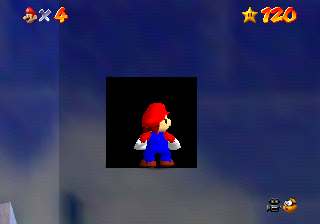
Power StarThe goal of every mission. 120 in total; 70 needed to reach the final Bowser.
Big KeyDropped by Bowser in the Dark World and the Fire Sea; opens the basement and the upper floors.
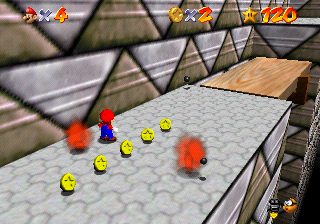
Yellow CoinHeals one wedge. 100 in a course earns a star; 50 earns a life.
Red CoinEight per course, worth two coins each; collect all eight for a star.
Blue CoinWorth five. Released by blue coin switches and some enemies.
1-Up MushroomAn extra life, often chasing Mario down from a tree or a hidden block.
Spinning HeartRun through it to refill the Power Meter; the faster you go, the more it heals.
Cap BlocksRed for the Wing Cap, green for the Metal Cap, blue for the Vanish Cap; each is solid only once its switch has been stomped.
Koopa ShellHop on and surf across land, water and lava.
! BlockYellow blocks hide coins, stars and shells; a crate or cork box breaks with a ground pound.
Cartoons, Comics & Other Media
The cartoons had finished by 1996, but Super Mario 64 was everywhere else: on magazine covers, in a Japanese manga, and in the DNA of almost every game Nintendo has made since.
Nintendo Power, 1996–1998Nintendo of America · issues 80 to 98Nintendo Power followed the game for two years: a first look in Vol. 80, a full feature in Vol. 85 (June 1996), an exclusive special in Vol. 88, reader competitions and more than a year of Q&A columns answering the same question (where is Luigi?). Super Luigi Bros has the complete archive, and the magazine also published a Player’s Guide.
Super Mario-kun, volumes 15 to 19Yukio Sawada · Shogakukan · 1996–1998The gag manga spent five volumes in the castle: Peach’s party, Bowser’s takeover, a tour of the courses from Bob-omb Battlefield to Rainbow Ride, a mirror-world detour, a Bowser who deletes the save files, and a cake at the end.
“Change the System”US television · 1996Nintendo of America’s launch adverts cut Mario’s leaps together with a real kid jumping, sliding and flying through the air, to a voice-over promising you could go anywhere and do anything.
Mario Kart 64: Royal RacewayNintendo 64 · 1996The Mario Kart 64 track takes a detour past a full-size recreation of Peach’s castle, lawn, moat and all.
Super Mario Galaxy 2: Throwback GalaxyWii · 2010Whomp’s Fortress rebuilt in full, music and all, as a bonus galaxy in Super Mario Galaxy 2.
Super Mario Odyssey: the Mushroom KingdomSwitch · 2017Odyssey’s last kingdom is Peach’s castle and grounds as they were in 1996, complete with a low-polygon Mario 64 costume and a trip back inside the paintings.
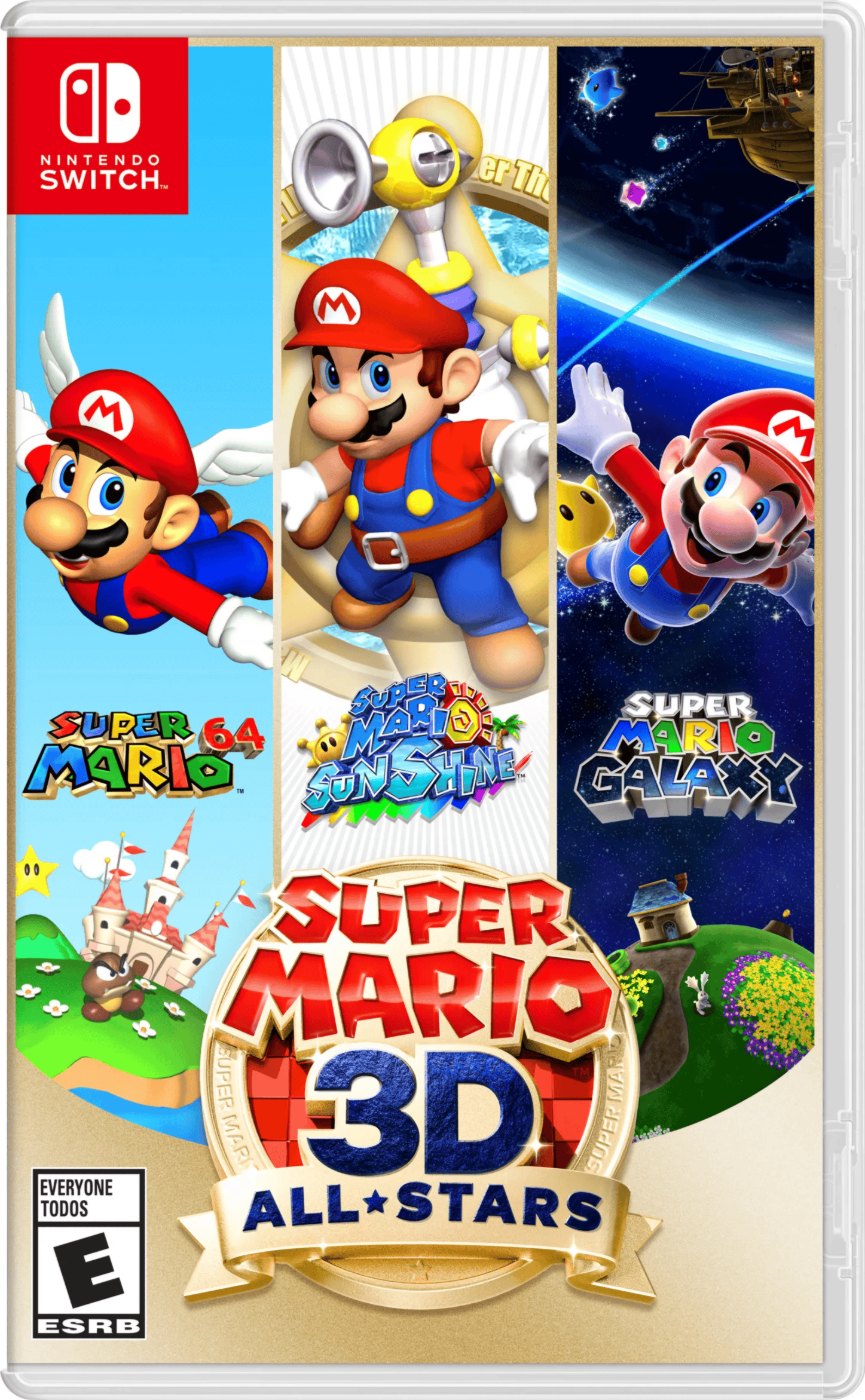
Super Mario 64 DS and 3D All-StarsDS 2004 · Switch 2020The DS remake retold the story with Yoshi, Luigi and Wario; Super Mario 3D All-Stars packaged the original with Sunshine and Galaxy for Mario’s 35th birthday.
Characters
A small cast for a big castle. Here is everyone who talks to Mario, races him, carries him or steals his hat.
Character
Who they are
In this game
Abilities & notes
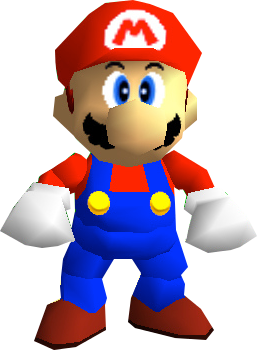
MarioThe hero, in 3D for the first time
Nintendo’s mascot, rebuilt as a polygon model with a face you can stretch on the title screen and a voice, from Charles Martinet, that had only been heard at trade shows and in a 1995 PC game.
Answers Peach’s invitation, finds the castle overrun, and recovers the Power Stars from fifteen paintings before throwing Bowser out of the sky.
Triple jump, long jump, backflip, side flip, wall kick, ground pound
Punch, kick, dive, grab and throw
Eight-wedge Power Meter
Wing, Metal and Vanish Caps
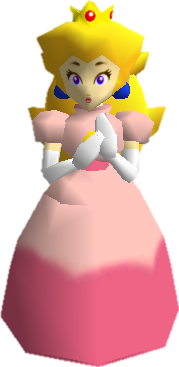
Princess PeachThe host
Princess Toadstool, signing herself “Peach” and making the name stick in the West, voiced by Nintendo Power editor Leslie Swan.
Invites Mario for cake, is sealed into the castle’s stained glass by Bowser, and floats free in the ending to deliver the kiss and the cake.
Not playable. Her image in the stained glass hides the Secret Slide.
BowserKing of the Koopas
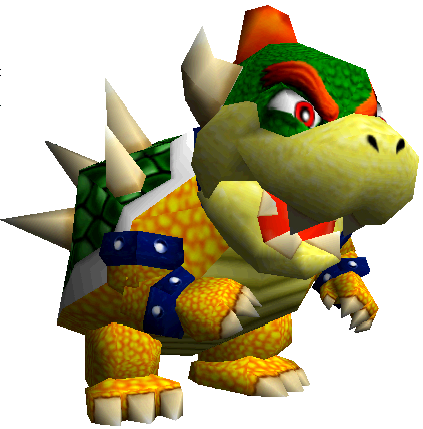
The villain, now a towering 3D model with a tail that invites grabbing.
Steals the Power Stars, seals Peach and the Toads into the walls, and taunts Mario from the Dark World, the Fire Sea and the Sky. Thrown into bombs five times across three fights.
Fire breath, shockwave stomps, charges
Teleports and tilts the arena from fight two
Three throws in the finale
ToadsThe castle staff
The castle’s retainers, trapped in the walls by Bowser but able to pop out and talk.
Explain what has happened, point Mario towards doors and switches, and three of them hand over Power Stars of their own at 12, 25 and 35 stars.
Not playable.
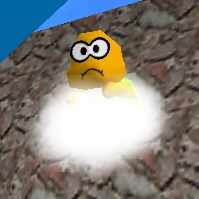
The Lakitu Bros.Camera crew
Two cloud-riding Lakitus who, according to the Player’s Guide, report for the Kingdom News Network. One films the intro, the other stays on Mario for the whole game.
Your camera. He can be glimpsed in mirrors and in the opening and ending, and he buzzes when you push the view somewhere it cannot go.
Controls: C buttons rotate and zoom, R switches camera mode.
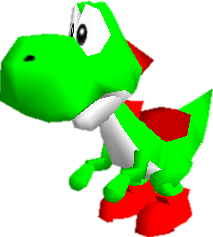
YoshiOn the roof
The green dinosaur of Super Mario World, here in a single cameo. His model was made for a cut event elsewhere in the game.
Waits on the castle roof for a Mario with 120 stars, hands over 100 lives and an upgraded triple jump, then dives off into the distance.
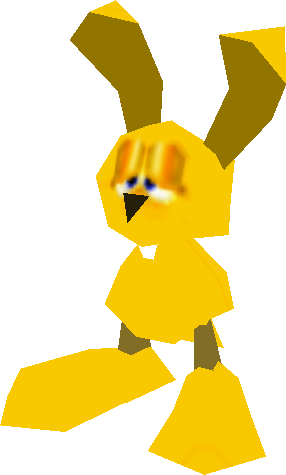
A yellow rabbit, named after the MIPS processor architecture inside the Nintendo 64, who quotes the White Rabbit from Alice in Wonderland.
Hops around the basement at 15 stars and again at 50. Catch him and he hands over a Power Star that Bowser gave him.
Two stars. Replaced by minigame-key rabbits in the DS remake.
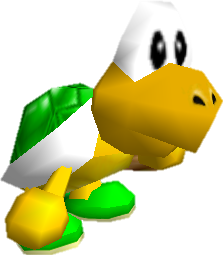
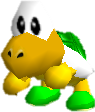
Koopa the QuickThe racer
A huge Koopa Troopa in running shoes with a taste for footraces.
Races Mario to the top of Bob-omb Battlefield, then demands a rematch on Tiny-Huge Island. Win fairly (no cannons) for a star each time.
Faster the second time.
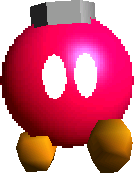
Bob-omb BuddiesThe pink Bob-ombs
Peaceful Bob-ombs at war with their black cousins.
Open the cannons in every course once you have spoken to them, and give Mario the lie of the land on Bob-omb Battlefield.
Friendly; cannot be picked up.
The penguinsCool, Cool Mountain
A mother penguin, her lost chick Tuxie, and a Big Penguin who fancies himself a slider.
Return Tuxie to her mother (not the impostor) for a star; beat the Big Penguin down the cottage slide for another. He is noticeably fatter after 120 stars.
Dropping Tuxie off the mountain is noticed, and remembered.
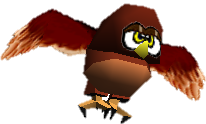
HootThe owl
An owl asleep in the tree at the start of Whomp’s Fortress, from the third mission onwards.
Carries Mario by the feet to the top of the fortress, complaining about his weight and telling him to lay off the pasta.
Hold A to hang on; drops you if you dawdle.
DorrieThe cave monster
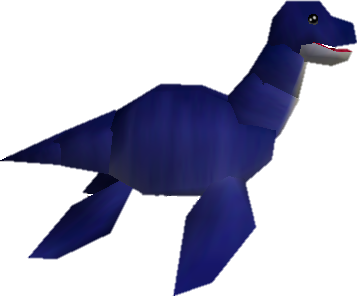
A gentle plesiosaur-like creature swimming in the great lake under Hazy Maze Cave.
Lowers his head when ground-pounded so Mario can climb on and ride to the Power Star and to the Metal Cap cavern.
Harmless; returned in Mario Party 3.
UkikiThe monkeys
Cheeky monkeys on Tall, Tall Mountain who, in earlier builds, roamed the game in greater numbers.
One steals Mario’s cap and has to be caught; another, caught and released, opens the cage holding a Power Star.
Catch them by hand.
Klepto and the cap thievesHat trouble
Klepto the condor circles Shifting Sand Land; a Ukiki on Tall, Tall Mountain likes Mario’s hat too, and the wind there and in Snowman’s Land can blow it off.
Snatch the cap, leaving Mario to take 50 per cent more damage until he wins it back. Klepto also carries a Power Star in his talons.
Hit them to get the cap back. Leave with a star and Mario stays bare-headed until he returns to that course to fetch it.
Enemies and bosses
Miyamoto said the team used just under 40 enemies, half the usual Mario roster, so that each could be fully realised in 3D. Here they are, plus every boss.
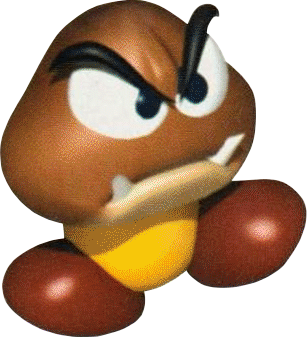
GoombaMost coursesRounder and chubbier in 3D. Giant and tiny versions roam Tiny-Huge Island.
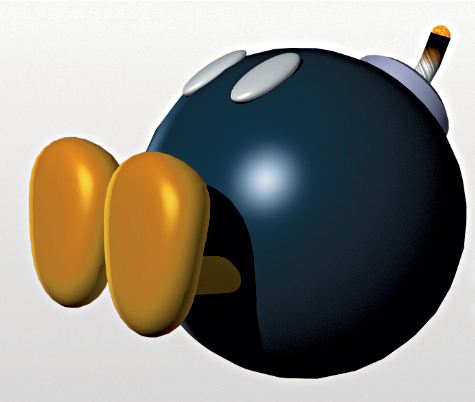
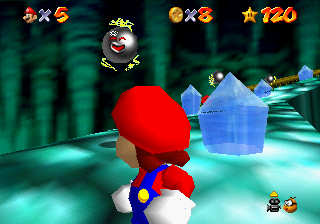
Bob-ombBattlefield, Fire Sea, clockLights its fuse and chases; grab it from behind and throw it.
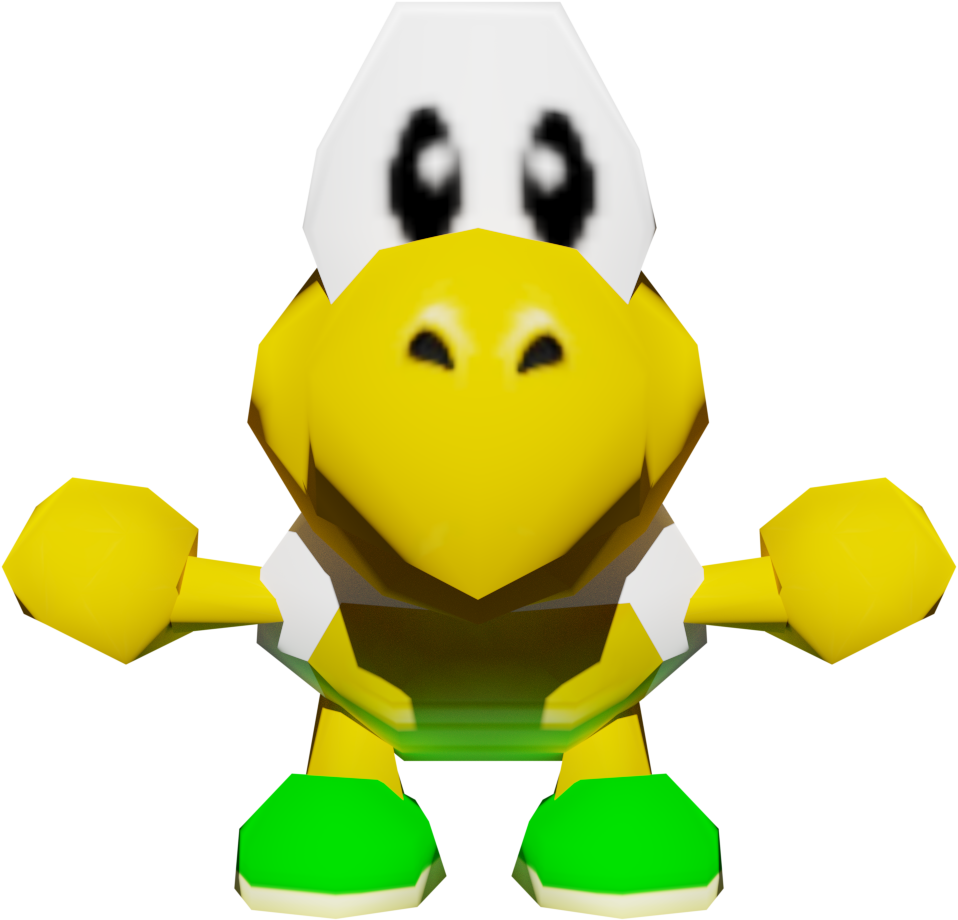
Koopa TroopaBattlefield, islandStomp it and ride the shell like a surfboard.
Piranha PlantFortress, islandSnoozes until you approach; a punch while it sleeps is the safe way.
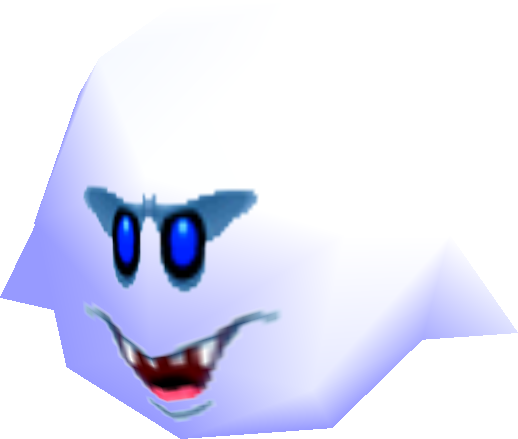
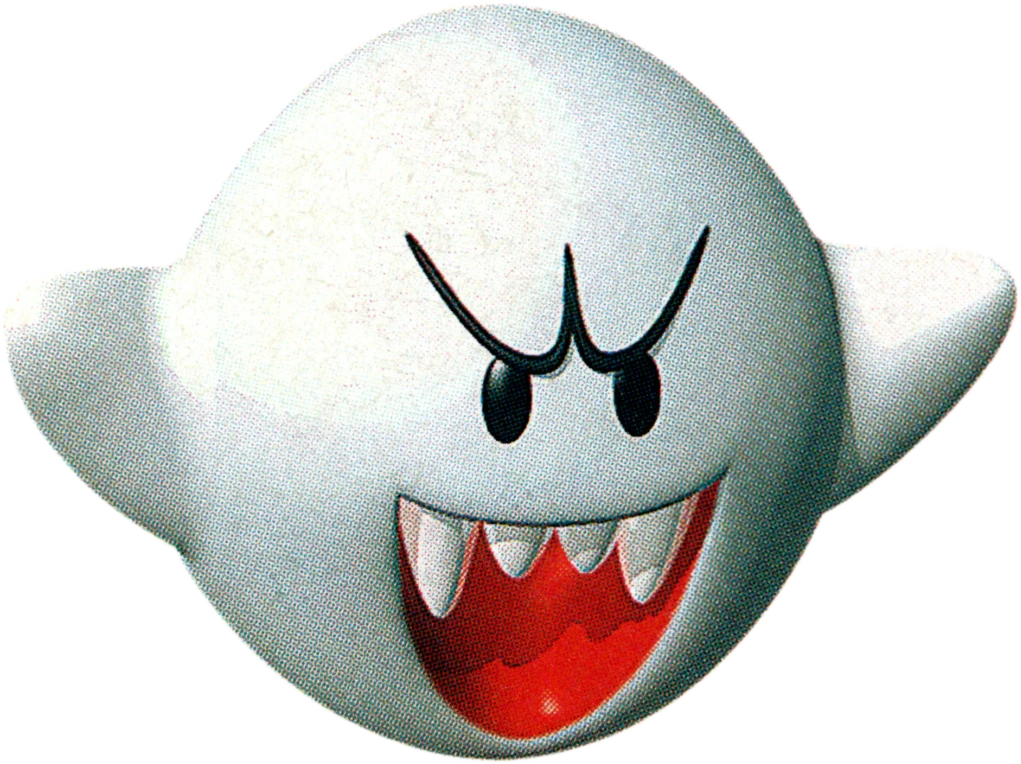
BooCourtyard, Big Boo’s HauntTurns shy when you look at it; punch from behind for a coin.
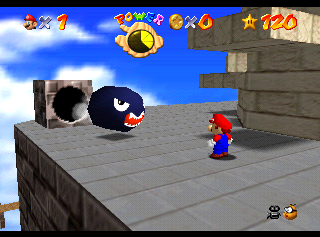
Chain ChompBob-omb BattlefieldChained to a post that three ground pounds will loosen.
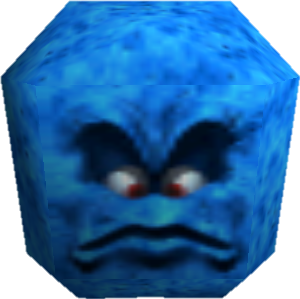
Thwomp and WhompFortress, clockThwomps drop; Whomps fall flat on their faces and take a ground pound to the back.
Bullet BillWhomp’s FortressFired from cannons at the top of the fortress.
BullyLava and snow coursesCannot be hurt; shove it off the platform instead.
Mr. IHaunt, cave, lavaA giant eyeball. Run circles round it until it gets dizzy and pops.
SnufitHazy Maze CaveA floating, masked cousin of the Snifit that spits bullets. Also found in the Cavern of the Metal Cap.
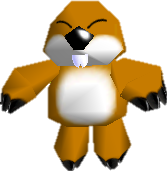
Monty MoleCave, mountainPops out of holes to throw rocks.
PokeyShifting Sand LandA stack of cactus segments; knock off the head.
KleptoShifting Sand LandThe condor who steals caps and stars.
Tox BoxShifting Sand LandA rolling stone cube with a hollow side; stand in the gap.
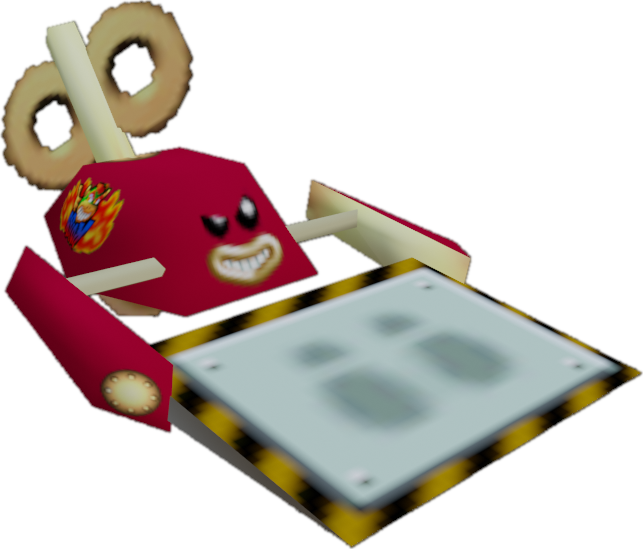
Heave-HoWet-Dry World, clockA wind-up robot that flips Mario into the air.
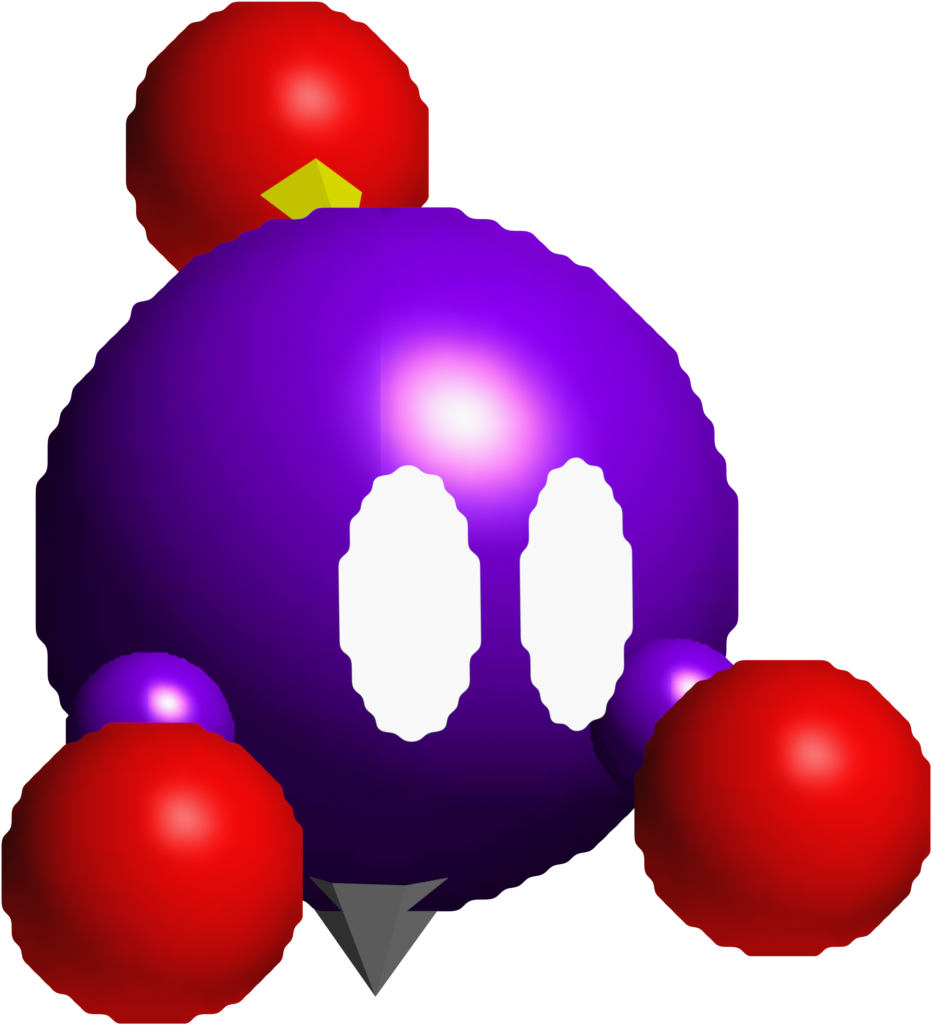
ChuckyaSeveral coursesA purple Bob-omb that grabs and hurls Mario. Grab it first.
AmpWet-Dry World, clock, Rainbow RideElectric balls that orbit platforms.
Mr. BlizzardSnow coursesSnowmen that pelt Mario with snowballs.
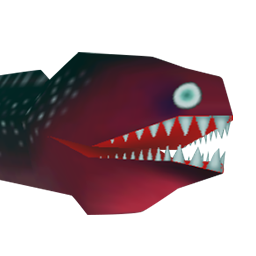
UnagiJolly Roger BayThe giant eel in the sunken ship, with a star on its tail.
Mad PianoBig Boo’s HauntA grand piano with teeth. Not King Boo; just a piano.
King Bob-ombBoss, Bob-omb BattlefieldGrab him from behind and throw him three times. He calls foul if you throw him off the summit.
Whomp KingBoss, Whomp’s FortressDodge his belly flop and ground pound his back three times.
Big BooBoss, Big Boo’s HauntFought three times; punch or pound him from behind three times each.
Big Bully and Chill BullyLethal Lava Land, Snowman’s LandShove them into the lava or the freezing water.
EyerokShifting Sand Land pyramidTwo stone hands; punch the eye in each palm three times.
WigglerTiny-Huge IslandDrain his pool, then ground pound him three times as he turns scarlet.
Big Mr. IBig Boo’s Haunt atticRun circles round him for the sixth star.
BowserDark World, Fire Sea, SkyGrab the tail, spin, and let go towards a bomb: once, once and three times.
The people who made it
Key staff, as credited, with what they have said about their work.
Shigeru MiyamotoDirector and producerSpent twenty months on production and one year on design with a team of fifteen to twenty. He has said the castle structure was first conceived for Zelda, and that the N64 controller and Mario’s controls were developed together.
Yoshiaki KoizumiAssistant directorModelled and animated Mario, designed the camera and built enemies and terrain. Pushed for a 3D Mario who could do anything a cartoon character could; later directed Super Mario Galaxy.
Takashi TezukaAssistant directorThe Super Mario World and Yoshi’s Island director, moved onto the project as it ramped up in 1995.
Yoichi YamadaCourse directorLed the design of the fifteen courses, which the team built by roughing out shapes and refining them like clay dioramas.
Yasunari Nishida and Yoshinori TanimotoSystem programmersNishida programmed the 193 animations; Tanimoto wrote the wall-hit effects and the painting ripple.
Takumi KawagoeCamera programmerApplied lessons from the camera and cutscenes of the unreleased Star Fox 2.
Giles GoddardProgrammerThe English programmer who wrote the stretchy Mario face on the title screen, inspired by a talking Mario head Nintendo showed at CES in 1993.
Koji KondoMusicA score of new themes (Bob-omb Battlefield, Dire, Dire Docks, Slider) and reworked classics. Yoji Inagaki produced the sound effects.
Charles Martinet and Leslie SwanVoicesMartinet’s first major outing as Mario; Swan, a Nintendo Power editor who also handled the English script, voiced Peach.
Shigefumi Hino, Hisashi Nogami, Yusuke NakanoDesign and artAmong the artists credited, alongside Yoichi Kotabe and Satoru Takizawa.
Advertisement
How It Was Made
Super Mario 64 has been unusually well documented by the people who made it: two 1996 Japanese guidebook interviews translated by Shmuplations, a Nintendo Power interview from January 1996, Giles Goddard’s later recollections, and Nintendo’s own leaked production records.
From Super Mario FX to a little room
The N64 controller and Mario’s moves were developed together.
Miyamoto had wanted a 3D Mario since the Super NES days. He told Nintendo Power in January 1996 that he had considered a Super FX game, remembered as Super Mario FX, built around the idea of an entire world in miniature, like a model railway. Argonaut’s Dylan Cuthbert has said the name was only the chip’s codename, but the ambition was real, and it moved to the Nintendo 64 as soon as that machine, with its many-buttoned controller, was on the drawing board.
Production records in the 2020 Nintendo leak date the project from 7 September 1994 to 20 May 1996. It began, Miyamoto said, as a prototype of Mario and Luigi running around a single room full of blocks, first on expensive Silicon Graphics workstations standing in for the unfinished console. The team spent months on nothing but the feel of movement; Miyamoto put the headcount at fifteen to twenty people, and said that at first nobody believed something like this could run on a $250 machine.
193 animations and no motion capture
Giles Goddard’s stretchable Mario, from a Mario Paint 3D prototype.
Motion capture was tried and rejected; every one of Mario’s moves was animated by hand around a skeleton whose centre of gravity sat in the hips. Yoshiaki Koizumi made the animation data and kept adding ideas such as the sweep kick and Mario falling asleep. When system programmer Yasunari Nishida totted them up there were 193, plus around 50 that were cut. Koizumi has said the hardest thing was that there were no 3D jumping games to learn from.
The game’s geometry changed under them. In 2D, a jump could be measured in pixels; in 3D, players simply could not judge depth that finely, so partway through development Miyamoto changed the rule: a jump now only had to be “close enough” to count. The staff booed. The stretchy Mario face on the title screen came from a different prototype altogether, Mario Paint 3D, and was programmed by Giles Goddard after Nintendo’s talking Mario head demo at CES 1993.
A castle borrowed from Zelda
A pre-release screenshot: Mario fights Bowser in an early build.
The hub-and-paintings structure, Miyamoto admitted, was something he had thought up for the Zelda series. The team expected half of all players to walk straight into the castle and half to go exploring the grounds first, and designed for both. Courses were built like clay dioramas, rough shapes first and details added for months afterwards; thirty-two were planned, and fifteen survived. Giles Goddard remembers the design starting as an isometric, fixed-path game in the manner of Super Mario RPG before it opened out into free roaming, with a few linear courses kept to funnel players towards Bowser.
Some ideas changed late. A rabbit race became the Koopa the Quick footrace; monkeys were everywhere in early builds and could be chased and thrown; a Yoshi event was cut, though its Yoshi model found work in the ending; and Mario was once able to throw MIPS, an idea dropped before release.
Where Luigi went
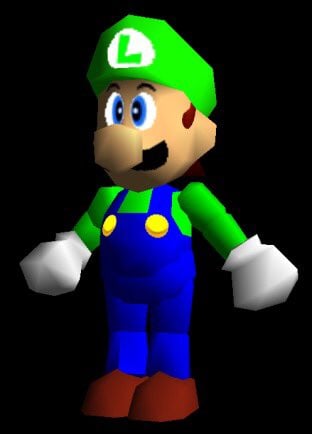
Luigi, rebuilt from the 2020 leak.
Luigi was in the game until February 1996. The plan had been a two-player mode, with the brothers on a split screen, and a Mario Bros.-style minigame for two. Koizumi has said the hardware forced a choice between Luigi and more elaborate landscapes; Miyamoto added that most buyers would only own one controller on launch day, and that memory, in the end, made the decision. Traces remained in the code (a second-player structure, a camera labelled for 2P, an empty folder of Luigi animations) and a courtyard plaque whose smeared text fans read as “L is real 2401” kept the rumour alive for decades. In July 2020 the source leak finally produced the Luigi model itself.
Inventing the camera
Nobody had built a camera for a free-roaming 3D platformer before. Koizumi designed it and Takumi Kawagoe programmed it, drawing on his work on Star Fox 2’s cinematics, and the solution was to personify it: a Lakitu on a cloud, introduced in the opening, following Mario everywhere. Players at the November 1995 Shoshinkai show found the controls wobbly and slippery; the team kept Mario’s gentle acceleration on purpose, and spent the final months tuning. Miyamoto reckoned the finished game used about 60 per cent of the N64’s power.
Voices and music
Placeholder yells from sound libraries were replaced when Nintendo of America hired Charles Martinet, whose Mario had so far been heard only in trade-show appearances and the 1995 PC title Mario’s Game Gallery. The English script and Peach’s voice came from Leslie Swan of Nintendo Power; the Western version has more dialogue than the Japanese original, including “Okie dokie!”. Koji Kondo wrote the music, mixing new themes with reworked classics, Yoji Inagaki made the sound effects, and the English studio Software Creations supplied the audio tools. Miyamoto, asked about the Boos, told Nintendo Power they were inspired by Tezuka’s wife, normally quiet, who one day exploded at the hours he was keeping.
Series Firsts
What Super Mario 64 did first. Only firsts we could confirm are listed.
1Mario in 3DThe first fully three-dimensional Mario adventure, built around an analogue stick.
2The hub castle and mission structurePeach’s castle, paintings as portals and a menu of named stars per course, the template for Sunshine and Galaxy.
3Triple jump, wall kick, long jump, backflip and ground poundMario’s modern move set, all debuting here (the ground pound borrowed from Yoshi).
4Charles Martinet in a Mario gameHis first major game as Mario, a role he kept until 2023.
5“Peach” in the WestThe princess signs her letter Peach. The English Yoshi’s Safari had used the name in 1993, but this is the game that made it standard.
6A player-controlled cameraThe Lakitu Bros. and the C-button camera, a first for Mario.
7The Power StarA new collectible that replaced the flagpole and became the currency of every 3D Mario since.
8No LuigiThe first home-console Super Mario game with no Luigi at all. The Game Boy’s Super Mario Land games had already left him out, and Super Mario Sunshine would do the same.
With all 120 stars, a cannon opens by the pond outside the castle. Shoot Mario onto the roof and talk to Yoshi for 100 lives and a sparkling new triple jump. Go back and fight Bowser afterwards and he has a different speech for you.
The fat penguin
After 120 stars, the Big Penguin of Cool, Cool Mountain has eaten rather well. Pick the Big Penguin Race mission and drop down the chimney to see for yourself.
Butterfly bonuses
On Whomp’s Fortress, Tall, Tall Mountain and Tiny-Huge Island, punching a butterfly turns it into either a 1-Up Mushroom or a bomb that chases you.
Easy lives at the castle
Do a handstand on top of the third tree near the waterfall for a 1-Up, pop into the castle and back out, and the mushroom is back. The 1-Up behind the top-left pillar in Bowser in the Sky is also handy if the final fight goes wrong.
Controller two in the ending
During the ending scene with Mario and Peach, and over the credits, a second controller’s stick moves the camera.
The hidden slide
On the first floor, jump into the right-hand stained-glass picture of Peach to find the Princess’s Secret Slide. Finishing it in under 21 seconds earns a second star.
The Secret Aquarium
In the Jolly Roger Bay room, look up: a hole high in the wall leads to a tank with eight red coins and a star.
The Japanese 1000-coin trick
In the original Japanese version only, collecting 1,000 coins in a single course makes the game try to set Mario’s lives to 999, more than the lives counter can hold, so it reads M25. Later releases cap the coin counter at 999.
Squash Mario’s face
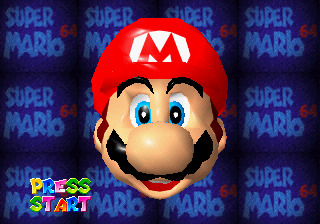
On the title screen, grab Mario’s face with A and pull with the stick; hold R to keep it stretched. Nintendo made this a feature, not a secret, but it still delights.
Compiled from Nintendo Life and Super Luigi Bros’ existing cheats page.
Glitches & Oddities
Few games have been taken apart as thoroughly as Super Mario 64. Its glitches are a sub-culture of their own, from speedrun skips to the famous attempt to beat a star with half an A press.
The backwards long jump
The endless staircase, the BLJ’s favourite target.
Long jump backwards on a staircase, slope or rising lift and tap A rapidly as Mario lands: his speed stacks with every hop until he is moving faster than the game can track. On the endless staircase this punches straight through the 70-star barrier, which is why speedrunners can finish the game with 16 stars, or even one. Removed in the Shindou version, iQue and 3D All-Stars; intact on the Virtual Console and Nintendo Switch Online.
Black Rooms of Death
Behind every castle door is a void used for the opening animation. Clip into one through a roof corner or a wall and Mario drops into blackness; opening the door from the wrong side dumps him into the room beyond. One such room cannot be escaped.
Bob-omb and Chuckya clips
Stand between a wall and an exploding Bob-omb, or throw one while backed against a wall, and Mario is pushed through the geometry. The trick collects the star behind Chain Chomp’s gate without freeing the Chomp. Chuckyas and crates work the same way.
Hatless Mario
Pull up over the corner ledge of the castle roof and Mario crosses the boundary, loses a life and leaves his cap behind for good (until he next collects it). In Snowman’s Land the giant snowman’s breath can blow the cap into the ice block where a star is kept.
The impossible coin and the Mystery Goomba
Super Mario 64 has 2,016 coins and one of them, in Tiny-Huge Island, spawns inside the floor and cannot be collected by normal means; it was found in 2014. A Goomba in Bowser in the Sky, the Mystery Goomba, likewise can never be met: it spawns far below the course, on the death barrier.
Death by transfer
Mario keeps his health between areas, so he can be set on fire outside the castle and drown in the moat, or fall from a great height and expire on landing in the lobby.
Parallel universes and the half A press
In 2016 the player pannenkoek2012 showed that building speed for twelve hours against a slope lets Mario pass into copies of the level’s collision far outside its bounds, in a video explaining how to collect “Watch for Rolling Rocks” in half an A press. In May 2024 a player called Marbler finished the entire game without pressing A at all.
Videos
Nintendo’s overview of the 2020 Switch collection that includes this game, and a long sit-down with one of its programmers.
Nintendo’s official overview of Super Mario 3D All-Stars, including the 720p Shindou-based Super Mario 64.
Double Fine’s Tim Schafer plays through the game with Giles Goddard, who programmed Mario’s face and worked on the early prototypes.
Trivia & Interesting Facts
The plaque. Or possibly “Eternal Star”.The courtyard statue carries a smeared plaque that fans read as “L is real 2401”. Luigi’s model finally surfaced in the July 2020 source leak, 24 years and one month after the game came out, a coincidence the internet enjoyed enormously. The same texture appears in Ocarina of Time.
Thirty-two courses were planned; fifteen made the cut.
Mario’s face on the title screen came from a prototype for Mario Paint 3D and was programmed by Giles Goddard, inspired by a talking Mario head Nintendo demonstrated at CES in January 1993.
MIPS the rabbit is named after the MIPS processor architecture inside the N64, and quotes the White Rabbit from Alice in Wonderland.
Yoshi on the castle roof, where his greeting reads “It that really you???”Yoshi’s greeting on the roof reads “Mario!!! It that really you???” The typo survived every re-release until the DS remake and 3D All-Stars corrected it.
The Japanese Jolly Roger Bay painting.The painting for Jolly Roger Bay is different in Japan, where it shows bubbles in a blue frame; Western versions show the sunken ship in gold.
Peach’s letter is signed “Peach”. The English version of Yoshi’s Safari (1993) used the name first, but it only became standard in the West with this game; Japan had always used it.
According to the Player’s Guide, the Lakitu Bros. are news cameramen on the Kingdom News Network payroll.
The clock in Tick Tock Clock remembers its last speed setting, and the credits show the clock at that speed.
Rainbow Ride’s last star is Somewhere Over the Rainbow and Tick Tock Clock’s second is The Pit and the Pendulums, nods to The Wizard of Oz and Edgar Allan Poe. Shifting Sand Land may also owe its name to the deserts of Oz.
To show how Mario should swim, Miyamoto lay sprawled across a desk at two or three in the morning miming the stroke, Koizumi recalled: not quite a breaststroke and not quite a crawl.
Mario’s pre-Martinet yells were library sound effects. Martinet had voiced Mario in the 1995 PC title Mario’s Game Gallery before this, his first console game.
A split-screen two-player mode with Luigi and a Mario Bros.-style minigame were both planned and cut; Luigi left the project in February 1996.
The Shindou version changed Mario’s throw line from “So long, kinga Bowser!” to “Buh-bye!” and added a Z-trigger title-screen Easter egg that fills the screen with Mario faces.
Dire, Dire Docks is the only course where Metal and Vanish cap blocks sit together, so Mario can be both at once.
Hazy Maze Cave is the only main course with a secret course inside it, the Cavern of the Metal Cap.
Snowman’s Land has no blue coins, and Jolly Roger Bay is the only main course without a star marker.
Super Mario 64 was the first game to receive a 10 from Edge, and a sealed copy became the first game to sell for over a million dollars.
The N64 shipped in Japan with just two other games: Pilotwings 64 and Saikyo Habu Shogi.
A 2013 study found that adults who played Super Mario 64 for 30 minutes a day over two months showed increased grey matter in the hippocampus and prefrontal cortex.
Fans decompiled the game into C in 2019, which led to a native PC port in 2020 and versions for everything from the Dreamcast to the Atari Jaguar; Nintendo has pursued the ports with copyright claims.
A 64DD sequel, often called Super Mario 128, was planned from around E3 1997 and cancelled as the disk drive failed; the name lived on as a GameCube tech demo.
Regional Box Art
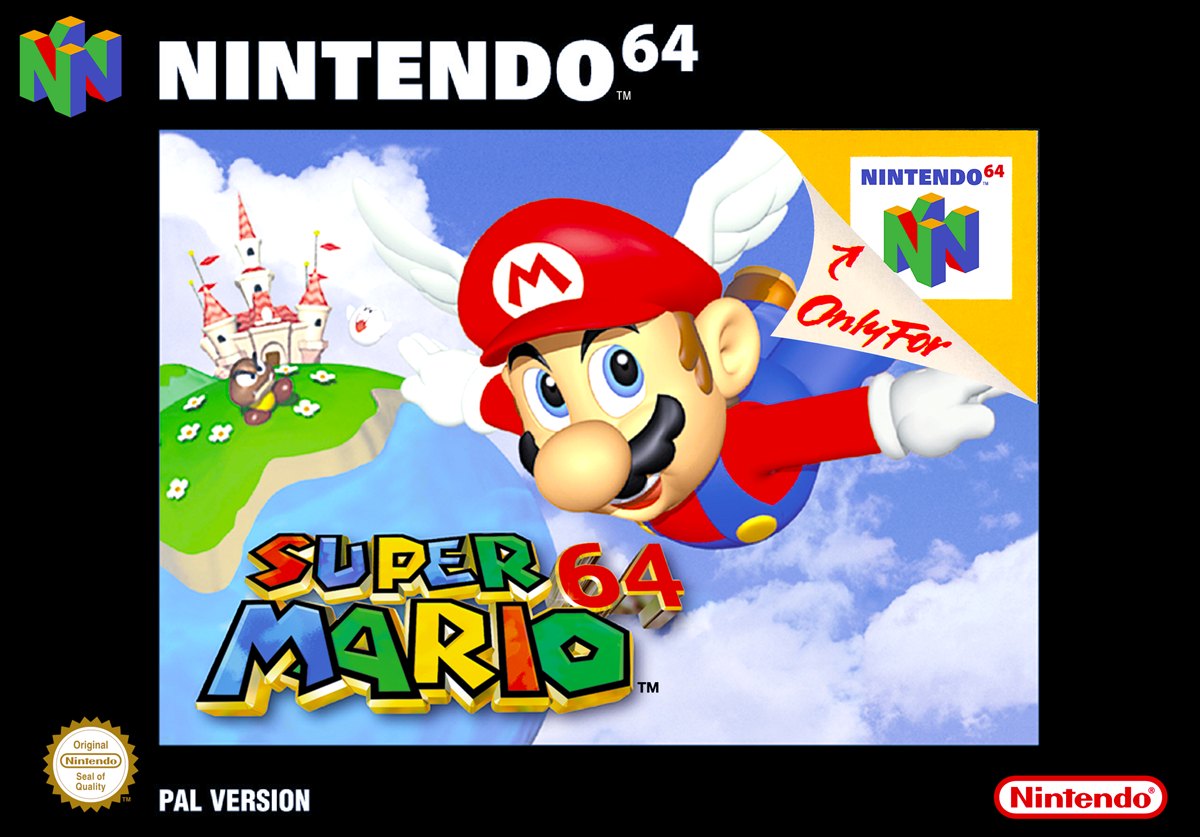
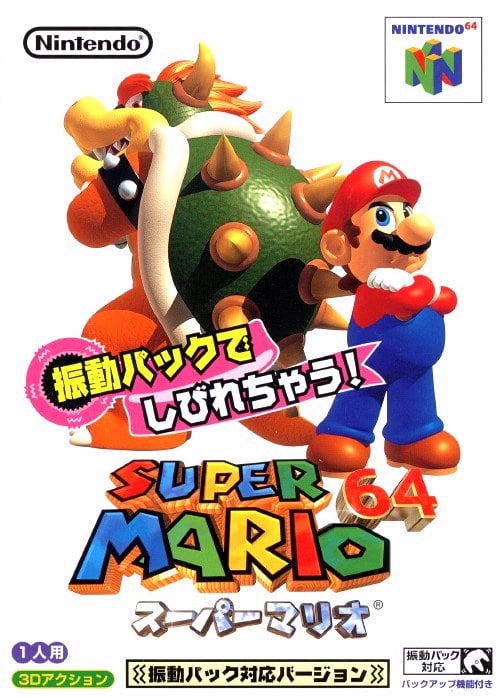
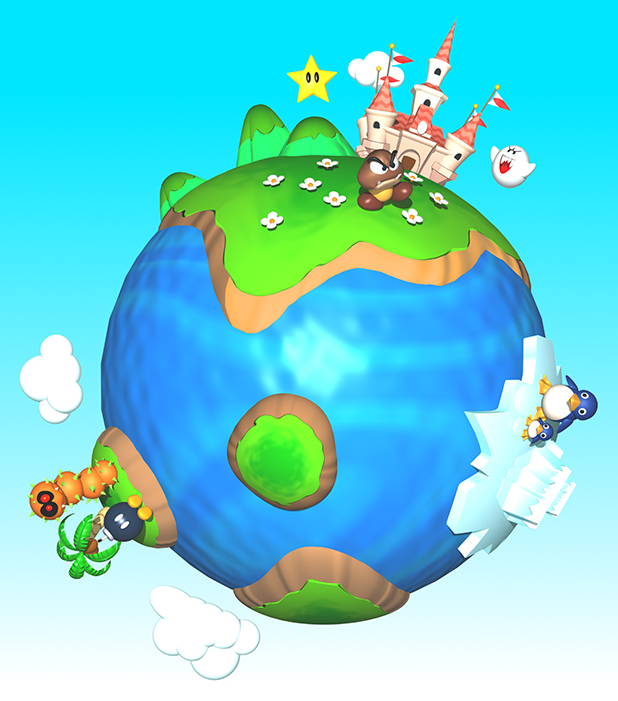
The Western box shows Mario leaping off the globe; the Japanese box is the same art with the red and yellow logo and the castle behind. The Shindou re-release and the iQue version restyled it for their markets.
North America (1996)Mario over the globe, the N64 launch look.Japan (1996)Super Mario 64 in red and yellow on a sky-blue box.Europe / Australia (1997)PAL release of 1 March 1997, with English, French and German.Japan: Shindou Pak Taiou Version (1997)The Rumble Pak revision of 18 July 1997.China: iQue Player (2003)Released in Mandarin on 18 November 2003.Super Mario 3D All-Stars (Switch, 2020)Bundled with Sunshine and Galaxy, 18 September 2020.
Screenshots
More from the castle and its paintings. Select any image to view it larger.
Wing Mario over Bob-omb Battlefield.Metal Mario in the Cavern of the Metal Cap.The rematch with Koopa the Quick on Tiny-Huge Island.The Princess’s Secret Slide.Downtown in Wet-Dry World.Inside Tick Tock Clock.Eyerok, in the pyramid of Shifting Sand Land.Big Boo’s Haunt by moonlight.Cool, Cool Mountain.
Artwork & Media Gallery
Artwork, renders and oddities from Super Mario 64. Select any image to view it larger.
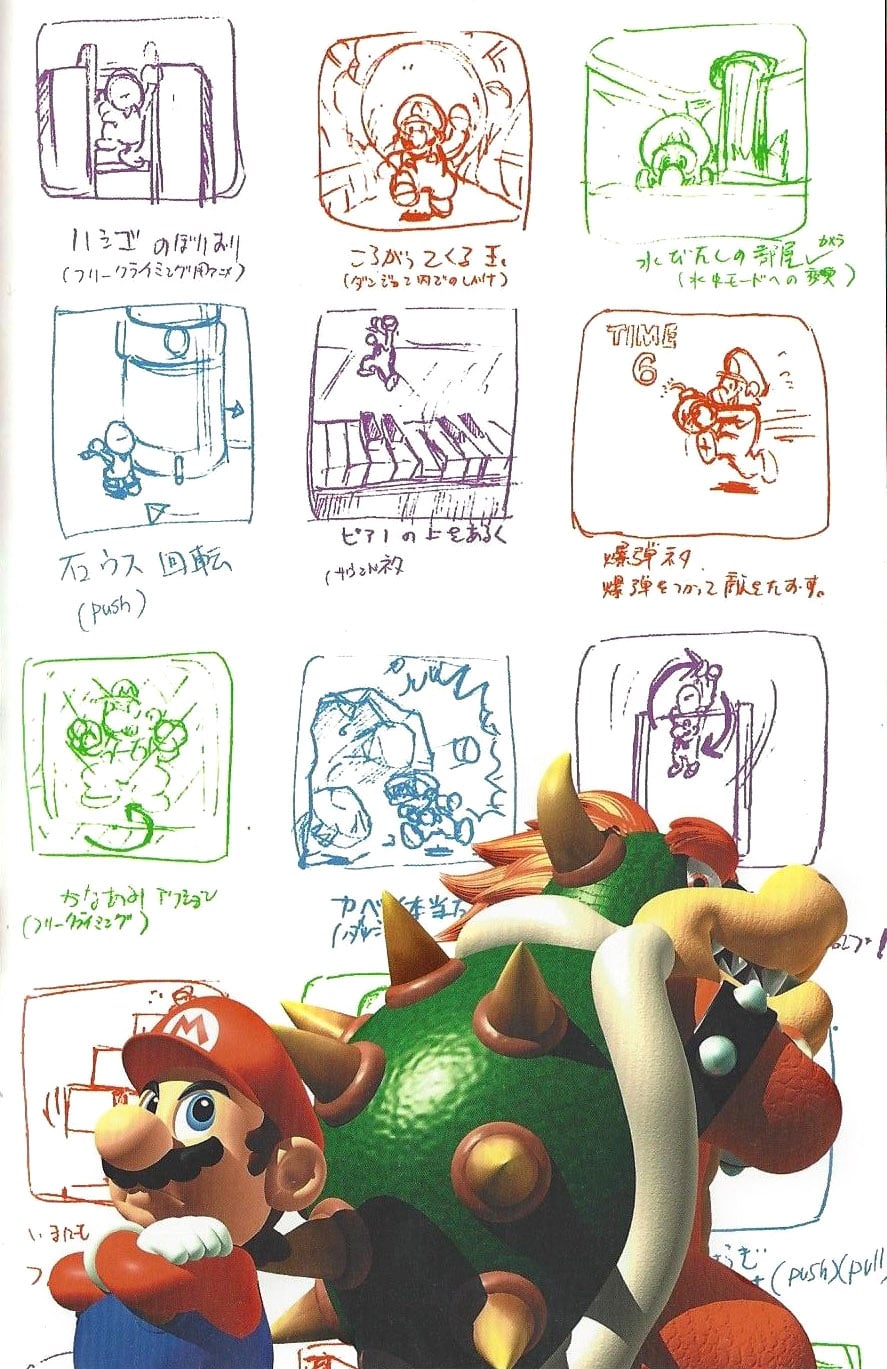
The logo.The Japanese logo.Mario and the globe.Mario swings Bowser by the tail.Concept art.The Nintendo Power Player’s Guide.Princess Peach.The letter.
Legacy & Re-releases
Super Mario 64 has been revised once, remade once and re-released on every Nintendo console since the GameCube. It has also been taken apart, rebuilt and ported by its fans more than any other Nintendo game.
From Nintendo 64 to Switch
Nintendo 641996–1997Japan 23 June 1996, North America 29 September 1996, Europe and Australia 1 March 1997, all as launch titles. A Player’s Choice reprint followed in the US in January 1998.
Shindou Pak Taiou Version18 July 1997Japan only. Rumble Pak support, the English voice acting with Japanese text, bug fixes including the removal of the backwards long jump, and “Buh-bye!”.
iQue Player18 November 2003A Mandarin version for China’s plug-and-play N64, based on the Shindou code.
Super Mario 64 DS2004The DS launch remake: Yoshi, Luigi and Wario join Mario, 150 stars, new bosses and minigames. See the Super Mario 64 DS page.
Wii Virtual ConsoleNovember–December 2006North America 19 November (Wii launch), Japan 2 December, Europe 8 December. The second most downloaded Virtual Console game by mid-2007.
Wii U Virtual ConsoleApril 2015North America and Europe 1 April, Japan 8 April, with off-TV play.
Super Mario 3D All-Stars18 September 2020Nintendo Switch, with Sunshine and Galaxy: the Shindou version at 960×720 with upscaled textures and a music player. Sold only until 31 March 2021.
Nintendo Switch Online + Expansion Pack25 October 2021In the Nintendo 64 library from the Expansion Pack’s first day (26 October in Japan). The original code, backwards long jump included.
Versions and differences
Nintendo of America made changes before the Western launch: more voice lines, including “So long, kinga Bowser!”, a fix for the 1000-coin counter bug, a Jolly Roger Bay painting with a ship instead of bubbles, and a key-collecting animation that no longer twirls the key. Europe’s version added French and German text through an options menu. The Shindou version took the Western code back to Japan with Rumble Pak support and the speed cap that kills the backwards long jump; it is the basis of the iQue release and 3D All-Stars, which is why speedrunners prefer the Virtual Console and Switch Online versions.
Speedruns, decompilation and ports
The game is a pillar of speedrunning, with categories for 120, 70, 16, 1 and 0 stars built on the backwards long jump, the Lakitu skip and clipping tricks, and a research community (pannenkoek2012’s parallel universes, the half-A-press) that treats the engine as a physics problem. In 2019 fans finished decompiling the ROM into readable C, which made a native PC port with widescreen and 4K possible in 2020, followed by mods such as Render96, online 16-player co-op, and ports to the 3DS, PlayStation 2, Dreamcast and even the Atari Jaguar. The July 2020 leak of Nintendo’s own source and assets added the Luigi model and early builds to the pile.
Influence
The game’s fingerprints are everywhere: Rare built Banjo-Kazooie in its image, Tim Schafer called it the single biggest influence on Psychonauts, Gabe Newell has cited it for Half-Life, and the lead designer of Assassin’s Creed IV modelled its open world on Peach’s castle. Inside Nintendo, Super Mario Sunshine and the Galaxy games kept its hub-and-stars shape, Odyssey rebuilt its castle, and Peach’s Castle, Rainbow Cruise and Whomp’s Fortress all became Smash Bros. stages or Galaxy 2 levels.
Reviews & Sales
Sales figures
Japan bought about 200,000 copies in launch week. In North America sales passed two million, bringing in around $140 million in its first three months, making it the best-selling game of 1996 by revenue; by early 2001 the total was 5.5 million, by 2008 11.8 million and Guinness listed it as the N64’s best-seller. The last widely quoted total, 11.91 million, was reported by Gizmodo in 2015 rather than published by Nintendo; it places the game twelfth among all Mario games. The DS remake added another 11.06 million. In July 2021 a sealed copy sold for $1.56 million at Heritage Auctions, then the highest price ever paid for a video game.
11.91mN64, worldwide (2015, via Gizmodo)
2m+North America, first three months
$1.56mSealed copy, July 2021
96%GameRankings, 22 reviews
Reception and review scores
The reviews of 1996 are among the most ecstatic ever printed. The camera was the one complaint then, and it is the one complaint now.
EdgeUK · 1996, the magazine’s first 10
10/10
GameFanUS · 1996 (100 × 4)
100/100
Total!UK · 1997
100%
Next GenerationUS · 1996
5/5
GameProUS · Scary Larry, October 1996
5/5
Computer and Video GamesUK · Paul Davies
5/5
Nintendo LifeCorbie Dillard · Virtual Console review
10/10
FamitsuJapan · 1996 (10, 10, 10, 9)
39/40
IGNDoug Perry · 25 September 1996
9.8/10
Game InformerUS · 1996
9.75/10
N64 MagazineUK · issue 1, 1997
96%
Electronic Gaming MonthlyUS · September 1996 (9.5 × 4)
38/40
GameSpotChris Hudak · 1996
9.4/10
Edge broke its own ten-point ceiling for the first time; Famitsu’s four reviewers gave 10, 10, 10 and 9; EGM’s four critics each gave 9.5 and three of them explicitly knocked off half a point for the camera. Next Generation found the camera erratic too, and when Game Informer re-reviewed the game in 2007 it said the camera would almost count as broken by then-current standards. Nobody doubted the rest: GamePro’s Scary Larry, IGN’s Doug Perry and GameFan’s panel all treated it as the arrival of a new kind of game.
GameRankings’ 96 per cent from 22 reviews made it the site’s eighteenth-highest-rated game ever, and Metacritic lists 94. It topped EGM’s list of the most important games since 1989, sits fourth in EGM’s greatest console games, eleventh in Guinness’s 2009 top 50, and in 2012 was one of the 80 games chosen by public vote for the Smithsonian American Art Museum’s The Art of Video Games, beating Banjo-Kazooie and Shadows of the Empire in the N64 action category. Designers from Tim Schafer to Gabe Newell have named it an influence, and Dan Houser of Rockstar said anyone making 3D games who denies borrowing from it is lying.
Honours
Electronic Gaming Monthly · 1996Game of the YearPlus Nintendo 64 Game of the Year, Adventure Game of the Year and Best Graphics.
Game Informer · 1996Game of the YearThe magazine’s top honour for 1996.
Spotlight Awards · 1997Game of the YearAlso Best Use of Innovative Technology and Best Console Game, from the Computer Game Developers Conference.
Golden Joystick Awards · 1997Game of the Year and Best Looking GameThe British industry awards.
Smithsonian American Art Museum · 2012The Art of Video GamesChosen by public vote as the Nintendo 64 action exhibit.
SLB User Reviews
Super Luigi Bros readers have reviewed Super Mario 64 over the years. Their write-ups are kept exactly as they were sent in:
Played it? If you’d like to add your own review, please get in touch.
More from the Super Luigi Bros Guide
These picture lists come from the earlier Super Luigi Bros guide to Super Mario 64 and are kept here in full.
Characters
Super Mario 64 has a small roster, but every face matters — and famously, no Luigi. Luigi was prototyped during development but cut from the final game; he wouldn’t be playable in a 3D Mario platformer until Super Mario 64 DS in 2004 (his 3D debut came in Mario Kart 64). Data structures in the code still reference where his object slot used to be.
Playable & Story Characters
Mario
Hero of the Mushroom Kingdom. Invited to the castle by Peach — arrives to find her missing and the castle taken. Gets a full new 3D moveset including triple jumps, wall kicks and the punch-punch-kick combo.
Princess Peach
Ruler of the Mushroom Kingdom. Kidnapped by Bowser and sealed inside the castle walls. Her letter starts the whole adventure; she bakes Mario a cake at the end as thanks.
Bowser
King of the Koopas. Has stolen 120 Power Stars and used them to corrupt the castle’s paintings. Fought three times — grab his tail, spin him round and chuck him at the bombs.
Toad
One of Peach’s attendants. Several Toads are dotted around the castle — some have been sealed into the walls and reward Mario with a Star when he frees them.
NPCs & Friendly Characters
Yoshi
Appears on the castle roof once Mario collects all 120 Stars. Gives Mario 100 extra lives and a parting “It has been so long since our last adventure!”
Lakitu Bros.
Cloud-riding camera operator filming Mario’s adventure for the Kingdom News Network. The in-universe excuse for the game’s free camera. Watch for his reflection in the second-floor mirror.
Bob-omb Buddies
Friendly pink Bob-ombs. After the war on Bob-omb Battlefield ends, they man cannons across other courses — just talk to one to open the cannon you need.
Koopa the Quick
A self-styled fastest Koopa in the kingdom. Races Mario across Bob-omb Battlefield and Tiny-Huge Island for Power Stars. Beat him to the flag for the reward.
Penguins
Inhabit Cool, Cool Mountain and Snowman’s Land. One mama penguin asks Mario to find her lost baby; the Big Penguin challenges him to a downhill race for a Star.
Ukiki
Mischievous monkeys on Tall, Tall Mountain. One of them swipes Mario’s cap and runs — catch and headbutt him to win it (and a Star) back.
Koopa Troopa
Classic green-shelled Koopa. Knock it out of its shell, hop on top and surf across lava, ice or water at high speed.
Hoot
A sleepy owl in a tree above the castle courtyard and Tall, Tall Mountain. Wake him up and grab his feet for a flying ride to hard-to-reach platforms.
MIPS
A yellow rabbit that scurries through the castle basement. Catch him once for a Star at 15 Power Stars, and a second time at 50 Stars. Named after the N64’s MIPS R4300i CPU.
Dorrie
A friendly long-necked sea serpent who lives in the underground lake in Hazy Maze Cave. Ride on her back across the dark water to reach the door to Bowser in the Fire Sea.
Princess Peach (in person)
After defeating Bowser in the Sky, Peach floats down from the stained-glass window, kisses Mario on the nose and bakes him a cake. The only time you see her outside the letter.
The Sealed Castle Toads
Five Toads are stuck inside the castle walls, sealed away with the Stars. Each one rewards Mario with a Power Star once enough Stars are collected to free them.
Items & Objects
You’re not building an inventory in Super Mario 64 — everything you pick up is either spent immediately, counted towards a Star, or restoring your health. Here’s the full lineup, straight from the game’s 3D model files.
Collectibles
Power Star
The primary objective. Collect 120 across the game; specific totals unlock new wings of the castle and the Bowser stages. A Jumbo Star appears after the final fight to free Peach.
Key
Earned after the first and second Bowser fights. Each one permanently unlocks a Key Door in the castle — first the basement, then the second floor.
Spinning Heart
Walk through to restore Mario’s Power Meter to full. Usually found in the castle and a few outdoor courses, often tucked behind trees.
Mario’s Cap
Mario’s iconic red cap. Lose it to Klepto, Ukikis or Snufits and your damage taken doubles until you punch it back off them.
Switches & Coins
Cap Switch
Three of these are hidden in their own stages — red, green and blue. Ground-pound to permanently activate the corresponding Cap Blocks across the whole game.
Yellow Coin
Restores one wedge of health. Collect 100 in a single course for a Power Star. 50+ at mission end grants extra lives.
Red Coin
Worth two coins each. Each course hides 8 — collect all 8 in a mission for a Red Coin Star.
Blue Coin
Worth five coins. Spawns from a Blue Coin Block or ground-pound switch — grab them fast, they vanish.
World Objects
Cannon
Spread across most courses, unlocked by talking to a Bob-omb Buddy. Aim with the C-buttons and fire Mario in an arc — sometimes the only way to reach distant Stars.
Treasure Chest
Underwater chests in Jolly Roger Bay and the Cavern of the Metal Cap. Open them in the correct numbered sequence to reveal a Power Star.
Bubble Ring
Bubble rings rise from the Manta Ray as she swims circles in Dire, Dire Docks. Swim through five in a row to earn the ray a Power Star.
Warp Pipe
Connect parts of the castle and a few courses. Step on top to be flung between rooms instantly — classic Mario plumbing in 3D form.
The 15 Main Courses
Each main course holds seven Power Stars: six story missions plus a 100-coin Star. The order below follows the Super Mario 64 Player’s Guide. Tap any screenshot to see the full-size MarioWiki original.
01. Bob-omb Battlefield
Default · 7 Stars Grassy fields surrounding a spiral mountain. A peaceful Bob-omb Buddy faction is at war with Bowser’s rebel Bob-ombs. King Bob-omb sits at the summit with the first Power Star.
02. Whomp’s Fortress
1 Star · 7 Stars A stone fortress in the sky ruled by the giant Whomp King. Falling platforms, rolling Thwomps, and a tower that rises only after you topple the king.
03. Jolly Roger Bay
3 Stars · 7 Stars A pirate cove with a wrecked galleon, a moray eel called Unagi sleeping in its hold, and an underwater cave guarded by clams holding treasure.
04. Cool, Cool Mountain
3 Stars · 7 Stars A snow-capped mountain dotted with penguins, a log cabin, and the game’s wildest natural slide. Help a mama penguin find her lost baby for a Star.
05. Big Boo’s Haunt
1st Bowser + cage · 7 Stars A haunted mansion tucked away in the castle’s courtyard. Books fly off shelves, pianos lunge at you, and the towering Big Boo guards a Star three times over.
06. Hazy Maze Cave
Basement: drain moat · 7 Stars A pitch-black underground labyrinth of toxic gas, rolling rocks, and an underwater chamber where you can ride Dorrie the dinosaur across an inky lake.
07. Lethal Lava Land
Castle basement · 7 Stars Floating volcanic platforms over an ocean of lava. The Big Bully rules a shifting puzzle island, and the volcano itself is its own enterable course-within-a-course.
08. Shifting Sand Land
Castle basement · 7 Stars A desert with a hollow pyramid at its heart. Klepto the buzzard circles overhead nicking Mario’s cap; quicksand pulls him under in seconds. The pyramid hides Eyerok.
09. Dire, Dire Docks
30 Stars · 7 Stars A deep undersea passage where Bowser hides his submarine. Pole-jumping, jet streams, and the only place in the game where you can wear two Caps at once.
10. Snowman’s Land
Castle 2nd floor · 7 Stars A frozen kingdom around a giant snowman. The Chill Bully waits on a floating ice rink; the snowman himself blows you off narrow paths if you’re too slow.
11. Wet-Dry World
Castle 2nd floor · 7 Stars A flooded ghost town with Crystal Taps that raise or lower the water level. Jump into the painting at different heights to start at different water levels.
12. Tall, Tall Mountain
Castle 2nd floor · 7 Stars A towering mushroom-platform mountain. Ukikis nick Mario’s cap, wind gusts knock him off ledges, and there’s a slide stuffed inside for good measure.
13. Tiny-Huge Island
Castle 2nd floor · 7 Stars One island, two scales. Two paintings on opposite walls warp you in at different sizes — tiny Mario in a giant world, or giant Mario in a tiny one. Wiggler is the boss.
14. Tick Tock Clock
Castle 3rd floor · 7 Stars A vertical clockwork tower. The speed of every gear, pendulum, and platform depends on where the minute hand is pointing when you jump in.
15. Rainbow Ride
Castle 3rd floor · 7 Stars The final main course — floating islands high in the clouds, traversed by Magic Carpets riding along rainbow rails. Time your jumps or fall forever.
To provide the best experiences, we use technologies like cookies to store and/or access device information. Consenting to these technologies will allow us to process data such as browsing behavior or unique IDs on this site. Not consenting or withdrawing consent, may adversely affect certain features and functions.
Functional
Always active
The technical storage or access is strictly necessary for the legitimate purpose of enabling the use of a specific service explicitly requested by the subscriber or user, or for the sole purpose of carrying out the transmission of a communication over an electronic communications network.
Preferences
The technical storage or access is necessary for the legitimate purpose of storing preferences that are not requested by the subscriber or user.
Statistics
The technical storage or access that is used exclusively for statistical purposes.The technical storage or access that is used exclusively for anonymous statistical purposes. Without a subpoena, voluntary compliance on the part of your Internet Service Provider, or additional records from a third party, information stored or retrieved for this purpose alone cannot usually be used to identify you.
Marketing
The technical storage or access is required to create user profiles to send advertising, or to track the user on a website or across several websites for similar marketing purposes.


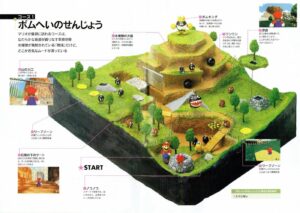 1. Bob-omb BattlefieldGround floor · no stars needed · boss King Bob-ombBig Bob-omb on the Summit; Footrace with Koopa the Quick; Shoot to the Island in the Sky; Find the 8 Red Coins; Mario Wings to the Sky; Behind Chain Chomp’s Gate. A grassy hillside at war, and the first course the team finished.
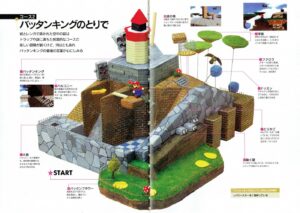 2. Whomp’s FortressGround floor · 1 star · boss Whomp KingChip Off Whomp’s Block; To the Top of the Fortress; Shoot into the Wild Blue; Red Coins on the Floating Isle; Fall onto the Caged Island; Blast Away the Wall. A stone tower in the sky that grows taller once its king is beaten; remade as Throwback Galaxy in Super Mario Galaxy 2.
 3. Jolly Roger BayGround floor · 3 stars · Unagi the eelPlunder in the Sunken Ship; Can the Eel Come Out to Play?; Treasure of the Ocean Cave; Red Coins on the Ship Afloat; Blast to the Stone Pillar; Through the Jet Stream. A deep bay with a wrecked galleon and the eel that gave a generation nightmares.
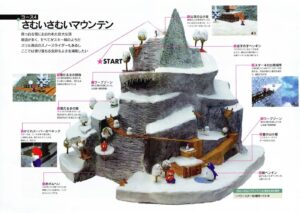 4. Cool, Cool MountainGround floor · 3 stars · the Big Penguin raceSlip Slidin’ Away; Li’l Penguin Lost; Big Penguin Race; Frosty Slide for 8 Red Coins; Snowman’s Lost His Head; Wall Kicks Will Work. A snowy peak with a cottage slide, a lost baby penguin and a snowman looking for his head.
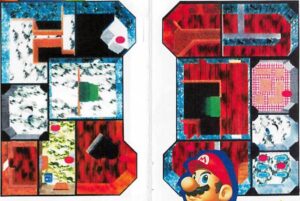 5. Big Boo’s HauntCourtyard · 12 stars · boss Big BooGo on a Ghost Hunt; Ride Big Boo’s Merry-Go-Round; Secret of the Haunted Books; Seek the 8 Red Coins; Big Boo’s Balcony; Eye to Eye in the Secret Room. A haunted mansion inside a birdcage, with a Mad Piano, Bookends and a merry-go-round in the cellar.
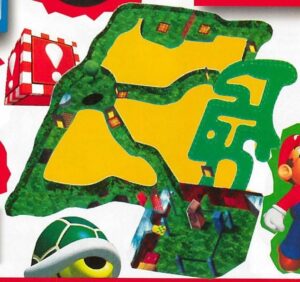 6. Hazy Maze CaveBasement · first key · DorrieSwimming Beast in the Cavern; Elevate for 8 Red Coins; Metal-Head Mario Can Move!; Navigating the Toxic Maze; A-Maze-Ing Emergency Exit; Watch for Rolling Rocks. A cave of poison gas and rolling boulders, with a gentle sea monster to ride and the way to the Metal Cap.
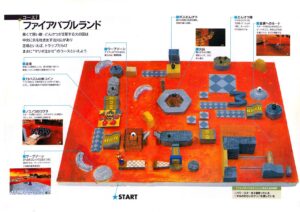 7. Lethal Lava LandBasement · first key · boss Big BullyBoil the Big Bully; Bully the Bullies; 8-Coin Puzzle with 15 Pieces; Red-Hot Log Rolling; Hot-Foot-It into the Volcano; Elevator Tour in the Volcano. Platforms over lava, a sliding Bowser puzzle and a volcano you can climb inside.
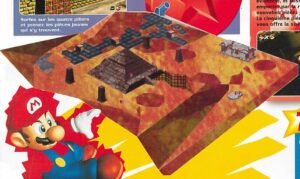 8. Shifting Sand LandBasement · first key · boss EyerokIn the Talons of the Big Bird; Shining Atop the Pyramid; Inside the Ancient Pyramid; Stand Tall on the Four Pillars; Free Flying for 8 Red Coins; Pyramid Puzzle. A desert with quicksand, Pokeys, a cap-stealing vulture and a pair of giant stone hands inside the pyramid.
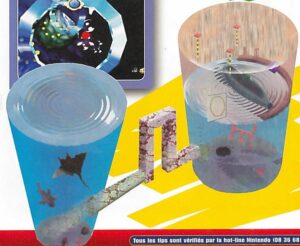 9. Dire, Dire DocksBasement · 30 stars · Bowser’s submarineBoard Bowser’s Sub; Chests in the Current; Pole-Jumping for Red Coins; Through the Jet Stream; The Manta Ray’s Reward; Collect the Caps…. Mostly underwater, with a manta ray to follow and the only place both Metal and Vanish caps can be worn together.
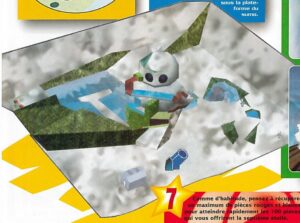 10. Snowman’s LandSecond floor · second key · boss Chill BullySnowman’s Big Head; Chill with the Bully; In the Deep Freeze; Whirl from the Freezing Pond; Shell Shreddin’ for Red Coins; Into the Igloo. Entered through a mirror; a mountain shaped like a snowman that blows Mario off its bridge.
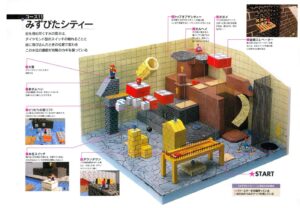 11. Wet-Dry WorldSecond floor · second keyShocking Arrow Lifts!; Top o’ the Town; Secrets in the Shallows & Sky; Express Elevator–Hurry Up!; Go to Town for Red Coins; Quick Race Through Downtown!. Flooded ruins whose water level depends on how high you jump into the painting.
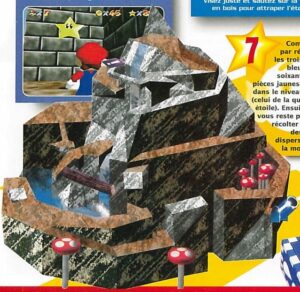 12. Tall, Tall MountainSecond floor · second keyScale the Mountain; Mystery of the Monkey Cage; Scary ’Shrooms, Red Coins; Mysterious Mountainside; Breathtaking View from Bridge; Blast to the Lonely Mushroom. A climb past Ukiki the cap-thief, a Fwoosh and a hidden slide.
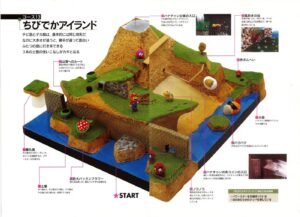 13. Tiny-Huge IslandSecond floor · second key · boss WigglerPluck the Piranha Flower; The Tip Top of the Huge Island; Rematch with Koopa the Quick; Five Itty Bitty Secrets; Wiggler’s Red Coins; Make Wiggler Squirm. Two paintings, one island: Mario is either a giant among Goombas or an ant among them.
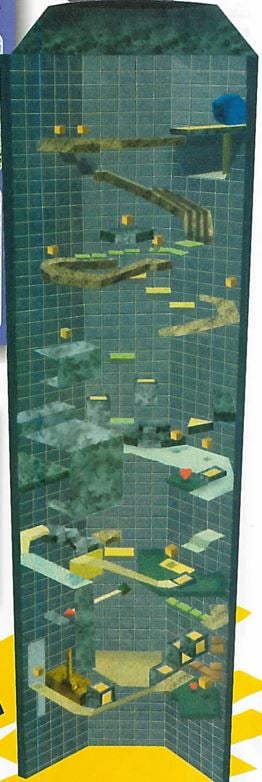 14. Tick Tock ClockThird floor · 50 starsRoll into the Cage; The Pit and the Pendulums; Get a Hand; Stomp on the Thwomp; Timed Jumps on Moving Bars; Stop Time for Red Coins. Inside a grandfather clock whose machinery runs fast, slow or not at all depending on the minute hand when you jump in.
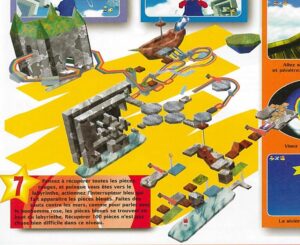 15. Rainbow RideThird floor · 50 starsCruiser Crossing the Rainbow; The Big House in the Sky; Coins Amassed in a Maze; Swingin’ in the Breeze; Tricky Triangles!; Somewhere Over the Rainbow. Magic carpets on rainbow rails between floating islands, a flying ship and a house in the clouds.
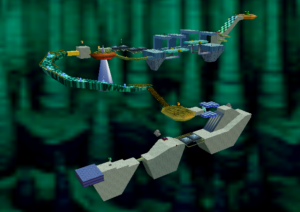 Bowser in the Dark WorldGround floor · 8 stars · 1 star (red coins) + keyA platforming gauntlet in the void, then the first tail-swinging duel. One throw.
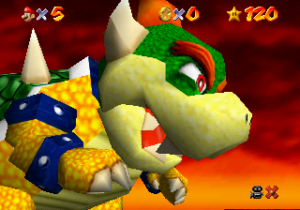 Bowser in the Fire SeaBasement · via Dire, Dire Docks · 1 star + keyMesh and stone over a lava lake; Bowser tilts the arena and teleports. One throw.
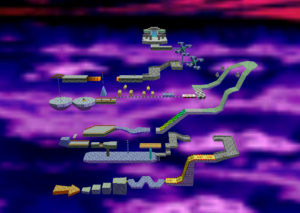 Bowser in the SkyEndless staircase · 70 stars · 1 star + Jumbo StarThe long climb to the final battle. Three throws.
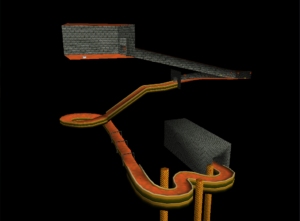 The Princess’s Secret SlideGround floor · 1 star to enter · 2 starsBehind the Peach stained glass upstairs. One star for finishing, another for beating 21 seconds.
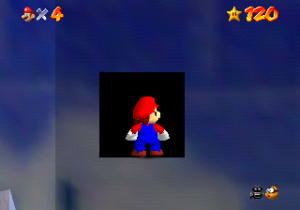 The Secret AquariumGround floor · 1 starA hidden tank off the Jolly Roger Bay room with eight red coins and no floor to stand on.
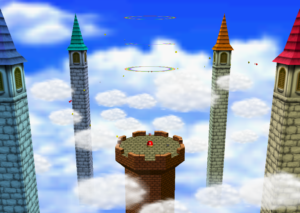 Tower of the Wing CapLobby light beam · 10 stars · red switch + 1 starLook up into the sun mosaic to fly here and collect eight red coins in the clouds.
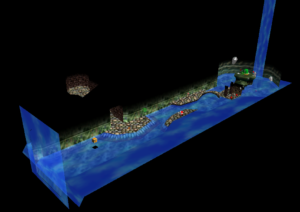 Cavern of the Metal CapHazy Maze Cave · green switch + 1 starRide Dorrie to the double doors and drop into the pool of liquid metal; the way out is over the castle waterfall. Metal Mario strolls along the riverbed for red coins.
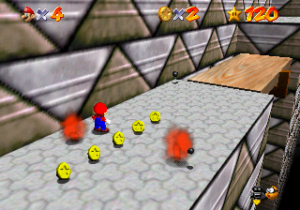 Vanish Cap Under the MoatDrained moat · blue switch + 1 starGround-pound the two pillars in the basement to drain the moat and drop in.
 Wing Mario Over the RainbowThird floor · 1 starA cannon-and-Wing-Cap hunt for red coins among floating islands.

 Power StarThe goal of every mission. 120 in total; 70 needed to reach the final Bowser.
 Big KeyDropped by Bowser in the Dark World and the Fire Sea; opens the basement and the upper floors.
 Yellow CoinHeals one wedge. 100 in a course earns a star; 50 earns a life.
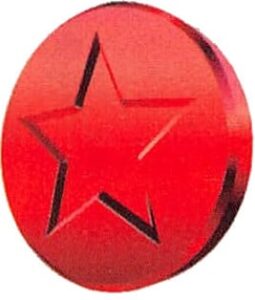 Red CoinEight per course, worth two coins each; collect all eight for a star.
 Blue CoinWorth five. Released by blue coin switches and some enemies.
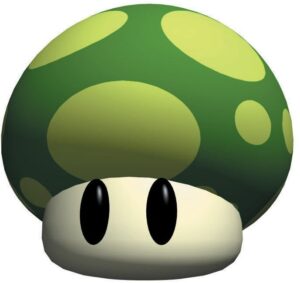 1-Up MushroomAn extra life, often chasing Mario down from a tree or a hidden block.
 Spinning HeartRun through it to refill the Power Meter; the faster you go, the more it heals.
 Cap BlocksRed for the Wing Cap, green for the Metal Cap, blue for the Vanish Cap; each is solid only once its switch has been stomped.
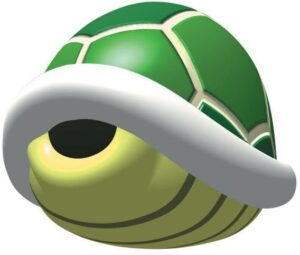 Koopa ShellHop on and surf across land, water and lava.
 ! BlockYellow blocks hide coins, stars and shells; a crate or cork box breaks with a ground pound.

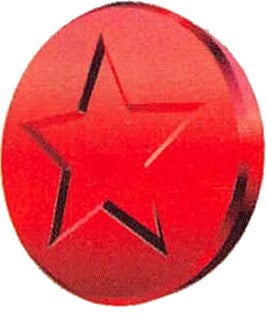
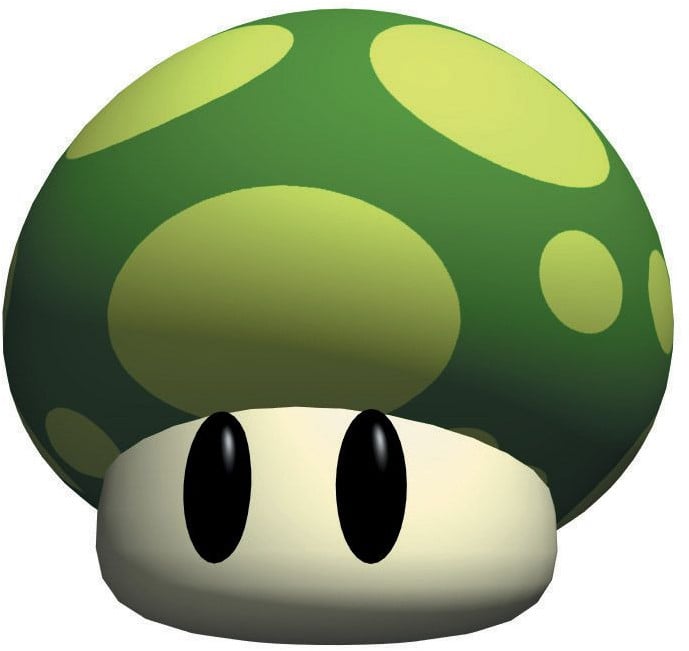


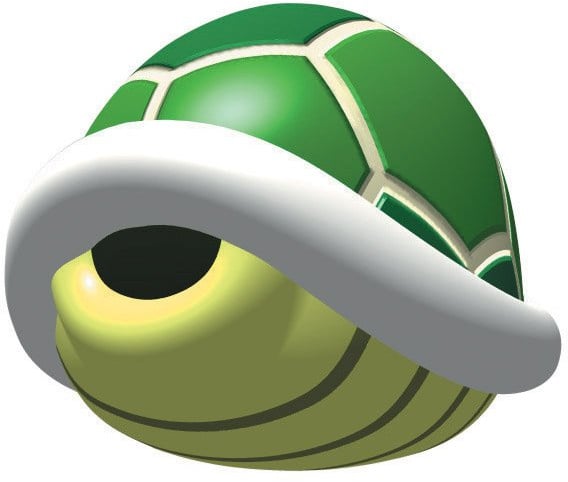

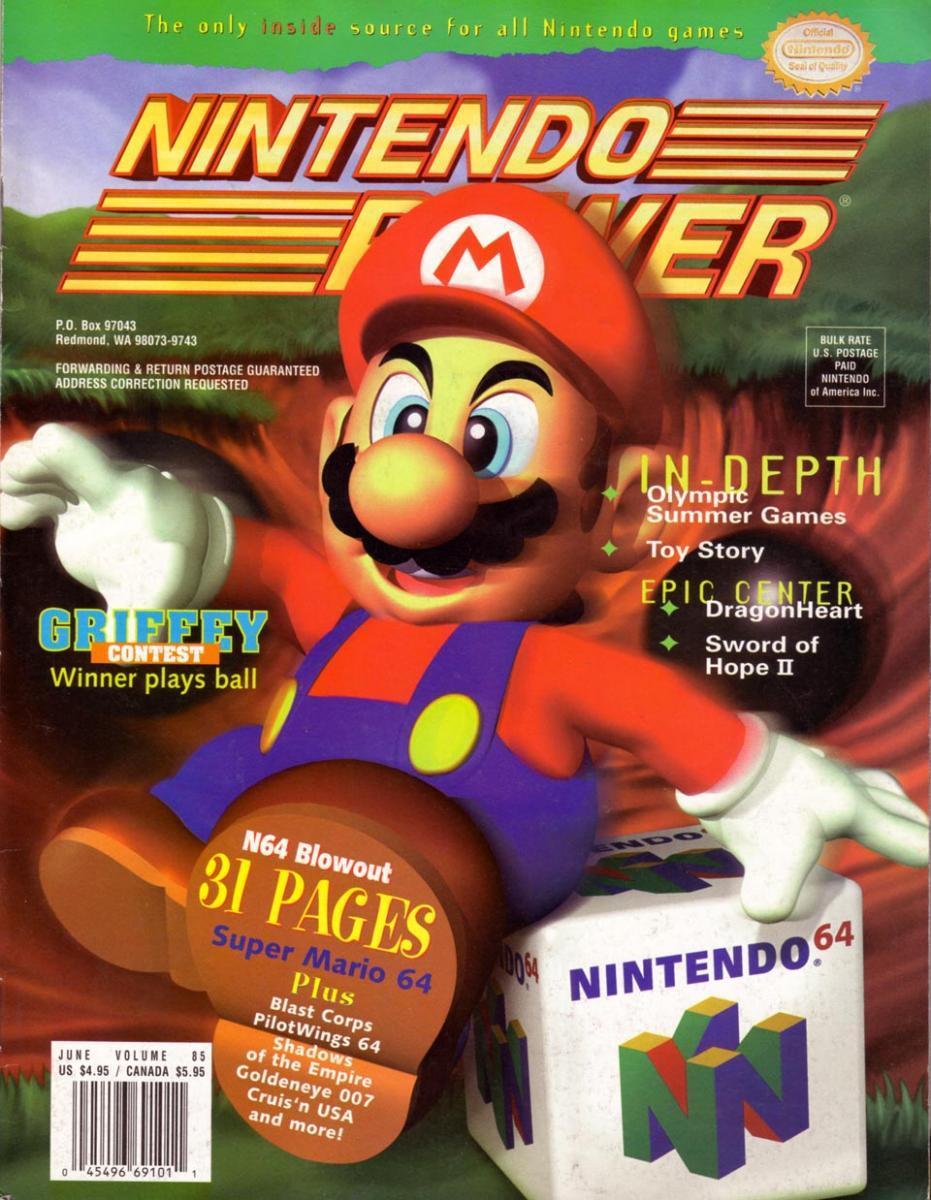 Nintendo Power, 1996–1998Nintendo of America · issues 80 to 98Nintendo Power followed the game for two years: a first look in Vol. 80, a full feature in Vol. 85 (June 1996), an exclusive special in Vol. 88, reader competitions and more than a year of Q&A columns answering the same question (where is Luigi?). Super Luigi Bros has the complete archive, and the magazine also published a Player’s Guide.
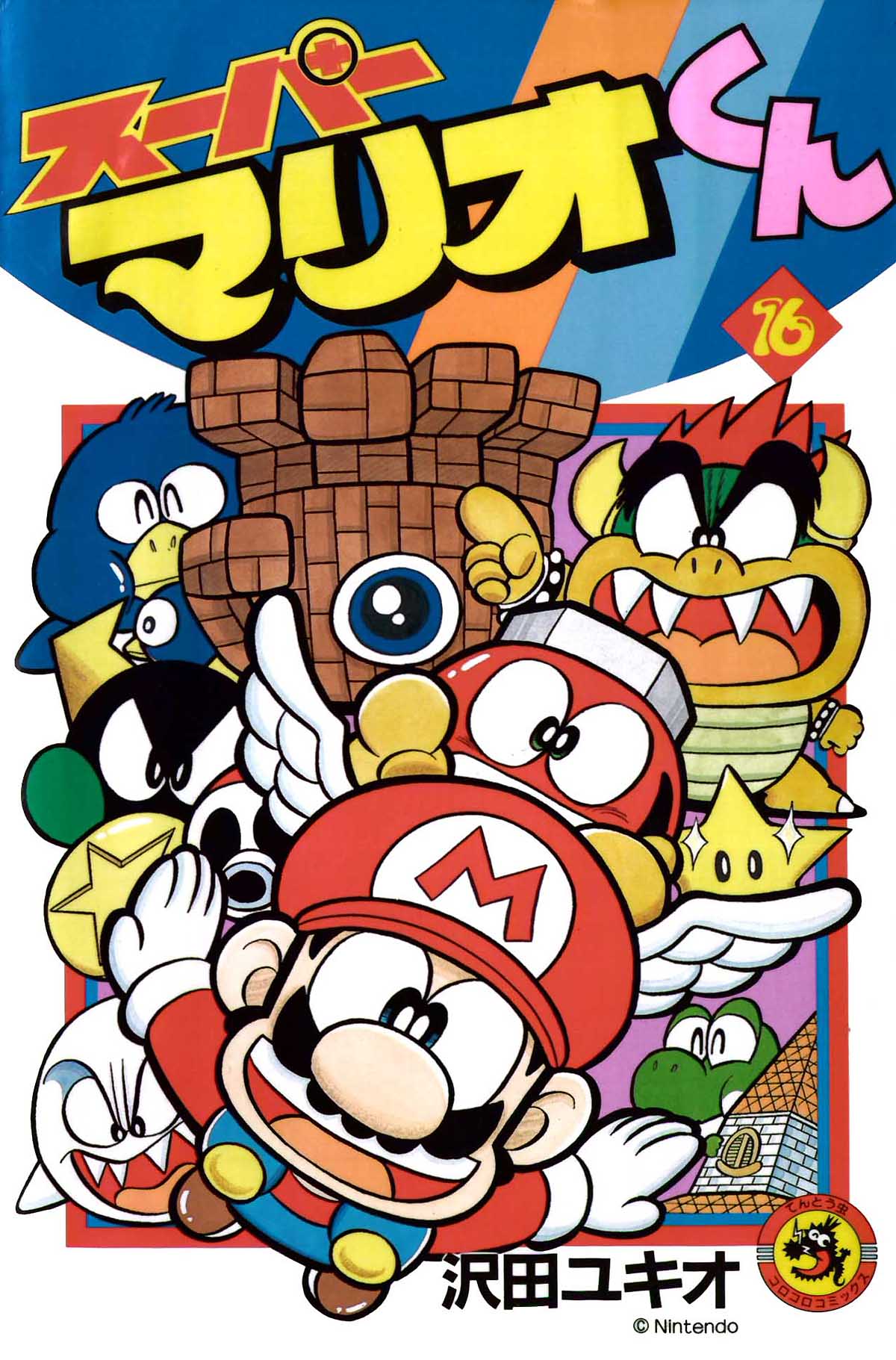 Super Mario-kun, volumes 15 to 19Yukio Sawada · Shogakukan · 1996–1998The gag manga spent five volumes in the castle: Peach’s party, Bowser’s takeover, a tour of the courses from Bob-omb Battlefield to Rainbow Ride, a mirror-world detour, a Bowser who deletes the save files, and a cake at the end.
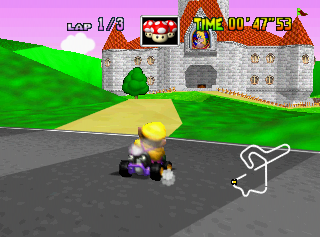 Mario Kart 64: Royal RacewayNintendo 64 · 1996The Mario Kart 64 track takes a detour past a full-size recreation of Peach’s castle, lawn, moat and all.
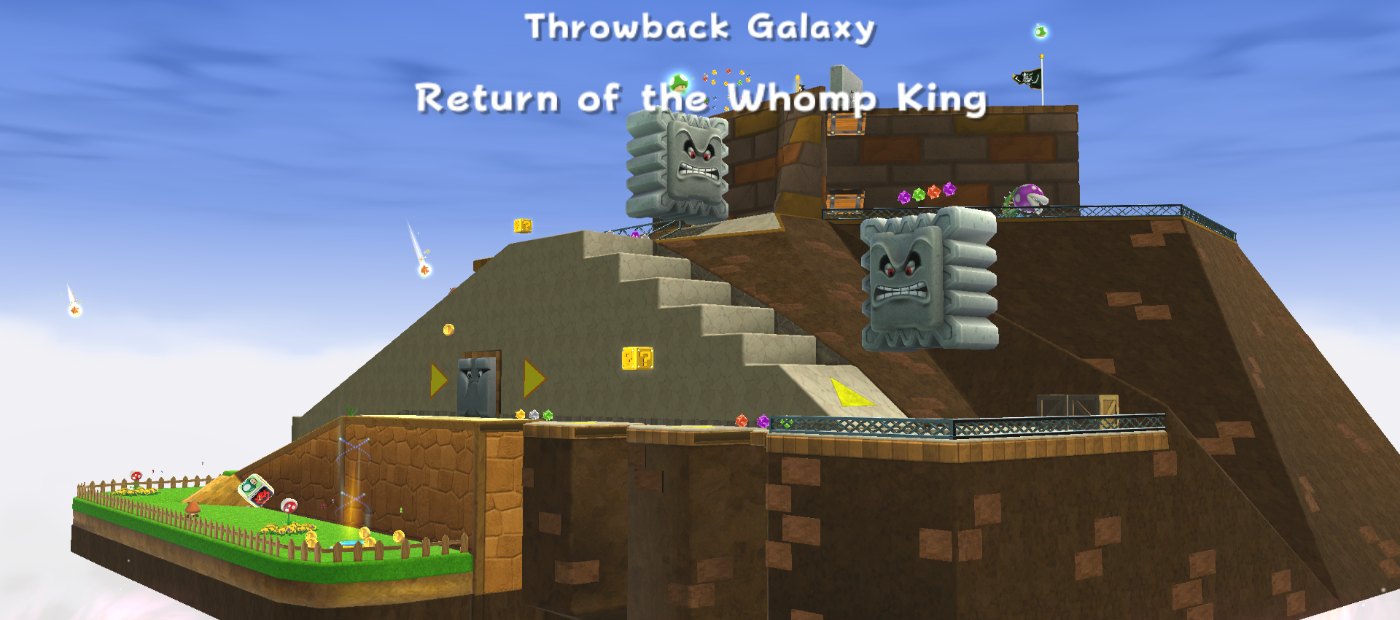 Super Mario Galaxy 2: Throwback GalaxyWii · 2010Whomp’s Fortress rebuilt in full, music and all, as a bonus galaxy in Super Mario Galaxy 2.
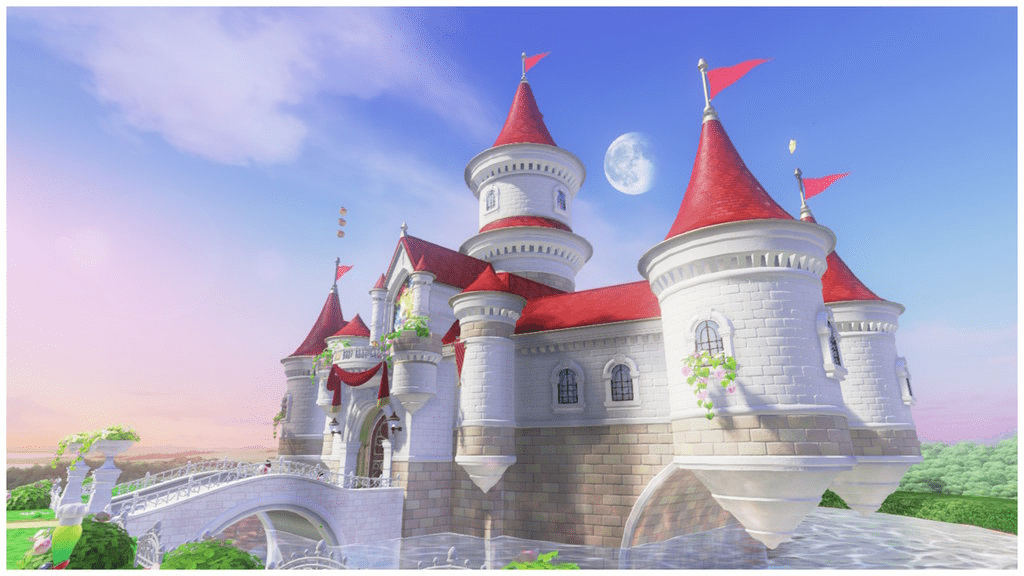 Super Mario Odyssey: the Mushroom KingdomSwitch · 2017Odyssey’s last kingdom is Peach’s castle and grounds as they were in 1996, complete with a low-polygon Mario 64 costume and a trip back inside the paintings.
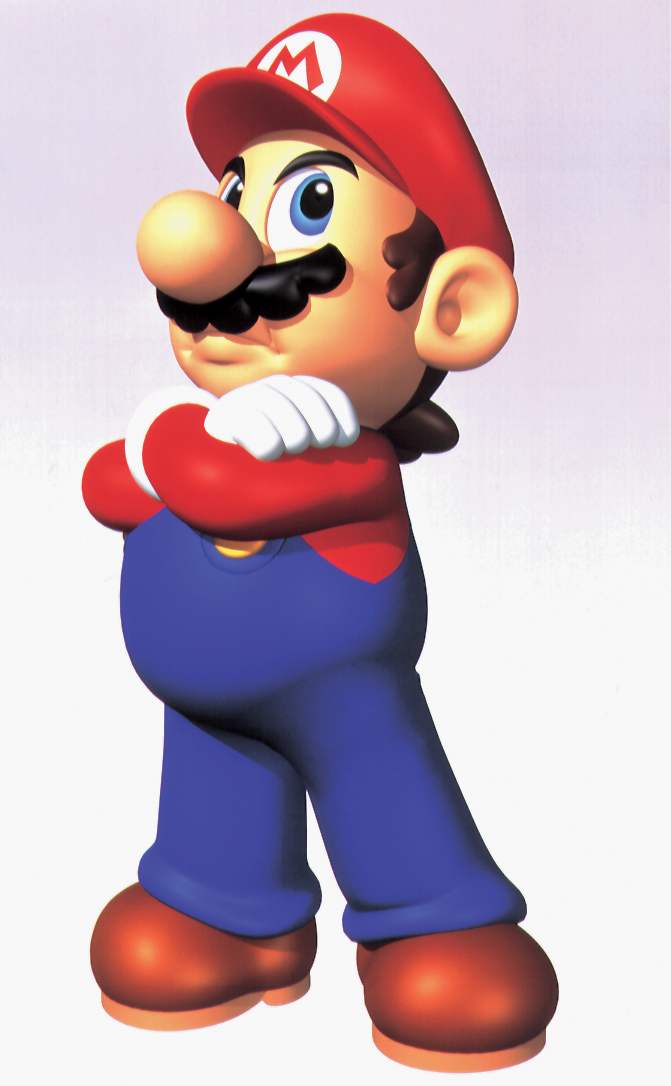 MarioThe hero, in 3D for the first time
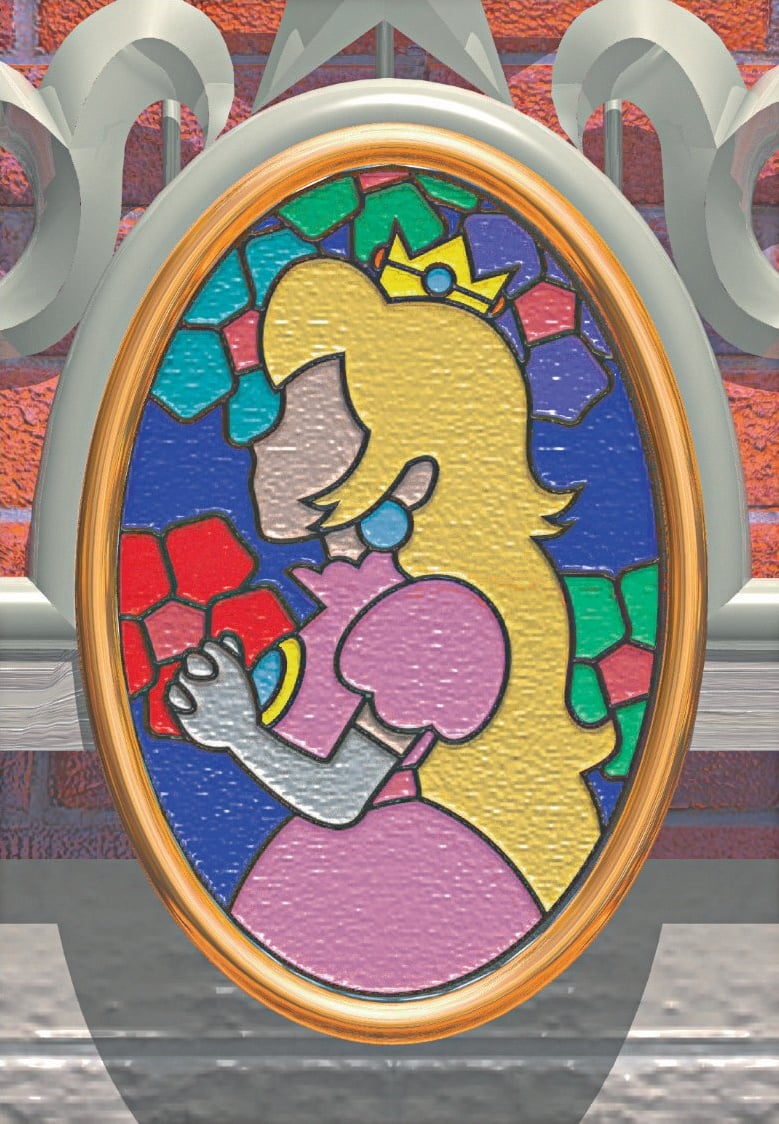 Princess PeachThe host
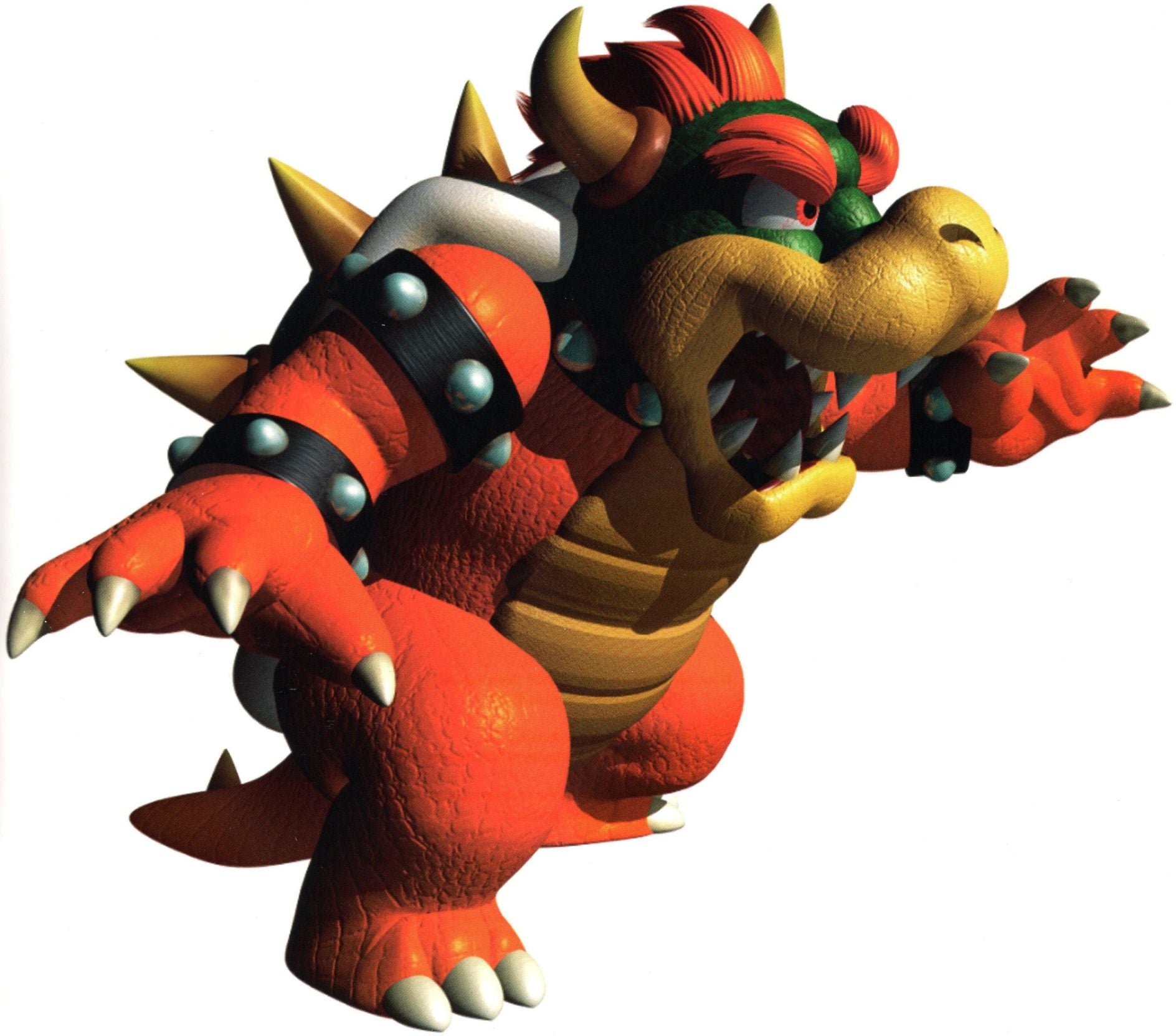 BowserKing of the Koopas
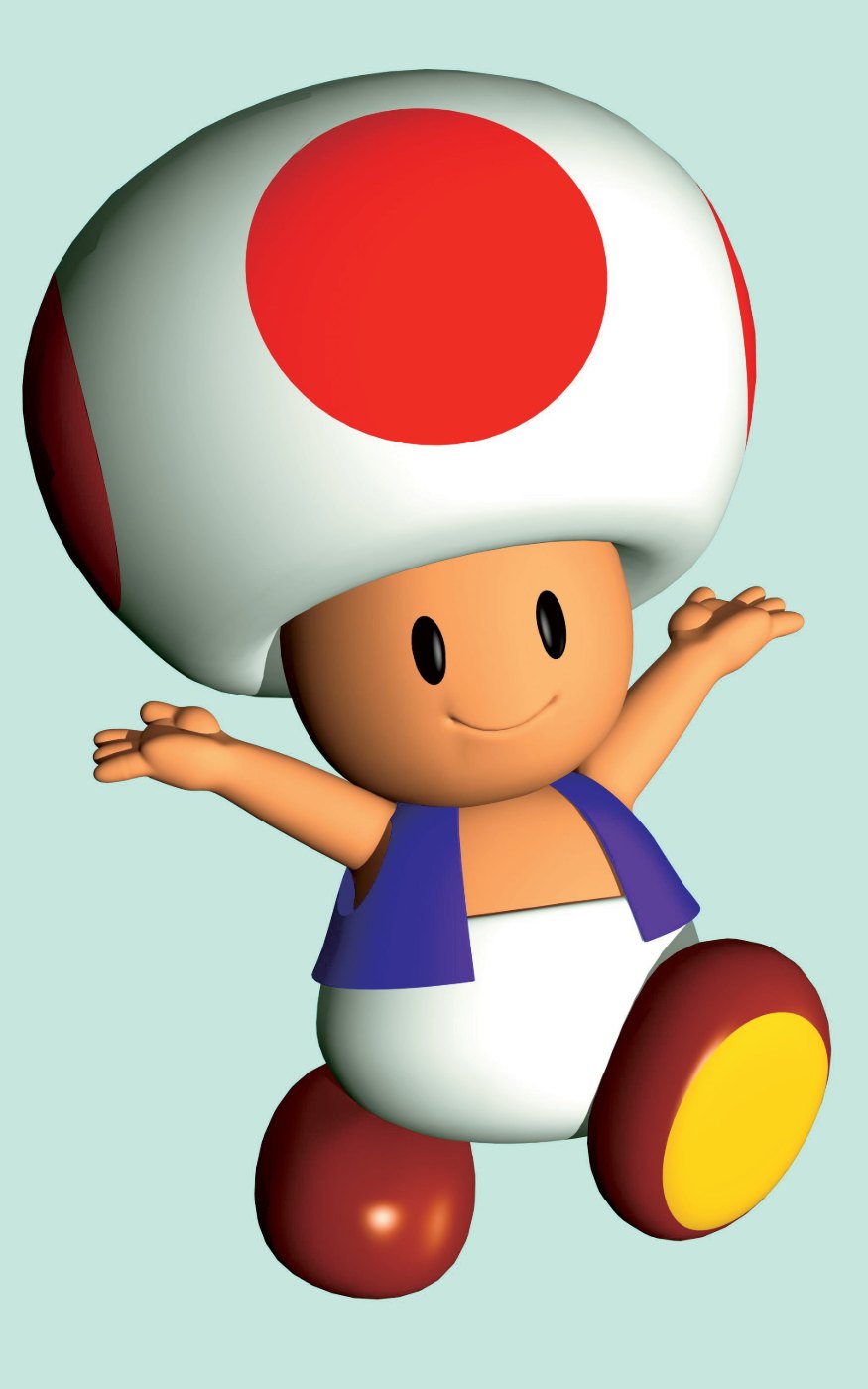 ToadsThe castle staff
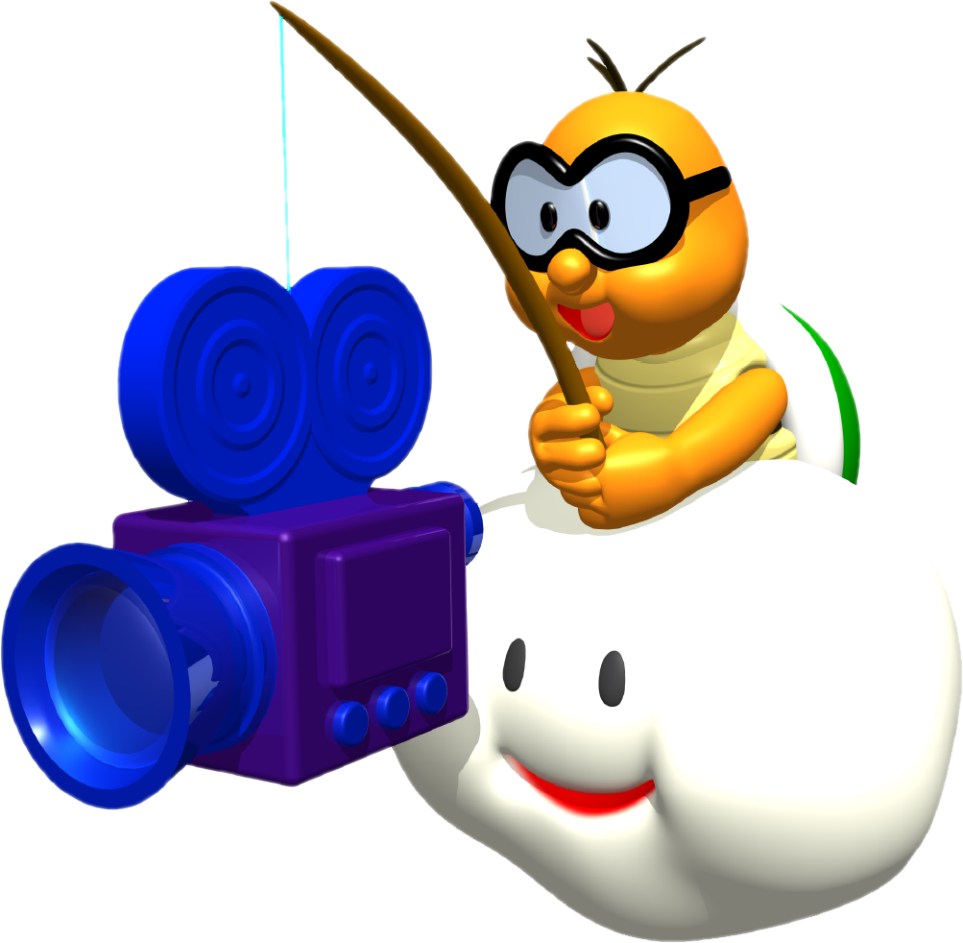 The Lakitu Bros.Camera crew
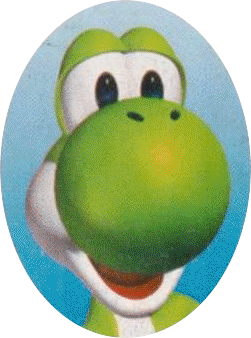 YoshiOn the roof
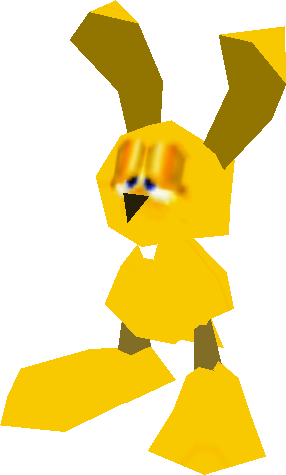 MIPSPeach’s rabbit
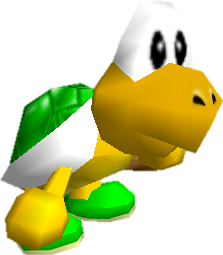 Koopa the QuickThe racer
 Bob-omb BuddiesThe pink Bob-ombs
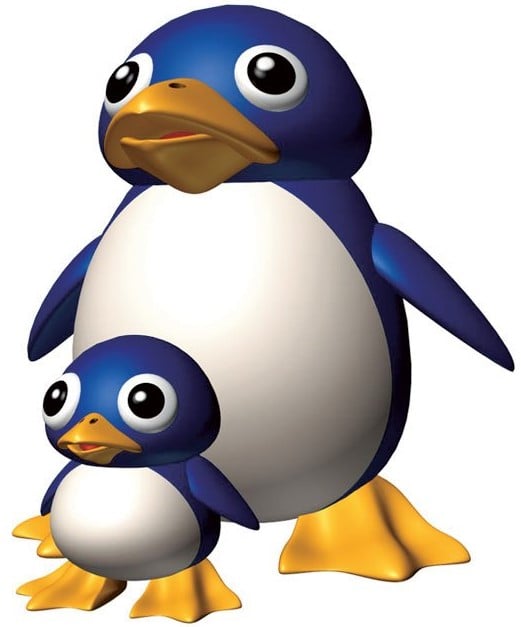 The penguinsCool, Cool Mountain
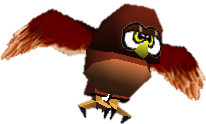 HootThe owl
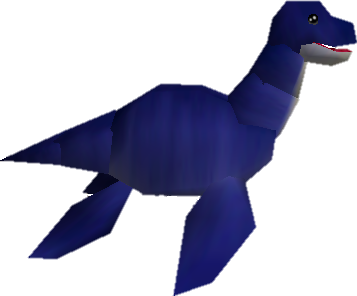 DorrieThe cave monster
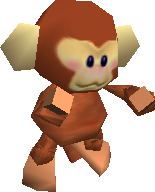 UkikiThe monkeys
 Klepto and the cap thievesHat trouble
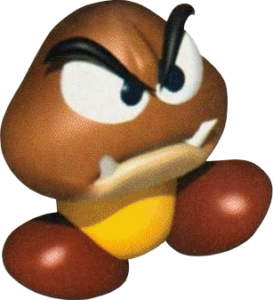 GoombaMost coursesRounder and chubbier in 3D. Giant and tiny versions roam Tiny-Huge Island.
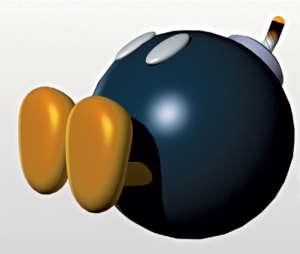 Bob-ombBattlefield, Fire Sea, clockLights its fuse and chases; grab it from behind and throw it.
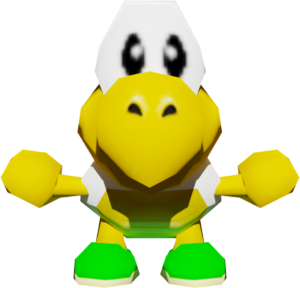 Koopa TroopaBattlefield, islandStomp it and ride the shell like a surfboard.
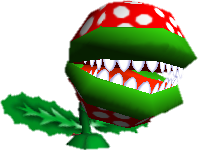 Piranha PlantFortress, islandSnoozes until you approach; a punch while it sleeps is the safe way.
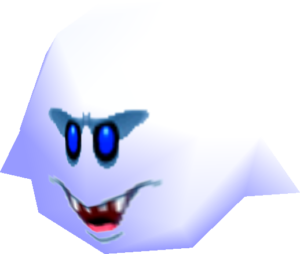 BooCourtyard, Big Boo’s HauntTurns shy when you look at it; punch from behind for a coin.
 Chain ChompBob-omb BattlefieldChained to a post that three ground pounds will loosen.
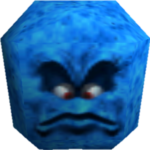 Thwomp and WhompFortress, clockThwomps drop; Whomps fall flat on their faces and take a ground pound to the back.
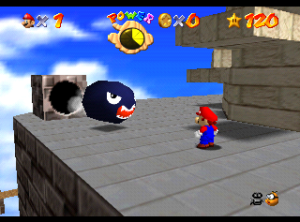 Bullet BillWhomp’s FortressFired from cannons at the top of the fortress.
 BullyLava and snow coursesCannot be hurt; shove it off the platform instead.
 Mr. IHaunt, cave, lavaA giant eyeball. Run circles round it until it gets dizzy and pops.
 SnufitHazy Maze CaveA floating, masked cousin of the Snifit that spits bullets. Also found in the Cavern of the Metal Cap.
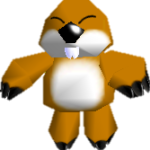 Monty MoleCave, mountainPops out of holes to throw rocks.
 PokeyShifting Sand LandA stack of cactus segments; knock off the head.
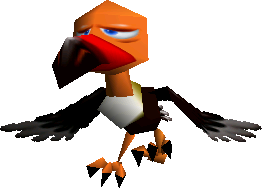 KleptoShifting Sand LandThe condor who steals caps and stars.
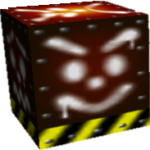 Tox BoxShifting Sand LandA rolling stone cube with a hollow side; stand in the gap.
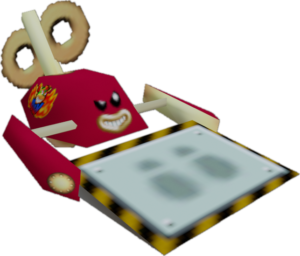 Heave-HoWet-Dry World, clockA wind-up robot that flips Mario into the air.
 ChuckyaSeveral coursesA purple Bob-omb that grabs and hurls Mario. Grab it first.
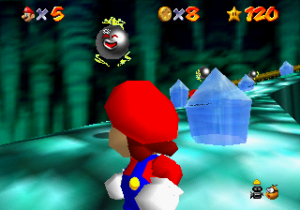 AmpWet-Dry World, clock, Rainbow RideElectric balls that orbit platforms.
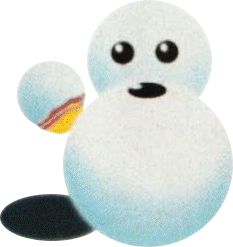 Mr. BlizzardSnow coursesSnowmen that pelt Mario with snowballs.
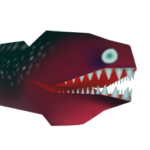 UnagiJolly Roger BayThe giant eel in the sunken ship, with a star on its tail.
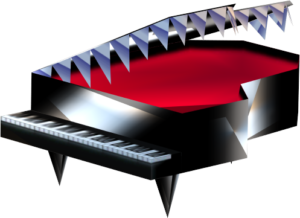 Mad PianoBig Boo’s HauntA grand piano with teeth. Not King Boo; just a piano.
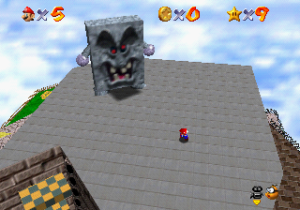 Whomp KingBoss, Whomp’s FortressDodge his belly flop and ground pound his back three times.
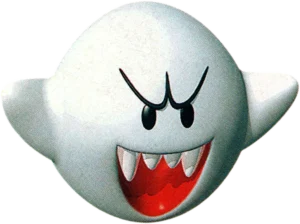 Big BooBoss, Big Boo’s HauntFought three times; punch or pound him from behind three times each.
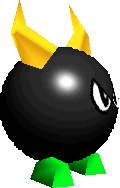 Big Bully and Chill BullyLethal Lava Land, Snowman’s LandShove them into the lava or the freezing water.
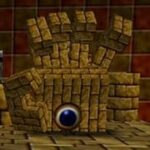 EyerokShifting Sand Land pyramidTwo stone hands; punch the eye in each palm three times.
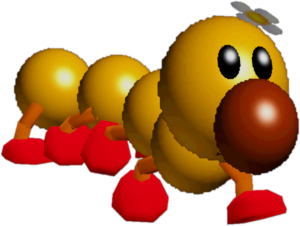 WigglerTiny-Huge IslandDrain his pool, then ground pound him three times as he turns scarlet.
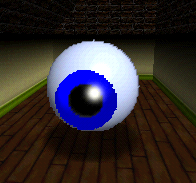 Big Mr. IBig Boo’s Haunt atticRun circles round him for the sixth star.
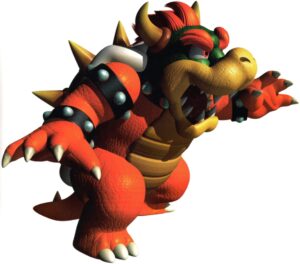 BowserDark World, Fire Sea, SkyGrab the tail, spin, and let go towards a bomb: once, once and three times.