Nintendo GameCube20023D platformerNintendo EADF.L.U.D.D.120 Shine SpritesBowser Jr.’s debut5.9 million soldKoizumi’s first as director
Super Mario Sunshine
Six years after Super Mario 64 rewrote the rules, Mario went on holiday and ended up on community service. Super Mario Sunshine landed on the Nintendo GameCube in July 2002 in Japan and that autumn everywhere else, strapped a talking water pump called F.L.U.D.D. to Mario’s back and dropped him on Isle Delfino, a dolphin-shaped resort smothered in paint-like goop by a shadowy impostor. It is the game that introduced Bowser Jr., Toadsworth, Petey Piranha, the Piantas and the Nokis, and the first 3D Mario not directed by Shigeru Miyamoto: Yoshiaki Koizumi took the chair, with Miyamoto and Takashi Tezuka producing.
Collect 120 Shine Sprites across seven sun-soaked areas and a hub town, ride a paint-made Yoshi, tackle some of the hardest platforming in the series in its F.L.U.D.D.-free secret courses, and settle things with Bowser in a hot tub on top of a volcano. Critics scored it in the 90s, Nintendo counts around 5.9 million copies sold, and it has come back twice on Switch hardware, most recently through Nintendo Classics on Switch 2 in 2026.
Developer:Nintendo EAD
Publisher:Nintendo
Platform:Nintendo GameCube
Genre:3D platformer
Japan:19 July 2002
N. America:26 August 2002
Europe:4 October 2002
Australia:11 October 2002
South Korea:14 December 2002 (Daiwon C&A)
Players:1
Directors:Yoshiaki Koizumi, Kenta Usui
Producers:Shigeru Miyamoto, Takashi Tezuka
Executive producer:Satoru Iwata
Music:Koji Kondo, Shinobu Tanaka
Areas:Delfino Plaza hub + 7 areas + Corona Mountain; 120 Shine Sprites, 240 blue coins
Sales:About 5.9 million (Nintendo, November 2023 investor chart)
Re-releases:Player’s Choice (2003) · Super Mario 3D All-Stars, Switch (2020) · Nintendo GameCube – Nintendo Classics, Switch 2 (13 August 2026)
Advertisement
Overview
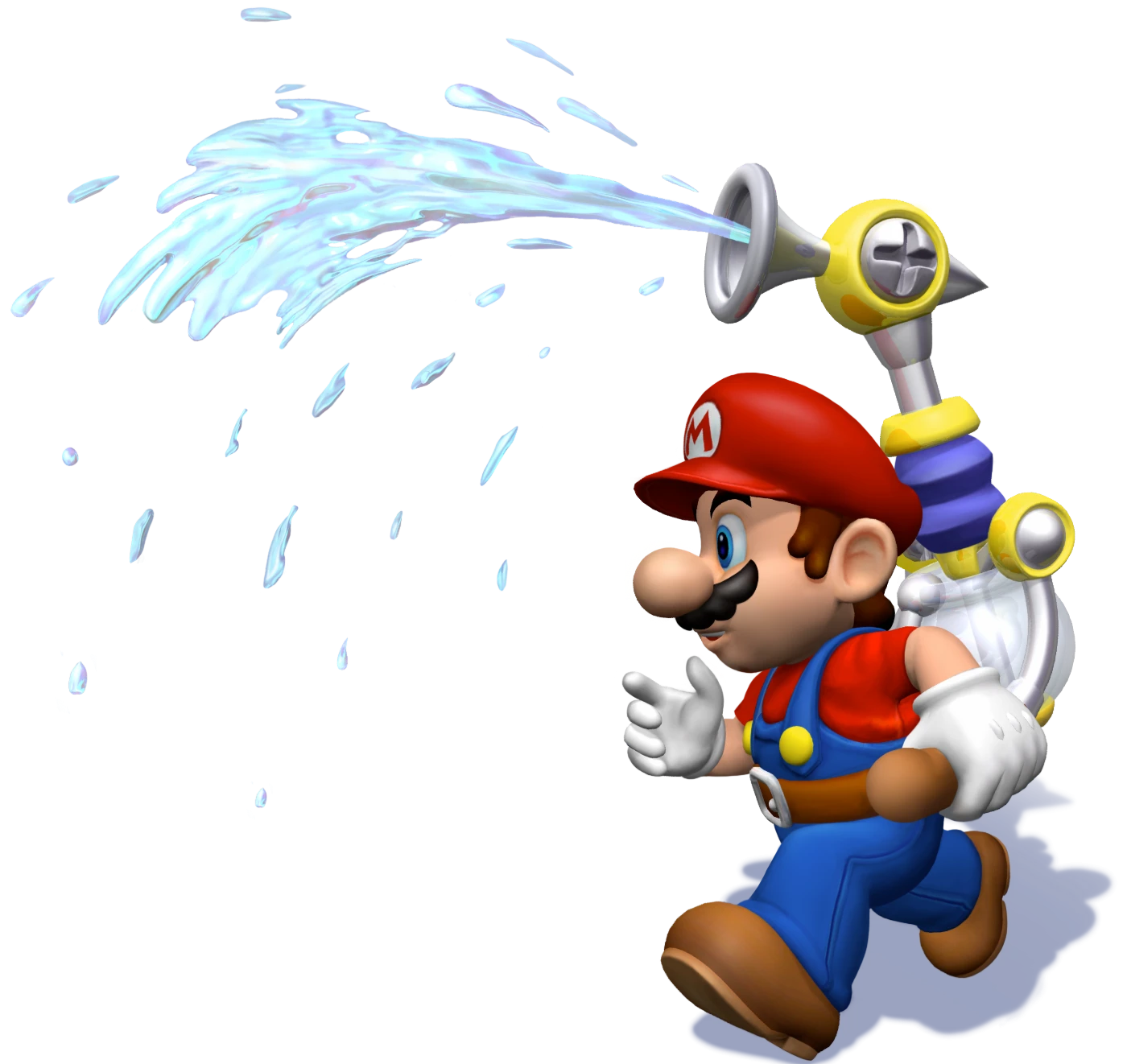
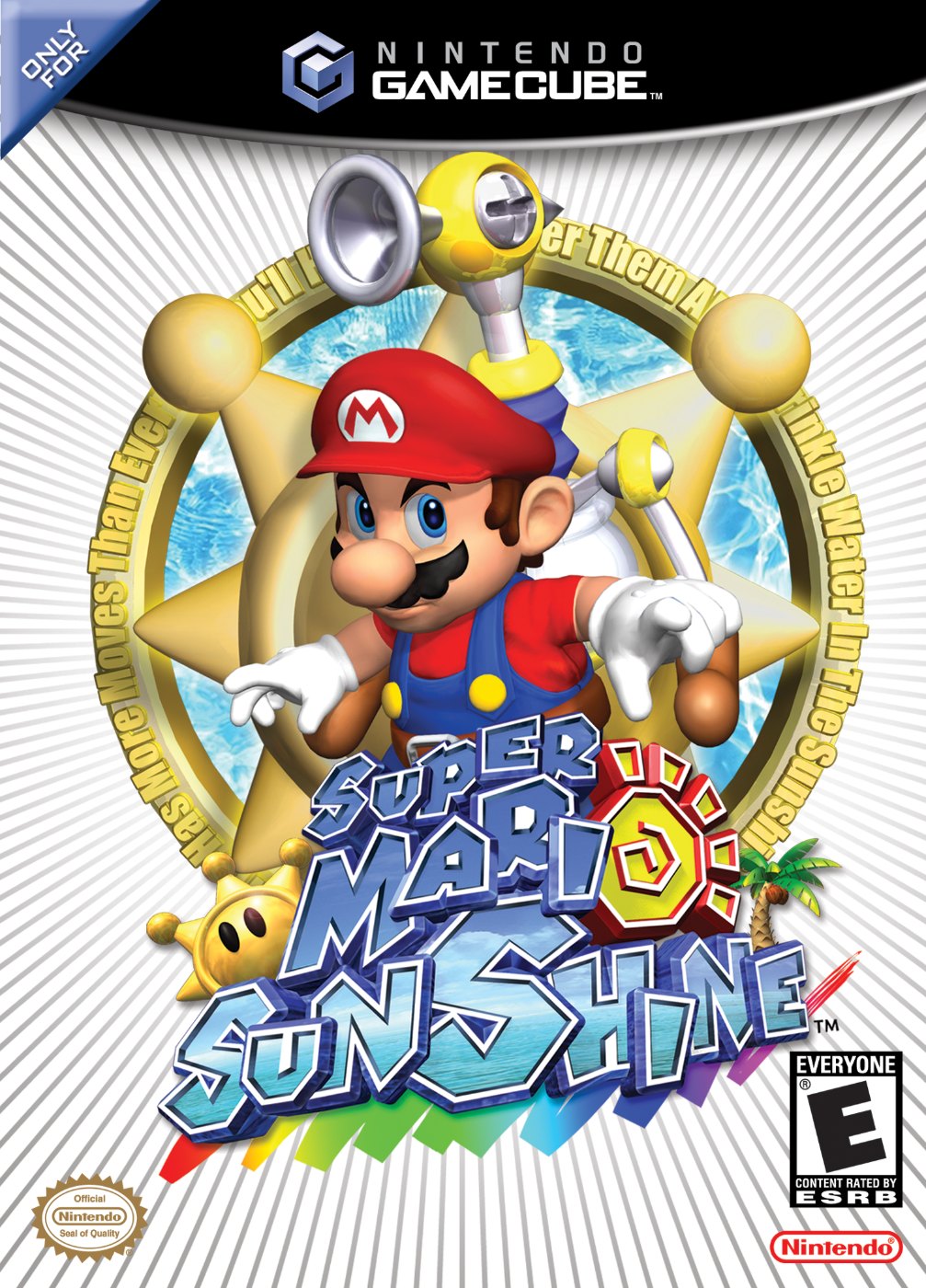
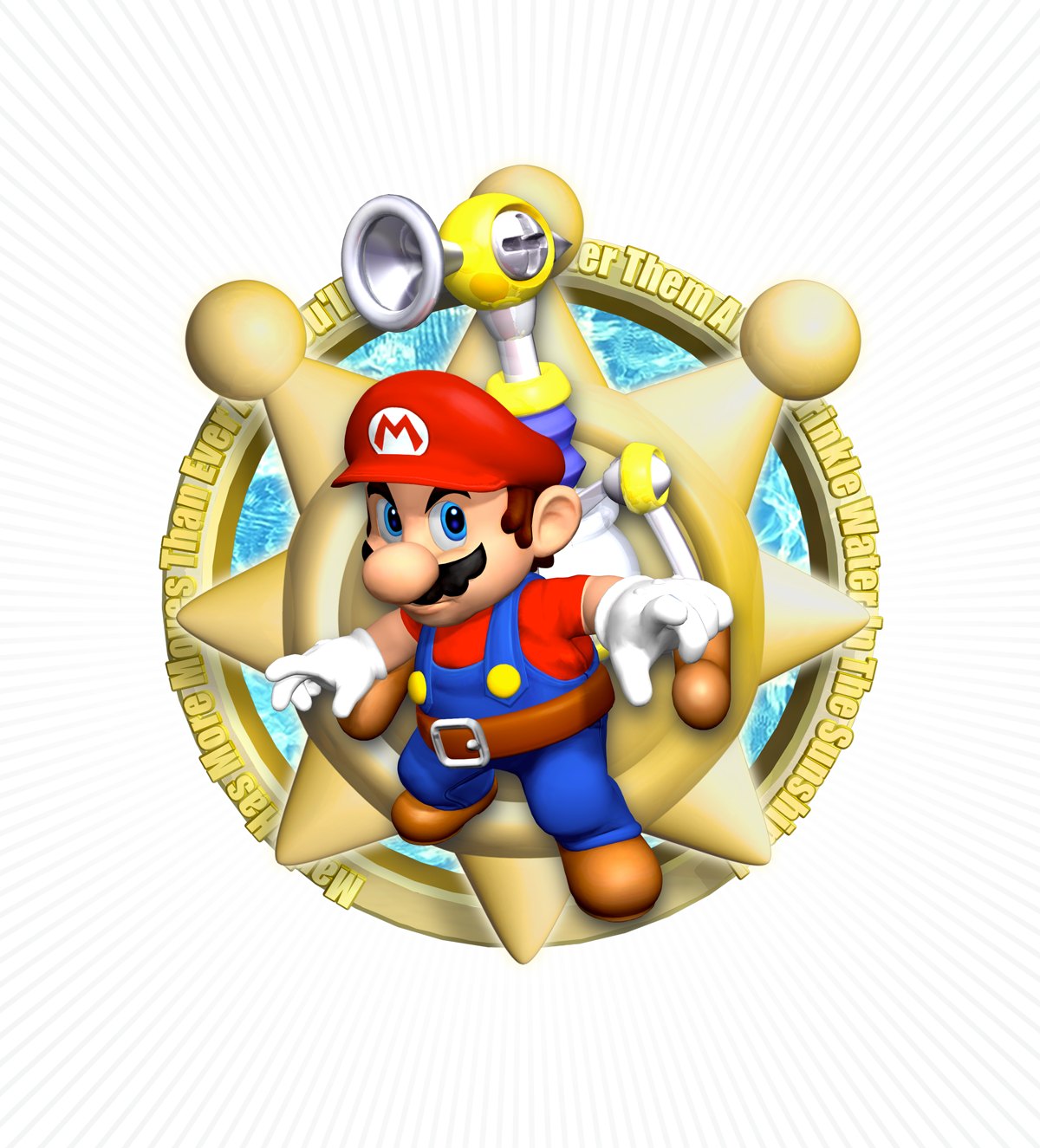
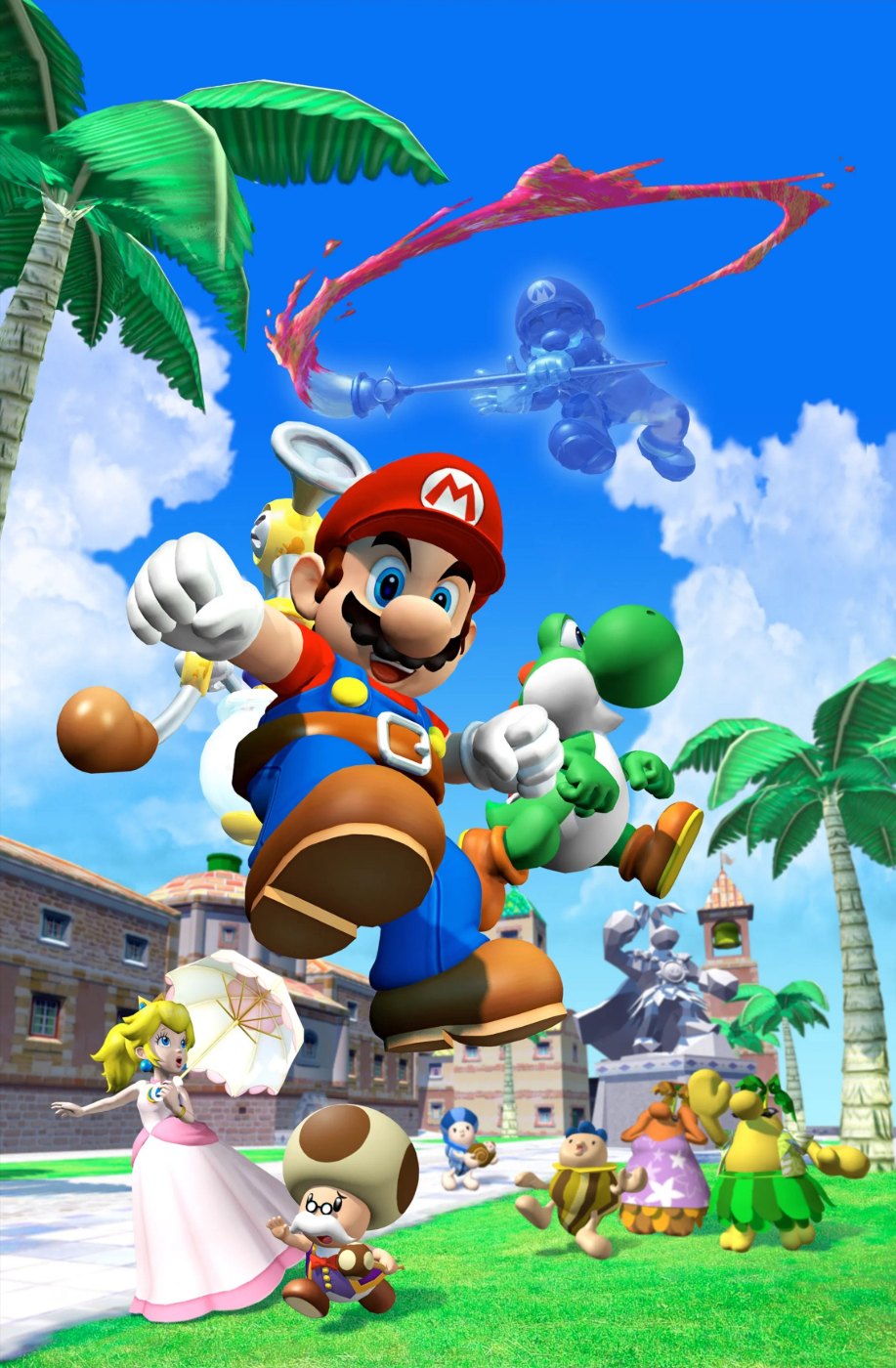
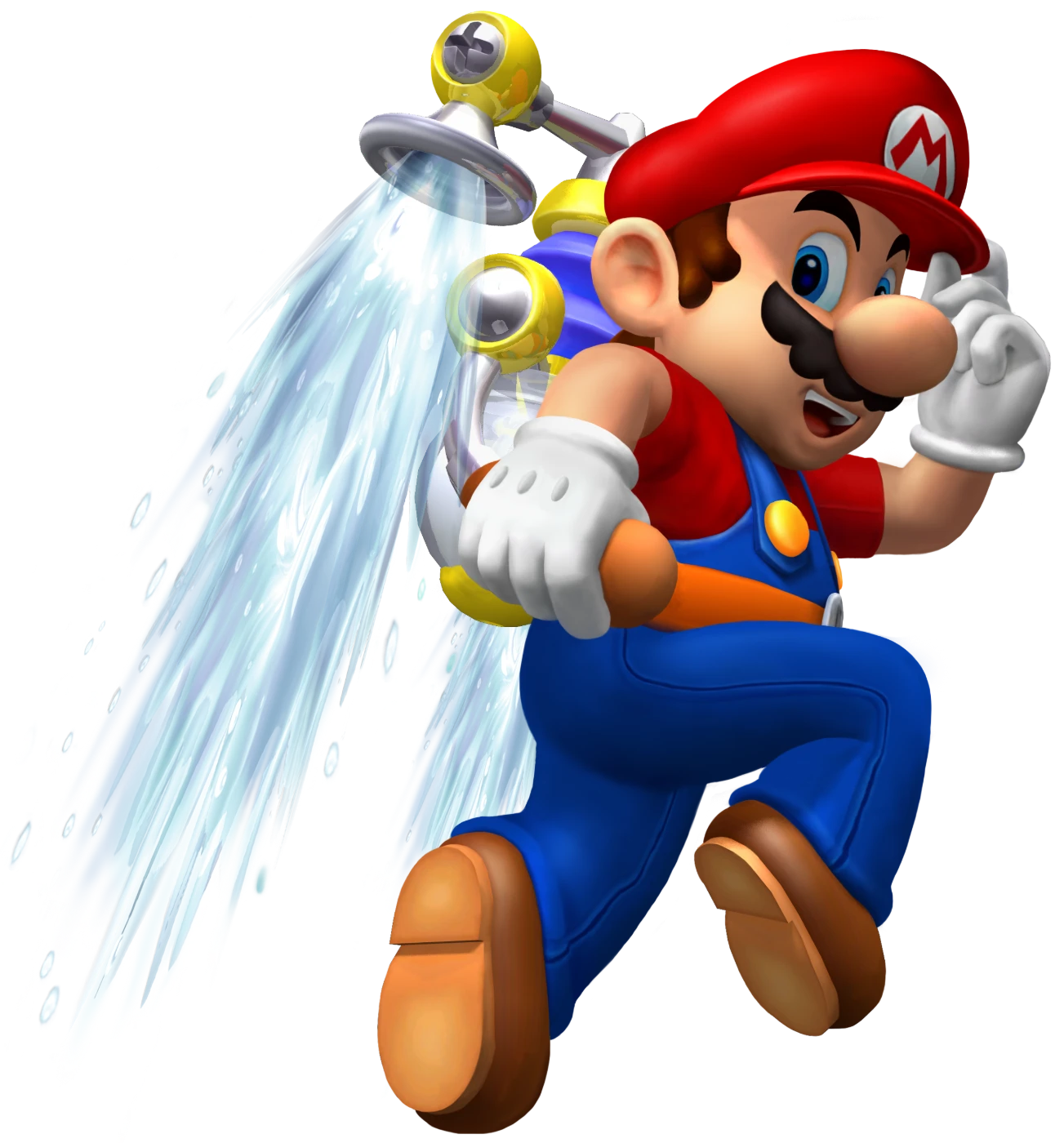
Nintendo’s key artwork: Mario, F.L.U.D.D. and a Shine Sprite.
Every Mario game is about a journey, but Super Mario Sunshine is the only one that starts with a boarding pass. Mario, Princess Peach, her new steward Toadsworth and a gaggle of Toads fly to Isle Delfino for a break, and within a minute of landing Mario is accused of plastering the island in filthy graffiti, hauled before a judge and sentenced to scrub the whole place clean. The real culprit is Shadow Mario, a translucent blue doppelgänger with a magic paintbrush, and the game’s big twist is that he is Bowser’s son, making his very first appearance.
The tool for the job is F.L.U.D.D. (the Flash Liquidizer Ultra Dousing Device, a name only the English version uses), a chatty water pump built by Professor E. Gadd that squirts, hovers, rockets and turbo-dashes depending on the nozzle. It changes Mario’s whole rhythm: hovering turns a missed jump into a second chance, spraying is how you fight, and finding water to refill the tank becomes part of reading each level. Take F.L.U.D.D. away, as the game does in its abstract secret courses, and you are back to pure, unforgiving platforming.
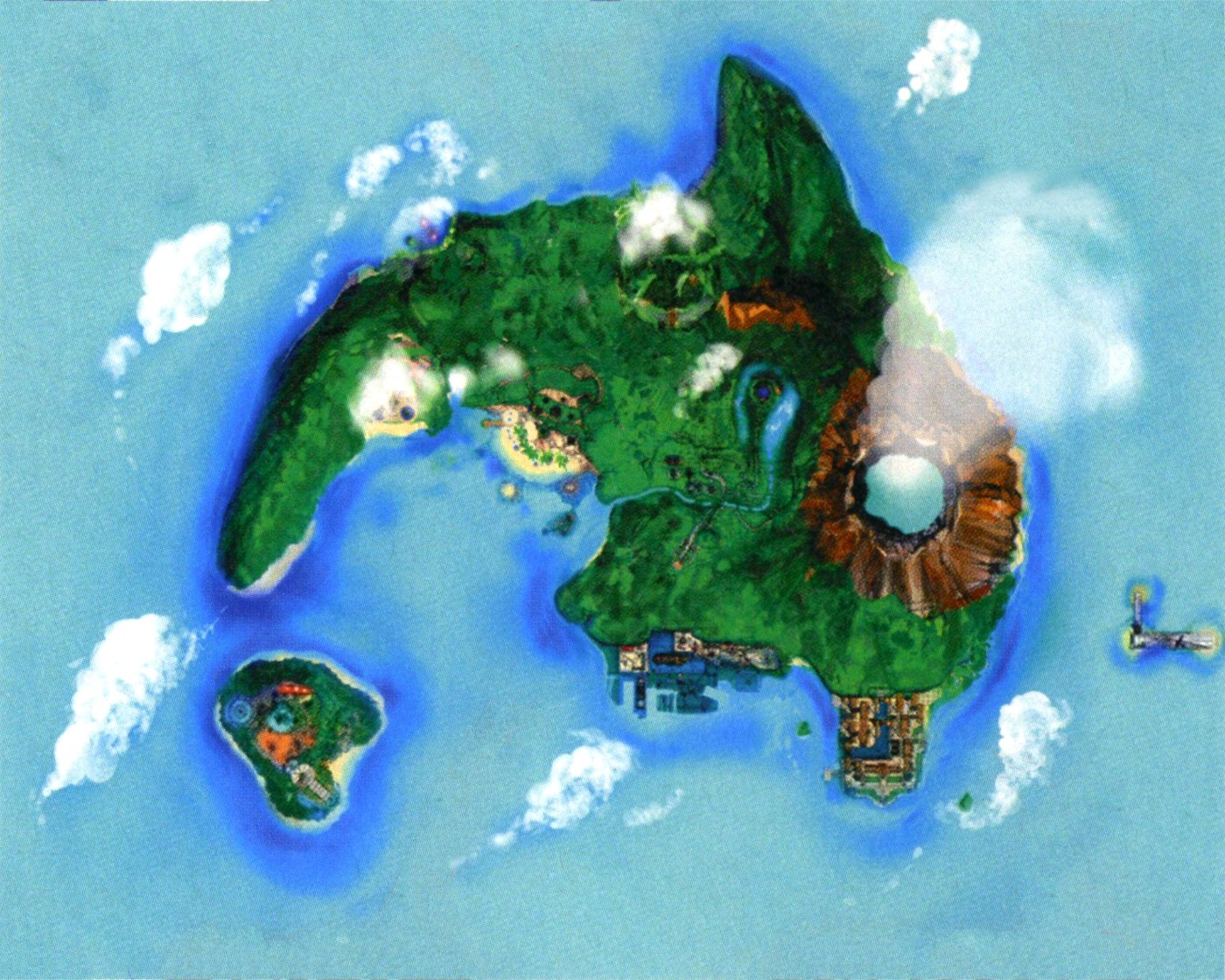
Structurally it is Super Mario 64 on a Mediterranean holiday. Delfino Plaza is the hub, each of the seven areas is reached through a portal in the town and offers eight numbered episodes, and there are exactly 120 Shine Sprites to find, the same number as the earlier game’s Power Stars. The difference is coherence: every area is a real place on the same island, visible from the others, with bosses that return across episodes and a story that moves forward as the town itself changes, fills with light and, late on, floods.
Nintendo EAD built it in roughly eighteen months after the Space World 2000 Mario 128 demo, with Yoshiaki Koizumi, a veteran of Super Mario 64 and the Zelda games, directing a Mario for the first time. It sold strongly, scored a 92 on Metacritic and an Edge cover, and then spent two decades as the series’ most argued-over entry: too hard and too gimmicky for some, the most atmospheric and characterful 3D Mario for others. Nintendo brought it back in Super Mario 3D All-Stars in 2020 and again through the GameCube library on Nintendo Switch 2 in 2026.
It’s been a long wait for a proper follow-up to Super Mario 64, the game that shifted the videogame landscape forever back in 1996. But one glimpse at Super Mario Sunshine and it’s clear that Shigeru Miyamoto, Nintendo’s head games brain, has spent those six years conjuring up the kind of stunning Nintendo GameCube debut that the Mario series demanded.
Super Mario Sunshine kicks off with Mario packing enough red t-shirts and blue dungarees for two weeks’ wear, and jetting off with Princess Peach for a much-deserved holiday on a sun-kissed tropical island. But the rest and relaxation don’t last long. A dastardly vandal has been polluting the beautiful landscape – and to make matters worse, he’s the spitting image of Mario himself! His moustache no doubt bristling with rage, Mario sets out to clear up the island – and clear his name.
— Official description (Nintendo UK, 2002)
Why Super Mario Sunshine Matters to Mario Fans
It is the game that gave the series Bowser Jr., Toadsworth, Petey Piranha, Shine Sprites and Isle Delfino, all of which have been turning up in Mario Karts, Smash Bros. stages and spin-offs ever since. It is also the only Mario adventure with a fully voiced story, a single connected island and a gimmick bold enough to split fans for twenty years. If you want to understand why Nintendo made Super Mario Galaxy the way it did, play the game that came before it.
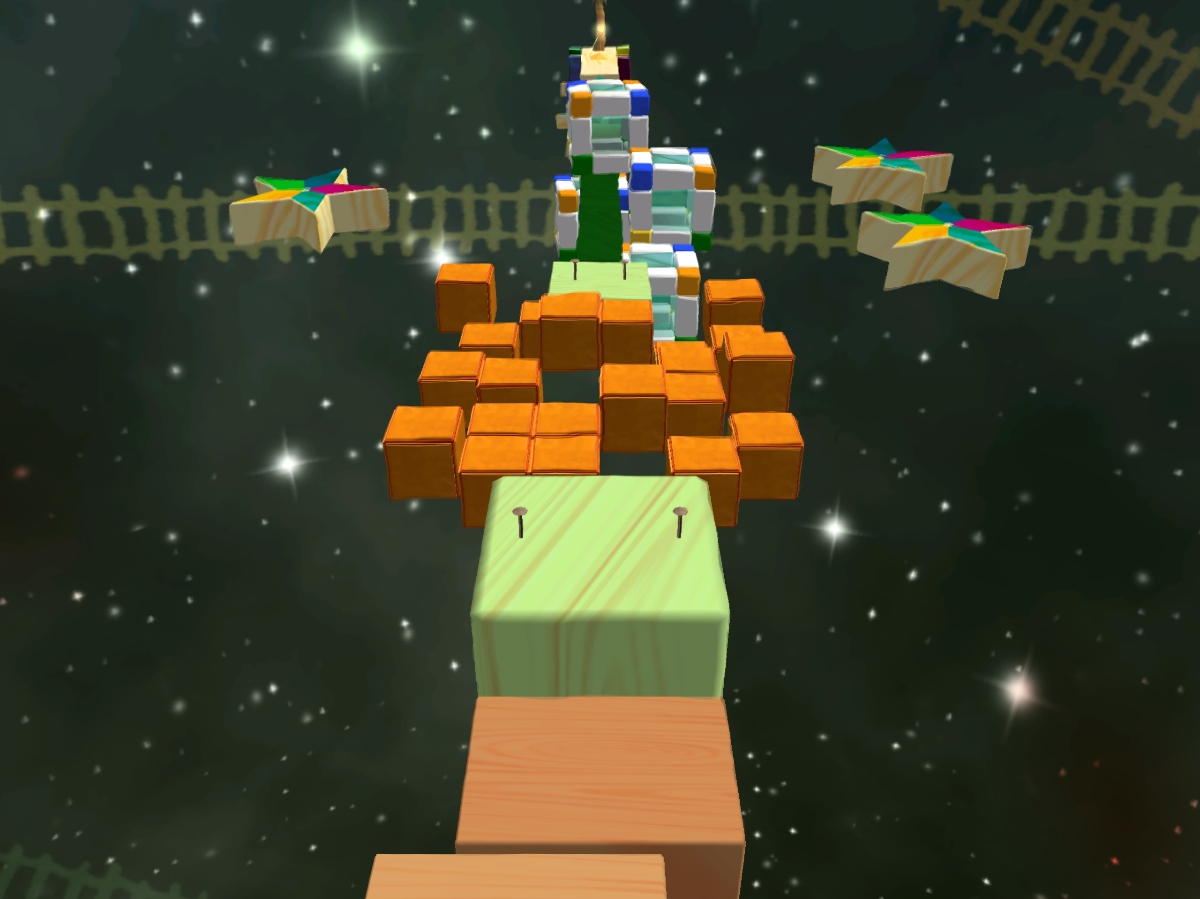
Delfino Plaza, the hub town, once the sun is back.Bianco Hills, the first proper area, with its big windmill.The Hover Nozzle in action: a few seconds of airtime that change everything.A secret course: no F.L.U.D.D., just blocks, timing and nerve.
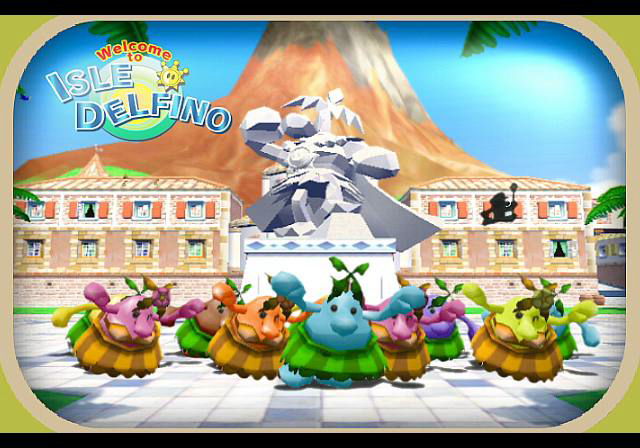
“Welcome to the sun-drenched tropical paradise of Isle Delfino!”
Nintendo, Super Mario Sunshine (2002), opening Isle Delfino promotional video. One line quoted.
The opening line of the in-flight tourist video that plays as the game begins. Peach is the only passenger paying enough attention to spot a shadowy Mario lurking in the footage, a detail the islanders will shortly hold against the real one.
Quick Answers
The things people ask most about Super Mario Sunshine, answered briefly here and in depth further down the page.
When did Super Mario Sunshine come out?
On 19 July 2002 in Japan, 26 August 2002 in North America, 4 October 2002 in Europe and 11 October 2002 in Australia, for the Nintendo GameCube. South Korea followed on 14 December 2002. More →
How many Shine Sprites are there?
120. Each of the seven main areas holds 11 (eight episode Shines, a 100-coin Shine and two hidden ones), Delfino Plaza, the Airstrip and Corona Mountain hold 19 between them, and trading the island’s 240 blue coins at the boathouse earns the last 24. More →
Who is Shadow Mario?
Bowser Jr. in disguise. He wears a bandana with a Mario-style moustache drawn on it and uses a magic paintbrush to become a watery blue copy of Mario. He frames Mario for the graffiti and kidnaps Peach because Bowser has told him she is his mother. More →
What does F.L.U.D.D. stand for?
Flash Liquidizer Ultra Dousing Device. In Japan the pack is simply called the Pump; the acronym was invented for the English version. More →
How do you unlock Yoshi?
Clear Episode 4 of Pinna Park, then return to Delfino Plaza, where Shadow Mario is running around with a Yoshi egg. Beat him, bring the egg the fruit it asks for and Yoshi hatches. The Turbo Nozzle follows at 25 Shines and the Rocket Nozzle at 30. More →
How do you reach Corona Mountain?
Clear Episode 7, the Shadow Mario chase, in all seven areas. Shadow Mario then floods Delfino Plaza and the cave behind the Shine Gate opens. More →
Is Luigi in Super Mario Sunshine?
No. Luigi does not appear at all, although Miyamoto joked in 2002 that it was fine for Luigi to carry a vacuum cleaner, so a water pump for Mario could pass. The Toads, Peach and Toadsworth are the only Mushroom Kingdom faces on the island. More →
Who directed it?
Yoshiaki Koizumi and Kenta Usui, with Shigeru Miyamoto and Takashi Tezuka producing. It was Koizumi’s first Mario game in the director’s chair; he went on to direct Super Mario Galaxy. More →
How well did it sell and review?
About 5.9 million copies according to Nintendo’s own 2023 investor chart, making it the third best-selling GameCube game. Metacritic averages 92 from 61 reviews; Edge, IGN, Game Informer and Famitsu all scored it highly, while GameSpot’s 8/10 called F.L.U.D.D. and Yoshi gimmicks. More →
Where can I play it today?
The original GameCube disc, the widescreen version in Super Mario 3D All-Stars (Switch, 2020, sold only until 31 March 2021) or the GameCube library in Nintendo Classics on Nintendo Switch 2, where it arrived on 13 August 2026 for Expansion Pack members. More →
Story
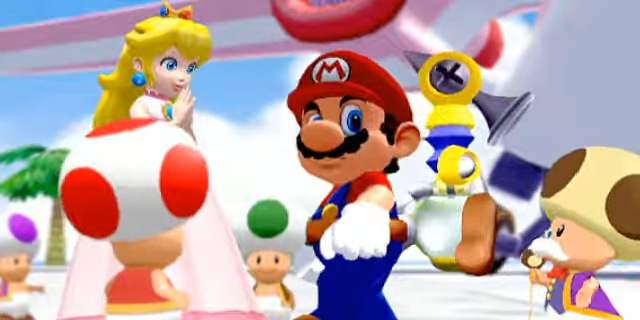
The holiday party, Shadow Mario in pursuit, in Nintendo’s group artwork.
For a game about scrubbing graffiti, Sunshine has a surprising amount of plot, and it is the first Mario platformer to tell it with fully voiced cutscenes. Here is the whole holiday, from take-off to the credits.
A holiday goes wrong
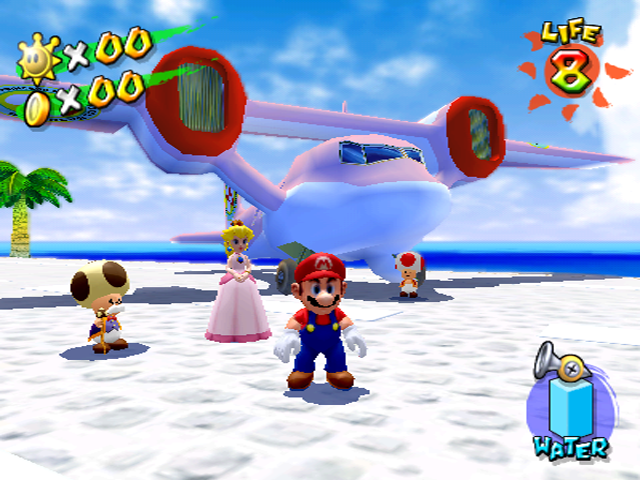
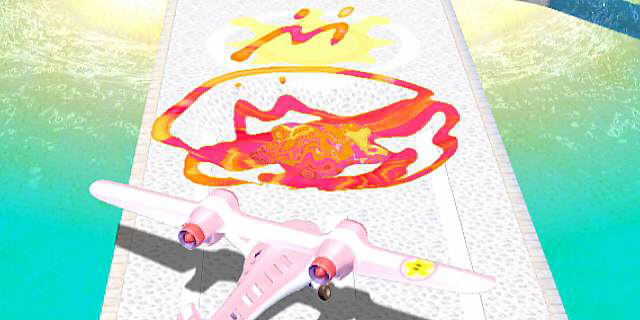
The game opens aboard a plane. Peach, Toadsworth and the Toads watch a cheery promotional film about Isle Delfino, its Shine Sprites and its two peoples, the Piantas and the Nokis, while Mario and Toadsworth daydream about the food. Only Peach notices the shadowy figure with Mario’s silhouette flitting across the footage. When the plane touches down at Delfino Airstrip the runway is smeared with glowing orange goop in the shape of Mario’s head and a plant-like creature bursts out of it.
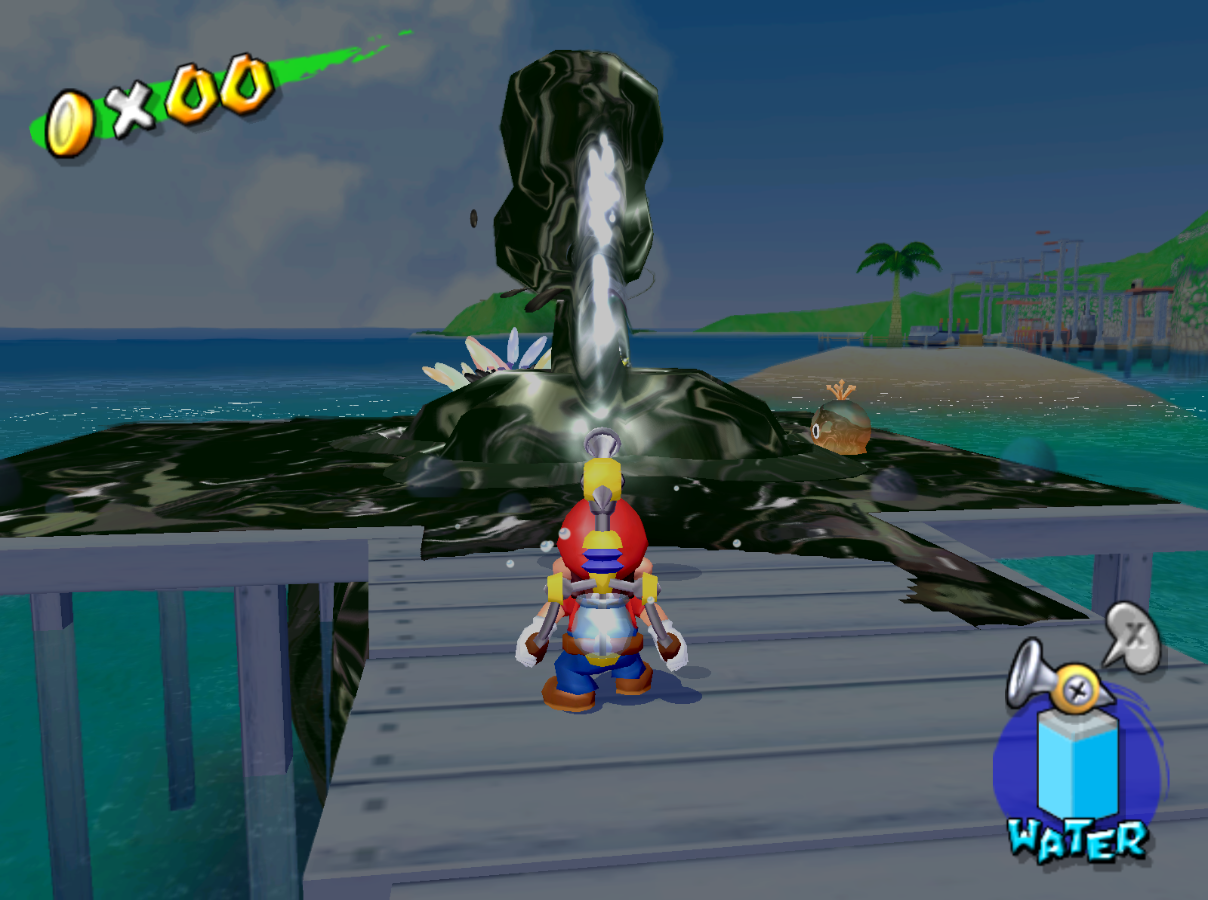
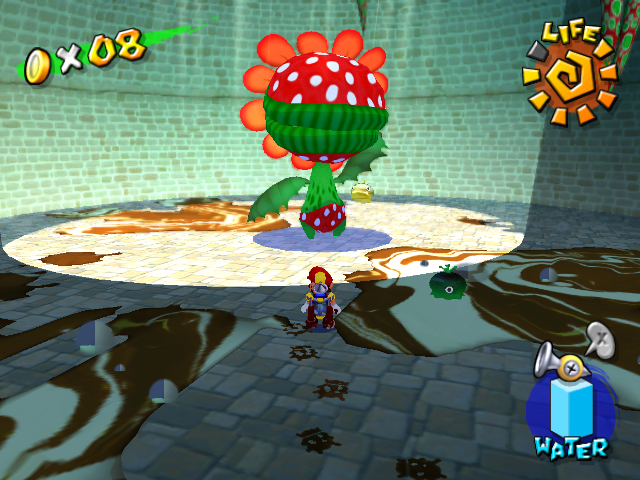
Mario finds a strange pump lying on the tarmac. It scans him, introduces itself as F.L.U.D.D., a product of Gadd Science Incorporated, and offers its services. A quick tutorial later Mario has sprayed the Proto Piranha into submission, uncovered the island’s first Shine Sprite and is immediately arrested by the Pianta police.
The in-flight tourist video, and the shadow only Peach sees.Delfino Airstrip, drowned in goop.F.L.U.D.D. introduces itself.
Mario on trial
Isle Delfino’s courtroom is the funniest scene in the game. A Pianta prosecutor lays out the case, that someone has defaced the island, that the Shine Sprites have fled and that the culprit is obviously the man in red, while Peach protests and the judge nods along. The verdict is instant: Mario is guilty, must clean every inch of the island, and may not leave until he has. He spends his first night on Isle Delfino in a cell.
Released the next morning into a dark and grimy Delfino Plaza, Mario sets to work. Spraying goop reveals coins, people and hidden paths; spraying the giant Proto Piranha sprouting from the town square restores the Grand Pianta Statue. And it is here that the real vandal shows himself: a transparent blue Mario with a paintbrush, who grabs Peach and runs.
The trial: the prosecutor points the finger.A Proto Piranha erupts from the goop in Bianco Square.Shadow Mario makes off with Peach.
Shadow Mario and the Rainbow M
Mario chases the impostor through the plaza and soaks him until he drops the princess, but Shadow Mario escapes through a glowing M he paints on the statue, a Rainbow M portal into Bianco Hills. From here the game settles into its loop: Mario enters an area, restores a Shine, and comes back to find the town a little brighter and Shadow Mario a little bolder, with new portals uncovered beneath the goop at the boathouse and the lighthouse as the Shine count climbs.
Each area has been polluted in its own way. Bianco Hills’ windmill has grown a giant Piranha Plant, Ricco Harbor’s fishing bay is home to a colossal squid, Gelato Beach’s sand is patrolled by Cataquacks, and the Piantas and Nokis in each place have small requests and big complaints. Shadow Mario himself appears for a chase in every area’s seventh episode, always gone before Mario can unmask him.
A Rainbow M portal, Shadow Mario’s signature.Petey Piranha on the windmill in Bianco Hills.Gooper Blooper breaks out at Ricco Harbor.
Pinna Park and the truth
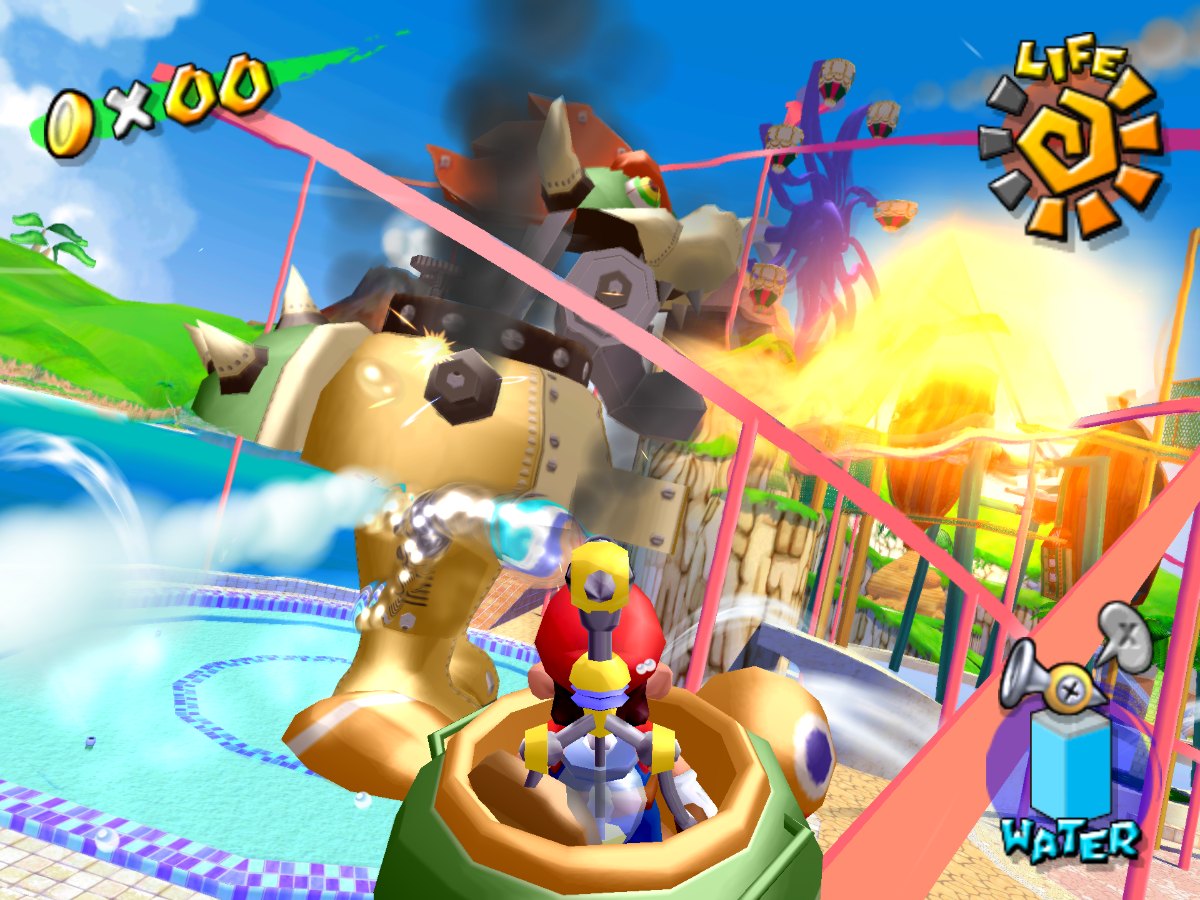
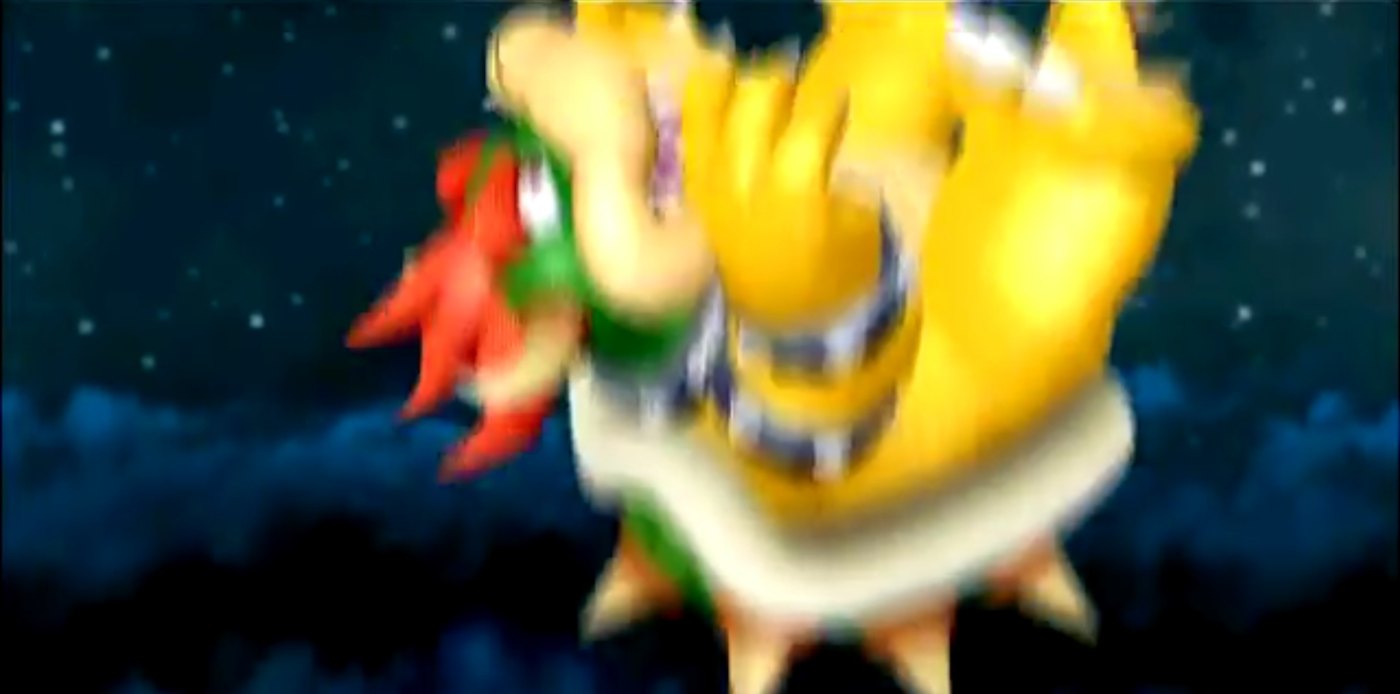
With ten Shines in hand, Mario returns to the plaza to see Shadow Mario kidnap Peach again, this time by boat, towards the island’s theme park. Mario follows via the beach cannon and arrives at Pinna Park as a towering Mecha-Bowser rises from the sea. Riding the park’s roller coaster, he fires water rockets at the robot until it collapses, and the figure in the cockpit pulls off his bandana.
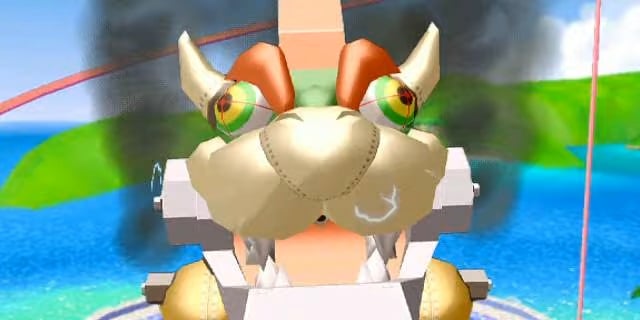
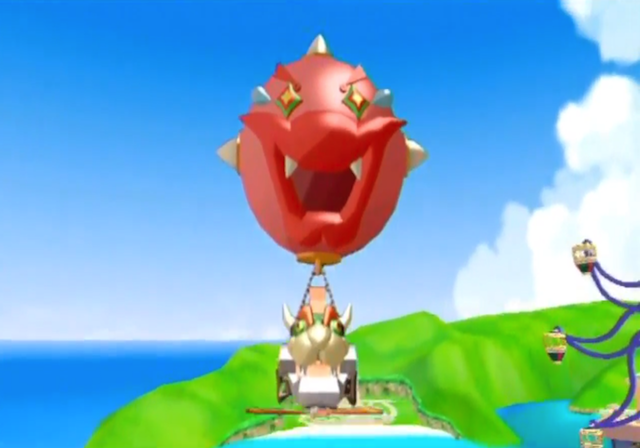
It is Bowser Jr., a small Koopa with a bib and his father’s temper, who announces that Peach is his mama, that the evil Mario has kidnapped her, and that a peculiar old man in a white coat gave him the magic brush he has been using to paint the island. He makes a hot-air balloon out of the wreck of Mecha-Bowser and floats off to Corona Mountain with Peach, leaving Mario to work out how to follow.
Mecha-Bowser rises over Pinna Park.The bandana comes off: Bowser Jr.’s first appearance.Off to the volcano in a Mecha-Bowser balloon.
Yoshi, nozzles and the rest of the island
Shadow Mario is not done with the plaza. He turns up with a Yoshi egg, then with the Turbo Nozzle and finally the Rocket Nozzle, and beating him each time hands Mario a new way to move and a new area to open: Yoshi eats the pineapple blocking the pipe to Sirena Beach, staring into the sun from a Shine imprint on the dock reveals Noki Bay, and the Rocket Nozzle reaches the pipe on top of the Shine Gate that leads to Pianta Village.
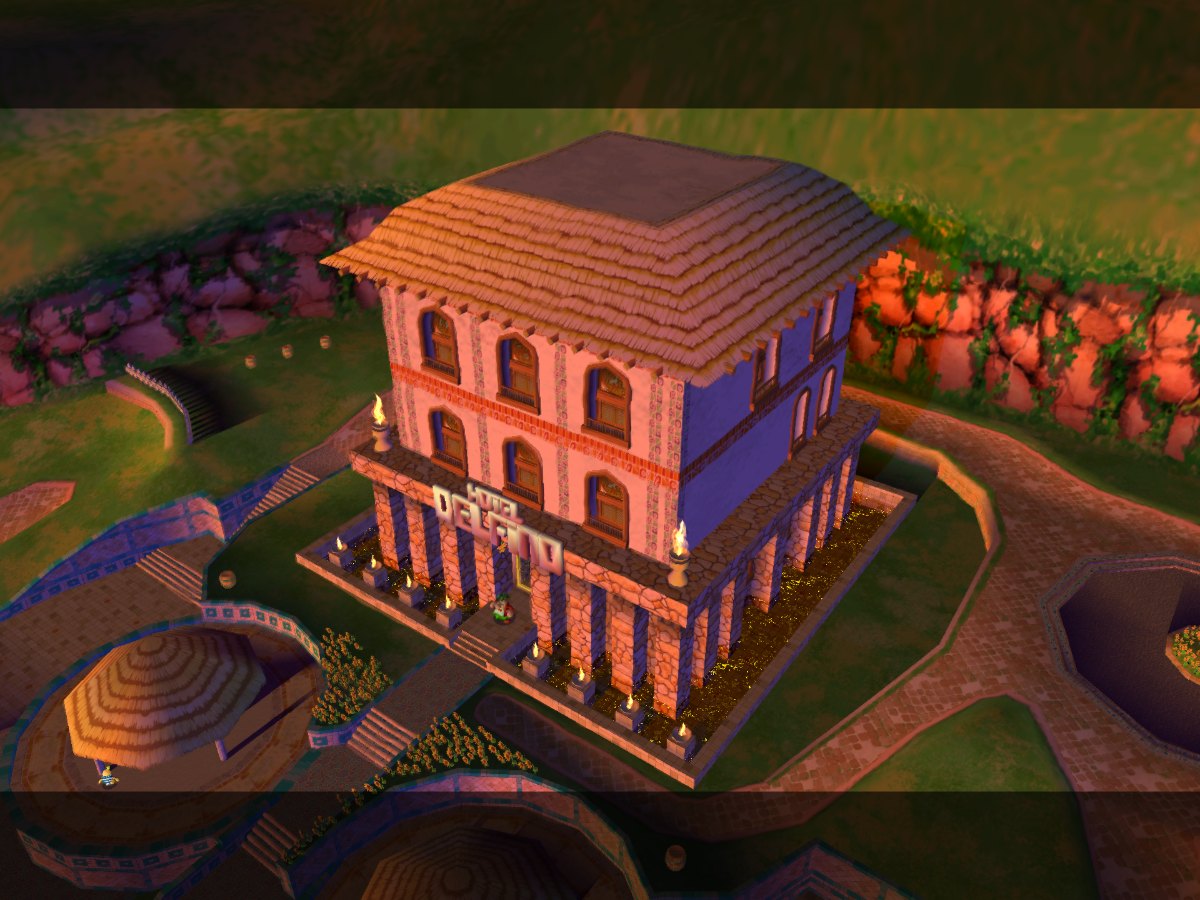
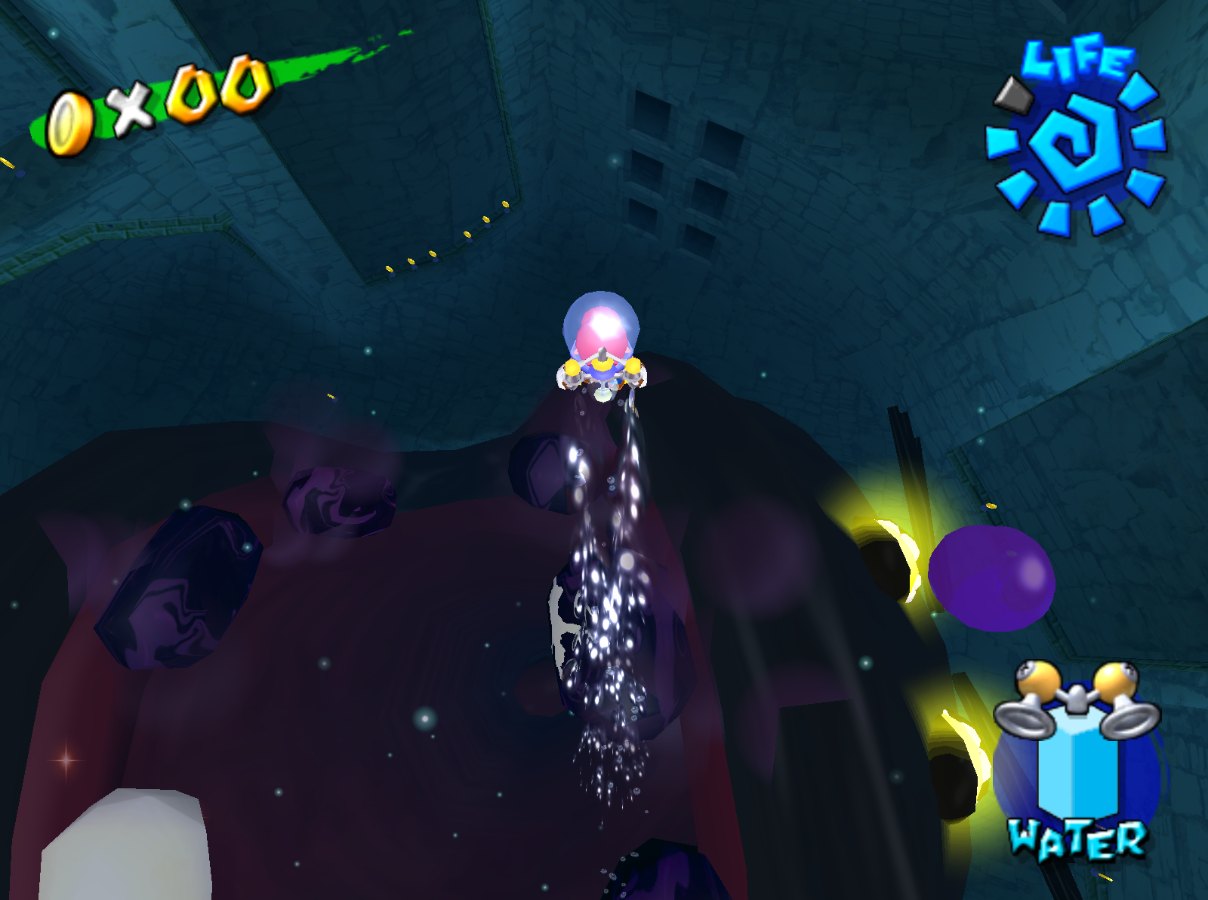
The second half of the island is stranger and sadder. Sirena Beach’s Hotel Delfino is haunted and its casino basement hides King Boo; Noki Bay’s water is poison until Mario cleans the teeth of the eel that lives at the bottom of it; Pianta Village burns in episode three and holds a Chain Chomp that wants a bath. Il Piantissimo, a mysterious runner in a Pianta costume, challenges Mario to races in three of the areas.
Hotel Delfino at Sirena Beach, Boos and all.Dentistry at the bottom of Noki Bay.Pianta Village in the treetops.
The flood and Corona Mountain
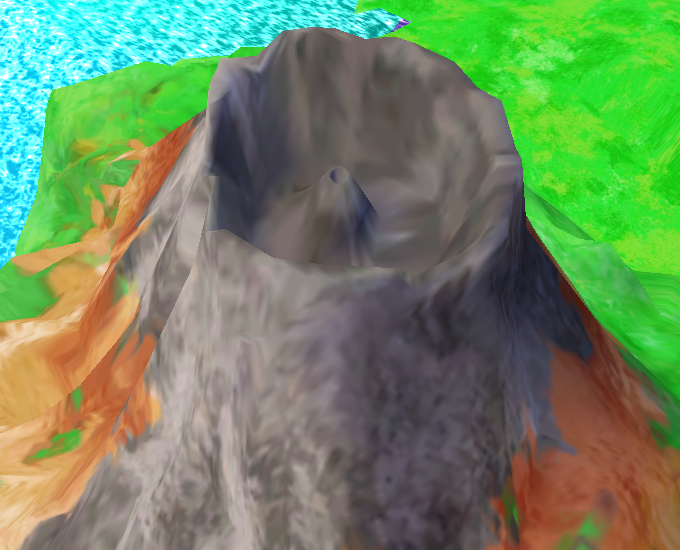
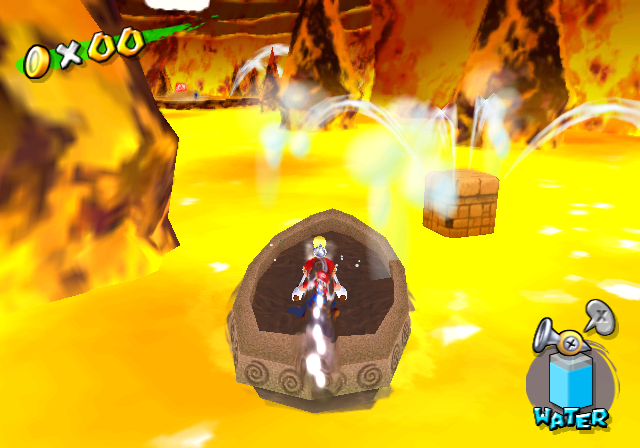
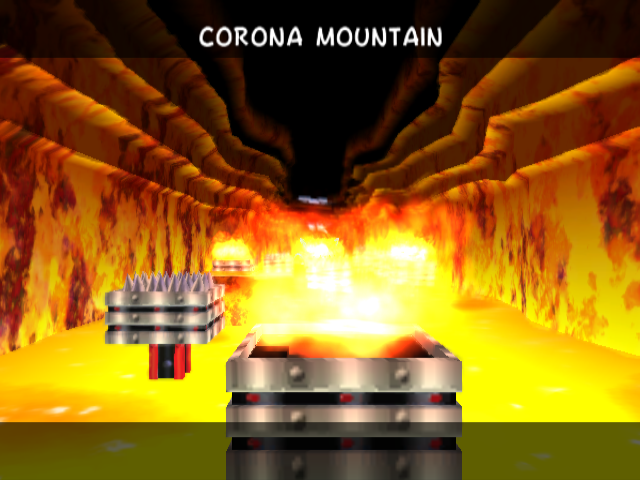
Once Shadow Mario has been chased out of all seven areas he makes his last move: he swamps Delfino Plaza, leaving rooftops poking out of the water and opening a cave behind the Shine Gate. Inside Corona Mountain is a lake of lava crossed on platforms that spit fire and spikes, then a mudboat that Mario steers by spraying water behind him, with Lava Cheep Cheeps leaping at the hull.
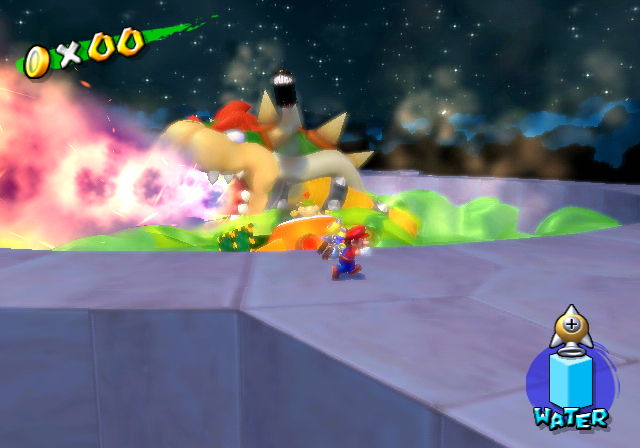
At the summit, on a cloud above the crater, Bowser and Bowser Jr. are relaxing in a giant hot tub full of sludge, Peach perched unhappily on the rim. Bowser bellows, Junior fires Bullet Bills, and Mario uses the Rocket Nozzle to ground pound the five platforms holding the tub up, one after another, until it tips.
Delfino Plaza under water.Steering the mudboat across Corona Mountain’s lava.Father and son in the hot tub.
Father and son fall
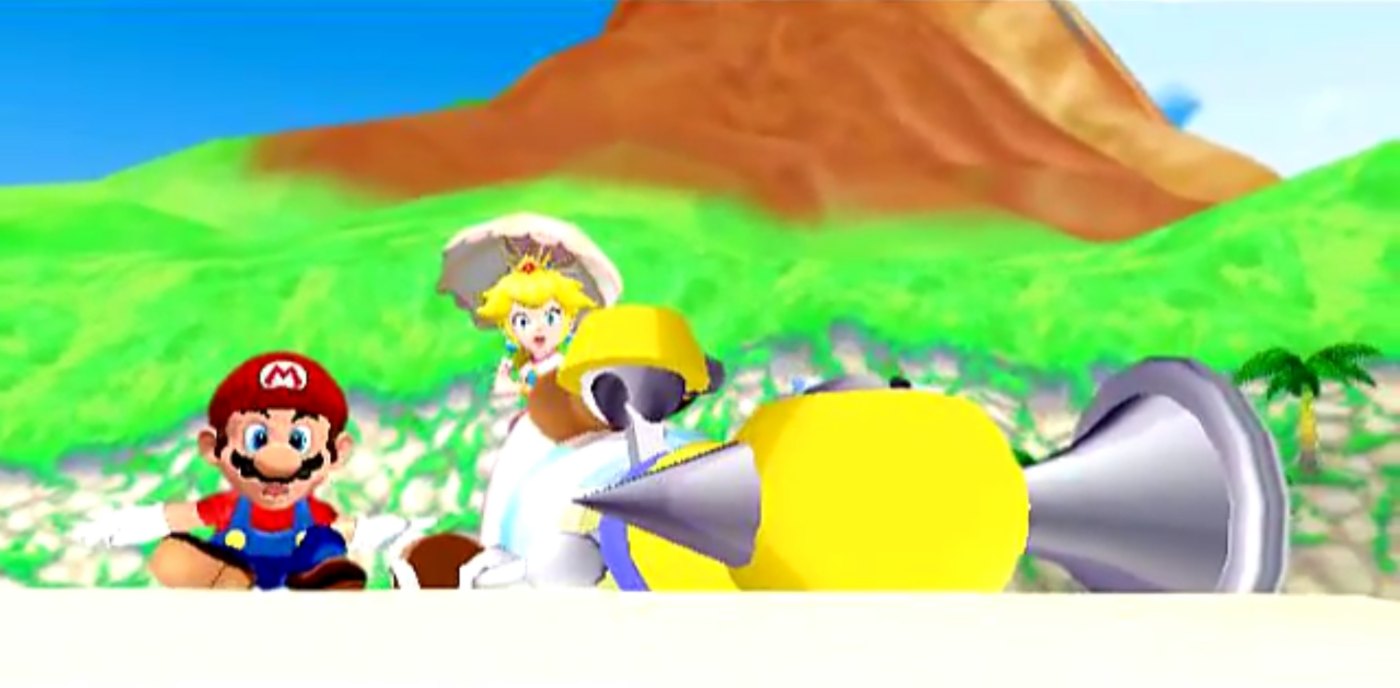
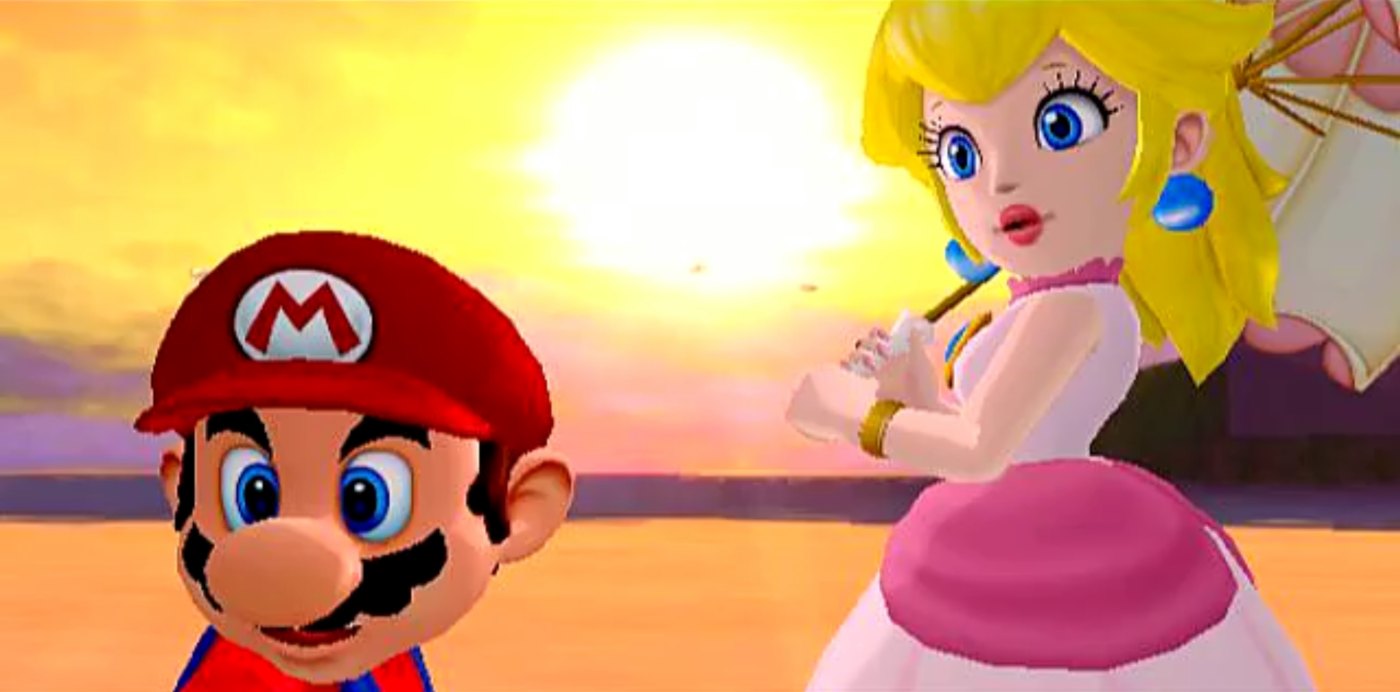
The tub capsizes and everyone tumbles out of the volcano. Mario and Peach come down safely on a small island beside Delfino Plaza, while Bowser and his son drift out to sea on the upturned tub. There, Bowser finally admits that Peach is not Junior’s mother; Junior says he had already worked that out, and promises that when he is bigger he wants to fight Mario again. The Shine Sprites return to the Shine Gate and the island fills with light.
There is a sting. F.L.U.D.D. was damaged in the fight, and on the beach it sputters and shuts down in front of Mario, who stares at the empty space on his back. In the final scene the Toads hand back a repaired F.L.U.D.D., which declares that the holiday can finally begin, and the credits roll over the party on the beach. Finish with every Shine Sprite and the closing photograph changes to a group portrait of the whole cast.
Bowser falls out of the tub.F.L.U.D.D. shuts down on the beach.The holiday, at last.
Every area on Isle Delfino
The island, in the order you can first reach it. Each main area has eight episodes, three more Shines and 30 blue coins; the figure in each entry is the boss roster.
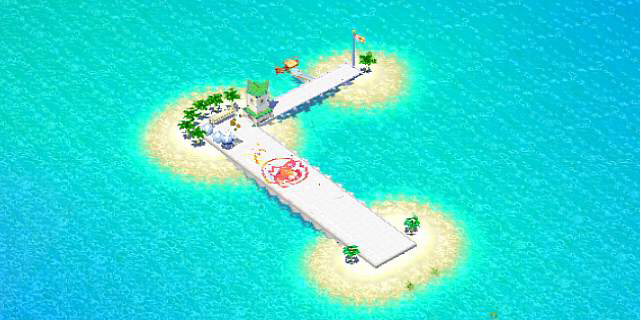
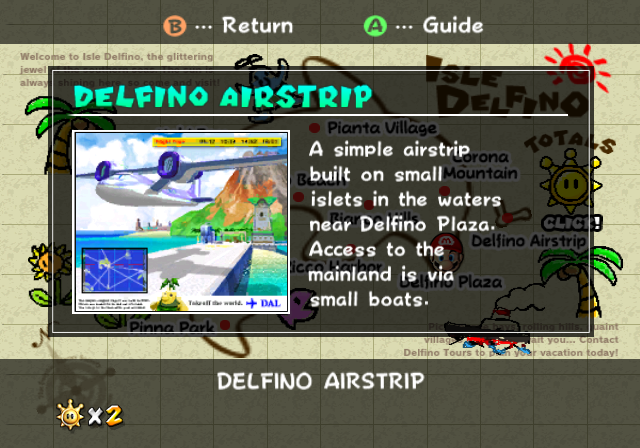
Delfino Airstrip2 Shines · Proto PiranhaThe gooped runway where Mario meets F.L.U.D.D. and the game begins. You can come back by boat late in the game for a second Shine made of red coins.
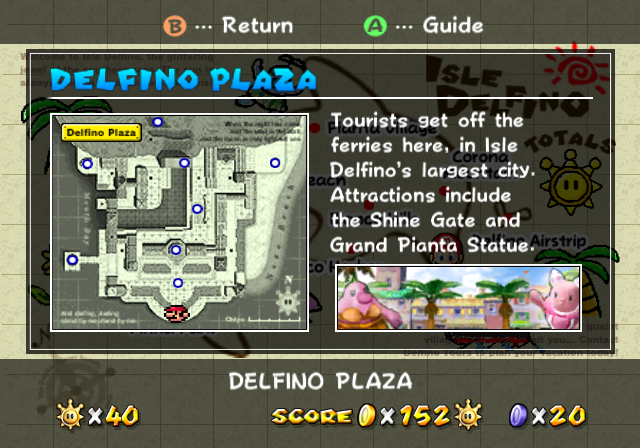
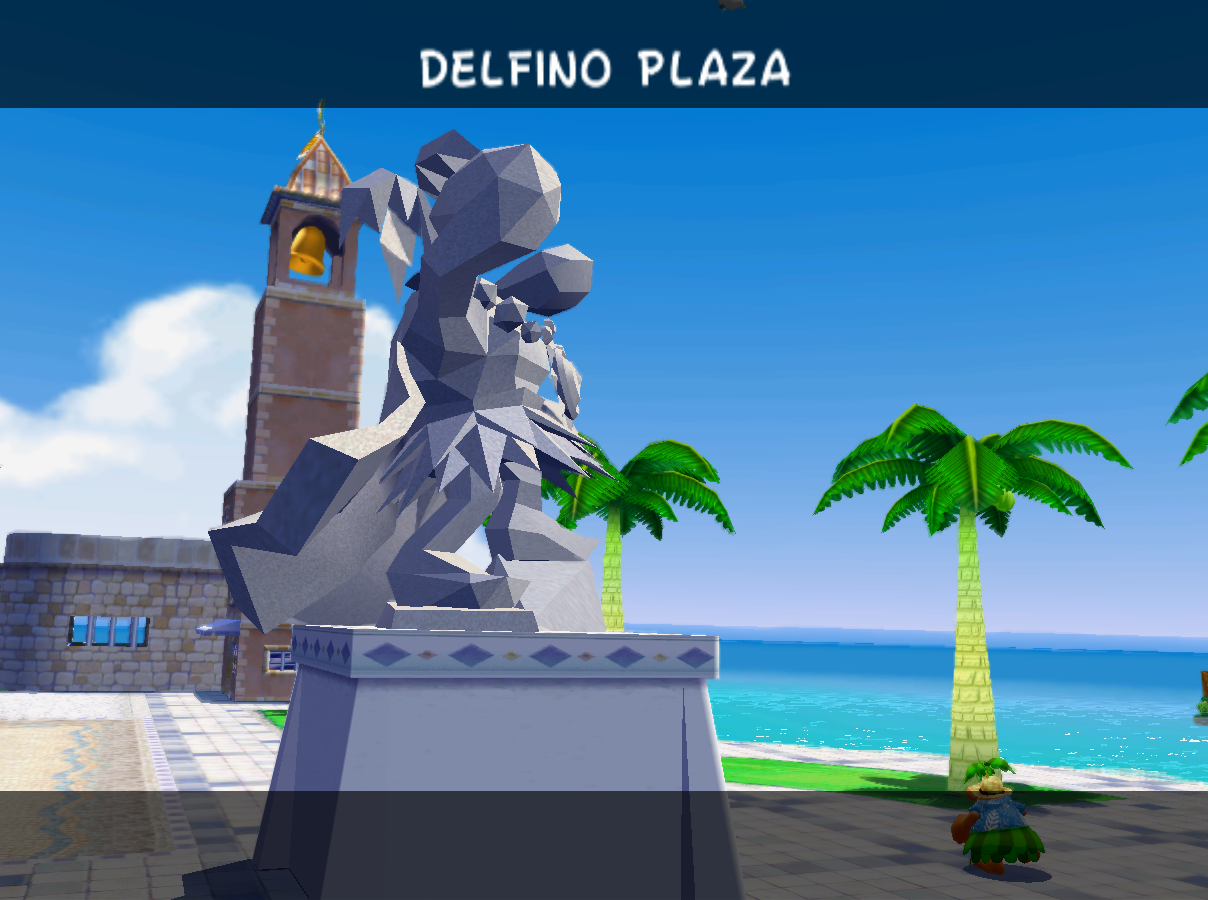
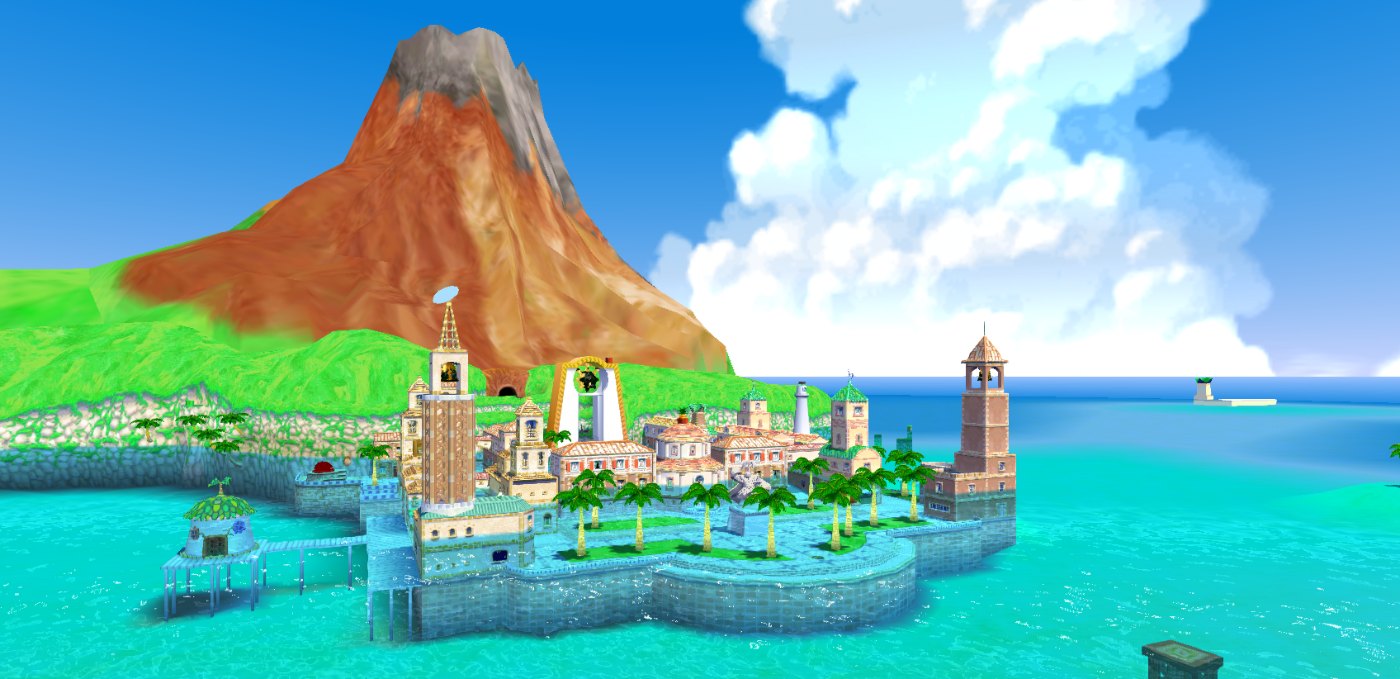
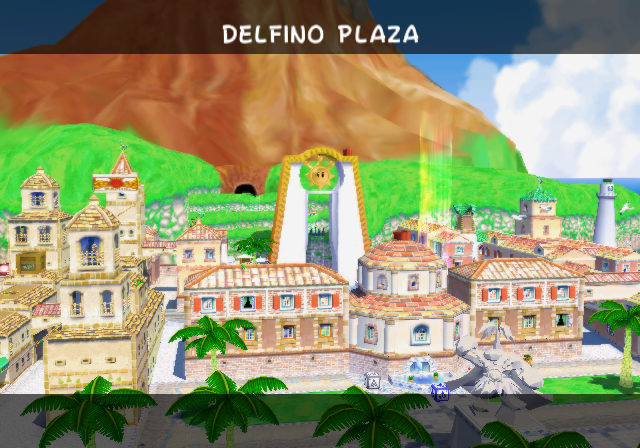
Delfino PlazaHub · 16 Shines + 24 blue-coin Shines · Shadow Mario, Proto PiranhasThe harbour town at the centre of everything: Shine Gate, Grand Pianta Statue, boathouse, lighthouse, two bell towers, a sewer network and five secret courses. It gets brighter with every Shine and floods before the finale.
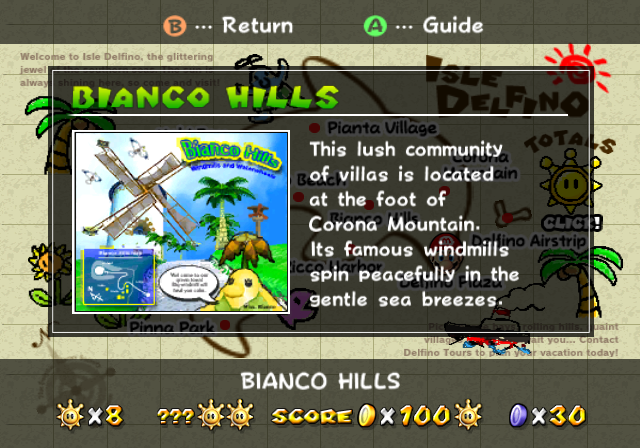
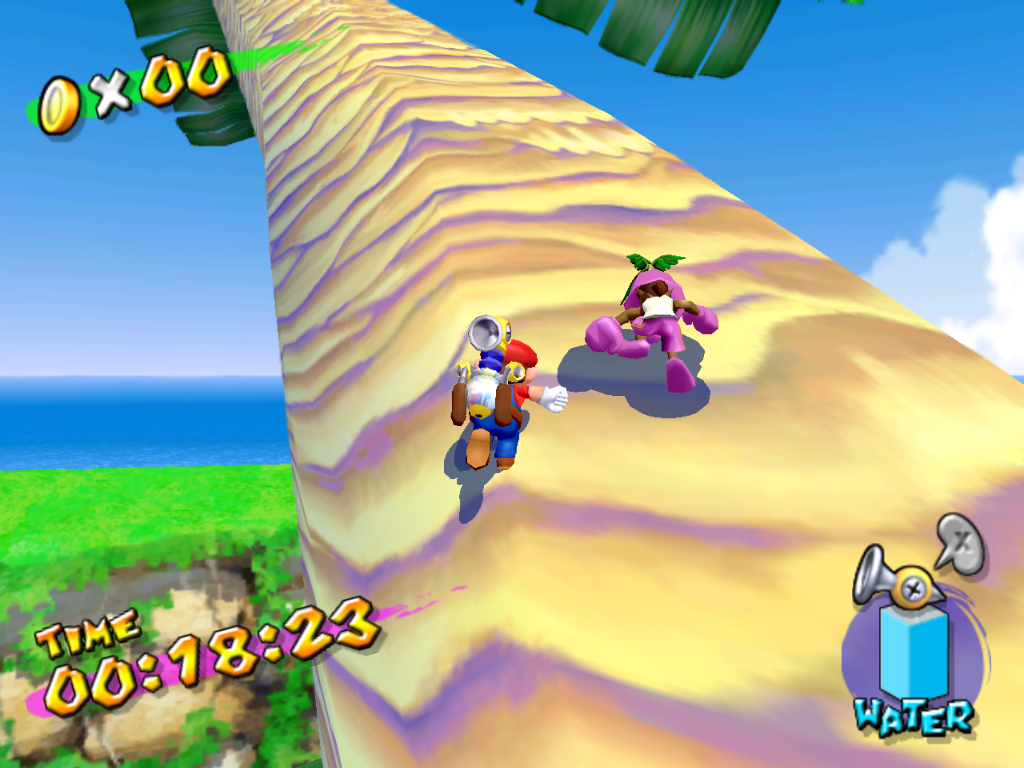
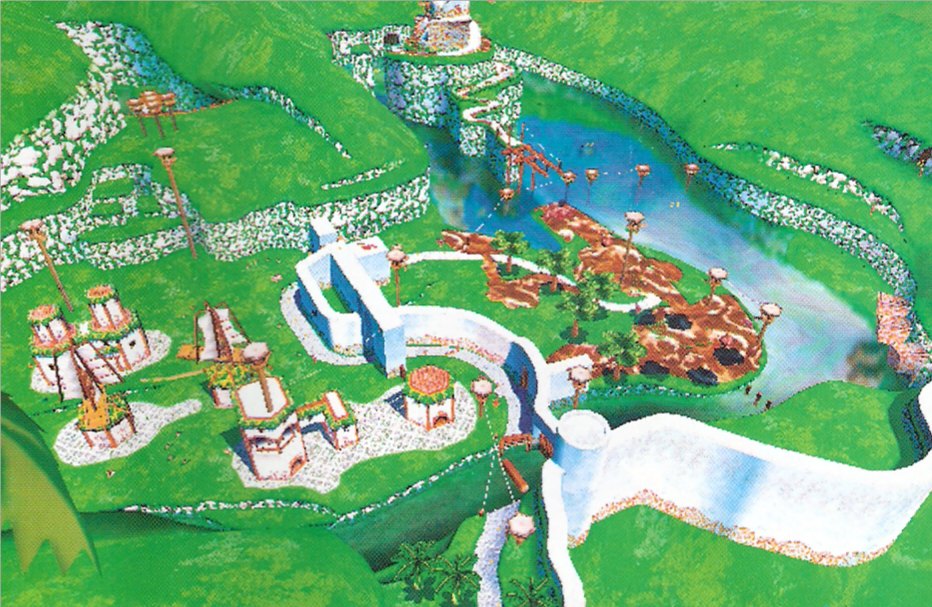
Bianco Hills11 Shines · Petey Piranha (Ep. 2 and 5), Shadow MarioA hillside village of windmills, a lake and a cliff-top path. Petey Piranha roosts on the big windmill, and the Hillside Cave and Dirty Lake hide the first two secret courses.
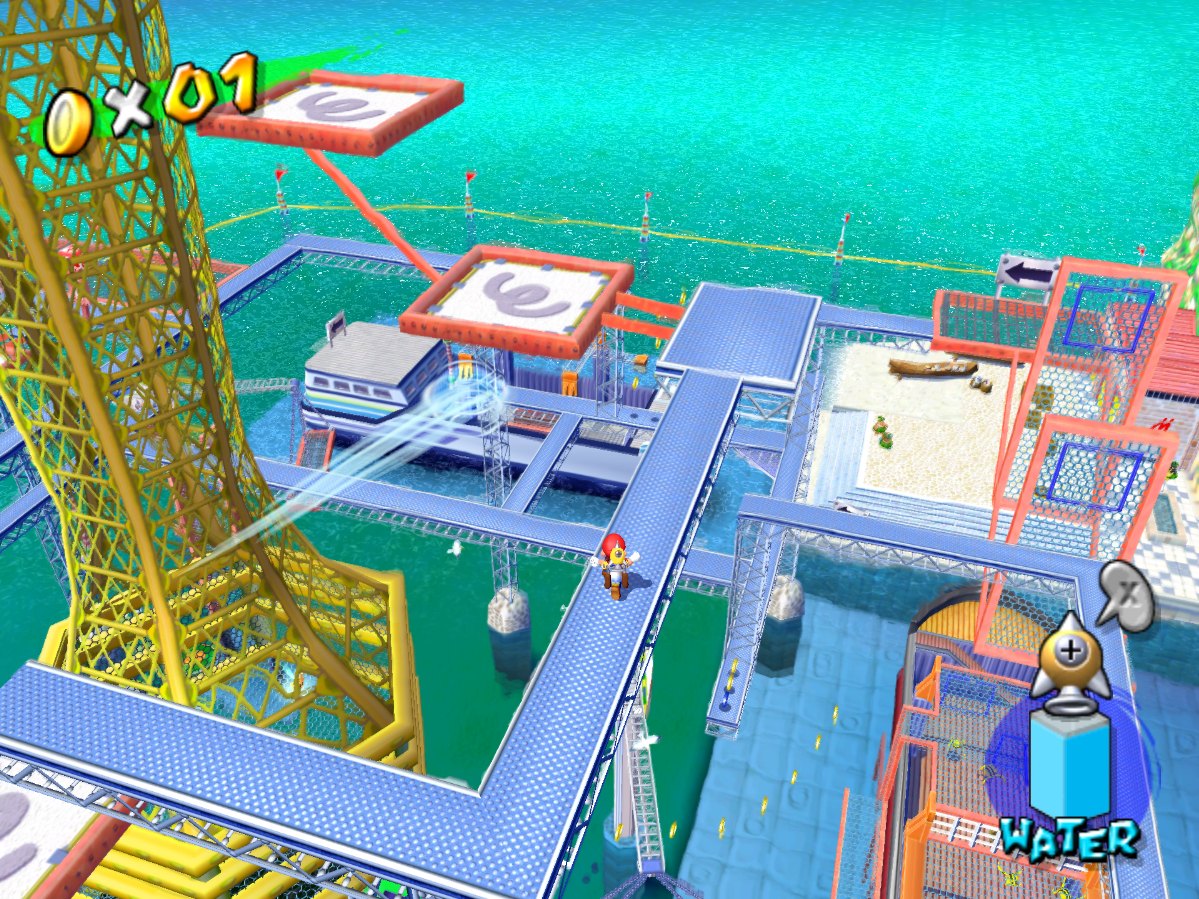
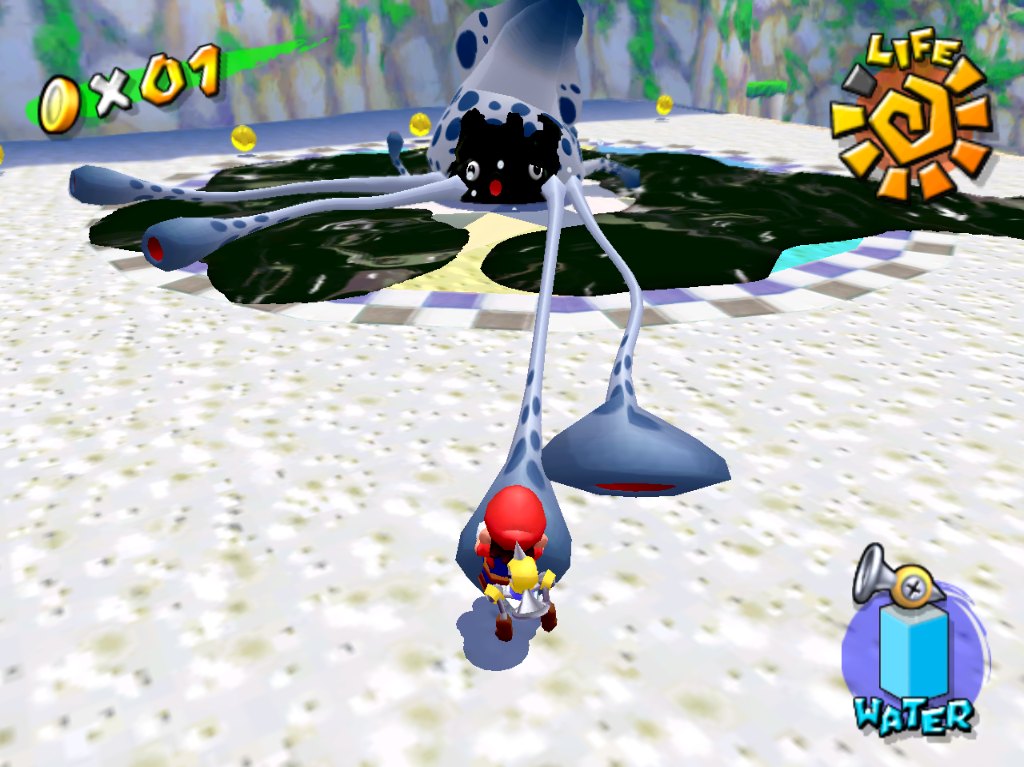
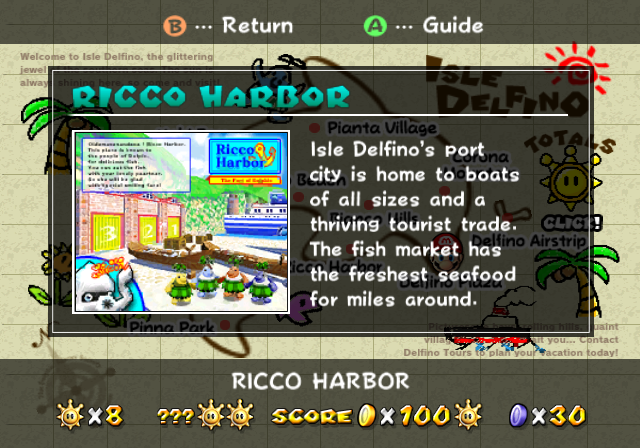
Ricco Harbor11 Shines · Gooper Blooper (Ep. 1 and 5), Shadow MarioA working port of cranes, gantries and fish markets. Blooper surfing, a caged Shine, a tower to climb and Yoshi’s fruit adventure.
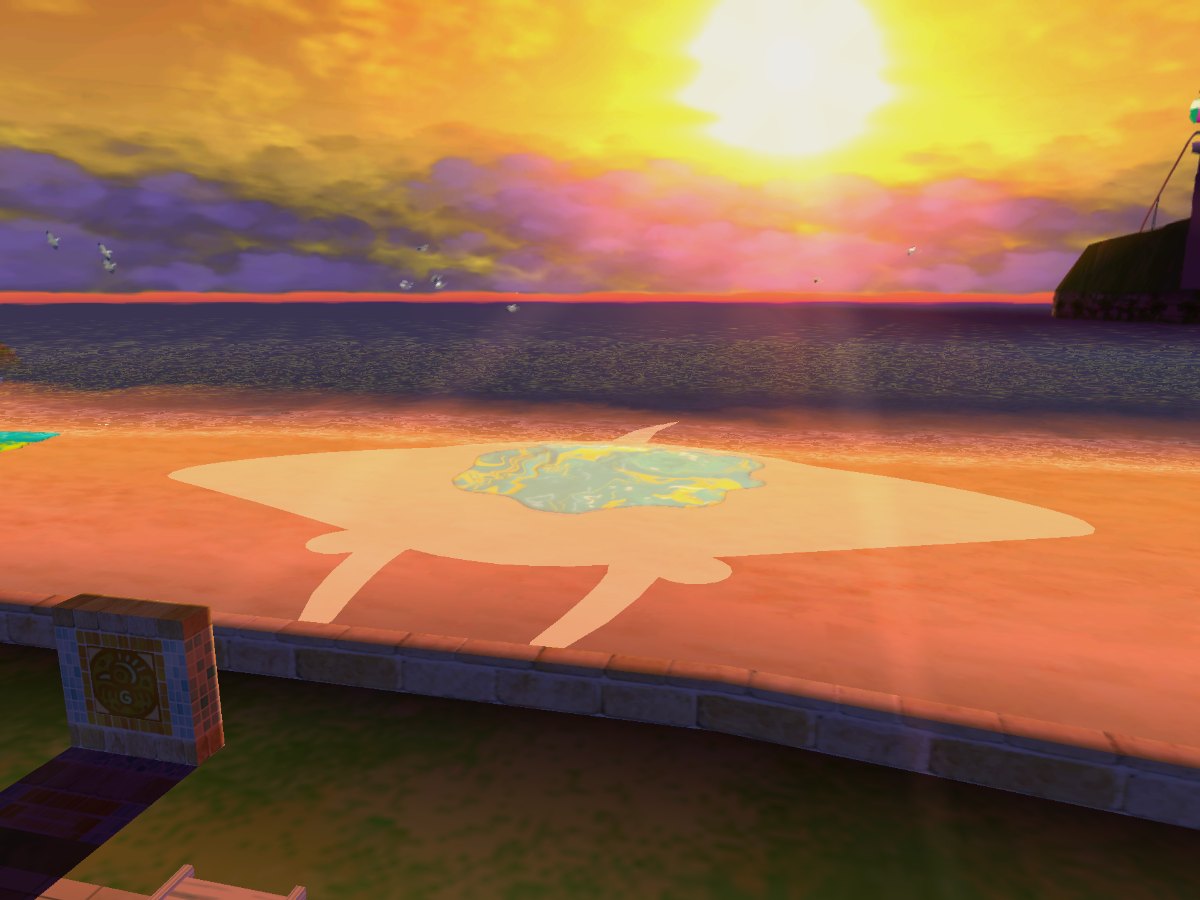
Gelato Beach11 Shines · Plungelos (Ep. 2), Wiggler (Ep. 3), Shadow MarioThe island’s biggest beach, with a sand castle, a coral reef, the Sand Bird’s egg and a watermelon festival. Il Piantissimo’s first race is here.
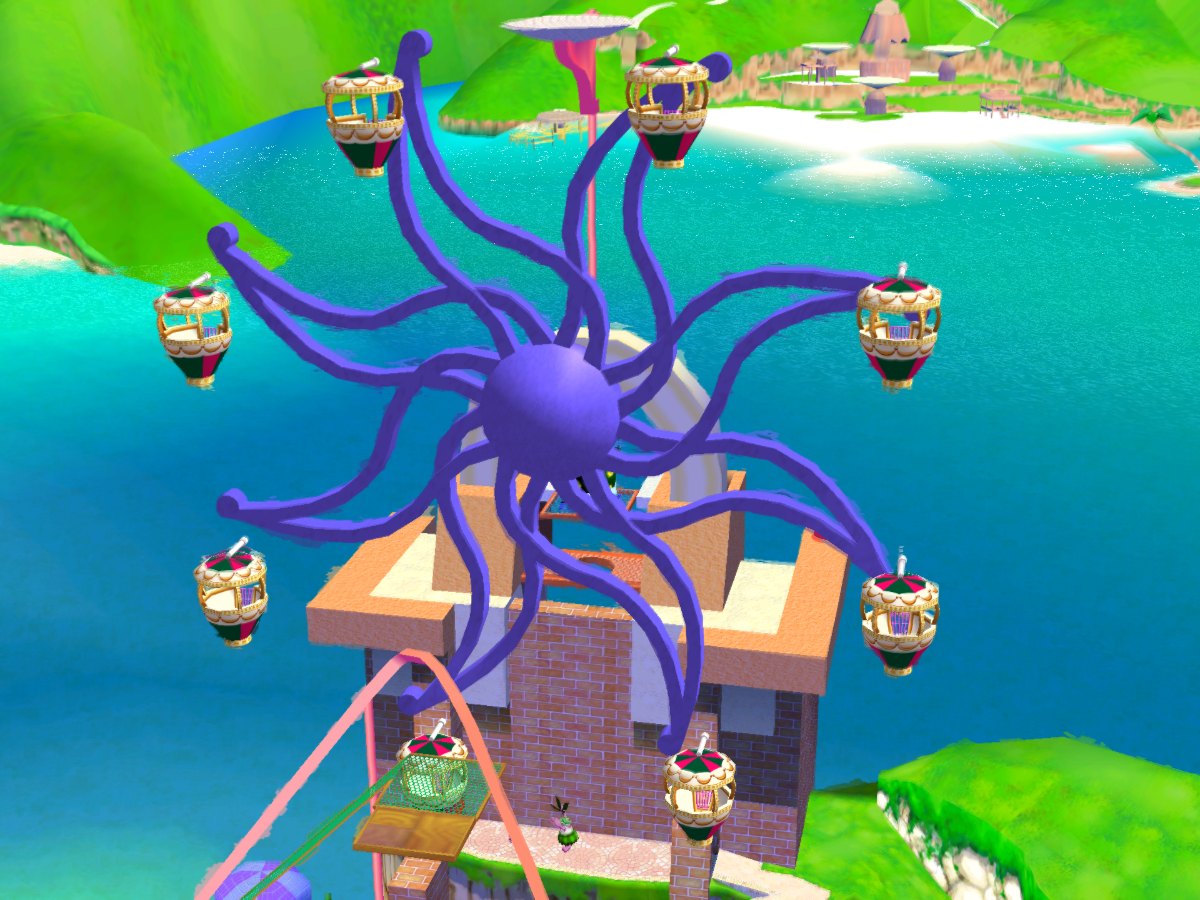
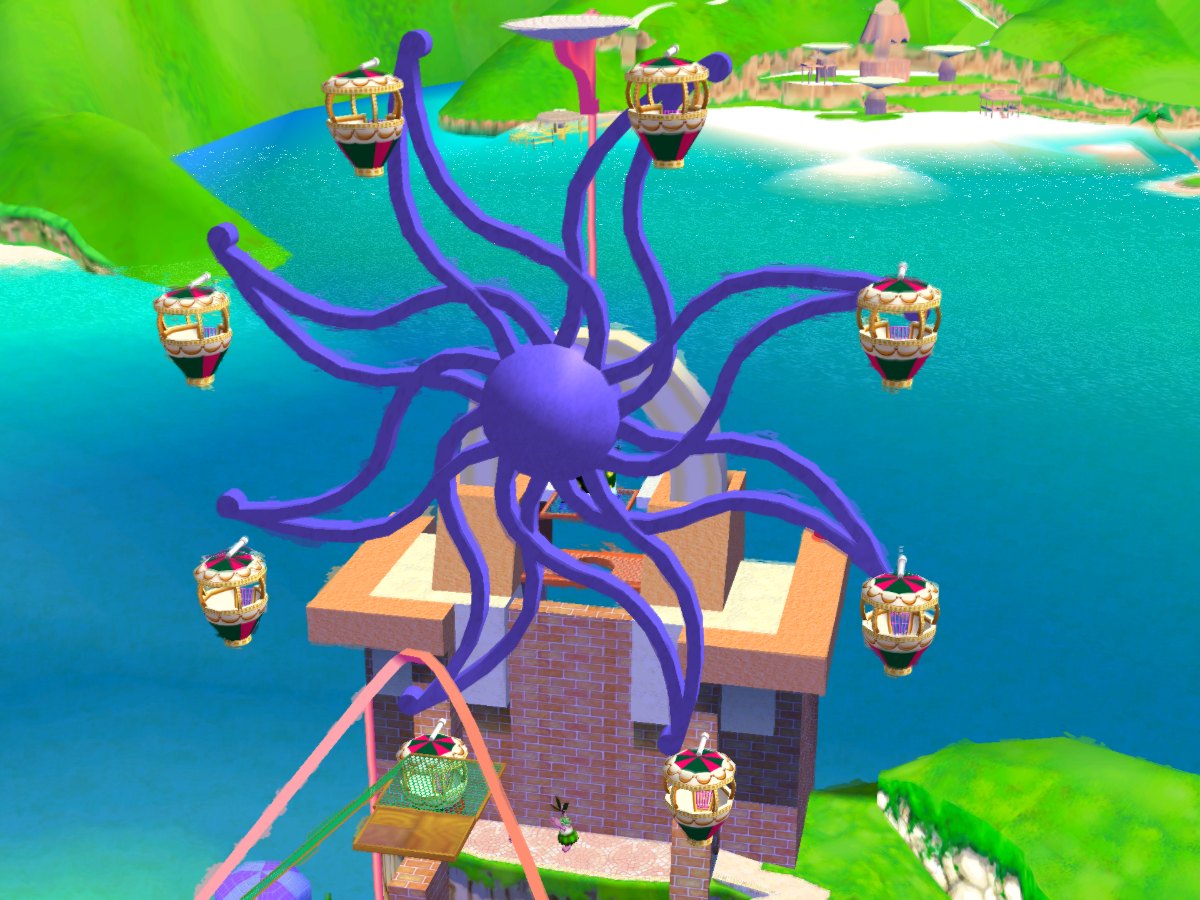
Pinna Park11 Shines · Mecha-Bowser (Ep. 1), Monty Mole (Ep. 2), Shadow MarioA theme park on the island’s fin, reached by cannon: roller coaster, Ferris wheel, pirate ships, Yoshi-Go-Round and the Bowser Jr. reveal.
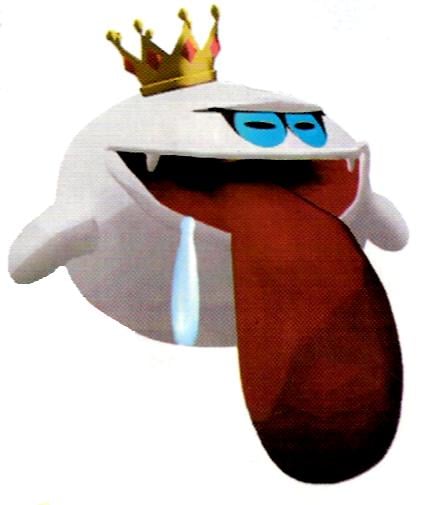
Sirena Beach11 Shines · Phantamanta (Ep. 1), King Boo (Ep. 5), Shadow MarioA sunset beach dominated by Hotel Delfino, which is haunted, rearranged by Boos and built over a casino where King Boo spins the slots.
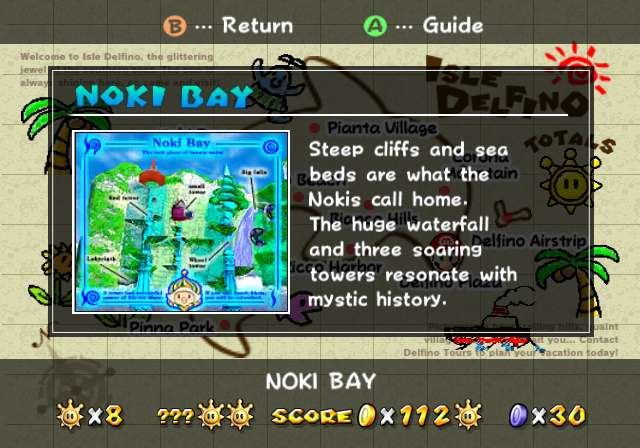
Noki Bay11 Shines · Monty Mole (Ep. 1), Gooper Blooper (Ep. 2), Eely-Mouth (Ep. 4), Shadow MarioA hidden bay of cliffs, ruins and a clogged waterfall, opened by looking into the sun. Its water is poison until Eely-Mouth’s teeth are cleaned; one episode happens inside a bottle.
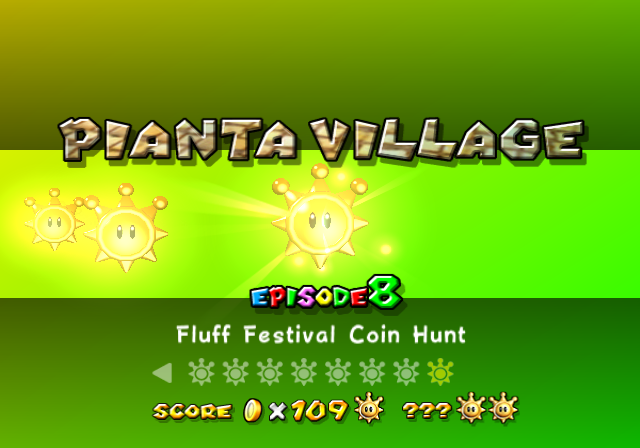
Pianta Village11 Shines · Shadow Mario onlyA village built in the branches of a giant palm, alternating day and night episodes. Chain Chomplets, a Chain Chomp’s bath, a burning village, a hot spring and the Fluff Festival. The only area without a unique boss.
Corona Mountain1 Shine · Bowser and Bowser Jr.The volcano behind the plaza: fire platforms, spikes, a mudboat ride over lava and the hot tub showdown.
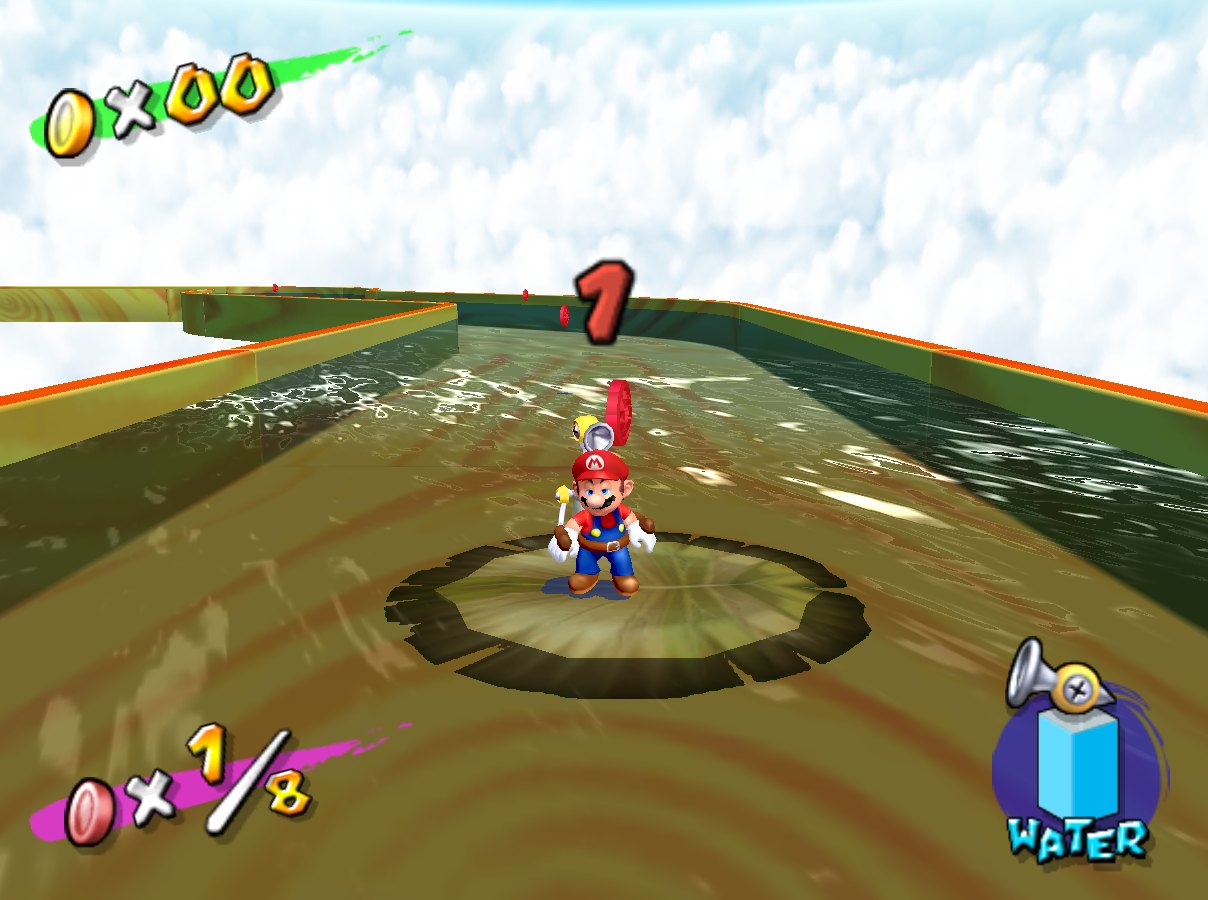
The five plaza secret courses, the Super Slide, Pachinko Game, Lily Pad Ride, Turbo Track and Red Coin Field, each hold a Shine, and the Pachinko and Lily Pad stages have a reputation as the two most frustrating Shines in the game.
Advertisement
Gameplay & Controls
Super Mario Sunshine keeps the body of Super Mario 64, the triple jump, the wall kick, the dive and the ground pound, and bolts a water tank onto it. The result plays like no other Mario: you spend as much time spraying as jumping, you can save almost any leap with a burst of hover, and the island is designed so that nearly every ledge has two or three ways up.
Each visit to an area is an episode with a named goal, from toppling a boss to chasing Shadow Mario, and completing it hands over a Shine Sprite and sends you back to Delfino Plaza. The town is a level in its own right, with its own Shines and secrets, and it brightens, darkens and finally floods as the story moves on.
Controls and Mario’s moves
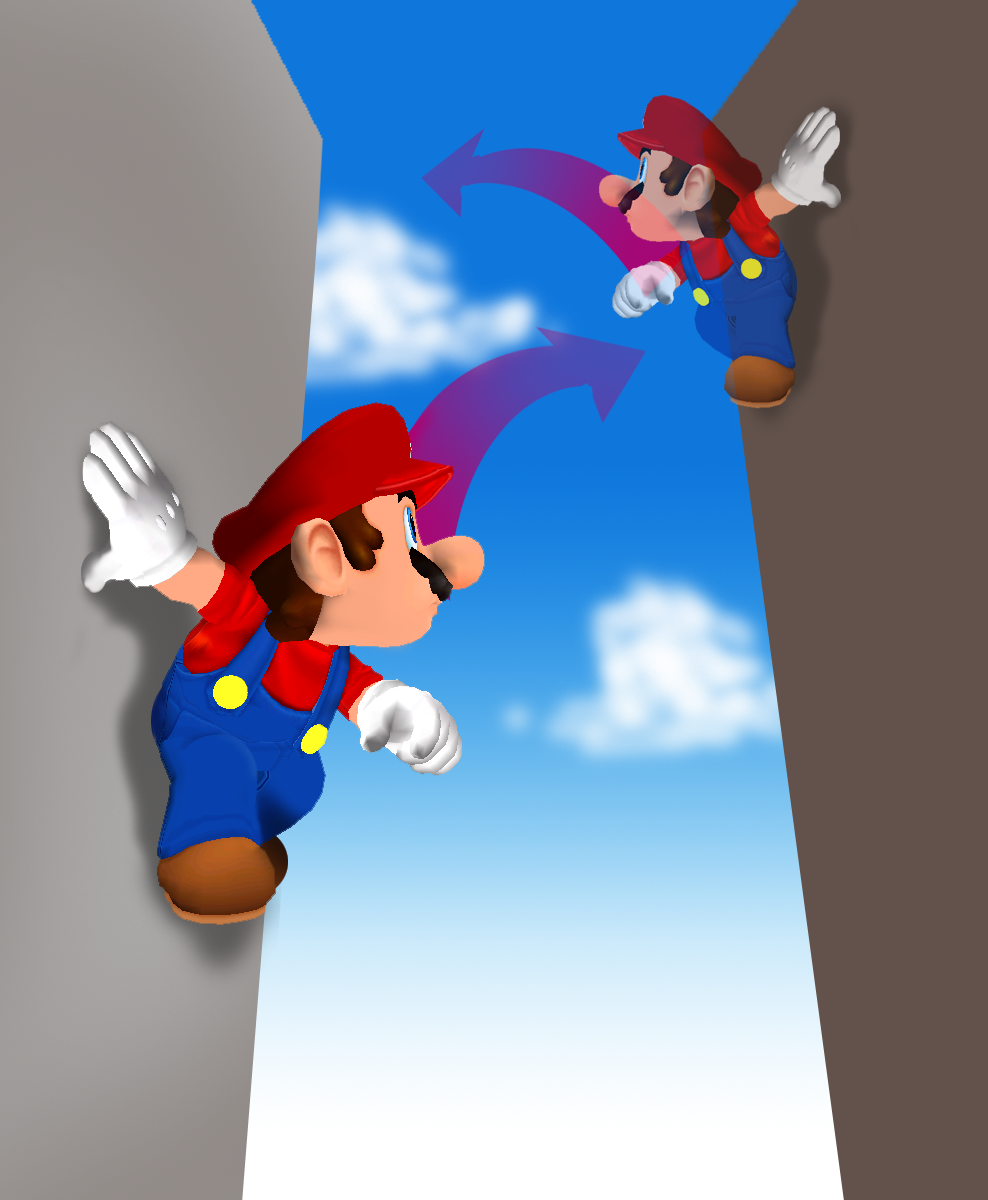
Mario’s classic moves, wall kick included, all survive the trip to Isle Delfino.
The GameCube pad does the work. A jumps (chain three for a triple jump, flick the stick and jump for a side somersault, spin the stick for a spin jump), B talks, grabs, throws and dives, and L in the air is the ground pound. Mario can still wall kick, slide and swing on ropes, and he has picked up a few new tricks: a high Super Whirl Jump off a rope, and a back somersault when you press R and A together with the Squirt Nozzle.
The R trigger is F.L.U.D.D. A light squeeze sprays while you keep running; press it all the way down and Mario stops, braces and lets you aim with the stick, which is also how the Hover Nozzle works. X swaps between the two nozzles you are carrying, Y gives a first-person look, the C-stick moves the camera and Z opens the island guidebook. Water runs out, so you refill by standing in any body of water and holding R, or by grabbing a water bottle.
F.L.U.D.D. and the four nozzles
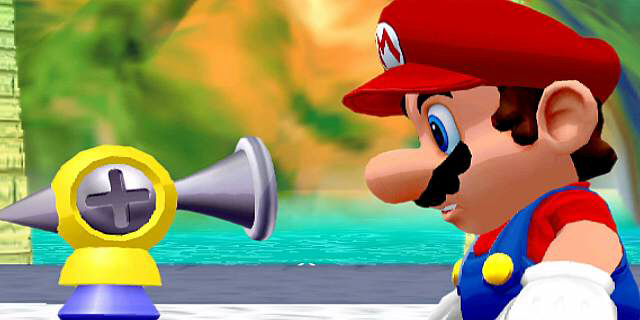
F.L.U.D.D. talks, gives hints and carries two nozzles at once. The Squirt Nozzle is always one of them: it washes away goop, knocks over enemies, fills the mouths of Piranha-like bosses and reveals hidden paths behind wall paintings. The Hover Nozzle, available from the start, fires two jets downwards for about four seconds of lift, long enough to correct a jump or drift across a gap, and it is the single biggest reason newcomers find Sunshine more forgiving than its predecessor.
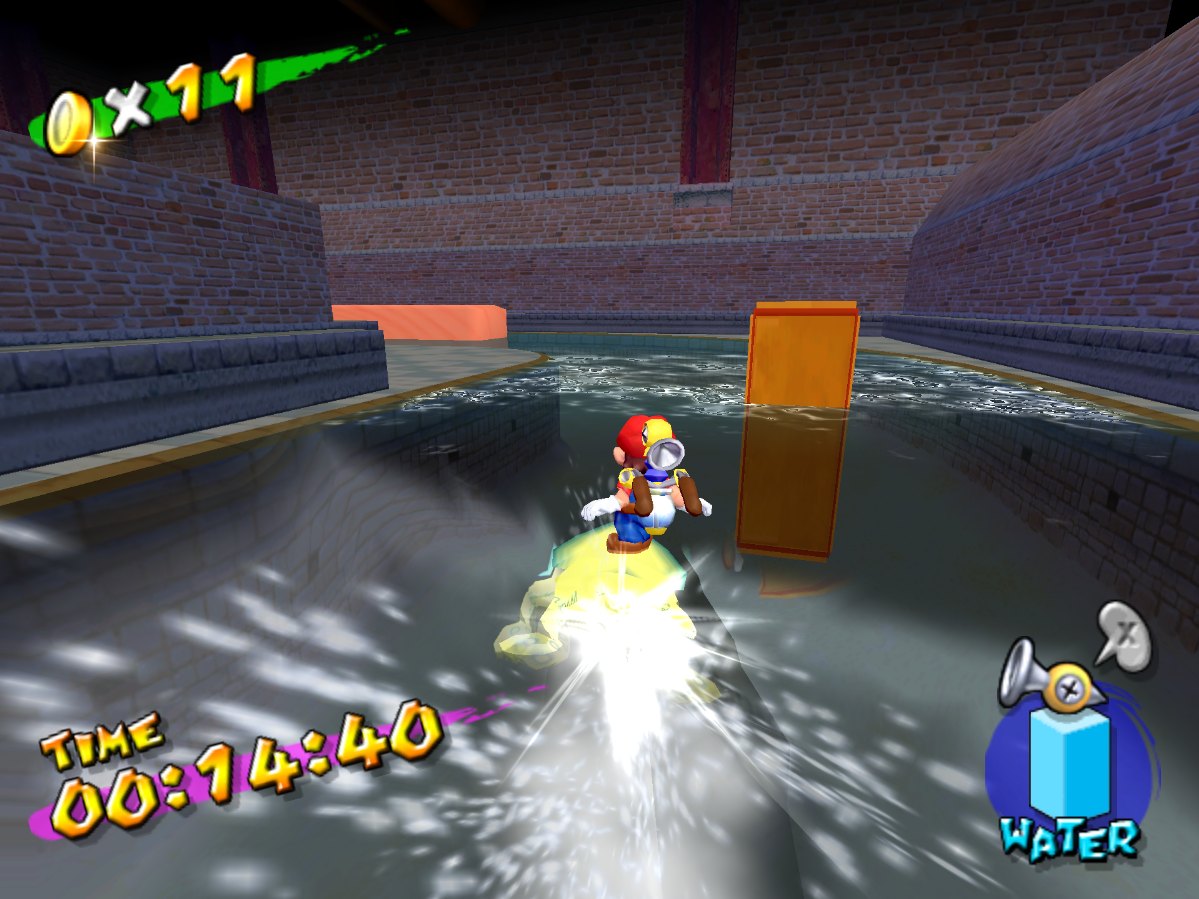
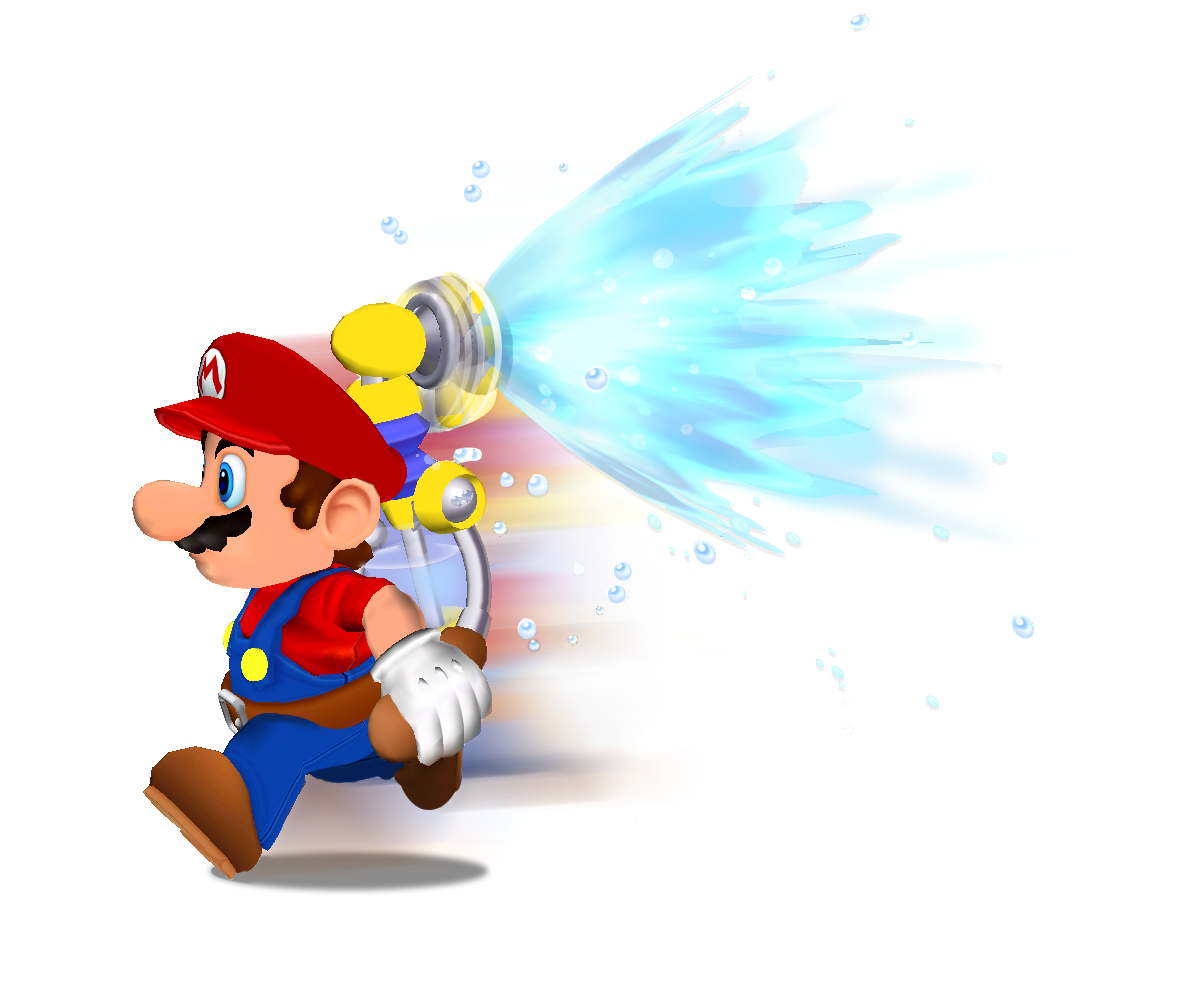
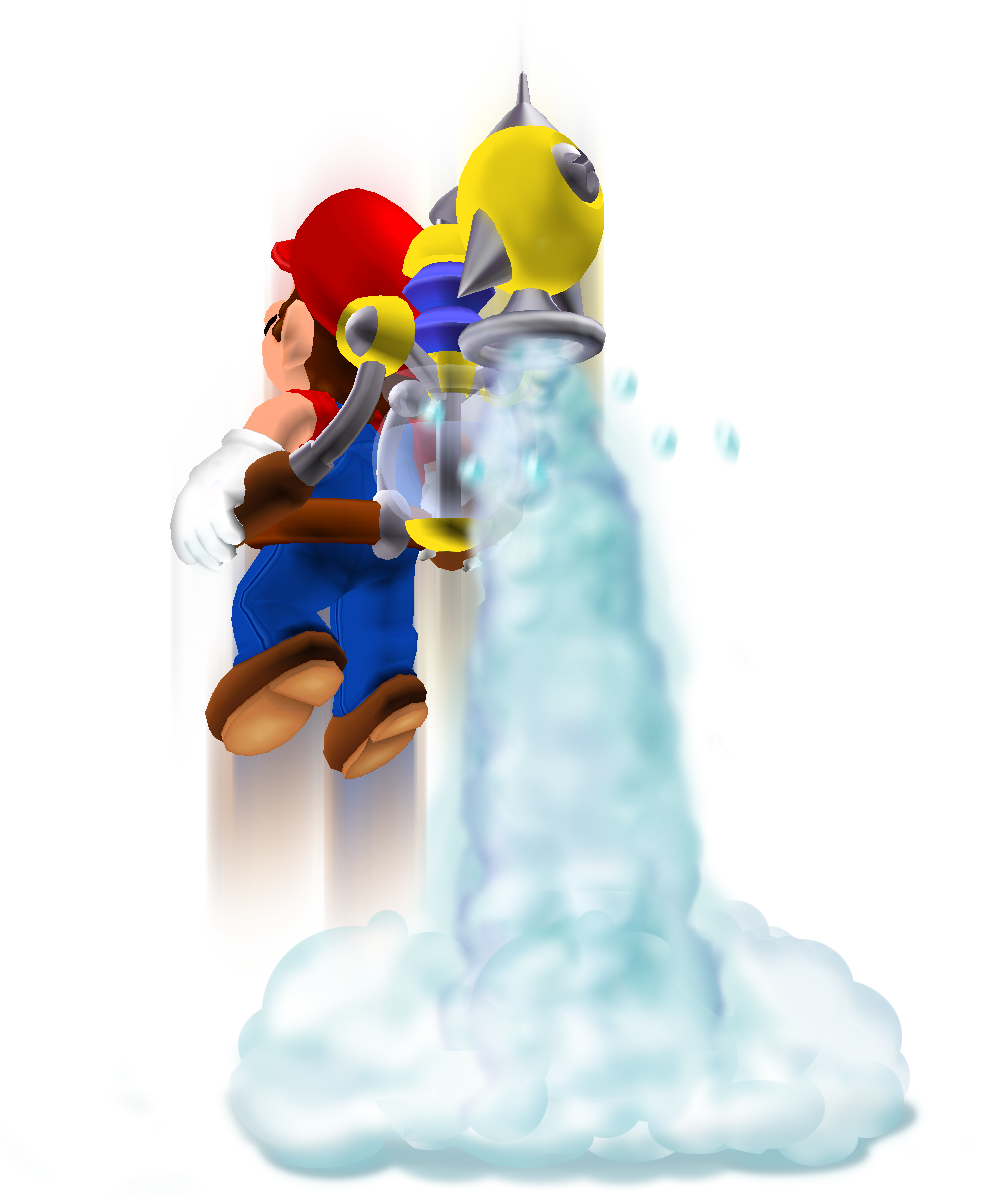
Two more nozzles are won from Shadow Mario in Delfino Plaza. The Turbo Nozzle (from 25 Shines, once Yoshi is available) sends Mario sprinting across land and skimming across water, and smashes through marked wooden doors. The Rocket Nozzle (30 Shines, after the Turbo) charges for a moment and then launches him straight up without any fall damage, which is how you reach rooftops, the top of the Shine Gate and the pipe to Pianta Village. Nozzle boxes around each area swap your second nozzle in and out, and many Shines are hidden behind the question of which nozzle you brought.
Hover Nozzle: a few seconds of lift.Turbo Nozzle: speed on land and water.Rocket Nozzle: straight up.
Shine Sprites, coins and blue coins
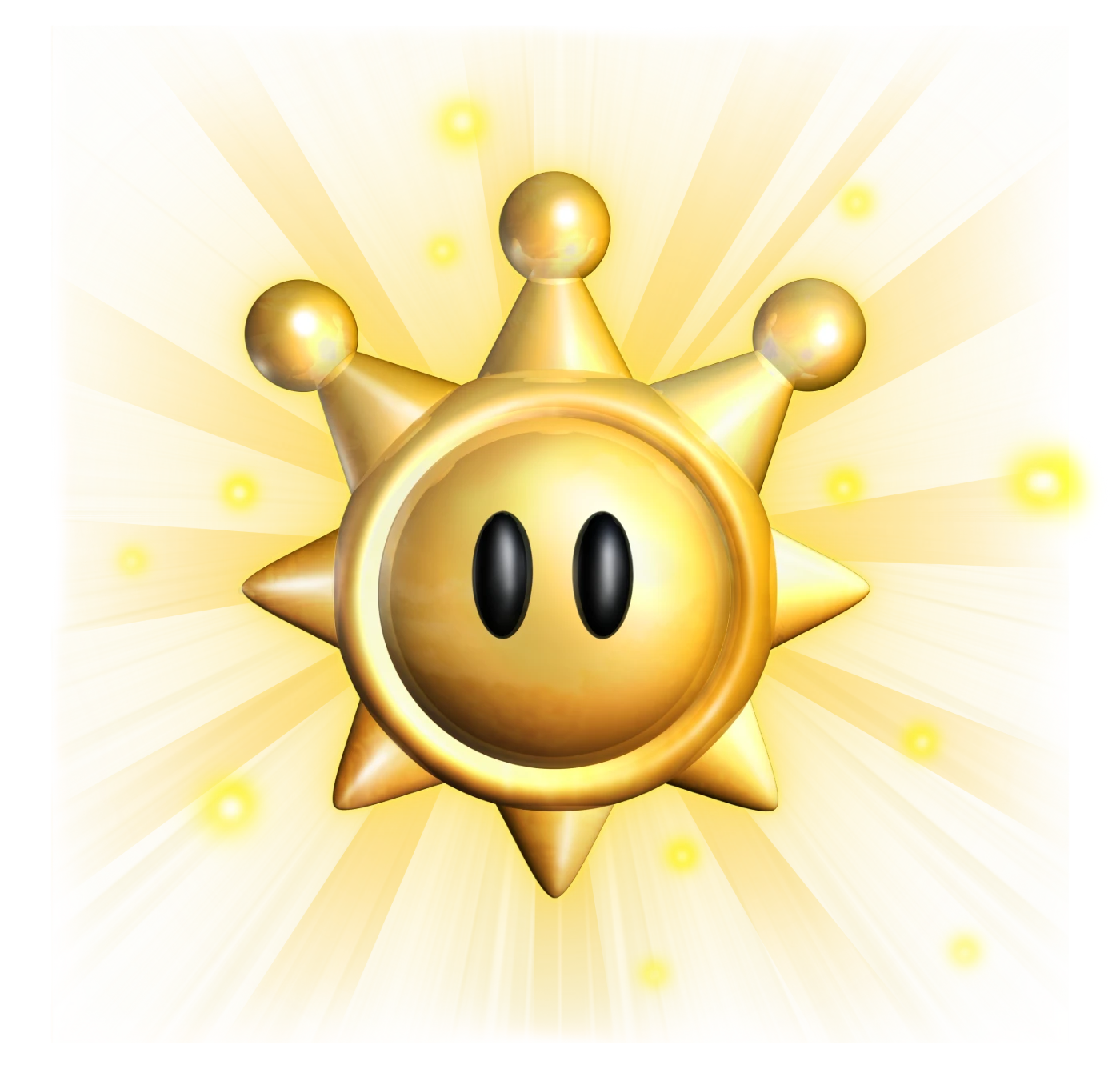
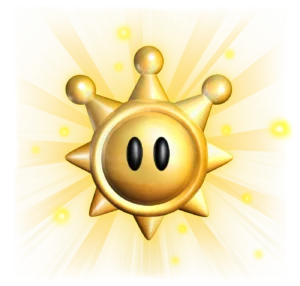
A Shine Sprite, the island’s sunlight in collectible form.
Shine Sprites are the island’s sunlight and the game’s currency of progress. Each area holds eleven: one for each of its eight episodes, one for collecting 100 coins in a single visit, and two hidden in bonus rooms or behind odd tasks such as spraying a golden bird. Delfino Plaza has its own, from cleaning the two bell towers to the five secret courses tucked away around the town, plus the first two Shines at the Airstrip and the one on Corona Mountain.
The last 24 come from blue coins. There are 240 scattered across the island, 30 per area, 20 in the town and Airstrip and 10 in the volcano, hidden behind graffiti, inside birds and in pairs that must be sprayed within seconds of each other. The Raccoon running the boathouse shop trades ten of them for a Shine, and hunting them all down is what turns a 15-hour game into a 30-hour one. Yellow coins restore a point of health, red and blue coins restore two, and eight red coins in an episode make a Shine of their own.
Yoshi, fruit and juice
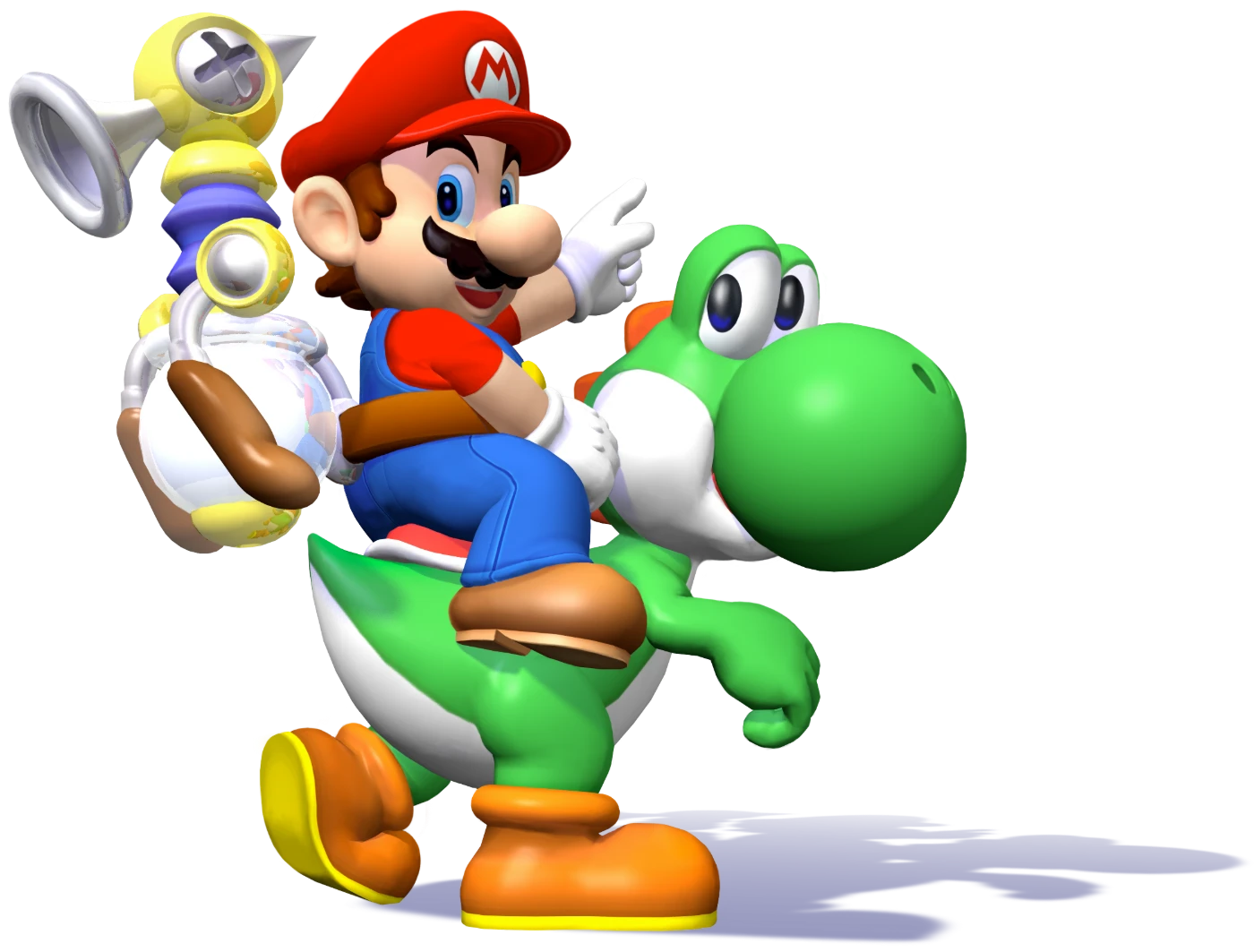
Mario riding Yoshi, who is as colourful as his last meal.
Yoshi hatches from an egg that asks for a particular fruit, and this Yoshi is made of paint: he changes colour with whatever he last ate, sprays juice instead of water, dissolves into nothing if he touches deep water, and vanishes if his juice meter runs dry. Papaya and pineapple turn him orange, banana and coconut pink, durian and the fiery pepper purple, and the colour of his juice decides what happens to a sprayed enemy, which briefly becomes a platform that either sits still or moves.
He can eat enemies, bees and birds, flutter jump across gaps and spit juice to dissolve the pulsating goop that water cannot touch. He cannot leave the area he hatched in, so Yoshi is a tool for particular episodes rather than a constant companion, and finding the fruit he wants is often half the puzzle.
Episodes, secret courses and the hub
Picking an episode on the way into Pianta Village.
Every area has eight episodes, selected on entry and played in order, with the same place rearranged each time: a windmill becomes a boss arena, a hotel fills with Boos, a village catches fire. Episode 7 is always a Shadow Mario chase, and clearing all seven of them is what opens Corona Mountain. The town joins in with its own events, from a rooftop Pianta who hurls Mario at a Shine Sprite sealed in a tower to a golden bird that appears only once you have ten Shines.
The secret courses are the game’s cruellest and most loved idea. Shadow Mario snatches F.L.U.D.D. at the door and leaves Mario to cross spinning blocks, sliding platforms and sand that crumbles under his feet, to a cheerful a cappella version of the original Super Mario Bros. theme. Each has a second Shine for collecting its eight red coins against the clock, and Delfino Plaza hides five more of them: the Super Slide, the Pachinko Game, the Lily Pad Ride, the Turbo Track and the Red Coin Field.
Health, lives and difficulty
Mario has an eight-point life meter that doubles as an air gauge underwater, and he loses points to goop, enemies and long falls. 1-Up Mushrooms are generous, 50 coins in a visit add a life, and the sewers under Delfino Plaza are a reliable place to stock up. Even so, Sunshine is widely held to be the hardest 3D Mario of its era: the blue coin hunt is enormous, the Pachinko Game and Lily Pad Ride are notorious, and Miyamoto himself admitted afterwards that the game had turned out too difficult for the average player, and that he regretted making the secret courses compulsory.
Nozzles, pickups and fruit
Everything Mario straps on, picks up or feeds to Yoshi.
Squirt NozzleThe default hose. Always equipped; light press to spray on the move, full press to stand and aim.
Hover NozzleAround four seconds of lift from twin downward jets. Available from the start; blue nozzle boxes.
Turbo NozzleCharge and sprint across land or water; bashes through orange and green wooden doors. 25 Shines and Yoshi.
Rocket NozzleCharge and launch straight up with no fall damage. 30 Shines and the Turbo Nozzle.
Shine Sprite120 to find; the island’s light source and the end of every episode.
CoinRestores one point of health; 50 in a visit give a life, 100 give a Shine.
Red coinRestores two points; eight in an episode make a Shine.
Blue coinRestores two points; 240 in all, ten buy a Shine at the boathouse.
Water bottleRefills F.L.U.D.D.: small ones halfway, large ones fully.
1-Up MushroomAn extra life plus full health and a full tank.
Yoshi eggShows the fruit it wants; bring it and Yoshi hatches.
Pineapple and papayaTurn Yoshi orange. A pineapple also unblocks the pipe to Sirena Beach.
Banana and coconutTurn Yoshi pink.
Durian and pepperTurn Yoshi purple. Durians are kicked rather than carried; peppers are what finally hurt King Boo.
Mario’s capSwipin’ Stus steal it in Pinna Park; without it Mario’s health drains in the sun.
Cartoons, Comics & Other Media
Isle Delfino never got a cartoon, but its people, bosses and music have been on tour ever since 2002.
Super Mario-kunYukio Sawada · CoroCoro Comic / Shogakukan · Volume 28Japan’s long-running gag manga began its Sunshine arc at the end of Volume 28, with Mario and Peach’s holiday going wrong and a far more emotional F.L.U.D.D. who sprays Mario in the face. The manga has also been published in French (from December 2014) and in Spanish (from November 2016).
Nintendo Power Vol. 160 and the Player’s GuideNintendo of America · September 2002Mario and F.L.U.D.D. took the cover of Nintendo Power’s September 2002 issue, and Nintendo published its own Super Mario Sunshine Player’s Guide alongside third-party books from Prima and BradyGames.
Edge #114Future Publishing · September 2002The British magazine put Sunshine on its cover and gave it 9/10, having already featured Mario on its E3 “Class of 2002” issue two months earlier.
Mario Kart: Double Dash!!GameCube · 2003Petey Piranha and King Boo became playable racers, Piantas and Nokis crowd the stands, and the awards ceremony borrows the Delfino Plaza tune. See our Double Dash!! page.
Mario Golf: Toadstool Tour and Mario Power TennisGameCube · 2003–2004Petey Piranha, Shadow Mario and Bowser Jr. joined the sports line-ups, and Power Tennis added courts set in Delfino Plaza and Ricco Harbor, complete with goop to clean up.
Super Mario 64 DSNintendo DS · 2004The remake’s new course Sunshine Isles is set to an arrangement of the Delfino Plaza theme. See Super Mario 64 DS.
Mario Kart coursesDS to SwitchDelfino Square (Mario Kart DS) and the rising-tide battle stage Delfino Pier (Mario Kart Wii) are set on the island, Mario Kart 8 added Sunshine Airport, and Mario Kart World (2025) made a Pianta a playable racer.
Super Smash Bros.Wii, Wii U, 3DS, Switch · 2008 onwardsF.L.U.D.D. has been Mario’s down special since Brawl, and the Delfino Plaza stage tours the island on a floating platform with the original music playing.
Super Mario OdysseySwitch · 2017–2018A February 2018 update sold Mario’s Isle Delfino shades and shirt in the Crazy Cap shop, and Isle Delfino survives as a texture on the game’s globe even though the island itself was never visited. See Odyssey.
The Super Mario Galaxy MovieIllumination / Nintendo · 2026The second animated film introduced Bowser Jr. to cinema audiences, with F.L.U.D.D. glimpsed among his gadgets, Piantas in the crowd and the tropical shirt hanging in the brothers’ wardrobe.
Television advertsNintendo of America and Nintendo of Europe · 2002The North American launch spot sold the game on sunshine and splashing, while European territories ran their own campaigns around the 4 October release; Japan’s advert and print campaign leaned on Mario’s pump. SLB’s own commercials archive has more.
Characters
A Mario game with a cast list. Here is everyone who matters on Isle Delfino, from the hero and his talking backpack to the island’s two peoples and a runner in a very suspicious costume.
Character
Who they are
In this game
Abilities & notes
MarioThe accused
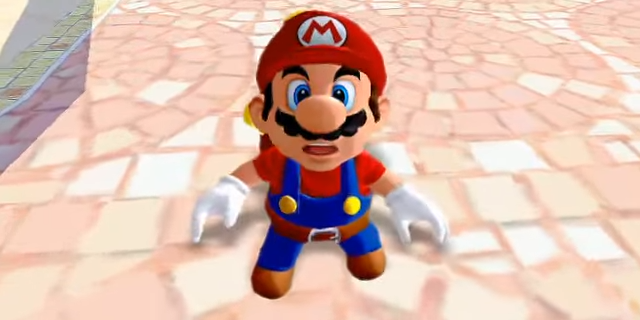
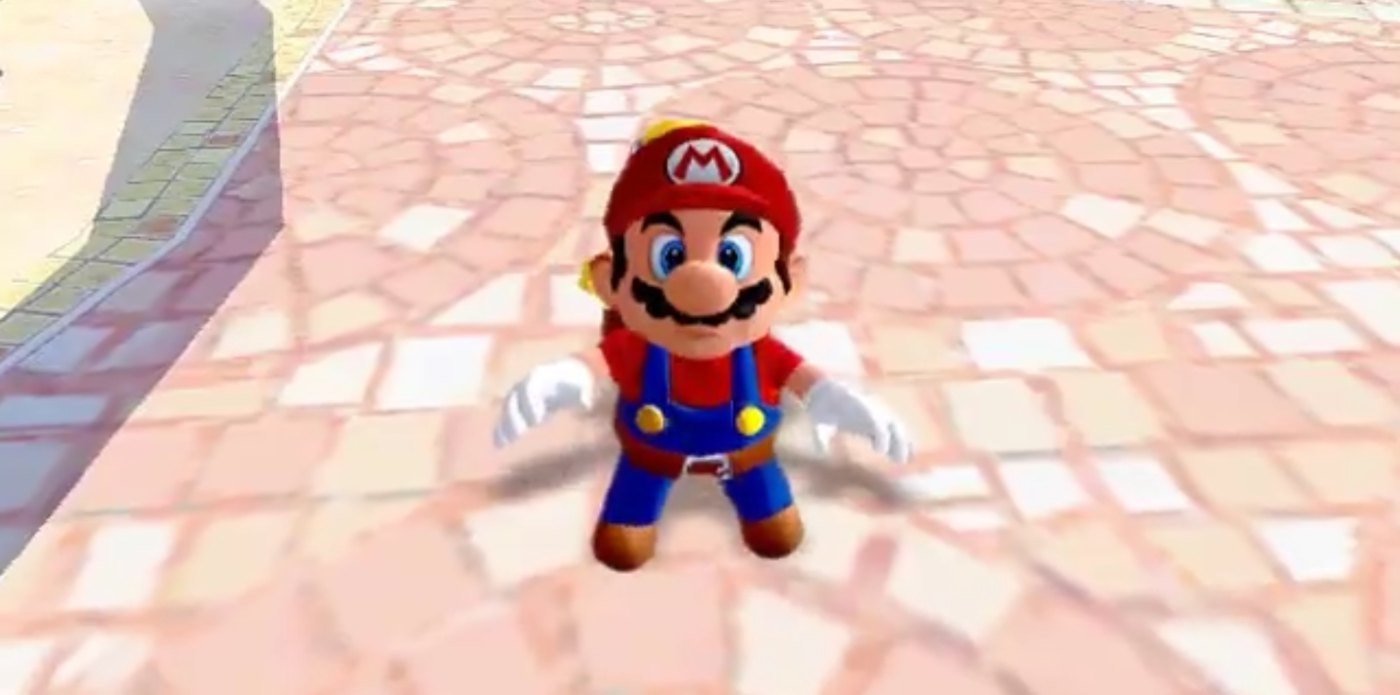
Our hero in a short-sleeved shirt for the first time, a concession the team made for the tropical setting after a tank top was tried and rejected. Charles Martinet voices him and also narrates the island’s tourist video.
Arrives on holiday, is convicted of vandalism within the hour and spends the game cleaning the island, rescuing Peach and unmasking Shadow Mario. The wrongly accused angle gives him more personality than usual: he winces at the verdict, pleads with the judge and mourns F.L.U.D.D.
A water pump with a voice, a camera eye and a habit of scanning things. Built by Professor E. Gadd’s Gadd Science Incorporated (whose logo appears on it in the Pinna Park cutscene), it was simply “the Pump” in Japan. Voiced in English by Kit Harris.
Mario’s weapon, jetpack and guide. It explains the island, nags about water levels, gets stolen by Shadow Mario at the door of every secret course, and is wrecked in the final fight before the Toads repair it.
Squirt and Hover Nozzles from the start; Turbo and Rocket later
Tank refills in any water or from bottles
Hover lasts about four seconds
Princess PeachThe holidaymaker
Peach in a pink sundress and ponytail, voiced by Jen Taylor. She is the first to see Shadow Mario in the airline video and the only one to speak up for Mario in court.
Kidnapped three times: in the plaza, by boat to Pinna Park and then to Corona Mountain, where she sits on the edge of Bowser’s hot tub looking thoroughly unimpressed. Bowser Jr. believes she is his mother.
Not playable. Rescued from the volcano at the end.
ToadsworthPeach’s steward (debut)
The princess’s elderly, fretful attendant, with spectacles, a cane and a walrus moustache. This is his first appearance; Scott Burns voices him.
Organises the holiday, panics when Peach is taken and spends most of the game in Delfino Plaza worrying. He went on to become a fixture of Peach’s entourage in the Mario RPGs and spin-offs.
Not playable.
The ToadsThe entourage
A handful of Toads in different colours who came along for the trip, voiced by Jen Taylor.
Comic relief in the cutscenes, a source of hints and water in the plaza, and the mechanics who put F.L.U.D.D. back together at the end.
Not playable.
YoshiThe paint dinosaur
Yoshi as you have never seen him: hatched from an egg Shadow Mario brings to the plaza, coloured by whatever fruit he last ate, and made of something so paint-like that deep water dissolves him. Kazumi Totaka provides his voice.
A mount for particular episodes. He eats enemies, bees and birds, flutter-jumps and sprays juice that melts the goop water cannot shift and turns enemies into temporary platforms. He opens the way to Sirena Beach by eating a pineapple.
Orange, pink or purple depending on fruit
Juice meter drains with every spray
Vanishes in deep water or when hungry
Shadow MarioThe impostor
A watery blue copy of Mario with a magic paintbrush, scuttling through the island leaving Rainbow M portals and goop behind him. Made with a bandana and a brush, not magic in his blood.
Frames Mario, kidnaps Peach, scatters the Shine Sprites and must be chased down in the seventh episode of every area and several times in the plaza. Spray him enough and he drops whatever he is carrying: a princess, a Yoshi egg, a nozzle.
Defeated by soaking; faster than Mario on foot but stops to taunt.
Bowser Jr.The real culprit (debut)
Bowser’s son, introduced here: a small Koopa with a topknot, a bib and a bandana with fangs drawn on it to look older. Delores Rogers voices him. He has been in almost every Mario game since, from New Super Mario Bros. to the 2026 film.
Shadow Mario unmasked. He vandalised the island because his father told him Mario had kidnapped his mama, Peach, and a peculiar old man in a white coat (almost certainly E. Gadd) gave him the brush. He pilots Mecha-Bowser, flies Peach to the volcano and fires Bullet Bills from the hot tub.
Boss as Mecha-Bowser (Pinna Park Episode 1) and alongside Bowser on Corona Mountain
Ends the game vowing a rematch when he is bigger
BowserThe dad in the hot tub
The Koopa King speaks his first proper lines in a Mario game, voiced by Scott Burns, and spends almost all of them relaxing.
Appears only at the very end, lounging in a tub of sludge on a cloud above Corona Mountain, breathing fire and roaring while his son does the fighting. Knocked out of the volcano and into the sea, where he admits the truth about Peach.
Final boss with Bowser Jr.; beaten by ground-pounding the five platforms around the tub.
The PiantasIslanders (debut)
Big, round, tree-topped islanders in grass skirts who run most of the island, from the mayor and the police to the hotel manager, the sunglasses vendor and the Chucksters who fling Mario about. Male Piantas are voiced by Scott Burns, females by Delores Rogers.
Victims, witnesses, judges and quest-givers. Spraying goop off a buried Pianta earns a coin; freeing the villagers trapped in goop in Pianta Village earns a Shine.
Not playable. A Pianta became a Mario Kart racer in 2025.
The NokisIslanders (debut)
Small, shell-wearing sea folk who live in Noki Bay and run Pinna Park. Kit Harris voices the females and Scott Burns the males.
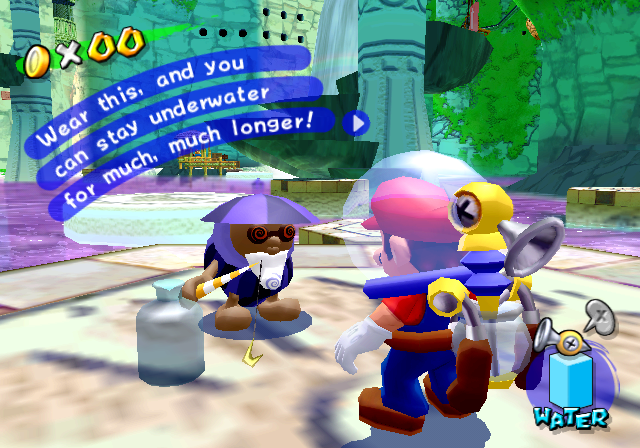
The Noki elder knows the legend of the bay and lends Mario a diving helmet to reach Eely-Mouth; one episode takes place inside his bottle.
Not playable.
Il PiantissimoThe runner
A fast, boastful figure in a Pianta costume whose human face can be glimpsed through the mask, and who looks a great deal like the Running Man from Ocarina of Time. His Japanese name is Monteman.
Races Mario to a flag at Gelato Beach, Noki Bay and Pianta Village; lose and it costs a life. In the standard ending he is seen examining Bowser Jr.’s brush, a tease that has never been followed up.
Uses Mario’s moves but never F.L.U.D.D.; on replays he finishes just behind your best time.
The RaccoonsShopkeepers
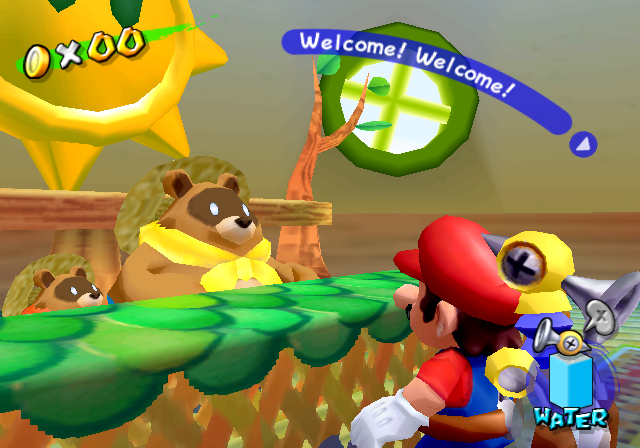
A few tanuki-like traders who run the boathouse and the mudboat rental in Noki Bay.
The boathouse Raccoon swaps ten blue coins for a Shine, 24 times over; the 10-coin boat back to the Airstrip is run by a Pianta.
Not playable.
The Great Sunflower and the Sunflower KidsPinna Park locals
A family of talking sunflowers on the Pinna Park beach.
Their children wilt when Snooza Koopas bury themselves nearby; waking and defeating the Koopas restores them and earns a Shine.
Not playable.
Enemies and bosses
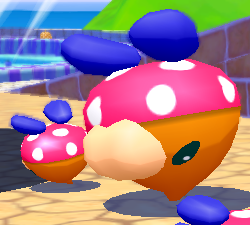
Nearly every enemy on Isle Delfino was new in 2002, and according to Nintendo’s Super Mario Bros. Encyclopedia all of them were painted into being by Bowser Jr.’s brush. The regulars (Bloopers, Bob-ombs, Boos, Bullet Bills, Cheep Cheeps, Pokeys) turn up in island form.
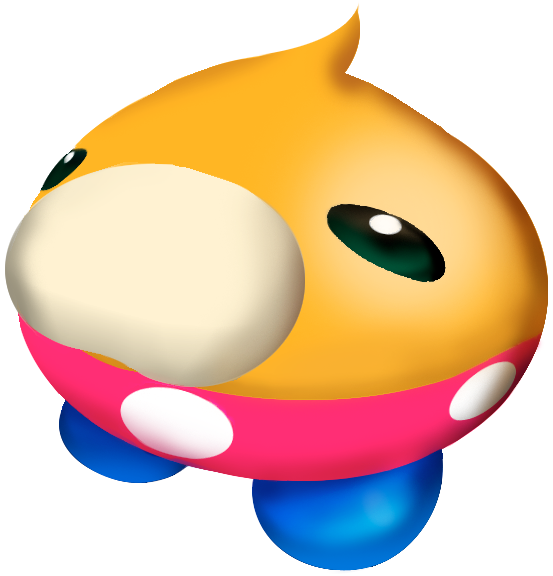
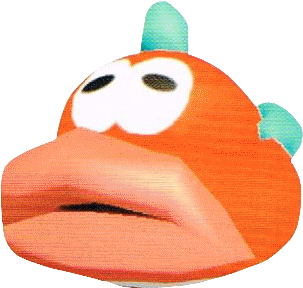
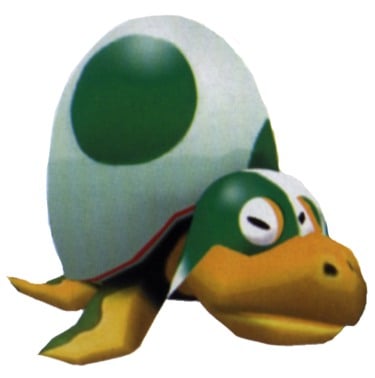
Strollin’ StuEverywhereThe game’s Goomba: a wandering blob with a mask-like face, flattened by a jump or washed away.
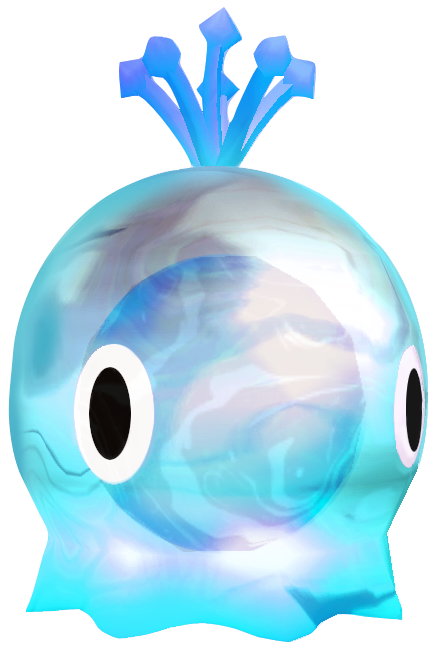
GooblePlaza, most areasA goop creature that rises out of pollution; spraying it leaves a water bottle.
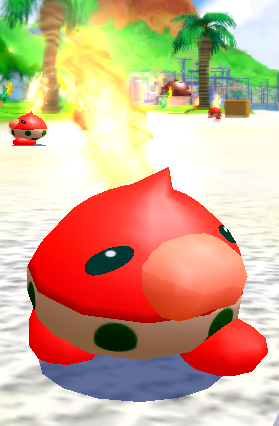
Smolderin’ StuPinna Park, Sirena BeachA Stu on fire; put it out before you stomp it.
Swipin’ StuPinna Park, Sirena BeachWinged Stus; the green one steals Mario’s cap and the sun drains his health until he gets it back.
PokeyBianco Hills to Pianta VillageThe cactus column, now with a flower on top; spray or knock the segments down.
Pokey Pod and Seedy PodBianco Hills onwardsPokey heads that spit seeds; spray one into a wall for three coins.
Piranha PlantBianco HillsGrows out of goop; spray water into its mouth.
PiranhabonBianco HillsA goop-covered Piranha head that rolls down the slopes like a boulder, trailing goop.
GlorpedoNoki BayBouncing goop globs fired from Monty Mole’s cannon; spray them until they burst.
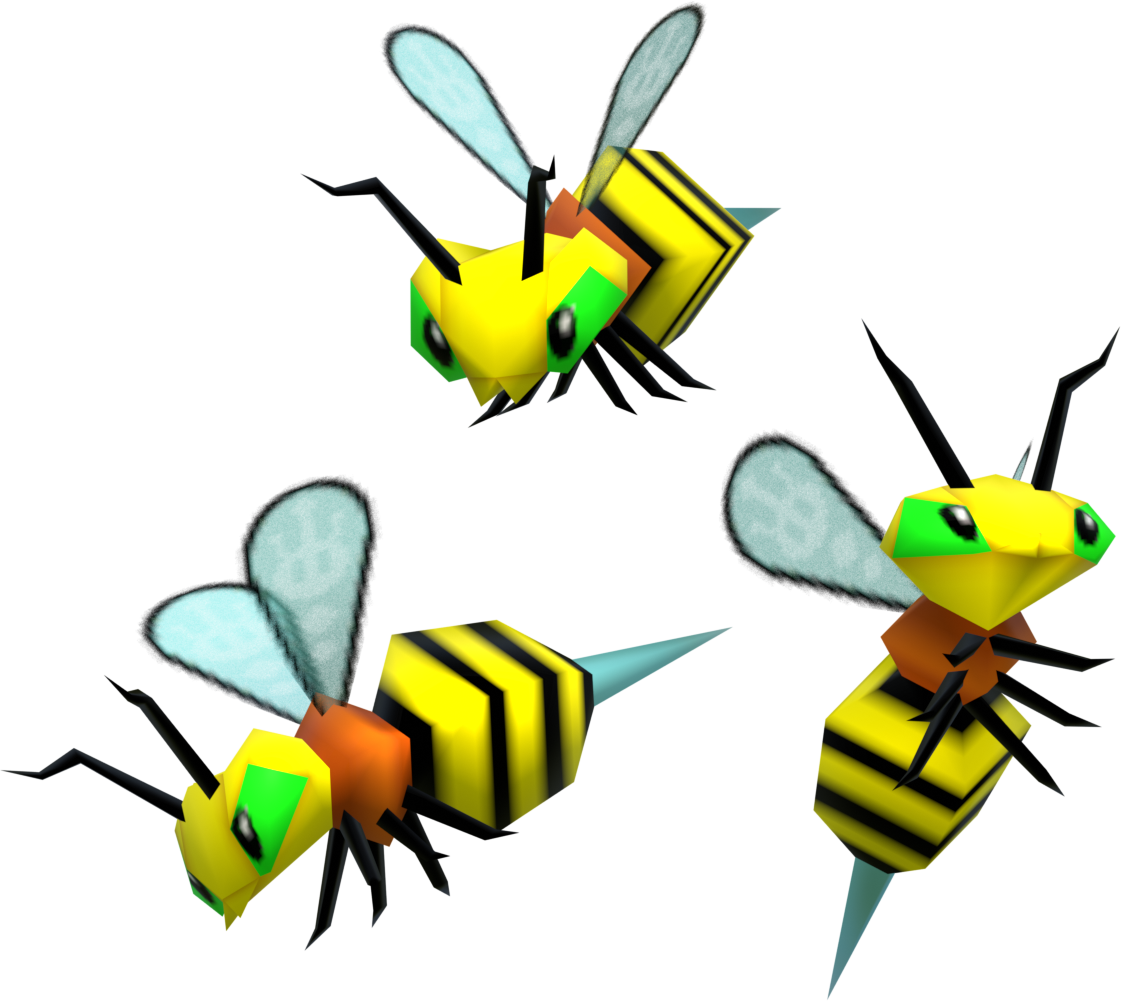
BeeBianco Hills, Pianta VillageHives that swarm when sprayed; Yoshi can eat them.
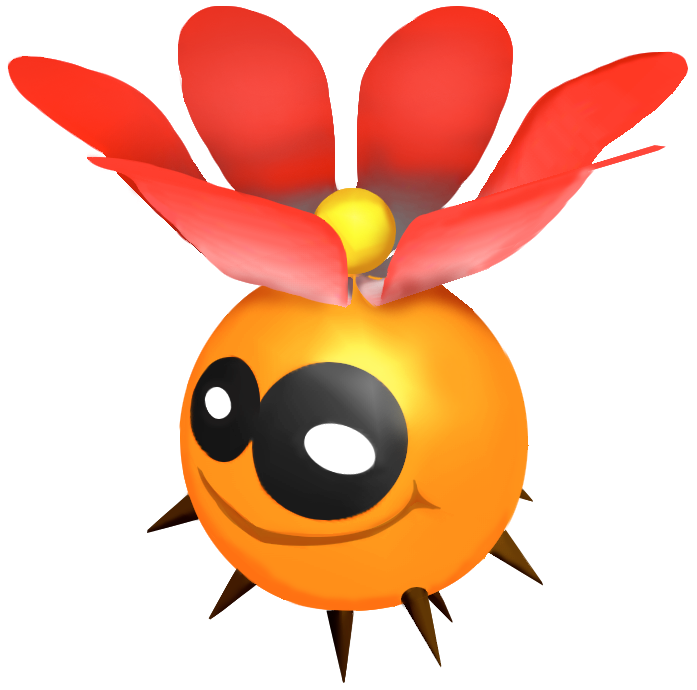
PlurpBianco Hills onwardsA bird that drops goop as it flies; spray it down and stomp it for a shower of coins.
Wind Spirit (Cyclo)Bianco Hills to Pianta VillageA whirlwind that blows Mario off platforms.
PondskaterBianco HillsSkims the lake; harmless to look at, not to touch.
PoinkBianco Hills to Sirena BeachA floating, balloon-like pig that latches onto F.L.U.D.D.’s nozzle and can be fired as a projectile.
Wire TrapBianco Hills to Noki BaySparks that slide along ropes and wires; time your crossing.
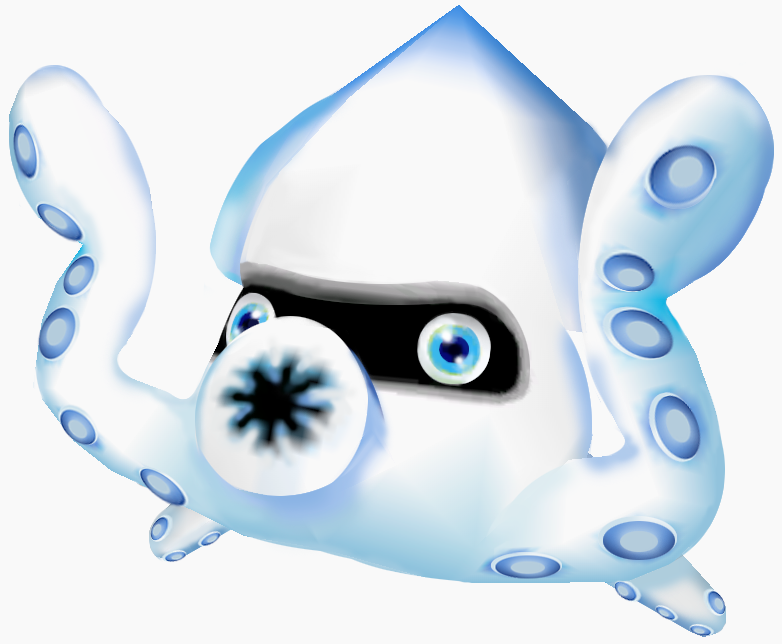
BlooperRicco Harbor to Noki BaySquid that spit black goop at Mario; Ricco’s surfing Bloopers are rideable.
BloopadRicco HarborA small leaping Blooper; spray one and it flattens into a platform.
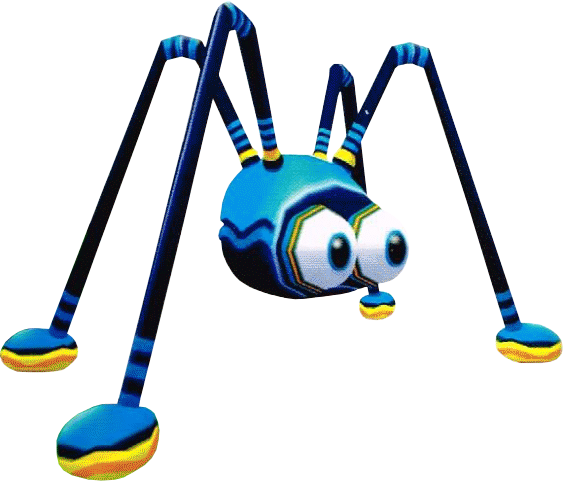
KlamberRicco Harbor to Pianta VillageA spider that scuttles along fences and nets; spray it off.
Cheep CheepRicco Harbor to Sirena Beach; lava variant on Corona MountainFish that leap at Mario, including pink ones and the Lava Cheep Cheeps of the volcano.
CataquackGelato Beach, Sirena BeachA duck-like beast that flips Mario skyward; the blue ones are a lift, the red ones hurt.
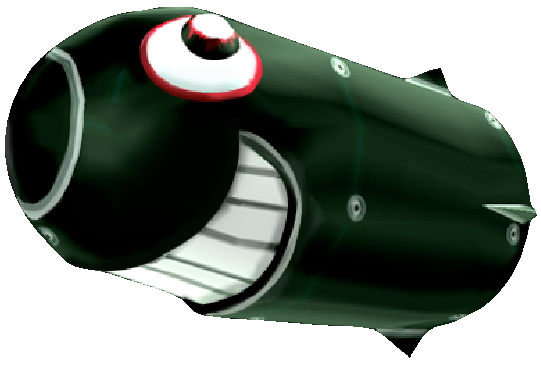
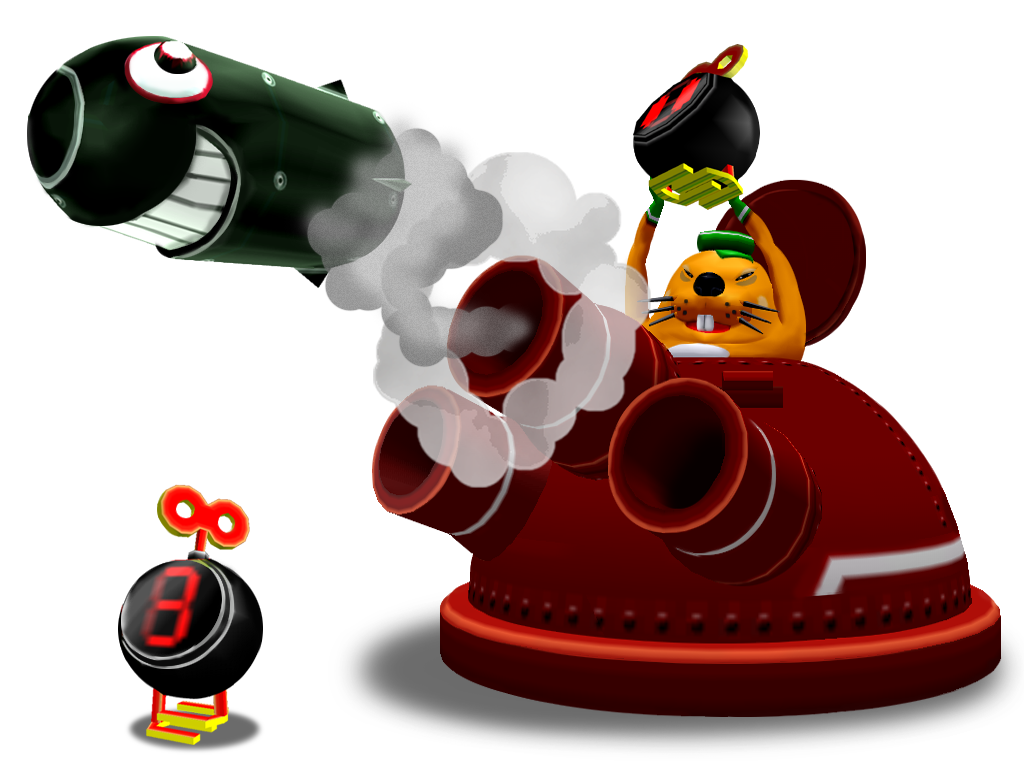
Bullet BillPinna Park to Corona MountainFired from Mecha-Bowser and the hot tub; gold and purple variants pay out coins, blue ones hold 1-Ups.
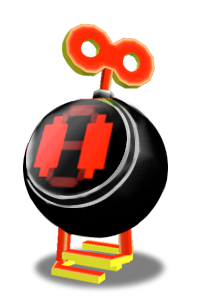
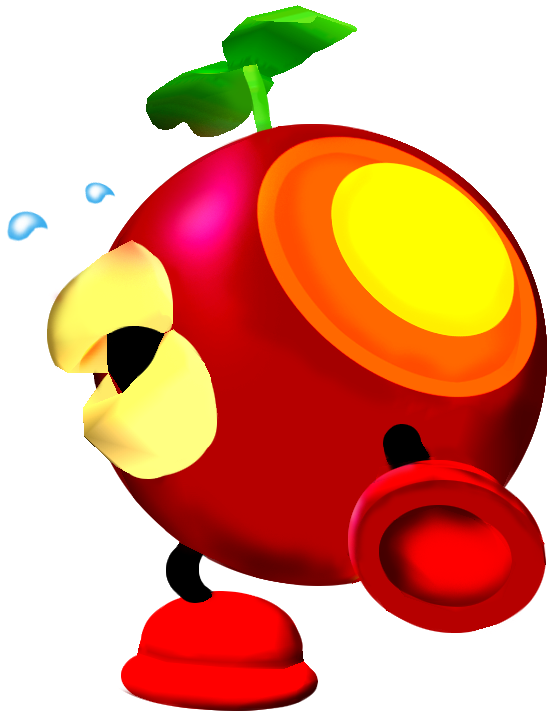
Bob-ombPinna Park, Noki BayThrown by Monty Mole; spray them to defuse, then throw them back.
Snooza KoopaPinna ParkSleeping Koopas buried in the beach that wilt the Sunflower Kids; flip them with a ground pound.
Electro-KoopaPinna Park to Pianta VillageBlue ones throw their electric shells; red ones climb the Ferris wheel cage. The Electro-Koopa King guards a Shine behind the park.
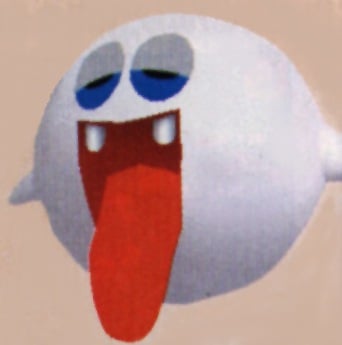
Boo, Sleepy Boo and Block BooSirena BeachHotel Delfino’s ghosts; pink Block Boos turn into platforms when sprayed.
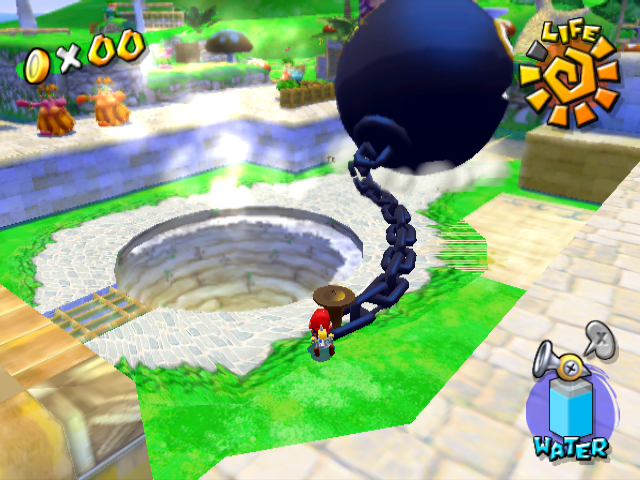
Chain Chomplet and Chain ChompPianta VillageRed-hot chomps that need cooling with water; the big one wants dragging to the hot spring.
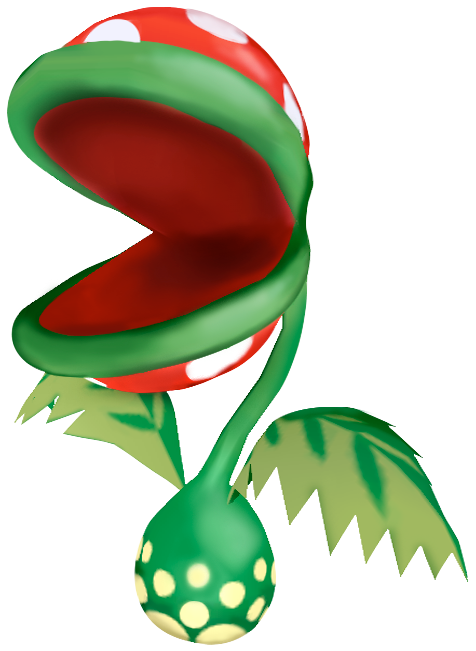
Proto Piranha (Polluted Piranha)Airstrip, Delfino Plaza, Bianco HillsA goop plant with a gaping mouth; three squirts down the throat.
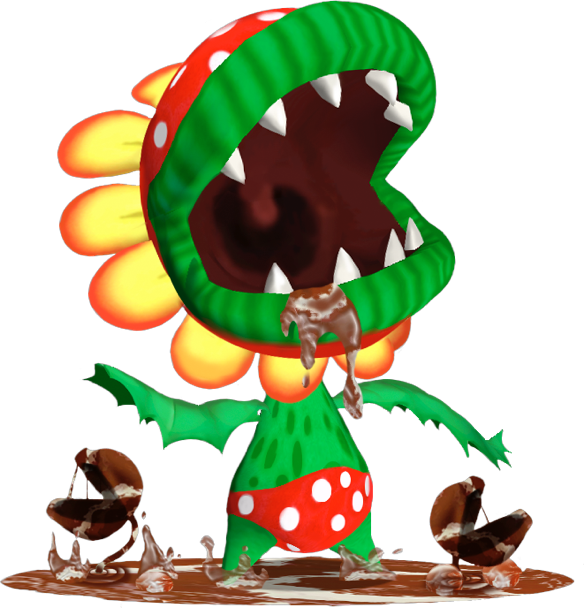
Petey PiranhaBianco Hills Ep. 2 and 5Fill his mouth with water until he keels over, then ground pound his belly. He returns airborne, spitting goop.
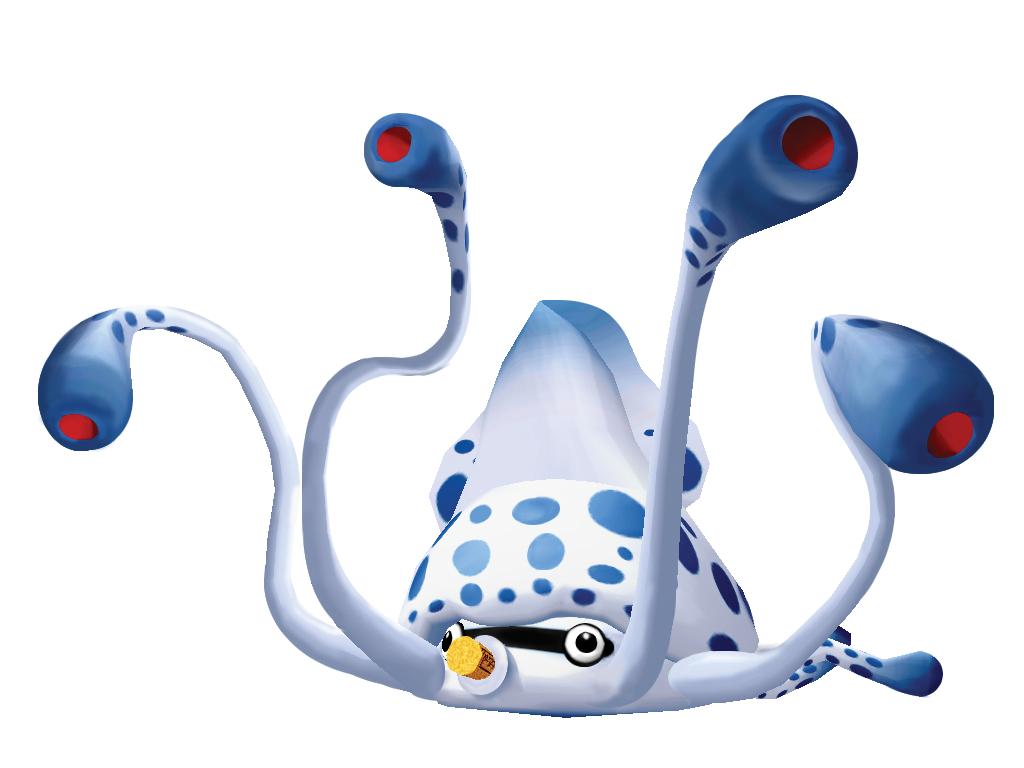
Gooper BlooperRicco Harbor Ep. 1 and 5, Noki Bay Ep. 2Yank off his tentacles, then grab his snout and let it snap back.
PlungeloGelato Beach Ep. 2Sucker-footed critters on the mirrors around the Shine Tower; spray them off balance, then slam the mirror to fling them off.
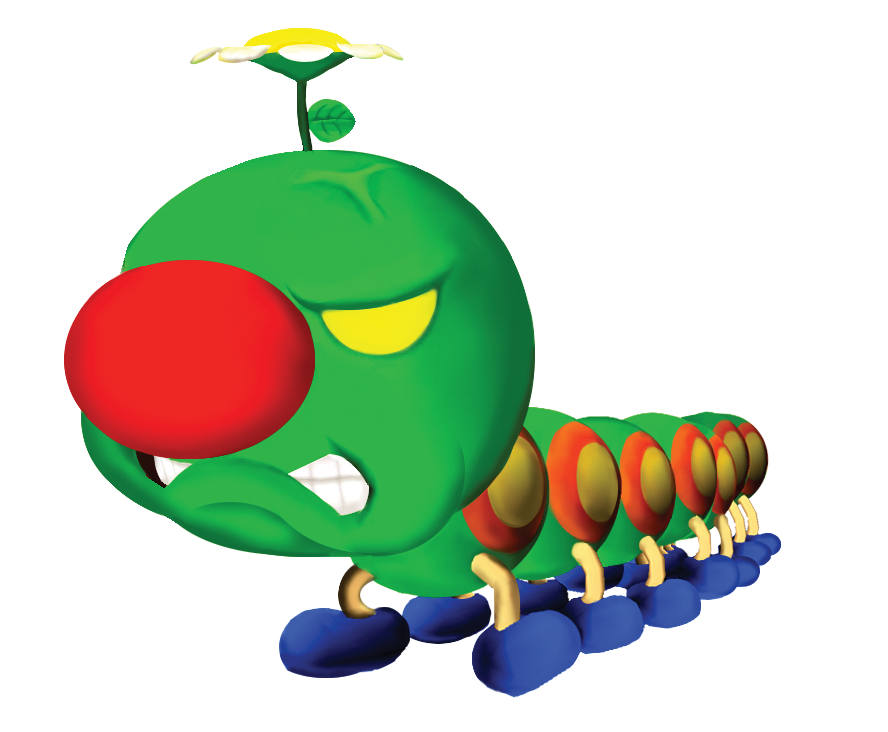
WigglerGelato Beach Ep. 3A rampaging giant; grow a Dune Bud in its path to flip it and ground pound its segments.
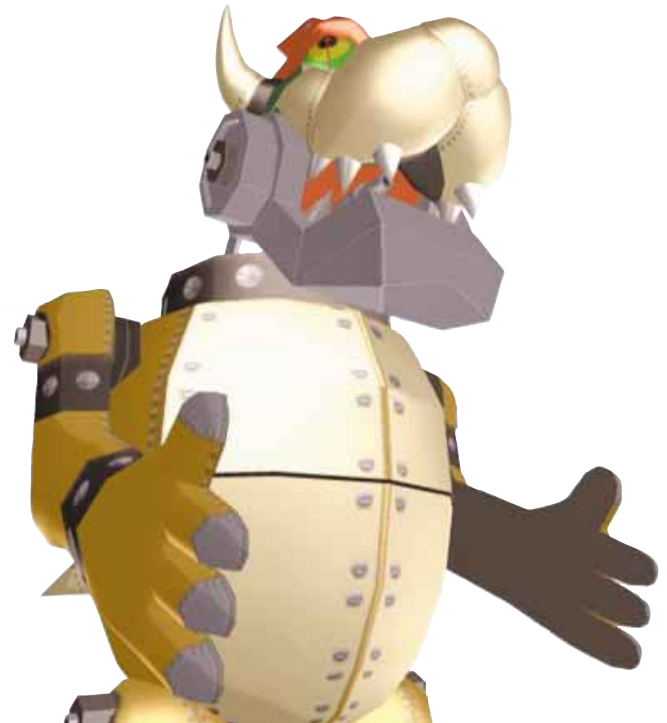
Mecha-BowserPinna Park Ep. 1Bowser Jr.’s robot, fought from a roller coaster with water rockets.
Monty MolePinna Park Ep. 2, Noki Bay Ep. 1Lobs Bob-ombs from a cannon or a cliff; soak them and throw them back.
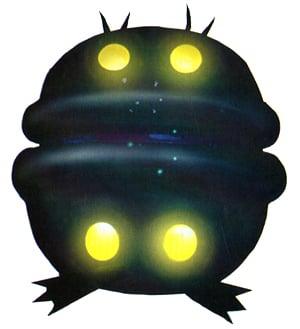
PhantamantaSirena Beach Ep. 1A ghostly manta that leaves electric goop and splits into smaller mantas as you spray it.
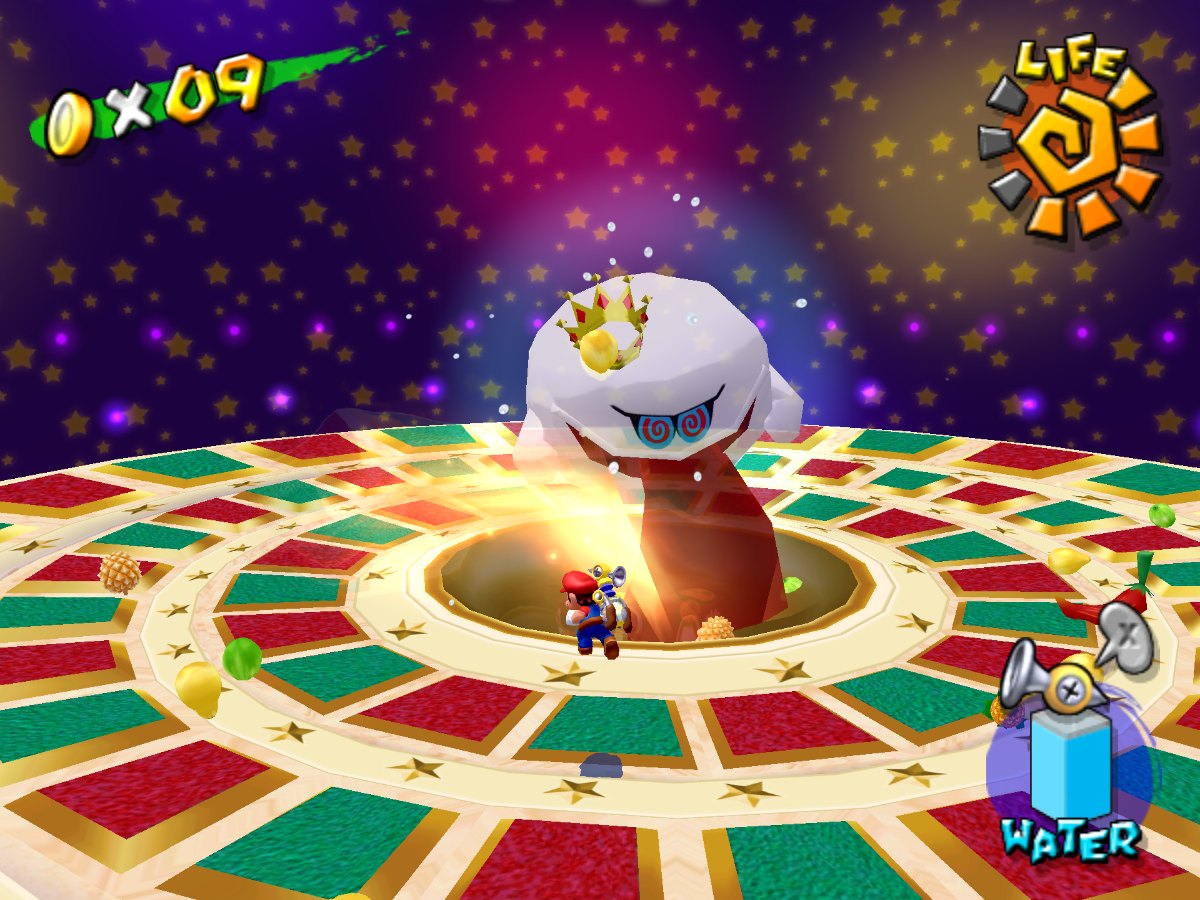
King BooSirena Beach Ep. 5Spins a fruit slot machine in Casino Delfino; set his tongue alight with a pepper, then hit him with fruit, three times.
Eely-MouthNoki Bay Ep. 4A huge eel at the bottom of the bay whose rotten teeth are poisoning the water; brush them clean.
Shadow MarioEvery area, Episode 7, and the plazaChase and soak.
Bowser and Bowser Jr.Corona MountainRocket Nozzle ground pounds on the five hot-tub platforms while dodging fire and Bullet Bills.
The people who made it
Key staff from the credits.
Yoshiaki KoizumiDirectorAssistant director on Super Mario 64 and co-director of Majora’s Mask, directing a Mario for the first time. He conceived the water pump, built a clay model of Isle Delfino and later directed Super Mario Galaxy.
Kenta UsuiDirectorCo-director, a course designer on Super Mario 64 and Yoshi’s Island who later led level design on the Yoshi games.
Shigeru Miyamoto and Takashi TezukaProducersMiyamoto, turning 50 that year, says he gave no brief and trimmed out whatever did not feel like Mario; Tezuka approved the short sleeves.
Satoru IwataExecutive producerNintendo’s new president, who took over from Hiroshi Yamauchi in the spring of 2002, weeks before the game shipped.
Koji Kondo and Shinobu TanakaMusicKondo wrote the Isle Delfino theme and its Bianco Hills, Ricco Harbor, Gelato Beach and credits variations; Tanaka handled much of the rest.
Koichi HayashidaMain programmerWent on to direct Super Mario Galaxy 2, 3D Land and 3D World.
Futoshi ShiraiMap directorIn charge of the island’s level layouts, with map designers Hiromu Takemura, Atsushi Miyagi, Shinko Konishi and Taeko Sugawara.
Makoto WadaScriptWrote the story and dialogue; Leslie Swan, Tim O’Leary, Nate Bihldorff and Scot Ritchey localised it for North America.
Charles Martinet, Jen Taylor, Scott Burns, Kit Harris, Delores Rogers, Kazumi TotakaVoicesMario; Peach and the Toads; Bowser, Toadsworth, Il Piantissimo and the male islanders; F.L.U.D.D. and the female Nokis; Bowser Jr. and the female Piantas; Yoshi (uncredited).
Advertisement
How It Was Made
Two Japanese interviews from 2002, translated by Shmuplations in 2022, plus Nintendo’s trade-show history and The Cutting Room Floor’s dig through the disc, tell the story of how a water pistol became a Mario game.
From Mario 128 to a water pump
Koizumi’s clay model of Isle Delfino, built during development.
A GameCube Mario had been promised since the console was unveiled. At Space World in August 2000 Nintendo showed Super Mario 128, a technology demo of dozens of Marios swarming over a shifting disc, and fans assumed a sequel to Super Mario 64 would follow quickly. It did not. Work on what became Sunshine started in late 2000, once Majora’s Mask was finished, and the project took close to eighteen months.
Yoshiaki Koizumi, Miyamoto’s right hand on Super Mario 64 and fresh from co-directing Majora’s Mask, led the team. His starting point was the controller: the GameCube pad’s springy analogue shoulder buttons reminded him of the water pistols of his childhood, and a Mario who squirts rather than shoots grew from there. Takashi Tezuka says the team deliberately steered away from anything resembling a gun, which is how the pump became a backpack; Koizumi wanted it to suggest a firefighter, with a rocket nozzle styled on a plastic-bottle water rocket.
The great F.L.U.D.D. debate
Not everyone was convinced. Miyamoto has said there was a very serious debate inside Nintendo about whether Mario should use a gadget at all, since the character had always relied on his own body; his own joke was that it had been fine for Luigi, who had just carried a vacuum cleaner through Luigi’s Mansion. Koizumi remembers Miyamoto looking worried when first shown the pump prototype, but the team pressed on, and Miyamoto later described his role as trimming out whatever did not feel like Mario.
The pump went through about ten nozzle designs. New ones kept being added to solve particular situations until Koizumi decided that a game built on hunting for and switching between lots of items felt more like Zelda than Mario, and cut the list to hover, rocket and turbo. The interviews do not name the casualties, though there are abandoned sprites of Yoshi vomiting up swallowed water.
Dressing Mario, prettifying filth
The resort setting was Koizumi’s: he wanted players to feel they were going on holiday, and shaped the island as a dolphin, a nod to the GameCube’s “Dolphin” codename. Early builds of the plaza were populated by ordinary human tourists, which Miyamoto felt looked wrong next to Mario, so the Piantas and Nokis took their place. Koizumi also asked to change Mario’s clothes; a tank top was tried and, Miyamoto says, did not look like Mario at all, so Tezuka settled on short sleeves, and the Hawaiian shirt the team wanted became an unlockable reward instead.
The goop was a problem of taste. Realistic filth was off-putting, but a game about cleaning cannot be too clean, so the team tuned the pollution until it looked, in Koizumi’s words, pretty; he is fond of sweets and pushed it towards something like chocolate sauce. Tezuka says the graffiti idea grew out of the wall kick and tall city buildings, and Miyamoto notes that painting and erasing it in real time was so demanding that only the GameCube could manage it.
Hover, routes and regret
The Hover Nozzle changed the design in ways the team did not fully expect. Miyamoto compares the result to a zero-gravity platformer: because players could reach almost anything by almost any route, setting difficulty was hard, obstacles were kept to a minimum to encourage exploring, and the secret courses were added to restore the pure jumping of the older games. Koizumi notes that players do not care about the intended solution once they have found their own.
Miyamoto has been candid about the outcome. He wanted a Mario anyone could pick up and felt Sunshine turned out too hard for the average user; he also regretted making players clear certain stages before the finale, and said the final area should have been open regardless. The lesson fed directly into Super Mario Galaxy, which Koizumi would direct with a much gentler difficulty curve.
Space World to the shops
The game was first glimpsed at Space World in August 2001 in a short clip that already had the pump, the goop and an early plaza stalked by a giant, Stu-spawning creature later found in the disc’s test map. Miyamoto said at E3 2001 that he wanted the next 3D Mario to appeal to a much wider age range than recent games had. It was shown again at E3 in May 2002, under a preliminary logo and box, and Japan got the finished game on 19 July, with North America on 26 August and Europe on 4 October.
Nintendo also built a new development pipeline around the project, with standardised character designs that could be reused; Miyamoto said Sunshine was the first game to use it and the next Zelda would be the second. Satoru Iwata, who became Nintendo’s president that spring, is credited as executive producer.
Music and voices
Koji Kondo wrote the bright, ukulele-and-steel-drum Isle Delfino theme and its Bianco Hills, Ricco Harbor and Gelato Beach variations plus the credits; Shinobu Tanaka wrote much of the rest. The Shadow Mario chase reworks the original underground music, and the secret courses are played to an a cappella rendition of the 1985 Super Mario Bros. theme. No soundtrack album was sold at the time; the first official release came bundled with Super Mario 3D All-Stars in 2020, and a new version based on it joined the Nintendo Music app on 12 August 2026.
It is also the only Mario platformer with fully voiced cutscenes. Charles Martinet plays Mario and narrates the island’s tourist video, Jen Taylor is Peach and the Toads, Kit Harris gives F.L.U.D.D. its clipped delivery, Scott Burns voices Bowser (speaking at length for the first time), Toadsworth and the island’s men, and Delores Rogers voices Bowser Jr. and the Pianta women. The voices are English in every region; the Japanese release simply has no option to switch the subtitles off.
Series Firsts
What Super Mario Sunshine brought to the series for the first time. Only firsts we could confirm against the earlier games are listed.
1Bowser Jr.Bowser’s son makes his debut, disguised as Shadow Mario. He has barely missed a Mario game since.
2ToadsworthPeach’s elderly steward appears for the first time and became a regular in the RPGs and spin-offs.
3Petey Piranha, Piantas, Nokis, Shine SpritesA whole cast of newcomers who went on to Mario Kart, Smash Bros. and beyond.
4A 3D Mario not directed by MiyamotoYoshiaki Koizumi and Kenta Usui direct; Miyamoto produces. Every 3D Mario since has followed that model.
5Fully voiced cutscenesThe first and still the only Mario platformer to tell its story with spoken dialogue throughout.
6A gadget on Mario’s backF.L.U.D.D. is the first permanent tool a Mario platformer has given its hero, a decision Nintendo argued over internally.
7One connected worldEvery area is a real place on one island, visible from the others, rather than a painting or a portal to somewhere unrelated.
8Short sleevesMario’s first costume change in a mainline platformer, and the first unlockable outfit (the shades and shirt).
Cheats & Secrets
Sunshine has no cheat codes, but it is full of unlockables, shortcuts and rewards for the thorough. The highlights, with more on SLB’s Super Mario Sunshine cheats page.
Unlocking Yoshi and the nozzles
Yoshi: clear Pinna Park Episode 4 (The Wilted Sunflowers), then beat Shadow Mario in the plaza and feed the egg the fruit it shows. Turbo Nozzle: 25 Shines with Yoshi unlocked, then catch Shadow Mario again. Rocket Nozzle: 30 Shines plus the Turbo, same routine. The Rocket Nozzle is also the intended way into Pianta Village, via the pipe on top of the Shine Gate.
Opening Noki Bay
With 20 Shines, stand on the Shine Sprite imprint on the dock near the Shine Gate and look up into the sun with the first-person view. A beam of light appears, Mario is pulled skyward and Noki Bay opens, much like the Tower of the Wing Cap from Super Mario 64.
Sunglasses and the Hawaiian shirt
Talk to the Pianta sunglasses vendor once you have a decent stack of Shines and he will lend Mario a pair of shades that tint the screen. Finish the game and he adds the tropical shirt. You can return them any time, and they come off automatically in Pianta Village’s night episodes.
Blue coins into Shines
There are 240 blue coins, 30 per area plus 20 around the plaza and Airstrip and 10 in Corona Mountain. The Raccoon in the boathouse trades ten for a Shine, 24 Shines in all, and the guidebook’s map screen tracks how many you have found in each area. Look for M graffiti to spray, blue birds, paired symbols (a circle, triangle or cross) that must be sprayed within a few seconds of each other, and fruit baskets that want three of a kind.
Back to the Airstrip
Once you have entered Corona Mountain, pay the boathouse Pianta 10 coins and he will ferry you back to Delfino Airstrip, now restored, for the red-coin Shine Red Coin Waterworks and a last blue coin.
Free lives
The sewers under Delfino Plaza hide 1-Up Mushrooms and coins and can be reached through the manhole covers. Blue Bullet Bills on Corona Mountain carry 1-Ups, 50 coins in any visit add a life, and the lives counter stops at 99.
Yoshi’s juice
Yoshi’s colour depends on his last fruit: pineapple or papaya make orange juice, banana or coconut pink, durian or pepper purple. Juice sprayed on an enemy turns it into a temporary platform, and SLB readers note that the colour decides whether the platform stays put or drifts. Eat a golden bird for a Shine, blue birds for blue coins. Leave Yoshi beside regrowing fruit and he will feed himself while you explore.
Two endings
Finish with fewer than 120 Shines and the final photograph shows Il Piantissimo inspecting Bowser Jr.’s brush on Gelato Beach. Finish with all 120 and it becomes a group portrait of the whole cast.
Pianta Village early
The red pipe on top of the Shine Gate can be reached long before the Rocket Nozzle with a triple jump or side somersault into a wall kick and a hover, from your very first visit to the plaza. Episode 5 cannot be finished as intended until Yoshi is unlocked, but the rest of the village is yours.
Covers Delfino Plaza, Pianta Village, Noki Bay and the sightseeing outfit; compiled with SLB’s own cheats sub-page.
Glitches & Oddities
Isle Delfino’s open design makes it a playground for sequence breakers and speedrunners. The Cutting Room Floor documents dozens of quirks; these are the famous ones.
The invisible plaza
Delfino Plaza with the town switched off.
Use the Rocket Nozzle while pressed against the boathouse entrance and Mario pops inside its walls. Fall out the other side and the whole of Delfino Plaza stops drawing, leaving only coins, people and objects floating over nothing until you enter a level.
Swimming in lava
Get hit by a Lava Cheep Cheep in Corona Mountain at just the right moment and Mario is pushed under the lava’s surface, where an invisible layer of water lets him swim about. It cannot last: once he comes up for air he is no longer invulnerable and dies at once.
The perpetual fall
Ground pound off a Dune Bud at Gelato Beach as it bursts and Mario is fired into the sky, where he can keep pounding for minutes on end before gravity catches up. Doing it on Yoshi sends him higher still.
Ghost Yoshi
Jump onto Yoshi in the last frame before he dissolves and Mario rides an invisible Yoshi who never gets hungry. Feed him a fruit and he reappears.
Walking underwater
The game only switches Mario into swimming when he touches the water’s surface, so entering water from out of bounds, in the plaza, Ricco Harbor or Noki Bay, lets him stroll along the seabed.
Throwing teleport
Throw a fruit or barrel the instant Mario lands on the edge of a ledge and he snaps straight down to the ground below, however far it is. In Pianta Village this drops him past the death barrier under the tree.
Inside the cannon
Ground pound the Pianta working the Pinna Park cannon and Mario can end up inside it; in The Beach Cannon’s Secret, a hover-assisted pound through Monty Mole reaches the secret course entrance early. SLB reader Brandon Sellers sent this one in years ago.
Watermelon Festival skip
Bounce off the Surf Cabana roof with a coconut, hover through the juice tube and the Watermelon Festival Shine can be collected in any Gelato Beach episode rather than only the eighth.
Debug cubes
Grey cubes marking moving-platform paths in the secret courses are meant to be invisible, but they showed up in the first release of Super Mario 3D All-Stars until the November 2020 update hid them again. The disc also still contains a test map with a giant masked Stu, reachable with an Action Replay.
Videos
Nintendo’s own trailer for the Switch collection that brought Sunshine back, and a short documentary on the game’s history and cut content.
Nintendo of America’s official September 2020 trailer, with Sunshine in widescreen alongside Super Mario 64 and Super Mario Galaxy.
A nine-minute look at the game’s development, F.L.U.D.D.’s origins and the content that was cut.
Trivia & Interesting Facts
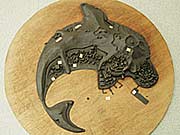
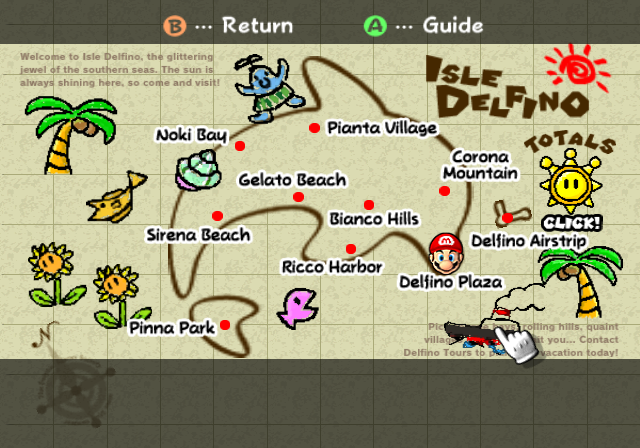
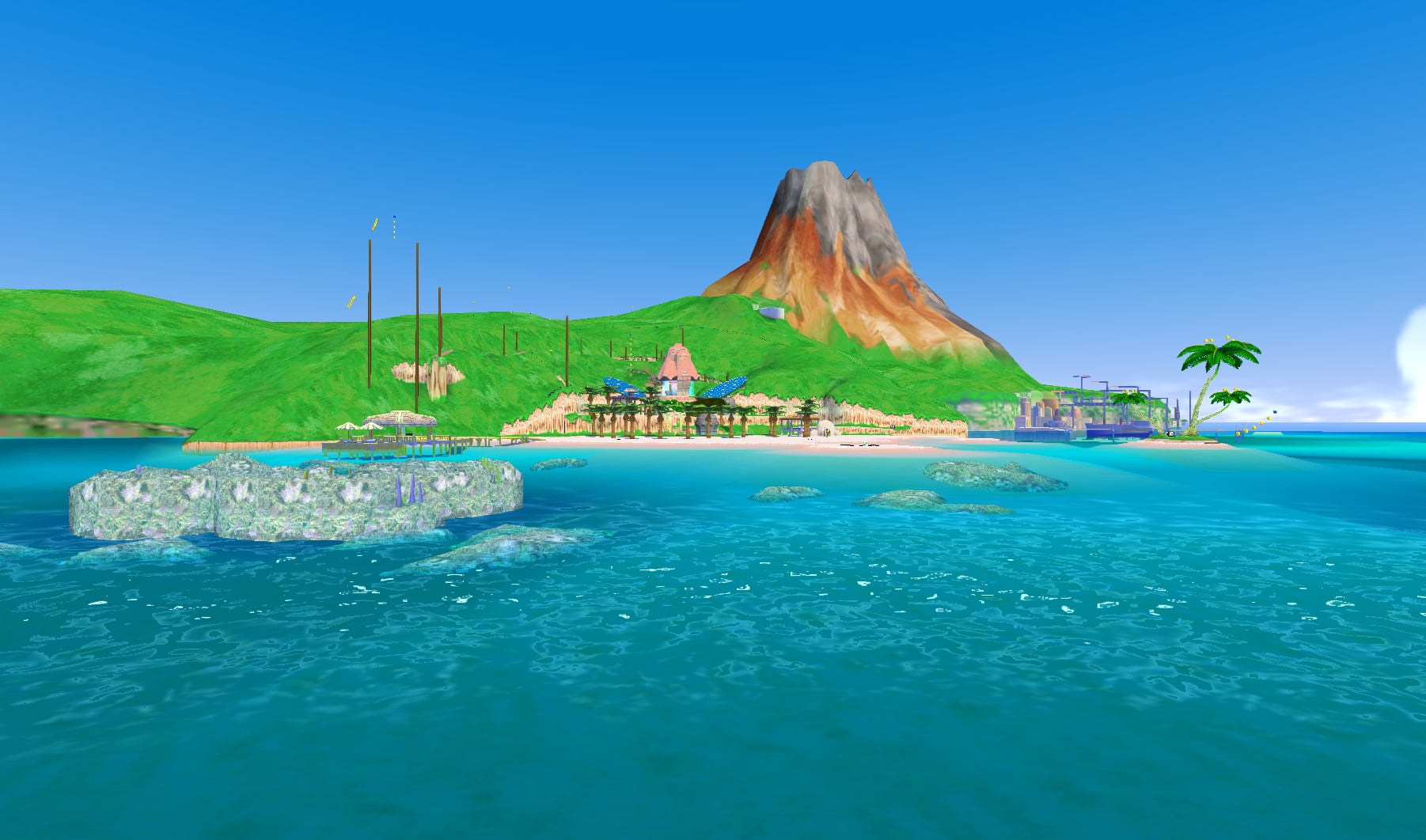
“Delfino” is Italian for dolphin, and the island (with Pinna Island as its fin) is drawn in that shape as a nod to the GameCube’s pre-release codename, Dolphin.
In Japan F.L.U.D.D. is simply the Pump; the acronym Flash Liquidizer Ultra Dousing Device was invented for the English script.
The courtroom scene exists in two takes.The Japanese release uses the English voice track with no subtitle toggle, and keeps an alternative take of the courtroom scene in which the prosecutor says “Shrine Sprites” and “Delfino Isle”.
Koizumi sculpted Isle Delfino in clay before it was built in polygons; the model has been photographed for Nintendo’s own histories.
About ten F.L.U.D.D. nozzles were designed and cut to three because, Koizumi said, hunting for lots of gadgets felt more like Zelda than Mario.
A tank top was tried on Mario before the team settled on short sleeves. The Hawaiian shirt they wanted to give him became the unlockable sightseeing outfit, and returned in Super Mario Odyssey in 2018.
Luigi does not appear at all. When Nintendo staff asked whether Mario should really use a gadget, Miyamoto’s answer was that it had been fine for Luigi.
Early builds filled the plaza with ordinary human tourists; Miyamoto thought they looked odd beside Mario, so the Piantas and Nokis replaced them.
Il Piantissimo.Il Piantissimo’s human face can be seen through the eyeholes of his Pianta costume, and it looks remarkably like the Running Man from The Legend of Zelda: Ocarina of Time. In the standard ending he is spotted studying Bowser Jr.’s brush.
According to Nintendo’s Super Mario Bros. Encyclopedia, every enemy on the island was created by Bowser Jr.’s magic paintbrush.
The secret courses are scored with an a cappella arrangement of the original Super Mario Bros. theme, and the Shadow Mario chase music reworks the 1985 underground tune.
There are exactly 120 Shine Sprites, matching Super Mario 64’s 120 Power Stars, and 240 blue coins, worth 24 of those Shines.
Pianta Village alternates day and night: odd-numbered episodes are set after dark, even-numbered ones in daylight, and the sunglasses vendor refuses to lend his shades at night.
Noki Bay has the most bosses of any area (Monty Mole, Gooper Blooper, Eely-Mouth and Shadow Mario); Pianta Village is the only area with no unique boss at all.
A one-in-eight chance of Mario saying “ciao” on the title screen is coded in but can never trigger, because the random seed is never set.
The Space World 2001 trailer featured a giant masked Stu spawning smaller enemies; it never shipped as an enemy but survives in a hidden test map on the disc.
The 3D All-Stars release initially showed grey debug cubes floating through the secret courses until a November 2020 patch hid them.
Scott Burns gave Bowser his first extended speaking role here, while also voicing Toadsworth, the judge, the prosecutor and Il Piantissimo.
Nintendo Power Vol. 160 and Edge #114 both put Sunshine on their September 2002 covers; Edge gave it 9/10.
The first official soundtrack was only released in 2020, as a 58-track bonus with Super Mario 3D All-Stars; the music reached the Nintendo Music app on 12 August 2026, the day before the game joined Nintendo Classics.
Plug a GameCube controller into a Switch 2 and the GameCube Nintendo Classics menu swaps its sound effects for Sunshine’s.
In Mario Sports Mix Corona Mountain became the Fire Mountain arena, which is also its Japanese name, and the Minecraft Super Mario Mash-Up Pack rebuilt Delfino Plaza, the volcano and a Petey Piranha statue in blocks.
Isle Delfino appeared on a promotional world map for Super Mario Odyssey and is still hidden in the textures of that game’s globe, although Mario never visits.
Regional Box Art
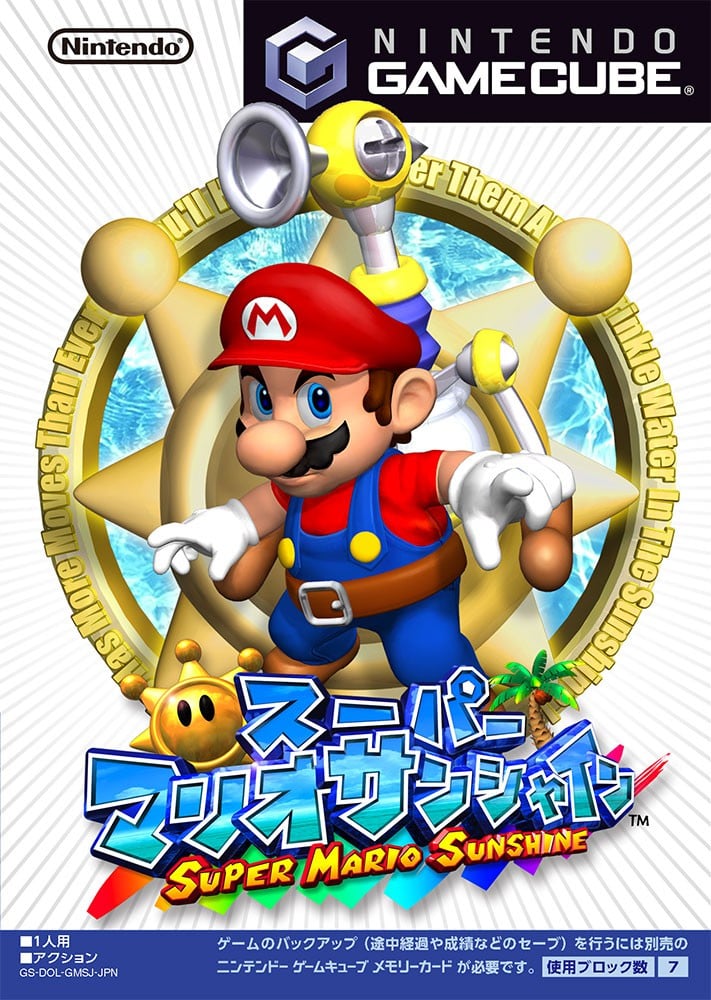
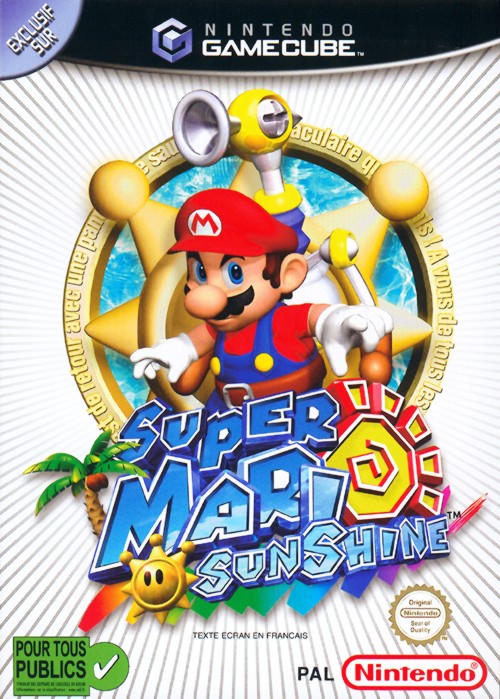
Nintendo used the same leaping Mario on almost every cover, but the logo, layout and background changed from region to region, and the game went through a preliminary E3 box and several Player’s Choice reprints.
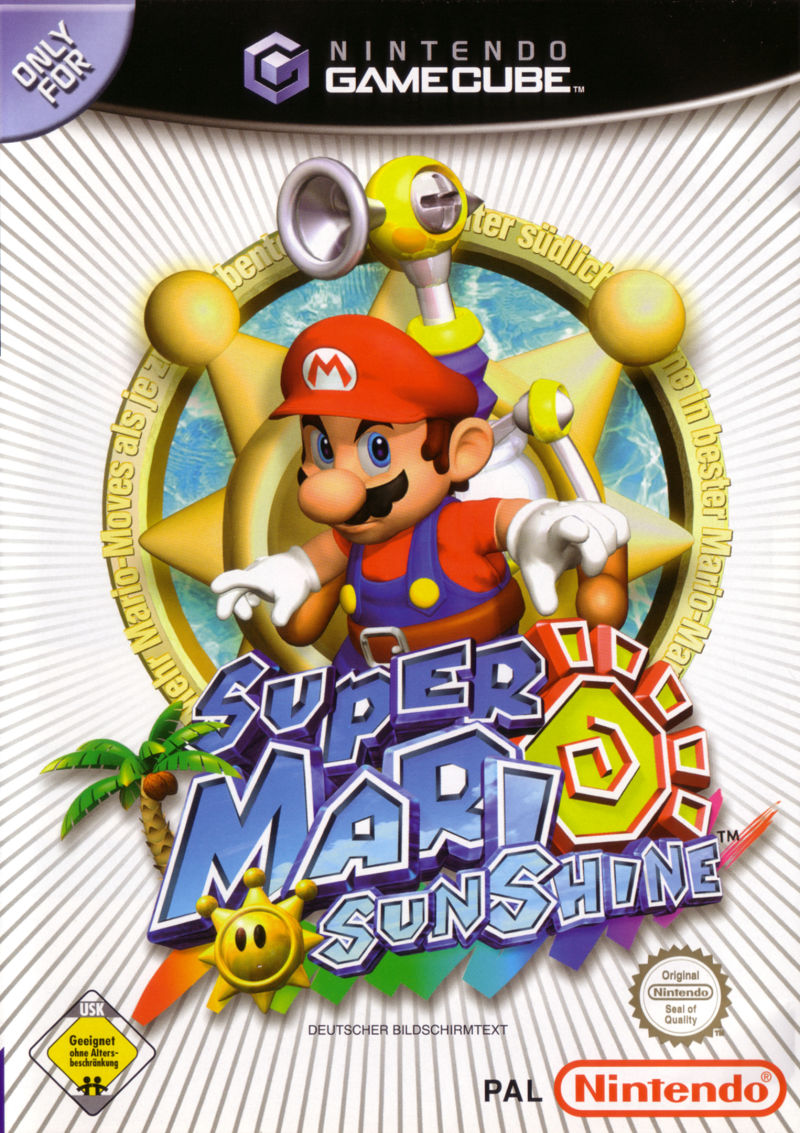
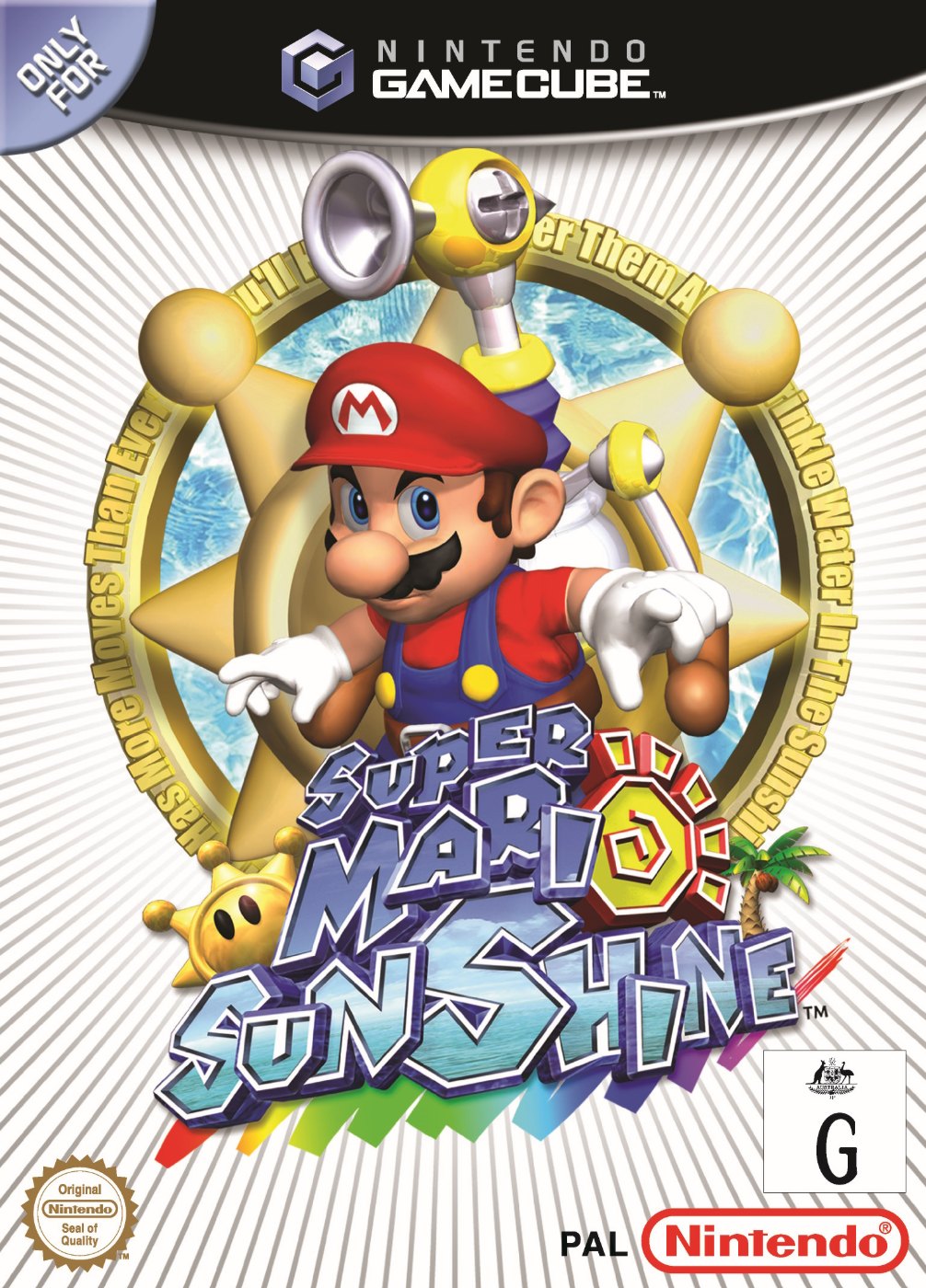
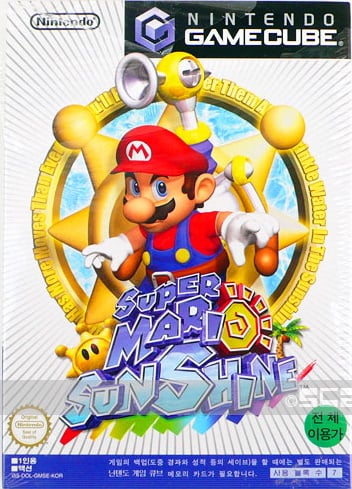
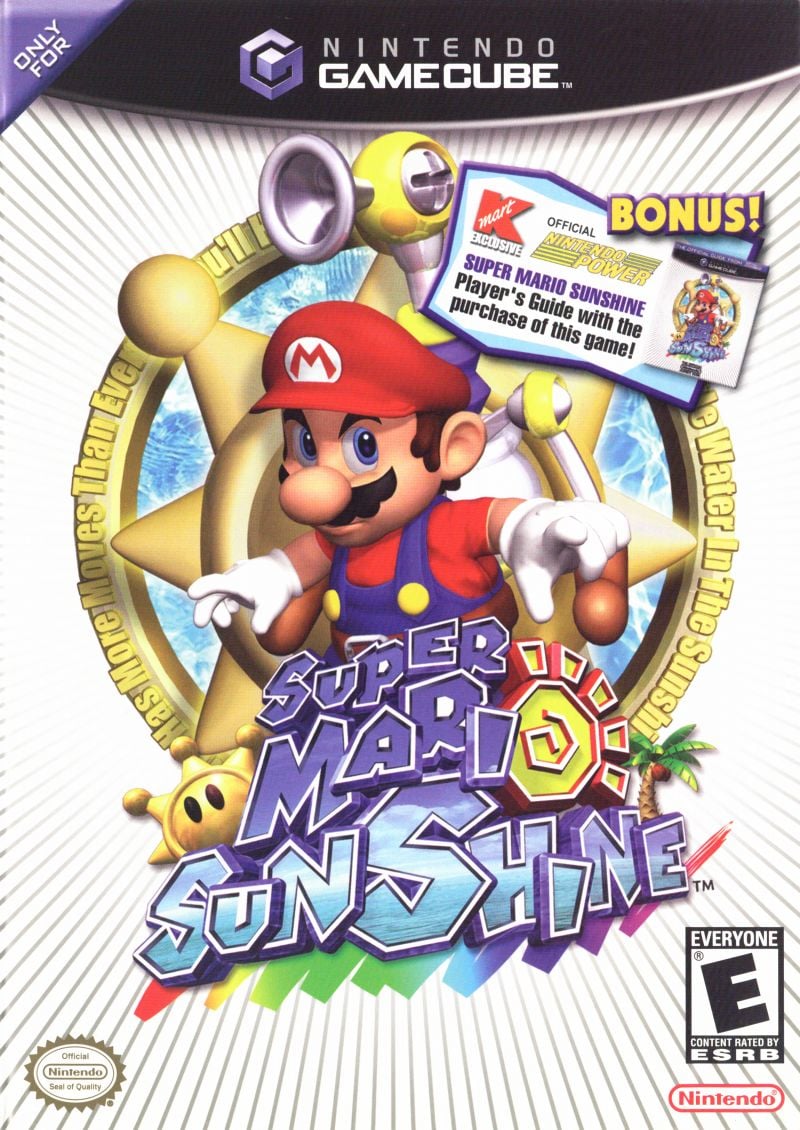
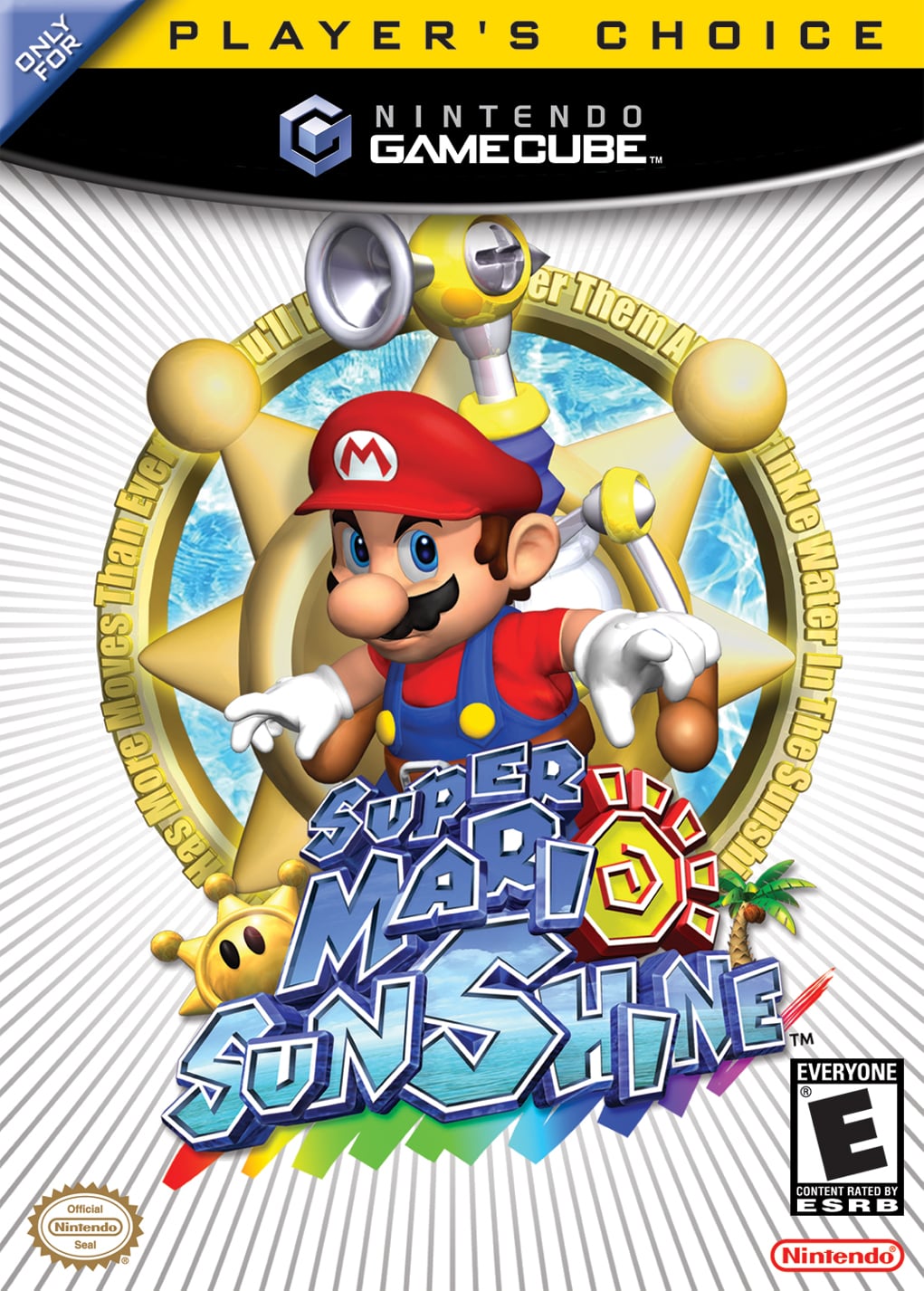
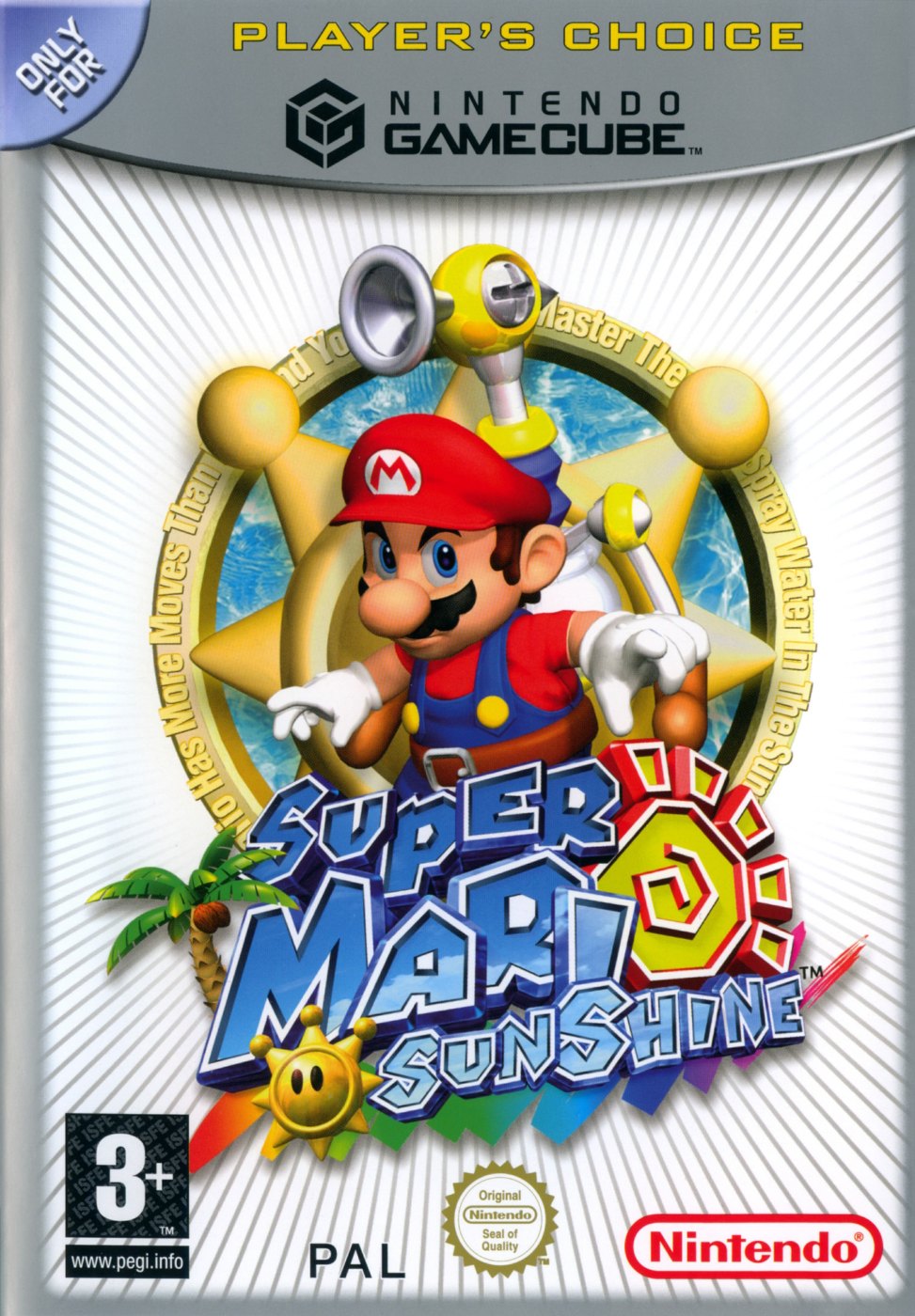
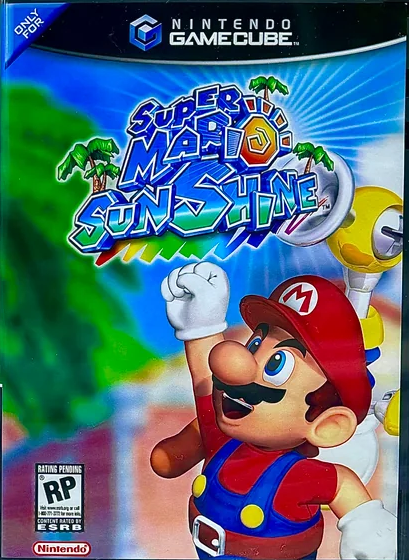
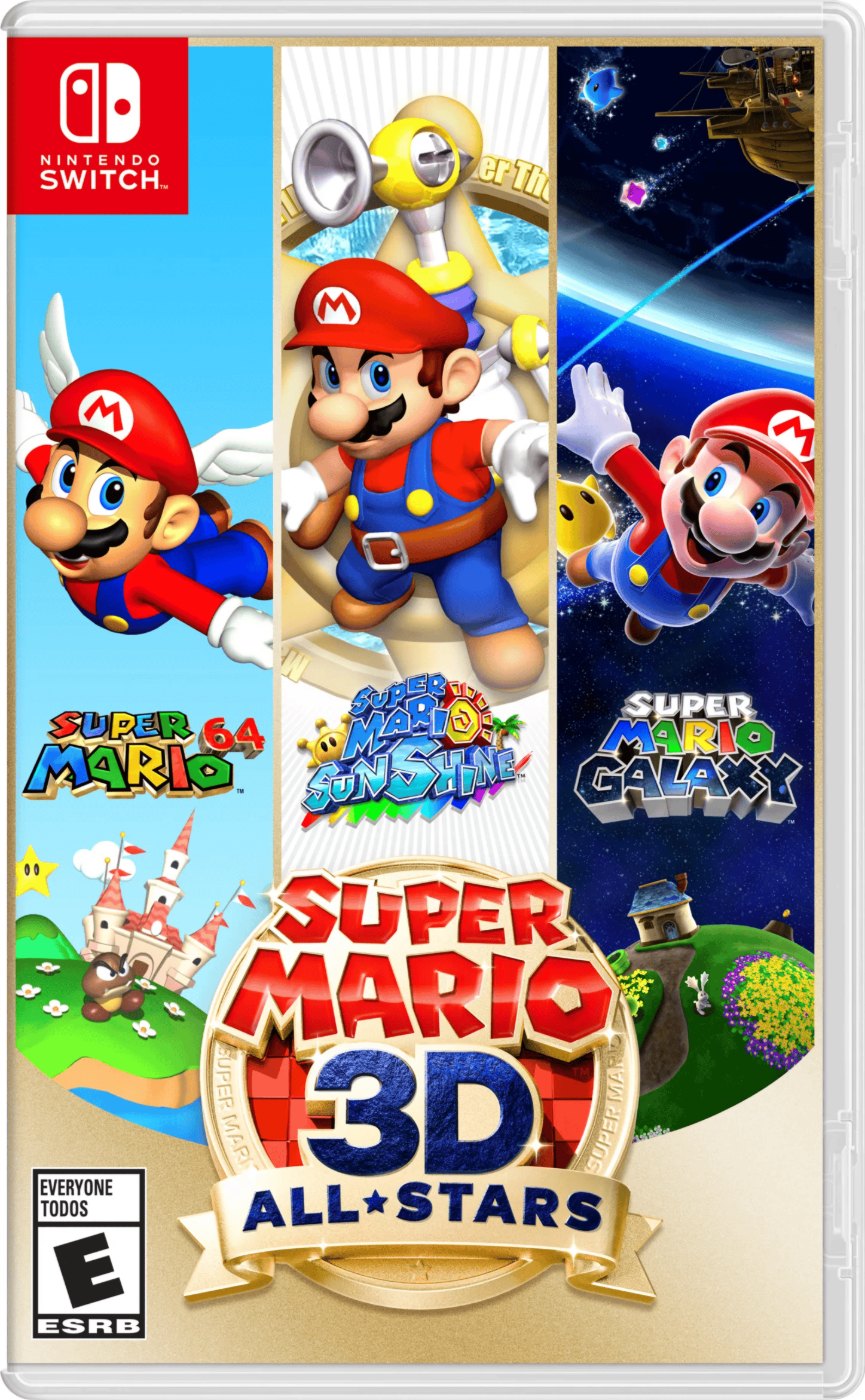
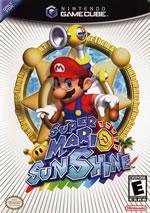
North AmericaGameCube, 26 August 2002JapanGameCube, 19 July 2002; the logo sits on a paler skyEurope (France)PAL, 4 October 2002, with the redesigned European logoEurope (Germany)PAL, 4 October 2002AustraliaPAL, 11 October 2002South KoreaDaiwon C&A, 14 December 2002North America (Kmart exclusive)A retailer-exclusive sleeve variantPlayer’s Choice (USA)25 September 2003Player’s Choice (UK)10 October 2003E3 2002 preliminary boxShown at the May 2002 show with the early logoSuper Mario 3D All-Stars (Switch)18 September 2020, sold until 31 March 2021
Screenshots
More views of Isle Delfino, from the opening flight to the volcano.
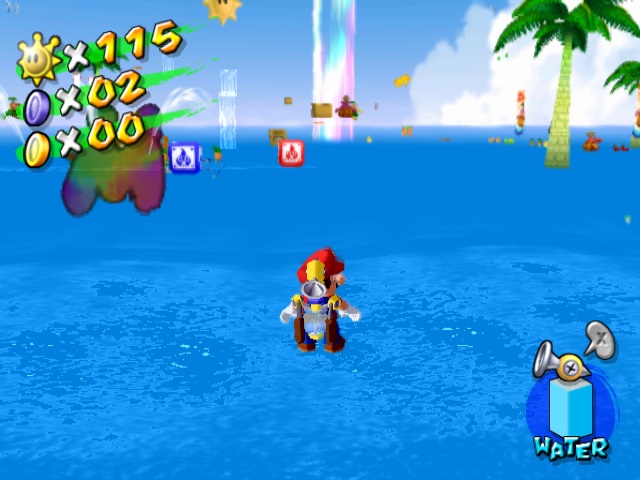
Delfino Airstrip after the goop is gone.Ricco Harbor’s cranes and gantries.Gelato Beach, with Corona Mountain on the horizon.The Ferris wheel at Pinna Park.Blooper surfing at Ricco Harbor.King Boo and his slot machine in Casino Delfino.Mario in the Noki elder’s diving helmet.Dragging a Chain Chomp to the Pianta Village hot spring.Trading blue coins at the boathouse.The Lily Pad Ride, the plaza’s most feared secret course.The guidebook map of the island.The cloud platforms above Corona Mountain’s crater.
Artwork & Media Gallery
Official artwork, logos, maps, adverts and promotional material from Super Mario Sunshine. Select any image to view it larger.
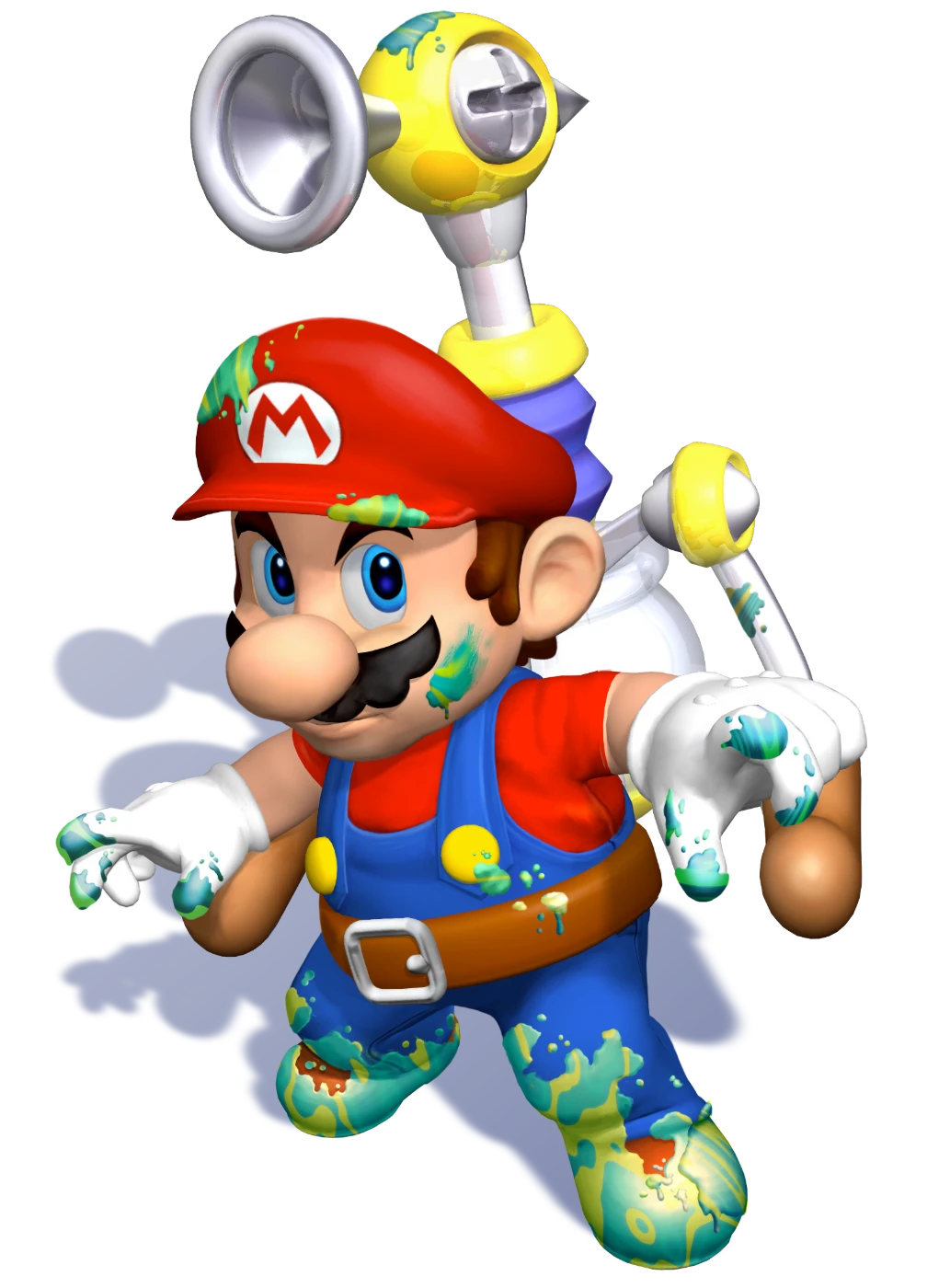
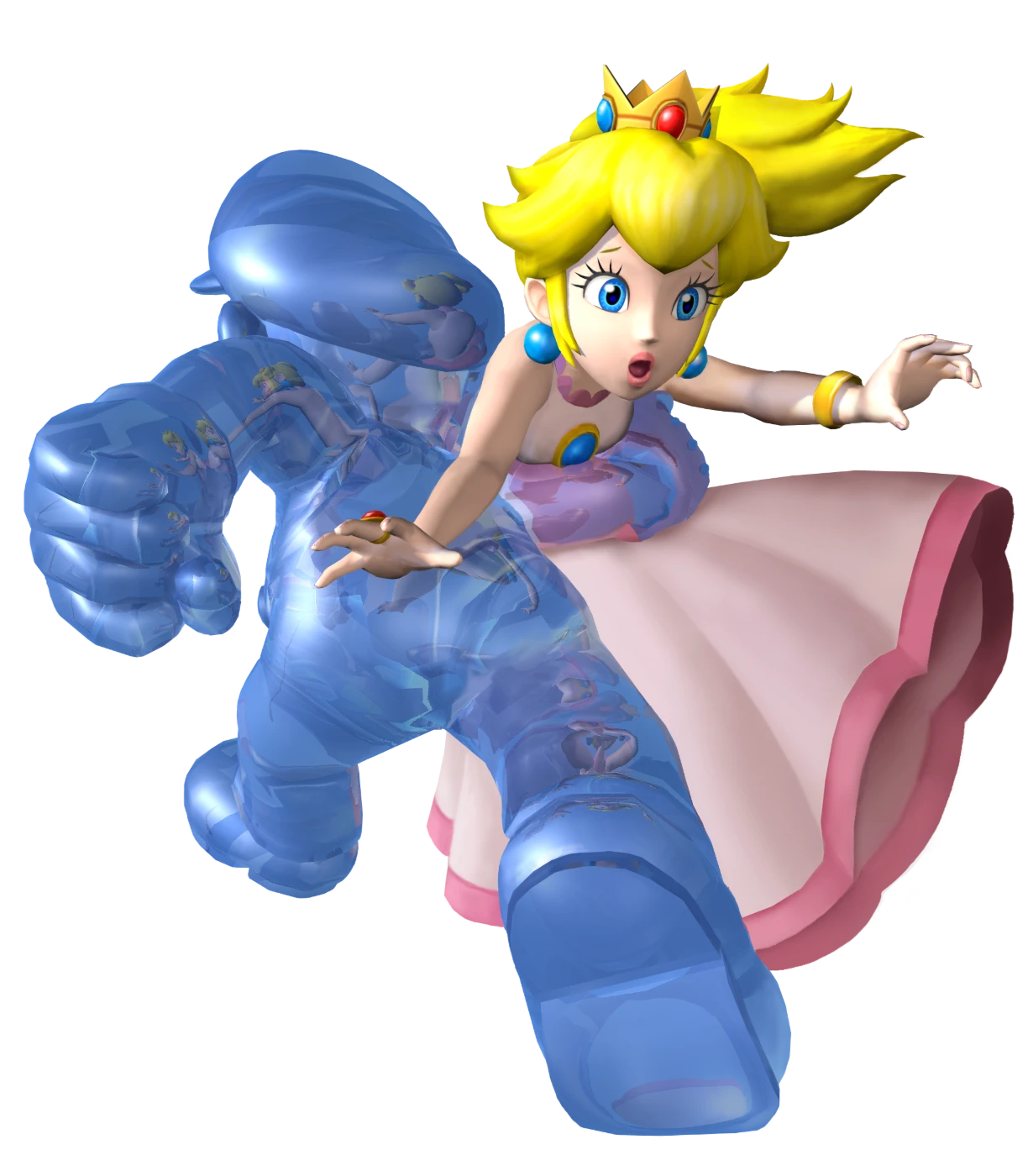
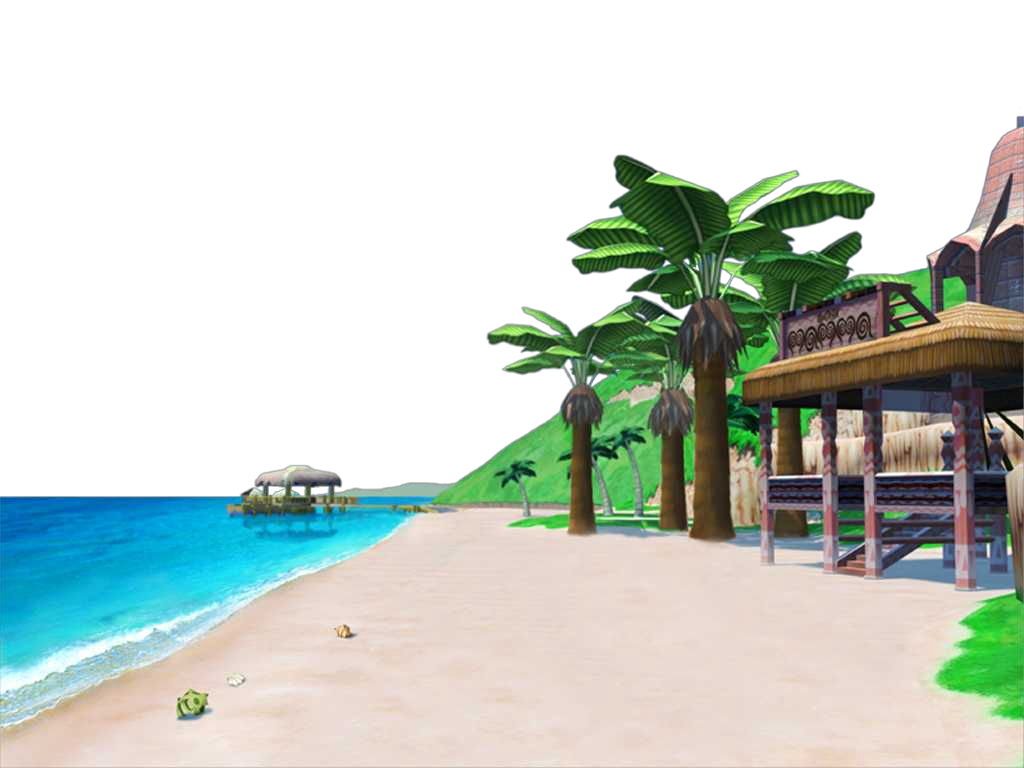
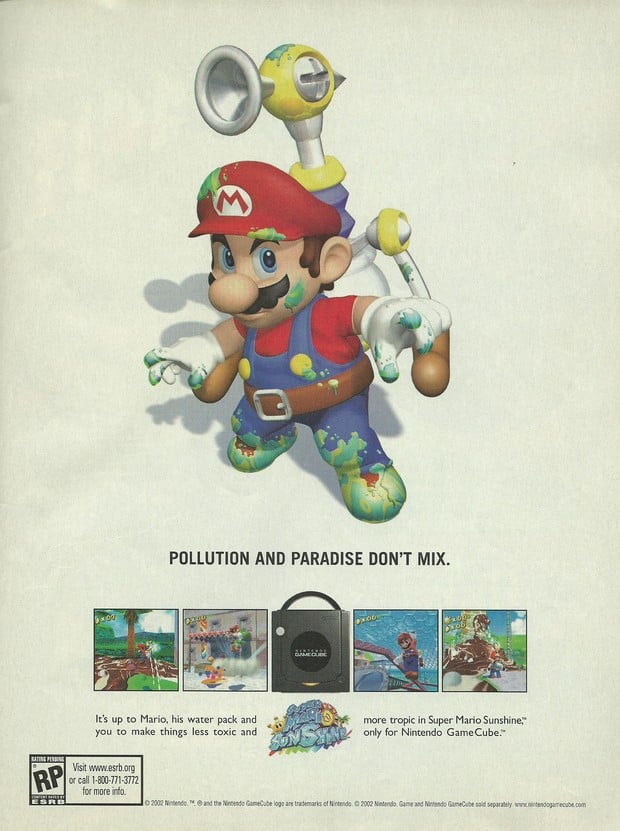
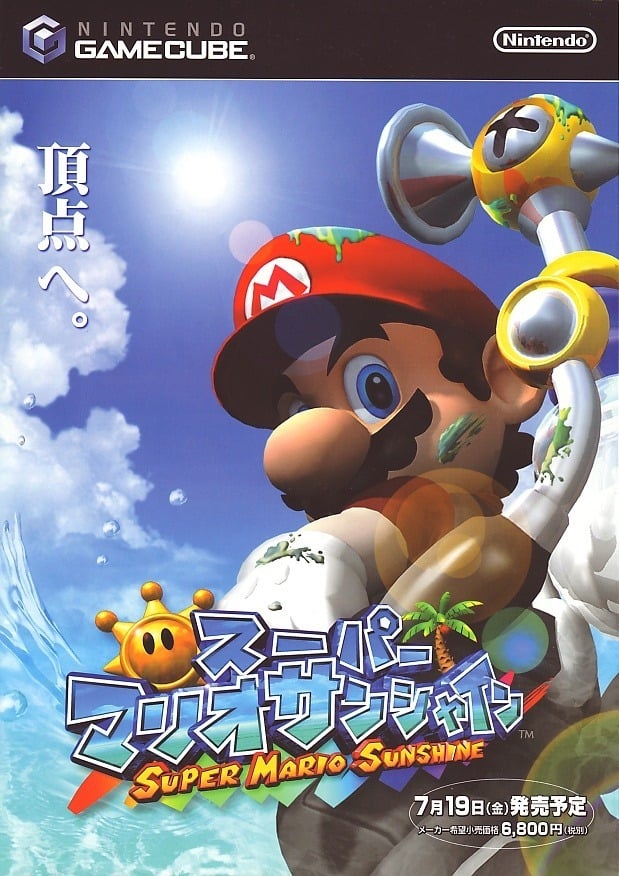
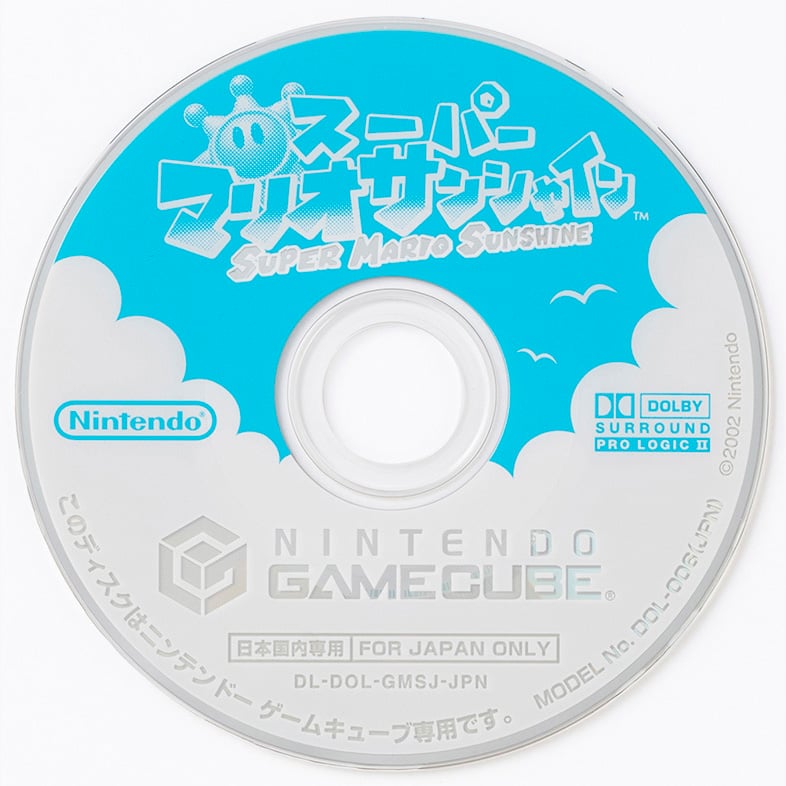
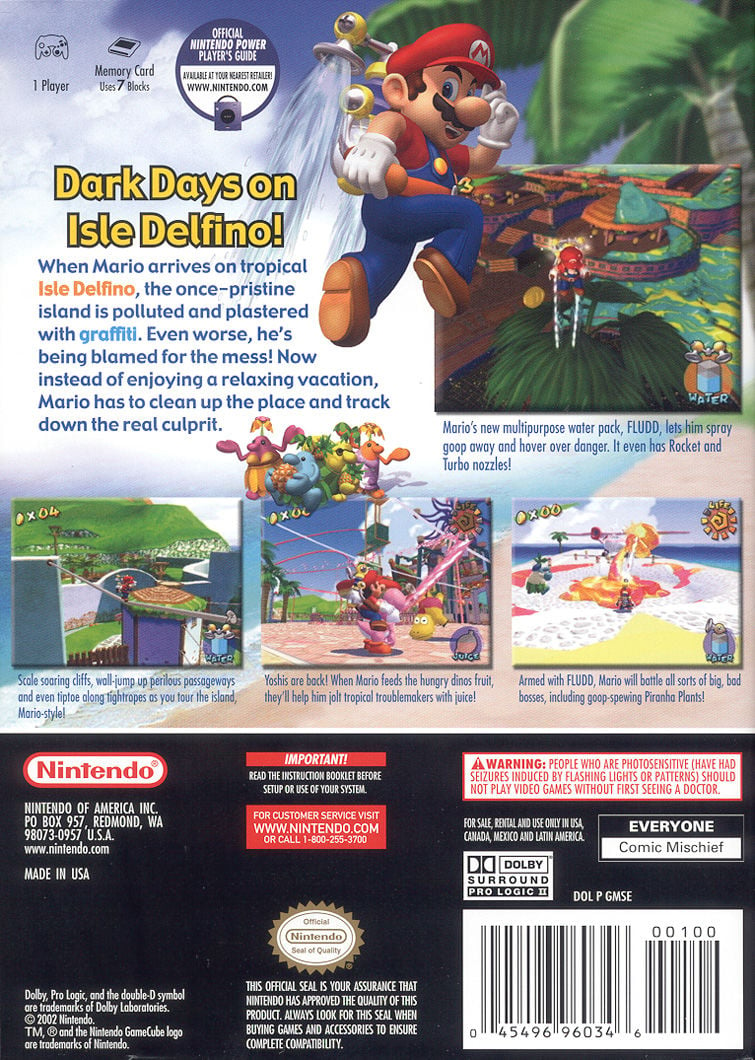
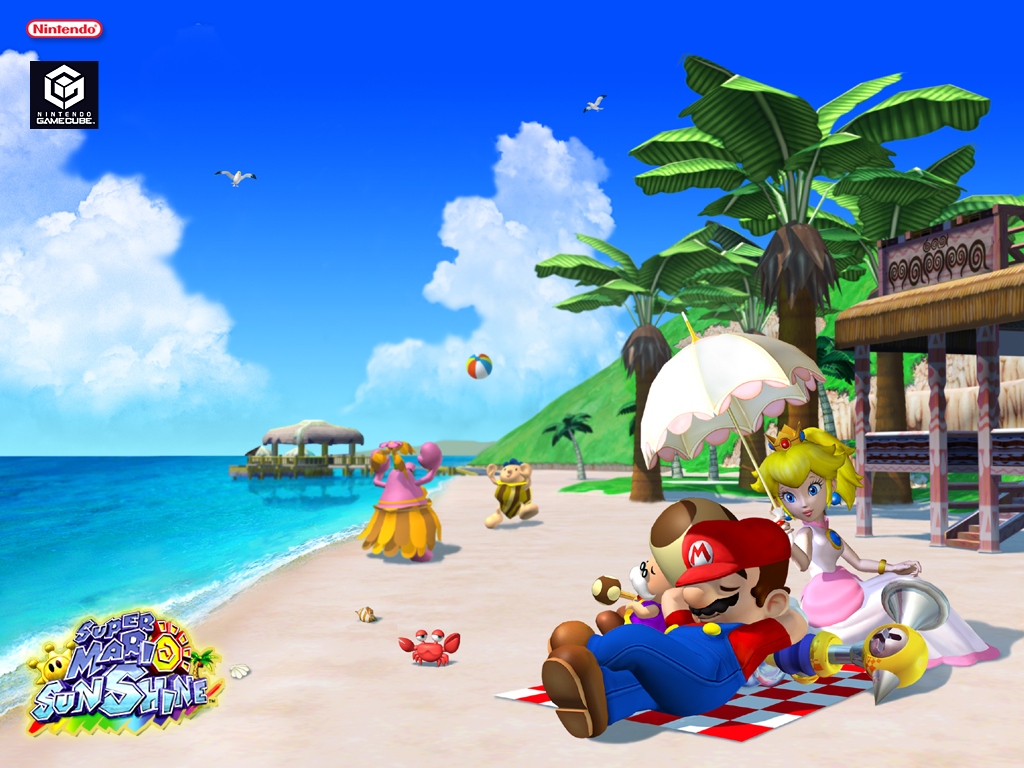
The international logo.Mario and the Squirt Nozzle.Mario and F.L.U.D.D. covered in goop.Shadow Mario makes off with Peach: official artwork.The official map of Isle Delfino.Gelato Beach background artwork.The North American print advert.The Japanese print advert.The Japanese disc.The back of the North American box.The 2020 soundtrack cover from Super Mario 3D All-Stars.Mario, Peach and Toadsworth on Gelato Beach: a Nintendo wallpaper.An early Delfino Airstrip from pre-release footage.The giant Stu from the Space World 2001 trailer and the test map.
Legacy & Re-releases
Twenty-four years on, Sunshine is the 3D Mario that keeps getting rediscovered, and its island has become part of the furniture of the whole series.
From GameCube to Switch 2
Nintendo GameCube2002Japan 19 July, North America 26 August, Europe 4 October, Australia 11 October, South Korea 14 December (Daiwon C&A). A GameCube console bundle followed in North America on 14 October.
Player’s Choice2003Budget reprints: Germany 4 July, USA 25 September, Australia 27 September, UK 10 October, rest of Europe 17 October.
Super Mario 3D All-Stars18 September 2020Nintendo Switch, for Mario’s 35th anniversary, with Super Mario 64 and Super Mario Galaxy: 16:9 widescreen, 1080p docked, upscaled cutscenes, a bundled soundtrack and new trigger controls. On sale only until 31 March 2021; the 1.1.0 update (November 2020) added GameCube controller support and an inverted-camera option.
Nintendo Music12 August 2026A new version of the soundtrack, built on the 2020 release, arrives on Nintendo’s streaming app.
Nintendo GameCube – Nintendo Classics13 August 2026The original GameCube version joins the Switch 2 library for Nintendo Switch Online + Expansion Pack members, announced on 31 July 2026.
The 3D All-Stars version
Nintendo’s 2020 collection was the first chance to play Sunshine in eighteen years and the only version in widescreen. Because Switch controllers lack analogue triggers, spraying was remapped so that the right bumper aims while standing still and the right trigger approximates the GameCube’s pressure-sensitive squirt; a later update let owners plug in a real GameCube pad. F.L.U.D.D.’s tutorial was re-edited to stop mentioning button names. The collection sold 9.01 million copies before it was withdrawn at the end of March 2021, and its limited run became a controversy of its own.
The 2026 Nintendo Classics release goes the other way: it is the GameCube game as it shipped, in 4:3 and without the widescreen work of 2020, which GamesRadar pointed out leaves Switch 2 owners with a less polished version than the one Switch owners had in 2020.
What it left behind
Bowser Jr. is the obvious legacy: the villain of New Super Mario Bros., a boss in both Galaxy games, a Smash Bros. fighter and a movie star in 2026. Toadsworth, Petey Piranha, King Boo’s Delfino incarnation, the Piantas and Nokis and the Shine Sprites all found second careers in Mario Kart, the sports games and Paper Mario: The Thousand-Year Door, and F.L.U.D.D. has been Mario’s down special in Smash Bros. since Brawl.
Its design lessons were learned the hard way. Miyamoto’s regret about difficulty and gating fed straight into Super Mario Galaxy, which Koizumi directed with Koichi Hayashida as level design director; Super Mario Odyssey brought back the idea of a hub full of locals with their own culture, and sold the shades and shirt. Among fans it remains the series’ great divider, loved for its atmosphere and freedom of movement, argued over for its camera and blue coins, and the only Mario in which the ending is a holiday finally beginning.
Reviews & Sales
Sales
It started fast. IGN reported more than 400,000 copies sold in Japan in its first four days, Nintendo of America announced over 350,000 in ten days in the United States, and Europe took 175,000 in its first week. The NPD Group ranked it the tenth best-selling game of 2002 in America, and Nintendo bundled it with GameCube consoles there from 14 October 2002. Even so, Satoru Iwata said at E3 2003 that Sunshine and Metroid Prime had sold below expectations.
The long tail did the rest. Nintendo’s own figures put it past 5.5 million by mid-2006 and at about 5.9 million in a chart of Super Mario titles shown to investors in November 2023, which makes it the third best-selling GameCube game behind Super Smash Bros. Melee and Mario Kart: Double Dash!!. Super Mario 3D All-Stars, which contains it, sold 9.01 million copies on Switch in just over six months.
5.9mlifetime, Nintendo chart (Nov 2023)
400kJapan, first four days
350kUSA, first ten days
3rdbest-selling GameCube game
9.01m3D All-Stars, by March 2021
Reviews
Scores as recorded by Wikipedia from the original reviews, with the outlet and date where known. Metacritic’s average is 92 from 61 critics; GameRankings averaged 91.5%.
Computer and Video GamesUK · 2002
10/10
Nintendo World ReportUS · 2002
10/10
GameSpyUS · Hector Guzman, 25 Aug 2002
5/5
Nintendo PowerUS · 2002
5/5
Game InformerUS · Andrew Reiner, Sept 2002
9.75/10
Electronic Gaming MonthlyUS · Oct 2002
9.5/10
IGNUS · Fran Mirabella III, 22 Aug 2002
9.4/10
FamitsuJapan · 9, 9, 9, 10
37/40
1Up.comUS
A
EdgeUK · issue 114, Sept 2002
9/10
EurogamerUK · Tom Bramwell, 4 Oct 2002
9/10
GamesRadar+UK/US
4.5/5
Nintendo LifeUK · retrospective
9/10
GameSpotUS · Jeff Gerstmann, 25 Aug 2002
8/10
AllGameUS · Scott Alan Marriott
3.5/5
The praise was for the look of the island, Kondo’s music, the sheer variety of Mario’s moves and, from IGN among others, the way the water pack changed the game’s rhythm; Computer and Video Games reckoned it better than Super Mario 64, and Game Informer called it arguably the best Mario yet. The criticism settled on two things that have followed the game ever since: a camera that struggled in tight spaces, and a difficulty spike in the secret courses and blue coin hunt. GameSpot’s Jeff Gerstmann went furthest, calling F.L.U.D.D. and Yoshi mere gimmicks and suggesting the game felt rushed, and the full voice acting divided reviewers.
GameSpot managed to name it both the best GameCube platformer and the most disappointing GameCube game of 2002. It was nominated for Console Platform Action/Adventure Game of the Year at the 6th Interactive Achievement Awards, and Official Nintendo Magazine later placed it 46th in its list of the 100 greatest Nintendo games. Its reputation has warmed with time: Nintendo Life’s retrospective review scored it 9/10, and the 3D All-Stars release introduced it to players who had only heard the arguments.
Honours
GameSpot · 2002Best Platformer (GameCube)GameSpot’s Best and Worst of 2002, which also listed it as the year’s most disappointing GameCube game.
Interactive Achievement Awards · 2003Nominee, Console Platform Action/Adventure Game of the YearAt the 6th annual awards.
Official Nintendo Magazine · 200946th greatest Nintendo gameIn the UK magazine’s 100 Greatest Nintendo Games list.
SLB User Reviews
Super Mario Sunshine has yet to receive a community review on Super Luigi Bros.
If you’ve played Super Mario Sunshine and would like to submit a review, please get in touch.
More from the Super Luigi Bros Guide
These picture lists come from the earlier Super Luigi Bros guide to Super Mario Sunshine and are kept here in full.
The 7 Main Courses
Each of the seven main courses has its own theme, biome, supporting cast, central boss, and 11 Shine Sprites to collect. Courses unlock in roughly the order shown here, though several can be tackled out of sequence once unlocked.
Course 1
Bianco Hills
The first proper course — a pastoral hillside village surrounded by windmills, flower gardens, and a freshwater lake. Bianco Hills is the gentlest of the courses, designed to ease the player into FLUDD-based platforming.
Key elements: giant windmill (the central landmark), Petey Piranha’s nest on top of the Big Windmill, the village proper with its flower beds and goop infestations, a lake with submerged secrets.
Boss:Petey Piranha appears here in two episodes — a giant goop-spewing Piranha Plant variant who would become one of Mario’s more memorable recurring monsters.
Course 2
Ricco Harbor
A bustling fishing-port town built around a circular harbour, with multi-level wooden piers, gantries, dock cranes, and cargo containers. The course mixes vertical platforming with water-traversal puzzles.
Key elements: the giant industrial dock crane, the fish market, the lighthouse, the underwater section with hidden Shines, the tall pier-mounted Yoshi Egg cart from Episode 6.
Boss:Gooper Blooper, a massive squid-like creature who fills the central harbour pool. Tentacle-pulling boss fight requiring FLUDD blasts to expose his face.
Course 3
Gelato Beach
A sun-soaked sandy beach with a coral reef offshore, a colossal sand castle, watermelon vines along the shoreline, and the legendary Sand Bird — a giant sand-construct creature that hatches from the dunes when certain conditions are met.
Key elements: the giant sand castle puzzles, the Watermelon Festival episode (push a giant watermelon down the beach without breaking it), the underwater coral reef section, and the Sand Bird itself — hatched and ridden in a memorable mid-air platforming sequence.
Boss:Wiggler, a giant version of the classic Mario enemy, awakened furious from his slumber and chased around the beach until ground-pounded on the head.
Course 4
Pinna Park
A coastal theme park accessible by a Yoshi-shaped Ferris wheel and Yoshi-decorated rollercoasters. Carnival-themed throughout: roller coaster tracks, a giant Yoshi-shaped Ferris wheel, the spinning Clam Cups ride, the Pirate Ship swing, balloon games, a giant slide. The most overtly fun setting in the game.
Key elements: the giant Yoshi Ferris wheel, the Yoshi-themed Pirate Ship ride, the Mecha-Bowser robot boss fight on the rollercoaster track, the underwater section featuring Phantamanta in some episodes.
Boss:Mecha-Bowser, a massive Bowser robot piloted by Bowser Jr. (in his Shadow Mario disguise). The fight takes place on the moving rollercoaster track and is one of the game’s most memorable set-pieces.
Course 5
Sirena Beach
A beach resort dominated by the colossal Hotel Delfino, a luxury holiday hotel. Sirena Beach features both outdoor beach sections (with sand-trap puzzles) and indoor hotel-based exploration with Boo-themed puzzles, casino-themed rooms, and a labyrinthine multi-floor interior.
Key elements: Hotel Delfino itself with its multiple floors, casino rooms, hotel-staff Piantas, the giant manta ray attack on the beach (multi-creature boss fight), Boos and Boo-related puzzles, the spinning wardrobe-Boo silhouette mini-game.
Boss:King Boo, the largest Boo Mario has fought to date. Fought in the casino beneath Hotel Delfino. Defeated via fruit-juicing puzzle mechanics.
Course 6
Noki Bay
A coastal Noki village built into the cliff face of a deep azure bay. The water has been turned toxic by Bowser Jr.’s pollution; Mario must clean the bay floor and traverse vertical cliff platforming. Some of the harder vertical FLUDD navigation in the game.
Key elements: the cliff-face Noki dwellings, the giant red Noki bottle (deep-sea puzzle area), the polluted bay floor that must be cleaned to restore the water, the vertical cliff platforming with sliding ropes and rotating platforms.
Boss:Eely-Mouth, a colossal moray eel living inside a giant clam shell on the bay floor. Mario must brush its teeth (literally) with FLUDD to drive it back.
Course 7
Pianta Village
A treetop Pianta village built across the canopy of a giant rainforest. Connected by rope bridges, treehouses, and high platforms. The most vertically dizzying course — falls from the trees lead to long drops to the forest floor below.
Key elements: the treetop bridges and houses, the giant Pianta village chief’s home, the giant pungent flower tree (gives off offensive odour Mario must dispel with water), the underground forest floor section, the goop-cleansing missions, the “Chain Chomp Spa Day” where Mario must clean a chain-chomp by squirting it.
Boss: Various — the Bowser Jr. encounter occurs here in his final pre-Corona Mountain form, plus assorted goop-restoration objectives.
Reference / Information
Sub-pages, guides, and walkthroughs for Super Mario Sunshine.
To provide the best experiences, we use technologies like cookies to store and/or access device information. Consenting to these technologies will allow us to process data such as browsing behavior or unique IDs on this site. Not consenting or withdrawing consent, may adversely affect certain features and functions.
Functional
Always active
The technical storage or access is strictly necessary for the legitimate purpose of enabling the use of a specific service explicitly requested by the subscriber or user, or for the sole purpose of carrying out the transmission of a communication over an electronic communications network.
Preferences
The technical storage or access is necessary for the legitimate purpose of storing preferences that are not requested by the subscriber or user.
Statistics
The technical storage or access that is used exclusively for statistical purposes.The technical storage or access that is used exclusively for anonymous statistical purposes. Without a subpoena, voluntary compliance on the part of your Internet Service Provider, or additional records from a third party, information stored or retrieved for this purpose alone cannot usually be used to identify you.
Marketing
The technical storage or access is required to create user profiles to send advertising, or to track the user on a website or across several websites for similar marketing purposes.

 Delfino Airstrip2 Shines · Proto PiranhaThe gooped runway where Mario meets F.L.U.D.D. and the game begins. You can come back by boat late in the game for a second Shine made of red coins.
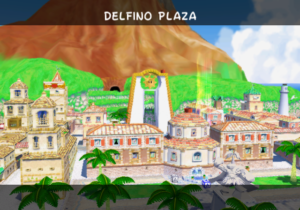 Delfino PlazaHub · 16 Shines + 24 blue-coin Shines · Shadow Mario, Proto PiranhasThe harbour town at the centre of everything: Shine Gate, Grand Pianta Statue, boathouse, lighthouse, two bell towers, a sewer network and five secret courses. It gets brighter with every Shine and floods before the finale.
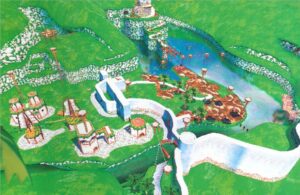 Bianco Hills11 Shines · Petey Piranha (Ep. 2 and 5), Shadow MarioA hillside village of windmills, a lake and a cliff-top path. Petey Piranha roosts on the big windmill, and the Hillside Cave and Dirty Lake hide the first two secret courses.
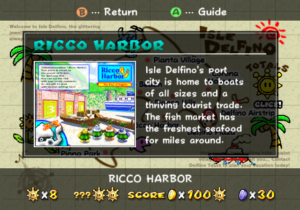 Ricco Harbor11 Shines · Gooper Blooper (Ep. 1 and 5), Shadow MarioA working port of cranes, gantries and fish markets. Blooper surfing, a caged Shine, a tower to climb and Yoshi’s fruit adventure.
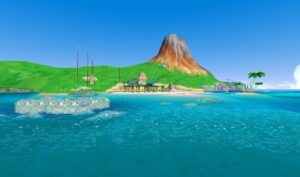 Gelato Beach11 Shines · Plungelos (Ep. 2), Wiggler (Ep. 3), Shadow MarioThe island’s biggest beach, with a sand castle, a coral reef, the Sand Bird’s egg and a watermelon festival. Il Piantissimo’s first race is here.
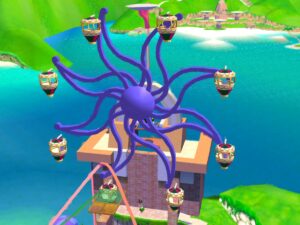 Pinna Park11 Shines · Mecha-Bowser (Ep. 1), Monty Mole (Ep. 2), Shadow MarioA theme park on the island’s fin, reached by cannon: roller coaster, Ferris wheel, pirate ships, Yoshi-Go-Round and the Bowser Jr. reveal.
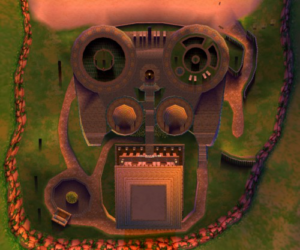 Sirena Beach11 Shines · Phantamanta (Ep. 1), King Boo (Ep. 5), Shadow MarioA sunset beach dominated by Hotel Delfino, which is haunted, rearranged by Boos and built over a casino where King Boo spins the slots.
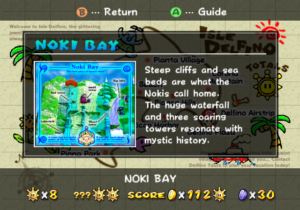 Noki Bay11 Shines · Monty Mole (Ep. 1), Gooper Blooper (Ep. 2), Eely-Mouth (Ep. 4), Shadow MarioA hidden bay of cliffs, ruins and a clogged waterfall, opened by looking into the sun. Its water is poison until Eely-Mouth’s teeth are cleaned; one episode happens inside a bottle.
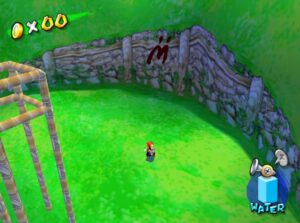 Pianta Village11 Shines · Shadow Mario onlyA village built in the branches of a giant palm, alternating day and night episodes. Chain Chomplets, a Chain Chomp’s bath, a burning village, a hot spring and the Fluff Festival. The only area without a unique boss.
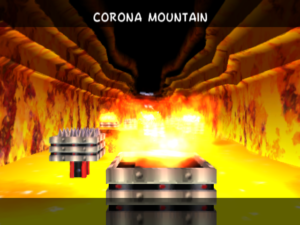 Corona Mountain1 Shine · Bowser and Bowser Jr.The volcano behind the plaza: fire platforms, spikes, a mudboat ride over lava and the hot tub showdown.
 Squirt NozzleThe default hose. Always equipped; light press to spray on the move, full press to stand and aim.
 Hover NozzleAround four seconds of lift from twin downward jets. Available from the start; blue nozzle boxes.
 Turbo NozzleCharge and sprint across land or water; bashes through orange and green wooden doors. 25 Shines and Yoshi.
 Rocket NozzleCharge and launch straight up with no fall damage. 30 Shines and the Turbo Nozzle.
 Shine Sprite120 to find; the island’s light source and the end of every episode.
 CoinRestores one point of health; 50 in a visit give a life, 100 give a Shine.
 Red coinRestores two points; eight in an episode make a Shine.
 Blue coinRestores two points; 240 in all, ten buy a Shine at the boathouse.
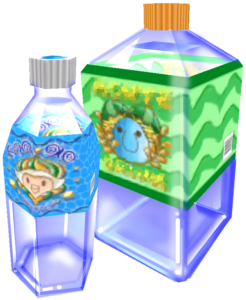 Water bottleRefills F.L.U.D.D.: small ones halfway, large ones fully.
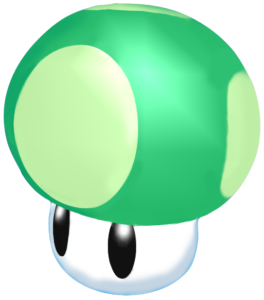 1-Up MushroomAn extra life plus full health and a full tank.
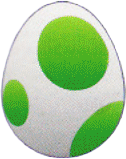 Yoshi eggShows the fruit it wants; bring it and Yoshi hatches.
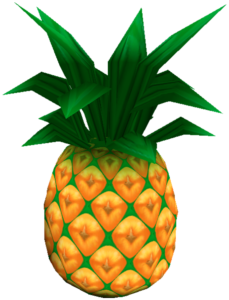 Pineapple and papayaTurn Yoshi orange. A pineapple also unblocks the pipe to Sirena Beach.
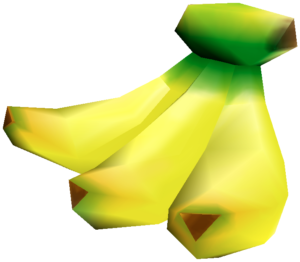 Banana and coconutTurn Yoshi pink.
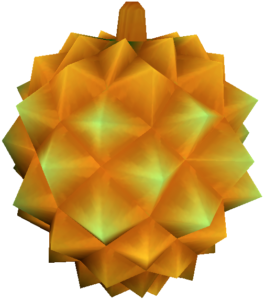 Durian and pepperTurn Yoshi purple. Durians are kicked rather than carried; peppers are what finally hurt King Boo.
 Mario’s capSwipin’ Stus steal it in Pinna Park; without it Mario’s health drains in the sun.
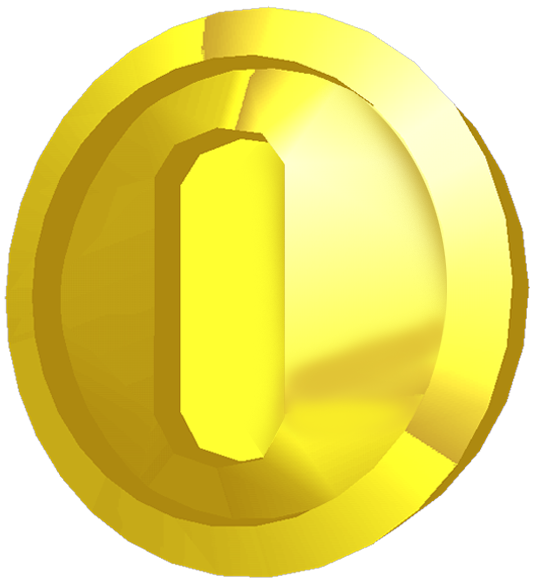


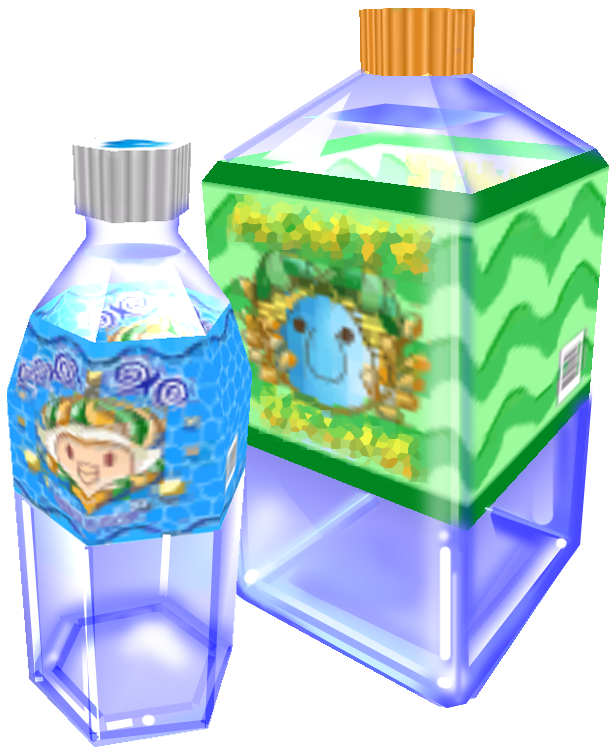
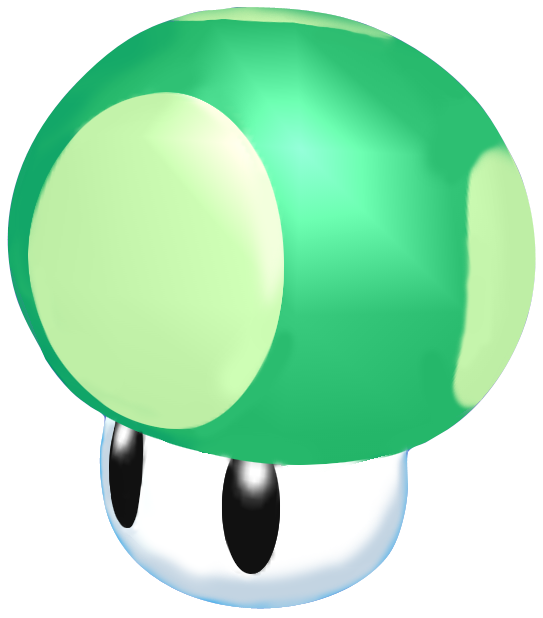
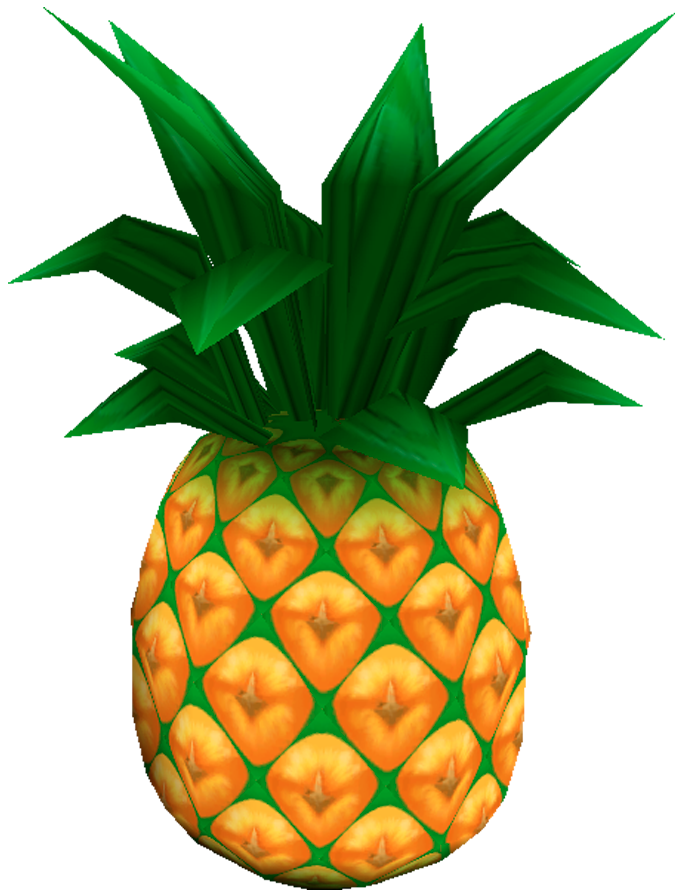
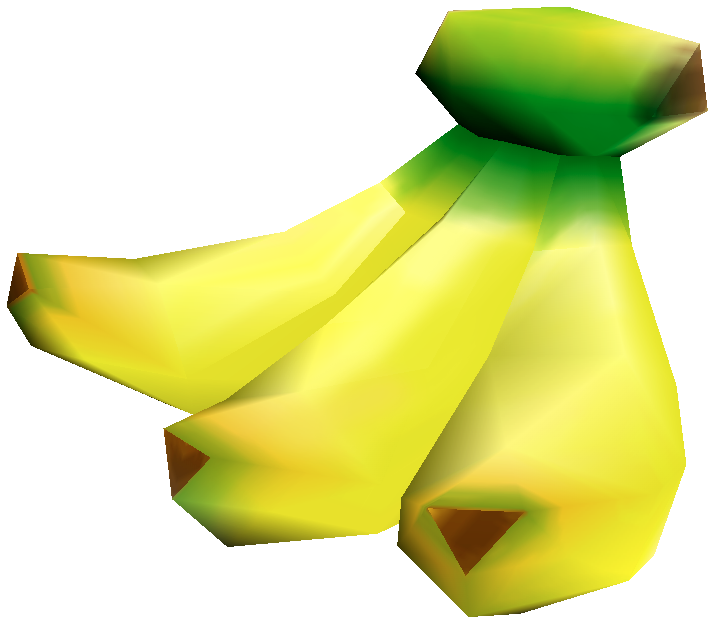
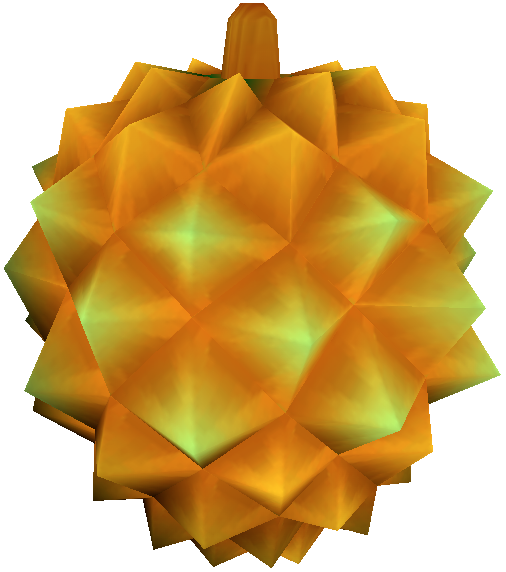
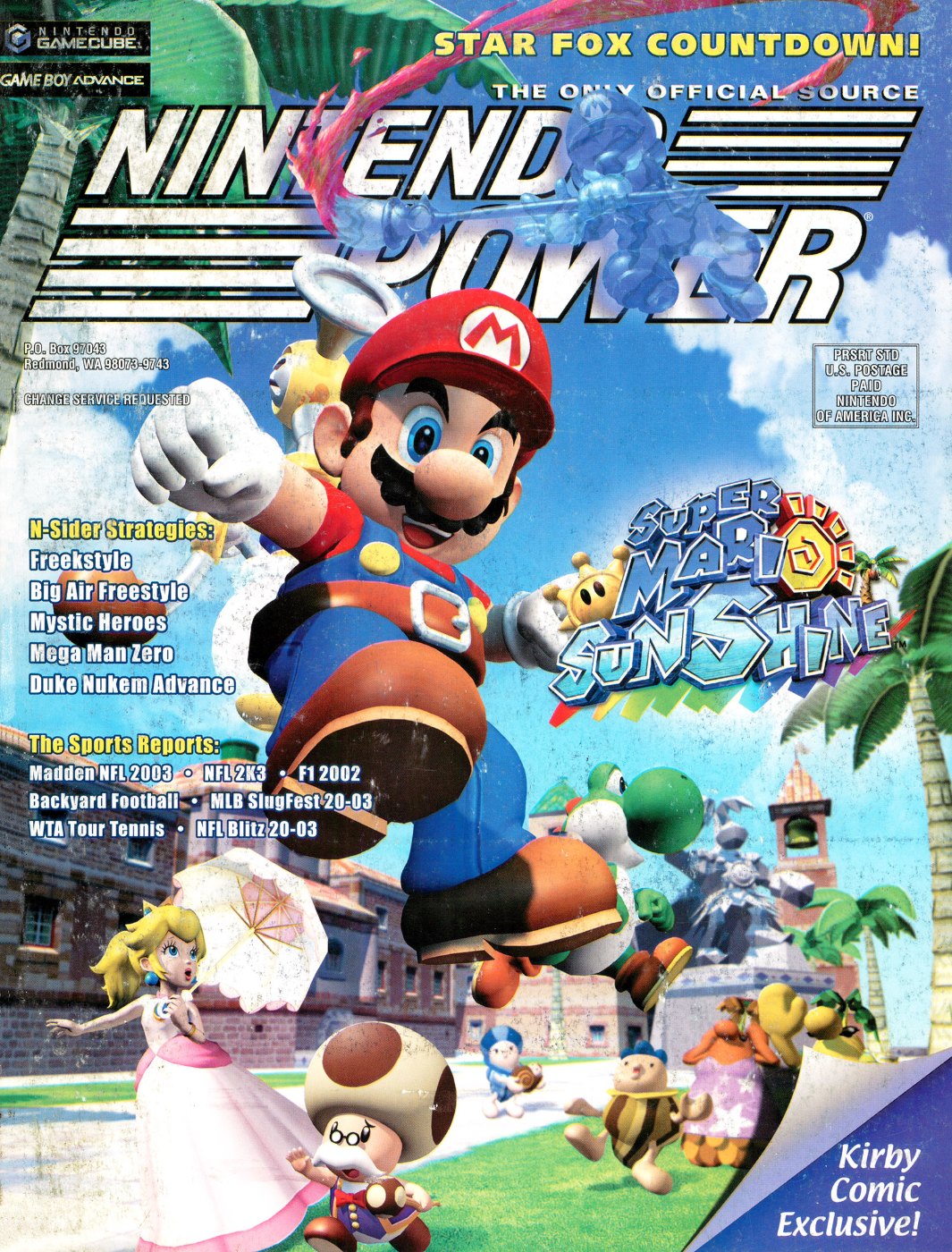 Nintendo Power Vol. 160 and the Player’s GuideNintendo of America · September 2002Mario and F.L.U.D.D. took the cover of Nintendo Power’s September 2002 issue, and Nintendo published its own Super Mario Sunshine Player’s Guide alongside third-party books from Prima and BradyGames.
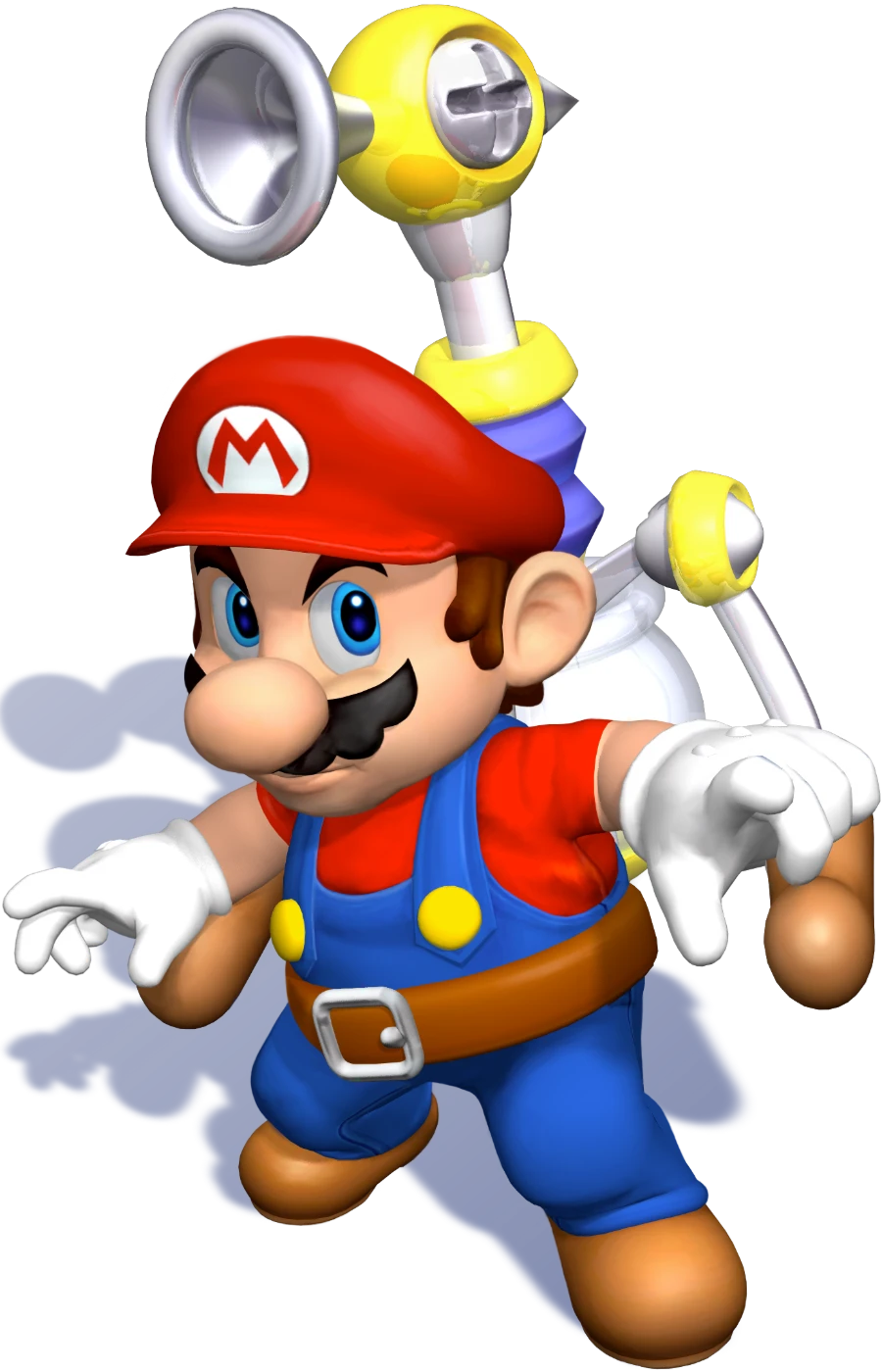 MarioThe accused
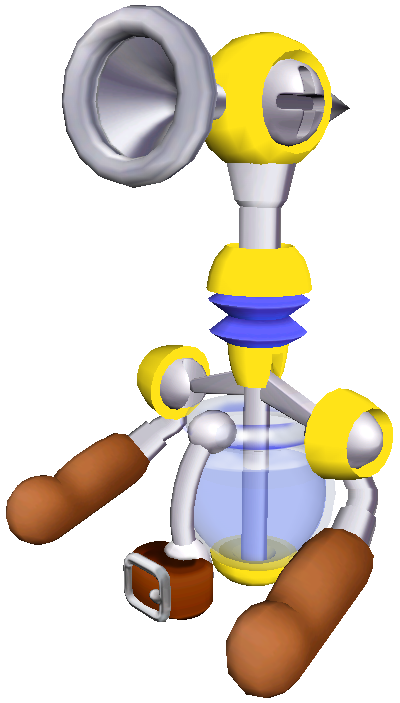 F.L.U.D.D.Flash Liquidizer Ultra Dousing Device
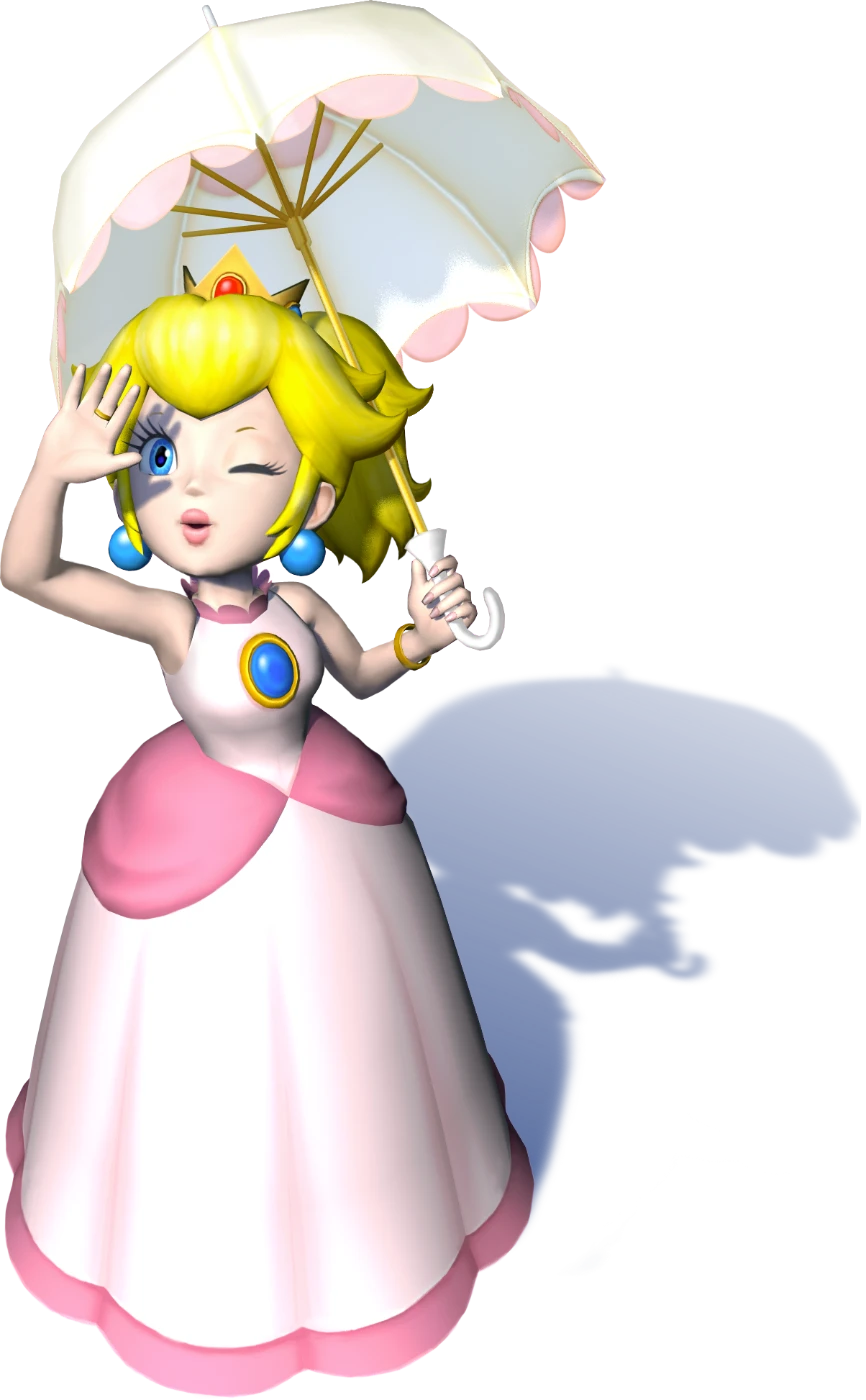 Princess PeachThe holidaymaker
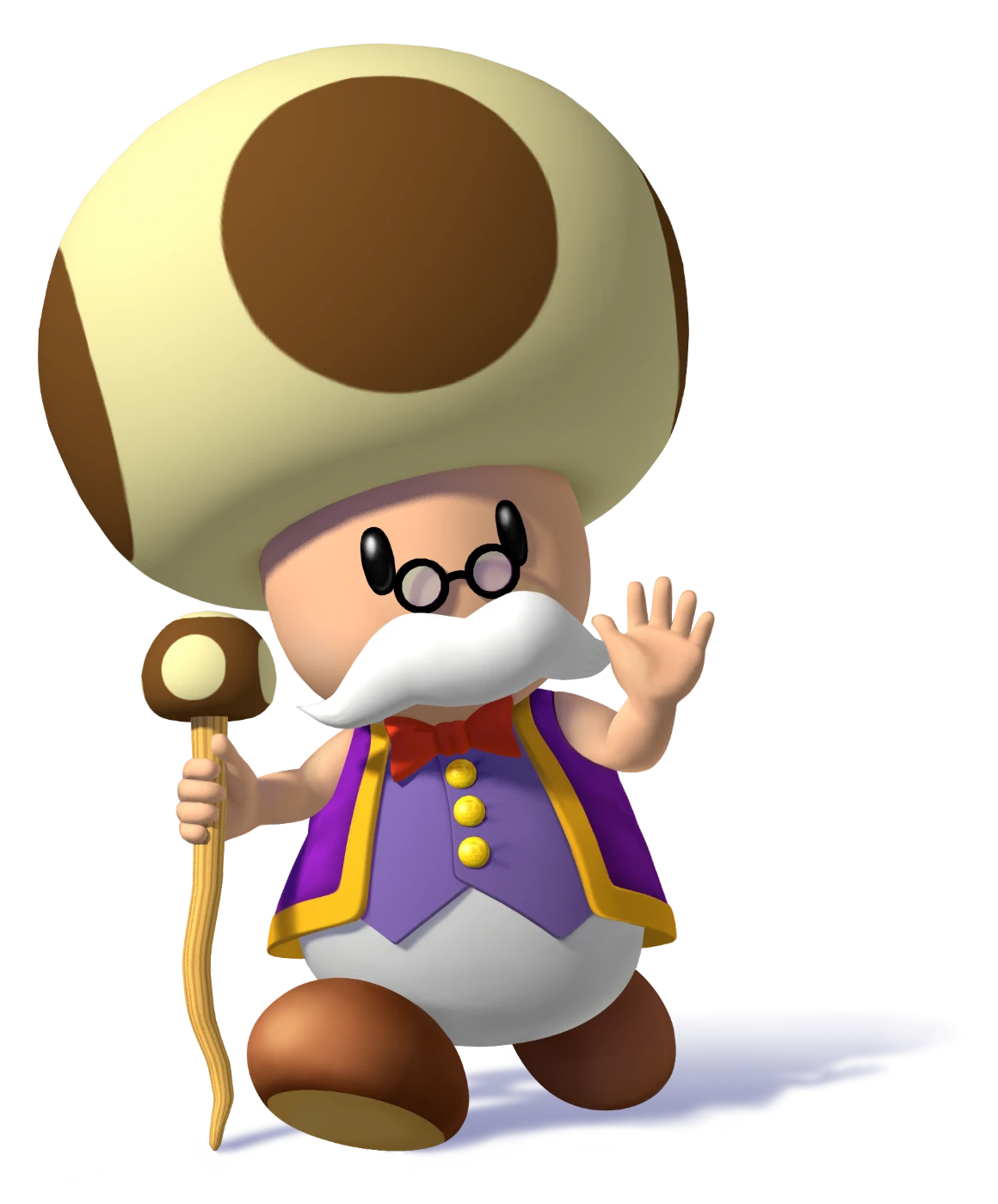 ToadsworthPeach’s steward (debut)
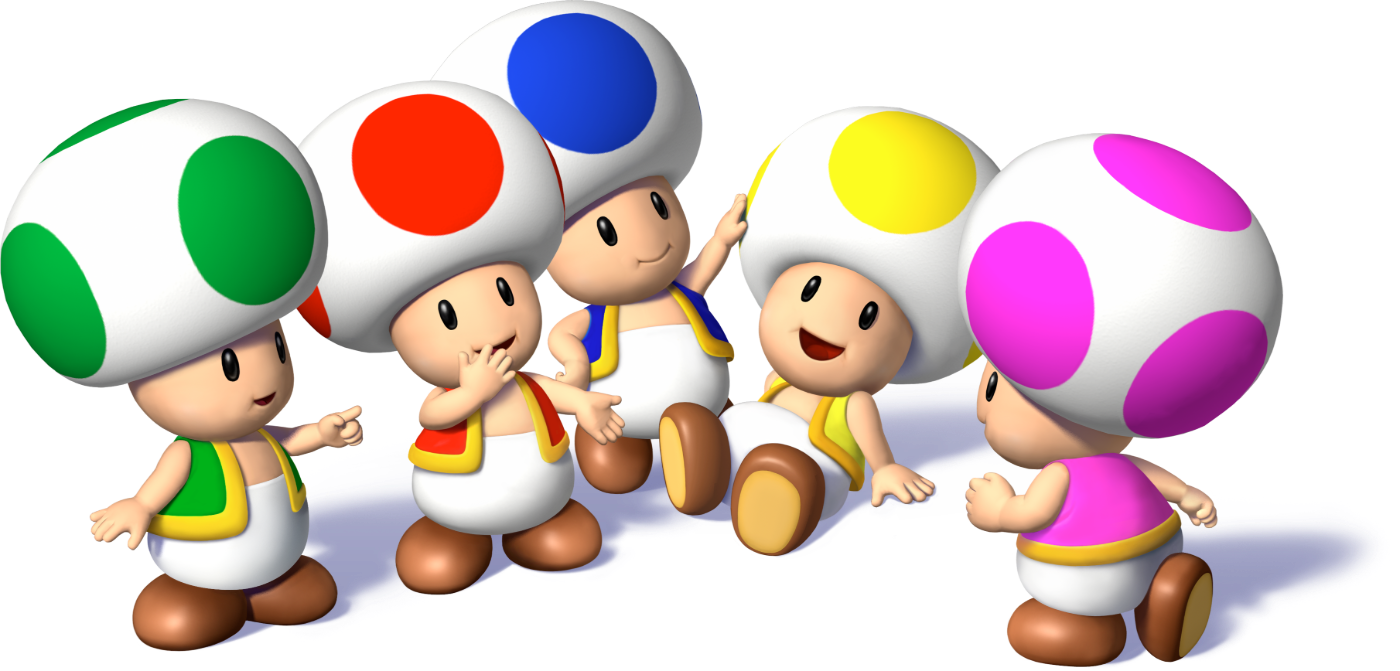 The ToadsThe entourage
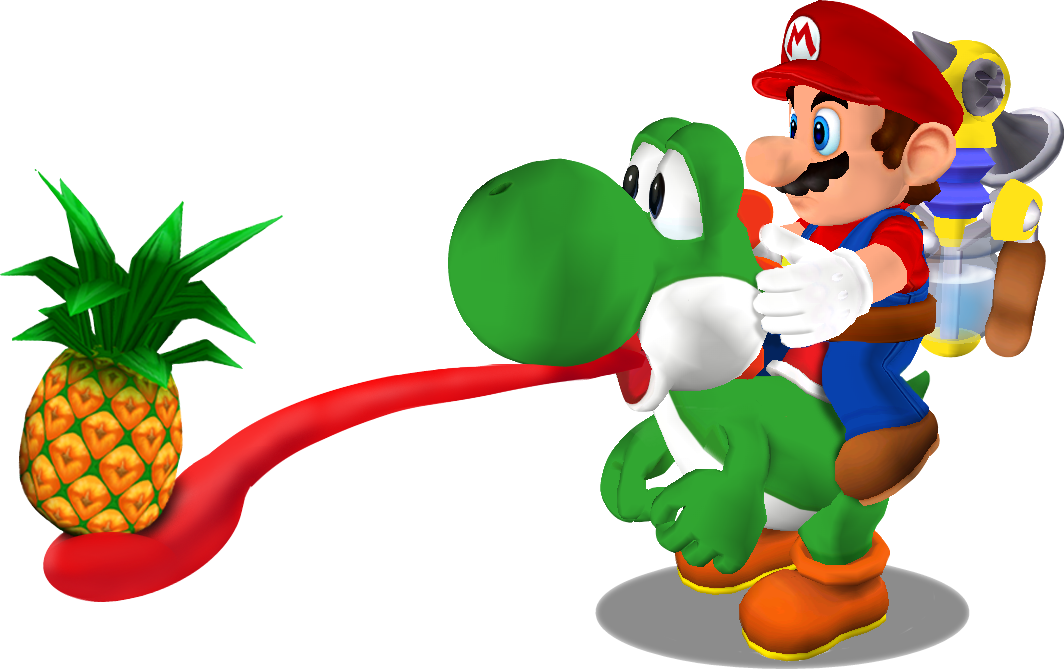 YoshiThe paint dinosaur
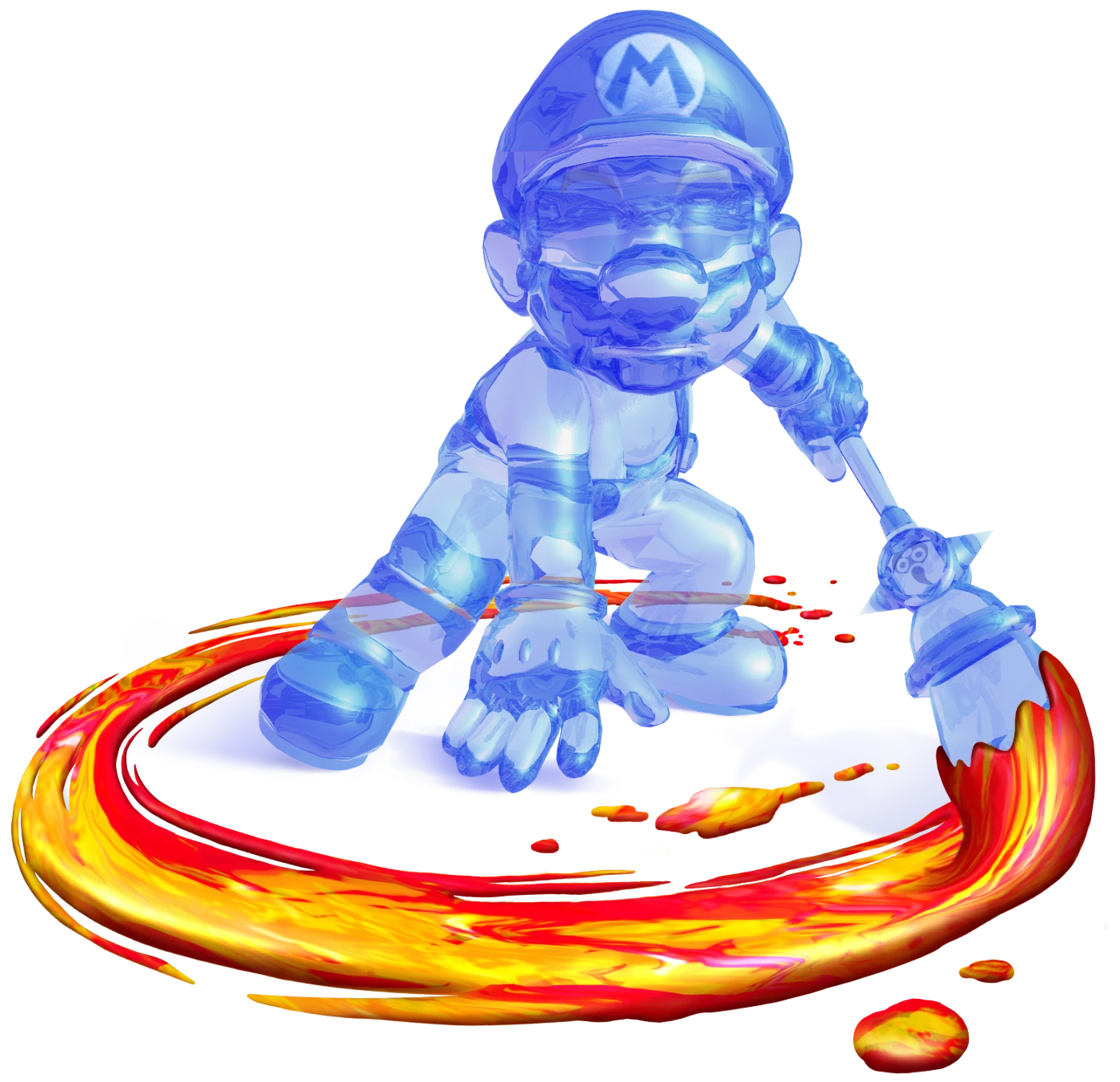 Shadow MarioThe impostor
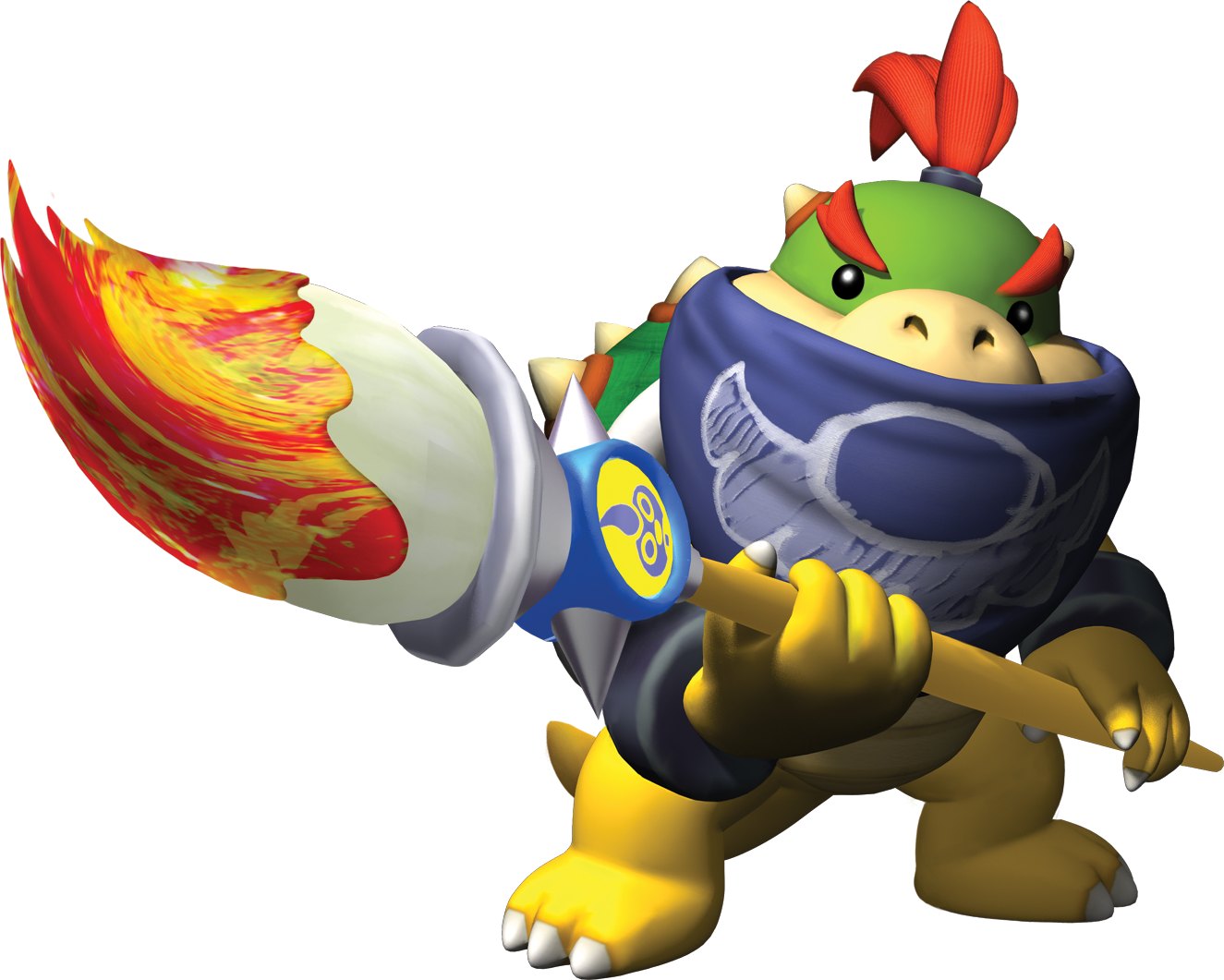 Bowser Jr.The real culprit (debut)
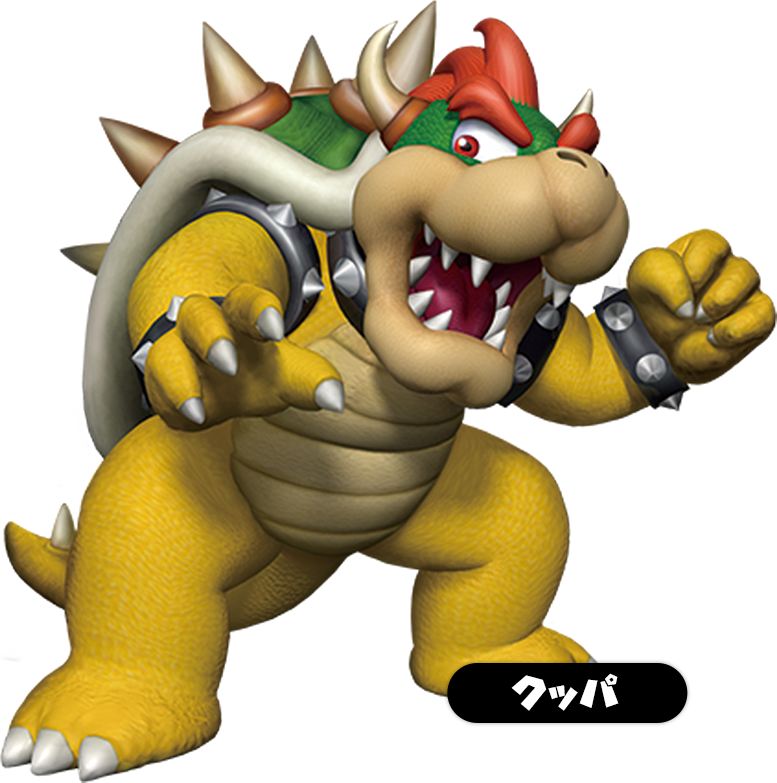 BowserThe dad in the hot tub
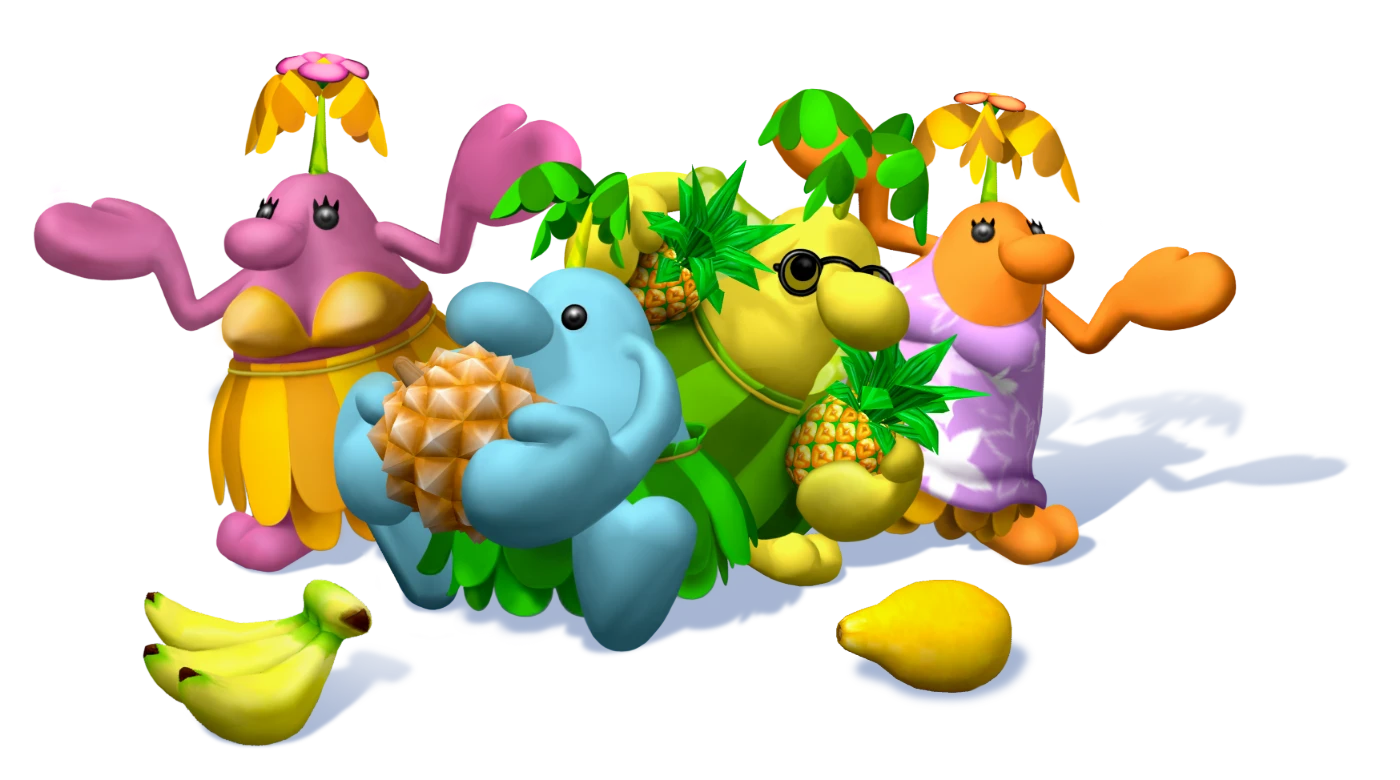 The PiantasIslanders (debut)
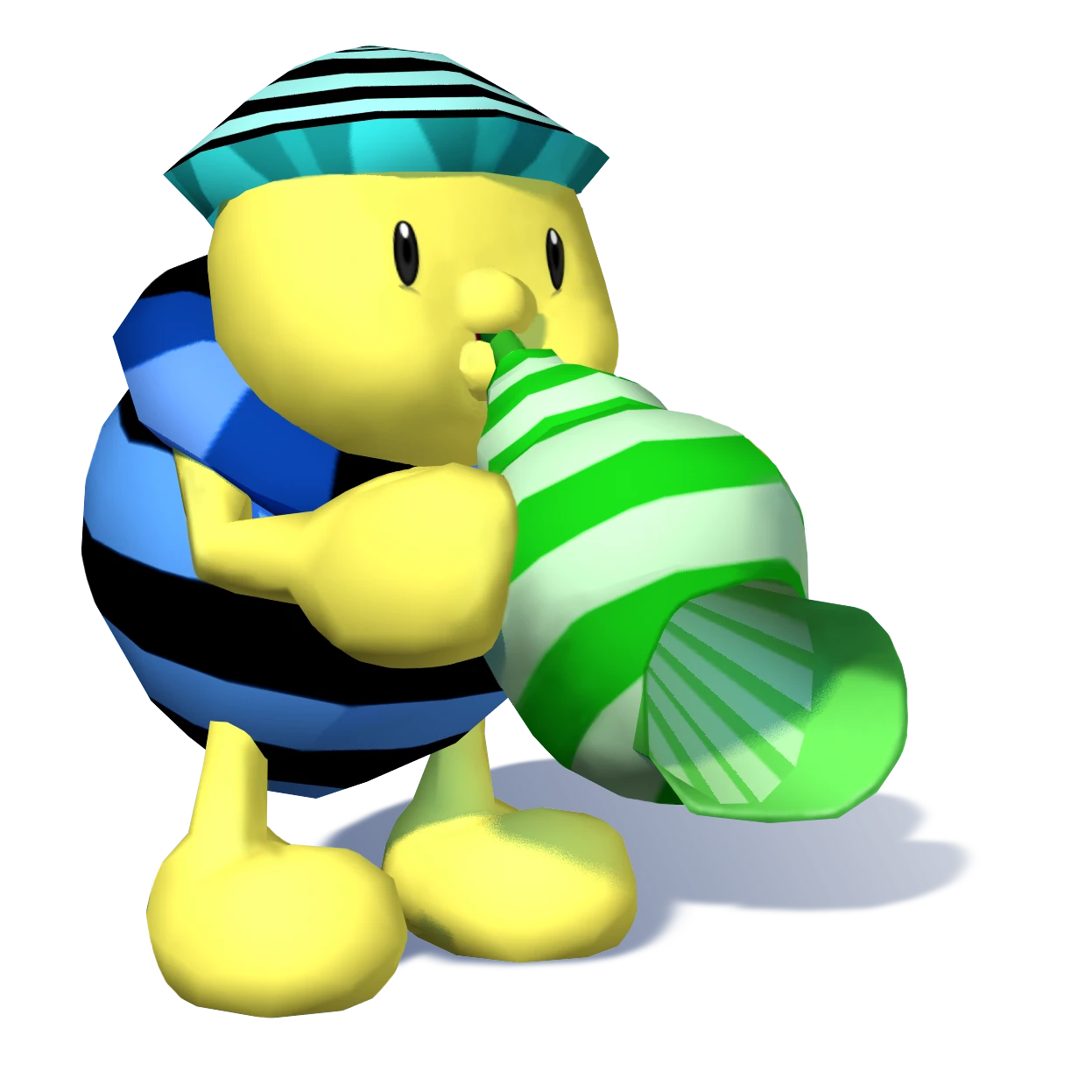 The NokisIslanders (debut)
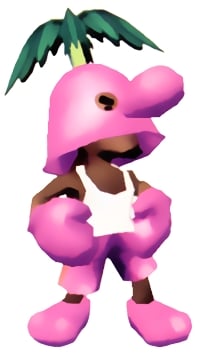 Il PiantissimoThe runner
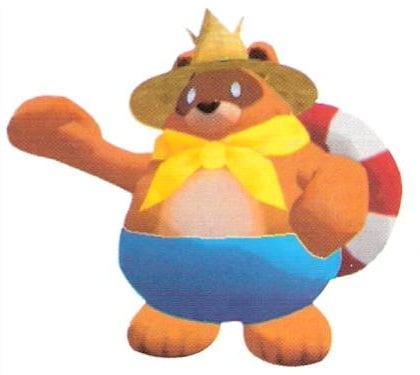 The RaccoonsShopkeepers
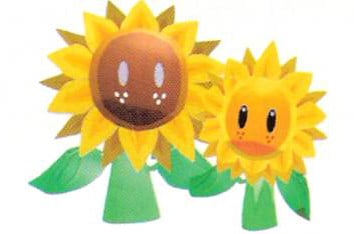 The Great Sunflower and the Sunflower KidsPinna Park locals
 Strollin’ StuEverywhereThe game’s Goomba: a wandering blob with a mask-like face, flattened by a jump or washed away.
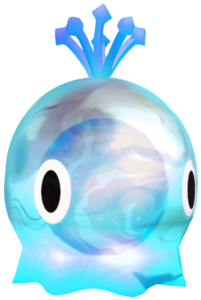 GooblePlaza, most areasA goop creature that rises out of pollution; spraying it leaves a water bottle.
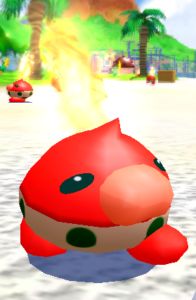 Smolderin’ StuPinna Park, Sirena BeachA Stu on fire; put it out before you stomp it.
 Swipin’ StuPinna Park, Sirena BeachWinged Stus; the green one steals Mario’s cap and the sun drains his health until he gets it back.
 PokeyBianco Hills to Pianta VillageThe cactus column, now with a flower on top; spray or knock the segments down.
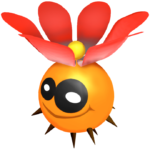 Pokey Pod and Seedy PodBianco Hills onwardsPokey heads that spit seeds; spray one into a wall for three coins.
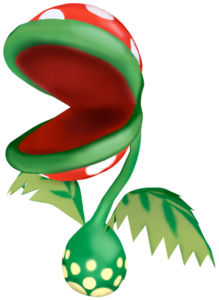 Piranha PlantBianco HillsGrows out of goop; spray water into its mouth.
 PiranhabonBianco HillsA goop-covered Piranha head that rolls down the slopes like a boulder, trailing goop.
 GlorpedoNoki BayBouncing goop globs fired from Monty Mole’s cannon; spray them until they burst.
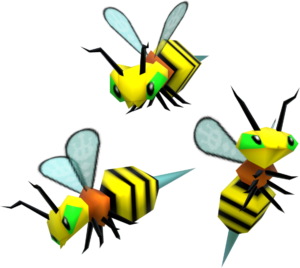 BeeBianco Hills, Pianta VillageHives that swarm when sprayed; Yoshi can eat them.
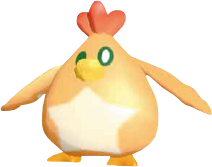 PlurpBianco Hills onwardsA bird that drops goop as it flies; spray it down and stomp it for a shower of coins.
 Wind Spirit (Cyclo)Bianco Hills to Pianta VillageA whirlwind that blows Mario off platforms.
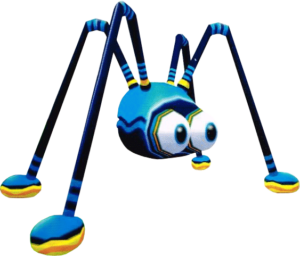 PondskaterBianco HillsSkims the lake; harmless to look at, not to touch.
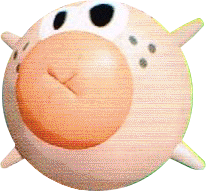 PoinkBianco Hills to Sirena BeachA floating, balloon-like pig that latches onto F.L.U.D.D.’s nozzle and can be fired as a projectile.
 Wire TrapBianco Hills to Noki BaySparks that slide along ropes and wires; time your crossing.
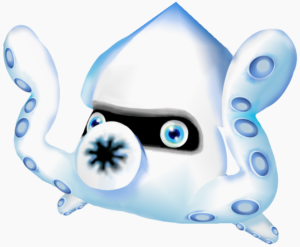 BlooperRicco Harbor to Noki BaySquid that spit black goop at Mario; Ricco’s surfing Bloopers are rideable.
 BloopadRicco HarborA small leaping Blooper; spray one and it flattens into a platform.
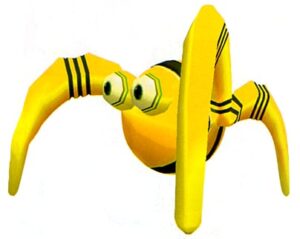 KlamberRicco Harbor to Pianta VillageA spider that scuttles along fences and nets; spray it off.
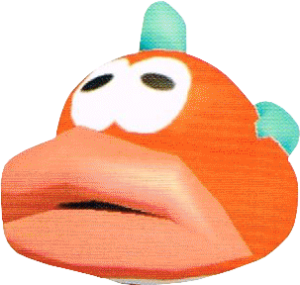 Cheep CheepRicco Harbor to Sirena Beach; lava variant on Corona MountainFish that leap at Mario, including pink ones and the Lava Cheep Cheeps of the volcano.
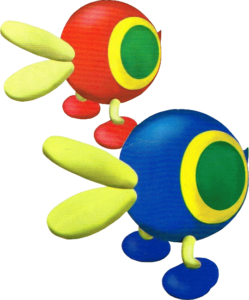 CataquackGelato Beach, Sirena BeachA duck-like beast that flips Mario skyward; the blue ones are a lift, the red ones hurt.
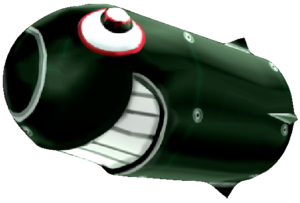 Bullet BillPinna Park to Corona MountainFired from Mecha-Bowser and the hot tub; gold and purple variants pay out coins, blue ones hold 1-Ups.
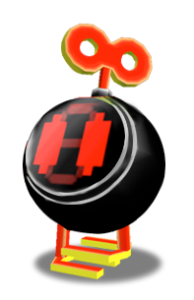 Bob-ombPinna Park, Noki BayThrown by Monty Mole; spray them to defuse, then throw them back.
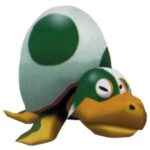 Snooza KoopaPinna ParkSleeping Koopas buried in the beach that wilt the Sunflower Kids; flip them with a ground pound.
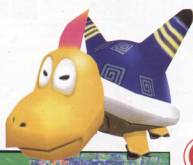 Electro-KoopaPinna Park to Pianta VillageBlue ones throw their electric shells; red ones climb the Ferris wheel cage. The Electro-Koopa King guards a Shine behind the park.
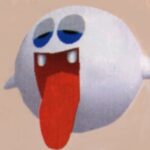 Boo, Sleepy Boo and Block BooSirena BeachHotel Delfino’s ghosts; pink Block Boos turn into platforms when sprayed.
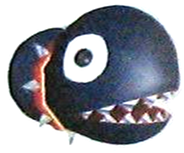 Chain Chomplet and Chain ChompPianta VillageRed-hot chomps that need cooling with water; the big one wants dragging to the hot spring.
 Proto Piranha (Polluted Piranha)Airstrip, Delfino Plaza, Bianco HillsA goop plant with a gaping mouth; three squirts down the throat.
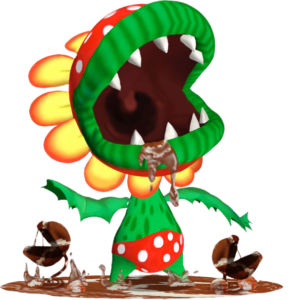 Petey PiranhaBianco Hills Ep. 2 and 5Fill his mouth with water until he keels over, then ground pound his belly. He returns airborne, spitting goop.
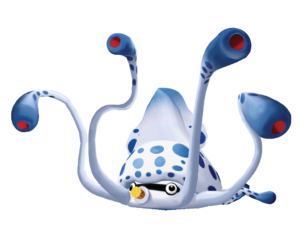 Gooper BlooperRicco Harbor Ep. 1 and 5, Noki Bay Ep. 2Yank off his tentacles, then grab his snout and let it snap back.
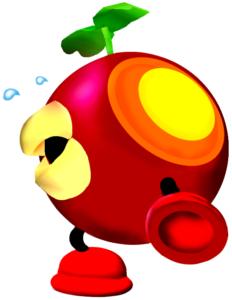 PlungeloGelato Beach Ep. 2Sucker-footed critters on the mirrors around the Shine Tower; spray them off balance, then slam the mirror to fling them off.
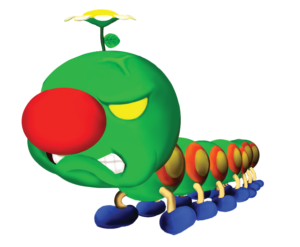 WigglerGelato Beach Ep. 3A rampaging giant; grow a Dune Bud in its path to flip it and ground pound its segments.
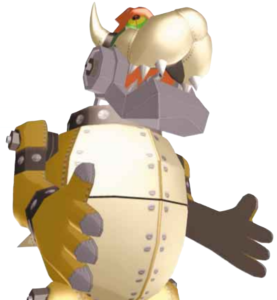 Mecha-BowserPinna Park Ep. 1Bowser Jr.’s robot, fought from a roller coaster with water rockets.
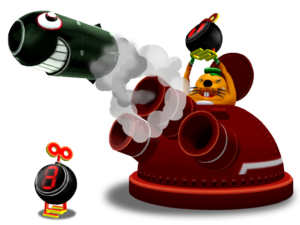 Monty MolePinna Park Ep. 2, Noki Bay Ep. 1Lobs Bob-ombs from a cannon or a cliff; soak them and throw them back.
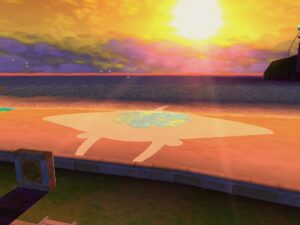 PhantamantaSirena Beach Ep. 1A ghostly manta that leaves electric goop and splits into smaller mantas as you spray it.
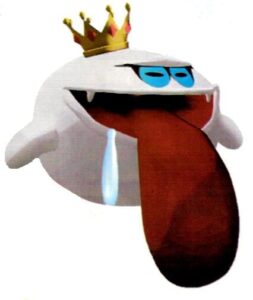 King BooSirena Beach Ep. 5Spins a fruit slot machine in Casino Delfino; set his tongue alight with a pepper, then hit him with fruit, three times.
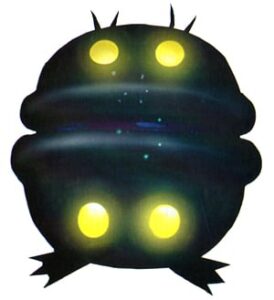 Eely-MouthNoki Bay Ep. 4A huge eel at the bottom of the bay whose rotten teeth are poisoning the water; brush them clean.
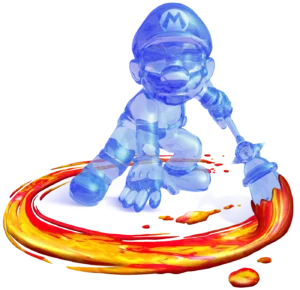 Shadow MarioEvery area, Episode 7, and the plazaChase and soak.
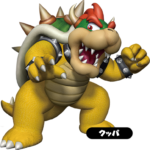 Bowser and Bowser Jr.Corona MountainRocket Nozzle ground pounds on the five hot-tub platforms while dodging fire and Bullet Bills.