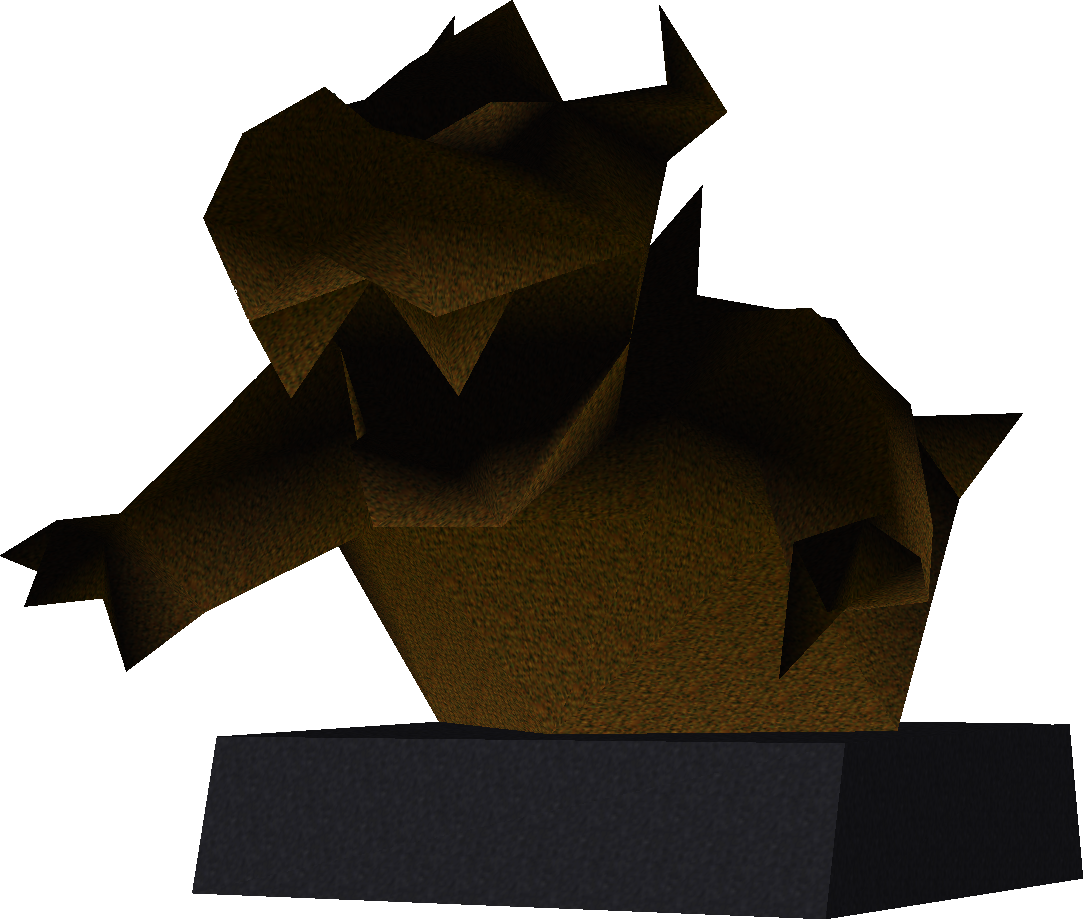
Nintendo 641996Kart racingNintendo EAD9.87 million soldFour-player split screen16 courses, 4 battle arenasFirst blue shellMirror Mode debut
Mario Kart 64
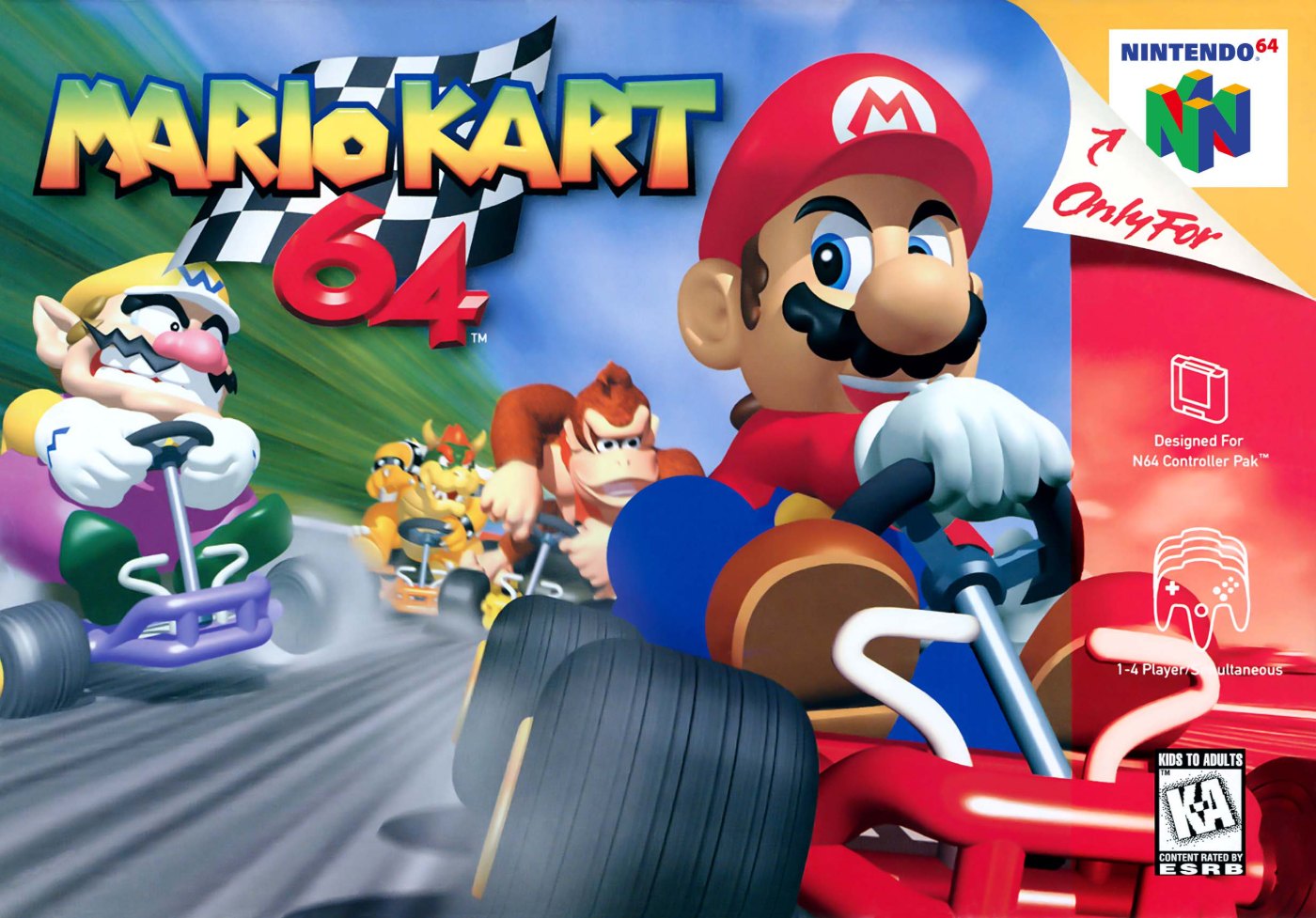
“Welcome to Mario Kart!” With those four words, the series left the flat world of Mode 7 behind. Mario Kart 64 arrived in Japan on 14 December 1996, in North America on 10 February 1997 and in Europe that June, and gave the karts real hills to climb, tunnels to dive into and a train to race across the desert. Director Hideki Konno’s team built 16 full-size courses in four cups and drew the eight drivers as pre-rendered sprites so that the console could keep up, which is also what made its greatest trick possible: four players on one television. This is the game that introduced the Spiny Shell (the dreaded blue one), drift Mini-Turbos with coloured smoke, weight classes, voices, staff ghosts and the mirrored Extra class, and that swapped Koopa Troopa and Donkey Kong Jr. for Wario and Donkey Kong. It turned Block Fort into a household name, gave speedrunners the Wario Stadium and Rainbow Road skips, and sold 9.87 million copies, second only to Super Mario 64 on the Nintendo 64. Friendships have never quite recovered.
Courses:16 race courses in 4 cups of four, plus 4 battle courses; 50cc, 100cc, 150cc and the mirrored Extra class
Sales:9.87 million worldwide, the second-best-selling Nintendo 64 game
Re-releases:iQue Player (China, 2003), Virtual Console (Wii 2007, Wii U 2016), Nintendo Switch Online + Expansion Pack (2021)
Advertisement
Overview
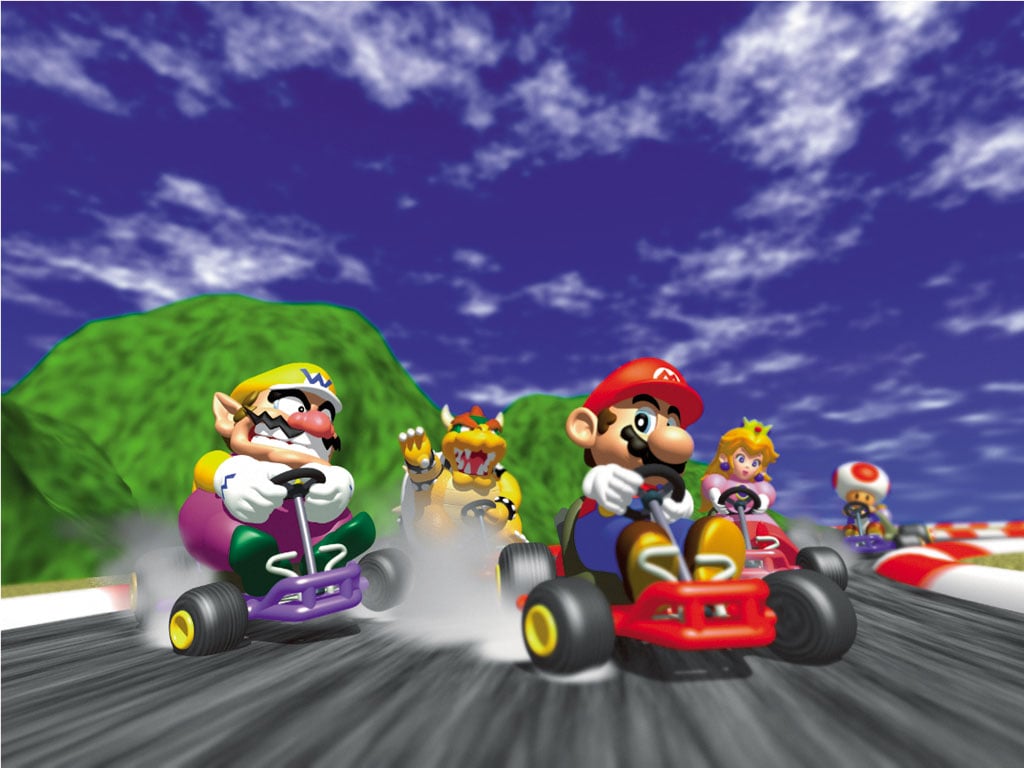
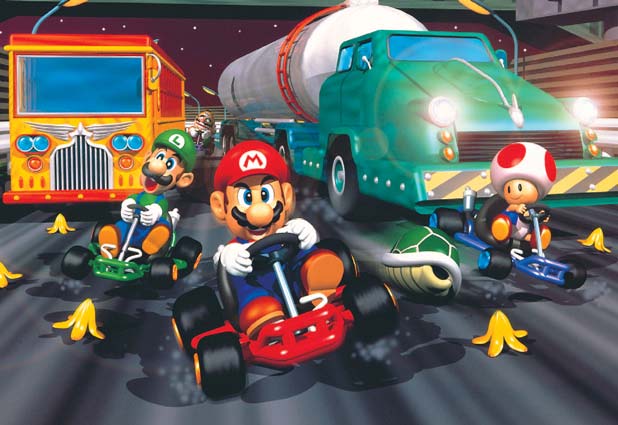
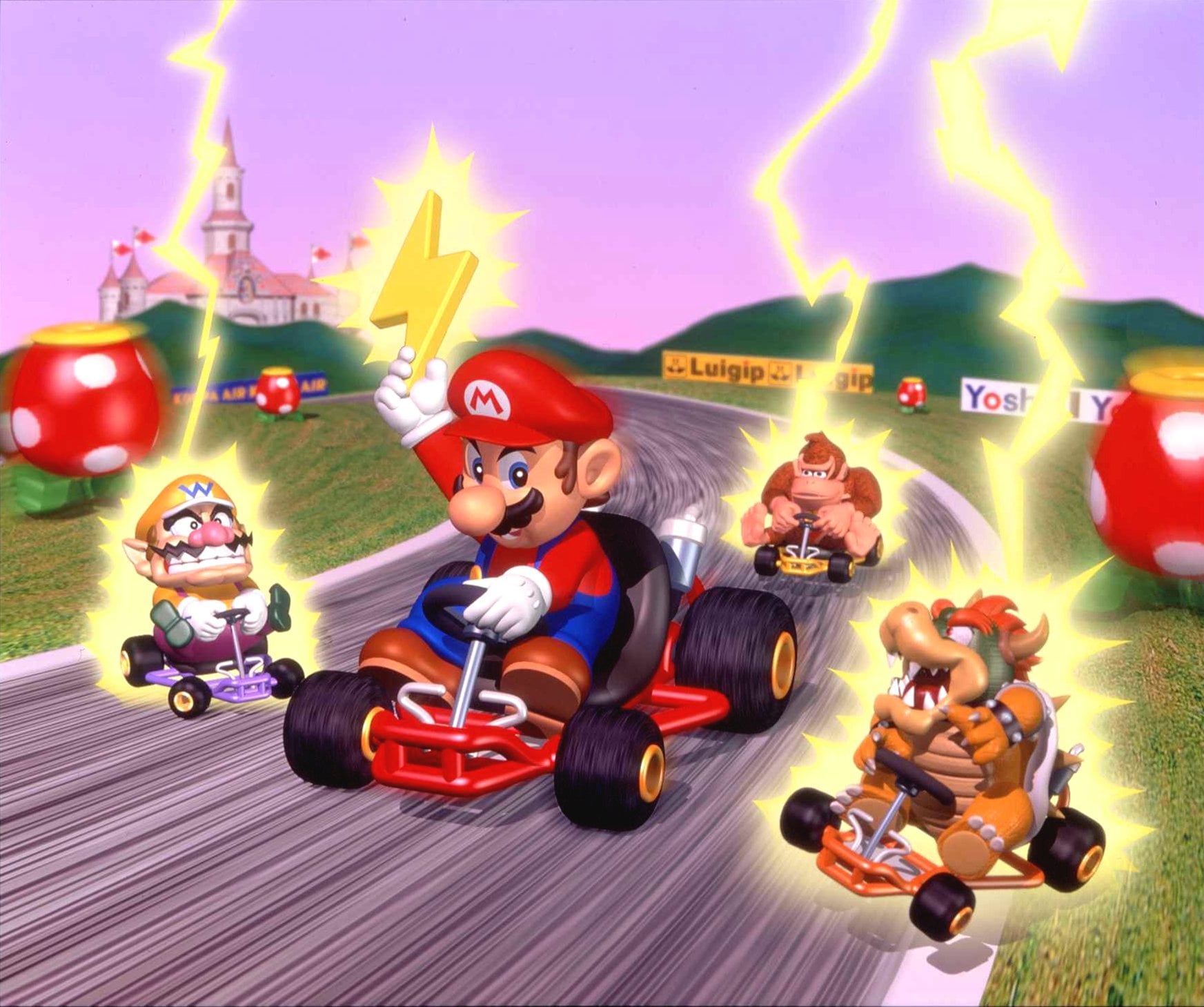
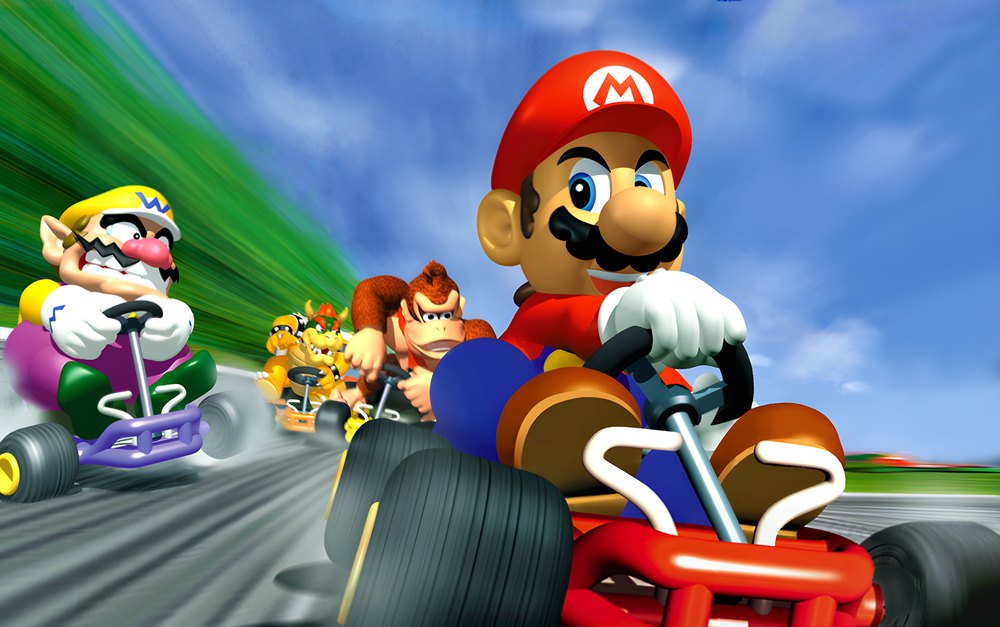
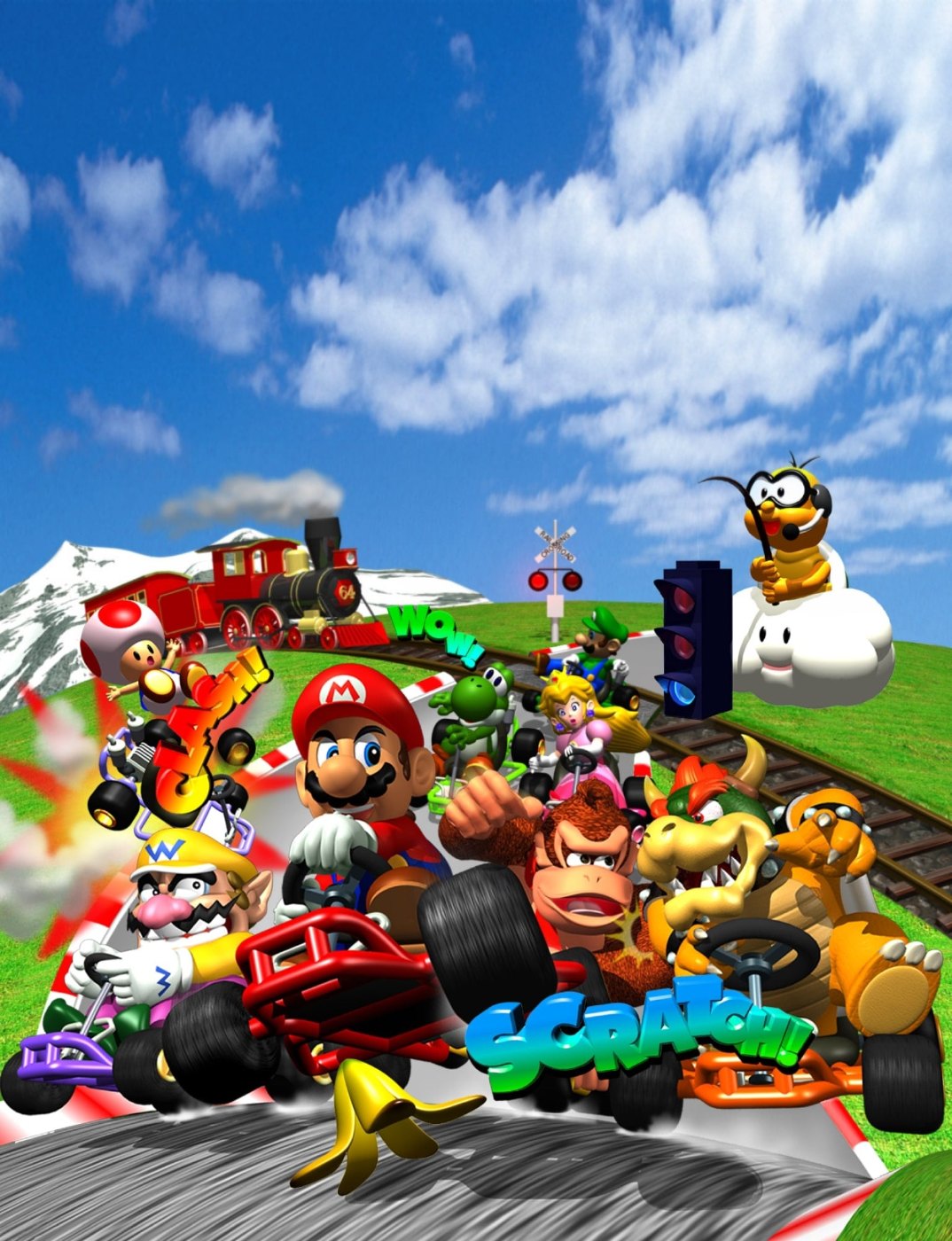
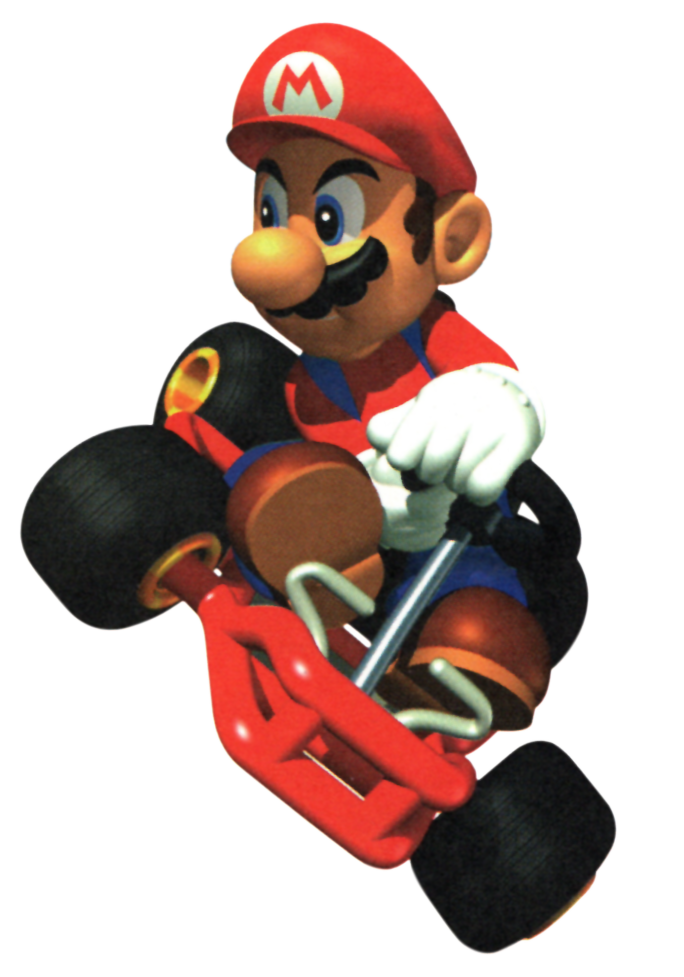
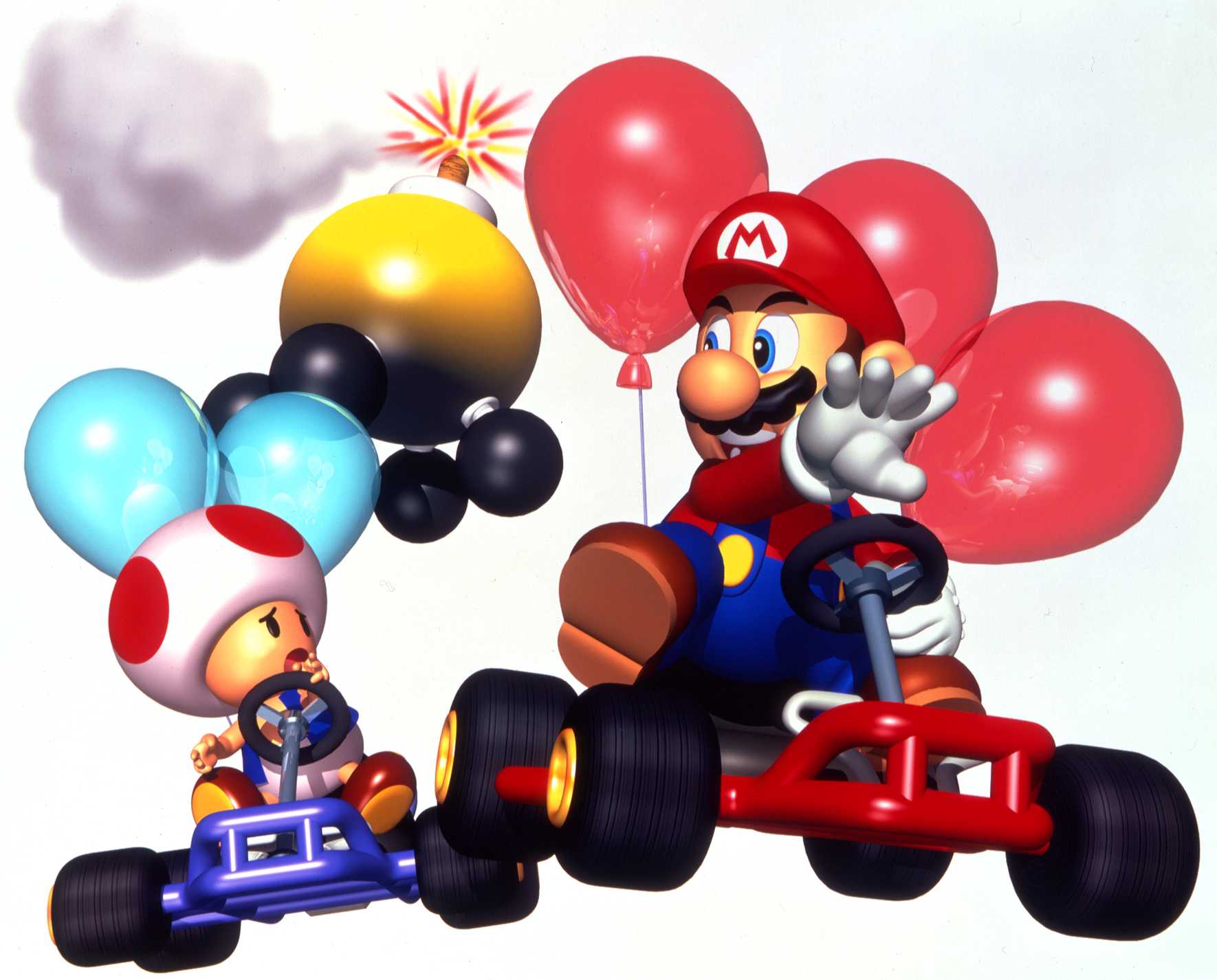
The illustration behind the box art: the whole grid, mid-race.
Super Mario Kart was a brilliant idea squeezed into flat squares. Mario Kart 64 is what happened when the squares were taken away. Its sixteen circuits are proper places with hills, cliffs, bridges, tunnels and banked corners: a beach with a cave behind a waterfall, a motorway full of lorries, a canyon you can fall into, a castle full of Thwomps and, to finish, a two-kilometre ribbon of glass looping through space. Where the first game had four Mario Circuits, this one has no two courses alike, and each of the eight drivers has a home track.
The racers themselves are not polygons. To keep eight karts on screen at once, each character was modelled in 3D, rendered from every angle and stored as a set of flat pictures that always turn to face the camera. It is a cheat, but it is the cheat that made the headline feature affordable: split the screen four ways and the Nintendo 64 could still cope. Versus races and balloon battles for three and four players, on the same full courses as the single-player game, made this the first Mario game of any kind to let more than two people play at once, and they are the reason this cartridge stayed in so many machines for so many years.
It also rewrote the rule book. Characters now belong to light, medium and heavy classes that really do drive differently. Holding a slide and waggling the stick charges a Mini-Turbo, signalled by smoke that turns yellow and then red. Items can be dragged behind the kart as a shield, shells come in orbiting threes, and somewhere near the back of the pack somebody is being handed a blue Spiny Shell with the leader’s name on it. Win everything on 150cc and the game flips all its courses left to right for a fourth class called Extra, the series’ first mirror mode.
Reviewers in 1997 were divided about the one-player Grand Prix (too easy, said some; too fond of letting the computer catch up, said others) and nearly unanimous about the multiplayer. The public voted with its wallet: it was the best-selling game in the United States in the first three months of 1997 and went on to sell 9.87 million copies worldwide. Every one of its sixteen courses has since been rebuilt for a later Mario Kart, and you can still play the original, with online races, on Nintendo Switch Online.
Put the pedal to the metal in this successor to that Super NES classic, Super Mario Kart. Mario Kart 64 boasts great graphics, tons of unique power-ups and a laugh-packed 3D version of the legendary Battle Mode.
Mario Kart 64 races eight familiar faces, including Mario, Bowser and Yoshi, through four progressively tough four-track cups. Wide curves and gentle banks mark the Mushroom Cup tracks. Your race gets notably tougher on the Flower Cup, though – you’ll have to dodge lorries rumbling on Toad’s Turnpike and bounding boulders on fog bound Choco Mountain! Star Cup tracks range from the icy surfaces of Sherbet Land to the lava lakes of Bowser’s Castle. The true test of karting competence, though, comes on the four courses in Special Cup. Zip through the dark caves and green hillsides of Donkey Kong’s Jungle Parkway, cling to the sheer cliffs of Yoshi Valley and hustle over haunted Banshee Boardwalk before tackling the longest track in the game: the neon-lit Rainbow Road!
— Official description (Nintendo UK, 1997)
Why Mario Kart 64 matters to Mario fans
Half the things people mean when they say “Mario Kart” start on this cartridge. The blue shell. The Mini-Turbo you charge in a drift. Mirror Mode. Weight classes. Four-player battles. Character voices, staff ghosts and the fake item box. It is the first Mario Kart with Wario and Donkey Kong, and the game that gave Luigi a voice and a racetrack of his own in a year when he was missing from Super Mario 64. Its courses are among the most revisited in the series: Moo Moo Farm, Kalimari Desert, Toad’s Turnpike, Yoshi Valley and the rest have all come back, and with Mario Kart World the set was finally completed when Wario Stadium returned after nearly thirty years.
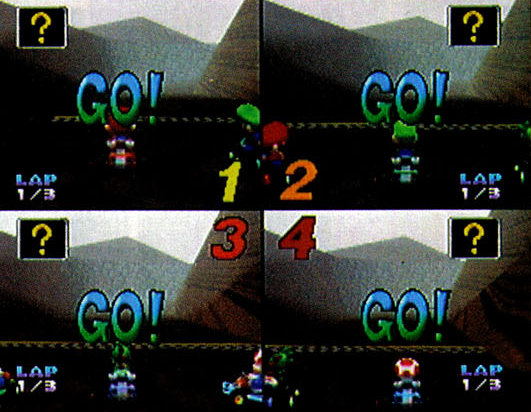
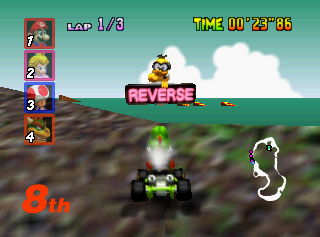
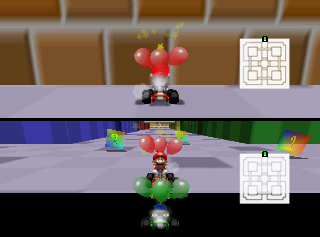
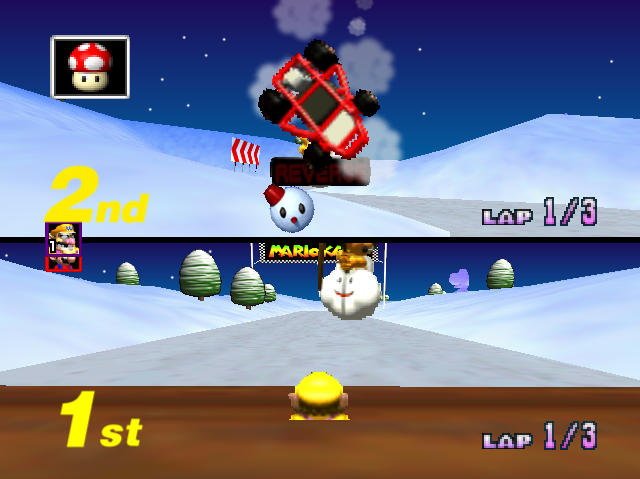
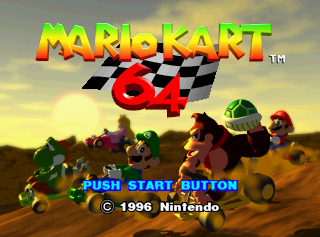
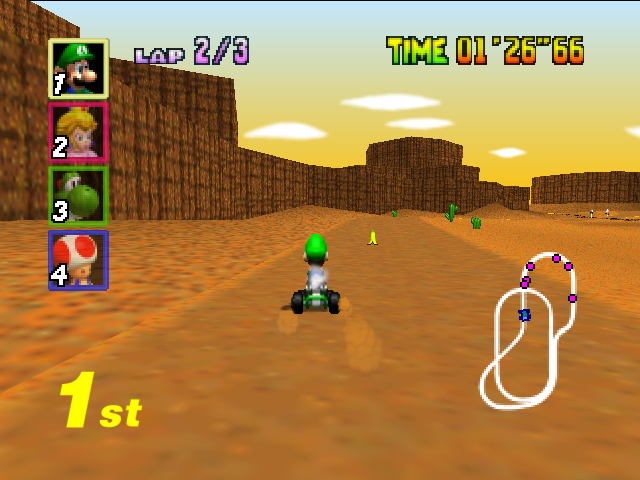
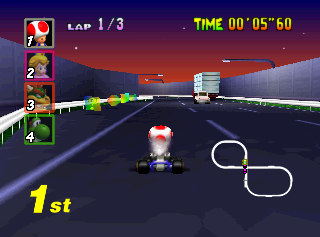
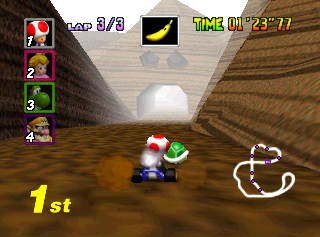
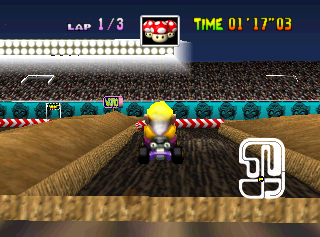
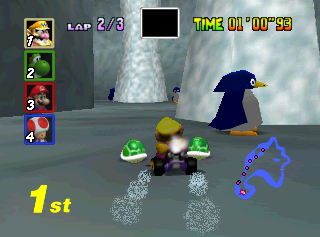
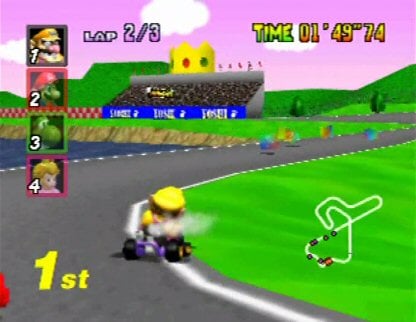
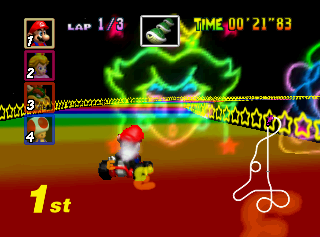
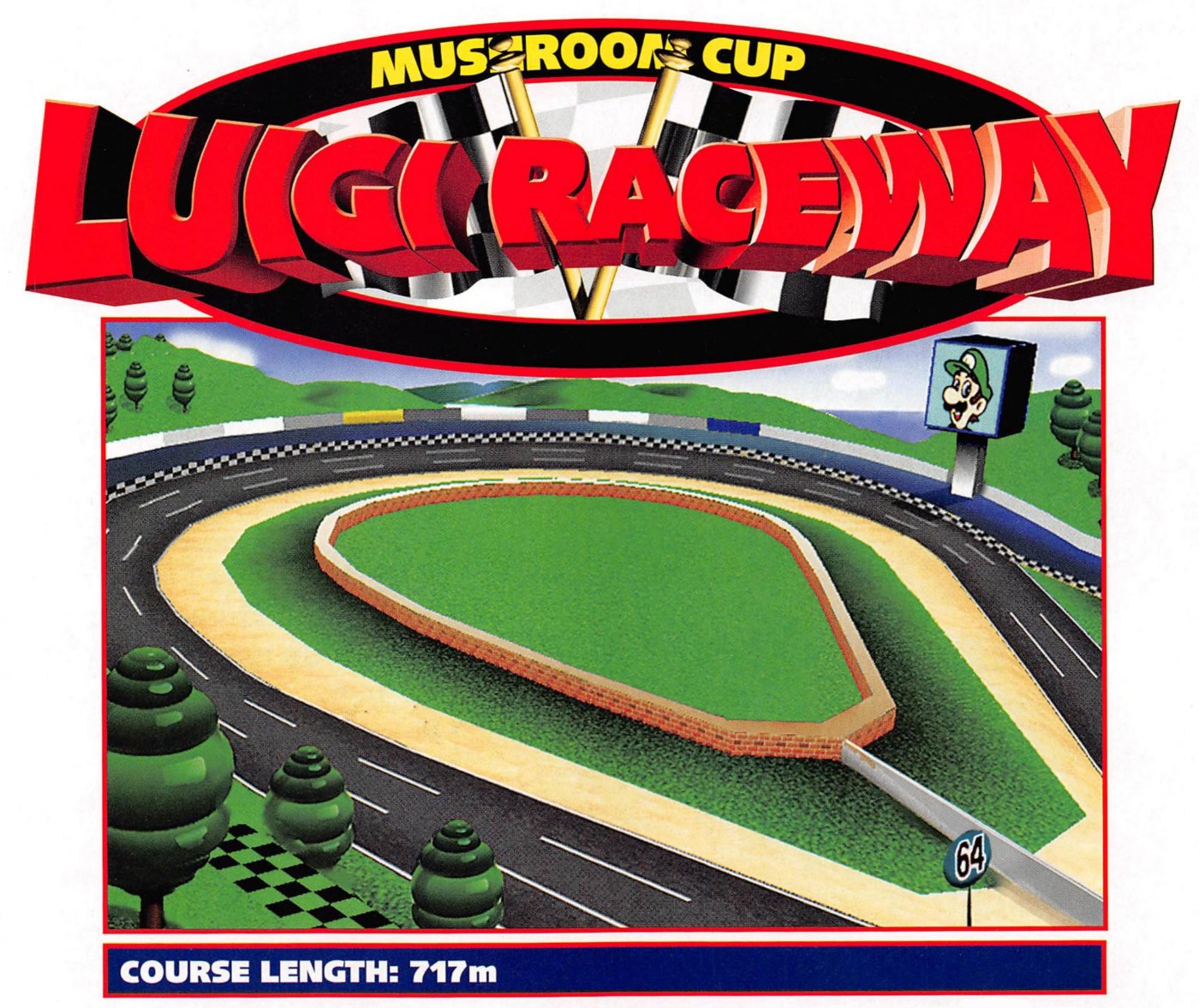
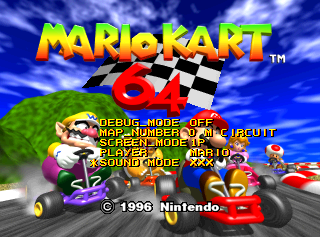
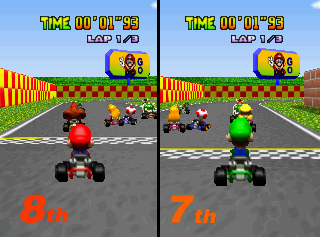
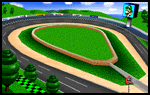
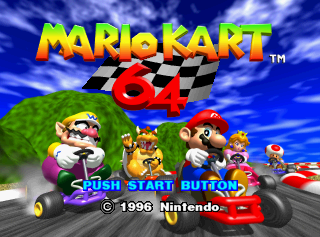
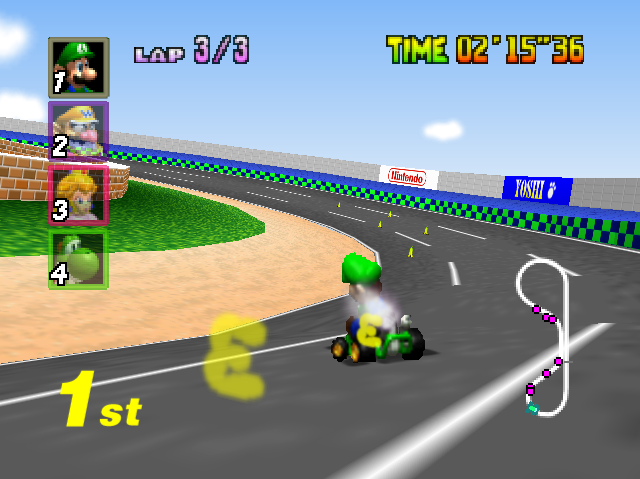
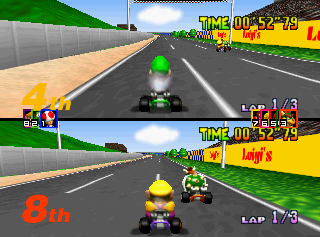
The title screen. Outside Japan, Mario welcomes you in person.Luigi Raceway, first course of the Mushroom Cup.Two-player Grand Prix: Luigi and Wario share the screen.Rainbow Road, two kilometres of it.
“We wanted to make a game where anyone, from age 3 to 100, could jump in and start competing right away”
Shigeru Miyamoto, interviewed for Nintendo’s official Japanese guidebook to Mario Kart 64 (1996), in the English translation by Shmuplations.
Shigeru Miyamoto, the game’s producer, explaining in 1996 why the team kept the basics of Super Mario Kart almost untouched and spent its effort on what the new hardware could add, four-player racing above all.
Quick Answers
The questions people ask most about Mario Kart 64, answered briefly here and in depth further down the page.
When did Mario Kart 64 come out?
Japan: 14 December 1996. North America: 10 February 1997. United Kingdom: 13 June 1997, with the rest of Europe on 24 June 1997, and Australia in July or August 1997. More →
How many courses are there?
Sixteen race courses in four cups of four (Mushroom, Flower, Star and Special), from the 527-metre Moo Moo Farm to the 2,000-metre Rainbow Road, plus four battle courses: Big Donut, Block Fort, Double Deck and Skyscraper. All four cups are open from the start. More →
Who are the drivers and which is best?
Lightweights Peach, Toad and Yoshi; middleweights Mario and Luigi; heavyweights D.K., Wario and Bowser. According to the game’s own data the lightweights have the best acceleration and a slightly higher top speed, while the heavyweights win every collision. More →
How do you unlock Mirror Mode?
Win the gold trophy in all four cups on 150cc. A fourth class called Extra appears, which runs every course flipped left to right at 100cc speed, and the title screen changes to a new picture. More →
Is this where the blue shell comes from?
Yes. The Spiny Shell makes its first appearance here. It chases the driver in first place along the ground, flattening anyone else in its path, and it can be destroyed by a wall. More →
How do you do a Mini-Turbo?
Hop with R and keep it held to slide, then push the stick away from the turn and back again. The smoke turns yellow and, after a second wiggle, red. Let go of R on red and the kart surges forward. More →
What are the famous shortcuts?
Hopping the rail at the start of Rainbow Road to drop on to a later part of the track; bouncing over the wall on Wario Stadium’s first hill; the cave behind the waterfall on Koopa Troopa Beach; and the railway tunnel on Kalimari Desert. More →
Was Kamek really going to be playable?
He was. Early versions, shown under the title Super Mario Kart R, have the Magikoopa Kamek on the driver-select screen in the slot that Donkey Kong fills in the finished game. More →
How many copies did it sell?
About 9.87 million worldwide, making it the second-best-selling Nintendo 64 game after Super Mario 64. It passed a million copies in the United States within two months. More →
Where can I play it today?
It has been part of the Nintendo 64 library of Nintendo Switch Online + Expansion Pack since October 2021. Earlier it was sold on the Virtual Console for Wii (2007) and Wii U (2016). None of the re-releases can save Time Trial ghosts, because they do not emulate the Controller Pak. More →
Cups & Courses
The racers line up under Lakitu’s lights in Nintendo’s Kalimari Desert artwork.
There is no story here beyond the oldest one in sport: sixteen races, four trophies, and somebody has to win them. The courses are grouped into the Mushroom, Flower, Star and Special Cups, four to a cup, and unusually for the series every cup is open from the moment you switch on. Each can be run at 50cc, 100cc and 150cc, and a clean sweep of gold at 150cc unlocks Extra, in which all sixteen are mirrored.
Every one of the eight course families from Super Mario Kart has a descendant (Donut Plains became Moo Moo Farm, Ghost Valley became Banshee Boardwalk, Vanilla Lake became Sherbet Land and so on), but nothing is repeated. In place of numbered variations there are sixteen one-offs, eight of them built around a particular driver. Lengths below are Nintendo’s own figures.
Mushroom Cup: a speedway, a farm, a beach and a train
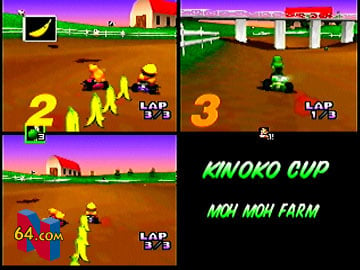
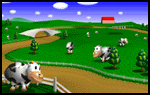
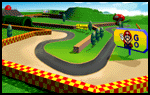
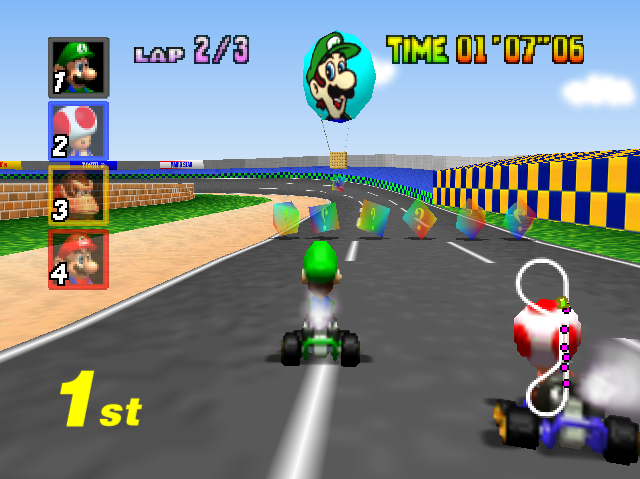
Luigi Raceway opens the game in a packed oval speedway, its grandstand crowned with a giant green cap and a four-sided screen showing Luigi’s face. It is a gentle introduction with one sly secret: on the second and third laps a Luigi balloon dips towards the track with an Item Box dangling beneath it, and that box always contains a Spiny Shell. Moo Moo Farm, the shortest course in the game at 527 metres, is a bumpy dirt loop past fields of cows, with Chubbies (Monty Moles to you and me) popping out of the ground on the inside of the bends.
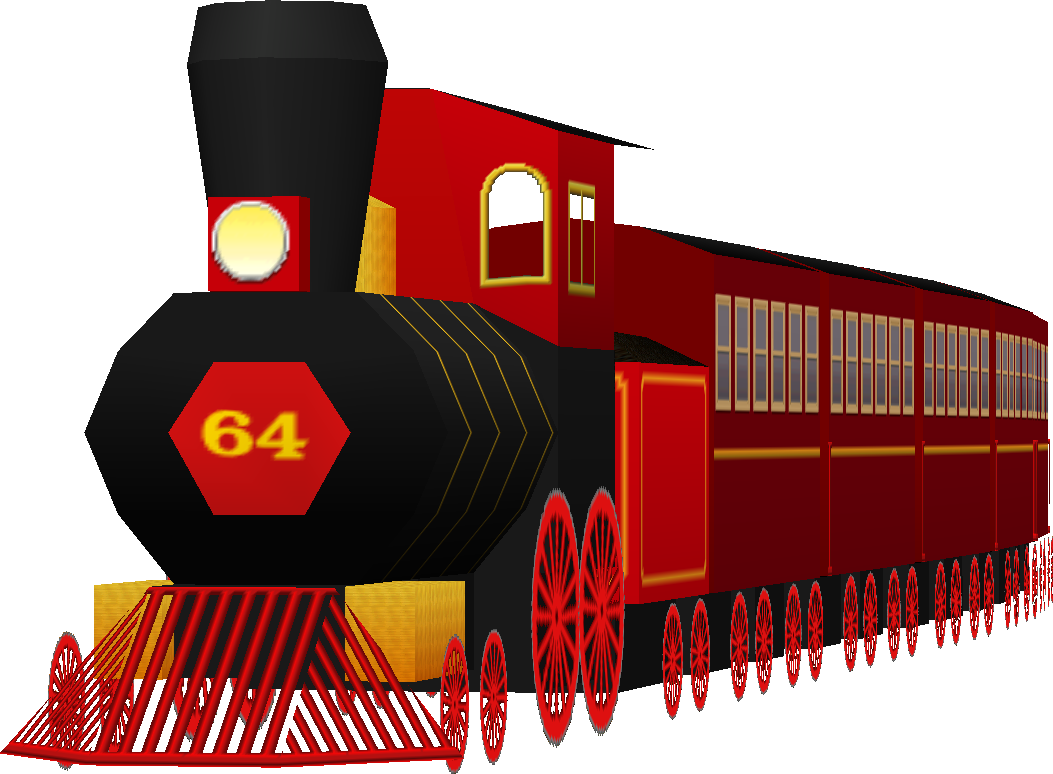
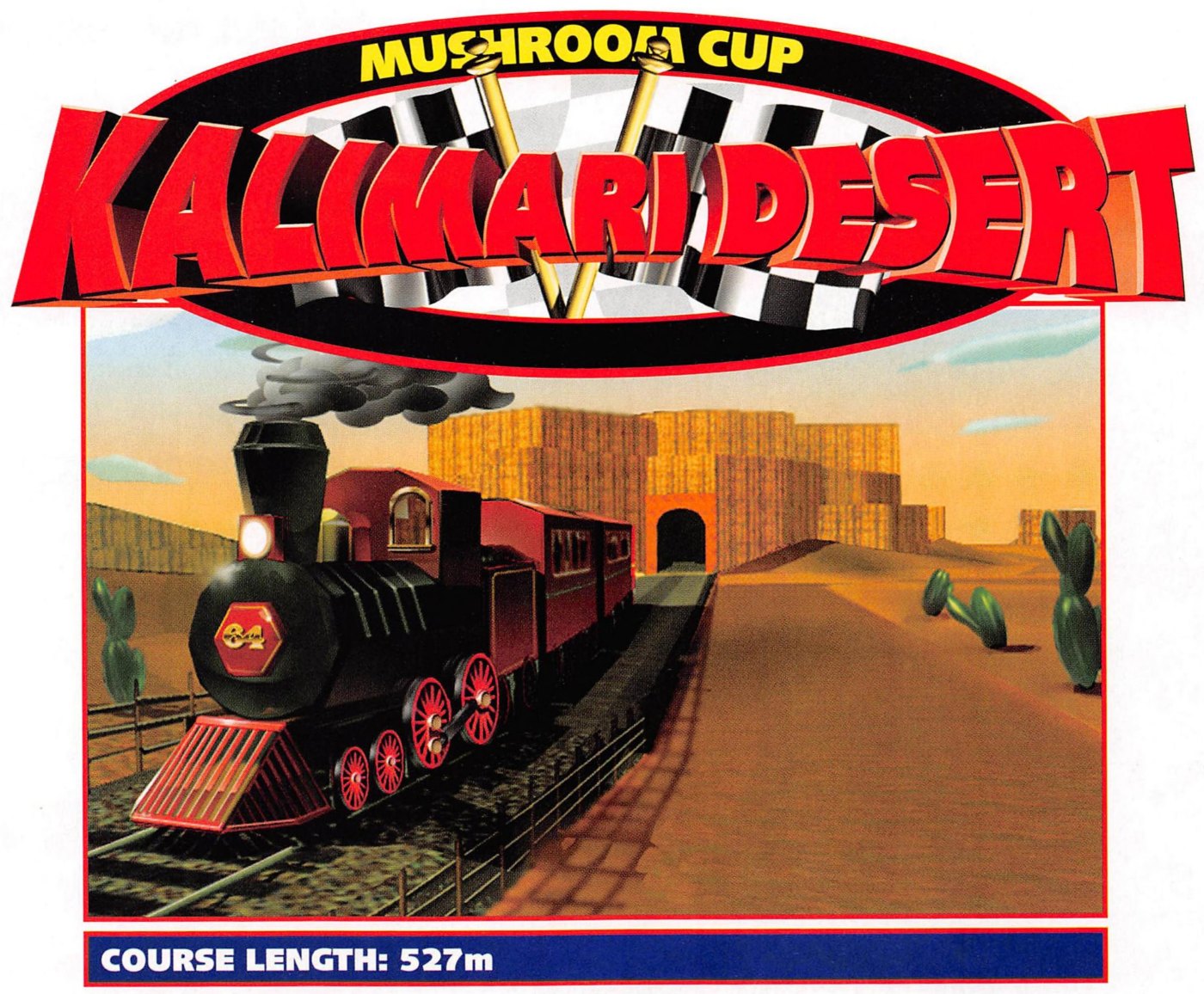
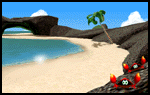
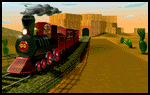
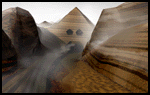
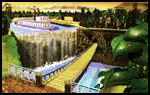
Koopa Troopa Beach circles a giant rock carved like a Koopa, between cliffs and surf, with crabs on the sand and a ramp that, hit with a Mushroom or a well-timed hop, fires you into a cave and out through a waterfall. Then comes the first classic. Kalimari Desert is a dusty loop crossed twice by a railway, and two steam trains run round it for the whole race. Arrive at a crossing at the wrong moment and you can wait (the computer drivers do), gamble, or be flung into the air.
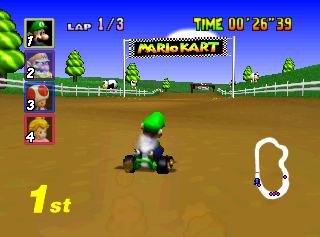
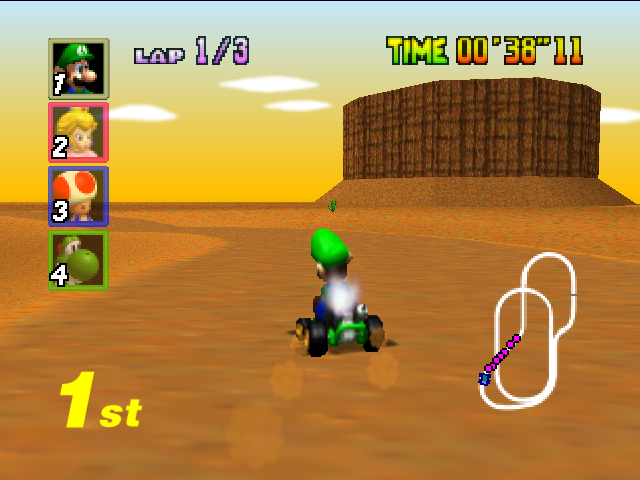
The Mushroom Cup.Luigi Raceway.Moo Moo Farm.Koopa Troopa Beach.Kalimari Desert, with a train due.
Flower Cup: traffic, snowmen and falling rocks
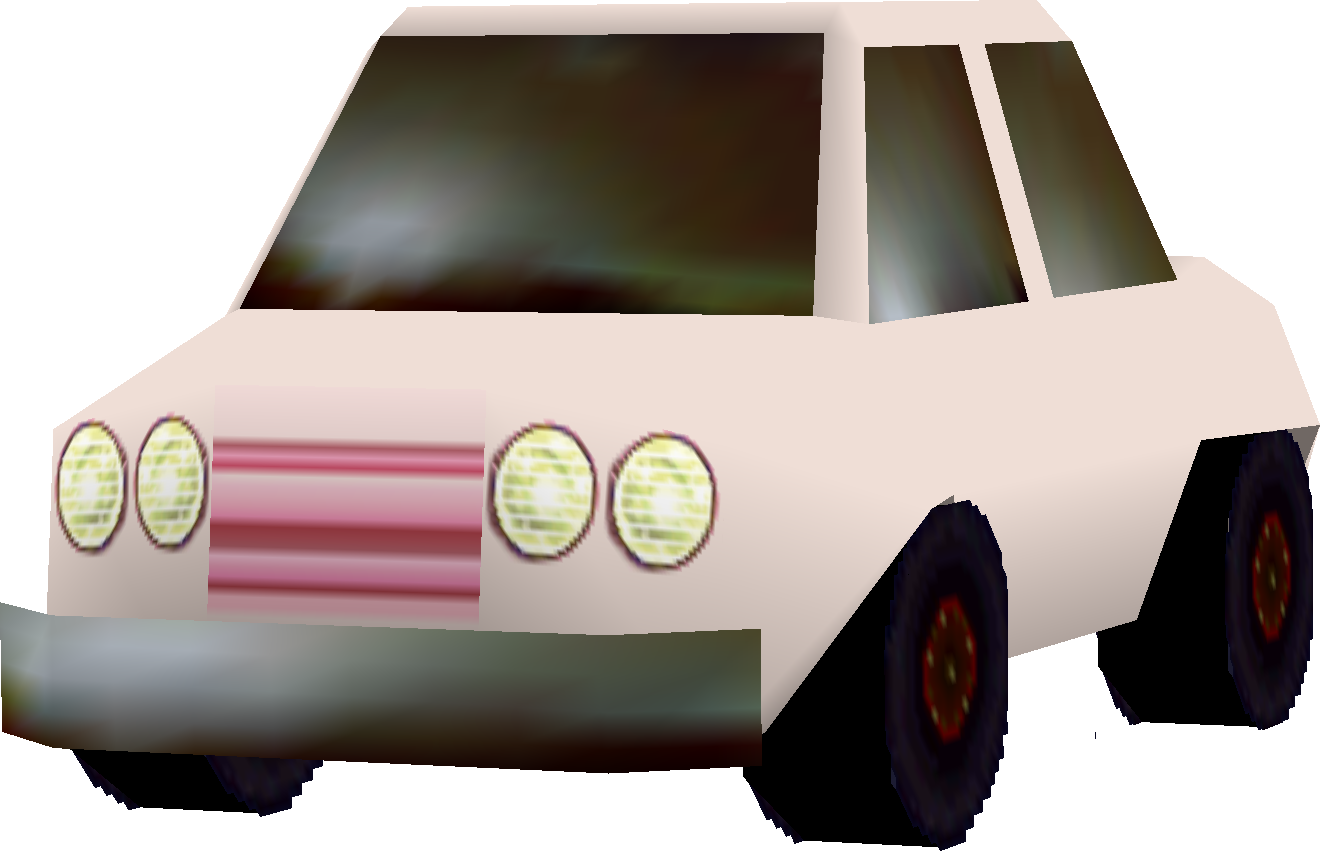
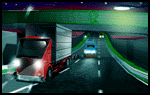
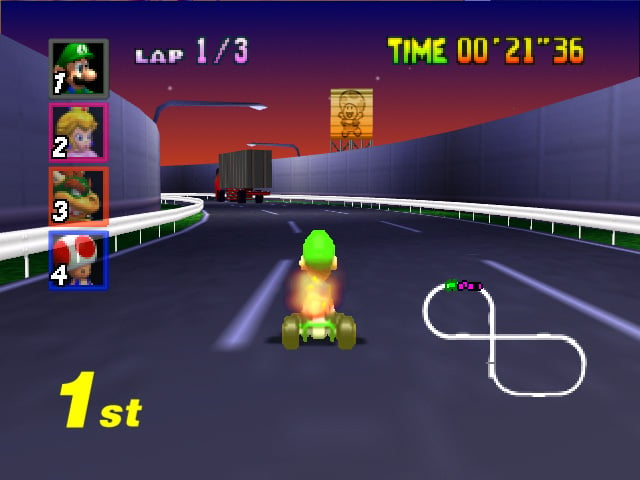
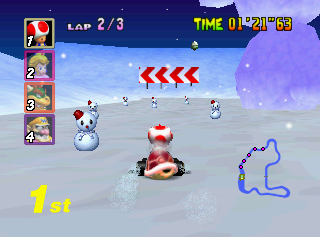
Toad’s Turnpike is a figure-of-eight motorway at dusk, and you share it with the public: white cars, tanker lorries, box trucks and yellow school buses, all of which send a kart cartwheeling. The traffic gets faster with each engine class, and in Extra it comes the other way. (Despite the name, there is not a toll booth in sight.) Frappe Snowland winds past a huge snow sculpture of Yoshi, leaps a river and then crosses a field of snowmen, each of which launches you skywards on contact.
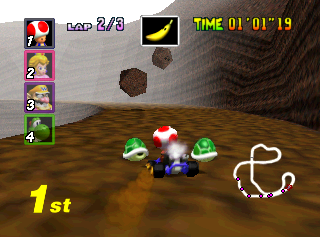
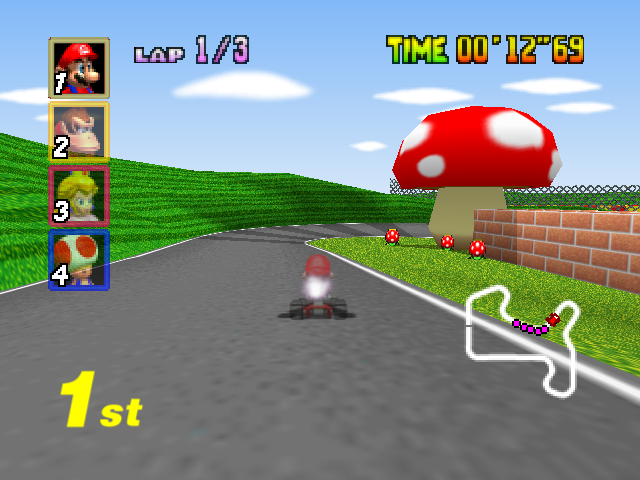
Choco Mountain climbs through a tunnel and round a cliff-edge hairpin where boulders bounce down from above. On 50cc and in Time Trials a railing guards the drop; on the faster classes it is gone. Mario Raceway closes the cup on smooth tarmac beneath a giant red cap, with a long sweep round a hill, a hairpin round an enormous toadstool and a run through a Warp Pipe big enough to drive in. At 567 metres it is one of the shortest laps in the game.
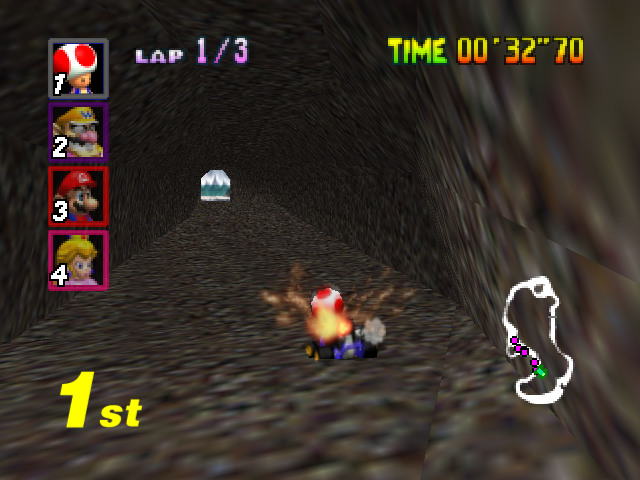
The Flower Cup.Toad’s Turnpike.Frappe Snowland.Choco Mountain.Mario Raceway.
Star Cup: mud, ice, a castle and a castle
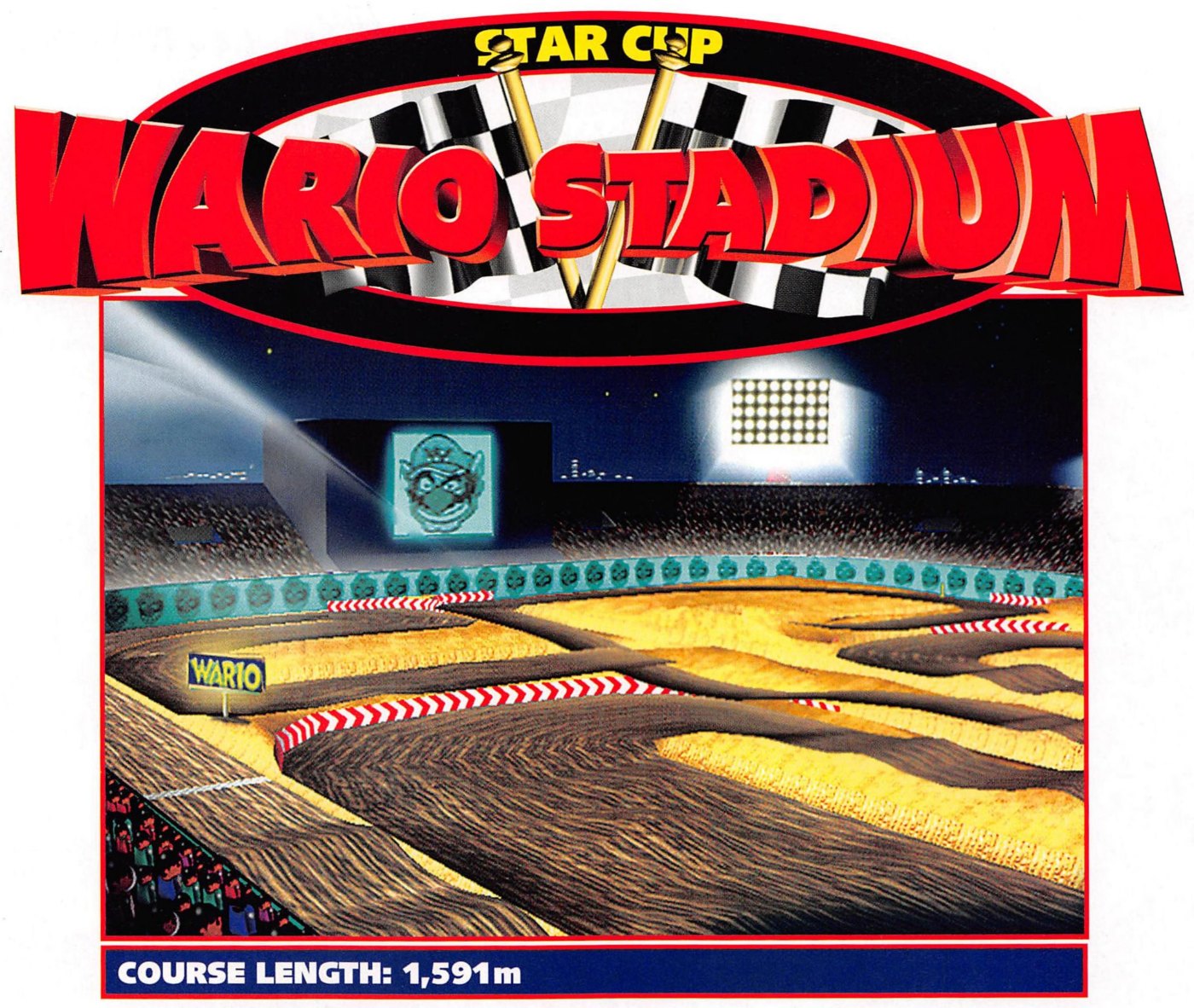
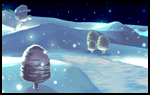
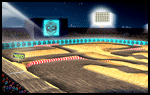
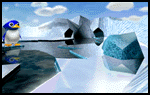
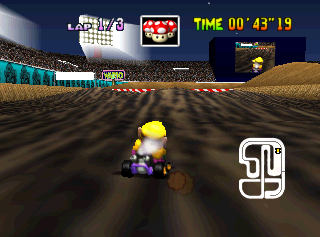
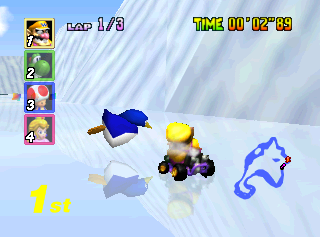
Wario Stadium is a dirt-bike arena plastered with Wario’s face, and at 1,591 metres the second-longest lap in the game: a roller-coaster of humps with one big jump across the track. Miss that jump and you drop on to the road you have already driven, with nobody coming to fetch you. Sherbet Land skirts a frozen lake where penguins toboggan across the racing line, then dives into an ice cave whose pillars are each patrolled by more penguins. Fall in the water and your driver is frozen into a block of ice until Lakitu arrives.
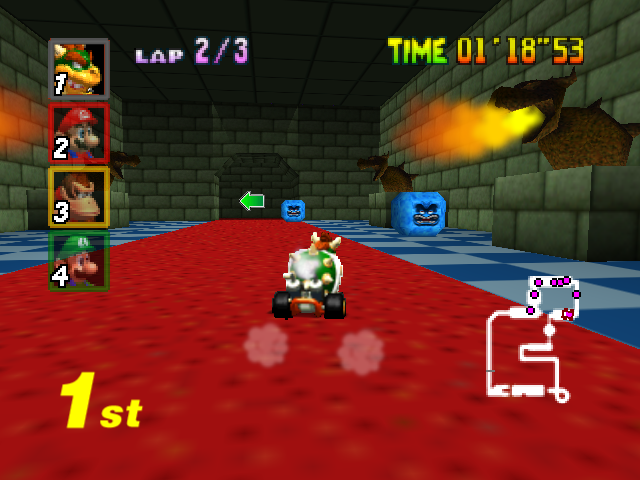
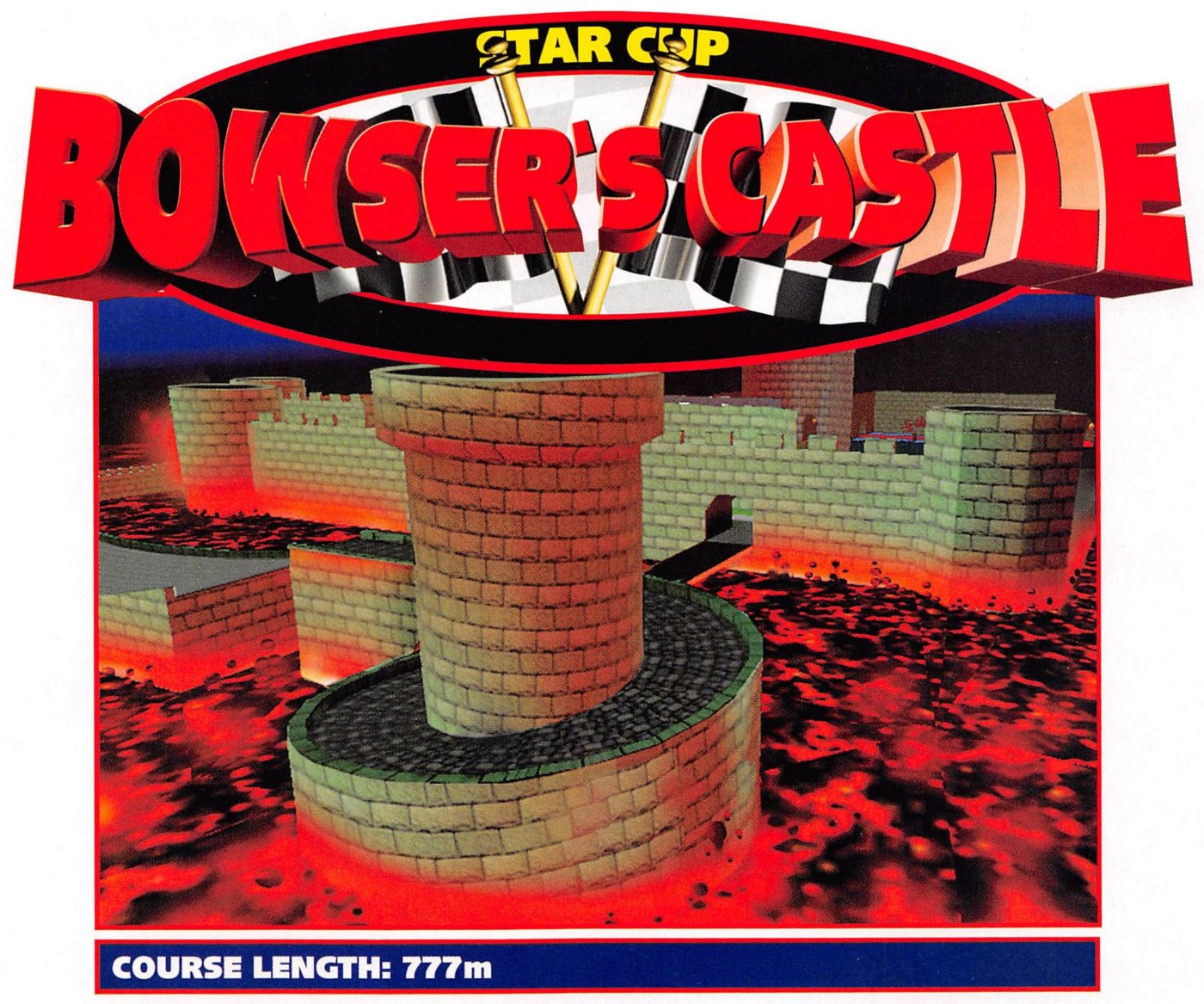
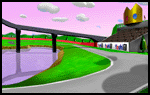
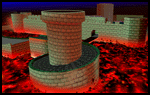
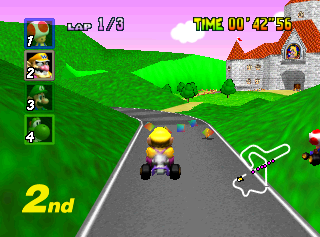
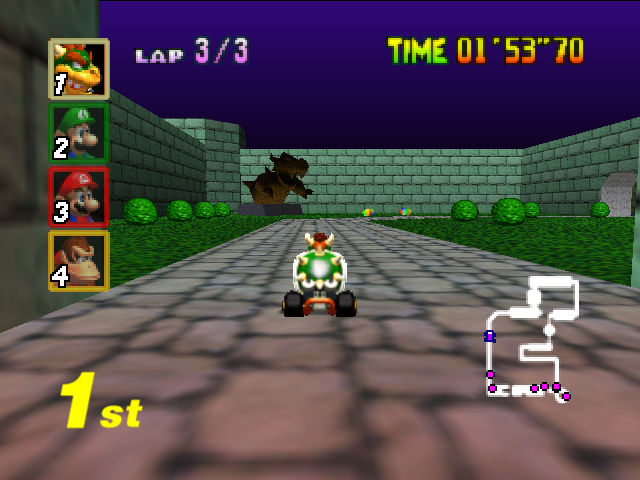
Royal Raceway, Peach’s course, loops a lake under a pink sky and has a huge ramp that hurls you across the water. Leave the circuit by a side road and you can drive up to the castle from Super Mario 64, reproduced almost stone for stone. Bowser’s Castle is the opposite of a welcome: corridors of Thwomps that drop, slide sideways and laugh in a slowed-down Wario voice, statues breathing fire, a narrow bridge across a lava chamber and a spiral climb round a tower. One Thwomp sits locked in a cell, rattling its bars as you pass. Fans call him Marty.
The Star Cup.Wario Stadium.Sherbet Land.Royal Raceway.Bowser’s Castle.
Special Cup: jungle, canyon, ghosts and glass
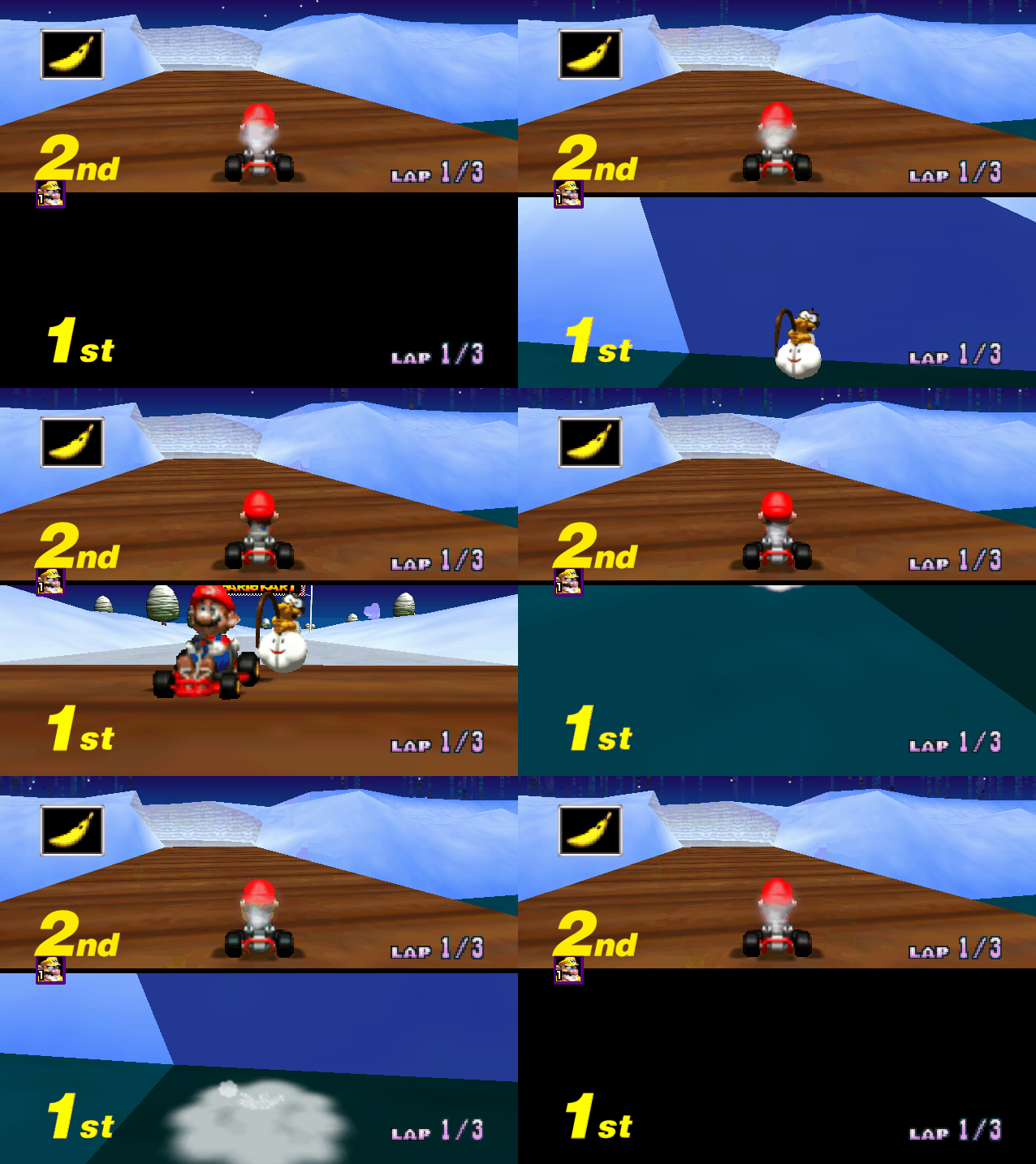
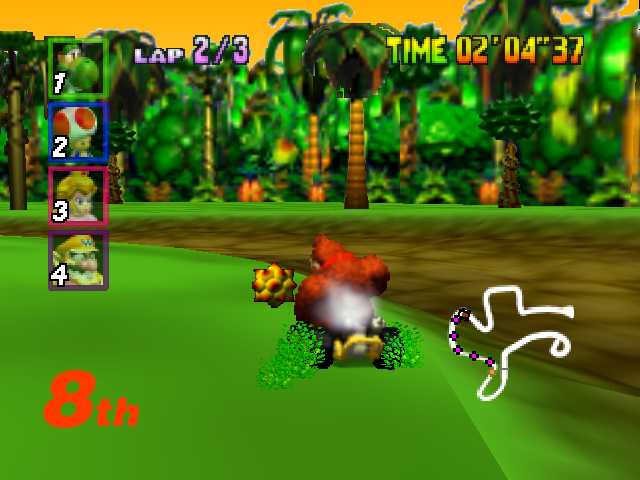
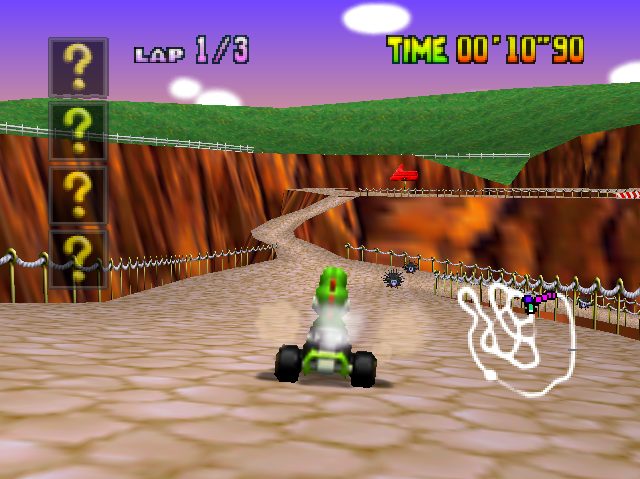
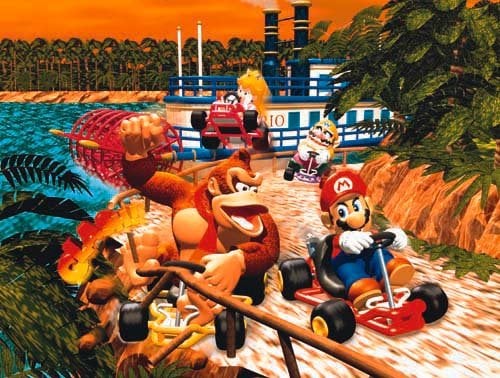
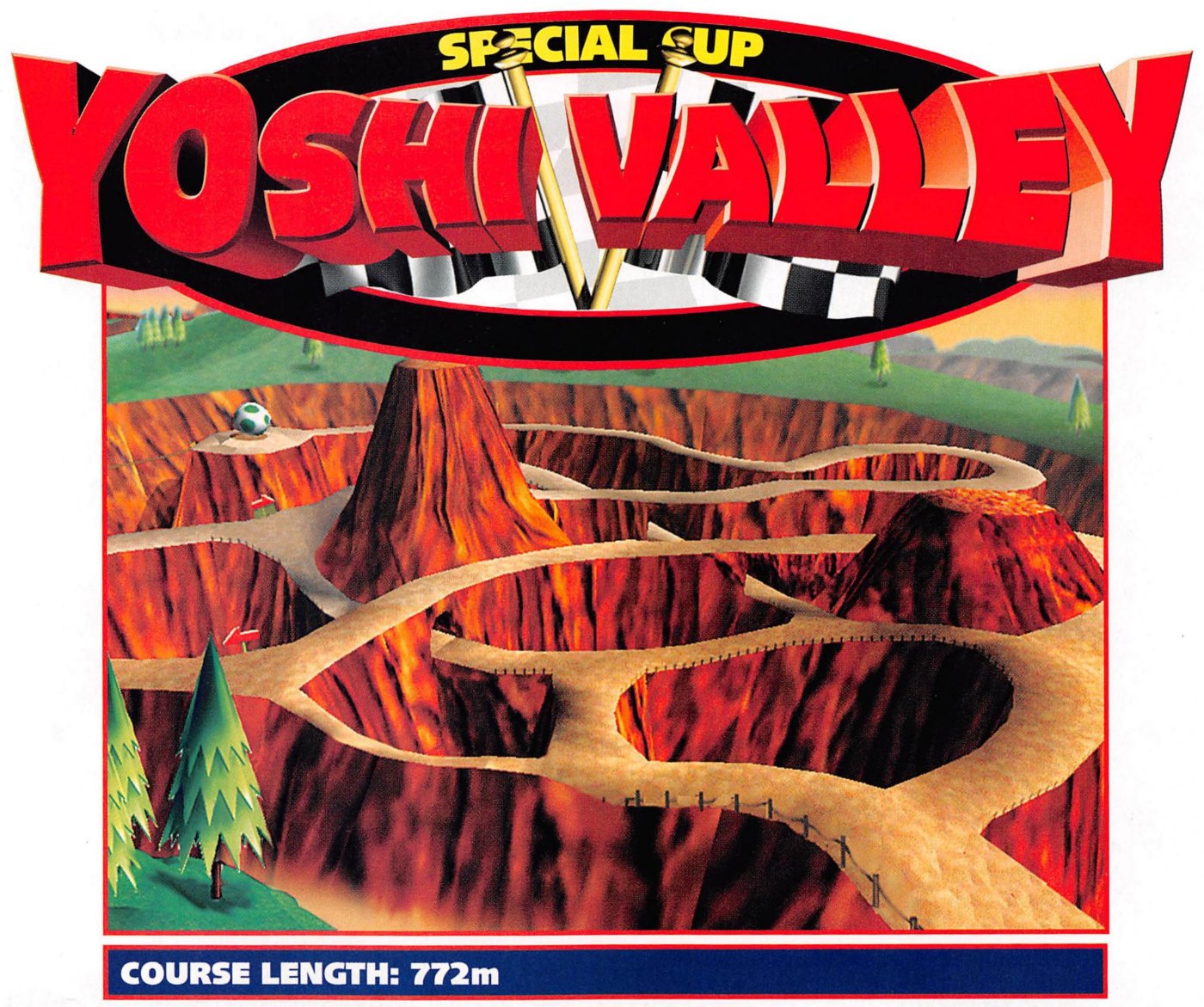
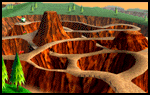
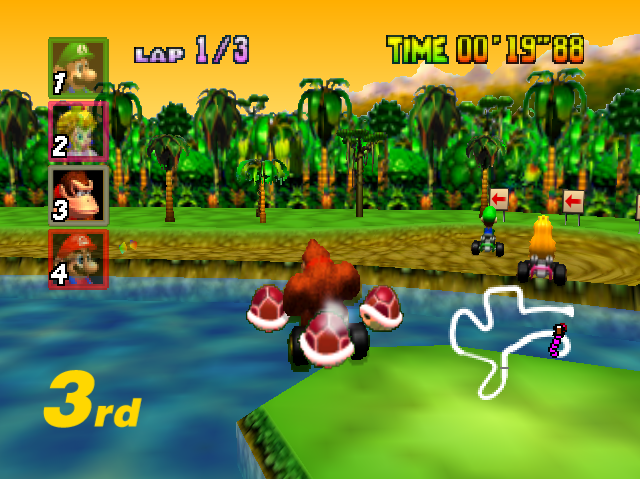
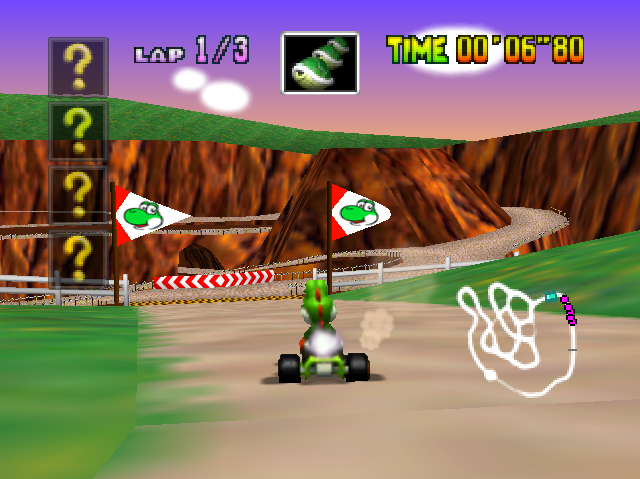
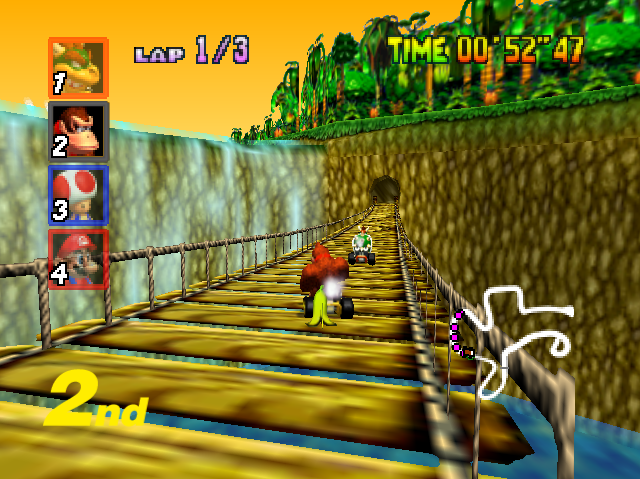
D.K.’s Jungle Parkway follows a river with a paddle steamer on it, climbs to a boost ramp that throws you across the water, then crosses a rope bridge and plunges into a cave. Stray on to the grass and something unseen in the trees pelts you with rocks until you get back on the road. Yoshi Valley is a maze: the road splits into a tangle of ledges through a canyon, some patrolled by porcupines, before everything rejoins near a giant spinning egg. Because nobody can tell who is ahead in there, the game does not try. The position board shows question marks until the race is over.
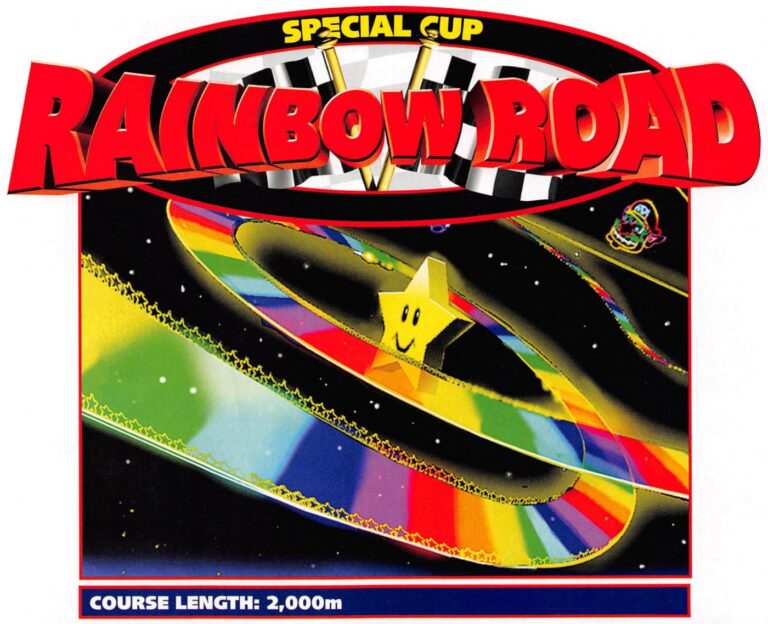
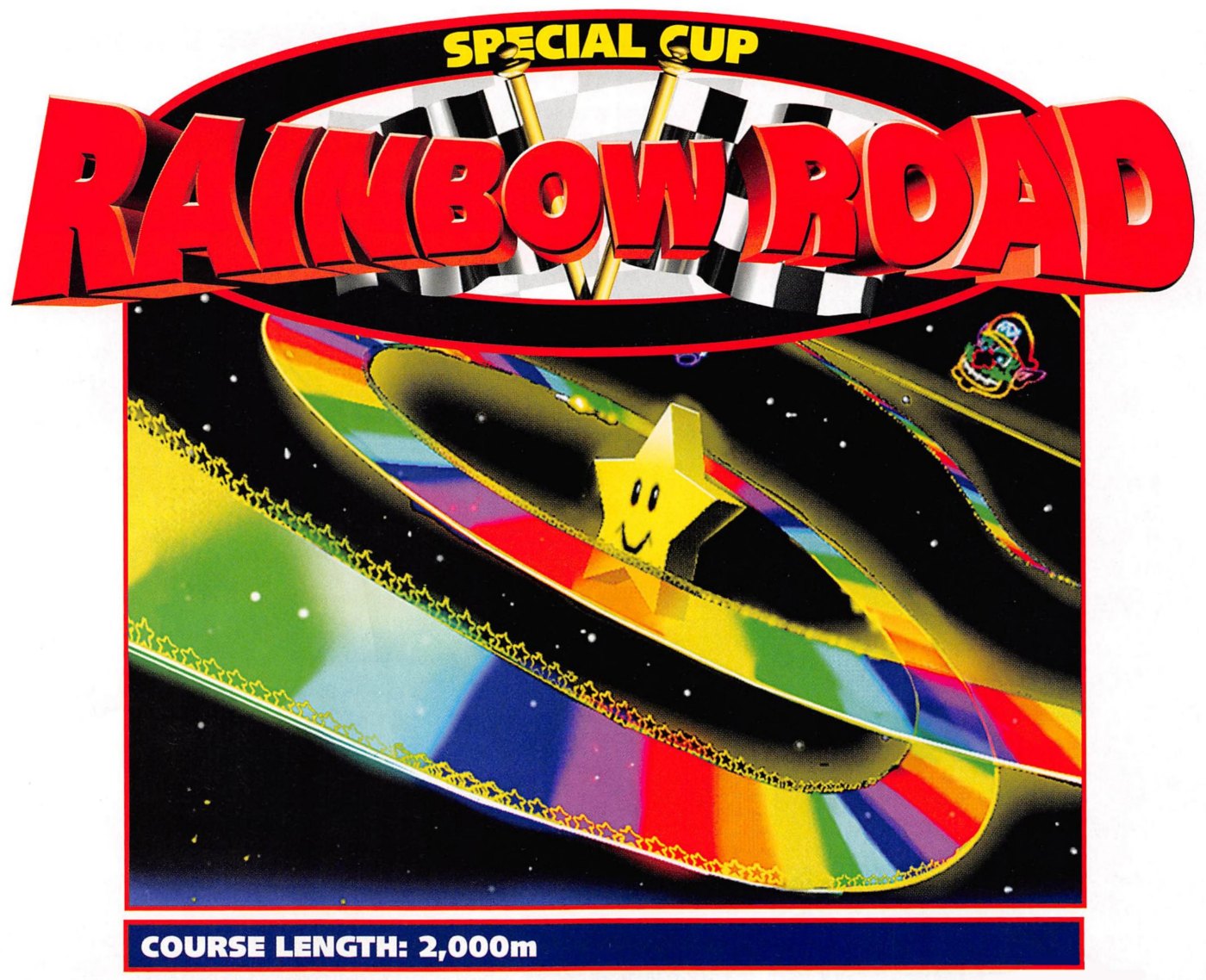
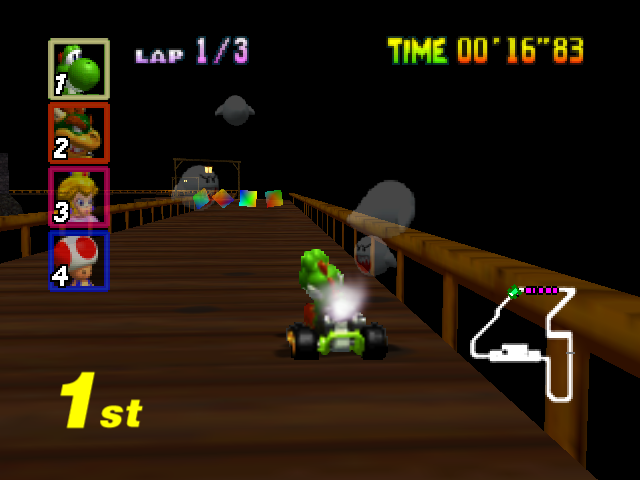
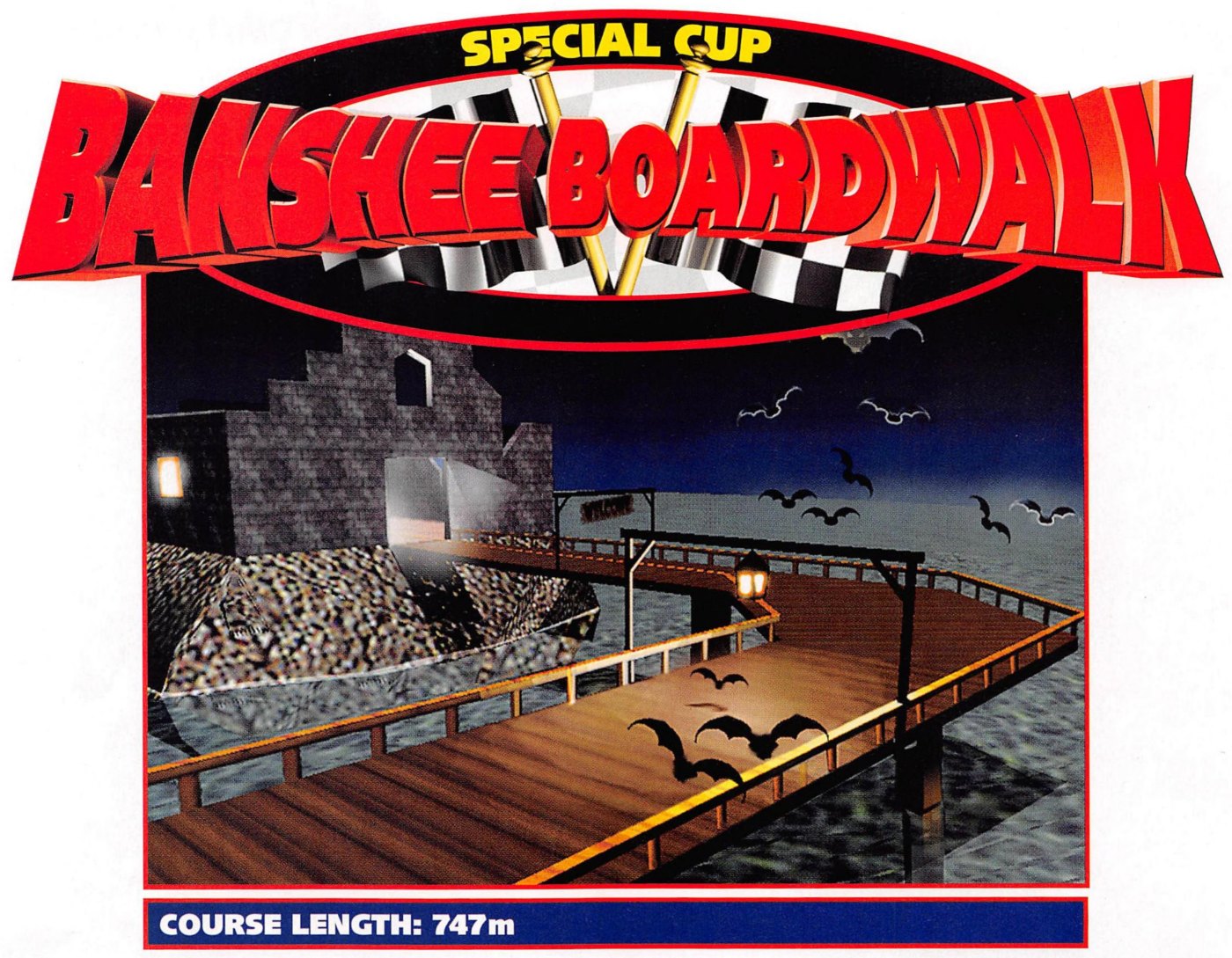
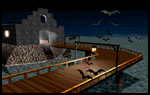
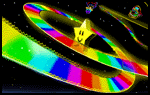
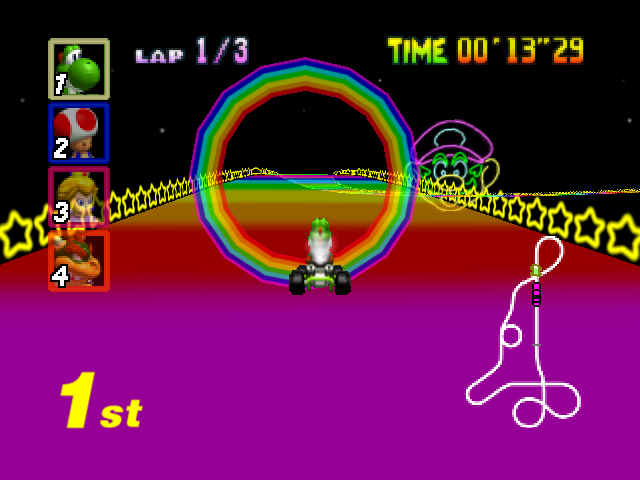
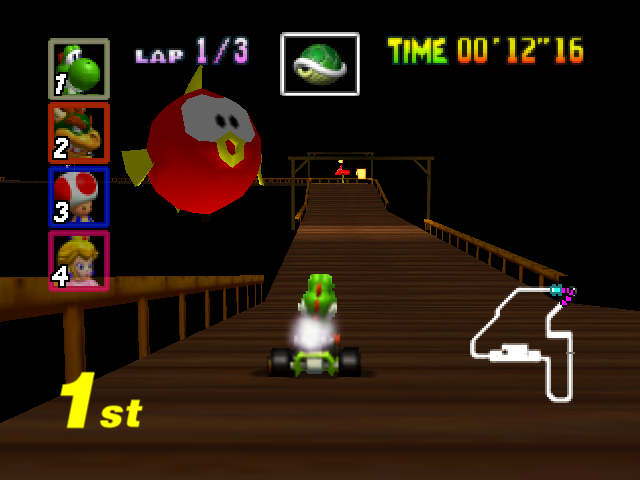
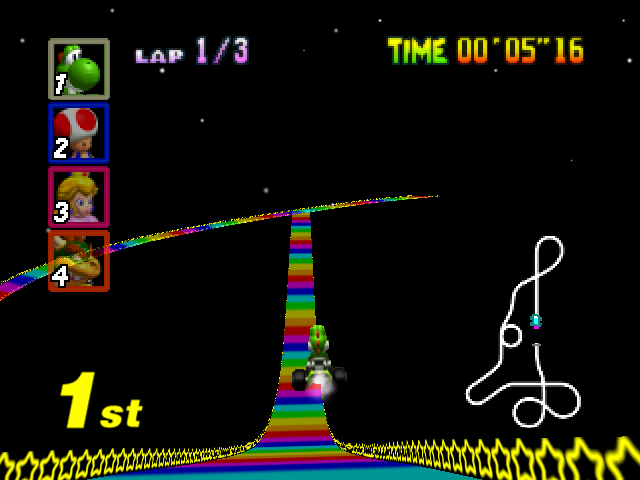
Banshee Boardwalk is a pier in the dark with the railings missing at its corners, a giant Cheep Cheep leaping overhead and a derelict house full of bats. And then, as tradition now demanded, Rainbow Road: two kilometres of translucent track in deep space, about two minutes a lap, lined with neon portraits of all eight drivers. This one has railings from start to finish and Chomps waiting on the track. It also has the most famous shortcut in the game, a hop over the left-hand rail right at the start that lands, if you are brave and lucky, a long way further round the lap.
The Special Cup.D.K.’s Jungle Parkway.Yoshi Valley.Banshee Boardwalk.Rainbow Road.
The four battle courses
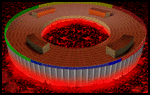
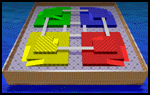
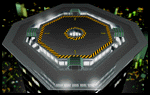
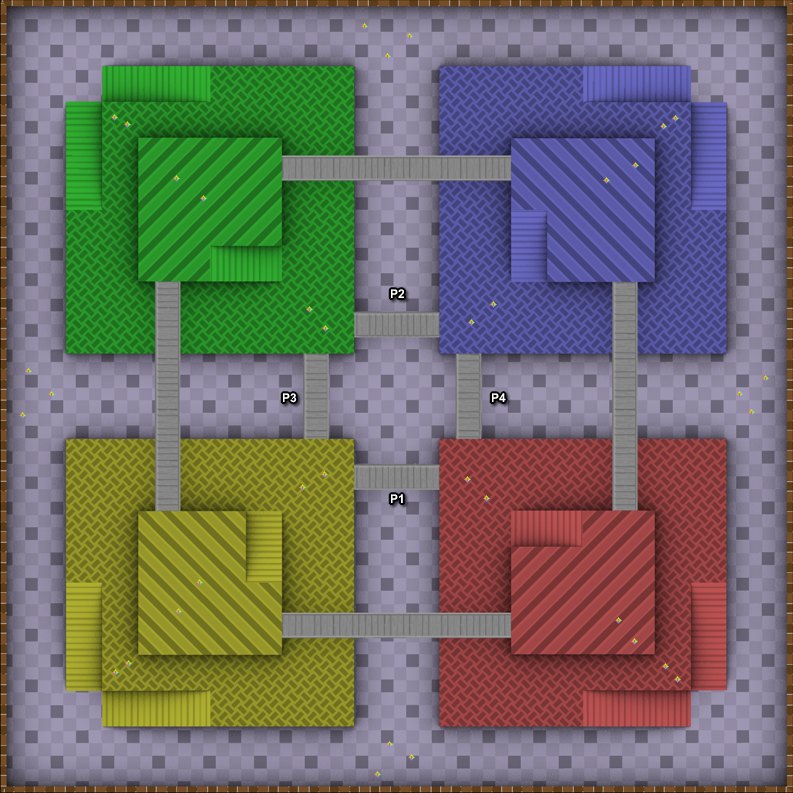
Block Fort is the one everybody remembers: four fortresses of coloured blocks (red, green, blue and yellow) in the corners of a square, each with ramps to two upper levels and narrow bridges across to its neighbours. It is perfect for ambushes from above and for long-range shell duels. Big Donut is a ring with a pool of lava in the middle, a floor that tilts towards it and four blocks to hide behind. Double Deck is a multi-level labyrinth joined by slopes, with a square hole near the top for dropping back to the ground. Skyscraper is a rooftop with no railings at all: an outer and an inner ring joined by four bridges, a hole in the centre and a very long way down.
All sixteen race courses in cup order, with their lap length and the driver each belongs to where there is one. Every course was new in 1996, so the notes record where it has been raced since.
Luigi RacewayMushroom Cup · 717 m · Luigi’s course · later in Mario Kart 7 and TourA speedway oval with a tunnel. From lap two, a balloon lowers an Item Box that always holds a Spiny Shell.
Moo Moo FarmMushroom Cup · 527 m · later in Mario Kart DSThe shortest course. Cows in the fields, Chubbies in the road.
Koopa Troopa BeachMushroom Cup · 691 m · later in Mario Kart 7 and TourCrabs, ramps and a cave behind a waterfall that cuts a whole corner.
Kalimari DesertMushroom Cup · 753 m · later in Mario Kart 7, 8 Deluxe and TourTwo trains, two level crossings and a railway tunnel that daring drivers use as a shortcut.
Toad’s TurnpikeFlower Cup · 1,036 m · Toad’s course · later in Mario Kart 8 and 8 DeluxeRush hour on a figure-of-eight motorway. In Extra the traffic drives towards you.
Frappe SnowlandFlower Cup · 734 m · later in Mario Kart DS and TourA river jump, a Yoshi made of snow and a minefield of snowmen.
Choco MountainFlower Cup · 687 m · later in Mario Kart DS, Tour, 8 Deluxe and WorldFalling boulders on a cliff-edge hairpin that only has a railing on 50cc and in Time Trials.
Mario RacewayFlower Cup · 567 m · Mario’s course · later in Mario Kart Wii and TourFast tarmac, a giant toadstool hairpin and a drive-through Warp Pipe.
Wario StadiumStar Cup · 1,591 m · Wario’s course · later in Mario Kart WorldA dirt arena of humps and one big jump. It waited until 2025 for its first remake.
Sherbet LandStar Cup · 756 m · later in Mario Kart WiiSliding penguins, an ice cave and water that freezes you solid.
Royal RacewayStar Cup · 1,025 m · Peach’s course · later in Mario Kart 8, 8 Deluxe and TourA giant ramp across a lake, and Peach’s Castle from Super Mario 64 at the end of a side road.
Bowser’s CastleStar Cup · 777 m · Bowser’s course · later in Mario Kart WiiThwomps, fire-breathing statues, a lava bridge and a spiral ramp round a tower.
D.K.’s Jungle ParkwaySpecial Cup · 893 m · D.K.’s course · later in Mario Kart WiiA boosted leap over a river and a cave finish. Leave the road and the jungle throws things at you.
Yoshi ValleySpecial Cup · 772 m · Yoshi’s course · later in Mario Kart 8, 8 Deluxe and TourA maze of canyon ledges and a giant spinning egg. Positions are hidden until the finish.
Banshee BoardwalkSpecial Cup · 747 m · later in Mario Kart DSA haunted pier with gaps in the railings, bats and a leaping giant Cheep Cheep.
Rainbow RoadSpecial Cup · 2,000 m · later in Mario Kart 8 and 8 DeluxeThe longest course in the game: railings all the way, Chomps on the track and neon portraits in the sky.
The four battle courses (Big Donut, Block Fort, Double Deck and Skyscraper) are described above. SLB’s track information and shortcuts pages, linked under Reference below, go into each course in more detail.
Advertisement
Gameplay & Controls
The format is the one Super Mario Kart set down: eight karts, items from boxes on the track, points for the first four home. What changes is the scale. Races are three laps instead of five because the courses are so much longer, and the roads now rise, fall and bank, with real walls to bounce off and real drops to fall down.
Coins are gone, and so is the lives system: finish fifth or lower in a Grand Prix race and you simply try again, as often as you like. In their place come heavier and lighter drivers, items you can hold in reserve behind the kart and a drift that rewards skill with speed.
Driving, sliding and the Mini-Turbo
Mario in a slide, in Nintendo’s artwork.
The analogue stick steers, A accelerates and B brakes (hold the stick back as well and the kart reverses, a first for the series). Z or C-Down uses an item, R hops, C-Up switches between a near and a wide camera, C-Right cycles the display between course map, speedometer and lap chart, and L turns the music down or off. Holding A and B together spins the kart on the spot.
Keep R held after a hop and the kart slides, puffing out smoke in the shape of the letter V. Push the stick against the turn and back and the smoke becomes a row of yellow Es; do it again and they turn red. Release the slide at that point and you get a Mini-Turbo, announced by a whoop from your driver. Overdo the counter-steer and you spin instead. The designers originally hid the boost and added the coloured smoke late on, as a visible reward for driving well.
A few finer points separate the experts. Press A as Lakitu’s light changes from red to blue for a rocket start; press too soon and you spin your wheels. Hit a banana peel while driving straight and a quick dab of the brake cancels the spin, with a little musical note to confirm it. And after any crash, tapping the accelerator three times before holding it gets a kart back up to speed faster, a trick that helps the lightweights and Bowser most.
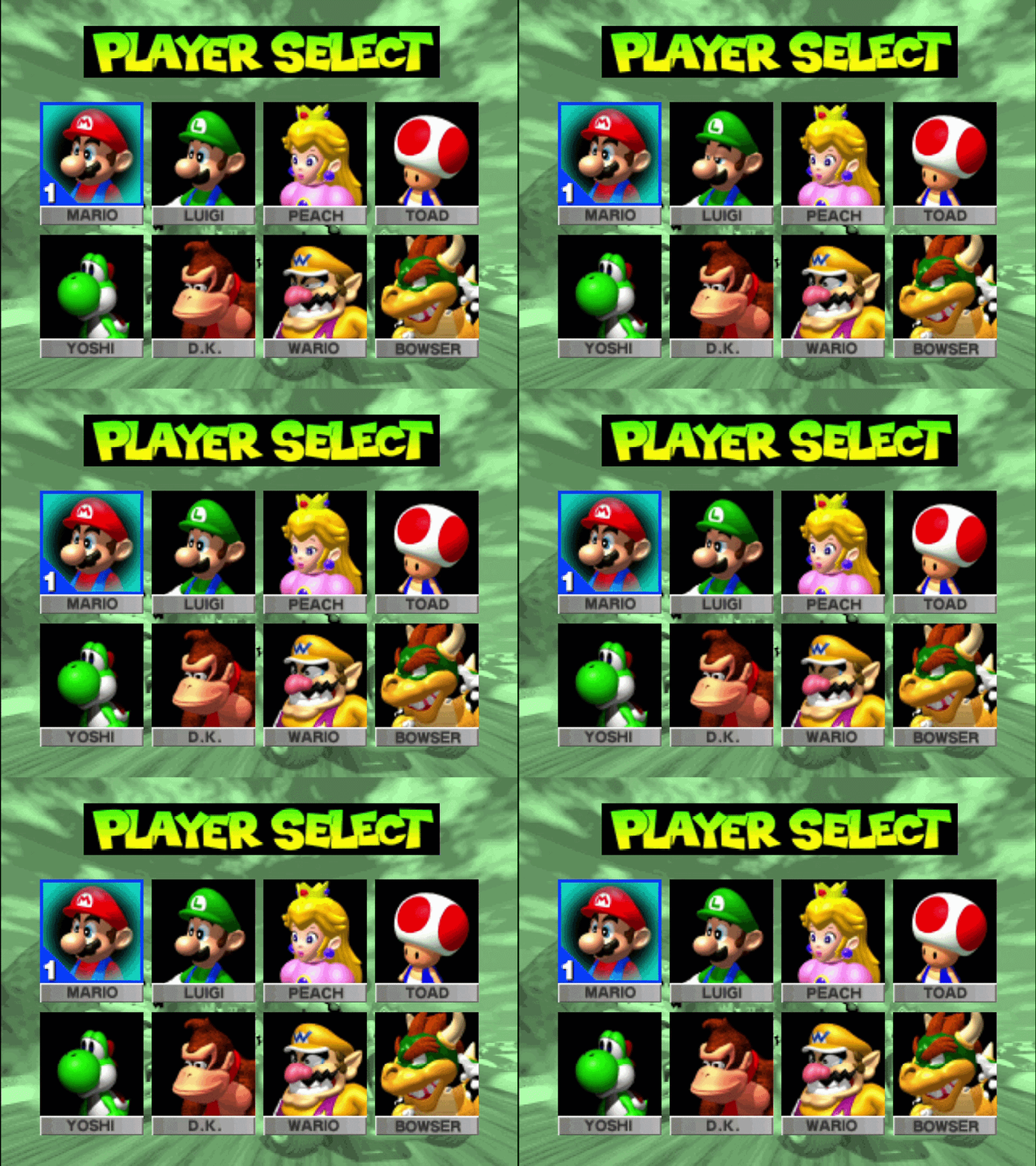
D.K. on his own Jungle Parkway. Karts and drivers are flat sprites; everything else is 3D.The player-select screen.
Light, medium and heavy
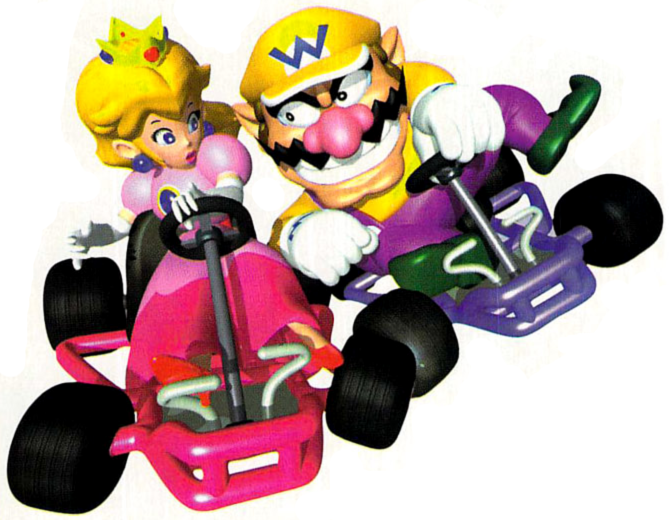
Wario demonstrates the heavyweight advantage on Peach.
For the first time the drivers are sorted by weight. Peach, Toad and Yoshi are light, Mario and Luigi are medium and D.K., Wario and Bowser are heavy. The manual calls the middleweights the ones with no extreme strengths or weaknesses. The numbers inside the game tell a slightly different story.
The lightweights have the quickest acceleration and, by a small margin, the highest top speed of the three classes. They gain most from a Mini-Turbo and lose least on grass and sand. Their price is in the corners (they have the widest turning circle and scrub off most speed when steered without a slide) and in contact: any heavier kart will knock them aside, and Toad, the lightest of all, spins if anyone so much as leans on him. The heavyweights get away slowly but are travelling faster than the middleweights within about three seconds, hold their pace best through a turn and suffer most off the road. Bowser is the heaviest and biggest driver in the game. Mario is a shade heavier than Luigi, so he wins when the brothers collide.
Weight matters most in Battle Mode, where a fast enough shunt from a heavy kart can burst a lightweight’s balloon without any item being involved.
Four ways to play
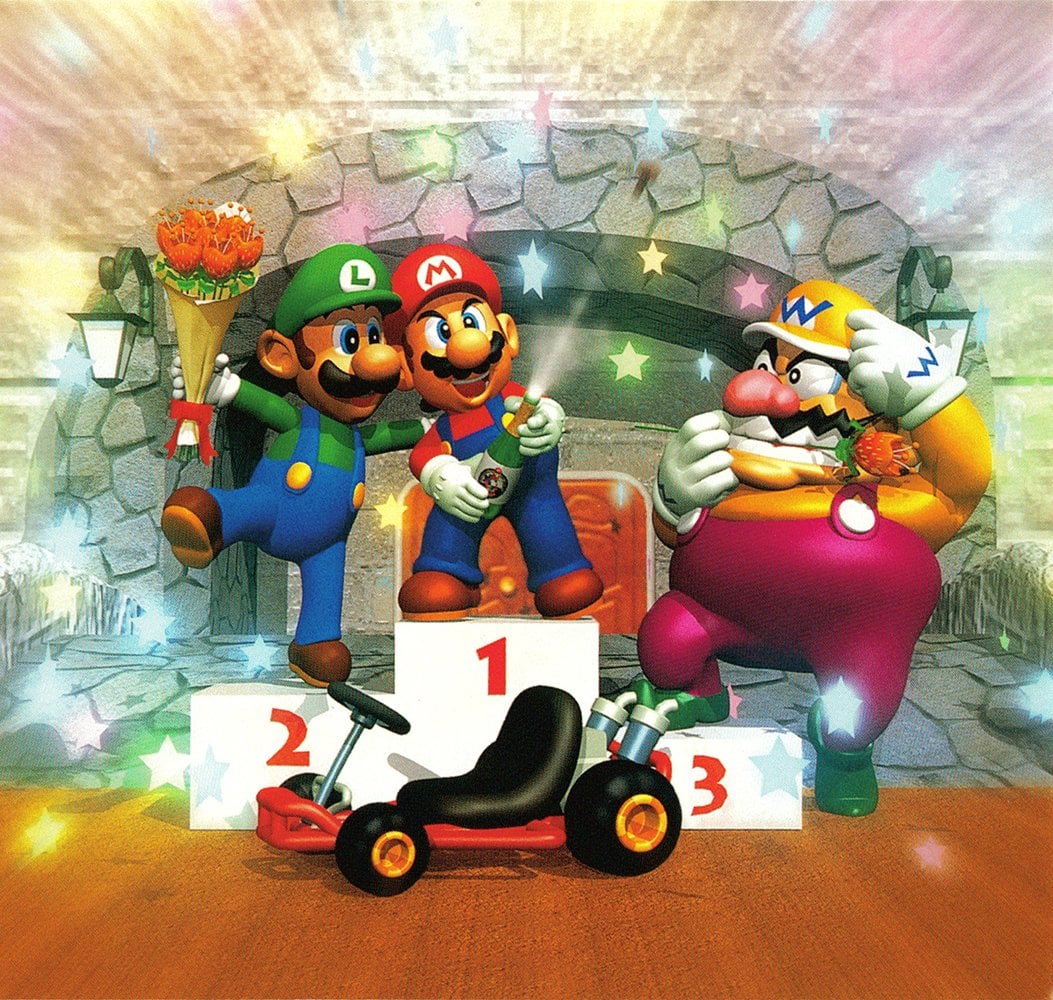
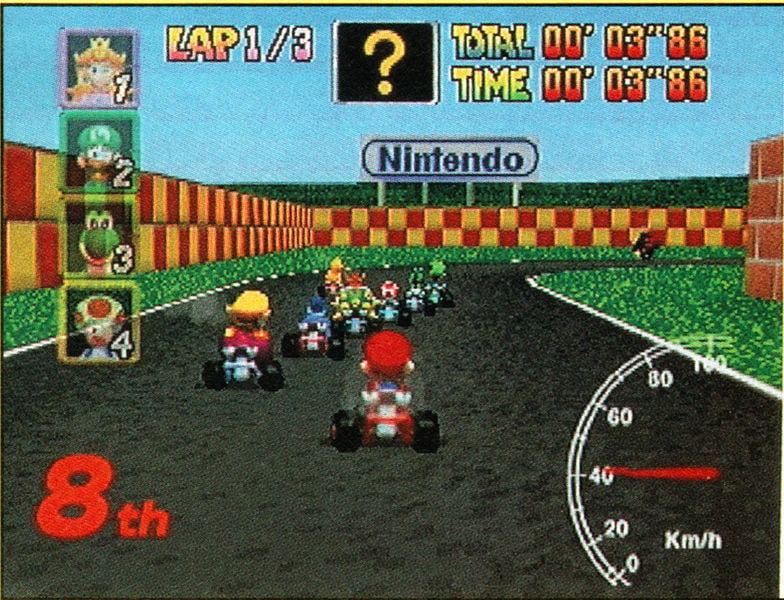
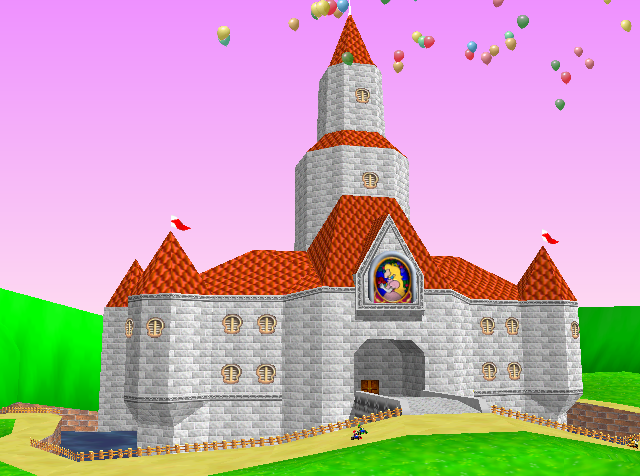
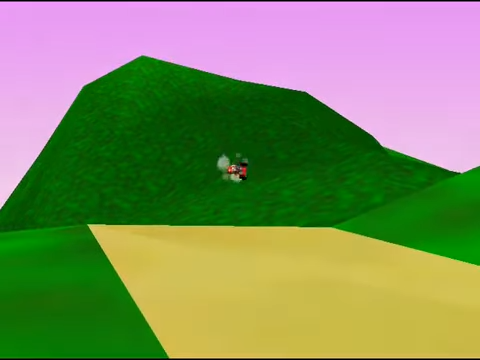
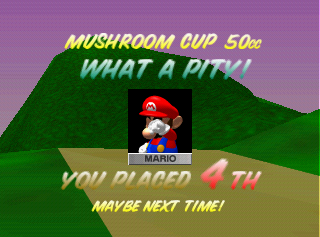
Mario GP is the championship, for one or two players against the computer: four races to a cup, with 9, 6, 3 and 1 points for the top four and nothing for anyone else. You start the first race from eighth on the grid and must finish in the top four to move on. At the end the top three climb a podium in front of Peach’s Castle for a bronze, silver or gold trophy. Finish the cup fourth or lower and your driver watches from a distance, drives sadly away and is blown up by a passing Mini Bomb Kart.
Time Trials give one player three Mushrooms and an empty track. Set a clean lap (no pausing, crashing, reversing or falling off) and the game records a ghost of your run to race against, provided a Controller Pak is plugged in: a ghost fills almost the whole Pak. Three courses also hide ghosts recorded by Nintendo’s staff.
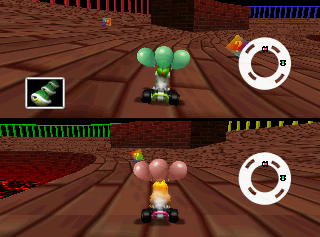
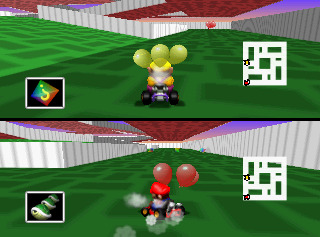
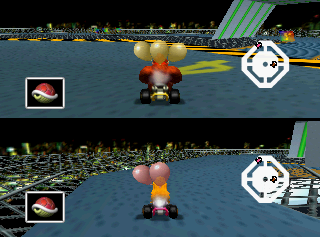
Versus lets two, three or four players race on any course with no computer drivers; instead, Mini Bomb Karts trundle about the track and explode on contact. Battle is balloon-popping for two to four players in one of four arenas. Everyone starts with three balloons in their character’s colour, and loses one whenever they are hit or fall off the stage. A player with no balloons left in a three- or four-player battle turns into a Mini Bomb Kart and gets one last chance to take somebody else down with them.
The trophy ceremony outside Peach’s Castle.Fourth place or lower: enter the Mini Bomb Kart.“Maybe next time!”D.K. and Peach duel on Skyscraper in Battle Mode.
Engine classes, Extra and the computer’s habits
All four cups can be entered at 50cc, 100cc or 150cc from the moment you switch on, the Special Cup included. Take gold in every cup at 150cc and a fourth option, Extra, appears: the 100cc game with every course mirrored, so that left-handers become right-handers. On Toad’s Turnpike the traffic even turns round and drives straight at you.
The computer drivers are helped along. They recover speed more quickly than a human can, whatever their weight, and each Grand Prix quietly appoints two of them as your rivals and keeps them close. On 150cc and Extra those two can shrug off a red shell and be back on your bumper within seconds. It keeps races tight; it also drew some of the game’s sharpest reviews.
Four players, and what it cost
Toad and Mario battle while a Mini Bomb Kart closes in.
Splitting the screen four ways meant drawing the 3D world four times, and something had to give. With three or four players the frame rate drops to 20 a second and there is no music during races at all, except for the jingle of a Super Star. Clouds vanish from every sky and the stars go out over Toad’s Turnpike, Wario Stadium and Rainbow Road. Moo Moo Farm loses its trees, Frappe Snowland its falling snow, Sherbet Land its giant penguin and D.K.’s Jungle Parkway its paddle steamer, and the trains of Kalimari Desert run as lone locomotives. With three players, the spare quarter of the screen shows the course map.
Nobody playing at the time cared in the slightest.
Japan versus the West
The Japanese game sounds different. Its title screen has a chorus of children shouting the name; overseas Mario says “Welcome to Mario Kart!” and takes over the menu announcements from a generic narrator. Luigi, Toad, Peach and Wario have different voices in Japan (abroad, Charles Martinet plays Luigi and Wario as well as Mario, with Leslie Swan as Peach and Isaac Marshall as Toad). Toad, D.K. and Bowser go by Kinopio, D. Kong and Koopa, and the three Raceways are Circuits, with Royal Raceway called Peach Circuit.
The trackside adverts changed too. Japan’s hoardings parody real motor-racing sponsors: Marioro for Marlboro, Luigip for Agip, Yoshi 1 for Mobil 1, a Koopa Air logo in Goodyear’s blue and yellow and an orange ball marked 64 in the manner of the 76 petrol brand. For the international release they became Mario Star, Luigi’s and Yoshi (with a paw print where the 1 was), Koopa Air was recoloured and the ball turned blue. Later versions made smaller changes: China’s iQue Player edition renames the Special Cup the iQue Cup, and the Wii Virtual Console tones down the flash of the Thunder Bolt.
Japan: the Marioro hoarding.Everywhere else: Mario Star.A Shot! sign, one of the fictional sponsors.
Every item in Mario Kart 64
Item Boxes replace the old ? Panels and reappear almost as soon as they are taken. The roulette still favours those at the back: the leader is offered little but bananas and green shells, while eighth place can hope for Stars, Thunder Bolts and the Spiny Shell. Hold Z and bananas, single green shells and fake boxes trail behind your kart as a shield. Seven of the fourteen items are new.
MushroomOne short burst of speed.
Triple MushroomsNew. Three boosts to use whenever you like.
Super MushroomNew. The golden one: as many boosts as you can hammer out before it expires.
BananaSpins whoever hits it. Brake at the right instant and you can save the slide.
Banana BunchNew. Five peels trailing behind the kart, dropped one at a time.
Fake Item BoxNew. Looks like an Item Box (its question mark is upside down) and flips anyone who drives into it.
Green ShellFlies straight, bounces off walls and sends its victim tumbling.
Triple Green ShellsNew. Three shells circling the kart, as shield or ammunition.
Red ShellLocks on to the kart ahead. Breaks if it hits a wall.
Triple Red ShellsNew. Three homing shells in orbit. Never offered to the leader.
Spiny ShellNew. The blue shell. Hunts down first place and bowls over anybody it meets on the way.
Super StarInvincibility. A hard knock against a wall ends it early.
Thunder BoltShrinks every rival so they crawl along and can be squashed.
BooTurns you invisible and untouchable for a moment, and steals an item from somebody else.
Cartoons, Comics & Other Media
Mario Kart 64 never had a cartoon, but it filled manga volumes, toy shelves and several soundtrack albums, and later games have been borrowing its tunes and its tracks ever since.
Super Mario-kunManga · Yukio Sawada · volumes 15 to 18Yukio Sawada’s long-running comic kept returning to the game: a batch of four-panel gags in volume 15, a crossover chapter in volume 16, a full story arc on its racetracks in volume 17 (alongside one for Super Mario 64) and an arc built on Battle Mode in volume 18.
4koma Gag Battle and 4koma Manga KingdomGag manga anthologiesBoth of Japan’s four-panel gag anthologies gave the game volumes of its own.
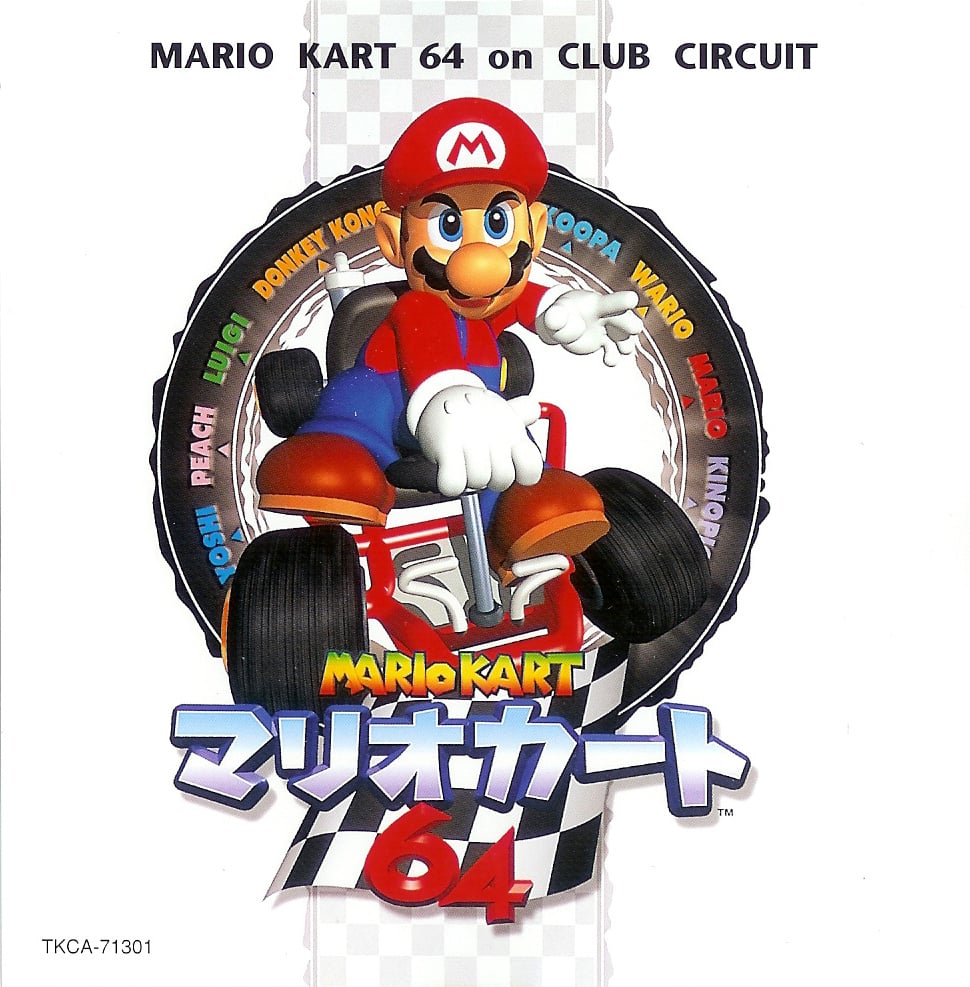
The soundtrack albumsMusic · 1997Kenta Nagata’s music was released on disc four times in a year: two American CDs from Nintendo in March and April 1997 (Race Tracks and a Greatest Hits selection), the Japanese Original Soundtrack from Pony Canyon on 19 September 1997, and a two-disc remix album, Mario Kart 64 on Club Circuit, on 26 December 1997. The soundtrack joined the Nintendo Music app in July 2025.
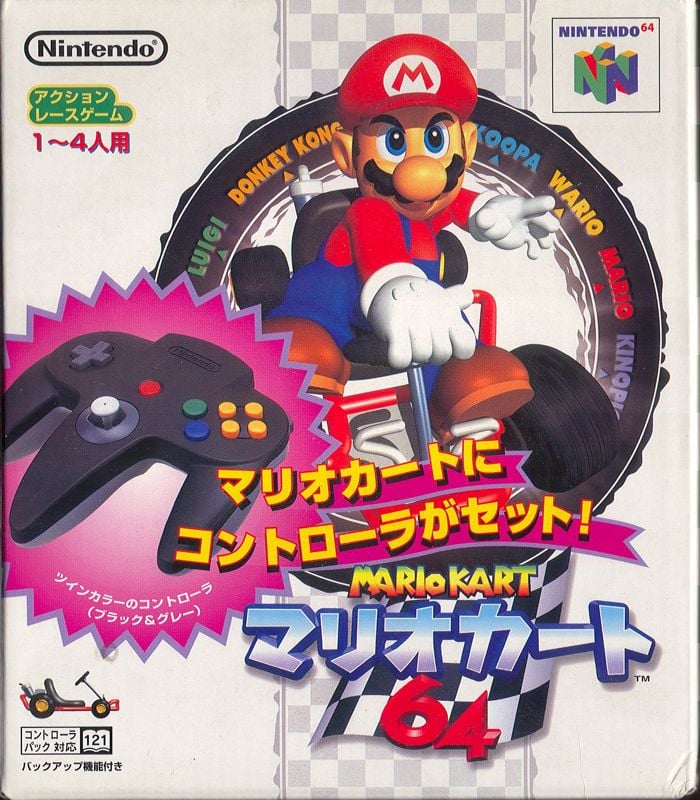
Toys, cards and sweetsMerchandiseRadio-controlled karts, character figures, a set of playing cards, collectible trading cards and even sweets all carried the game’s artwork, and the Japanese edition was sold in a bundle with a black-and-grey Nintendo 64 controller.
Game Boy CameraCameo · 1998In the American and European versions of Nintendo’s camera cartridge, a picture of Peach and Wario from this game appears while photos are being transferred.
In later Mario Kart gamesCameos and revivalsSuper Circuit reuses the drivers’ portraits and turns beaten battlers into Bob-ombs. Double Dash!! quotes the Rainbow Road theme in its own Rainbow Road. Mario Kart DS brings back four courses and Block Fort; Mario Kart Wii another four, plus Skyscraper, and bases Moo Moo Meadows and Block Plaza on the originals; Mario Kart 7 has three and Big Donut, and its Neo Bowser City borrows from Toad’s Turnpike. Mario Kart 8 rebuilds Toad’s Turnpike, Royal Raceway, Yoshi Valley and Rainbow Road, and Mario Kart World adds Choco Mountain, Wario Stadium and Big Donut, along with new arrangements of ten of the old tunes.
Beyond Mario KartOther games and filmA kart in the style of this game is a trophy in Super Smash Bros. Melee, and Brawl has an arrangement of the Luigi Raceway theme. The music of World 9 in New Super Mario Bros. Wii quotes a phrase of Rainbow Road, Paper Mario: Color Splash plays the same tune when Luigi drives along a rainbow to Bowser’s castle, and the 2023 Super Mario Bros. Movie works the title-screen theme into its score.
Characters
Eight drivers again, but not the same eight: Koopa Troopa and Donkey Kong Jr. have gone, and Wario and Donkey Kong have arrived. Each has a kart colour (used for their map marker and battle balloons), a weight class and, for the first time, a voice. Figures are the values in the game’s own data; the game gives no units.
Character
Who they are
In this game
Abilities & notes
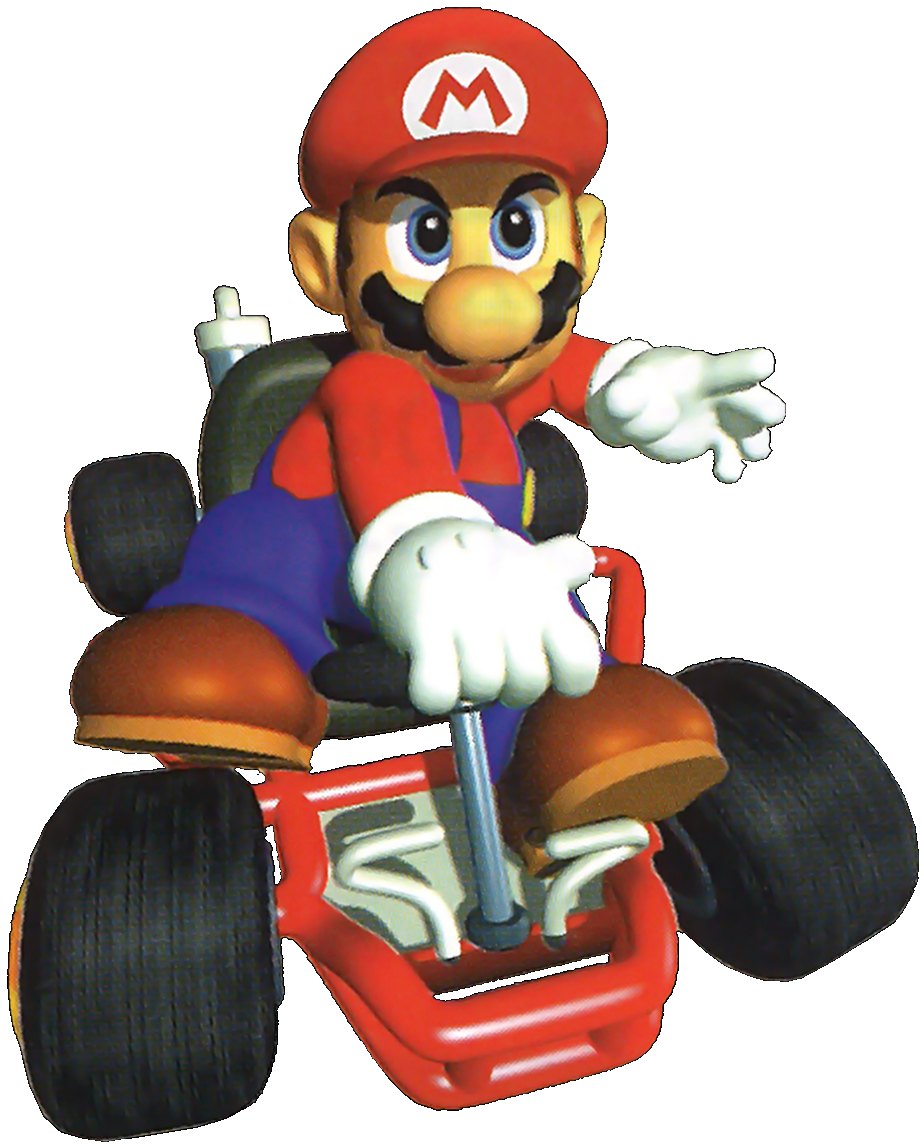
MarioMiddleweight · red
The all-rounder, voiced as in Super Mario 64 by Charles Martinet. Outside Japan he also reads out the menus.
Home course: Mario Raceway, where a staff ghost of him waits to be unlocked. Character designer Tomoaki Kuroume said he was the hardest driver to build, because his Super Mario 64 model had to be reshaped part by part to sit in a kart.
Top speed 310 · weight 1.2
Best cornering without a slide
Slightly heavier than Luigi
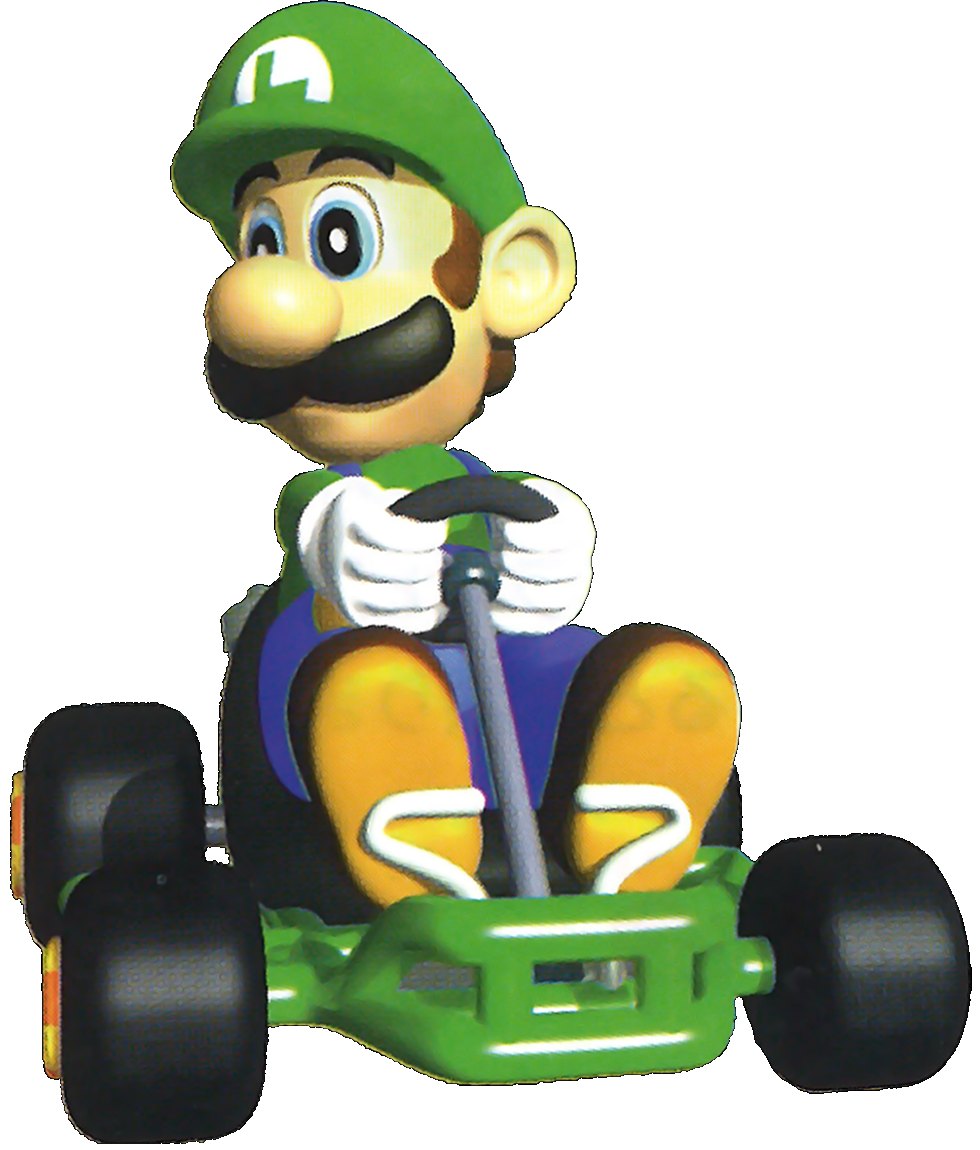
LuigiMiddleweight · green
Mario’s brother, absent from Super Mario 64 and making his Nintendo 64 debut here. Martinet voices him overseas; the Japanese version uses a different voice that later turned up in the West in Mario Party.
Home course: Luigi Raceway, with its own staff ghost.
Top speed 310 · weight 1.0
Handles exactly like Mario but loses a shoving match with him
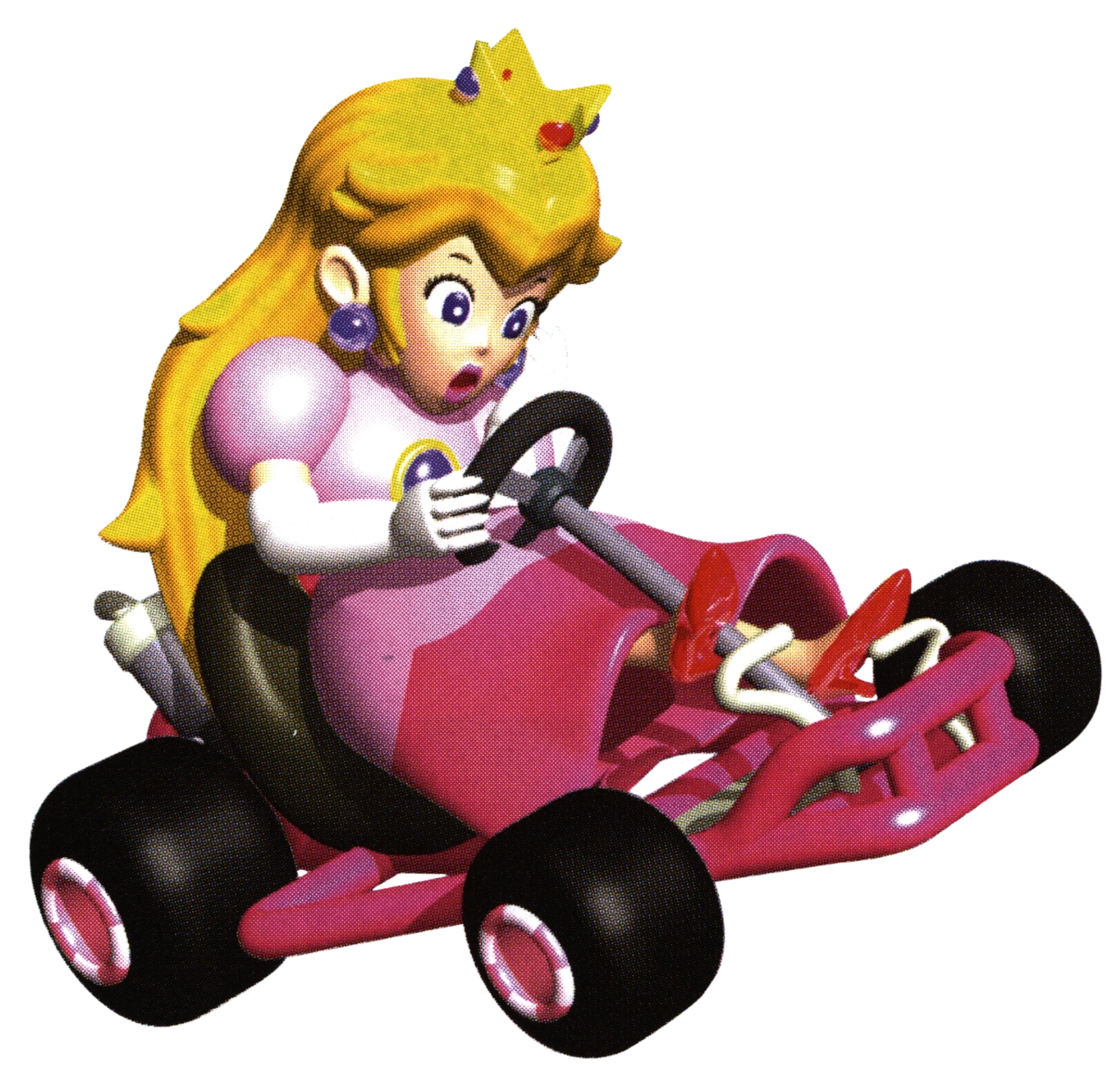
PeachLightweight · pink
The princess of the Mushroom Kingdom, voiced in the international version by Leslie Swan.
Home course: Royal Raceway (Peach Circuit in Japan), which runs past her castle and has the third staff ghost.
Top speed 314 · weight 0.9
Top-rate acceleration and Mini-Turbos
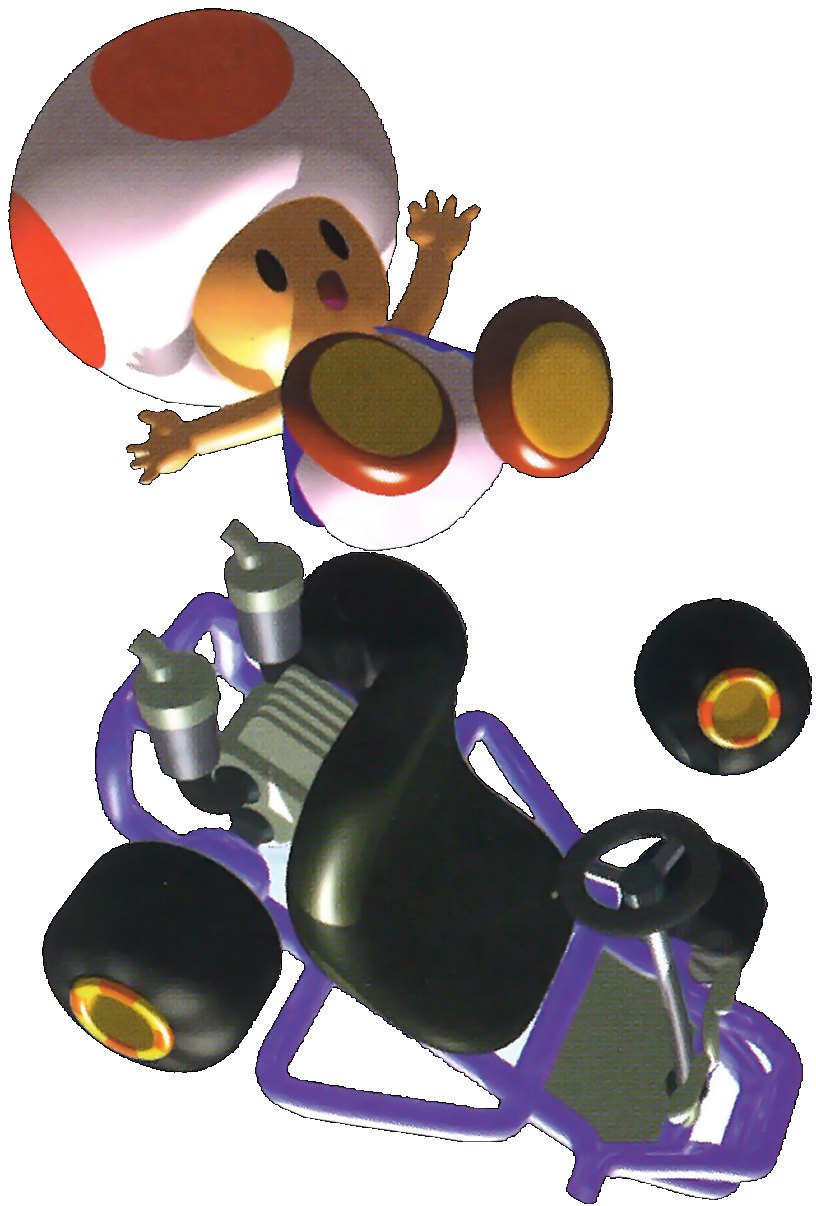
ToadLightweight · blue
Peach’s attendant, Kinopio in Japan, voiced overseas by Isaac Marshall.
Home course: Toad’s Turnpike. The lightest driver in the game, quick everywhere and bullied by everyone.
Top speed 314 · weight 0.7
Spins out when bumped by any other driver
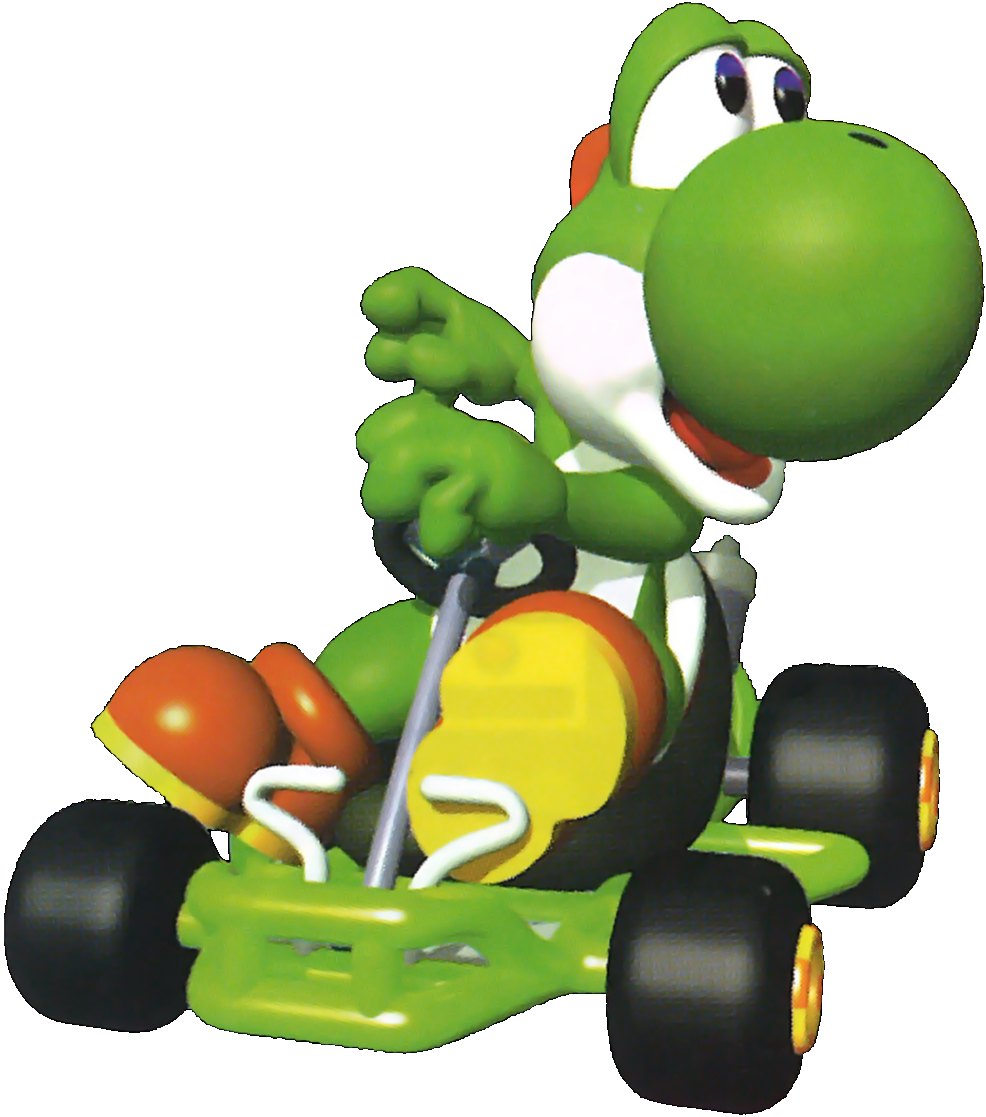
YoshiLightweight · lime green
Mario’s dinosaur friend. Kuroume considered letting his tail hang out of the back of the kart before settling on a slight crouch with the tail raised.
Home course: Yoshi Valley, complete with giant egg.
Top speed 314 · weight 0.9
Same figures as Peach
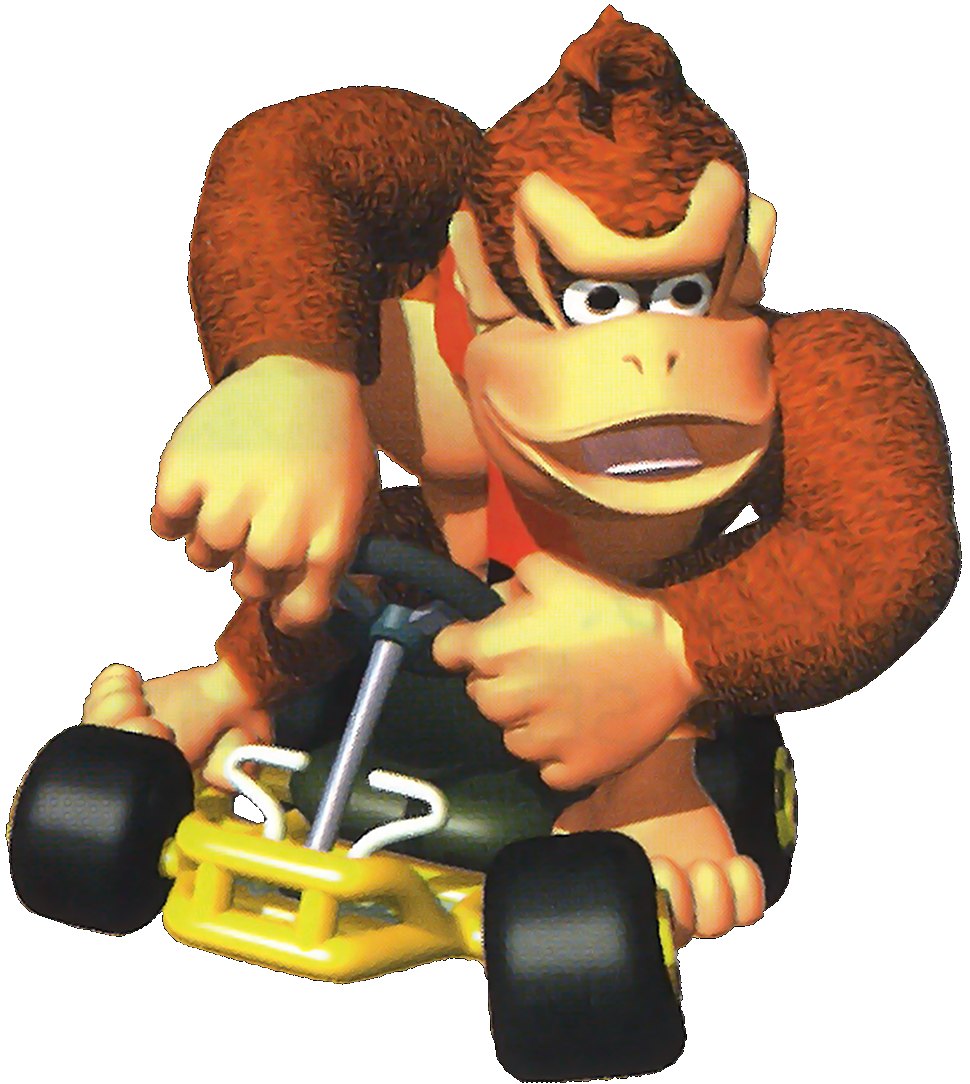
D.K.Heavyweight · yellow · new
Donkey Kong as redesigned for Donkey Kong Country, with Rare acknowledged in the credits. He takes the place of Donkey Kong Jr. from the first game and, during development, of Kamek.
Home course: D.K.’s Jungle Parkway. The Japanese game calls him D. Kong.
Top speed 310 · weight 2.0
Gains least from the triple-tap recovery, with Wario
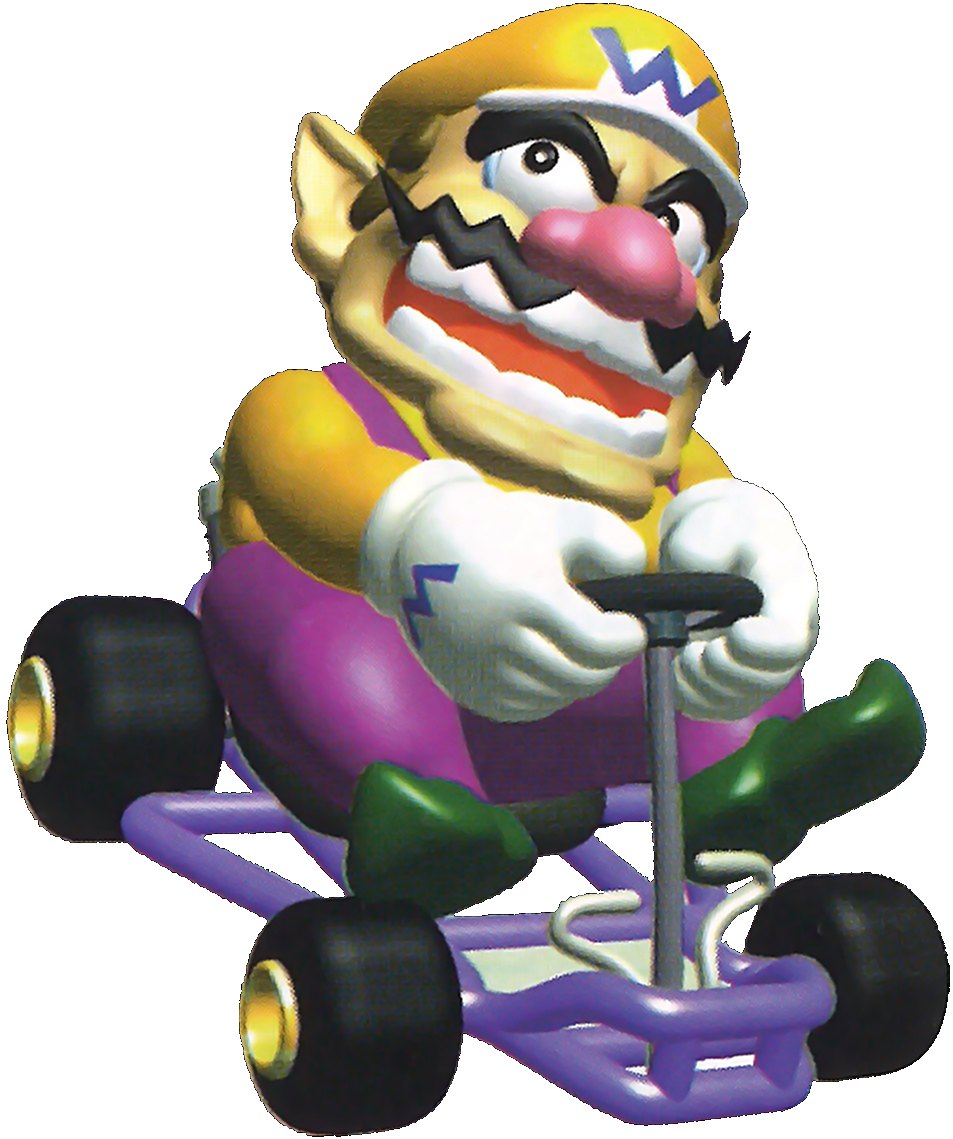
WarioHeavyweight · purple · new
Mario’s greedy rival makes his Mario Kart debut. Martinet supplies the international voice, and a slowed-down version of it is what the Thwomps of Bowser’s Castle laugh with.
Home course: Wario Stadium, which, the story goes, he built for dirt bikes.
Top speed 310 · weight 1.8
One of the two physically largest karts
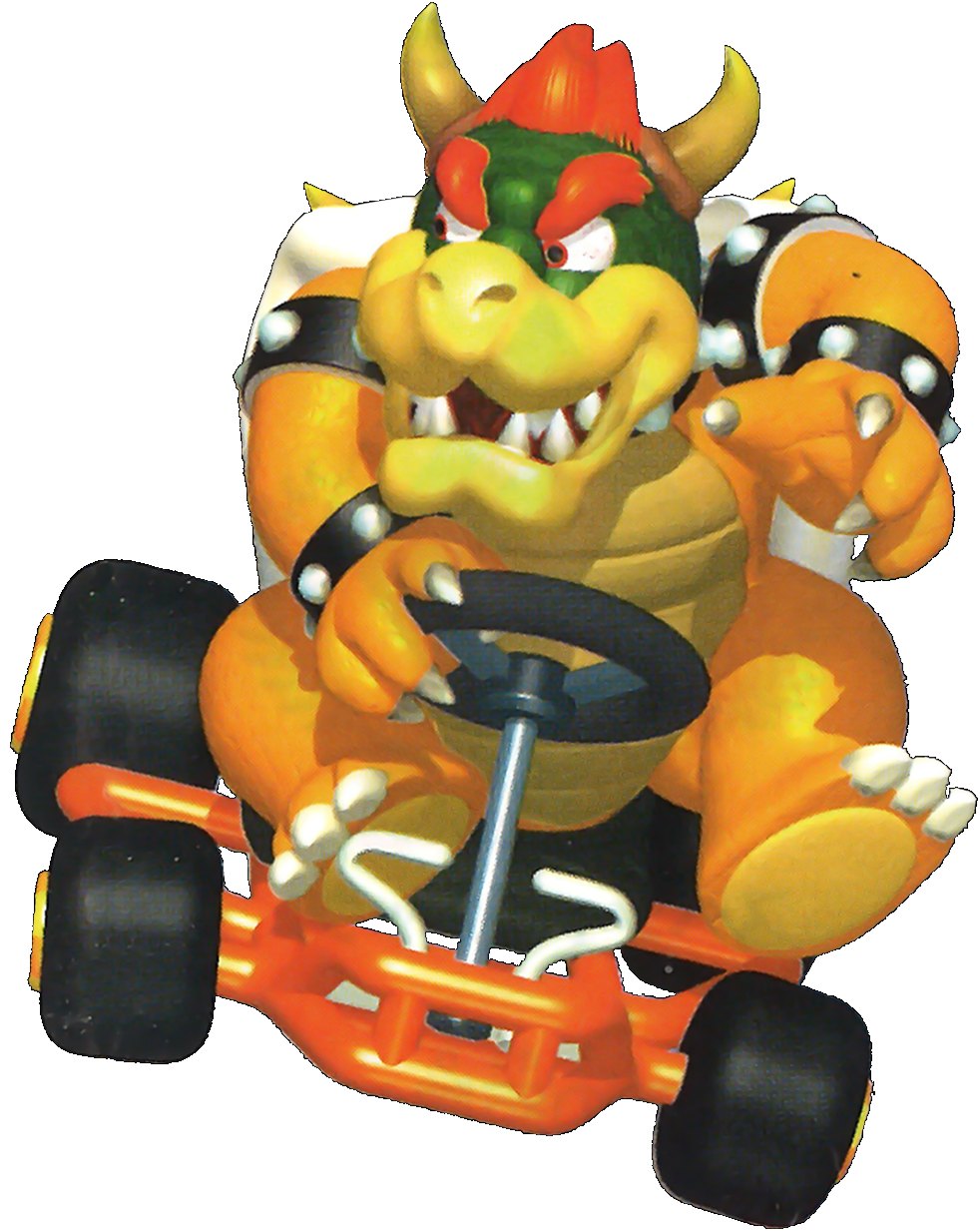
BowserHeavyweight · orange
The Koopa King, called plain Koopa in Japan.
Home course: Bowser’s Castle. The heaviest and largest driver, and the only non-lightweight who gets the full benefit of the triple-tap recovery.
Top speed 310 · weight 2.3
Wins any collision
LakituRace official
The cloud-riding referee from the first game.
Works the lights (red to blue), shows the lap boards, waves the flag and fishes out anyone who leaves the course, including defeated players driving Mini Bomb Karts.
Holds a green sign for the second lap and a blue one for the final lap, when the music speeds up.
Playable in early builds, where he sits in the slot that D.K. occupies in the finished game. A pre-release version featuring him was reported by Polygon in 2021.
Not in the final game in any form.
Hazards and trackside characters
With real scenery came real residents. These are the things you can hit, followed by a few you cannot.
TrainKalimari DesertTwo of them circle the course. Cross in front of one too late and you are launched.
VehiclesToad’s TurnpikeCars, trucks, tankers and buses. Faster in the higher classes, oncoming in Extra.
Mini Bomb KartVersus races; BattleA bomb on wheels. In Battle it is also what a beaten player becomes.
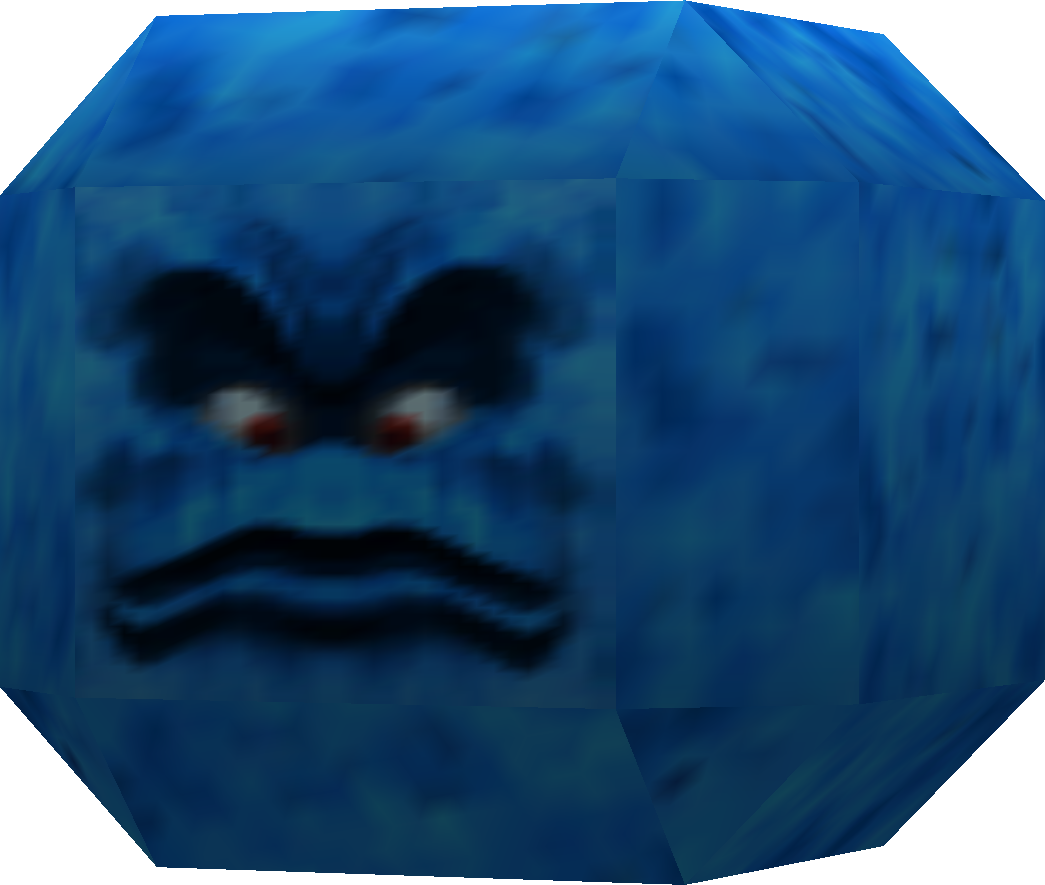
ThwompBowser’s CastleDrops, slides and laughs. One is locked in a cell.
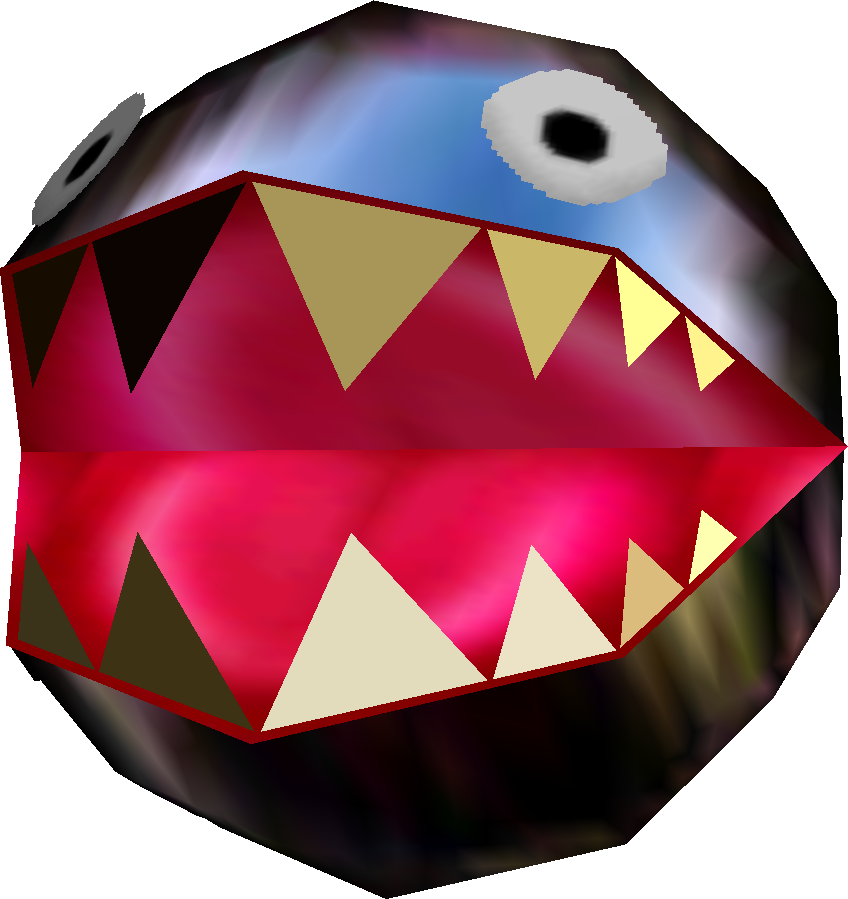
ChompRainbow RoadChain Chomps without chains. Touch one and your kart is launched.
BoulderChoco MountainTumbles down the cliff and flattens whatever it lands on.
SnowmanFrappe SnowlandSits on the road. Hit one and you are thrown into the air.
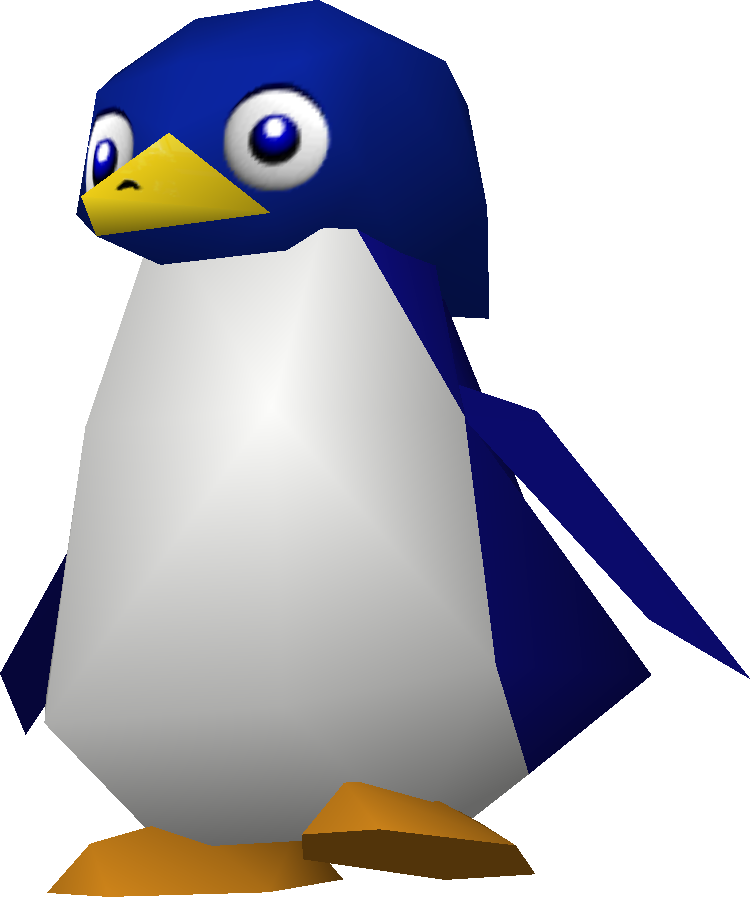
PenguinSherbet LandLarge ones waddle round the icicles in the cave; small ones slide across the track outside.
ChubbyMoo Moo FarmThe game’s name for Monty Mole. Pops up and flips passing karts.
CrabKoopa Troopa BeachSits on the sand and spins out anyone who drives into it.
CactusKalimari DesertAs solid as a tree and twice as prickly.
Piranha PlantMario Raceway, Royal RacewayLines the verges and spins anyone who cuts a corner too fine.
PorcupineYoshi ValleyWanders from side to side across the narrow paths.
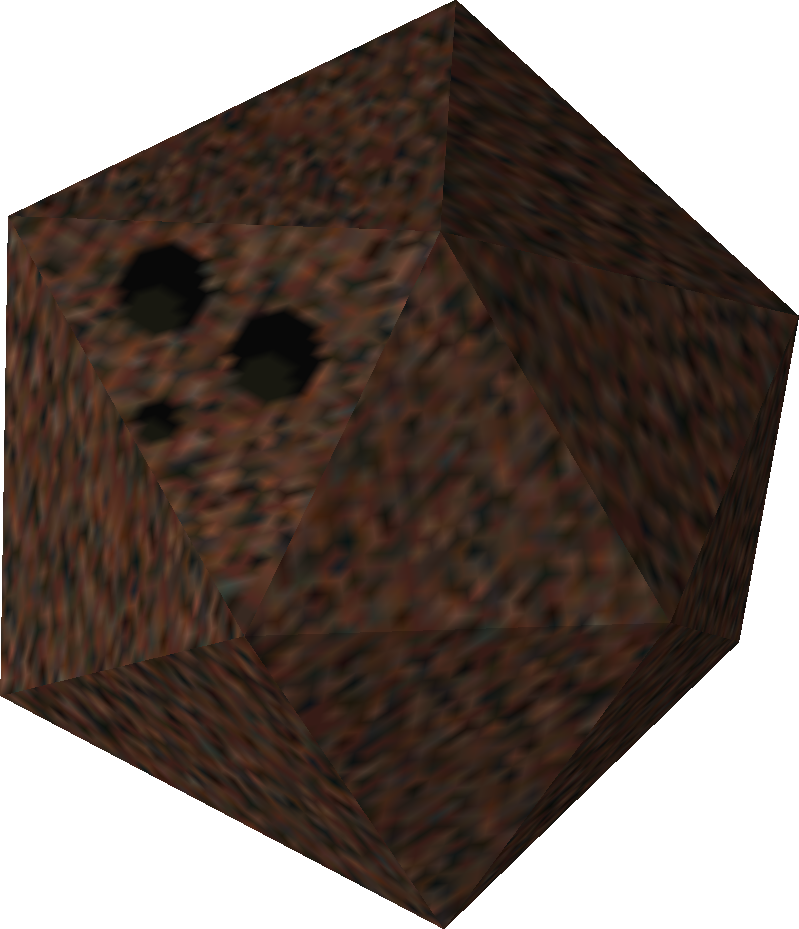
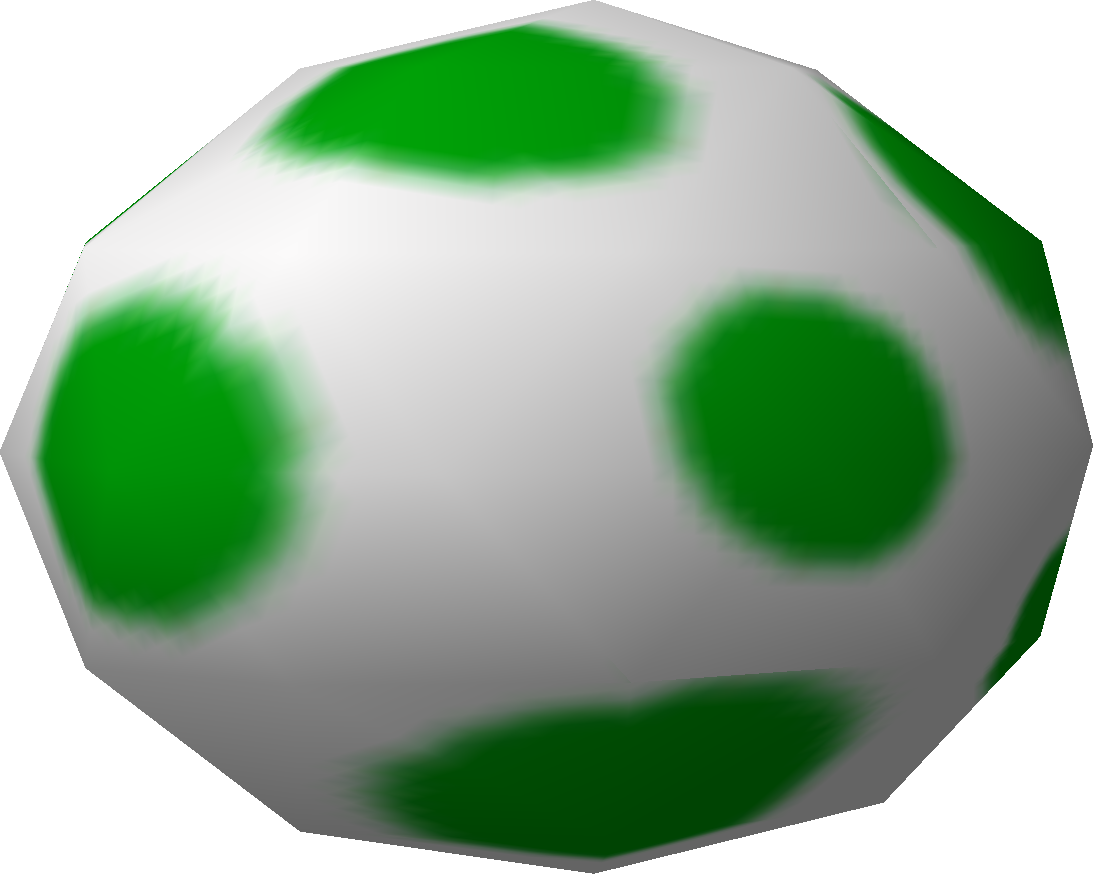
Giant EggYoshi ValleyAn enormous spotted egg rolling round in circles.
BatsBanshee BoardwalkA swarm that flies straight at you and slows you down.
Thrown stonesD.K.’s Jungle ParkwayHurled from the trees at anyone on the grass.
CowsMoo Moo FarmScenery only. They watch.
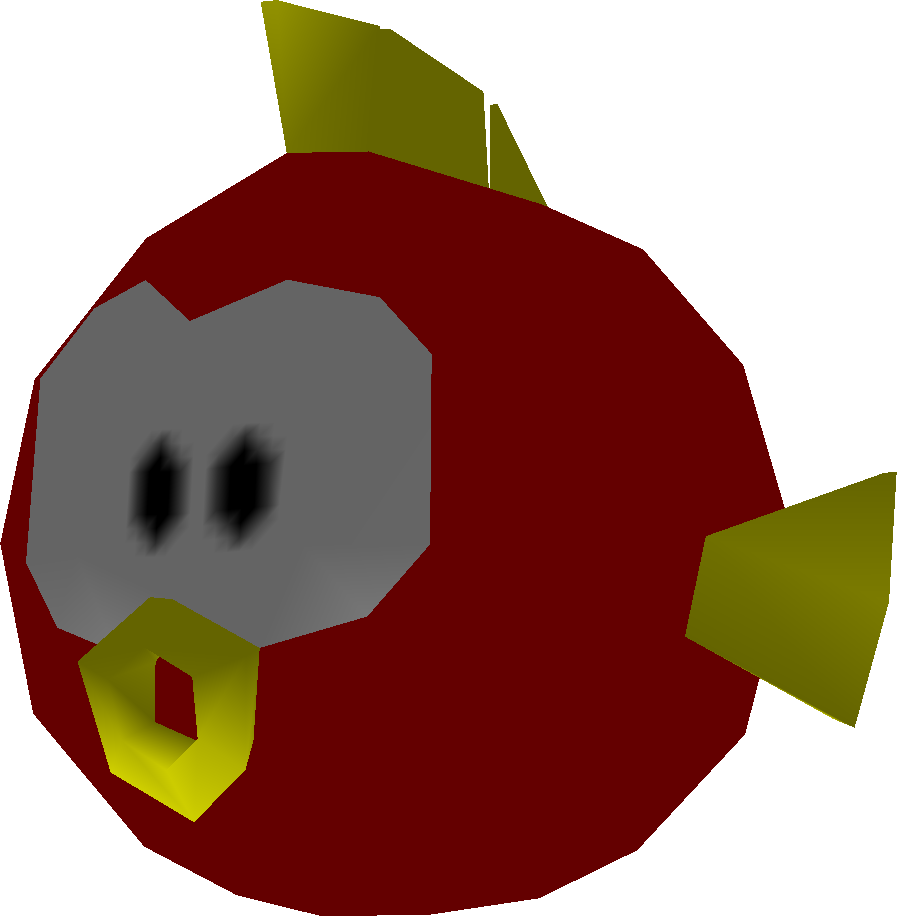
Cheep CheepBanshee Boardwalk; award ceremonyA giant one leaps over the boardwalk, and another carries in your trophy.
BoosBanshee BoardwalkThey laugh, and that is all.
Bowser statuesBowser’s CastleFire-breathing ornaments in the courtyards.
The people who made it
A considerably larger team than the eight who made the first game. Roles are as given in the 1996 guidebook interview and other references.
Hideki KonnoDirectorCo-director of Super Mario Kart, now in sole charge, and later the producer of the series.
Shigeru MiyamotoProducerInsisted that the basics stay simple enough for anyone to pick up, and borrowed some of Konno’s staff for Super Mario 64 along the way.
Tadashi SugiyamaVisual directorKonno’s co-director on the first game, here responsible for the look of the courses.
Masato KimuraMain programmerNamed collision detection, especially where roads cross on different levels, as the hardest problem.
Kenji YamamotoProgrammer (kart handling)Built a realistic driving model, then helped throw most of it away.
Tomoaki KuroumeCharacter designerModelled and rendered the eight drivers, most of them twice after a hard disk failure.
Kenta NagataComposerWrote the whole soundtrack and returned for Double Dash!! and Mario Kart 7.
Charles MartinetVoice of Mario (all versions), Luigi and Wario (international)Reprised Mario from Super Mario 64.
Leslie Swan and Isaac MarshallVoices of Peach and Toad (international)The Japanese version uses different performers for both.
John HulatonAnnouncer (Japanese version)Recorded his lines in the same sessions as his announcing for Wave Race 64.
Advertisement
How It Was Made
The fullest account of how the game was made is the developer round-table printed in Nintendo’s Japanese guidebook in 1996 (translated by Shmuplations in 2022), in which Miyamoto, Konno, Sugiyama and three of their colleagues talk through the project. Konno and Miyamoto added more in an Iwata Asks interview for Mario Kart Wii, and Konno returned to one sore subject, the blue shell, in 2011.
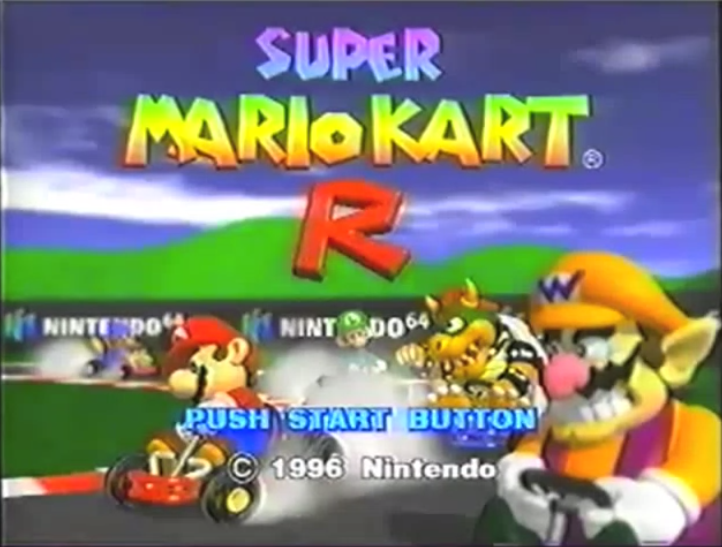
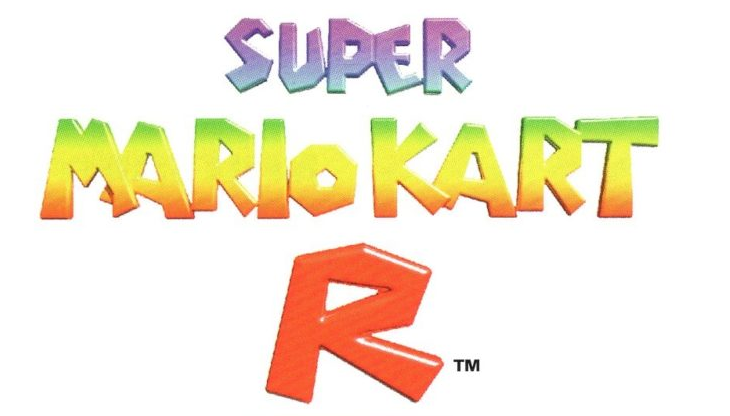
Super Mario Kart R
The title screen while the game was still Super Mario Kart R.
The sequel was first seen in November 1995 at Nintendo’s Shoshinkai show, where it was revealed alongside the new Nintendo 64 hardware on a videotape given to journalists. It was called Super Mario Kart R, the R standing for Rendered, a nod to the computer-rendered characters. Magazines of the time reported it to be nearly finished, and Konno has said his team fully intended it to be on shelves the day the console launched in mid-1996.
It was not. The game was being made at the same time as Super Mario 64 and Ocarina of Time, and Mario came first. Miyamoto’s team, working next door, took some of Konno’s staff to get the launch game finished, and Konno had to borrow help from other departments to complete his own. It finally reached Japan on 14 December 1996, six months after the console, under a plainer name.
Why the drivers are flat
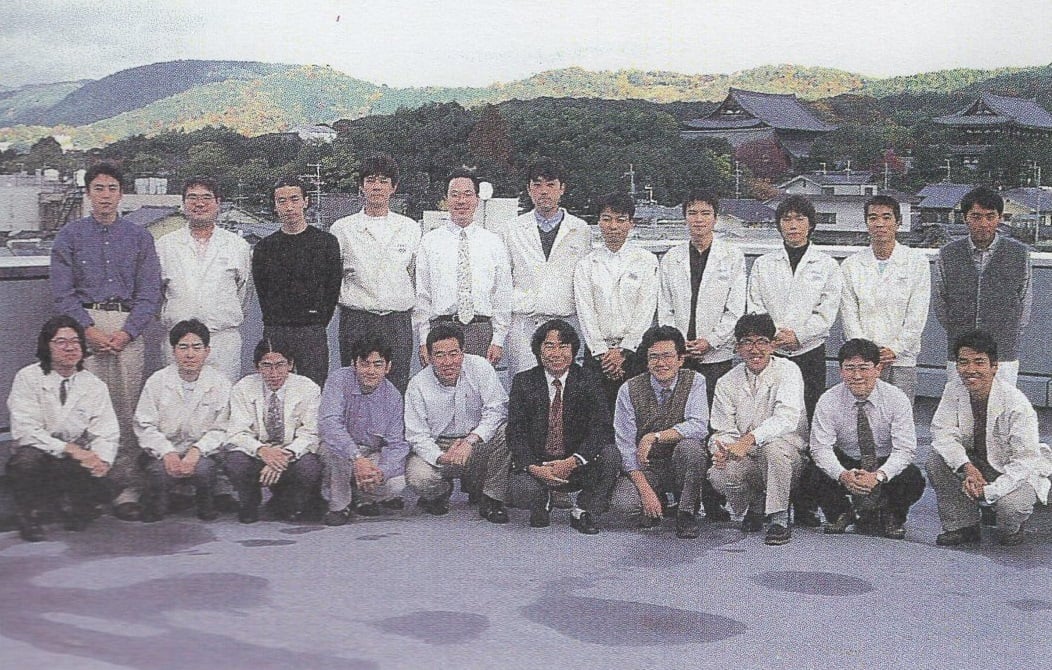
The development team in a commemorative photograph.
Konno had little experience of 3D when the project began, and the first problem was arithmetic. Eight fully modelled drivers in eight karts were more than the machine could move at once. The answer was a technique called billboarding: each character was built as a 3D model, rendered from many angles in many poses, and the resulting pictures were pasted on to flat boards that always face the camera. Miyamoto pointed out that Super Mario 64 does the same with its Bob-ombs and Wigglers.
It took thousands of frames. Character designer Tomoaki Kuroume started from existing models, and found Mario the worst: the Super Mario 64 figure had to be taken apart and adjusted limb by limb before it would sit in a kart and grip a wheel. Then a hard disk failed and took most of the work with it. About 80 per cent of the character models had to be made again. The pay-off came in multiplayer. “The four-player battles in Mario Kart 64 were also made possible with billboarding,” Konno told Iwata.
Too real to be fun
A start line from an early build, with a different display.
The team loved cars, and at first it showed. Konno bought radio-controlled models to study, and programmer Kenji Yamamoto wrote a handling model based on real vehicle physics. Testers could barely drive it. “Somehow it just didn’t feel like go-karts—it was too realistic, too niche,” said Konno. Midway through, most of it was thrown out in favour of something closer to the first game, though the simulation’s sense of grip and friction survived underneath.
Yamamoto wanted drifting to work on the analogue stick alone, and that proved too hard to control as well, so the slide stayed on a button. The Mini-Turbo began as a secret for experts. Only later was the coloured smoke added, so that players could see what they were doing and enjoy being good at it, and the manual was allowed to explain it.
Four screens, one cartridge
Luigi, Mario and Wario on the podium in Nintendo’s artwork.
Four-player racing was a goal from the outset, and Miyamoto was candid about its price: each window needs its own 3D calculations, so four players mean four times the work. The team nevertheless refused to build cut-down multiplayer tracks, and every mode uses the same sixteen courses. Miyamoto credited the cartridge format for making that possible, arguing that a CD-ROM could not have fed the machine data quickly enough.
Visual director Tadashi Sugiyama, who had co-directed the first game, admitted that standing out from it was hard: “we really did struggle to find ways to differentiate this game from Super Mario Kart.” Height was the answer. Hills, drops and crossovers changed the racing more than anything else, and set pieces such as the Kalimari Desert train gave each course an identity. Main programmer Masato Kimura found the price of that, too: working out what was touching what on tracks that pass over themselves was the hardest job on the project, and every shell in flight needed checking against all of it.
Where the blue shell came from
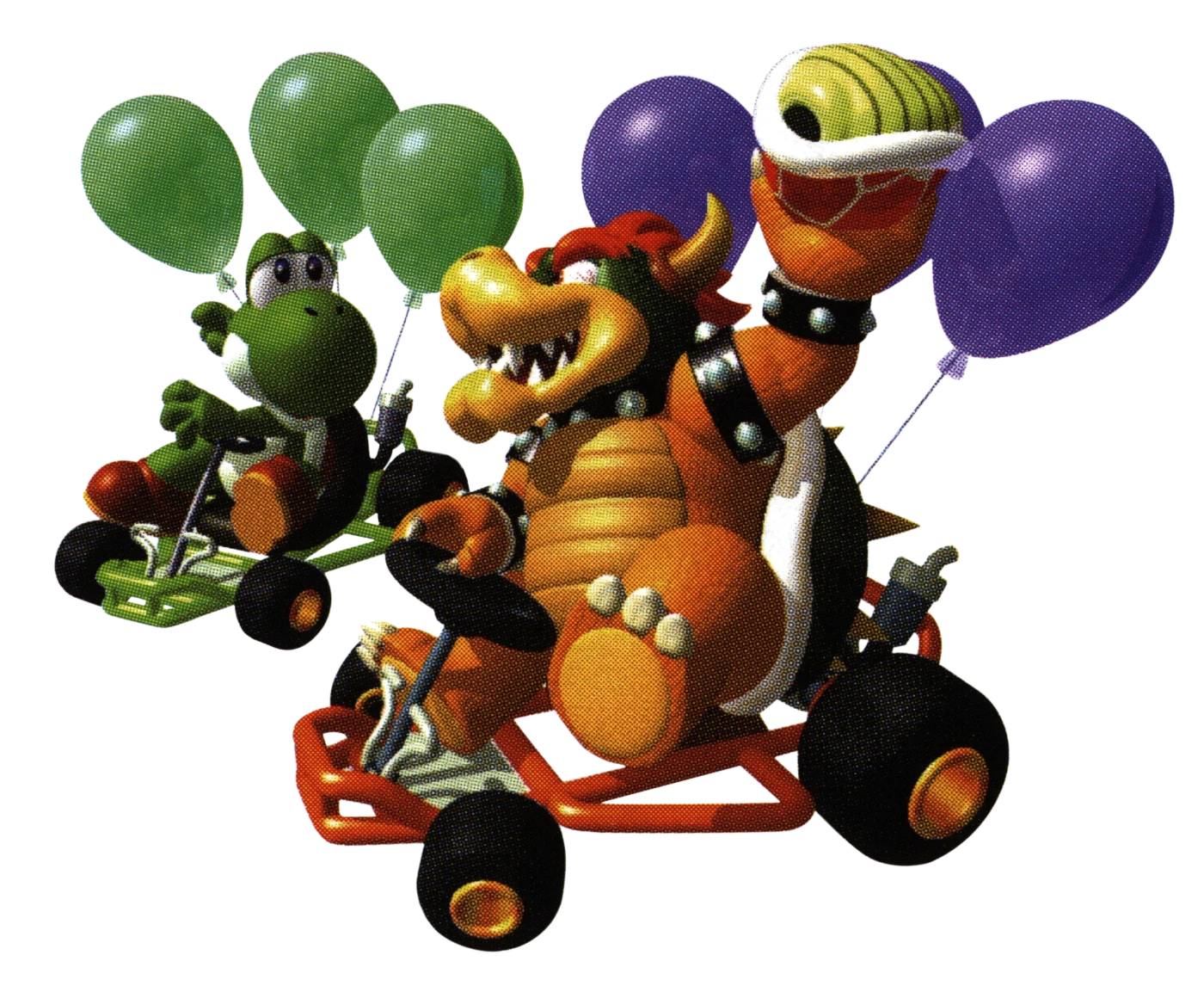
Bowser lines up a red shell on Yoshi.
The Spiny Shell was born of a compromise. Konno’s ideal race was one in which the whole field stayed bunched together to the flag. “With Mario Kart 64, we wanted to have the same thing where everyone was in it until the end,” he told Kotaku’s Stephen Totilo in 2011, but keeping eight karts on screen together strained the hardware: “because the processing power didn’t exist, we weren’t able to create the racing environment we wanted.”
Totilo’s reading was that the blue shell is what the team reached for instead: if the pack could not be kept together, the leader could at least be brought back to it. The team also tuned the homing shells by feel rather than by physics: Kimura explained that red and blue shells ignore the rules that govern the green ones and simply do what seemed right.
Kamek, the Feather and the tracks that got away
Kamek on Mario Raceway in an early build.
Early screenshots show a different game around the edges. Kamek the Magikoopa is on the driver-select screen where Donkey Kong would end up. Item Boxes are black with coloured question marks. The Fake Item Box, then called the Bogus Box, has a bomb inside it. Royal Raceway is Toadstool Turnpike, and the cups run in another order, with Banshee Boardwalk opening the Flower Cup and Toad’s Turnpike closing the Special. The Feather from the first game is in one picture (it even made it on to the back of the Nintendo 64 box), and two jump animations for it are still on the cartridge.
Two whole courses were abandoned. One was a multi-storey car park, dropped because driving round it made people feel ill. The other was a large town with a castle, a pond and houses, which simply took too long to lap; a model for it, labelled TOWN, survives in the game’s unused data. A no-items mode was built for fans of F-Zero and removed when nobody at demo sessions chose it. And at one stage the Thunder Bolt worked in Battle Mode, where it would have cost every opponent a balloon at a stroke.
Series Firsts
What this entry added to the series. Each was checked against Super Mario Kart.
1Four players at onceVersus and Battle for up to four on a split screen. It is usually counted as the first game in the whole Mario franchise to support more than two simultaneous players.
2Courses with heightHills, jumps, tunnels, bridges and walls replace the flat Mode 7 maps, and each of the sixteen courses is a one-off rather than a numbered variation.
3The Spiny ShellThe blue shell that targets first place appears for the first time, along with Triple Green and Triple Red Shells, Triple Mushrooms, the golden Super Mushroom, the Banana Bunch and the Fake Item Box.
4The modern Mini-TurboCharging a boost by counter-steering in a slide, with smoke that changes colour, begins here and has been the heart of the series’ driving ever since.
5Mirror ModeThe Extra class flips every course. Later games renamed it Mirror Mode and kept it.
6Weight classesLight, medium and heavy drivers replace the first game’s four matched pairs.
7VoicesThe drivers speak, shout and gloat for the first time in a Mario Kart, led by Charles Martinet’s Mario.
8Staff ghostsThree courses contain Time Trial ghosts set by Nintendo’s own staff, the first in the series, and your own best runs can be saved to a Controller Pak.
9Wario and Donkey KongBoth make their Mario Kart debuts, replacing Koopa Troopa and Donkey Kong Jr.
10Items in towHolding the item button drags a banana, shell or fake box behind the kart as a shield, a defensive habit that later games kept.
Cheats & Secrets
Mario Kart 64 has few codes but plenty to discover: a hidden class, three buried ghosts and shortcuts that range from the officially sanctioned to the frankly unsporting. SLB’s cheats, driving tips and shortcuts pages, linked under Reference below, have more.
Extra (Mirror Mode) and the second title screen
Win the gold trophy in all four cups on 150cc. A new class, Extra, joins the menu: all sixteen courses mirrored and run at 100cc speed. The title screen changes at the same time, to a new picture of the cast. You do not need to have won anything on 50cc or 100cc first.
The three staff ghosts
Beat a target time in Time Trials and a ghost recorded by Nintendo’s staff appears on that course. The targets are 1:52 on Luigi Raceway, 1:30 on Mario Raceway and 2:40 on Royal Raceway. The ghosts are Luigi (1:48.37), Mario (1:27.16) and Peach (2:38.55), each on their own course.
Rocket start
Press A at the moment Lakitu’s signal changes from red to blue. Too early and you spin on the line.
Saving a banana slip
If you hit a peel while driving straight, tap B as the kart begins to skid. A musical note appears and you carry on. After any spin or crash, tap A three times and then hold it: the kart gets back to speed more quickly.
The Spiny Shell balloon
On laps two and three of Luigi Raceway a hot-air balloon with Luigi’s face sinks towards the track. The Item Box hanging under it always gives a Spiny Shell.
Shortcuts the designers left for you
Koopa Troopa Beach: just past the rock arch, a small ramp leads up to a cave mouth; a Mushroom or a hop at the top of the ramp gets you in, and you come out through a waterfall with a corner saved. Kalimari Desert: at the first level crossing, turn along the rails and follow them through the tunnel, ideally with a Star running, to skip most of the lap. Rainbow Road: hop the left-hand rail at the very start and, with luck, you land on the loop far below. Yoshi Valley: where the routes come back together, a hop to the left (or a Mushroom) skips a curve. D.K.’s Jungle Parkway: inside the cave at the end of the lap, cutting across the off-road strip shaves the final turn. Bowser’s Castle: a Mushroom or Star across the grass in the first courtyard. On the three Raceways, Mushrooms and Stars let you straighten most of the bends across the grass.
Sightseeing
On Royal Raceway, leave the track by the road beside the big jump and you can drive right up to Peach’s Castle, modelled on the one in Super Mario 64. On Sherbet Land a giant penguin sits on an island in the lake; the only way to reach it is in multiplayer, by having a heavyweight ram a lightweight across.
Display, music and the Controller Pak
C-Right swaps the course map for a speedometer or a lap chart, and L turns the music down and then off. Holding Start as you switch the console on opens a manager for whatever is saved on the Controller Pak. A single ghost needs 123 pages, the whole of a standard Pak (later revisions trimmed it to 121).
The debug menu
With a GameShark, the code 8818EDEF 0002 followed by the GS button on the title screen opens the developers’ menu. Among its options is one that awards every gold cup, and it can switch on an unfinished vertical split screen.
Compiled from StrategyWiki’s secrets page and SLB’s own cheats and shortcuts pages. SLB’s older cheats page lists target times for ghosts on fifteen courses; only the three above are documented elsewhere.
Glitches & Oddities
Real walls can be climbed, and Lakitu can be fooled. Mario Kart 64’s speedrunning scene (its unofficial Players’ Page has been tracking records since 1997) is built on tricks that persuade the game you have completed a lap when you have done nothing of the sort. Most are much harder than they sound.
Wario Stadium: over the wall
On the first hill, drive at the wall so that the kart bounces over it, turn round and hop back across so that you land just short of the starting line. Cross it and Lakitu credits a lap, turning a 1.5-kilometre circuit into a few seconds’ work.
Rainbow Road: the big drop
With a precisely timed slide and hop to the left before the barriers, a kart can clear the rail and land on a distant part of the track without using any item at all.
Frappe Snowland: the lap skip
Clipping out of bounds on Frappe Snowland.
Turn on to the bridge, then leave it for the snow and drive out of bounds beyond the start line until Lakitu comes to collect you. Cross the line and the next lap begins. Done three times, the race takes about a minute.
Mario Raceway and Yoshi Valley: over the fence
Neither works in Extra. On Mario Raceway, a Mushroom fired at exactly the right angle just before the hairpin round the giant toadstool takes you over the wall. On Yoshi Valley, turn hard left straight after the finish line and boost over the fence into the canyon: Lakitu drops you back on the start with a lap added.
Royal Raceway and D.K.’s Jungle Parkway
On Royal Raceway (again, not in Extra), swing left halfway down the straight after the big ramp and Mushroom across the river to the far bank. On the Parkway, turn round inside the cave, squeeze between its left edge and the drop near the exit and fall into the water; Lakitu puts you back in the cave further on than he should.
Koopa Troopa Beach: inside the island
Somewhere a kart was never meant to be.
To the left of the big turtle-shaped rock there is a mossy crease in the cliff. Drive into it and keep pushing and the kart climbs through the scenery and drops into water in the middle of the island.
Block Fort: through the wall
The Block Fort wall clip.
In a two-player battle, one player sits still by a wall while the other builds a boost and pins them against it. Released at the right moment, the stationary kart pops straight through the blocks.
Frappe Snowland: the bottomless bridge
Falling through the bridge, repeatedly.
In two-player mode, a kart that drives off the bridge into the river at one particular point is set down by Lakitu in such a way that it falls through the bridge again, and again, until the other player comes to help.
Fifth place, still racing
Cross the line in a Grand Prix nose to tail with the driver in fifth and the game may let you continue to the next race even though you are recorded as fifth and score nothing. Touch the winner as you finish second and you hear the first-place fanfare, though you only get second-place points.
The tune nobody was meant to hear
Leave the results screen running after a top-four finish and, after 64 loops of the music (about 50 minutes), it switches to an alternative version. Mario Kart World pays tribute to the bug in its own results music.
Odds and ends
Two unreachable Item Boxes sometimes appear underneath Big Donut. On Kalimari Desert it is possible to drive between the wheels of the train and sit underneath it. And a Star that runs out exactly as you start a new lap can leave its music playing until the race ends.
Videos
Nintendo’s trailer for the Wii U Virtual Console release, and a tour of the game’s secrets and development history.
Nintendo’s official Japanese trailer for the Wii U Virtual Console release of January 2016, as uploaded by IGN.
Did You Know Gaming’s July 2020 episode on the game’s development, cut content and trivia.
Trivia & Interesting Facts
The original logo.The game was announced as Super Mario Kart R. The R stood for Rendered.
The early driver-select screen, with Kamek among the eight.Kamek the Magikoopa was one of the eight drivers in early versions and was replaced by Donkey Kong before release.
The Feather from Super Mario Kart was planned to return. A screenshot showing it was printed on the back of the Nintendo 64’s own packaging, and its animations are still in the game’s data.
The Fake Item Box was originally called the Bogus Box, and early screenshots show a bomb inside it instead of an upside-down question mark.
Royal Raceway was called Toadstool Turnpike during development. In Japan it is Peach Circuit.
A course set in a multi-storey car park was cut because it made players feel sick, and a town course was cut because a lap took too long.
A hard disk failure during development destroyed so much work that around 80 per cent of the character models had to be rebuilt.
The Thwomps in Bowser’s Castle laugh with Wario’s voice, slowed down and lowered.
By most counts, this is the only Mario Kart in which every driver has a course of their own.
All four cups are available from the start. The only other game in the series to do that is Mario Kart 8 Deluxe.
With Wario Stadium’s return in Mario Kart World, this became the first Mario Kart (leaving aside Super Circuit’s wholesale revival of the SNES courses) to have had every one of its race courses remade.
Rainbow Road in Nintendo’s course artwork.Its Rainbow Road, at 2,000 metres, was recognised by Guinness World Records 2011: Gamer’s Edition as the longest track in the series. When Mario Kart 8 rebuilt it, the three laps became one lap in three sections.
The Japanese version’s trackside sponsors are parodies of real ones: Marioro (Marlboro), Luigip (Agip), Yoshi 1 (Mobil 1) and Koopa Air in Goodyear’s colours. All were changed overseas.
On the Japanese title screen a group of children shout the game’s name. Everywhere else, Mario says “Welcome to Mario Kart!”
The Japanese cartridge has a second, Japanese-language credits sequence, shown only after clearing the Special Cup in Extra.
This is the first Mario Kart to spell out its sound effects on screen: Poomp! Boing! Crash! Whirrrr!
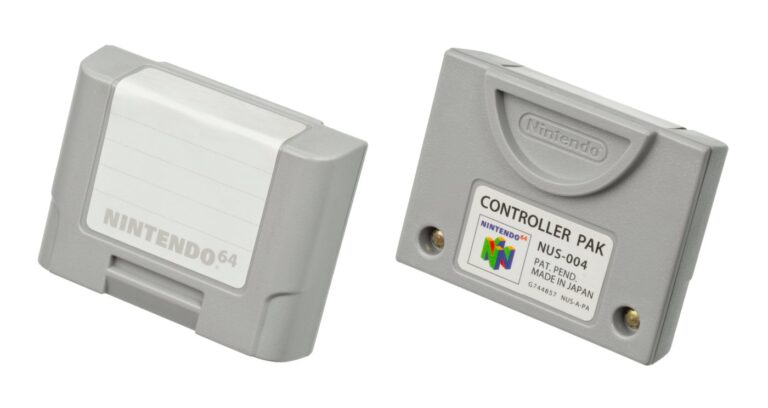
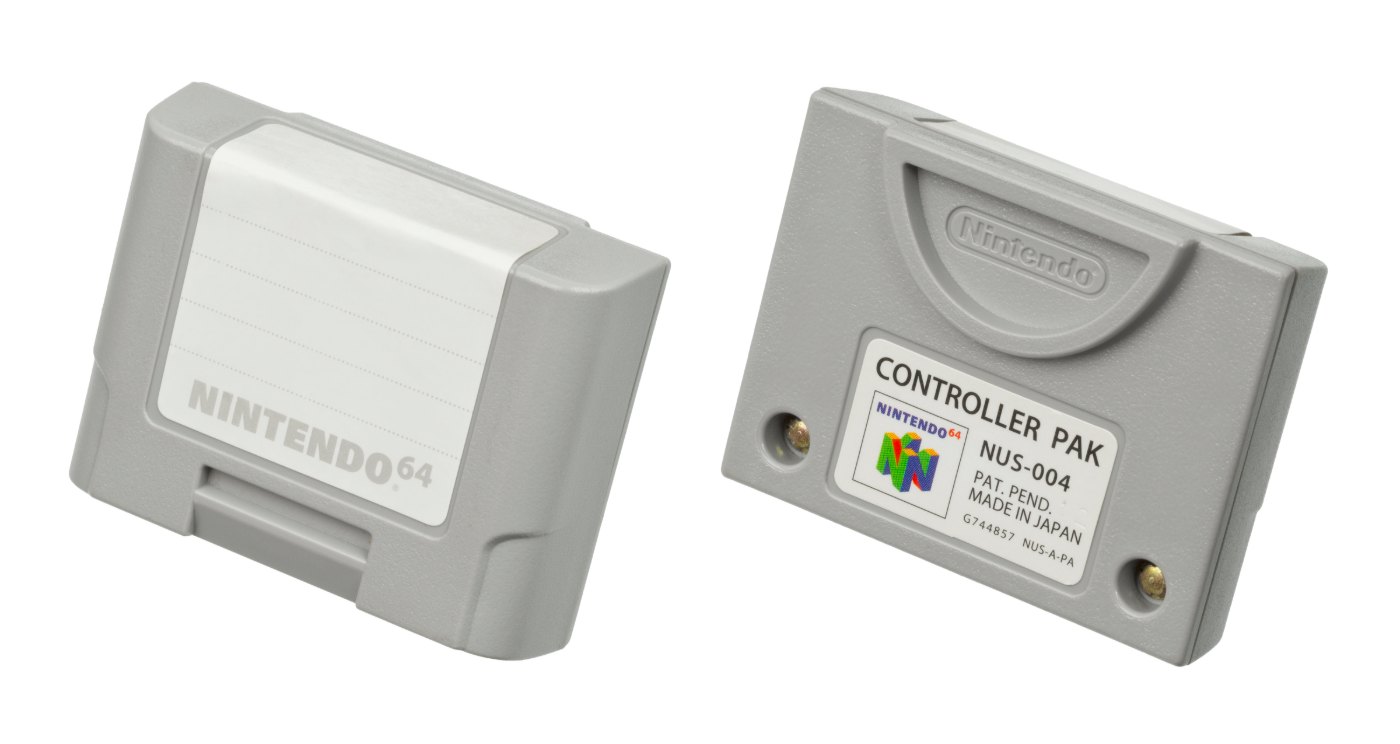
The Nintendo 64 Controller Pak.A single Time Trial ghost fills an entire Controller Pak (123 pages). None of the Virtual Console or Switch Online versions can save ghosts at all.
According to the developers, Super Mario Kart could handle four banana peels on screen at a time. Mario Kart 64 can handle a hundred.
Code that would let the computer drivers drift is on the cartridge but never used. They did not learn the trick until Double Dash!!.
Chubby, the mole of Moo Moo Farm, has a complete body in the game’s data, though you only ever see his top half.
A vertical split screen for two players was started and left unfinished in the debug menu. Mario Kart 8 finally used the idea.
A version of the game was offered in hotel rooms through the LodgeNet system. Most of those installations wiped their save data on every reset, so Extra could never be unlocked on them.
The announcer of the Japanese version, John Hulaton, recorded his lines in the same sessions as his commentary for Wave Race 64.
Regional Box Art
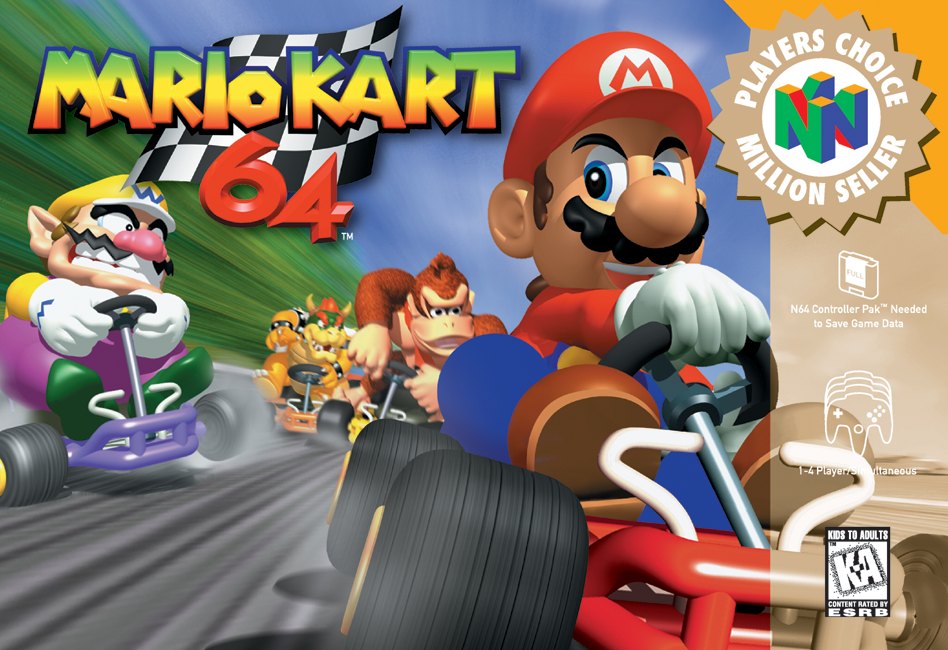
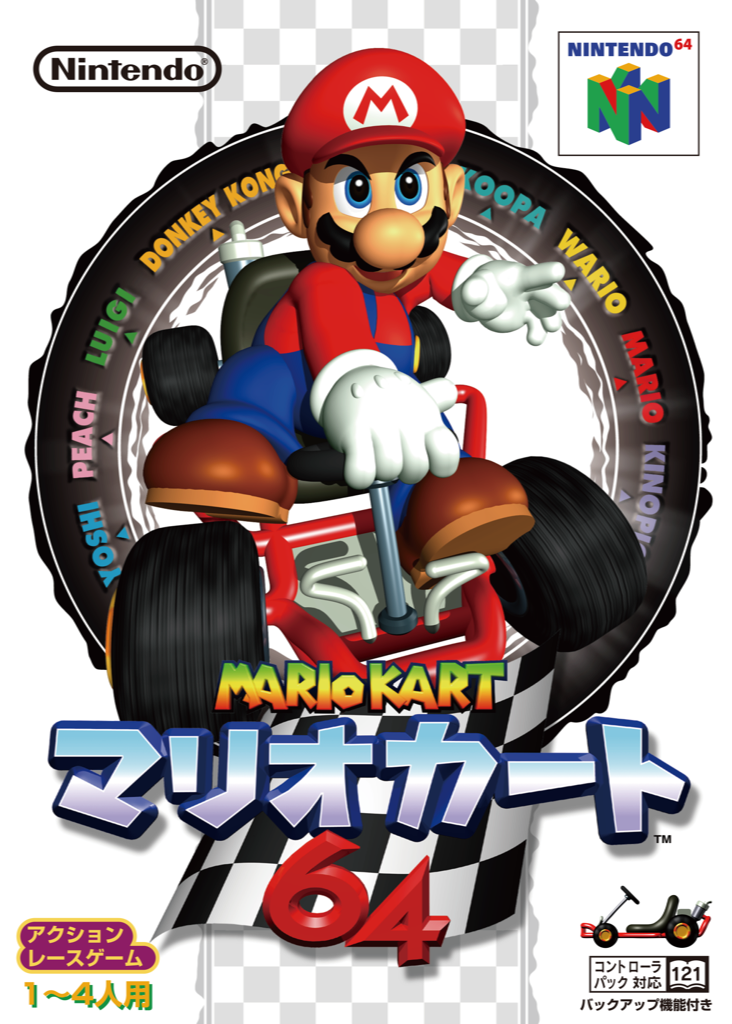
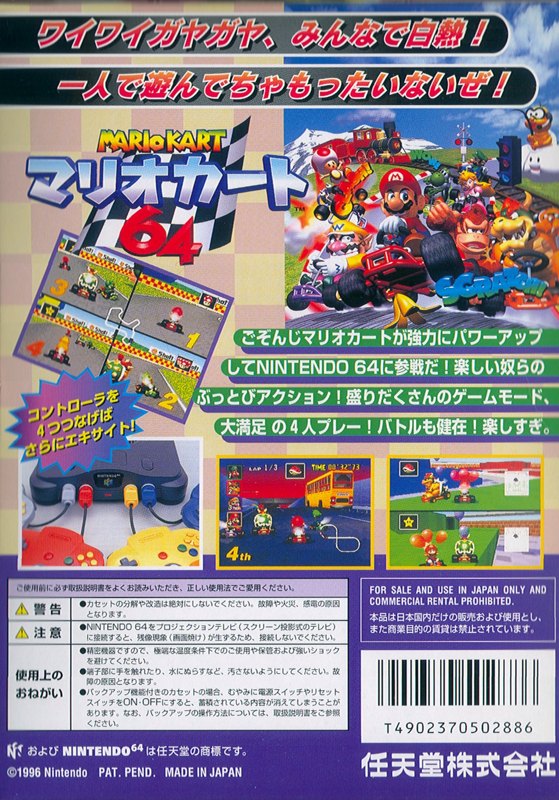
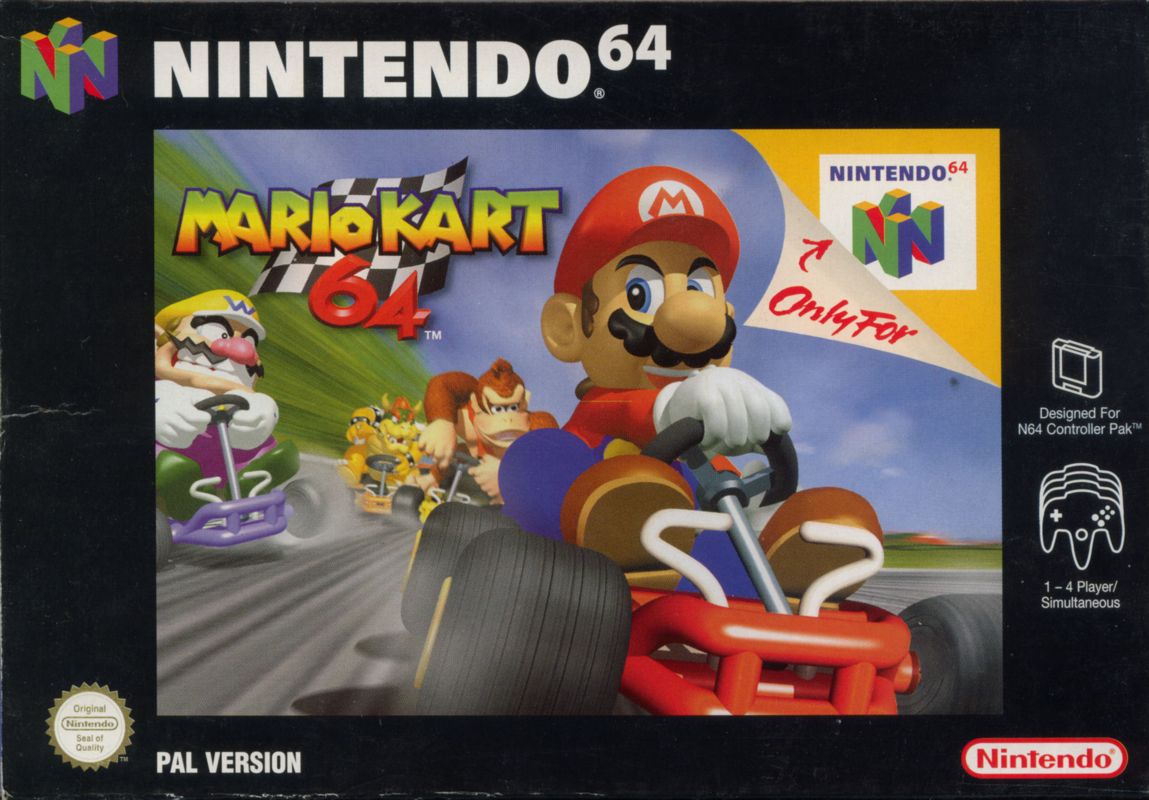
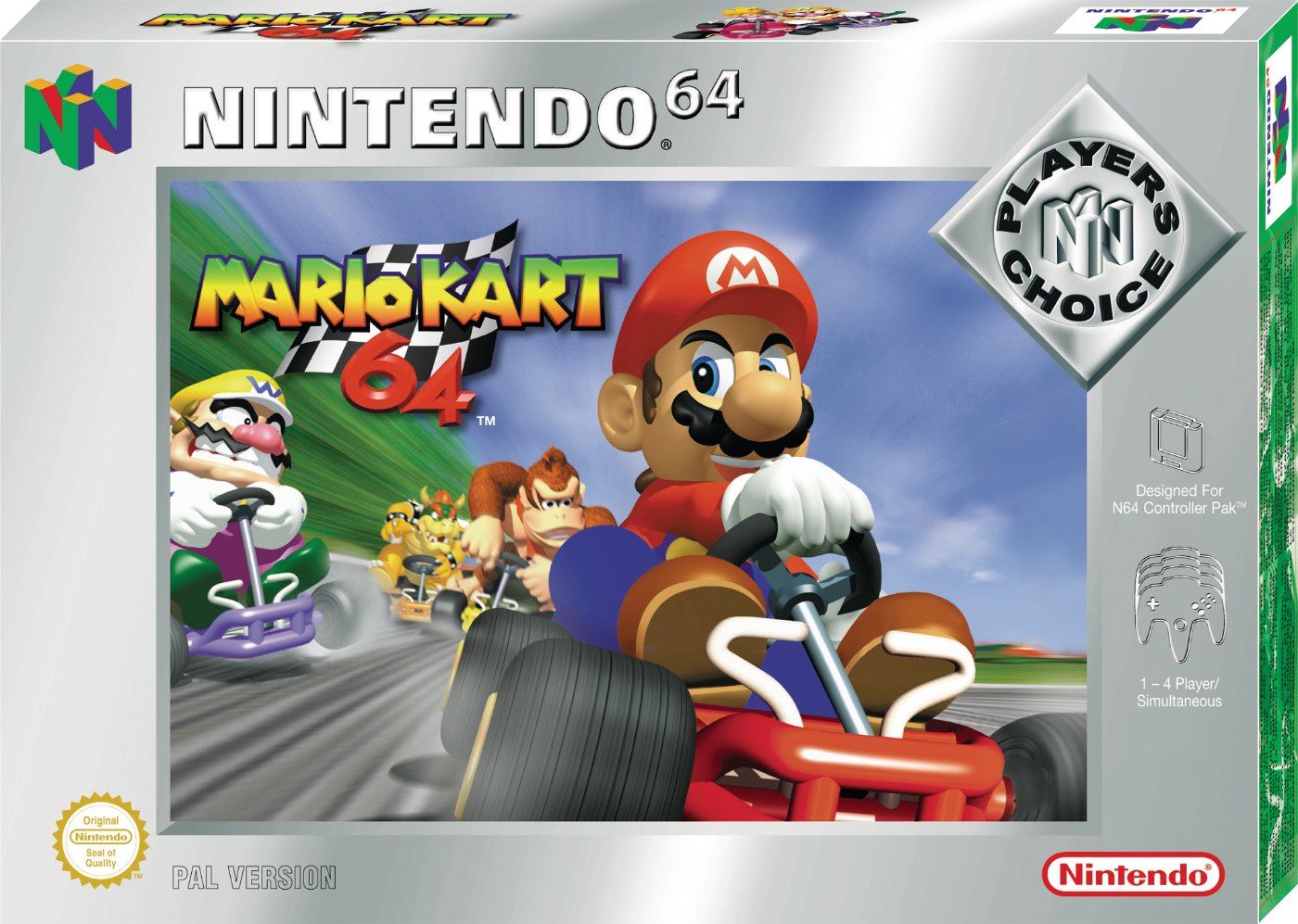
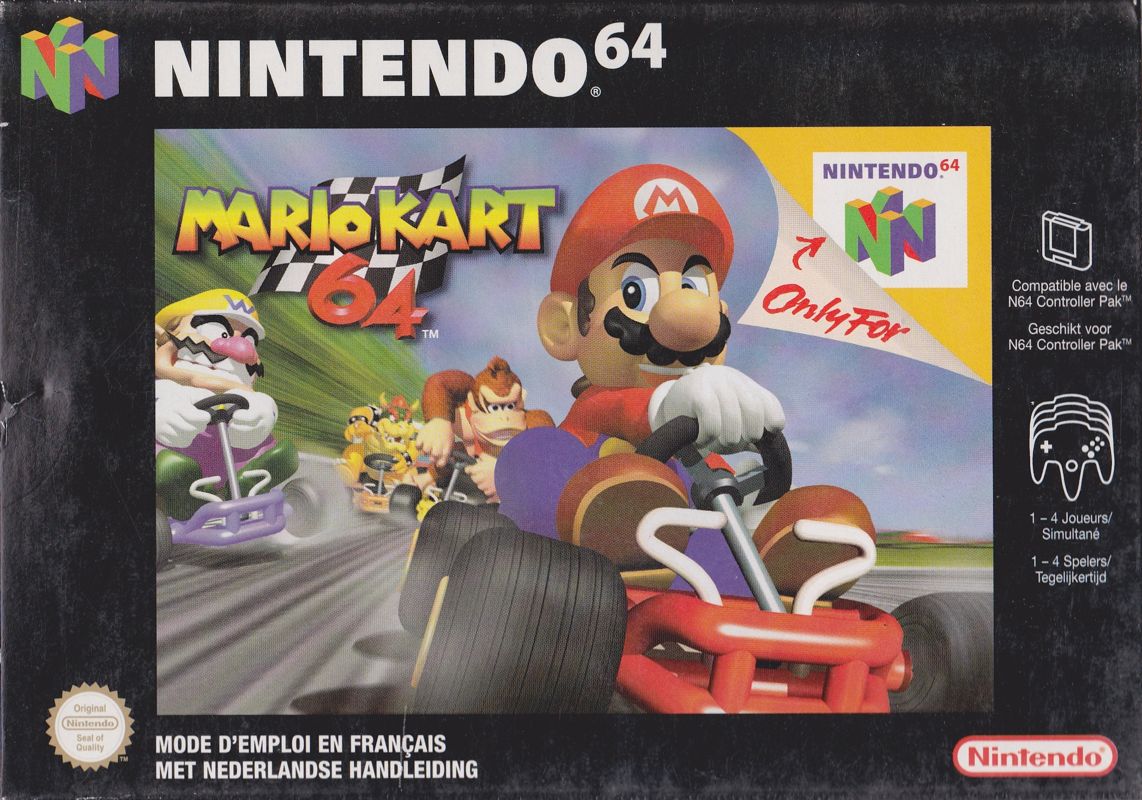
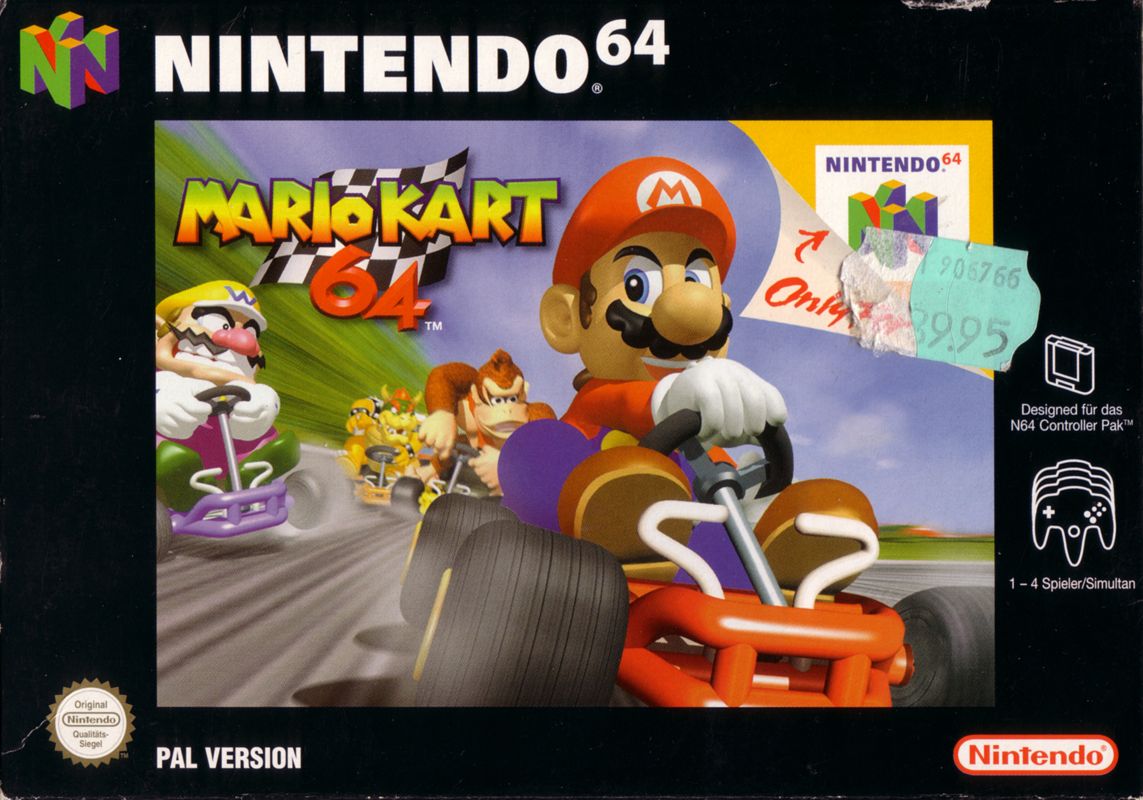
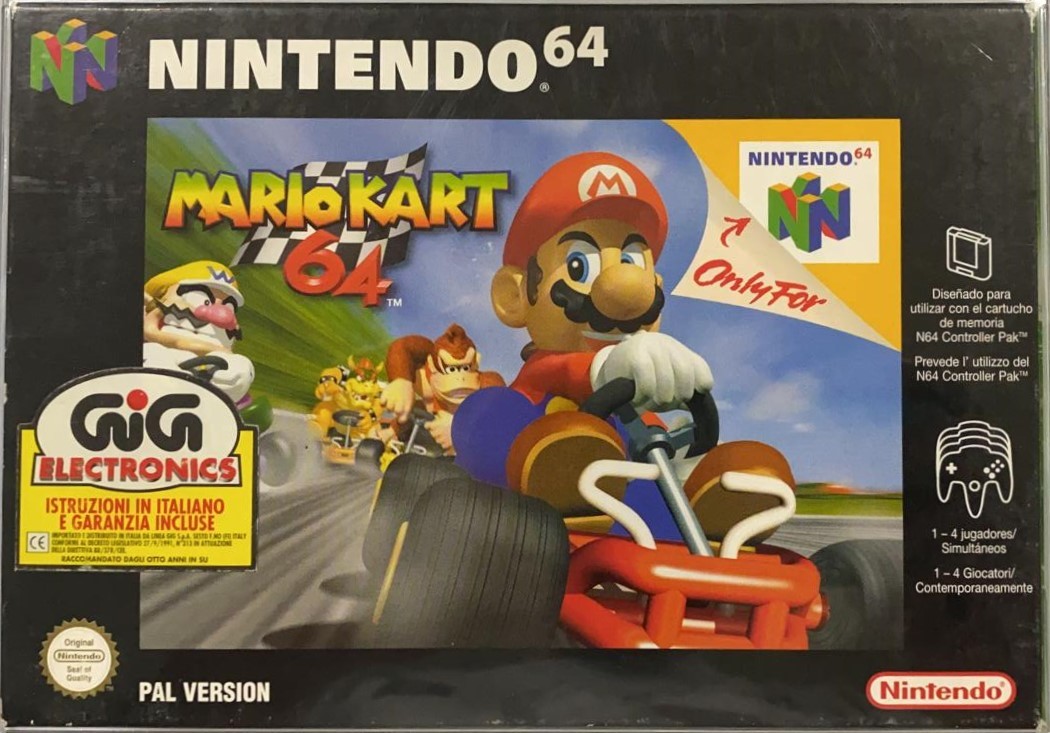
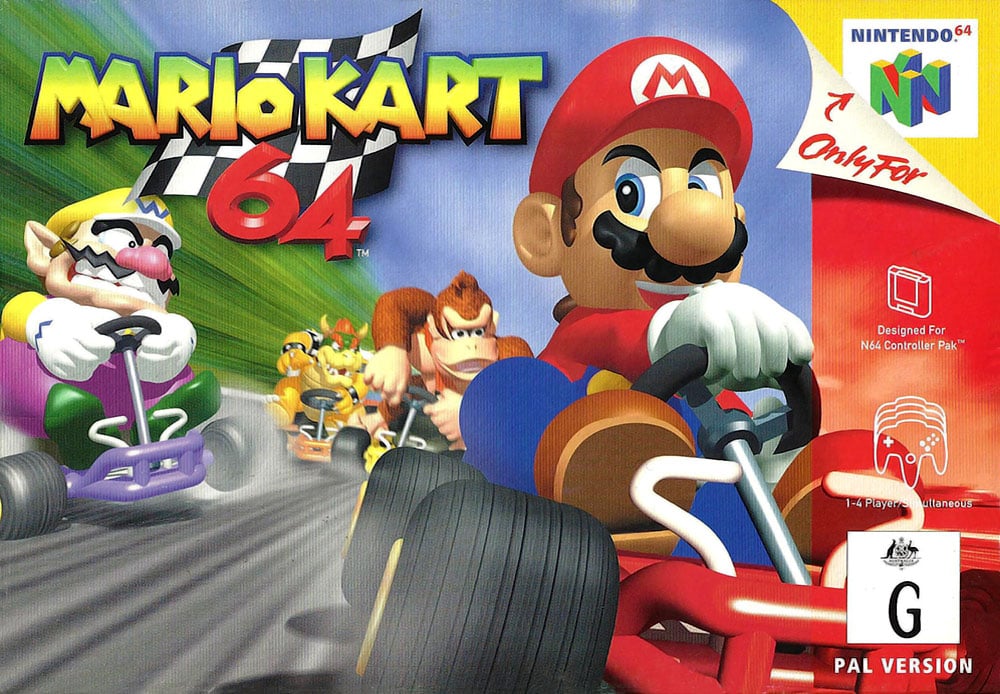
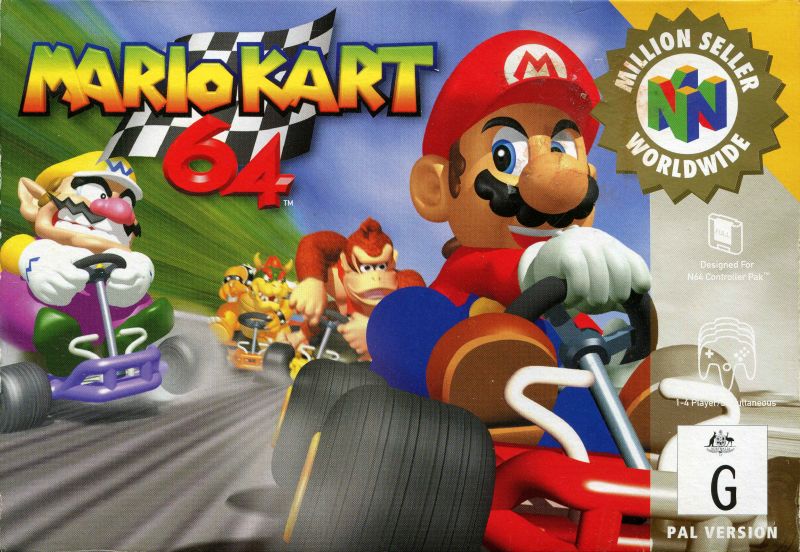
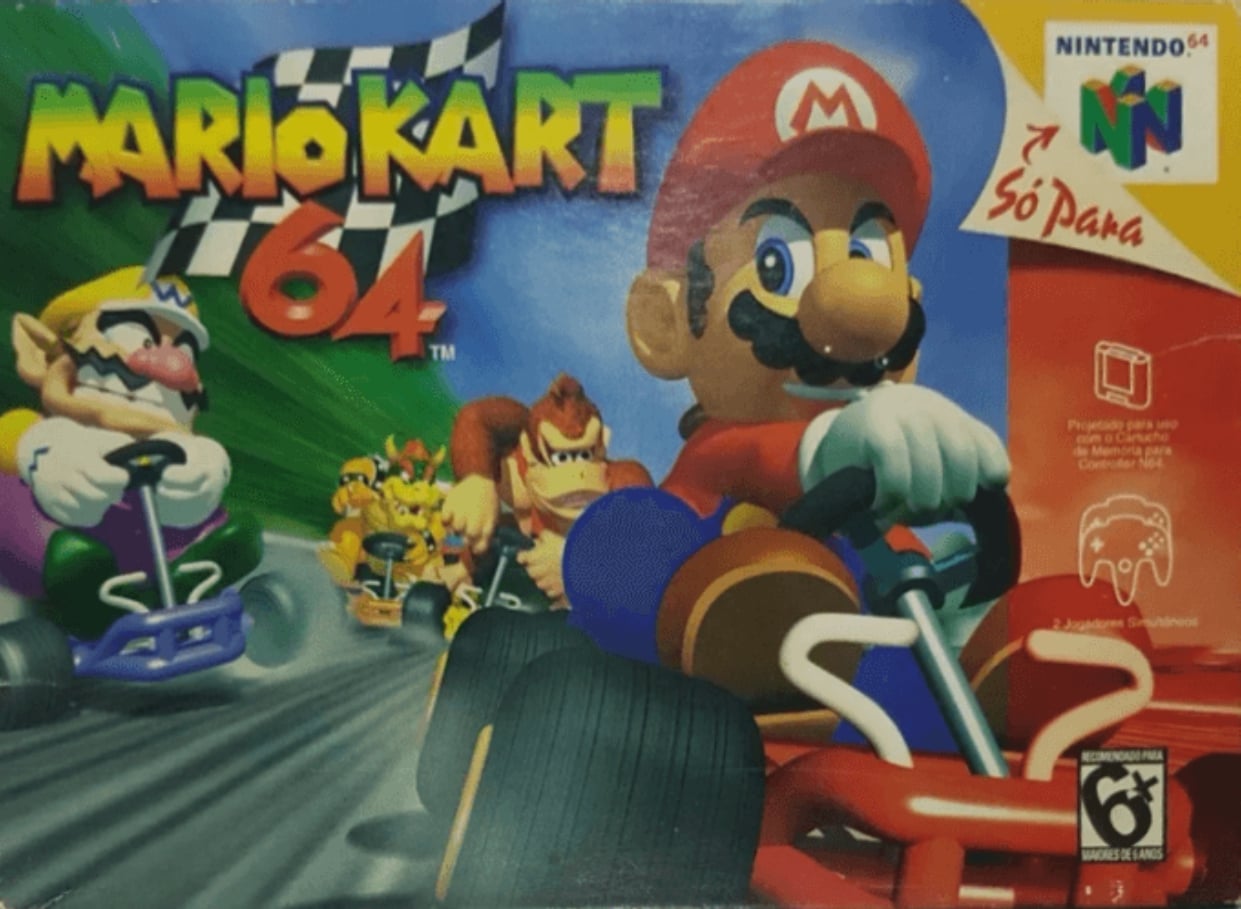
One painting of the whole grid in full flight did duty in every region, cropped and framed to suit, and most territories saw a second printing under the Player’s Choice banner. Japan also sold the game boxed with a controller.
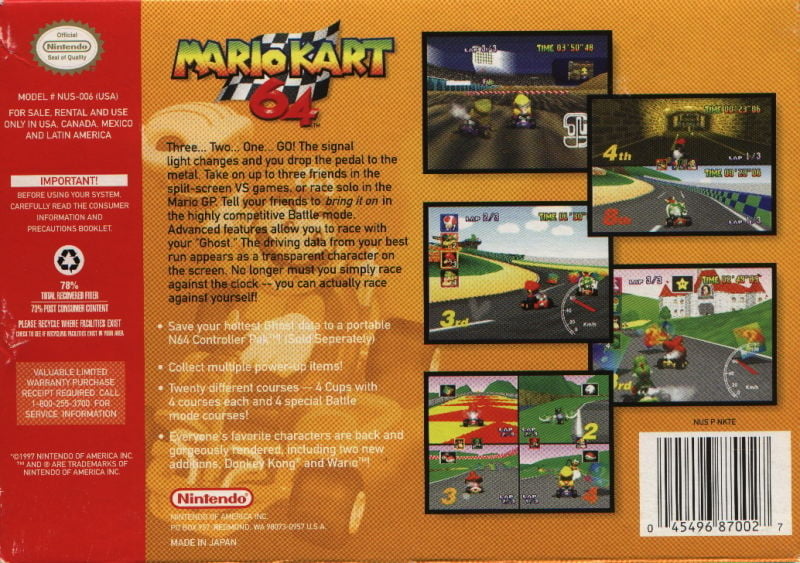
North America (1997)The standard American box.North America (back)The reverse of the American box.North America (Player’s Choice, 1998)The reissue of 26 January 1998.Japan (1996)The Japanese box.Japan (back)The reverse of the Japanese box.Japan (controller bundle)The larger box sold with a black-and-grey controller.Europe (1997)The standard European box.Europe (Player’s Choice)The European reissue.France and the NetherlandsShared French and Dutch packaging.GermanyGerman-language packaging.ItalyThe Italian version.Australasia (1997)The Australian and New Zealand box.Australasia (Player’s Choice)The Australasian reissue.BrazilThe Brazilian release.
Screenshots
More from the Nintendo 64 original: a second look at a dozen of the courses, and the title screen you earn by winning everything.
The second title screen, unlocked with Extra.Kalimari Desert.Traffic on Toad’s Turnpike.The tunnel on Choco Mountain.The humps of Wario Stadium.Sherbet Land.Royal Raceway.Inside Bowser’s Castle.D.K.’s Jungle Parkway.Yoshi Valley.Banshee Boardwalk.Rainbow Road.
Artwork & Media Gallery
Official artwork, course illustrations, logos, cartridges, soundtrack sleeves and pre-release curios from Mario Kart 64. Select any image to see it full size; SLB’s Virtual Console screenshot gallery is linked below.
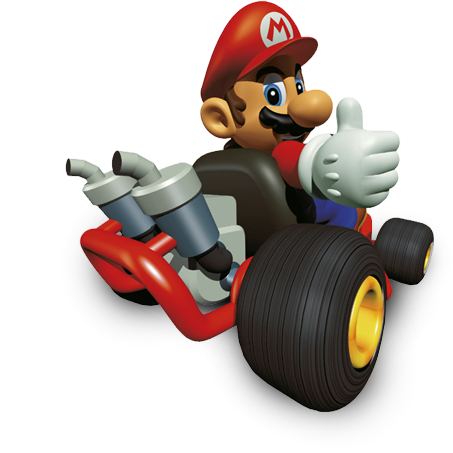
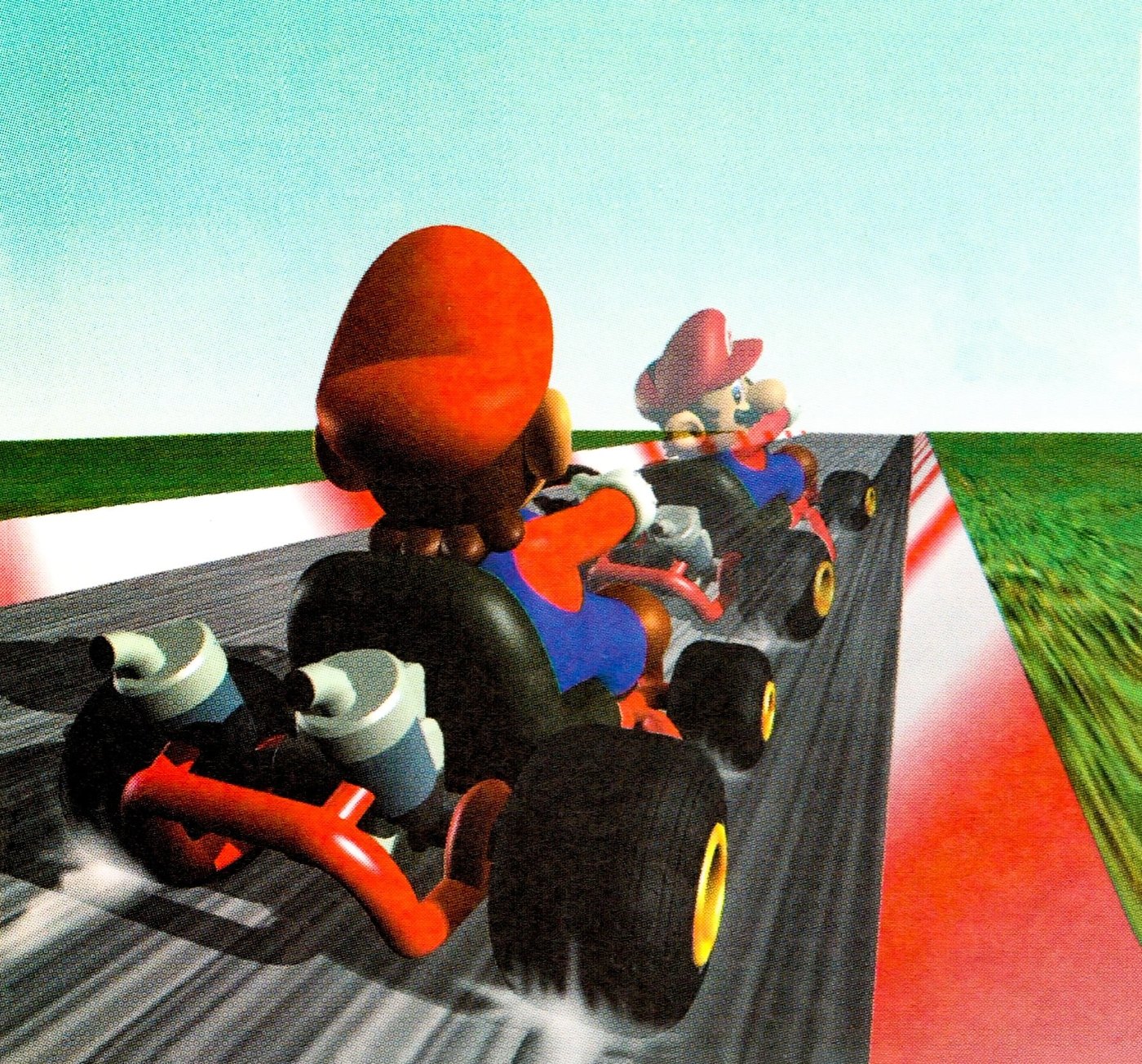
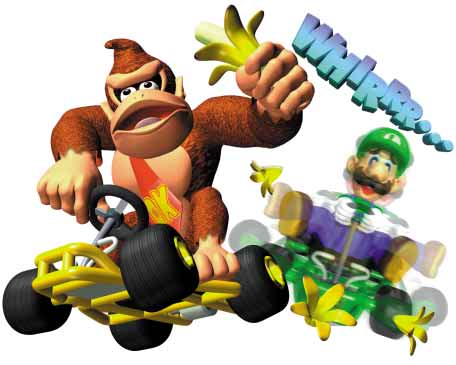
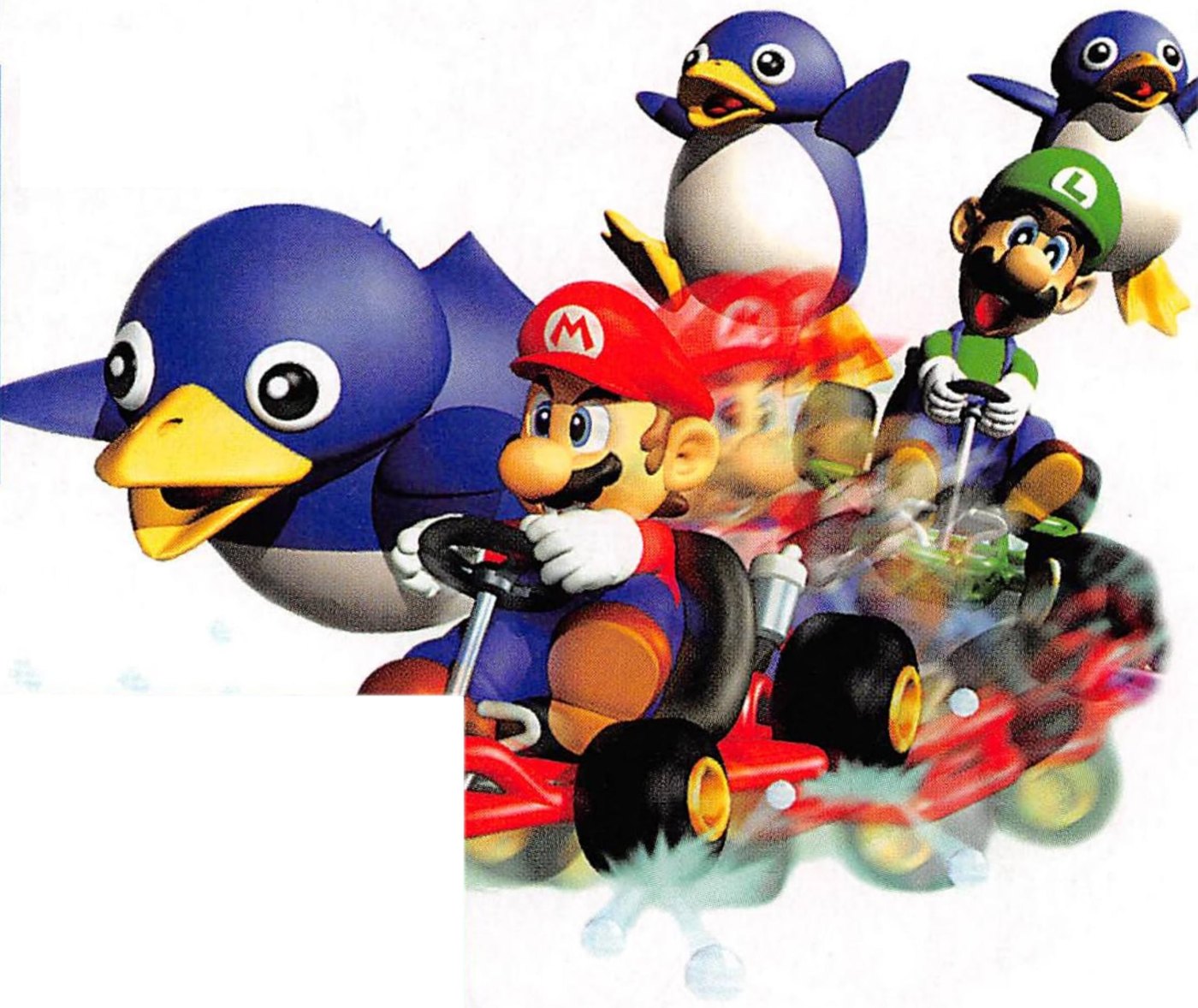
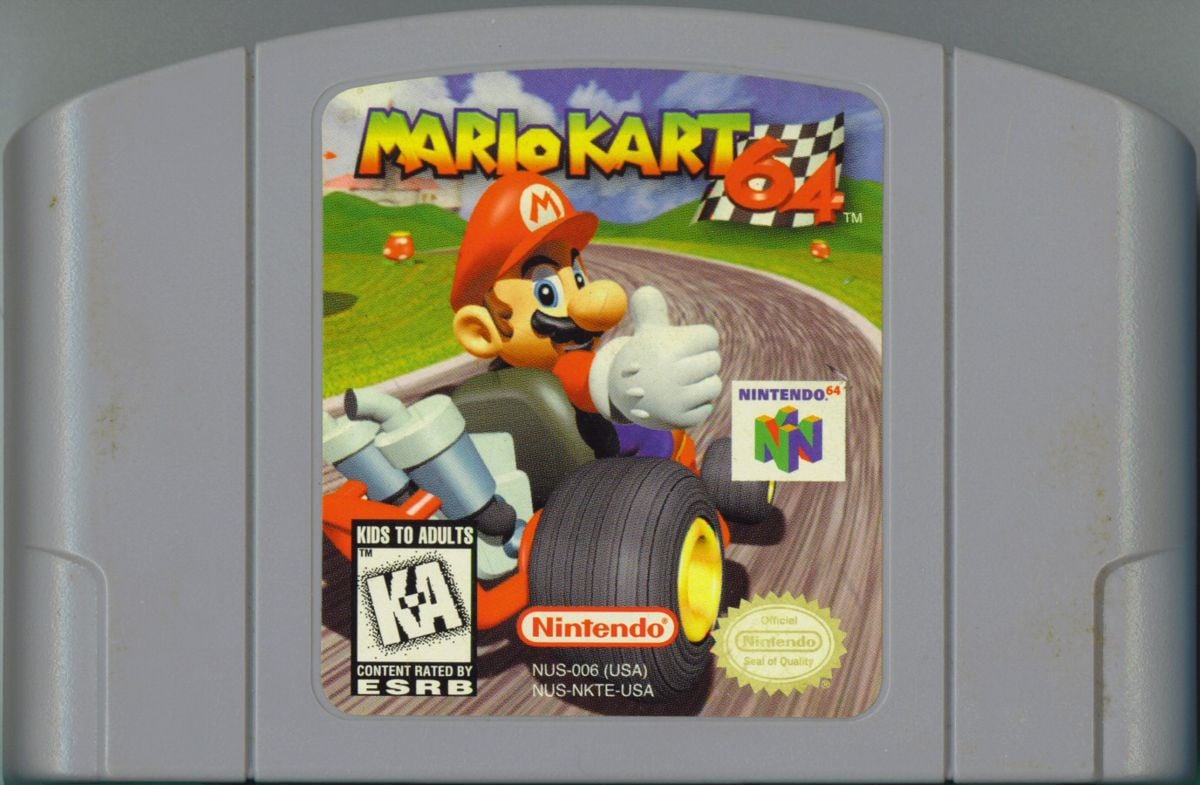
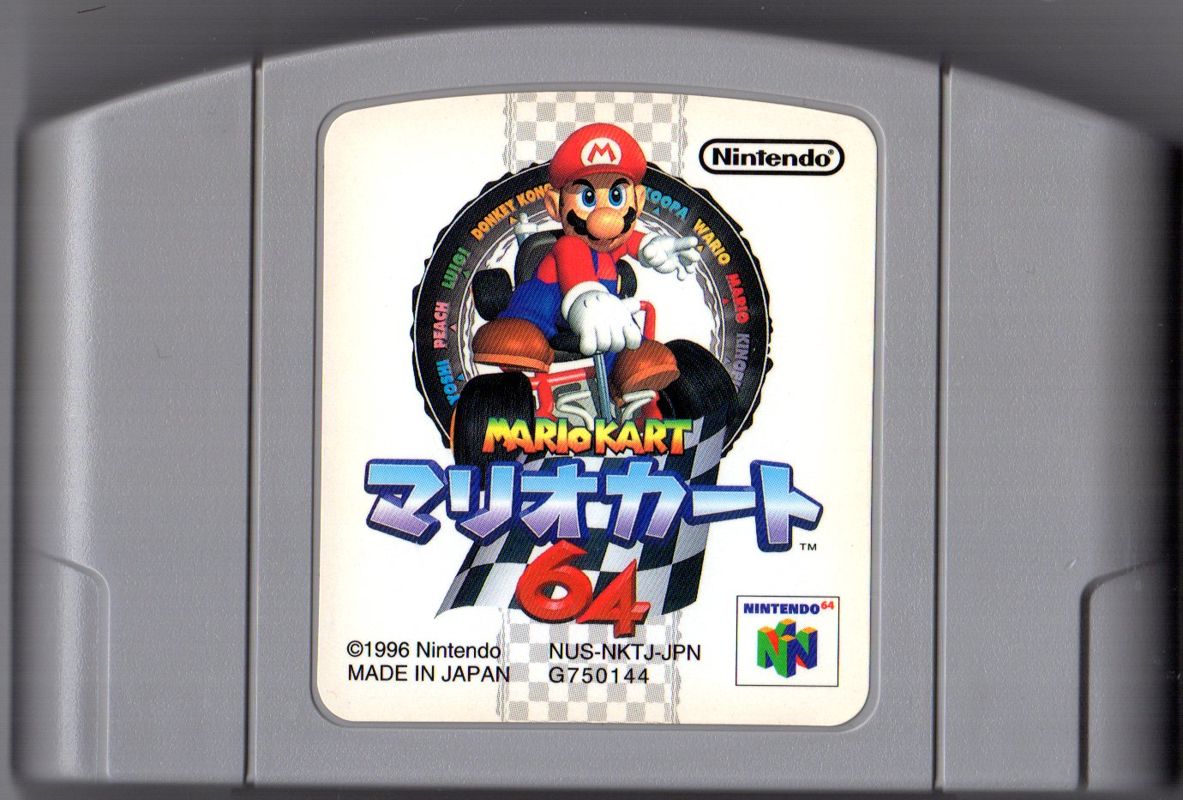
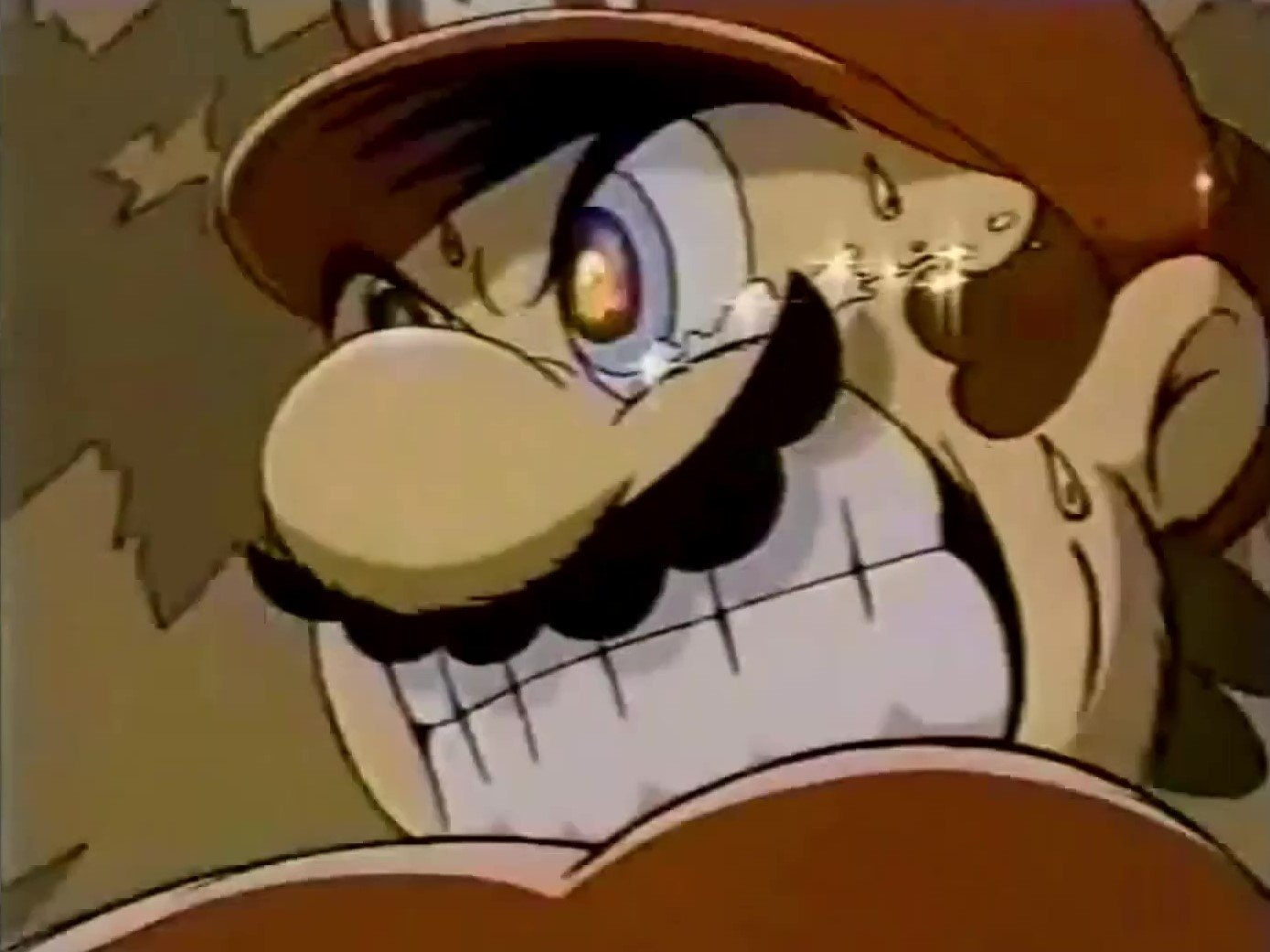
The international logo.The Japanese logo.Five of the racers, as used on the title screen.Mario gives the thumbs up.Mario races his own ghost.D.K. scatters bananas in front of Luigi.The Mario Bros. meet the penguins of Sherbet Land.Rush hour on Toad’s Turnpike.Royal Raceway, with the castle behind.D.K.’s Jungle Parkway.Course artwork: Luigi Raceway.Course artwork: Kalimari Desert.Course artwork: Wario Stadium.Course artwork: Bowser’s Castle.Course artwork: Yoshi Valley.Course artwork: Banshee Boardwalk.The North American cartridge.The Japanese cartridge.The American Race Tracks soundtrack CD.Mario Kart 64 on Club Circuit, the remix album.Mario in the Japanese television advert.Mario Kart 64 playing cards.An early Moo Moo Farm with Japanese course and cup names on screen.The hidden debug menu on the title screen.The unfinished vertical split screen.
Legacy & Re-releases
Mario Kart 64 has been re-released on every Nintendo home console since the Wii, always as the original game rather than a remake. Here is every version, followed by what it left behind.
Every release since 1996
Nintendo 64 (Japan)14 December 1996The original, with its own voices, sponsor boards and course names. Also sold bundled with a controller.
Nintendo 64 (North America)10 February 1997New voices for Luigi, Toad, Peach and Wario, Mario as announcer and reworked trackside adverts. Released in Mexico the same day.
Nintendo 64 (Europe and Australia)June to August 1997United Kingdom 13 June, the rest of Europe 24 June, Australia in July or August.
Player’s Choice1998North America 26 January 1998; Spain 30 April 1998.
iQue Player (China)25 December 2003In Simplified Chinese. The Special Cup becomes the iQue Cup and most mentions of “64” are removed.
Wii Virtual ConsoleJanuary 2007Europe and Australia 26 January, North America 29 January, Japan 30 January 2007 (South Korea 26 April 2008). The Thunder Bolt’s flash is softened and ghosts cannot be saved.
Wii U Virtual Console2016Japan 6 January, Europe 21 January, Australia 22 January and North America 29 December 2016.
Nintendo Switch Online + Expansion PackOctober 2021One of the first games in the Nintendo 64 library: North America 25 October, the rest of the world 26 October 2021.
The template
Super Mario Kart invented the series, but most of what later games took for granted was settled here. From Double Dash!! to Mario Kart World, a Mario Kart means 3D courses with their own scenery and set pieces, cups of four races, a drift you charge for a boost, a mirror class for experts, light and heavy drivers, four-player battles and a blue shell waiting for whoever is winning.
Konno went on to produce the series. Kenta Nagata’s music proved just as durable: the title theme, the raceway tune and Rainbow Road have all been rearranged for later games, most recently for Mario Kart World, which uses ten of this game’s pieces on its open roads.
Sixteen courses, all remade
Mario Kart DS began the process with Moo Moo Farm, Frappe Snowland, Choco Mountain and Banshee Boardwalk, plus Block Fort. Mario Kart Wii took Mario Raceway, Sherbet Land, D.K.’s Jungle Parkway and Bowser’s Castle, with Skyscraper for battles. Mario Kart 7 chose Luigi Raceway, Koopa Troopa Beach and Kalimari Desert, and Big Donut. Mario Kart 8 remade Toad’s Turnpike, Royal Raceway, Yoshi Valley and Rainbow Road, and 8 Deluxe’s Booster Course Pass added Choco Mountain and Kalimari Desert again. Mario Kart Tour ran eight of them.
That left one. Wario Stadium, the long dirt track with the notorious wall, went unvisited for almost three decades until Mario Kart World brought it back in 2025 along with Choco Mountain and Big Donut. Of everything on the cartridge, only the Double Deck battle course has never been seen again.
The shell heard round the world
No item in any game has been argued about as much as the Spiny Shell. Its director has linked it to the team’s wish to keep everybody in the race until the end, on hardware that could not keep the pack together, and it has been part of the series ever since. Whether it is the great leveller that keeps a beginner interested or a punishment for driving well depends entirely on where you were when it hit you.
Reviews & Sales
Sales
Mario Kart 64 sold 9.87 million copies worldwide, according to figures reported by Game Informer in June 2014. Only Super Mario 64 sold more on the Nintendo 64.
Its American launch was a rout. Wikipedia’s sourced account, drawn from IGN’s reports of the time, records that in February 1997 Nintendo games held the top seven places in the US chart and that Mario Kart 64 was selling ten times as fast as Tomb Raider. It passed a million copies within two months, a target Nintendo had set for the end of March, and was the country’s best-selling game across the first quarter of the year. Nintendo of America’s Peter Main credited the four-player mode, which he said had made the game a focal point for group entertainment. A five-million-dollar advertising campaign did no harm either.
Japan bought more than two million, and the game was reissued in the Player’s Choice range in North America on 26 January 1998.
9.87mcopies sold worldwide
2ndbest-selling Nintendo 64 game
1m+sold in the US within two months
10×the sales rate of Tomb Raider, US, February 1997
Reviews and rankings
Period scores are as listed in Wikipedia’s review table with the issues it cites; the last two are for the Wii Virtual Console release.
Electronic Gaming MonthlyUS · No. 92, March 1997 · four reviewers
9.5, 9.5, 9, 9
Game InformerUS · No. 46, February 1997
9.25/10
GameFanUS · Vol. 5, No. 2
92/100
EdgeUK · No. 52, February 1997
8/10
IGNPeer Schneider · 20 February 1997 · Editor’s Choice
8.1/10
GameSpotTrent Ward · 6 February 1997
6.4/10
N64 MagazineUK · Jonathan Nash · No. 1, April 1997
91%
HyperAustralia · David Wildgoose · No. 44, June 1997
95%
Next GenerationUS · No. 30, June 1997
3/5
Official Nintendo MagazineUK · No. 58, July 1997
90%
Computer and Video GamesUK · No. 188, July 1997
4/5
Nintendo LifeCorbie Dillard · Wii Virtual Console · 27 January 2007
9/10
IGNLucas M. Thomas · Wii Virtual Console · 30 January 2007
7.9/10
GameRankingsAverage of 20 reviews
87.01%
Metacritic15 reviews
83/100
No Mario Kart has split opinion quite like this one. For its admirers it was the best reason yet to own four controllers. Game Informer called it “one of the best multiplayer games ever made”, IGN’s Peer Schneider described “multi-player mayhem at its best” and judged it “a great addition to the N64 line-up”, and Australia’s Hyper praised the analogue steering and called the computer drivers “ingeniously fiendish”. Reviewers picked out the same sights players still talk about: the trains of Kalimari Desert, the lorries of Toad’s Turnpike, the penguins, the cows and Peach’s castle.
The doubters were just as clear. GameSpot’s Trent Ward thought it a thin upgrade that “is very likely to disappoint you after about a week”. Next Generation felt the flat sprites made it look dated, Edge found the one-player game simple, and N64 Magazine, IGN and others objected to computer opponents that seemed to catch up whatever you did and to races decided by who drew the best item. Four-player battles, several noted, ran slowly and were hard to read on a small screen. Time has largely sided with the fans: Nintendo Life’s Corbie Dillard, reviewing the Virtual Console version in 2007, called it “easily one of the best Nintendo 64 releases of them all”.
Honours
Electronic Gaming Monthly · Editors’ Choice Awards for 1997Runner-up, Multiplayer Game of the YearBehind Saturn Bomberman.
Academy of Interactive Arts & Sciences · 1998Nominee, Console Racing Game of the YearAt the first Interactive Achievement Awards.
Electronic Gaming Monthly · November 1997No. 49 of the 100 best console gamesIn the magazine’s 100th issue; Super Mario Kart was 15th.
Official Nintendo MagazineNo. 17 of the 100 greatest Nintendo gamesAs listed by Wikipedia.
Guinness World Records 2011: Gamer’s EditionLongest track in the Mario Kart seriesAwarded to this game’s Rainbow Road.
SLB User Reviews
Mario Kart 64 has yet to receive a community review on Super Luigi Bros.
If you’ve played Mario Kart 64 and would like to submit a review, please get in touch.
More from the Super Luigi Bros Guide
These picture lists come from the earlier Super Luigi Bros guide to Mario Kart 64 and are kept here in full.
The four cups — 16 race courses
Sixteen race tracks split into four cups of four each. Special Cup is unlocked from the start — rare for the Mario Kart series. Each character has a signature track named after them.
Mushroom Cup — the easy one
Luigi Raceway
717 m · Wide oval tutorial track. Watch the blimp.
Moo Moo Farm
527 m · Pastoral dirt track. Watch for Chubbies popping up.
Koopa Troopa Beach
691 m · Sandy beach with a hidden cave shortcut and pesky crabs.
Kalimari Desert
753 m · Western desert. A train crosses the track — time it wrong and you’re flattened.
Flower Cup — stepping it up
Toad’s Turnpike
1036 m · Real highway with civilian traffic to dodge. Drive against the flow on Mirror.
Frappe Snowland
734 m · Snowy track with snowmen scattered on the racing line.
Choco Mountain
687 m · Cliff-hugging mountain road. Boulders fall from the high edge.
Mario Raceway
756 m · Tight technical circuit. The classic shortcut takes a Mushroom to clear the wall.
Star Cup — the serious challenge
Wario Stadium
1591 m · Longest track in the game. Dirt arena with massive jumps. Famous reverse-shortcut.
Sherbet Land
756 m · Icy track with frozen water and rolling penguins.
Royal Raceway
1025 m · Peach’s track. Look up — that’s Princess Peach’s castle from Super Mario 64 in the background. Big launch ramp.
Bowser’s Castle
777 m · Lava-strewn castle with Thwomps slamming down on the racing line.
Special Cup — the boss cup
D.K.’s Jungle Parkway
893 m · Tropical jungle with a river jump and natives throwing coconuts at you.
Yoshi Valley
772 m · Branching paths through a valley. Position is hidden — you race blind. Giant Egg rolls down the hill.
Banshee Boardwalk
747 m · Spooky lake boardwalk. Bats swoop, drop into the water and you’re done.
Rainbow Road
2000 m · The grand finale. The only Rainbow Road with no walls in places, Chain Chomps embedded in the track, and silhouetted Mario characters as constellations.
Battle arenas
Four arenas for Battle Mode. Each player gets three colour-coded balloons; lose them all and you’re out. Items only — no racing.
Big Donut
Circular ring with a hole in the middle. Fall in — lose a balloon.
Block Fort
Four colour-coded forts on a flat plane. Multi-level chases.
Double Deck
Two-storey arena with ramps connecting the decks. Long sight-lines.
Skyscraper
Rooftop arena. No safety walls — one wrong drift and you’re off the building.
To provide the best experiences, we use technologies like cookies to store and/or access device information. Consenting to these technologies will allow us to process data such as browsing behavior or unique IDs on this site. Not consenting or withdrawing consent, may adversely affect certain features and functions.
Functional
Always active
The technical storage or access is strictly necessary for the legitimate purpose of enabling the use of a specific service explicitly requested by the subscriber or user, or for the sole purpose of carrying out the transmission of a communication over an electronic communications network.
Preferences
The technical storage or access is necessary for the legitimate purpose of storing preferences that are not requested by the subscriber or user.
Statistics
The technical storage or access that is used exclusively for statistical purposes.The technical storage or access that is used exclusively for anonymous statistical purposes. Without a subpoena, voluntary compliance on the part of your Internet Service Provider, or additional records from a third party, information stored or retrieved for this purpose alone cannot usually be used to identify you.
Marketing
The technical storage or access is required to create user profiles to send advertising, or to track the user on a website or across several websites for similar marketing purposes.



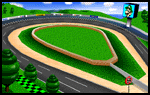 Luigi RacewayMushroom Cup · 717 m · Luigi’s course · later in Mario Kart 7 and TourA speedway oval with a tunnel. From lap two, a balloon lowers an Item Box that always holds a Spiny Shell.
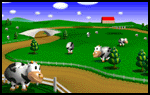 Moo Moo FarmMushroom Cup · 527 m · later in Mario Kart DSThe shortest course. Cows in the fields, Chubbies in the road.
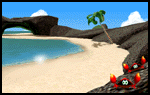 Koopa Troopa BeachMushroom Cup · 691 m · later in Mario Kart 7 and TourCrabs, ramps and a cave behind a waterfall that cuts a whole corner.
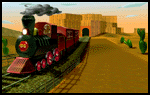 Kalimari DesertMushroom Cup · 753 m · later in Mario Kart 7, 8 Deluxe and TourTwo trains, two level crossings and a railway tunnel that daring drivers use as a shortcut.
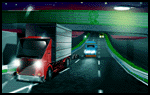 Toad’s TurnpikeFlower Cup · 1,036 m · Toad’s course · later in Mario Kart 8 and 8 DeluxeRush hour on a figure-of-eight motorway. In Extra the traffic drives towards you.
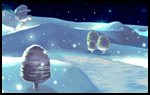 Frappe SnowlandFlower Cup · 734 m · later in Mario Kart DS and TourA river jump, a Yoshi made of snow and a minefield of snowmen.
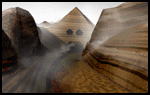 Choco MountainFlower Cup · 687 m · later in Mario Kart DS, Tour, 8 Deluxe and WorldFalling boulders on a cliff-edge hairpin that only has a railing on 50cc and in Time Trials.
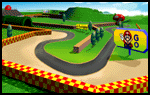 Mario RacewayFlower Cup · 567 m · Mario’s course · later in Mario Kart Wii and TourFast tarmac, a giant toadstool hairpin and a drive-through Warp Pipe.
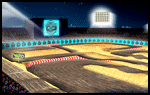 Wario StadiumStar Cup · 1,591 m · Wario’s course · later in Mario Kart WorldA dirt arena of humps and one big jump. It waited until 2025 for its first remake.
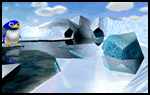 Sherbet LandStar Cup · 756 m · later in Mario Kart WiiSliding penguins, an ice cave and water that freezes you solid.
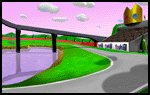 Royal RacewayStar Cup · 1,025 m · Peach’s course · later in Mario Kart 8, 8 Deluxe and TourA giant ramp across a lake, and Peach’s Castle from Super Mario 64 at the end of a side road.
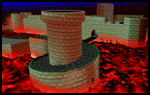 Bowser’s CastleStar Cup · 777 m · Bowser’s course · later in Mario Kart WiiThwomps, fire-breathing statues, a lava bridge and a spiral ramp round a tower.
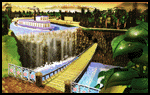 D.K.’s Jungle ParkwaySpecial Cup · 893 m · D.K.’s course · later in Mario Kart WiiA boosted leap over a river and a cave finish. Leave the road and the jungle throws things at you.
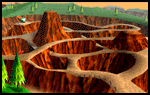 Yoshi ValleySpecial Cup · 772 m · Yoshi’s course · later in Mario Kart 8, 8 Deluxe and TourA maze of canyon ledges and a giant spinning egg. Positions are hidden until the finish.
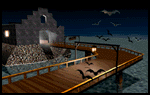 Banshee BoardwalkSpecial Cup · 747 m · later in Mario Kart DSA haunted pier with gaps in the railings, bats and a leaping giant Cheep Cheep.
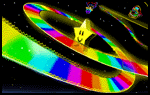 Rainbow RoadSpecial Cup · 2,000 m · later in Mario Kart 8 and 8 DeluxeThe longest course in the game: railings all the way, Chomps on the track and neon portraits in the sky.



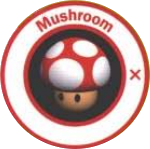 MushroomOne short burst of speed.
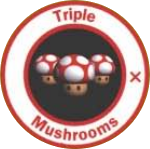 Triple MushroomsNew. Three boosts to use whenever you like.
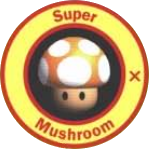 Super MushroomNew. The golden one: as many boosts as you can hammer out before it expires.
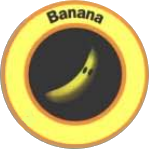 BananaSpins whoever hits it. Brake at the right instant and you can save the slide.
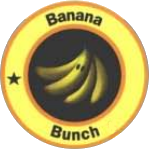 Banana BunchNew. Five peels trailing behind the kart, dropped one at a time.
 Fake Item BoxNew. Looks like an Item Box (its question mark is upside down) and flips anyone who drives into it.
 Green ShellFlies straight, bounces off walls and sends its victim tumbling.
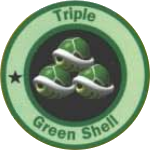 Triple Green ShellsNew. Three shells circling the kart, as shield or ammunition.
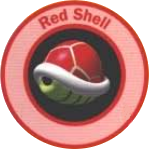 Red ShellLocks on to the kart ahead. Breaks if it hits a wall.
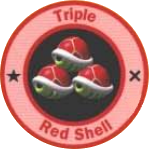 Triple Red ShellsNew. Three homing shells in orbit. Never offered to the leader.
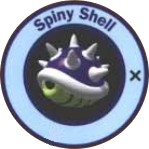 Spiny ShellNew. The blue shell. Hunts down first place and bowls over anybody it meets on the way.
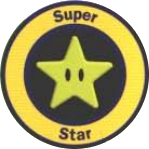 Super StarInvincibility. A hard knock against a wall ends it early.
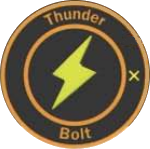 Thunder BoltShrinks every rival so they crawl along and can be squashed.
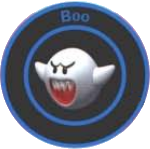 BooTurns you invisible and untouchable for a moment, and steals an item from somebody else.
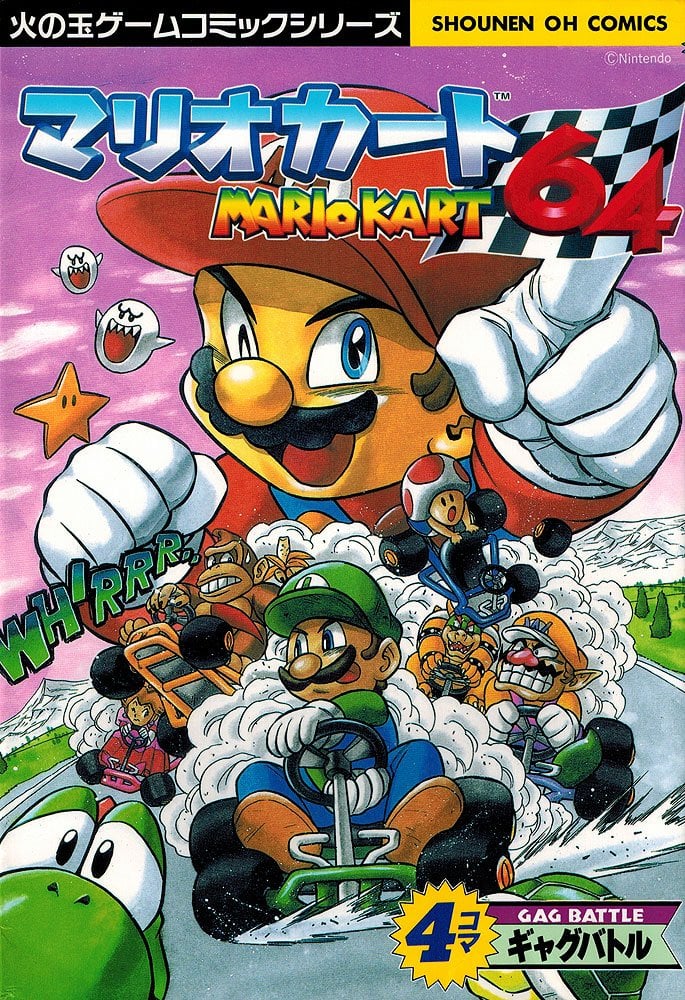 4koma Gag Battle and 4koma Manga KingdomGag manga anthologiesBoth of Japan’s four-panel gag anthologies gave the game volumes of its own.
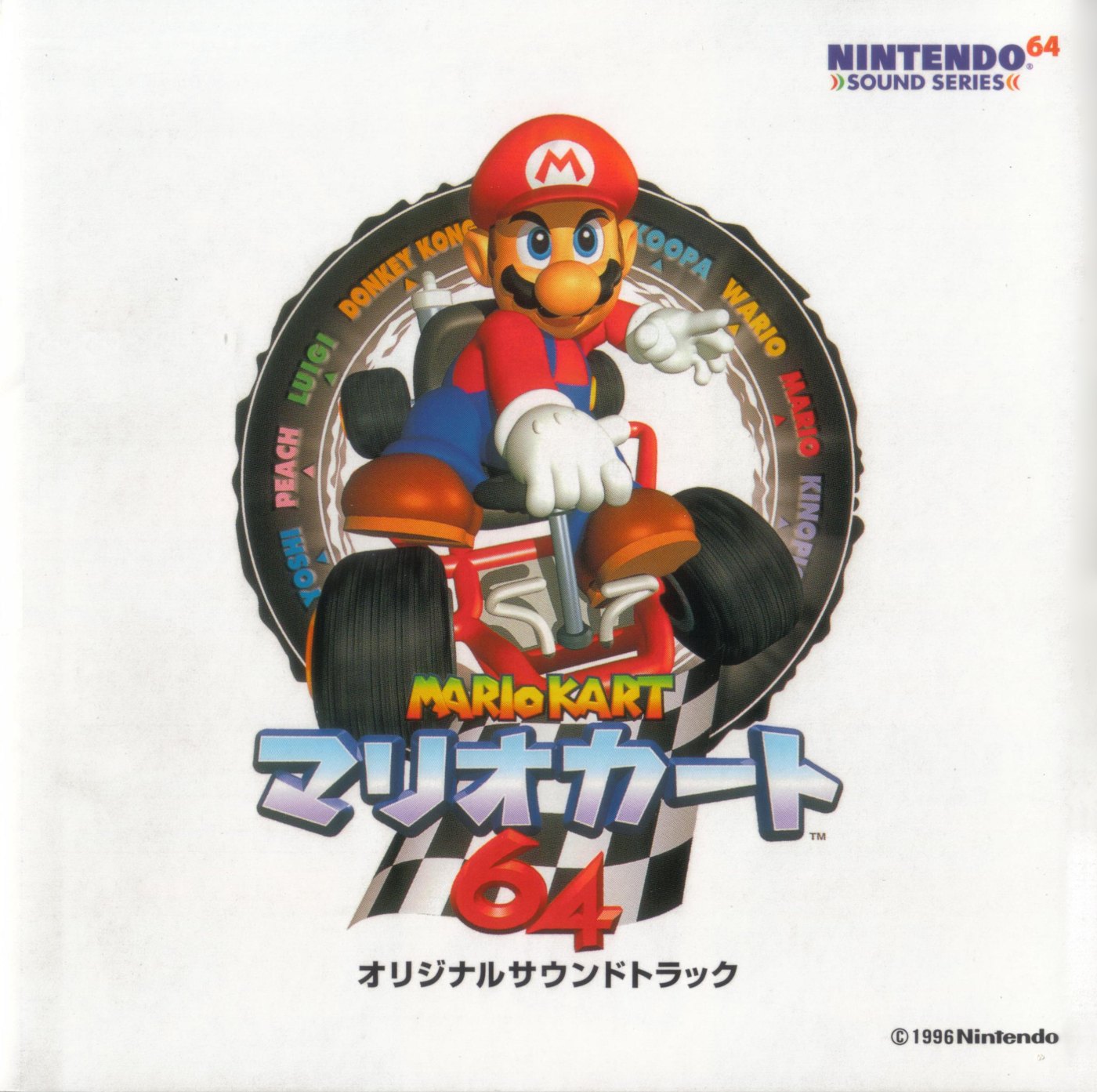 The soundtrack albumsMusic · 1997Kenta Nagata’s music was released on disc four times in a year: two American CDs from Nintendo in March and April 1997 (Race Tracks and a Greatest Hits selection), the Japanese Original Soundtrack from Pony Canyon on 19 September 1997, and a two-disc remix album, Mario Kart 64 on Club Circuit, on 26 December 1997. The soundtrack joined the Nintendo Music app in July 2025.
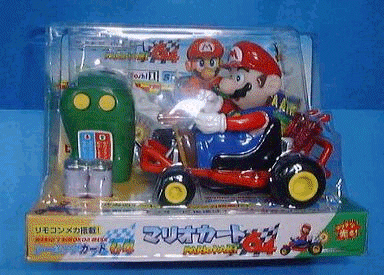 Toys, cards and sweetsMerchandiseRadio-controlled karts, character figures, a set of playing cards, collectible trading cards and even sweets all carried the game’s artwork, and the Japanese edition was sold in a bundle with a black-and-grey Nintendo 64 controller.
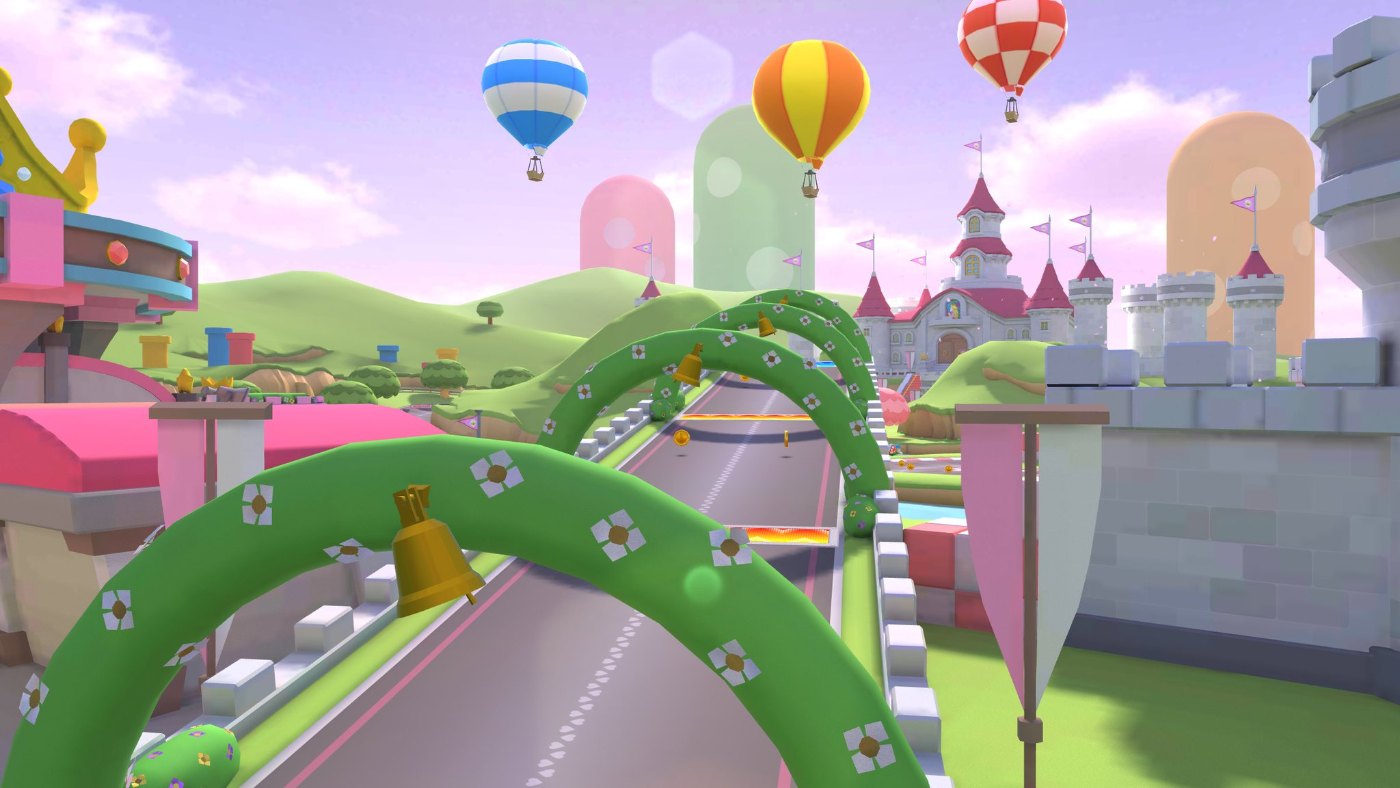 In later Mario Kart gamesCameos and revivalsSuper Circuit reuses the drivers’ portraits and turns beaten battlers into Bob-ombs. Double Dash!! quotes the Rainbow Road theme in its own Rainbow Road. Mario Kart DS brings back four courses and Block Fort; Mario Kart Wii another four, plus Skyscraper, and bases Moo Moo Meadows and Block Plaza on the originals; Mario Kart 7 has three and Big Donut, and its Neo Bowser City borrows from Toad’s Turnpike. Mario Kart 8 rebuilds Toad’s Turnpike, Royal Raceway, Yoshi Valley and Rainbow Road, and Mario Kart World adds Choco Mountain, Wario Stadium and Big Donut, along with new arrangements of ten of the old tunes.
 MarioMiddleweight · red
 LuigiMiddleweight · green
 PeachLightweight · pink
 ToadLightweight · blue
 YoshiLightweight · lime green
 D.K.Heavyweight · yellow · new
 WarioHeavyweight · purple · new
 BowserHeavyweight · orange
 LakituRace official
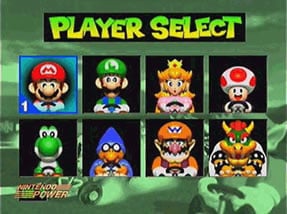 KamekThe driver who was dropped
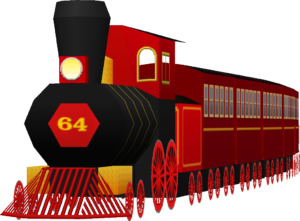 TrainKalimari DesertTwo of them circle the course. Cross in front of one too late and you are launched.
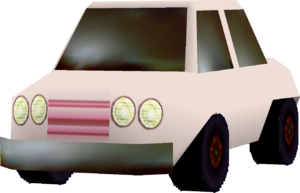 VehiclesToad’s TurnpikeCars, trucks, tankers and buses. Faster in the higher classes, oncoming in Extra.
 Mini Bomb KartVersus races; BattleA bomb on wheels. In Battle it is also what a beaten player becomes.
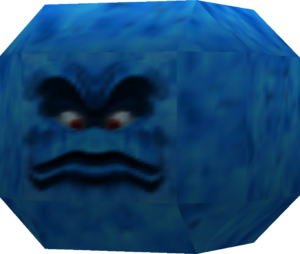 ThwompBowser’s CastleDrops, slides and laughs. One is locked in a cell.
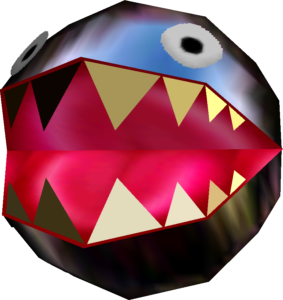 ChompRainbow RoadChain Chomps without chains. Touch one and your kart is launched.
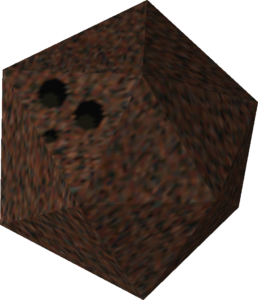 BoulderChoco MountainTumbles down the cliff and flattens whatever it lands on.
 SnowmanFrappe SnowlandSits on the road. Hit one and you are thrown into the air.
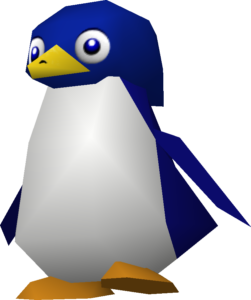 PenguinSherbet LandLarge ones waddle round the icicles in the cave; small ones slide across the track outside.
 ChubbyMoo Moo FarmThe game’s name for Monty Mole. Pops up and flips passing karts.
 CrabKoopa Troopa BeachSits on the sand and spins out anyone who drives into it.
 CactusKalimari DesertAs solid as a tree and twice as prickly.
 Piranha PlantMario Raceway, Royal RacewayLines the verges and spins anyone who cuts a corner too fine.
 PorcupineYoshi ValleyWanders from side to side across the narrow paths.
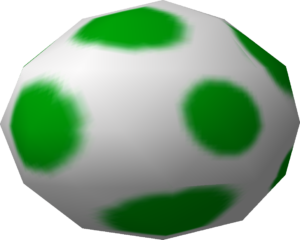 Giant EggYoshi ValleyAn enormous spotted egg rolling round in circles.
 BatsBanshee BoardwalkA swarm that flies straight at you and slows you down.
 Thrown stonesD.K.’s Jungle ParkwayHurled from the trees at anyone on the grass.
 CowsMoo Moo FarmScenery only. They watch.
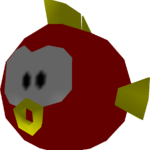 Cheep CheepBanshee Boardwalk; award ceremonyA giant one leaps over the boardwalk, and another carries in your trophy.
 BoosBanshee BoardwalkThey laugh, and that is all.
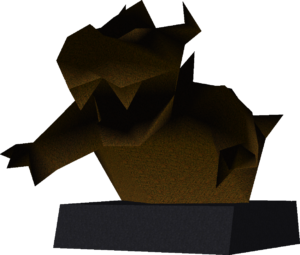 Bowser statuesBowser’s CastleFire-breathing ornaments in the courtyards.