
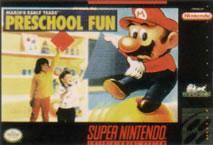
Mario’s Early Years! Preschool Fun
“Kid-tastic fun with Mario in diapers” — shapes, colours and sounds for the very youngest
Overview
Mario’s Early Years! Preschool Fun is an educational game aimed at children under six — making it the most foundational entry in the three-game Mario Early Years series. Released for MS-DOS in 1993 and SNES in November 1994, it was the last of the trilogy to arrive, following Fun with Letters and Fun with Numbers. Where those two games tackled literacy and numeracy respectively, Preschool Fun goes even more fundamental — colours, shapes, sounds, opposites and basic body awareness.
The game is set around a group of islands in the style of the other Early Years titles, with each island representing a different learning world. Its visual design is based on Super Mario World, with character sprites derived directly from that game. In Europe it was released under the name Mario’s Playschool. The official tagline — used in promotional materials — was “Kid-tastic fun with Mario in diapers”, which is certainly a sentence that exists.
“Kid-tastic fun with Mario in diapers.” — the actual official slogan. We’re just reporting the facts.
How it works
Like the rest of the Early Years series, the whole game is mouse-driven — either with the SNES Mouse on console, or a standard PC mouse. Players click on islands to visit different learning worlds, and within each world interact with objects by clicking on them. Your chosen character (Mario, Princess Peach, or Yoshi on SNES) walks over to whatever you click on and interacts with it, Mario-style.
Each world is guided by characters called Fun Friends (more on them below) who explain the tasks and cheer when you get things right. Before the learning activity starts in most worlds, you need to click on Luigi — who is, as always, fast asleep somewhere on screen. Wake him up and he’ll watch your progress, occasionally piping up with some encouragement.
Clicking Exit Pipes takes you to other parts of a level, while Warp Pipes marked with an arrow (yellow on PC, green on SNES) take you back to the main world selection map.
The worlds
The SNES version has six worlds. The PC version has seven (with Sing Song World), and the CD-ROM Collection adds an eighth (Time World). Here’s what the SNES version covers — all matching the subjects listed in the original Joomla page:
- Body World — Explore Mario’s body parts by clicking on them. Different body parts are clickable depending on the version. Monkeys in the background wave when clicked; the sun raises its eyebrows. Silly, charming, and effective for very young children.
- Color World — Wake Luigi up first, then the game shows pictures and names their colour. Click the indicated coloured object. A solid introduction to colour recognition in a bright Mario-themed setting.
- Counting World — A child’s playroom setting where players count objects. Tap a group and the objects count themselves while children in the room hold up fingers to show the number. The CD-ROM version also includes Mario’s Kitchen from Fun with Numbers.
- Listening World — Set on a farm, three animals are shown and a sound is played. Click the animal that makes that sound. Great for audio discrimination skills. The PC version adds three extra stages.
- Opposite World — Pairs of opposites (big/small, fast/slow, etc.) are presented and the player must click the item that is the opposite of what’s shown. Three stages of increasing complexity.
- Shape World — An art studio setting where clicking on shapes causes the character to strike them and transport them to a canvas, building a picture. Players identify and click indicated shapes to complete the artwork.
The PC-exclusive Sing Song World reenacts nursery rhymes with the Mario cast: I’m a Little Teapot, the English Alphabet Song, Old MacDonald Had a Farm, The Wheels on the Bus, and Itsy Bitsy Spider. The CD-ROM Collection adds Time World — an exploration of seasons, life cycles (people, plants, butterflies, frogs), months of the year, and day and night.
Characters
The three playable characters are the same as in the other Early Years games. On MS-DOS you pick between Mario or Princess Toadstool — purely cosmetic, no gameplay difference. On SNES, Yoshi joins as a third option.
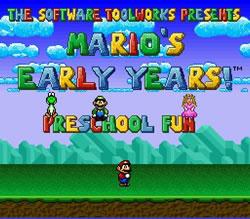
Luigi is the sleeping helper, present in most worlds. You have to click him to wake him up before the learning game starts. He watches your answers and cheers correct choices — and appears on the title screen too, helping assemble the letters of the game’s title.
Fun Friends — the cheerleaders
Unique to this game is a cast of characters called the Fun Friends. These characters pop up in each world to instruct the player on what to do and congratulate correct answers. The lineup differs between versions — the SNES cast includes Goomba, Koopa Troopa, Piranha Plant, Lakitu and Yoshi, while the PC version has Bowser, multiple monkey variants and a Koopa Troopa dressed as Ludwig von Koopa.
Their encouragement lines are compiled from separate prerecorded sound clips, and include classics such as:
- “That works for me!”
- “Mario likes you.”
- “Wow, you did it.”
- “Good choice.”
- “You are good!”
- “I know that’s right.”
- “You found it!”
Having Bowser and Goombas cheer your correct answers is genuinely a fun detail — even the villains are on your side when you’re learning shapes.
SNES vs PC — what’s different?
The SNES version is a condensed version of the PC original, with several changes:
- Yoshi added as a third playable character on SNES — not in the PC version
- Sing Song World removed from SNES (PC only) — five nursery rhymes including I’m a Little Teapot and Old MacDonald
- The main menu music differs: PC uses a rearrangement of the Donut Plains map theme from Super Mario World; SNES uses the title screen theme
- Menu icon positions are slightly different between versions
- Audio mute options, question randomiser, and text display toggle were removed on SNES
- The help screen with out-of-game learning tips was removed
- Various background graphic differences throughout
- Mario’s default pose in Body World on SNES is reused from the language selection screen of the MS-DOS version of Mario is Missing!
Regional differences
In Europe, the PC version was released as Mario’s Playschool rather than Preschool Fun. The European PC CD-ROM version also supports three languages — English, French and German — selectable at startup.
The French version of the game includes the exclusive song Au clair de la lune, while the German version includes Alle meine Entchen (All My Little Ducklings). The French version also greets the player with a welcome message on starting, consistent with the other Early Years games in their European editions.
The French title is Mario à l’école (Mario at School) and the German title is Marios Vorschule (Mario’s Preschool).
Release information
All three Early Years games were collected in the Mario’s Early Years! CD-ROM Collection for MS-DOS in 1994, which also added the exclusive Time World to this game.
Trivia & interesting facts
- The official promotional tagline was “Kid-tastic fun with Mario in diapers” — a real sentence that Nintendo approved
- Last of the three Mario Early Years games to release, completing the series alongside Fun with Letters and Fun with Numbers
- Visual design is based on Super Mario World — sprites and music arrangements are drawn directly from that game
- The main menu music on PC is a rearrangement of the Donut Plains map theme from Super Mario World — changed to the title screen theme on SNES
- Yoshi is a SNES-exclusive playable character — absent from the original PC version
- Mario’s Body World pose on SNES is reused from the language selection screen of the MS-DOS version of Mario is Missing!
- Features a cast of “Fun Friends” — including Bowser and Goombas — who cheer your correct answers
- Luigi must be clicked awake in each world before learning activities begin
- Six worlds on SNES; seven on PC (adds Sing Song World); eight in the CD-ROM Collection (also adds Time World)
- Released in Europe as Mario’s Playschool
- The European CD-ROM version supports English, French and German with region-exclusive songs in each language
- French title: Mario à l’école (Mario at School) | German title: Marios Vorschule (Mario’s Preschool)
- Never released in Japan
- All three Early Years games were bundled in the Mario’s Early Years! CD-ROM Collection in 1994
- Part of the broader Mario Discovery Series alongside Mario is Missing! and Mario’s Time Machine