
 |
Character fact sheetName: Luigi First Appearance: Mario Bros. (1983, arcade) Home: Mushroom Kingdom (originally Brooklyn, New York) Voiced by: Kevin Afghani (2023–present), Charles Martinet (1995–2023) Associates: Mario (brother), Princess Daisy, Princess Peach, Yoshi, Toad, Polterpup, Professor E. Gadd |
General profile
Luigi is the younger twin brother of Mario and one of the longest-tenured protagonists in video-game history. He stands taller and noticeably thinner than his brother, wears green where Mario wears red, and has consistently been characterised as the more cautious, anxious, and self-doubting of the two — a personality that has only deepened over the decades as his solo adventures (especially the Luigi’s Mansion series) have given him room to grow beyond a Player 2 archetype.
Where Mario is the bold front-man, Luigi is the reluctant hero — frequently terrified of ghosts, easily startled, and given to nervous gulps and yelps. But when his brother, Princess Peach, or the Mushroom Kingdom are in genuine danger, Luigi summons surprising courage and is fully capable of saving the day on his own. His characteristic combination of timidity and bravery has made him one of the most beloved characters in the Mario series, with Nintendo dedicating an entire year-long celebration (the Year of Luigi, 2013) to him on his 30th anniversary.
Quotes
Enemies
Luigi’s principal enemy is Bowser, King of the Koopas, with whom he has clashed in every mainline Mario game since Super Mario Bros. in 1985. He also fights against the Koopalings (Larry, Morton, Wendy, Iggy, Roy, Lemmy and Ludwig), Bowser Jr., Wario, King Boo (his personal nemesis in the Luigi’s Mansion series), Petey Piranha, the Shroobs (in Mario & Luigi: Partners in Time), Cackletta, Fawful, Antasma, the Tatanga forces from Super Mario Land, and dozens of recurring Mushroom Kingdom adversaries from Goombas and Koopa Troopas upward.
Friends
Luigi’s closest companion is his elder twin brother Mario, with whom he shares both a profession (plumbing) and an apartment in the Mushroom Kingdom. His other major friends include Princess Peach, Princess Daisy (his canonical romantic interest from Mario Tennis onward), Yoshi, Toad, the Toad Brigade, Captain Toad, Professor E. Gadd (his closest non-family ally, who supplies the Poltergusts), Rosalina, Polterpup (his ghost dog), Birdo, and Pauline. In the cartoons and the Super Mario Bros. Movie (2023) his bond with Mario is the emotional centre of the story.
Appearances
Mario Bros. (1983, arcade)
 Luigi debuted as the green-and-white Player 2 character in Mario Bros., the 1983 arcade game in which Mario and his brother work as Brooklyn plumbers clearing pests from the New York sewer system. In this debut Luigi was a palette-swap of Mario with identical gameplay — jumping under platforms to flip enemies, then kicking them away. Although they share basic moves, this introduction established the visual identity (green cap and overalls) that has defined Luigi ever since. Luigi’s exact origin story — named after the "Mario & Luigi" pizzeria near Nintendo of America’s 1981 offices in Washington — was confirmed in a 2003 Nintendo Power interview with Shigeru Miyamoto.
Super Mario Bros. (1985)
Luigi returned as Player 2 in the landmark NES launch title Super Mario Bros. Still mechanically identical to Mario, this is where the green-clad brother officially entered the Mushroom Kingdom mythos as Mario’s co-protagonist. The Famicom Disk System sequel Super Mario Bros.: The Lost Levels (1986) became the first game in which Luigi played differently from Mario — he jumps higher but has more slippery momentum, a characterisation that has persisted as his signature gameplay quirk for forty years.
Super Mario Bros. 2 (1988)
The Western Super Mario Bros. 2 (a re-skin of Doki Doki Panic) marked a major leap for Luigi: for the first time he was selectable as a unique playable character with his own statistics. Luigi was given the highest jump and the longest mid-air float of the four heroes, but the slowest running speed and weakest grip on enemies. These attributes — high jump, weak grip, slippery feet — codified his "floaty" identity for decades.
Super Mario Bros. 3 (1988) and Super Mario World (1990)
Luigi returned as Player 2 in SMB3 and Super Mario World, again sharing Mario’s moveset in the original Japanese releases. Super Mario All-Stars (SNES, 1993) updated both games to give Luigi his distinctive higher-jump-but-slipperier physics, finally bringing his solo characterisation to console-Mario platformers. SMW’s SNES original gave him a unique sprite for the first time on console.
Super Mario 64 / Super Mario 64 DS (1996 / 2004)
Despite years of fan rumours, Luigi was famously not playable in the original Super Mario 64 (1996) — Nintendo had planned to include him but cut him for memory reasons. He was finally added in the 2004 DS remake Super Mario 64 DS, where he wields an exclusive flip-jump and the ability to walk on water, alongside his trademark higher jump.
Luigi’s Mansion (2001)
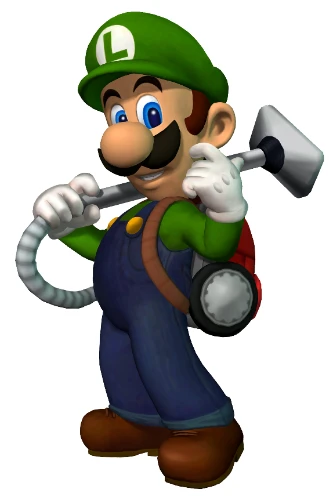 Luigi finally headlined his own game with Luigi’s Mansion, the GameCube launch title in which he wins a mansion he never entered in a contest, only to discover it haunted and his brother missing inside. Armed with Professor E. Gadd’s Poltergust 3000 vacuum, Luigi must clear the mansion of ghosts and rescue Mario. This first solo outing gave Luigi a distinct identity — nervous, mumbling, humming his own theme song to stay brave — and established his cowardice-versus-courage characterisation that has defined him ever since.
Super Mario Galaxy / Galaxy 2 (2007 / 2010)
Luigi appears as an unlockable post-game character in Super Mario Galaxy (after Mario collects all 120 Power Stars), letting players replay the entire game with his unique slippery-jump physics. In Super Mario Galaxy 2 Luigi is integrated more deeply, appearing on individual planets to give Mario hints. The famously meme-worthy "Luigi 360 noscope" sequence on the Throwback Galaxy emerged from his frantic running animation in this game.
New Super Mario Bros. Wii (2009) and the NSMB Series
Luigi appears as the Player 2 character in New Super Mario Bros. Wii, marking the first time the brothers played simultaneously in a true 2D platformer on home console. He continued in New Super Mario Bros. 2 (3DS, 2012) and New Super Mario Bros. U (Wii U, 2012). The Wii U also received New Super Luigi U (2013) — the first standalone 2D platformer to star Luigi, released as part of the Year of Luigi celebrations. In New Super Luigi U every level is redesigned around Luigi’s higher jump and slipperier physics, with a strict 100-second time limit per stage.
Luigi’s Mansion: Dark Moon (2013) and Luigi’s Mansion 3 (2019)
The first sequel to Luigi’s Mansion, Dark Moon, arrived for the Nintendo 3DS in 2013 as a flagship Year-of-Luigi title. It traded the original’s single-mansion setting for a series of distinct haunted locations and introduced the upgraded Poltergust 5000 plus the Dark-Light flashlight. Luigi’s Mansion 3 (Switch, 2019) followed with a high-rise "Last Resort" hotel and the new Gooigi gel doppelgänger mechanic. The series, now four entries long counting the 2023 3DS remaster of Dark Moon, has become Luigi’s signature franchise.
Mario & Luigi RPG series (2003–2024)
The Mario & Luigi RPG series gave Luigi an equal co-starring role with Mario for the first time. Beginning with Superstar Saga (GBA, 2003), continuing through Partners in Time (DS, 2005), Bowser’s Inside Story (DS, 2009), Dream Team (3DS, 2013), Paper Jam (3DS, 2015), Bowser’s Inside Story + Bowser Jr.’s Journey (3DS, 2018), and Brothership (Switch, 2024). In every game Luigi shares the spotlight equally with Mario, with the brothers learning combination "Bros. Attacks" and frequently leveraging Luigi’s timidity for puzzle solutions — most notably in Bowser’s Inside Story where Luigi’s nightmares power dream-world sections.
Super Mario Odyssey (2017) and Super Mario Bros. Wonder (2023)
Luigi appears in Super Mario Odyssey as the host of "Luigi’s Balloon World", a competitive hide-and-seek mode added in a free post-launch update. He is also fully playable in Super Mario Bros. Wonder (2023), which marks the first 2D mainline platformer to give every character (including Luigi) identical physics rather than special-casing him — a deliberate design choice by producer Takashi Tezuka. Wonder also features Luigi prominently in its cooperative multiplayer.
The Super Mario Bros. Movie (2023)
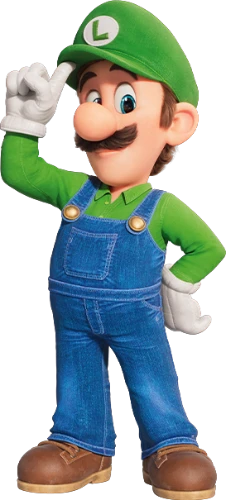 In Illumination and Nintendo’s The Super Mario Bros. Movie (2023), Luigi is voiced by Charlie Day and serves as the emotional core of the film — his abduction by Bowser drives Mario’s journey through the Mushroom Kingdom. The film grossed over $1.36 billion worldwide and re-established Luigi as one of Nintendo’s most marketable characters. A sequel was officially announced in 2024 for April 2026.
Mario Kart, Smash Bros., and Spin-offs (1992–present)
Luigi is a playable racer in every Mario Kart game from Super Mario Kart (SNES, 1992) through Mario Kart 8 Deluxe (Switch, 2017). He has been playable in every mainline Super Smash Bros. entry since the original Nintendo 64 game in 1999 — his Final Smash "Poltergust" (in Smash Ultimate) directly references the Luigi’s Mansion series. He appears in every Mario Party from 1998 onward, in the Mario Sports series, in Captain Toad: Treasure Tracker, in numerous puzzle and educational spin-offs, and as a guest character or amiibo unlock in titles ranging from Animal Crossing to Tetris 99.
Trivia & Official Sources
- Luigi’s name is derived from the Japanese word ruiji (類似) meaning "similar" — a pun on his original role as a Player 2 clone of Mario. The name was also chosen because of the "Mario & Luigi" pizzeria located near Nintendo of America’s first office in Tukwila, Washington in 1981, as confirmed by Shigeru Miyamoto in a 2003 interview.
- Charles Martinet provided the voice of Luigi from Mario 64 (1996) through Wonder (2023) — a 27-year tenure as one of the longest-running video-game voice roles. He was succeeded by Kevin Afghani beginning with Super Mario Bros. Wonder in October 2023.
- The 2013 calendar year was declared the "Year of Luigi" by Nintendo to mark his 30th anniversary, with major Luigi-focused releases including Luigi’s Mansion: Dark Moon, New Super Luigi U, Mario & Luigi: Dream Team, and Dr. Luigi, plus playable cameos and tributes scattered through other titles released that year.
- Luigi’s slippery physics and higher jump first appeared in Super Mario Bros.: The Lost Levels (FDS, 1986), making it the first game in which Luigi mechanically differs from Mario — a defining characterisation reused in every multi-character mainline platformer since.
- The Luigi’s Mansion series was originally conceived as a tech demo for the GameCube’s real-time lighting capabilities; Miyamoto’s decision to build it into Luigi’s first solo headline game came late in development, when staff suggested the timid green plumber suited a haunted house better than Mario would.
- Luigi’s height is officially given by Nintendo as "approximately 192 cm" (6´3½") in 2014 Japan-only promotional materials, making him significantly taller than Mario’s ~155 cm — the brothers’ height difference is one of the few canonical physical measurements Nintendo has confirmed.
- In the German Club Nintendo magazine, Luigi was frequently nicknamed der zweite Klempner ("the second plumber") in 1990s coverage, before later issues began using the more affectionate der grüne Bruder ("the green brother").
- The Encyclopedia Super Mario Bros. 30th Anniversary Edition (Pix’n Love, 2018) confirms that Luigi and Mario are fraternal rather than identical twins, with Luigi being "born a few minutes after his elder brother."
- Luigi’s romantic pairing with Princess Daisy was first hinted at in Mario Tennis (Nintendo 64, 2000), where their statues appear paired in the game’s endings. Subsequent appearances on Daisy Circuit in Mario Kart Wii and the credits of Super Mario Galaxy have reinforced the pairing, though Nintendo has never made it an explicit romance.
- Charles Martinet improvised the famous high-pitched, slightly nasal Luigi voice during his original 1995 audition by "making Mario’s voice sound like he’d had two espressos too many" — a quote from Martinet’s 2017 GDC retrospective.
- The original 1983 Mario Bros. arcade game referred to Luigi simply as "Player 2" on its cabinet — his name did not appear on Western Nintendo packaging until Super Mario Bros. in 1985.
- The infamous fan-made "Daddy Luigi" meme (originating from a 2007 deviantART comic) was acknowledged by Charles Martinet at a 2014 Nintendo NY launch event, where he performed the "haha hah" cackle on stage to enthusiastic audience response.
- Luigi appears in every Super Smash Bros. roster as a default-or-quickly-unlockable fighter, making him one of only a handful of characters (alongside Mario, Donkey Kong, Link, Samus, Pikachu, Fox, Kirby, and Yoshi) to be playable in all six mainline Smash games.